Jordan River, Galilee, and Golan with Nilly, Eitan and Dror

Shalom,

  We’re just starting to feel more at home here in Israel, and it’s time to leave.  Tomorrow when it’s light we’ll leave Ashdod Marina and go the 8 miles to Ashkelon Marina where there are government officials to check us out from Israel.  We are heading back to Turkey.  Our home for the time we will be there will be Netsel Marina in Marmaris.  We spent from May through July 2011 in Marmaris and liked the town.  We were "out in the country" at Yacht Marine last time.  This time we will be in the city which will be nice. 

   Our passage to Turkey will take 3 nights.  We should arrive in Marmaris July 18th.  It will take us a bit to get set up with a phone but hopefully the marina wifi will work so we can announce our safe arrival.  I still have lots to write about Israel.  I’ll catch up at some point.

    This email is about our day touring with Nilly, Eitan and their son Dror.

So for now, Shalom

Ru

Golan Heights with Nilly, Eitan, and Dror (which means freedom)

Some reminder notes from Nilly and Eitan to help me with this blog. So I especially want to say that any mistakes are truly my own.)

"Hi Ruth and Randal
   The name of the kibuz is o.k as you wrote. (Kibbutz Ma’agan Michael where we stopped for a quick tour.)
    The name of the guide is NITZAN GALPAZ. (Kibbutz Ma’agan Michael guide)
         we also stop at cohav yair were dror is living, (Dror is the son of Nilly and Eitan)
     In Yardenit, on the Jordan river.
    The tank in kibutz  DEGANIA
     breakfast close to ARIK SHARON bridge.
     mount BEN-Tal were cofee anan and the bunker. a view to Cunetra in Sirya, and other side
   to kibutz Merom-Golan. ( Cofee Anan is the name of the coffee shop on Mount Bental…a play on the name of Kofi Annan)
      the valley of tears and the  story of Avigdor Kealany.
    We cross the city  KAZARIN.
      a view on the Kinnert lake from the Golan  from the kibuz Kefar-Haruv ( Shalom point of view.
      ,  we drove from HAAMAT-GAder, the border of Syria,Jorden
       and Israel (were the Hot spring+spa+Crocodails.
     we eat dinner at OR-AKIVA  near CEASARIA. (And it was really really good!)
Hope it will help you to remember.

Love
     Nilly and Eitan."

You can see how much we crammed in so I might be forgiven for mixing up a few things.

You met Nilly and Eitan Bukchin in a earlier email.

clip_image001

On DoraMac in Herzliya

Nilly, Eitan and their son Dror Bukchin love their country. They don’t think everything about Israel is perfect, but they love it and have fought for it…..literally! More about all that later. Knowing our time in Israel was coming to an end, and that we hadn’t seen enough of the country they love, they pretty much dropped everything they were doing and planned a day to take us touring. Wednesday, July 12th was that day. From 7 am until 10 pm!!! And that doesn’t include the time from their home to collect us and then back to their home in Kfar Azar.

“ Kfar Azar (Hebrew: כְּפַר אֲזָ"ר‎‎) is a moshav ovdim located in the Ono Valley in central Israel. Previously part of Ef’al Regional Council, in 2007 it was transferred to the municipality of Ramat Gan together with Ramat Ef’al. With an area of around 1,000 acres (4.0 km2), its population is around 500.

The moshav was established in December 1932 by two pioneer groups, Brenner and Ma’ash. Land was purchased adjacent to the Arab village al-Khayriyya, and was later supplemented by more land bought by the Jewish National Fund. The name "Azar" was given to the moshav as an acronym for Alexander Ziskind Rabinovitz, a Jewish Russian writer.” http://en.wikipedia.org/wiki/Kfar_Azar
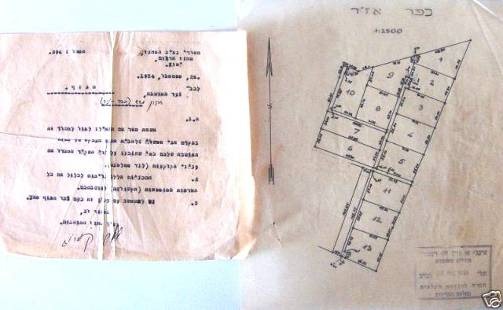
clip_image002

Historic & interesting item from the first year of Kfar Azar. 1934. + interesting Palestine government, south district in Jaffa, regarding the map of the new settlement (kfer Azar). Very rare!!! Relatively in good condition. http://www.ebay.com/itm/PALESTINE-ISRAEL-RARE-PARCELLING-MAP-KFAR-AZAR-34-DOC-/270772437435

(I hope this info is correct: the dates don’ t exactly match, but the story of how Israel came to be is the important part. If I were doing this as a reference question for someone else I’d make sure it was absolutely correct, but as it’s my question…..I’m piecing it together from the info I have. Nilly and Eitan, please correct me if I am wrong. I should have written everything down!)

But I don’t think most people realize that early in its modern history much of the land of Israel was actually bought from the Arabs; I certainly didn’t. Tel Aviv was purchased as we learned when we did the Bauhaus walking tour on Rothschild.

But back to our actually day touring…….

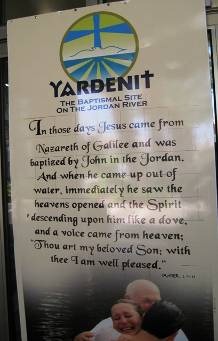
Our first stop was Kochav Yair the home of Nilly’s and Eitan’s son Dror. He would not only be joining us, but we would all pile into his car and he would be our driver and tour guide for the day. Then we were on our way. They were taking us to the Golan/Galilee area and Yardent, a baptismal site on the Jordan River was our first stop. Eitan told us that it is a very interesting pageant to watch as pilgrims make their way in white robes to the river where the actual baptism take place. It would have been interesting, and the location was lovely, but there were no baptisms taking place at that time we were there. There were so many things to see during the day so we didn’t have that much time to spend at any one place. I know little of the New Testament, but after being in Israel for these past months, I certainly know more than I did. Actually about Jewish history too.
clip_image003 clip_image004

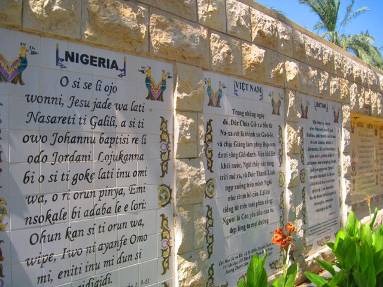
Around the walls of the complex are translations in at least 100 languages of the passage Mark 1.9-11.
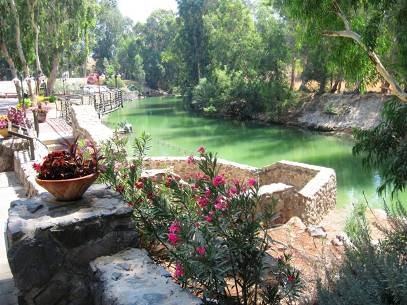
clip_image005

It is a lovely site for any ceremony.
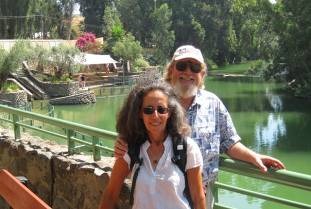
clip_image006

Randal and me: Randal was already baptized and I was Bas Mitzvah so neither of us was a candidate.

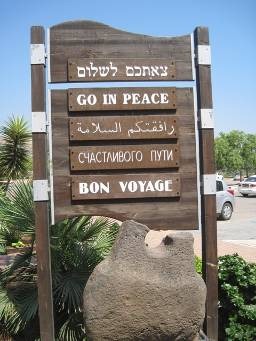
clip_image007 clip_image008

Glenn Beck planted an olive tree, but I’m still not a fan. This sign needed to add Shalom Y’all!

Here is a little bit about the geography of the area of the Jordan and the Galilee.

“The Jordan River is a river in Southwest Asia which flows into the Dead Sea. It is considered to be one of the world’s most sacred rivers. It originates approximately 200 meters above sea level on the slopes of Mt. Hermon, Israel. It ends its course at the lowest spot in the world, the Dead Sea, at 420 meters below sea level. Along its course, the Jordan feeds two lakes: the Hula (now almost completely drained) and the Sea of Galilee. (Israelis call the Galilee, the Kinneret. Kinnor in Hebrew means violin and the lake is shaped like a violin. When referred to as the Galilee, it is pronounced Galeel which always throws me off.) In its course from the Sea of Galilee to the Dead Sea, the Jordan travels a winding 230 kilometers, covering just 105 kilometers in a straight line.”

http://www.yardenit.com/?section=80&item=124

"The Sea of Galilee, known to Israelis as Lake Kinneret, is only 13 miles by 7 miles, but is one of the most well-known bodies of water in the world. It was on these beautiful shores that Jesus delivered sermons and performed miracles. Many famous sites are located around the lake, including Capernaum, home to at least five of the twelve disciples. The Church of the Beatitudes is said to be where the Sermon of the Mount was preached and Tabgha, believed to be the site where Jesus fed 5,000 followers from five loaves of bread and two fish, is marked by The Church of Multiplication. The nearby lakeside town of Migdal is the hometown of Mary Magdalene." http://www.jewishvirtuallibrary.org/jsource/Society_&_Culture/geo/Galilee.html

The water level of Lake Kinneret is very important. During our driving around the Golan, Eitan, Nilly and Dror kept commenting on the high level of water in the lake and other small bodies of water we saw. They explained how important it was for agriculture which is dependent on this water. Cold, rainy winters are hoped for. We also saw several small herds of beef cattle where in dry years there are none.

“All winter long, the most important part of the news report for Israelis is not the dollar-shekel exchange rate or the level of the Tel Aviv Stock Exchange index, but rather the water level in Lake Kineret, which often reflects the national spirit. The Kineret, or Sea of Galilee, is Israel’s largest fresh water reservoir, and is also the country’s largest and most important source and reservoir of drinking water. For this and other reasons, the Kineret has become an important national symbol and is also a first class tourism center. “ (I’ve seen it spelled Kineret and Kinneret.) “ http://www.goisrael.com/

Then it was off to find a spot for our breakfast; which had become, at this point in time more like brunch. Wait till you see where we ate.
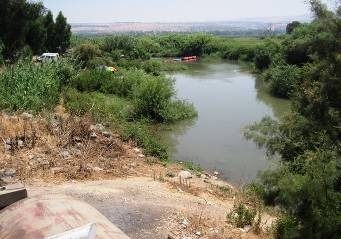
clip_image009

Picnic lunch along the Jordan

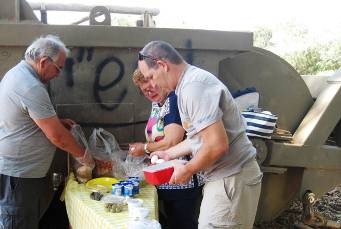
Along the Jordan River we found a place for our picnic. We’d been looking for a picnic table and there were some here, but two bus loads of kids had them all filled up. So instead we used a portable bridge as our table.
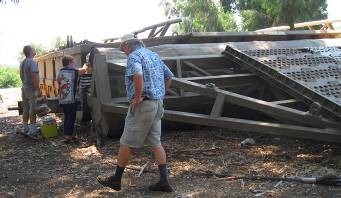
clip_image010

Setting out the food

clip_image011

Eitan, Nilly and Dror set out a wonderful Israeli breakfast.

Cheese, yogurt, hard-cooked eggs, cucumber, tomato, bread, olives and we were all pretty ready for it. The bridge is there in case the Israeli military has to cross the Jordan and the “real” bridges aren’t an option. They had used two of these portable bridges during the Yom Kippur War to cross the Suez. Here is the story about that from a review of the book Crossing by Amiram Ezov.

“Ezov does a fine job of describing the difficulties the complex operation entailed: The IDF (Israel Defense Forces) had no experience negotiating a water obstacle; contrary to all the planning, the operation did not commence at the waterline itself but rather kilometers from there, (they were hidden in the desert)  and penetrating the Egyptian deployment and clearing the crossing zone became the main effort; all of the movement to the bridgehead took place on the first night along a single route, which created a massive traffic jam; and the units that had practiced transporting the bridging to the waterline were fighting elsewhere, so the ones that ultimately carried out the job ran into trouble because they were inexperienced. As a result, the first bridge, the pontoon bridge, was laid over the canal 48 hours after the operation began and the second bridge, the roller-bridge, 33 hours later. The plan for the Abirei Lev operation called for both bridges to become operational on the first night of the operation.

http://www.haaretz.com/culture/books/on-one-of-israel-s-most-controversial-battle-campaigns-1.388512

clip_image012

Trail Markers http://aspni.org/?page_id=255

Inspired by the Appalachian Trail in the United States, the Israel Trail runs from one end of the country to the other, covering 950 kilometers. It intersects and overlaps with many trails – all part of the large network of trails and routes that were built and marked by SPNI’s Israel Trails Committee (ITC).

There are hiking trails and biking trails (though actual bike touring around the country isn’t particularly popular because of the traffic,) and tons of water sports. We especially miss our bicycles here. We certainly could have biked around Herzliya and here around Ashdod.
clip_image013

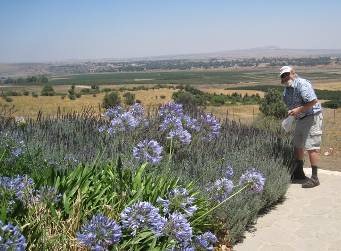
Randal collecting some lavender seeds where once there were battles.

clip_image014

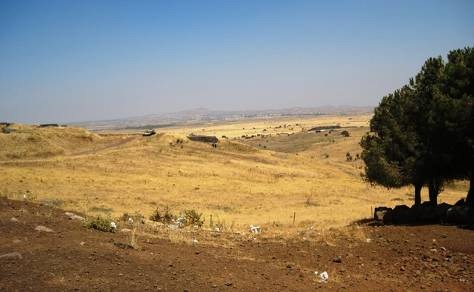
The valley separating Syria from Israel.  That may be the United Nations post visible in the distance.
clip_image015

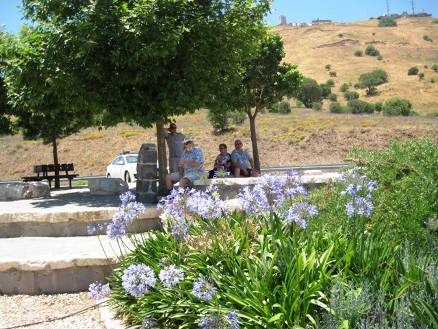
Up on the hill behind where we’re sitting is, I think, the hill where Eitan was stationed during the Yom Kippur War.

clip_image016

Mount Bental.

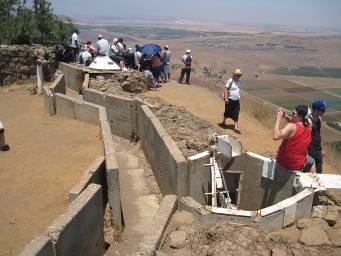
“The Mount Bental overlook is beautiful and provides stunning views of Mount Hermon and the Golan. Located in the Golan Heights, Mount Bental is 1,170 meters above sea level. The road to the top has recently been repaved and tourist facilities have been renovated and rebuilt. In a region where much is inaccessible to tourists due to restrictions on non-military traffic and poor roads, Mount Bental offers a rare and rewarding sight. The overlook is managed by Kibbutz Merom Golan, the first Kibbutz established in this region after the 1967 war. From the overlook one can see Mount Hermon (3,000 meters above sea level), several Druze villages as well as a network of old bunkers and trenches. Just to the east of Mount Bental is Syria, with Damascus lying just 60km away."
clip_image017

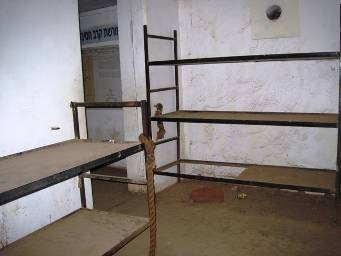
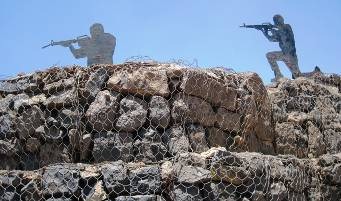
"In the Yom Kippur War of 1973, Mount Bental was the site of one of the largest tank battles in history. Mount Bental is a key strategic point for Israel due to its advantageous observation point. Israel knew it count not risk losing this mountain, nor any of the Golan Heights . The Syrians attacked the Golan with 1,500 tanks and 1,000 artillery pieces. Israel countered with only 160 tanks and 60 artillery pieces. The long stretch of valley in between Mount Bental and Mount Hermon became known as the Valley of Tears. The 100 Israeli tanks were reduced to seven under extreme enemy fire. However, the Israelis managed to take down 600 Syrian tanks in the process. The Syrians eventually retreated, but not without inflicting heavy casualties on Israel." http://www.jewishvirtuallibrary.org/jsource/Society_&_Culture/geo/bental.html
clip_image018

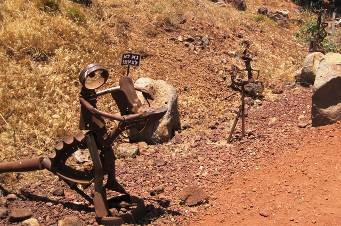
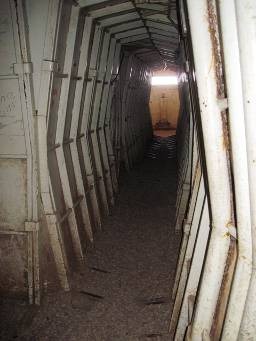
"Mount Bental is a dormant volcano which rises above the kibbutz of Marom Golan to the height of 1,165 meters above sea level. On the top of the mountain is a visitors’ center which belongs to the Golan Regional Council and includes an Israeli Defense Forces Bunker, with an automated information system, a charming café and a small and humorous Sculpture Garden made of scrap-iron, created by the Dutch sculptor Joop De Jong. From the mountain one can see the magnificent views of the Hermon, Northern Golan, Syrian Golan and the mountains of Southern Lebanon." http://www.israeltraveler.org/en/site/mount-bental

The cafe is called Coffee Anan Café…a play on the name Kofi Annan as there is a UN base not visible in the valley. Anan is the Hebrew word for cloud. We all had iced coffee!

clip_image019 clip_image020 clip_image021

 clip_image022

Where you are and where everyone else is.
clip_image023

 clip_image024

It was very dark entering the bunker but lights are provided inside.
clip_image025

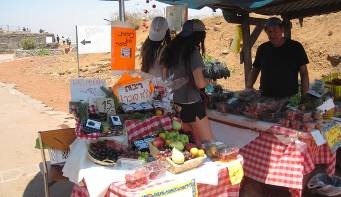
Organic produce from Kibbutz Merom Golan …swords into ploughshares.

clip_image026

Valley of Tears Memorial

clip_image027

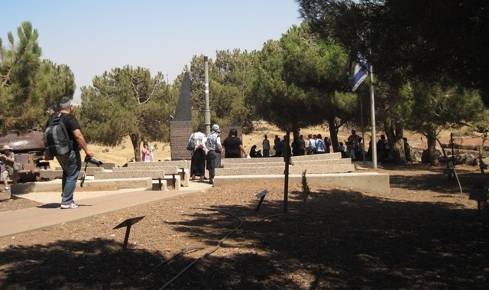
“At the Valley of Tears around 200 Israeli tanks held off about 1400 Syrian tanks over the course a a few days, breaking the momentum of the Syrian attack and giving Israel time to organize. In many ways the exploits of the 77 Battalion of the 7th Brigade saved much of Israel from the Syrian invasion. Their story has fittingly passed into Israeli legend. The tales of battalion commander Avigdor Kahalini jumping from tank to tank, during the Israeli counterattack, are known to every child. He later became an Israeli politician.

At the sight today, there is a lookout point, a grove of trees in memory of the fallen, a description of the combat, and a burnt out Syrian tank. Sometimes you can see Israeli tanks on site – adding a touch of authenticity. “  http://www.israelinsideout.com/Days-Out-in-the-Galilee-Golan/the-valley-of-tears.html
clip_image028

Near the small plaques are new trees planted for fallen soldiers.

This poem was on a plague at the memorial. It reminds me of Flanders Field from World War I by John McCrae. I didn’t photograph the poem and can’t find the author’s name and I’m not even sure this is the entire poem; just all I could find.

My Brothers the Heroes of Golan

I wanted to write to you, my brothers

With beards and sooty faces and all the other marks

I wanted to write to you – you who stood alone

Facing enemy tanks from front and flank

You whose clanking tracks set a land trembling,

You who proved that armor is iron but man is steel,

To you, who gave a shoulder and extended a hand

And destroyed them in their masses one by one

I wanted to write you a hymn if only one

For each of few who stood against the many.

I stand here on the ramps and count them by their scores

Sooty hulks and abandoned tanks and cold corpses

And I remember how you worked alone and in pairs

One turning on a light while the other struck from close,

And I look on towards the bloody path and Mazrat Beit Jan.

While looking to see what was meant by Mazrat Geit Jan I came across the website of photojournalist Rachael Hirsch. “Beit Jan, a Druze village in the north of Israel, had, at the time, the highest percentage of soldiers who were killed in Israeli wars. The widows claimed that, according to their religion, they would never remarry. “ NE and D had told us that the Druze fought in the Israeli military.  They have always chosen to stay in Israel rather than leave for Arab countries. 
clip_image029

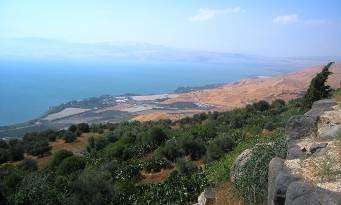
Mitzpah HaShalom (Peace Vista) of Kibbutz Kfar Haruv, overlooking the Kinneret (Sea of Galilee)

“Kfar Haruv, or "carob village," lies to the south of the Golan, east of Lake Kinneret…..The kibbutz was founded by English speakers and is economically strong. It has orchards, cow barns, traditional crops, lodging for tourists, and also A.R.I. Kfar Haruv, an industrial plant that makes fluid control accessories. The weather is comfortable, compared with the Jordan Valley, and it isn’t as chilly as the Golan. The expansion neighborhood lies along the cliffs, to the north of the kibbutz. Buyers can choose from a range of home styles.

http://www.haaretz.com/print-edition/features/the-good-life-on-a-kibbutz-1.315085
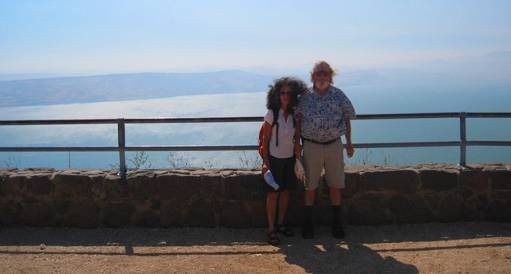
clip_image030

My ever expanding, exploding hair shows there was a lovely breeze.

Our next stop was Kibbutz Ma’agan Michael.
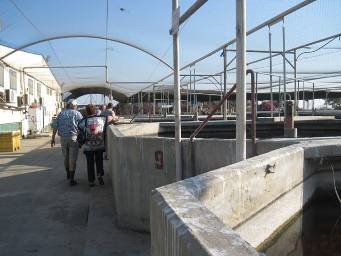
clip_image031

Kibbutz Ma’agan Michael was established on August 25, 1949 on a windswept, treeless sandstone hill

on Israel’s coastal plain – 30 km south of Haifa and 70 km north of Tel Aviv between the Mt. Carmel in the east and the Mediterranean Sea in the west.

The initial settlement, made up of a few spartan wooden huts, numbered barely 200 souls – of which almost 50 were children. Most of Ma’agan Michael’s agricultural land was located on inhospitable swamplands that were later reclaimed. The Kibbutz’s original assets consisted of one cow, a small flock of sheep and a few chickens.

Since then Kibbutz Ma’agan Michael has grown and prospered into the largest kibbutz in Israel – and one of the most successful – with a current population of 1,412 residents (excluding outside workforce hired by the Kibbutz). It has developed into a multi-million dollar agro-industrial complex with international activities that embrace much of the globe.

http://www.maaganm.com/HTMLs/article_p.aspx?C2023=14817&BSP=12905&BSS235=14817&BSS=14817&BSCP=12905
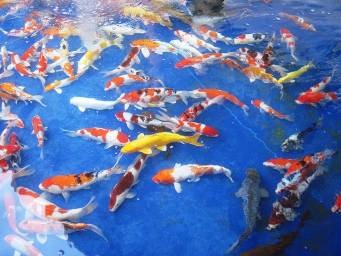
clip_image032

We toured their koi fish farm.

clip_image033

Dror called on his former army buddy NITZAN GALPAZ (in the red shirt), a member of the kibbutz, who kindly gave us a tour of the fish farms and the Plasson manufacturing plant (no photos allowed there) which Randal found particularly interesting. Nitzan worked in quality control and showed us the x-ray machine’s ability to detect any faults in the products. If so, the plastic product was broken down and completely recycled. Actually Dror was Nitzan’s commander, but it was Nitzan giving the orders that day.
clip_image034

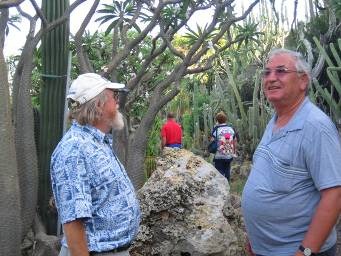
A walk through the cactus garden.

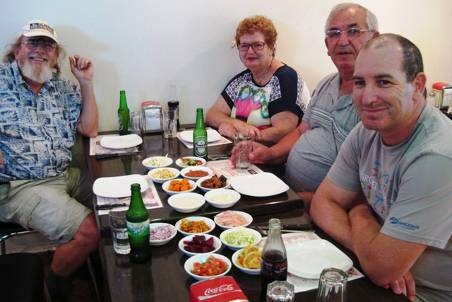
Then it was off to dinner. We’d had a snack of plums, wonderful pastry that Dror had made and some peanuts (I should have brought the ones without shells that dump in cars) while at the Peace Vista. But we were all pretty hungry. By the time dinner was over we were all really full!
clip_image035

Dinner at OR-AKIVA  near CEASARIA.

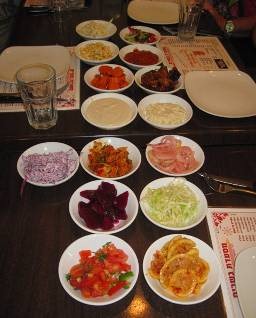
14 different meze refilled as needed and great grilled pita bread. THEN we ate wonderful grilled Moroccan beef kebabs, Israeli kebabs and chicken kebabs. Yum
clip_image036

If you are ever in Or-Akiva…the name of the restaurant is visible on the placemat…so I am including it.

So that was our amazing day! 

I’m going to end with a story about Nilly I had come across on the Internet from the Jerusalem Post by Tovah Lazaroff written on November 24, 2009 concerning the Israeli soldier Gilad Schalit.  Nilly and Eitan will soon have 3 grandchildren serving in the Israeli military.

“On Monday morning, Nilly Bukchin, 70, woke up with a nervous knot in the pit of her stomach, in anticipation of news that captive soldier Gilad Schalit might be released soon. "It’s the same feeling that I had before each of my three children were married," said the curly haired mother of three and grandmother of eight. She doesn’t know Gilad. Still, she has been so bothered by the thought of an Israeli soldier left in captivity, that for close to two years she has come to Jerusalem by bus from her Kfar Azar home once a month to sit in a protest tent that the young man’s supporters have pitched outside the prime minister’s residence. On Monday afternoon, in spite of the persistent media reports of Gilad’s imminent release, the white plastic tent was mostly empty, save for a few reporters who came to interview her. With no radio or television in sight, she has kept her cell phone close to her in hopes that her husband would call with news that Hamas and Israel have reached a deal by which Palestinian prisoners would be exchanged for Gilad, who has been held captive in Gaza since June 2006. As she spoke with The Jerusalem Post, an Egged bus driver honked in support as he passed. Pasted to the tent walls behind Bukchin, who sat on a folding chair on the Jerusalem sidewalk, were banners and posters from past protest campaigns that stated: "I have been drafted," and "Gilad is still alive." On top of the tent hangs a small sign with the number of days that 22-year-old Gilad has been held by Hamas in Gaza: 1247. For her, like for most Israelis, she said, the story of this young man has become very personal. Her grandson, is due to enter the army soon. Her husband and her son served in combat units. Their fate could have been his, she said. "It could be the story of any soldier in Israel," she said. "From the moment that a son is born here, you already start to worry what will happen once they enter the army. Time passes fast. Her husband and son served with the understanding that the IDF does not leave soldiers in the field, she said. Working on Gilad’s behalf is her obligation as a citizen, she said. "This boy has become the child of the nation." "I want to show his parents that we are with them," she said as she sat by a folding table, with petitions supporting the release of Gilad. Next to her sat an American blogger and comedian, Benji Lovitt, who made aliya from Texas. Unlike Bukchin, he was only recently recruited to Schalit’s cause, inspired to act after after walking by the tent. "I didn’t serve in the army and I was looking for a way to feel Israeli and to do my part to bring him home," he said. Almagor Terror Victims Association on Monday delayed its plans to pitch its own tent outside the prime minister’s residence to protest a prison swap for Gilad which would include the release of Hamas terrorists who have killed Israelis. Almagor has said that terrorists released in past deals have killed some 180 Israelis.

http://www.jpost.com/LandedPages/PrintArticle.aspx?id=161231

Shalit was released October 18, 2011
Jewish Quarter part 1

Shalom

This email finishes the Ramparts Walk and takes us into the Jewish Quarter.  In the email just before this I wrote about the Armenian Quarter.  But I started to think that it is the quarter that’s the hardest to readily understand its existence if you don’t know much about Jerusalem.  A Jewish, Christian, and Muslim section are easy to understand.  Buy why Armenian? 

   "Tucked away in a corner of the Old City of Jerusalem lies the Armenian Patriarchate of St. James, a sprawling convent and monastery complex built on the site of Rome’s vaunted 10th Legion encampment. Like the Jews, the Armenians have survived religious persecution, attempted genocide and exile from their historic homeland, currently divided between Turkey and the U.S.S.R.   Today, only 1500 Armenians remain in Jerusalem, and their future here is uncertain. According to their traditions, Armenians reached Eretz Israel between the tenth and sixth centuries BCE, when Tigranes the Great ruled an empire extending from the Caspian Sea to the shores of the Mediterranean. The first time the word "Armenia" is mentioned is in an inscription attributed to King Darius. Armenians arrived in the wake of the Roman legions, as traders, artisans, legionnaires and administrators. But it was Christianity that put the final stamp on the perpetual Armenian presence here. Diaspora Armenians are descended primarily from ancestors who lived in historic Armenia. Many still have relatives in the disparate towns and villages of Turkish Armenia, although their roots may have disappeared from the pages of history following frequent family name changes, necessitated by political exigencies. Apkar, for example, has been changed to Ali, Misak into Murad, or even Mohammed.  Armenians have survived by challenging empires and by scuttling all attempts at assimilation. They believe in the eternality of their race, symbolized by their emblem – the soaring twin peaks of Mount Ararat, traditional site of Noah’s stranded ark. The goldsmiths, jewelers, photographers, pharmacists, teachers and potters who pound the ancient cobblestones of the Old City – a place that is just another diaspora for most of them – are living proof of Armenian durability." http://jcpa.org/jl/hit04.htm tells an interesting story.

So now back to the Jewish Quarter..

Ru

clip_image001

Israeli Security

You can never have too much security. Those are my feelings after having to even think about the Somali pirates. When Randal and I did our Ramparts Walk, just near the end, a young boy, maybe 12, passed us and then turned to follow us. He didn’t say anything or smile. He just followed us. Randal and I were alone. We didn’t know if he had friends up ahead where we couldn’t see. And this is the Middle East where things do happen. Of course, nothing happened (and two adults being wary of a young boy is sad) but the memory gave me pause about doing the other half of the walk by myself. But I was determined to go and so I went and it was fine. Actually I kept passing small groups of people on the walk so that was reassuring.

clip_image002

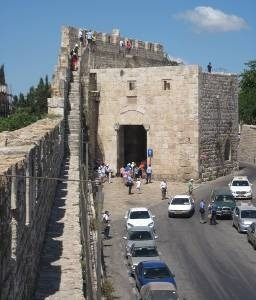
Climbing up and over the Zion Gate built in 1541

“Providing access to Mount Zion, this gate bears the marks of the Arab and Israeli battles of the 1948 War of Independence. The gate connects the Jewish and Armenian Quarters with Mount Zion, hence the name. Arabs call it “Bab Nabi Daud,” which means “Gate of the Prophet David” because legend has it that the tomb of David was located nearby, on Mount Zion.” iTravel Jerusalem

“Since the 10th century it has been thought that King David, after his 40-year reign of Israel, was probably buried here, although it is more likely that he is buried on the Ophel with the other Israelite kings.” Jerusalem

clip_image003

Mount of Olives

http://www.mountofolives.co.il/eng/timeline.aspx?CID=409 gives a timeline of the Mount of Olives. Click on a date for the information.

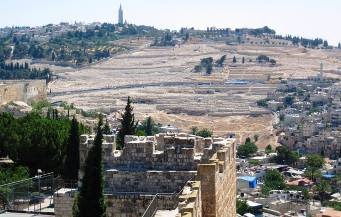
We stayed our first night in Jerusalem at the 7 Arches Hotel on Mount Olive. The next morning I was out at 6 am to walk down the mountain and through the cemetery. It was so vast that it was amazing. From Mount Olive you look over and see the Gold Dome of the Rock on Temple Mount.

http://www.mountofolives.co.il/eng/about.aspx?CID=415 shows a panorama of the area and tells its history.

“The hills of the Mount of Olives have served from time immemorial as the eastern border of ancient Jerusalem, forming a clear partition that separates the city from the edge of the Judean Desert. In fact it is a long hilly range that runs from Mount Scopus to the slopes running down to the Kidron Valley in the south, and to the foothills of the summit known as the Mount of Corruption. Its height, which is impressive in relation to its surroundings, provides a spectacular view of the city to the west and of the desert to the east.

During both the First and Second Temples Periods, the city of Jerusalem, with the Temple Mount at its centre, was the focus of Jewish life. This was to have a great influence on the status of Mount of Olives in Jewish history, tradition and culture. Its proximity to the Temple Mount, and, primarily, the view that could be had from it, gave the Mount of Olives a special religious significance and it became an integral part of the holy rites of Jerusalem. Jewish sources connect the Mount of Olives with future miraculous happenings that will occur at the time of the Redemption. These traditions turned the Mount of Olives into a place of deep Jewish significance from which developed religious practices and the Mount came to be regarded as holy and a place of pilgrimage.

The holiness of the Mount, its proximity to the city and in addition to these the texture of its rock (soft chalk, that is relatively easy to chisel out) resulted in the Mount becoming a burial place over the generations. The tradition of burial here started in the First Temple Period and has continued right down to the present day.

The Mount of Olives now offers spectacular views for tourists who come to its summit, and in addition to the impressive scenery, a variety of tours of the Mount that explore the depths of Jewish history are also available. From between its rocks the Mount softly whispers its stories and all we have to do is wander through its hidden corners to recognize its glorious past.”

clip_image004

Looking at ruins, and maybe and old cemetery, just outside the Old City Walls.

The walks ends just short of the Dung Gate which got its lovely name as it was thought that during the time of the 1st and 2nd Temple waste was taken out through this gate. I climbed down from the walls and wasn’t sure where I was, though I knew I was in the Jewish Quarter so I felt safe enough to wander anywhere. I also felt kind of stupid for not knowing where I was or being able to follow my map, but so it goes.

clip_image005

Even this didn’t help me much. But a kind woman who pointed me the “nicer way” that took me by shady lanes and a large book/Jewdaica shop where I finally bought my Jerusalem book,

clip_image006

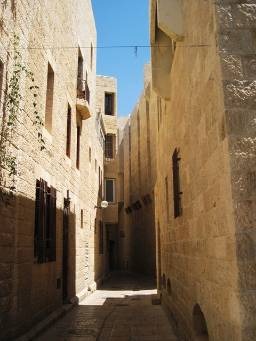
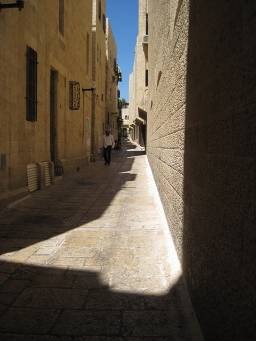
Somewhere in the Batei Machase neighborhood.

clip_image007

 clip_image008

Lots of this part of the Old City looked newly rebuilt since 1967 which  I’ll write more about from my visit to the museum Alone on the Walls about the defense of Jerusalem in 1948.

clip_image009

 clip_image010

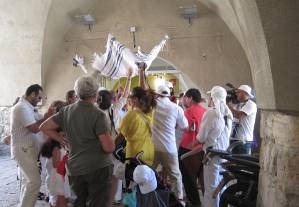
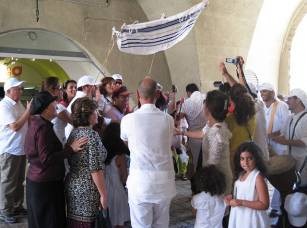
Thursday is Bar Mitzvah day so there were lots of celebrations, for the boys. Girls are on the outside looking in as this photo on the right serendipitously captured.

clip_image011

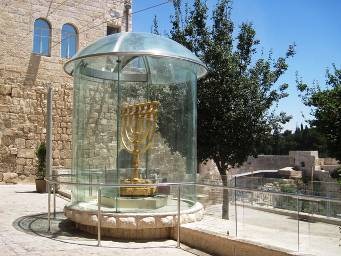
Golden Menorah Jewish Quarter

The menorah (spelled this way on the website) was painstakingly crafted only after years of extensive research by the Temple Institute’s full time staff of researchers. The conclusions upon which the construction of the menora was based took into account archeological evidence and, of course, the halachic (Jewish law) requirements of materials, dimensions, ornamental affects and manner of manufacture as first delineated in the Book of Exodus, and further explicated by Jewish sages throughout the millennia.

The menora weighs one-half ton. It contains forty five kilograms of twenty four karat gold. Its estimated value is approximately three million dollars. The construction of the menora was made possible through the generosity of Vadim Rabinovitch, a leader of the Jewish community of Ukraine.

http://www.templeinstitute.org/moving-menorah.htm

http://allaboutjerusalem.com/article/golden-menorah-jerusalem

The proportions of the menorah are over two meters in height and plated with 43 kg (95 lbs) of gold.

The golden menorah is located in the Jewish Quarter in the Old City of Jerusalem. The menorah was constructed by the Temple Institute and is based on extensive research carried out by the Academic and Biblical researchers.

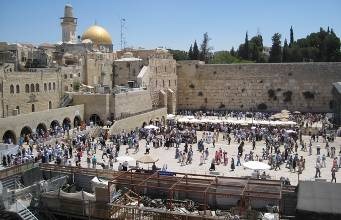
I walked, with about a billion other people, through the security gateway into the plaza of the Western Wall. I thought I would visit The Wall again, but it was just too crowded and I was too hot; and the awe from my first visit couldn’t be recreated. So I just looked around at the other people.

clip_image012

clip_image013

A once in a life time photo taken at someone’s Bar Mitzvah in Jerusalem at the Wall.

clip_image014

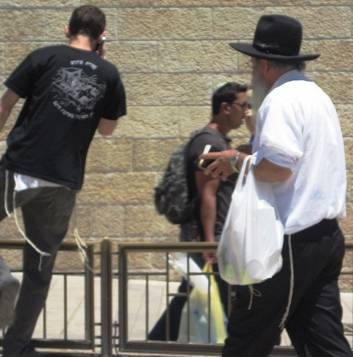
Three men wearing their religion in different way: notice the similar hanging fringes (Tallit Katan) on the two men and the white kippah on the man in the middle.

Tallit http://judaism.about.com/od/worshiprituals/f/tzitzit_what.htm

The mitzvah to wear Tzitzit ONLY applies to four-cornered garments. In biblical times, most clothing consisted of a four-cornered rectangle of cloth, direct from the loom, which was draped and fastened around the body. In modern times, people tend to wear more tailored clothing, which often does not consist of four corners. So a special four-cornered garment called a Tallit, which is somewhat like a shawl, is worn by those who want to fulfill the commandment to wear Tzitzit. The only religious significance of the Tallit is that it holds the Tzitzit on its corners.

According to Jewish Law, a Tallit must be long enough to be worn over the shoulders (so it qualifies as a garment). It may be made of any material, except wool and linen together (this is not a kosher combination for any clothes).

Tallit Katan (Tzitzit)

In more observant Jewish communities, boys and men often wear a Tallit Katan (little tallis). The Tallit Katan consists of a simple rectangle of cloth with a hole for the neck and fringes on the four corners. Sometimes the Tallit Katan is simply called Tzitzit.

They wear the Tallit Katan every day, all day long, under their shirts, with the Tzitzit hanging out. They do this because they want to fulfill the mitzvah of wearing Tzitzit more often than just during prayers and because it is written "and you shall see them."

clip_image015

So what else is new?”

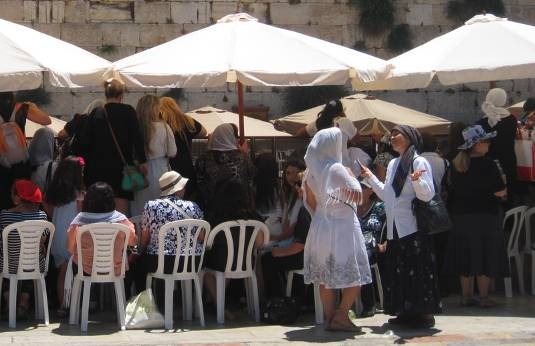
The men wear the fringe and the women are on it.

All I could think of is that they come all the way to Jerusalem for the Bar Mitzvah and then can’t really even see it or be there. They have to look over the barricade that separates the men and the women.

So that’s enough for this email. But I’m not finished with Jerusalem yet, as if you ever could be. More in the next email.

Ramparts walk south part 1

Shalom,

Randal and I did a "formal" one day tour of the Old City, and I did read the biography of Jerusalem by Montefiore, but mostly we have just wandered around and looked and, after the fact, I’ve done some research.  We don’t own a tour guide of Israel, though Charmaine and Linda had one which we used while they were here.  I, for one, didn’t come to Israel with lots of questions.  I did read several of Bruce Feiler’s books so that gave me some background.  Wandering around the Jewish Quarter this last visit I did buy a book about Jerusalem.  It was published by the same Italian company that published the book we’d bought in Ephesus when we were in Turkey.   If I were you coming to Jerusalem for the first time, I would read ahead as much as you could and look at lots and lots of pictures.  I think it would be easy to spend at least a month in Jerusalem alone if you really wanted to explore the different areas, old and new and not have to make a mad rush of it.  If your focus is the Old City, stay in the Old City.  Stay in the different neighborhoods that you want to visit.  Anyway, that would be how I would do it if we were just coming to see Israel and not traveling on a boat around the world.

Ru

Ramparts Walk South: The Armenian and Jewish Quarters by myself…

clip_image001

 clip_image002

clip_image003

 clip_image004

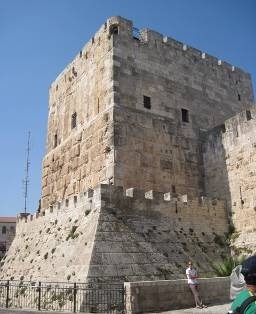
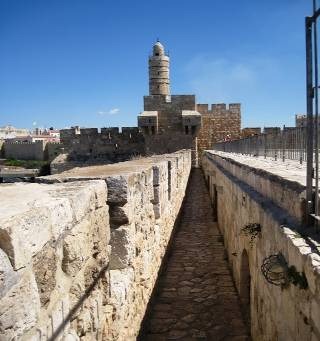
The Citadel and Tower of David

“Situated next to the Jaffa Gate, the Citadel encompasses an area where once stood three towers built by King Herod: the Phaseal Tower (named for his brother,) the Hippicus Tower (named for his friend,) and the Miriamne Tower (named for his wife.) They were there to guard Herod’s adjacent palace and were later spared destruction by Titus’ Roman army in order to house his Twelfth Legion. During the Byzantine era it was in such a state of ruin that philosophers and recluses chose it as a place of meditation. It was used as a fortress headquarters in the 12th century by the Crusaders, who repaired its walls and surrounded it by a moat. The Muslim Mamluks demolished it in 1239 and it remained in a state of abandon until 1335 when the Turks repaired the walls and added the minaret known today as the Tower of David. The Citadel became a British base during the Mandate (1917-1948) and then a Jordanian one until 1967. Today it houses the Museum of the History of Jerusalem and is famous for the sound and light shows presented on its walls.” Jerusalem

clip_image005

clip_image006

 clip_image007

“As you continue along the wall, you pass above the Armenian Quarter. The Armenian quarter is home to about 2500 Armenians. A walled compound encompasses the mostly residential area, as well as the St James Church, the Mardigian Museum, the Gulbenkian Library, the convent of the olive tree, and the residency of the Armenian Patriarch.

clip_image008

The back of the Armenian Library in the Armenian Quarter (I think.)

clip_image009

“There is also an empty lot, which is valuable real estate and archaeologically, but the Armenians will not allow excavations in the area.”

I walked along looking inside towards the Armenian Quarter, but there really wasn’t so much to see close to the walls.

clip_image010

More land left undeveloped by the Armenians who make the decisions for their quarter.

Outside there was always something to see even if, at the time, I didn’t really know what I was looking at. It was just being able to look down that was amazing. Not far from the Jaffa Gate is the Mamilla area.

“Outside of the old city is the new Mamilla neighborhood; Mamilla used to be on the Jordanian border and was a poor residential area. Following Mamilla, are the neighborhoods of Yemin Moshe and Mishkenot Sheananim. The relative “skyscrapers” which you can see from the ramparts are the King David Hotel, the Sheraton Hotel, and the YMCA building.”

“This area extends just outside of the Old City west of the Jaffa Gate. Built in the 19th century as the financial center of the Arabs and Jews, between 1948 and 1967 Mamilla fell into decline. It was later the subject of an impressive urban renewal project and, today, is a luxury residential and business district.

Jerusalem

clip_image011 clip_image012

The high rises are few and far between so Jerusalem, to me, has a “human” scale.”

Within this area is “the Sultan’s Pool,” once a reservoir, now a stadium.

clip_image013

Sultan’s Pool (the outdoor stadium.)

Jerusalem’s Secret Revealed: How They Filled The Sultan’s Pool

Archaeologists have uncovered the secret to how ancient engineers filled the Sultan’s Pool with water in the Old City of Jerusalem.

By Hana Levi Julian

First Publish: 6/16/2009, 1:29 PM

http://www.israelnationalnews.com/News/News.aspx/131901

“During an excavation prior to the construction of the Montefiore Museum in Mishkenot Sha’ananim by the Jerusalem Foundation, archaeologists uncovered the main aqueduct that conveyed water to the pool.

The aqueduct supplied pilgrims and residents with water for drinking and purification, at the Temple Mount as well as the Sultan’s Pool.

Although today most Israelis think of the Sultan’s Pool as a venue for outdoor concerts and other large cultural events, for hundreds of years it was one of the city’s most important reservoirs.

The dig, led by Gideon Solimany and Dr. Ron Be’eri (of IAA), focused on a section along the course of the Low-Level Aqueduct on the western side of the Ben Hinnoam Valley, above the Derech Hevron Bridge. The aqueduct originally reached a height of three meters.

"Naturally, one of the first things Sultan Suleiman The First hastened to do in Jerusalem (along with the construction of the city wall as we know it today) was to repair the aqueduct that was already there which supplied the large numbers of pilgrims who arrived in Jerusalem with water for drinking and purification," explained Be’eri.

"Suleiman attached a small tower to the aqueduct, inside of which a ceramic pipe was inserted. The pipe diverted the aqueduct’s water to the Sultan’s Pool and the impressive sabil (a Muslim public fountain for drinking water), which he built for the pilgrims who crossed the Derekh Hebron bridge and is still preserved there today.”

Beeri added that the location of the aqueduct was extremely successful and efficient. "We found four phases of different aqueducts that were constructed in exactly the same spot, one, Byzantine, from the sixth-seventh centuries CE and three that are Ottoman which were built beginning in the sixteenth century CE. The last three encircle a large subterranean water reservoir that was apparently built before the Ottoman period”.

The Low-level Aqueduct is one of two ancient water conduits that originated at the springs in the Hebron Highlands and at Solomon’s Pools, and terminated in Jerusalem and the Temple Mount.

Research has shown that the ancient aqueduct was meant to supply high quality spring water to the Temple Mount, to Jerusalem’s residents and to the many pilgrims that have come to the city over the course of generations, according to a statement by IAA.

“We can see that from the time of the Second Temple until the Byzantine period water flowed in an open channel that was covered with stone slabs. In later phases, beginning in the Ottoman period, water was conveyed in ceramic pipes which were installed inside the aqueduct,” Be’eri noted.

The Low-level Aqueduct is to be incorporated in the Montefiore Museum, which the Jerusalem Foundation plans to build inside the pool, adjacent to the aqueduct.”

clip_image014

An illustration of Sultan’s Pool as a reservoir.

clip_image015

The Dormition Abbey (outside the Old City walls on Mount Zion)

“This massive structure that rises on Mount Zion resembles a mighty fortress: it is topped by a high, domed bell tower, a conical dome, and corner towers. The church, built over the site where the Virgin is said to have fallen asleep for the last time, is the last in a series of buildings erected over the centuries. It was completed by Kaiser Wilhelm II during the first decade of the 20th century based on plans by Heinrich Renard, based on the model of the Carolingian cathedral of Aix-la-Chapelle. The church belongs to the Benedictines. The highlights are the mosaic and the wood-and-ivory statue of the Sleeping Virgin in the crypt.” Jerusalem

clip_image016

Renovations/repair were underway.

clip_image017

There was an Armenian Cemetery on one side of the Abbey and a Greek Cemetery on the other.

clip_image018

The Church of St. Peter in Gallicantu: (the gray domed topped building on the right surrounded with greenery.)

“The name of the church recalls the episode in which Peter denied Jesus three times before “the cock crowed.” This church was consecrated in 1931 and belongs to the Catholic Assumptionists, and was built over the remains of an older Byzantine basilica. It has been said, but never officially confirmed, that it stands over the house of the High Priest Caiaphas.

The church crypt has a series of grottoes, one of which has been called Jesus’ prison. It is said that after having been questioned by Caiaphas that he spent the night here before being taken before Pontius Pilate.” Jerusalem

At this point, I am still on the walls looking over to Mount Olive and Its amazing view. But this email is already too long so I’ll save the end of the walk when I reach the Jewish Quarter and include it with some of the things I saw wandering around inside.

Jerusalem Ramparts Walk: Northern Route

Shalom,

  A week or so ago we had a visit from one of the many people who are quite curious about our boat.  We invited him aboard and had a lovely chat.  His name is Avi and he and Eve, who had been on our boat for dinner,  discovered that they had relatives who lived near each other…or something like that as always seems to happen in Israel.  Yesterday, Friday, Ari came to collect us for the Friday lunch and wine tasting at a nearby vineyare.  We also stopped at a Kibbutz that raises olives.  I’ve been to wine tastings before, but never to an olive oil tasting.  It is quite interesting as the flavors are very distinct.  We also went to visit Avi’s home and community meeting his lovely wife.  I will write about it when I know how to spell every name and place correctly.  We had a lovely day.  We also had a visit from the owners of the sail boat Sea Gull.  Guy Zagursky is a sculpture with a studio in Tel Aviv.  His brother Ran makes jewelry.  You can Google their names.  Nice guys! 

   I have lots more to write about Jerusalem, especially as I went again last Thursday for the day ALL BY MYSELF!  Randal really didn’t want to go and that was fine.  He drove me on the motorbike to the Ashdod bus station and I caught the early bus to Jerusalem getting off at the Central Station where we always get off.  From there it’s just a short walk to Jaffa Road which takes you to the Old City.  I spent the day and caught the insanely crowded 3:50 bus back to Ashdod.  Lots of soldiers going home for Shabbat weekend leave.  This email is about the walk Randal and I did on the walls that surround the Old City of Jerusalem.

Ru

Jerusalem Ramparts Walk

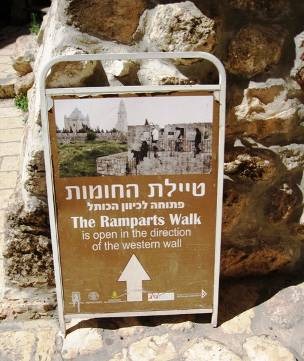
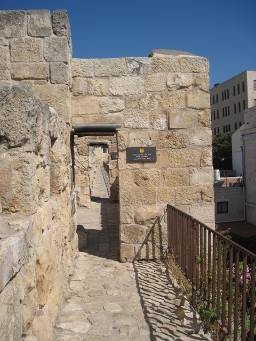
You can walk along the walls of the Old City circumambulating (how’s that for a word) almost the entire area. The section that passes by the Temple of the Mount is blocked off so you have to do the walk in two parts. Randal and I did the longer northern route around the Christian and Muslim areas first as we wanted to end the walk near the Damascus Gate. Last Thursday when I went to Jerusalem alone, I did the southern route along the Armenian and Jewish Quarters by myself. Both were interesting, the northern for its look into the Old City and the southern for its views looking away from the Old City. There’s no glitz, no noise, no crowds along the walk…at least when we did them. I think you get a real sense of the Old City and its story when you walk the walls.

clip_image001

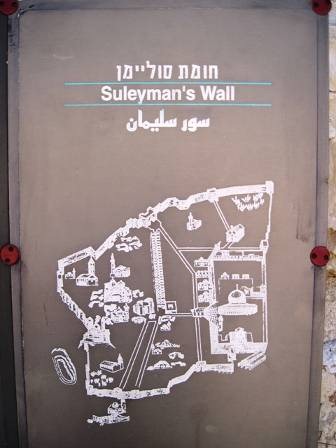
The walls of Jerusalem that exist today were built by Seleyman the Magnificent in the 16th century as fortification for the Old City.

clip_image002

A map of the Old City Walls

Randal and I walked the “northern route” from the red Jaffa Gate in the middle of the left side of the Old City until the barrier at the beginning of the green Temple Mount area on the right side of the map. We looked down into the pink Christian area and the gray Muslim area exiting at the Lion’s Gate just before the area of the Temple of the Mount which is the green area with the gold dome. I went south from the Jaffa around the tan Armenian quarter and the blue Jewish quarter ending at the Dung Gate.

clip_image003

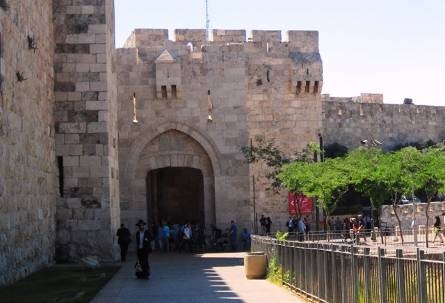
Walking towards the Jaffa Gate

“In ancient days if you were a pilgrim who docked at the Mediterranean port of Jaffa and walked east for three days or perhaps more, along the Jaffa Road, you would eventually reach the Jaffa Gate. “

iTravel Jerusalem Summer Edition 2012

“Its traffic and strategic position make it the most important junction in the Old City. Known as Bab el Khalili in Arabic, it has two openings: the smaller one in the original, while the other was created in 1989 to make room for the procession of the Kaiser Wilhelm II.

Jerusalem : Golden Book Series 2011

http://www.goisrael.com/Tourism_Eng/Articles/Attractions /Pages/OldCityJerusalem.aspx

The Moslem Quarter The Moslem quarter is the largest quarter in the old city, and most of its population arrived after its original Jewish and Christian residents moved to newer neighborhoods. The Moslem Quarter has churches and mosques, and there are several Jewish homes and Yeshivas still remaining. The most important sites in the Moslem Quarter are sacred sites for the Moslem faith such as the Dome of the Rock on Mount Moria (also a holy place for the Jews).

clip_image004

Looking up Jaffa street to the left of the building with the rounded front.

clip_image005

“The walls stretch for some 4.5 kilometers (2.8 miles), rising to a height of up to 15 meters, (49 feet), with an average thickness of 3 meters (10 ft). Along the course of the walls are 11 gates to the Old City, seven of which are open: New Gate, Damascus Gate , Herod’s Gate, Lions’ Gate, Dung Gate, Jaffa Gate, and Zion Gate.” http://www.jpost.com/VideoArticles/Video/Article.aspx?id=235062

clip_image006

Looking into homes in the Christian Quarter of Jerusalem.

The Old City was always a place where people lived; not just a collection of historic buildings

The Christian Quarter http://www.goisrael.com/Tourism_Eng/Articles/Attractions /Pages/OldCityJerusalem.aspx

The Christian quarter has more than 40 churches, monasteries, and hostels that were built for Christian pilgrims. In the heart of the Christian quarter is the Church of the Holy Sepulchre or the Church of the Resurrection, which, according to Christian tradition, was the site upon which Jesus was crucified and buried following his final walk along the Via Dolorosa, or the Stations of the Cross. The Via Dolorosa begins at the courthouse – which was located at what is now the Lions’ Gate – also known as St. Stephen’s Gate– and ends at Calvary Hill or Golgotha, where the Church is now located. Many Christian pilgrims walk along the Via Dolorosa following the final path of Jesus.

There are several sites that are important to the Christian tradition inside the Church of the Resurrection, including the Stone of Anointing, the tomb, and the rotunda.

The market – one of Jerusalem’s most popular tourist attractions, is located in the Christian quarter and is a noisy, colorful market where one can buy decorated pottery, candles, souvenirs, ethnic costumes, mats, rugs, beads, and jewelry, glass lamps and decorative items. The merchants call out their wares and the food stands emit tantalizing aromas. One of the most outstanding attractions of this market is that shoppers are expected to bargain for wares, and if you insist, you can bargain shopkeepers down from their original price.

clip_image007 clip_image008

clip_image009

clip_image010

clip_image011 clip_image012
clip_image013

A private family mosque in the Christian Quarter.

“Just inside the northwestern corner of the Old City walls is a modest family mosque with a large dome. Built in the 16th century it is known as Masjid al-Qaymariyya

clip_image014

Inside the walls are all manner of shops including bars!

clip_image015

clip_image016

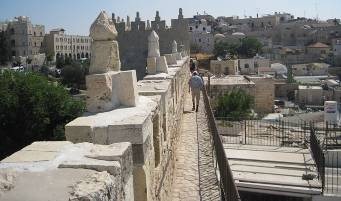
The walls followed mostly along the Christian quarter.

clip_image017

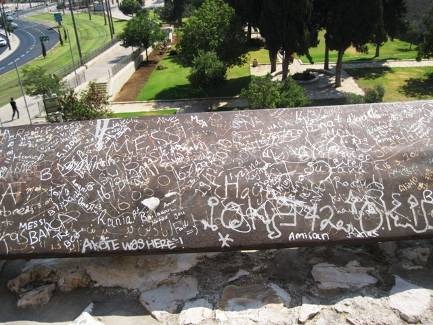
The ever-present graffiti

clip_image018

clip_image019

Not so picturesque; just real life inside the walls.

clip_image020

clip_image021

She just looked at us and then go onto her swing.

clip_image022

Looking outside the walls toward the Arab area of Eastern Jerusalem.

clip_image023

A play area in the Muslim Quarter in the Muslim Quarter.

clip_image024

The Dome of the Rock visible behind this playing field.

clip_image025

A final rest before we climb down from the walls at Lion’s Gate which borders on the area of Temple Mount. Actually we just sort of re-entered the Old City and never exited through the  Lion’s Gate

“The Lion’s Gate opens toward the Mount of Olives: Christians call it St. Stephen’s Gate because they believe that the saint was stoned to death on that spot while the Muslims call it Bab Sitti Maryam, that is the Virgin Mary’s Gate, believing it to be the site of her birthplace. “ Jerusalem

“Legend has it that the four figures of lions on the gate’s crest appear there because Suleiman dreamed that if he did not construct a wall to protect Jerusalem’s citizens, he would be killed by lions.”

ITravel Jerusalem

The best humus joint in Israel and maybe the worst bus terminal

Shalom,

   It has been a really nice few days so I was in a really good mood when I sat down to finish this email.  Then our "neighbors" off across the dock next to Eve’s boat turned on their music loud enough to blast us off the planet…..again.  I walked over to ask them to turn it down and they got mad and told me this was how they lived so too bad.  They said not to come over every night and tell them to turn it down.  Since we’ve been here I’ve asked 3 times, tonight being the 3rd.  Other nights, and often during the day,  when it isn’t SO LOUD or so POUNDING we just put up with it.  Even the Israeli Navy’s music in Herzliya wasn’t so loud.  We learned today that we have to move the boat to Ashkelon to check out from Israel so we are thinking to move the boat there for our final few weeks in Israel just to get away from our awful neighbor.  It will mean leaving Eve and the little kitty, but for our sanity I think we’ve no choice.  And there are things to see in Ashkelon.  We’ll see.  I actually called Yorman Greenburg, the marina manager this evening because I was so mad.  Not sure what he can do.  The music is a bit lower and in some ways that’s all they needed to do.  Not shut it off, but just not make our windows rattle which is only a slight exaggeration.  Now it’s off altogether.  Are they cutting off their noses to spite their faces or are they just getting ready to blast off again?  Unfortunately they were getting ready to broadcast what sounds like some really bad karaoke.  The boat has some really nice music too so if they would play that at a reasonable level we’d probably like it.  Even the loud Ramadan Prayers in Indonesia were more tolerable because they had some purpose.  These people are insane has become my new overworked phrase since we’ve come to the Ashdod Marina.    I use it for the loud music and for the horrible long lines in the grocery stores.  Time to leave for sure!  Israel is a neat place to visit, but if you’re not fond of blasting music, I would be a bit leery of the marinas. 

" Long lines mean good food.  When you see a restaurant with a line of people waiting to get in, go there and eat, even if you’re not hungry."

"Don’t ask for the check until you’re finished eating, we’ll have to get up from the table."  Both quotes are by Eve’s son Norm and will become clear as you read the email.

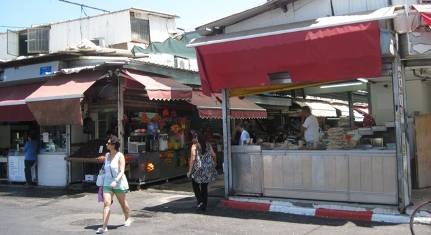
Our friend Eve has been working as an evening/overnight care giver just outside of Tel Aviv this past week. So Sunday Randal and I took the 7:48 bus from Ashdod to the Central Bus Station in Tel Aviv and then bus 4 to Shuk Ha Camel to meet her as she has most of the day free. Shuk Ha Camel is a huge bazaar with lots of stalls selling t-shirts, souvenirs, fruit, cheese, wine. We’d been there once before with Linda and Charmaine, but it was on a “market day” and the place was insanely jam packed. Sunday there were no additional market vendors so you could actually walk through the center promenade and not get claustrophobic. We stopped in some of the Judaica shops and I did find a few things.

Because the highways in Israel are just too busy for our small, slow motorbike, Randal and I are becoming veteran bus riders. The HUGE and slightly awful Central Bus Station in Tel Aviv is confusing, but this time we paid attention to where we got off the bus (floor 6 in the back at the Veolia Line.) And we knew we needed to catch the # 4 bus on the Dan Line from the terminal to Shuk Ha Camel to meet Eve. Finding bus 4 was easy; finding the well hidden WC and having the correct 1 shekel change to get in, another story.

We arrived before Eve so found a coffee shop and had a 10 am snack.

clip_image001

Randal ordered his favorite ice coffee smoothie. The cappuccino machine was having an issue so I had to wait for mine. Bad Randal also ate a cheese pastry and I ate part of a honey nut seed thing.

Eve arrived and we walked through the main row of the shuk. Most of the stuff is aimed at tourists, but that’s what I am so I could find a few things that I liked but didn’t cost more than our boat. That’s a slight exaggeration, but you know you’re not in China, India or Malaysia when you go shopping in Israel. We strolled along not taking so much time as we still wanted to walk to Jaffa where we would meet Eve’s son Norm for lunch. (Food plays a big part in this email.)

clip_image002

Emerging from the stalls of the Shuk.

clip_image003

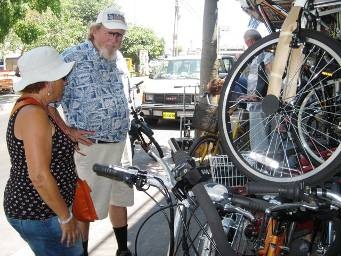
Eve wants a motorized bicycle so we stopped to look.

clip_image004

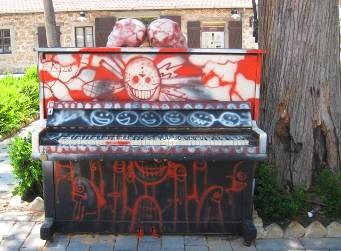
Graffiti piano at the renovated Train Station complex. (Lots of graffiti in Israel.)

I tried to play but my fingers were stiff from walking and so completely out of practice. Mom was right, I should have practiced. We had stopped mid way between Tel Aviv and Jaffa at the renovated train station to visit the book shop. Eve bought some magazines that her son Norm would take Monday when he left Israel for China to visit his sister who works near Shanghai. I had said that selection was limited as I remembered from our time in China. Eve’s daughter who speaks Hebrew, English, and German is now learning Chinese for her work as a fashion designer. Eve said that there are many Israelis working in the industry in China.

clip_image005

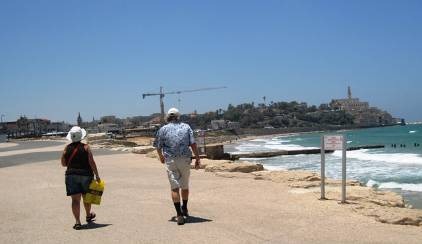
Walking the beach between Tel Aviv and Jaffa

clip_image006

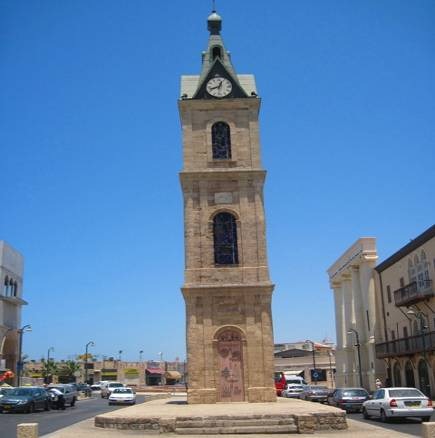
The Clock Tower showing the time in Jaffa.

The clock tower in Jaffa is one of seven clock towers built in Israel and of the hundred clock towers built in the Ottoman Empire in celebration of the 25th anniversary of the reign of the Turkish sultan Abdul Hamid the Second. The towers were built as part of the modern reforms guided by the sultan, in order to conduct the empire’s cities by accurate, Western timetables. According to the local tale, the tower was built at the initiative of Yossef Moial, a wealthy Jew of Jaffa, who erected the clock tower in order to save himself pestering by pedestrians who would come in to his shop to ask the time on their way to the train station.

Four clocks were installed in the tower – two of them showing the time in Europe, and two of them the time in Israel. http://www.oldjaffa.co.il/?CategoryID=212&ArticleID=356

clip_image007 clip_image008

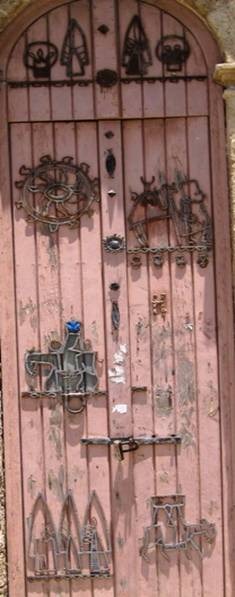
The decorative doors of the clock tower.

I couldn’t really see the stained glass or much of anything else as they were too high and the sun was too bright. I have just spent about an hour trying to find information about the door decorations but no luck other than a tiny bit of info on the following somewhat confusing website.

“The Jaffa clock tower was built in honor of the sultan Abdul Hamid the second in honor of his 25th year in rules, although the initiative for building it actually came from the Jaffa Jewish community. The clock tower concept was Moritz Sheinbergs, a watchmaker, one of the free masons who promoted the establishment of 17 shops on Bostros street. The French company’s management, who won the railway permit in Jaffa in 1892, chose to install by it 7 watches in each train station from Jaffa to Jerusalem. The Jaffa watchtower was reacted with the contribution from the city’s residents, Arabs and Jews. The cornerstone was placed on September 1st 1900. That same morning, both different religions held prayers at the same time, and in the evening the Rishon Le Zion band performed.

The tower stands in the Jaffa main entrance and crossroad- between the new government buildings, the police station, the jailhouse and Muhamdia mosque. In 1901 two stories were built and the third story was in construction. In 1903 the tower was complete, two clocks were installed and in the second floor, Abdul Hamids signature mark was engraved to all four sides of the tower. In 1965 the tower was

renovated by the city of Tel Aviv, new clocks were installed, artistic bars, stained glass windows which illustrate chapters of Jaffas history.

In 2001 the tower was renovated once more with the initiative from the department of tourism in Tel Aviv Jaffa.”

http://www.yourway.co.il/The_Clock_Tower.html

clip_image009

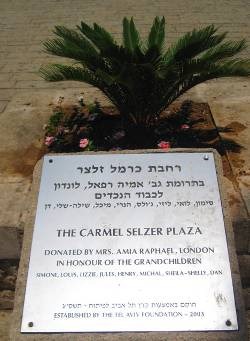
Clock Tower Square in now The Carmel Selzer Plaza

It seems as if almost everything in Israel has some kind of plaque on it. Many are for sad reasons, but this one is in “honor of the 9 grandchildren.”

clip_image010

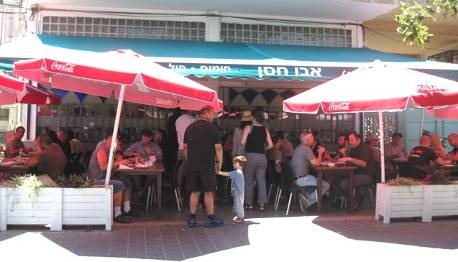
Ali Karavan (or popularly called Abu Hassan): the best humus in Israel

Eve called her son Norm who met us near Clock Tower Square and led us what felt like half way across Jaffa for lunch. It was hot, we were tired, and it was the best humus I’ve ever eaten. It wasn’t just good humus; it was delicious food. The place was packed with a line out the door when we arrived. I took this photo after we ate.

clip_image011
This is Humus Masabacha

It is served warm, spiced and drizzled with a bit of olive oil. It doesn’t taste like any humus you’ve ever eaten. The smooth part is thick and creamy but there are also bits of chick peas that are still whole, but cooked soft.

Along with the humus you are given a small bowl of lemon/garlic juice, huge chunks of onion and a stack of pita bread. I couldn’t imagine eating the entire dish of humus; it was so huge and who can digest that much chickpea at one time? Having said that, I ate it all and there were no ill after affects. I was brave enough to use some of the lemon/garlic oil but left the onions. Everyone else left the onions too. I wish we’d discovered Abu Hassan’s when Charmaine and Linda were with us. They love humus.

clip_image012

Everyone shares tables and you sit where there’s room. We were next to this young woman and her soldier friend next to me. Those other folks are waiting for us all to hurry up and eat. As soon as our tablemates were finished, two men sat down.

clip_image013 clip_image014

Inside the place was packed too: The man on the left was running the show and serving the food and telling the jokes. Eve asked for the falafel they sometimes serve with the humus and his answer was, “it’s out of season.” There was no time for falafel; it was just too busy for them to do anything than seat people, dish up the humus , plunk down your drinks, and collect the money.

clip_image015

If you are ever in Jaffa….

“Tourists do not tend to explore much past the attractions of the old port, the flea market and a few fish restaurants. The only real exception to the rule is Ali Karavan, popularly known as Abu Hassan’s, which is widely considered the best hummus joint in Israel. Given that Israelis are completely obsessed with hummus, this is saying a great deal. If you want to check out this 40-year-old legendary hole-in-the wall, it’s just down the hill on Dolphin Street. But get there early – by mid-afternoon the hummus is usually all gone, and on Fridays a queue of people starts to gather from early in the morning for their weekend treat.” http://www.cityguidetelaviv.com/new/INDEX/jaffa.htm

http://myjerusalemkitchen.wordpress.com/2012/03/11/hummus-with-mushrooms-onion-and-israeli-%D7%97%D7%95%D7%9E%D7%95%D7%A1/ gives a recipe for this humus dish.

The Ali Karavan restaurant serves the Best Humus in Jaffa, and has been serving it for almost 40 years now. Located in Jaffa, the restaurant was opened by the father of the family, Abu-Hassan, in 1966. Since then it has been known throughout Tel Aviv and Israel for its fresh and creamy humus. You might have to wait quite a while until you manage to get a seat, especially on weekends, but it is worth it. Sitting beside strangers and eating humus with pita-bread and fresh onion. There is nothing quite like it.

The menu is very limited, only humus, Masbacha and pita-bread, topped off with cooked chickpeas or fava beans, and served with fresh onion and lemon juice. Oh, and if you were wondering – There are no napkins. ( I did notice that, but had a package of tissues.)

The ambiance is vibrant and friendly, but you will be expected to be on your way once you have finished eating so others can take your place.

Make sure you arrive for an early lunch (or breakfast), because once the humus is finished the place closes down!

clip_image016

Eve writes a note to put with the magazines she had bought for her daughter while Norm and Randal chat.

clip_image017

Norm, Eve, Randal

clip_image018

Me, Norm and Eve

Norm’s shirt kind of looks like the graffiti painted on the piano. He and I talked a bit about the “street art” that seems to be all over Israel. I really don’t like it much but Norm, being about 30 years younger seems to be able to appreciate it.

We said good-bye to Norm and then Eve, Randal and I walked back to the Jaffa Flea Market but really didn’t have the oomph you need for a place like that. I think we were all too tired and hot (and full) and we were ready to be done. We checked with a taxi to take us all back to Tel Aviv but Eve waved him off saying we weren’t going to pay his “too high tourist prices.” We would take the bus so we walked over to the main road and with Eve’s help got a bus that would take us a block or so from the Central Bus Station. The bus driver assured us he’d tell us where to get off. Unfortunately the driver had already driven several blocks past our stop when he remembered. He’d been having a heated discussion with an elderly lady just after we’d gotten on so apparently forgot about us. When he finally remembered, he pretty much said, “sorry, get off.” So we got off, not at all sure where we were exactly or where the bus terminal was. I wish I could have taken photos but we just wanted to get where we needed to be as fast as we could. South Tel Aviv, in the blocks around the terminal, is not where you want to be if you don’t have to be there. If you have read about the refugee problems in Israel, you have read about the problems in south Tel Aviv. It looks terrible and smells worse. We stopped one women who spoke just enough English to give us vague directions and then I asked the driver of a big yellow minibus who said, “2nd set of lights, go left.” We did and got back to the terminal with no problem; hunted down another hidden WC and managed to catch the #320 bus just about to leave for Ashdod. It had been a really fun day with the special experience of Abu Hassan’s wonderful humus!

Here are some articles about the Tel Aviv Central Bus Station. Picture any large, unappealing bus station you’ve been in and you get the idea.

Tel Aviv Central Bus Station, known as the New Central Bus Station (HaTachana HaMerkazit HaChadasha), is the main bus station of Tel Aviv, Israel. Located in the south of the city, it was opened on August 18, 1993. It was the largest bus station in the world from its opening date until 2010, when it was overtaken by Delhi, India’s Millennium Park Bus Depot. The station covers 230,000 m2 and a total area of 44 dunams (44,000 m2). http://en.wikipedia.org/wiki/Tel_Aviv_Central_Bus_Station

Tel Aviv Central Bus Station.

The entire fourth floor of Tel Aviv’s central bus station shakes every time a bus rumbles along one of the platforms above. In a corner stands a clinic specializing in venereal diseases. Across from the clinic, in one of the “lost spaces” of the cavernous station, an experiment in community restoration has begun: a preschool and daycare center for the children of foreign workers and refugees who live in the area.

“We’re interested in turning the ‘lost spaces’ trapped in the central bus station into spaces that serve the residents of south Tel Aviv. We’re identifying these spaces and adapting the programs the community needs to the spaces’ particular configurations,” says architect Yoav Meiri, the designer of the new preschool and daycare center that recently opened.

“We believe in a slow, informed and thorough process to discover the added value of the central bus station building as part of the social space of the city,” Meiri adds with irrepressible optimism, the kind that allows someone to work instead of sinking into paralyzing inactivity.

With cosmic irony or perhaps poetic justice, the central bus station, which brought destruction to an entire urban neighborhood and its urban and human fabrics, is atoning − albeit very partially − for the wrong it inflicted by providing a home for a humanitarian endeavor, the UNITAF Preschool, Daycare Center and After-school Center Project, founded by the Yehuda Tribitch Memorial Fund for Social Involvement. The effort provides both an immediate solution for preschool children without making the families wait for government decisions, and uncompromising architecture and design that give the lost space a human dimension, a momentary respite, and a humanizing touch. “The greatest and most complex challenge we faced was how to create reasonable conditions under impossible circumstances,” says Ofra Paz, director of the UNITAF Project. Below the school is the commercial bazaar whose photogenic, romantic and multicultural charm does not make up for the station’s original sin.

Meiri sees the proximity of the preschool to the clinic, public transportation and bazaar shops downstairs as “a continuation − or even an enhancement − of the mixed usage motif that characterizes the neighborhood.” More than simple optimism is necessary to be able to view things this way. The preschool inside the door is the light at the end of the tunnel − literally. It is orderly and well-appointed, as well as aesthetically pleasing by any standard. Constraints such as the elongated space and leaky ceiling have been turned into advantages. The rooms are spacious and airy. One of the decisive factors in choosing this lost space was the expansiveness of the windows, originally part of the bus station building itself, letting in copious amounts of natural light. Even the bus ramps viewed through these windows look like a legitimate urban landscape.

The UNITAF Project, which opened its doors in 2005, operates preschools, daycare centers and afternoon programs throughout south Tel Aviv. It serves some 3,000 children, three years old and under, from the community of migrant workers and refugees. In addition to the central bus station location, the project operates preschools in Hatikva and Shapira neighborhoods as well as near the Carmel Market. The central bus station houses two preschools for some 100 children: a long-established infant daycare center slated to be redesigned and refurbished, and the new preschool for children up to age four.

Other project partners are the Tel Aviv Municipality, which leases the spaces for the schools, the municipality’s Mesila aid center for the foreign community, the Tel Aviv Foundation and the Central Bus Station Management Co. Equipment is provided by private donations ‏(which can be made through unitaf@gmail.com‏). The schools and daycare centers are run by preschool teachers and aides who themselves belong to the foreign community and who previously ran pirate babysitting services, often in surroundings bordering at times on the life-threatening. UNITAF’s contract with the teachers stipulates that they must maintain satisfactory childcare standards, says Paz. The plan and design of the new space are welcoming and supportive. Because the children are there from 7 A.M. until 6:30 P.M., the teachers get extra help from National Service volunteers and others who volunteer there regularly. Some are teaching professionals while others “come with lots of goodwill and the love that the kids need so much,” says Paz.

Nonetheless, she admits that the picture is far from rosy. Some of the children and their parents live under the threat of deportation, and live with a constant sense of impermanence and fear, dead-end violence and conflict.

UNITAF’s next goal is to erect an indoor playground inside the central bus station − an artificial “outdoors” as a stand-in for the real outdoors that is unavailable in the neighborhood, especially for the very young.

The site that has been chosen is a wide spot with tall ceilings that “will be a place for play, creativity, wandering about, and letting off steam for the children at the preschools,” says Meiri, who is also designing the playground for UNITAF. This project is in a sense a mirror image of his previous social/architectural project − the open public library in nearby Levinsky Park.

The designated spot is still a black hole; at a glance, it doesn’t seem ever to have had or be capable of having any sort of human purpose or justification. But judging by the plans and 3D imaging, it will be a brilliantly colorful playground with jungle gyms, a sandbox, wading pools, climbing structures and slides, swimming pools and artificial, neon-green grass − all underneath a ceiling painted in blue “to create the illusion of freedom,” as Meiri puts it.

In light of the recent and ongoing outbreaks of violence directed at the community of migrant workers and refugees in Tel Aviv and at various aid organizations, along with the lack of any official government solutions, a bottomless well of optimism is indeed needed to maintain this vision.

http://www.haaretz.com/news/features/making-tel-aviv-s-central-bus-station-child-friendly-1.429342

http://www.globes.co.il/serveen/globes/docview.asp?did=1000715394&fid=1124 is an article about the building’s history and projected huge revenue losses.

Jerusalem Mazkeret Moshe

Shalom,

  Up until now Randal and I have been really Gung Ho! about our cruising life.  But now, for some reason, we have hit a snag. We have been off traveling since November 2006 when we left Roanoke with a one way ticket for China. Since then we’ve spent 10 months of every year away from home.   Maybe it’s all of the obstacles to cruising in the European Union Countries that limit you to 90 days during a 180 day period.  Maybe it’s memories of our awful passage from Malaysia to Sri Lanka and India.  Maybe it’s Randal’s dream to build one more house during his life time from all he has seen during our travels. Maybe we’re a little tired of having "nothing real to do" other than just be outsiders with no involvement.   Maybe we’re just not really "boat people."  I know I’m not.  I need to be able to get onto land and walk.  Lots of people like to anchor out, relax, swim and take their dinghy ashore. I can’t get enough exercise swimming and we always seem to find our dinghy more trouble than it’s worth.  Our friend Linda on B’Sheret calls herself a "marina babe."  I guess that’s what we are too; "marina people."  So that’s where we’re heading when we leave Israel, the Netsel Marina in Marmaris, Turkey.  Turkey has no 90 day limit.  We spent some time in Marmaris last year at Yacht Marine.  This time we’ve chosen Netsel because it’s in town and you can get off your boat and just walk where you need to go. And there are lots of places to walk.   We do have our motorbike, but that’s not so fun in the winter.  Being in Marmaris town it might be more noisy in the summer time; but no place could be more noisy than Israel…at least I hope so. Israelis certainly like very loud music.   Maybe in Marmaris we were far enough from the discos and bars to hear the noise and real cruising marinas don’t allow blaring music from the boats.   In the cold months DoraMac will be closed up so we won’t hear it though I doubt there will be any.  In winter Marmaris has a population of about 30,000.  In the summer about 200,000 if I remember correctly.   In the warm months we can close up the boat and run the AC to drown out the noise if we have to.  We don’t do that here because with our location in the marina, the Mediterranean breezes keep us cool enough.  At least so far anyway.  Each day finds it a bit warmer, but not like the heat wave back in Virginia.  It certainly is a bit lonely here with no other real live aboards.  We have our pal Eve, but she has a life.  She has family and several job offers and a trip to Berlin to close up her daughter’s apartment. (Eve’s daughter moved from Berlin to China where she has a job as a fashion designer near Shanghai.)    Even our boat project that need to be done aren’t very appealing.  We’ve hit the doldrums.  I’m not whining, though if you’re still doing the 9 to 5 thing, I’m sure it sounds a lot like whining!   I’m just trying to explain the lack of emails and exciting stories lately.  Neither one of us seems very inspired. 

So anyway….

  We did visit Jerusalem this past Monday, Tuesday and Wednesday and I took lots of photos.  Wifi has been iffy so I have been having trouble doing my "post touring research."  I did come across some interesting online articles from the Jerusalem Post and Haaretz.  I’ll include them at the end of emails so you can read them or not.  This first email is about the neighborhood of Mazkeret Moshe just off Jaffa Road.

Ru

Jerusalem is such an important, historic, beautiful city: but that’s not why we keep returning. I’m actually not sure why I keep wanting to go back. On our first visit we did an organized tour that raced us around the major “tourist sites” in the Old City, Masada, The Dead Sea, and Yad Vashem. Our second visit, while Charmaine and Linda were still visiting, we did our own touring, again mostly famous sites like the Israel Museum, Shrine of the Book, Dome of the Rock and the Chagall Windows as well as an organized tour of Jericho and Bethlehem. In all of that we’d only spent 4 nights; not nearly enough time to visit everything. It isn’t just what’s in the Old City that makes me want to keep returning, it’s the interesting neighborhoods in “new” Jerusalem and the surrounding areas. Neither Randal nor I went to Jerusalem for religious reasons so neither of us felt drawn to religious sites. So what else is there? The old stones, the sounds, people watching, the cooler temperatures? Pico Iyer, one of my favorite travel writers did a piece about Jerusalem for Conde Nast Traveler April of 2010. City of God, City of Man

“What struck me as I wandered, though, was not how old the place seemed but how alive.”

“It’s common, almost inevitable, to call Jerusalem a pilgrimage site, since few people ever come here casually and almost everyone is on a mission.”

It was the liveliness that captivated me; but neither Randal or I were on a mission. Just the opposite in fact. We weren’t sure why we were there other than, How could we not go? We both put it on our list of places we’d like to live for 3 months when we stop cruising. I just can’t explain why.

This trip we explored some of the small neighborhoods and wandered up and down Jaffa Road. We like Jaffa Road. It has book stores and coffee shops and there are those interesting intersecting neighborhoods. There’s the Mahane Yehuda Market with its zillions of stalls and streets to get lost in. We also took half of the Ramparts Walk along the walls of the Old City. That was great! I hope to do the other half before we leave Israel. It is possible to take an early bus to Jerusalem, walk the walls, see a few things and then catch an afternoon bus back to Ashdod

We stayed in the same homey Allenby Hotel owned and run by Dan Flax and his family. It’s just a 5 minute walk from the Central Bus Terminal and just a block or so off Jaffa Road and a short walk to the Mahane Yehuda Market. When we arrived Monday, Dan welcomed us and gave us each a huge bowl of fruit salad that is served every morning at breakfast. We ate our fruit and chatted for a bit, catching up since our last stay. Then we left our packs and headed out to wander down Jaffa Road.

We’d left the boat about 8 am and had arrived at the Allenby about 10:30. By the time we got to the Mahane Yehuda Market, it was time for some food (even after the fruit salad because the cute little Market eateries were just too tempting.) Sandwiches in Israel are served on giant pieces of bread so Randal and I have learned that one sandwich is plenty for both of us. One of our favorites in a salmon sandwich with cream cheese and green onions. I’ve probably mentioned that before.

clip_image001 clip_image002

Salmon sandwich, mint tea for me, beer for Randal. The great bakery next door.

These photos look so calm! We were sitting outside the bustling restaurant on the tiny patio packed with tiny tables and chairs. We just managed to squeeze ourselves in. You `could hear any number of languages being spoken…that is when the man with the drill wasn’t drilling up some concrete tiles just across the alley. Thankfully that stopped pretty quick. Unfortunately they served Lipton tea rather than my favorite Wissotzky; so I drank my hot water and mint leaves sans tea bag.

clip_image003

A halva stall; I almost took a free taste but we’re not really halva fans.

The man in black is wearing a gold crown if you can see. Some kind of promotion I’m guessing. From what I can make out the Hebrew on his shirt says halva halva.

clip_image004

A shop just outside the market.

I don’t know how to interpret this photo other than to point out the variety of people who live in Jerusalem, apparently, from what I’ve been reading, more poorer than richer. One article I just read said that Israel should have two capitals, Jerusalem for the Orthodox Jews and Tel Aviv for the secular Israelis.

clip_image005

Oiy!

We didn’t buy it and I’m going to be snobby enough to say “Who would?” Like an Elvis painting on velvet. But far better than I could paint it…so there’s that. I didn’t like the movie with Charlton Heston either. But I think Moses must have been some fantastic leader/politician if half of what is attributed to him is true.

Speaking of Moses, we discovered a very charming neighborhood, Mazkeret Moshe, not far from the market. We walked several blocks: it was one of those places I could imagine myself living.

Mazkeret Moshe (Hebrew: מזכרת משה) is a neighborhood of Jerusalem, Israel.

Mazkeret Moshe was founded in 1882 with the financial support of Moses Montefiore. The name "Mazkeret Moshe" means "memorial to Moses." The neighborhood was intended for Ashkenazi Jews, while the adjacent neighborhood Ohel Moshe, also funded by Montefiore’s foundation, was intended for Sephardi Jews. In 1938,the Mo’adon Mazkeret was opened as the first community center in Jerusalem. It was a club for neighborhood kids not in the school system. In 1975 a second story was added for an old age center and a kindergarten. In 2000 the building was remodeled as a heritage center documenting the stories of the people who settled the residential areas outside the walls of the old city.

The Weiner Heritage Center, an archive of historic photographs, is located in Mazkeret Moshe.

http://en.wikipedia.org/wiki/Mazkeret_Moshe

clip_image006

Wiener Heritage Center (Closed, maybe for lunch, while we were there.)

The Wiener Family Heritage Center in Mazkeret Moshe was dedicated in 2000 by Hans Wiener from Stockholm, Sweden as a living memorial to the memories of his parents Kaete and Franz Wiener killed in Auschwitz in 1942. The Center’s vision is to create a dynamic, productive center that would instruct groups and individuals from Israel and abroad on the urban renewal work taking place in the center of Jerusalem.

The Wiener Center would also serve as a place for the exchange of ideas and a meeting place between divergent groups. One major task of the heritage center would be to gather information and document the historical neighborhoods of the Inner City, built in the second half of the 19th century from the Old City along Jaffa Street, ensuring that children and adults alike would learn from the area’s rich cultural

http://www.levhair.org.il/Index.asp?CategoryID=585 website has some interesting photos linked from this page, though most of the site is only in Hebrew.

clip_image007

Hessed Verahamim just across the street from the Weiner Heritage Center

“Pass under the arch and you will be inside the Mazkeret Moshe Quarter, founded in 1882 specifically for Ashkenazi Jews. Turn right (Rehov Carmel) and stop at Hessed Verahamim, surprising for two reasons: it is a Sephardi synagogue in an Ashkenazi neighborhood, and it was once a pub! Sometime in the late 1920s, as more and more Sephardim moved in, a neighborhood butcher and his goons "persuaded" the owner to transform the pub into a Sephardi synagogue. Be sure to examine the exquisite doors, covered with unique silver symbols representing the 12 tribes.”

I have to admit that I can’t find the Hebrew that says Hessed Verahamim on the door, so I don’t know why it’s called that.

clip_image008 clip_image009

I’d guessed about the twelve tribes but not that it had been a pub. I wasn’t even positive it was a synagogue until I did some research. It was a pretty amazing door. Lovely detailed trim depicting the city.

“THE QUIET on Nahlaot’s streets is interrupted momentarily by a crowd of over 30 Israelis on one of the many guided tours of the picturesque neighborhood. They marvel at the ornate artwork adorning the Hesed Verahamim Synagogue, admiring its shiny metal gates, painstakingly engraved with Hebrew prayers and 12 panels signifying the ancient Tribes of Israel. As their tour guide finishes his potted history of the area, the group disperses, revealing the Hebrew words "Na, Nah, Nahma, Nahman, Me’uman" spray-painted on a wall adjacent to the historic Moroccan synagogue. The stuttering Kabbalistic mantra, written by followers of the late Rabbi Nachman of Breslav, is probably Israel’s best-known graffiti, reaching just about every corner of the country.” http://www.jpost.com/LandedPages/PrintArticle.aspx?id=105667

We didn’t see this particular bit of graffiti, but we have seen more than I would have expected in such an historic city.

clip_image010

Side street adjacent to the Weiner Heritage Center; I think this was a café.

clip_image011
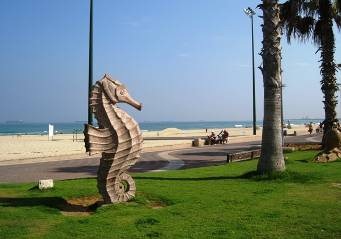
This is a real neighborhood with real people who live here.

For some reason black and white stripes seem to be very popular among the more religious women.

clip_image012

Shirat Devorah is an organization aimed at teaching 20-30 year old women how to make Torah teachings part of their everyday lives.

clip_image013

I especially liked this fence painting of the woman with the camera.

clip_image014

So picturesque.

clip_image015

Randal dreaming of the house he wants to build when we move to land.

Some of the homes seemed a bit shabby but were still appealing.

clip_image016 clip_image017

It was developed as a real neighborhood with communal ovens and cisterns.

clip_image018

Popular painting subject, Moses who adorns the side of this building and wall.

clip_image019

I’m not sure where one neighborhood ends and one begins; we wound around an ended our neighborhood walk where we had started exiting back into the seemingly much newer world of Jaffa Road.

Ashod Stuff

Shalom,

  It’s Sunday; the first day of the work week. 

In Hebrew my name is Rut.  There’s no th sound here.  When I have to give my name in a cafe and I say Ruth, they just look at me surprised.  Eve told me to say Ruthie, or Rutie because that’s the name Israelis would use.  I had to do that yesterday when Randal and I ate at a McDonalds in Star Center Mall.  We went there to the grocery store, the only one open on Saturday.  We had planned to eat at Aroma Cafe but it was closed.  The McDonalds was open.  There was no English menu.  Randal ordered a Big Mac and Coke Zero.  I ordered a salad with chicken and water.  The bill was 60.80 NIS, New Israel Shekels; almost $16 US. Seems a lot to me.   Granted there was a ton of chopped cucumber and tomato in my salad and the chicken actually tasted real, but it cost 39 NIS which is about $10.  The water had 00.00 next to it and the Big Mac was 11.90 NIS.  The medium Coke Zero was 9 NIS.  It’s about 3.85 NIS to $1 US.  That’s the first and last time we’ll eat in McDonalds.  At Aroma I ordered "a half "  Haloumi Cheese sandwich on whole wheat ( the size almost of a whole standard piece of bread) and it was about 16 NIS.  Randal had a "Breakfast for Two" of eggs, some tuna, some avocado, and some yogurt with bread, butter and jam and a huge chopped salad enough for two and that was 33 NIS. Much more food for less money at Aroma.   In China McDonalds was one of the more expensive places to eat while we lived in Jingan.  Actually it’s not such a bargain at home either if you get a Big Meal, which I don’t but Randal does…only occasionally.   Today we’ll walk into Ashdod to our favorite doner place and have that for lunch.  A Coke Zero, a Diet Sprite and a large baguette stuffed with grilled chicken cost 41 NIS.  They spread humus and a bit of pepper sauce on the bread and then add the chicken which makes it taste great.  You should try that.  And humus is healthier than mayonnaise.  We should never have started this voyage in China where a great noodle meal at the "Father and Son" food stall in the pedestrian mall cost about $1.50.

  I also bought some calcium chews as I finally finished all of the good ones I’d gotten at home from our friend Carol.  These have 500 mg of calcium and 400 of D.  They are sort of chalky but with enough sugar to make them ok.  I guess the Israelis need their medicine with sugar too.  I got 120 chews which cost 100 NIS, about 22 cents per chew.  Is that a good price?  Should I load up?  I like the gum drop ones from Carol better.  Obviously not much happening here if I’m writing about calcium and eating at McDonalds 

  We do have our tickets for home..September 19th and returning to somewhere in Turkey November 14th.  We’re not 100% sure what marina we will choose.  Our tickets are from Izmir rather than Istanbul. 

   Tomorrow, Monday we’ll take the bus to Jerusalem for one last visit.  We’ll return to Ashdod on Wednesday afternoon. 

And so it goes.

Ru

I wrote this email Friday. 

Ashdod June 2012

Not much happens in Ashdod during the summer. Everyone goes to the beach. Museums close for renovation. Classes for adults end, and programs for children off from school begin. Israelis go on vacation. Thank goodness for my Kindle. I’ve even been bored enough to clean half of the pilot house and the back bathroom cabinet. We did make our way to the small “light industrial” area of Ashdod looking for chemicals so Randal could pickle the water maker. No luck but Randal had some on the boat he could use. Eve and I went off to the Ashdod Museum of Philistine history and contemporary art; it was closed for renovation. But Ashdod is a great place to walk and there are lots of small neighborhoods to explore.

clip_image001

Yod Alef

The small shopping center in the Yod Alef neighborhood is about a mile from Doramac’s back door. Eve and I discovered it while on an evening walk.  You can get almost anything you need; fruit, vegetables, cheese, yogurt, soda, oatmeal, dried cranberries, and even bacon! There is also a post office, a hair salon, a veterinarian, a health clinic and family health center. The shop keepers are friendly and helpful and the prices not so different from the Wednesday open air market. According to the map Yod Alef has 2 high schools, 2 synagogues, a community center, day care centers, kindergartens, a park, playing fields, and 3 more health clinics. Amazing to me is the lack of a library. How can you have all of that other stuff and no library?

I have a new favorite walk that takes me about 80 minutes if I don’t dawdle too much or take took many photos.

My Friday morning walk…

I leave the marina and head north along the beaches. I can either walk the beach promenade or along Sederot Moshe Dayan.

clip_image002 clip_image003

The beach promenade has lots of kitsch sculptures but they’re fun. The street promenade has more serious sculptures. I’m not sure what the sculpture, paid for by French Ashdodians, is supposed to be, but the graffiti doesn’t help.

At the intersection of Moshe Dayan and Rogozin is the Monument to the Struma and Makfura, two illegal immigrant ships.

clip_image004 clip_image005

Mafkura and Strum.

Sederot Moshe Dayan turns away from the beach so I follow along Hatay Yelet past the huge area where the Wednesday open air market is held..

clip_image006

In the huge parking area adjacent to the Wednesday open air market I passed a group of cyclists having some type of class.

clip_image007

It was Thursday so the market had vanished. On Wednesday this area is packed with stalls, shoppers, trucks, cars, buses… It’s all much easier on a motorbike or even on foot. Security inspects the trunk of every vehicle that enters the area but they just wave us in. I guess our back carrier isn’t big enough for whatever they are looking for.

I turn right off Hatay Yelet and cut through a park as I head back up to Rogozin.

clip_image008

A pony?

I couldn’t believe I was actually seeing a pony until I got close because it’s so out of place. I guess some lucky kid really is getting to keep it in her room as there are only apartment buildings here near the park. No barns or farms or anyplace you would keep a pony. This other woman was also taking a photo.

clip_image009

Beit Canada Absorption Center

   "The Center is multicultural, integrating singles, families, professionals and non-professionals from all over the world including Latin America, North Africa, France, Russia, the Ukraine, Ethiopia, and Central Asian. Residents can be found mingling freely in the lobby, the library, courtyards or in the park.

   A variety of levels are taught in the Hebrew Ulpan classes. There is also a language lab, a library, and a computer room with educational software for language study, which serve the immigrants in their acquisition of Hebrew skills. Classes are taught by licensed Ministry of Education instructors, and are held five hours a day, five days a week for a period of five months. As a service to residents and immigrants in the area, the Center offers special classes for engineers with an emphasis on technical terminology.

    In addition to trips and seminars, Jewish and cultural programs, a strong emphasis is placed on both the cultural integration of the new immigrants, as well as their social involvement in the wider Ashdod community. Towards this end, there are joint holiday celebrations, on-going activities and special events with local artists, volunteer groups, I.D.F units and community and regional organizations. A testimony to the success of these activities is that many Beit Canada residents on leaving the Absorption Center, choose to live not only in Ashdod, but in the Beit Canada neighborhood.

   There is an Information Center on the premises, offering immigrants advice and guidance on vocational opportunities, retraining options, higher education and housing etc. A Russian language community library is available for olim and local residents, and the Institute for Jewish Studies offers study and conversion options for new immigrants." http://www.jewishagency.org/JewishAgency/English/Aliyah/Absorpton+Options /Absorption+Centers/Ashdod+12-overview.htm

Absorption centers provide help for those who come to Israel to live.  Those who come illegally from Sudan or Eritrea are as much of an issue as illegal aliens are in the US. 

On a lighter note, or I should say "highlighter" notes…….

clip_image010

Small shops along Rogozin.

Once coloring your hair was something people lied about.  Here women sit out in front of the salons and tell the world what they are doing.  There are lots of shades of red hair you only see in Europe.  We first noticed it back in 2000 in Italy.  I’m only brave enough to grow my hair and let it dry curly in the breeze; not brave enough to make it some other color from the rainbow.

There are a few 7 Eleven type shops but mostly lots of small shops in neighborhoods which is really more fun. If you spend enough time here you could become fluent in Hebrew and Russian.

Saturday

clip_image011

Shabbat at the Marina.

About 10 am this morning a small boat pulled up across from us. Lots of pre and young teens and some adults unloaded lots of picnic supplies, pool toys, etc. Even a rubber baby pool. Randal and I were working on our dinghy which had become unglued. We had the shell and the pontoon but they weren’t stuck together. Randal was laying down some stuff like sikaflex on both pieces and then we would put them together and let it set. It was not so easy to do and with kids walking by every 2 seconds unloading stuff…… Anyway, the dinghy got glued, no problem. Eve made a sign in Hebrew that asked people not to touch the dinghy. Randal put some heavy bricks on it to press the pieces together and wrapped rope around. We also tied the whole thing to the cleat on the dock. Hopefully it will work. With all of the kids running around in the area no one bothered the dinghy. We stopped worrying about it and went off to the grocery store that stays open on Saturday. The kids were noisy and energetic and in and out of the water all day; but everyone seemed nice. Past Saturdays there has been older kids drinking and being rowdy. Some took a discarded table top from Big Boat Karina and threw it into the water to float on. A security guard came and took the board and kicked them out. Technically you’re not supposed to be in the boat area unless you have a security key. That’s true of all marinas. The people visiting this Saturday were just fine. The small kitten wasn’t so thrilled with it all and stayed hidden most of the time. It did ask for food at one point and I fed it. (It had already eating a morning meal.) About 6 pm I heard a horrible meow that sounded like it was coming Davy Jones Locker; all echo and watery. Everyone went looking. The men in the big orange dredging boat; all of the picnickers, Randal and me. We found the kitten not where it should be.  It was hanging on a tire the dredging boat was using as a fender.   I went to get Randal and our look wood boat hook the kitten could cling on to.  Somehow before Randal got there the kitten ended up in the water.  And then just quiet. Randal and I were afraid that she had drowned. But then there she was swimming towards Eve’s dock. When she swam close enough to one of the boats near Eve’s a man grabbed her by the tail and flung her onto the dock! Whew. Everyone was smiling and happy…just because of one tiny kitten. Nice people. Russians I guess because it sounded like they were speaking Russian and not Hebrew. The kids could speak some English. Now it’s quiet. Hopefully it will stay that way. Big boat Karina played music way too loud, way too late last night.

clip_image012

Randal at the helm plotting our next passage…back to somewhere in Turkey where we will spend the winter. 

A very long email about the Bauhaus in Tel Aviv

Shalom,

   Our marina internet comes and goes, though thankfully, with our big booster antenna, we have it most of the time.  Today we found out that only Israeli citizens can buy dongels to use with their computer.  Eve asked as a kiosk in the mall.  We’ll double check at a bigger phone store.  We’ve had to register our passports in other countries for local SIM cards but we’ve always been able to get one.  Not good.  No library card, no SIM card: what’s the deal?  No English information in the big, fancy new Ashdod Art Museum.  Just because it seems the French XPats paid a big bunch so it’s called Monarts…they still could provide some English along with the French and Russian.  Not much to not complain about today! 

   This is a really long email about our walking tour in Tel Aviv.  I put most of the text at the end for anyone who wants to read it. 

Ru

Saturday, June 16th , Randal and I took the motorbike to Tel Aviv. On Shabbat, public transportation stops so there’s less roadway traffic. It wasn’t as bad as a week day, but I can’t imagine traveling on other days with double the traffic. We just can’t go fast enough on our little bike. Our friend Eve said she’d teach us some of the back roads so that will help. In Tel Aviv a free walking tour of the Bauhaus area of Rothschild Blvd. is offered every Saturday. It was well done. The guide had a mini-megaphone so you could hear and she knew quite a bit. The “White City” of Tel Aviv was declared a UNESCO Heritage Site in 2004 because of its 4,000 or so white box shaped Bauhaus structures. Some are lovely well maintained buildings, some are being renovated, and some are just beyond repair.

clip_image001
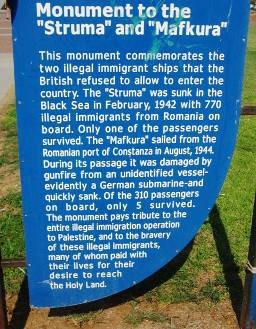
Our tour guide Yona Wiseman (in the center) had moved to Israel from South Africa in 1961.

www.yonawise.net ……..

“The most important thing that you should know about Yona is that she loves Israel : the history, the countryside, the cities and especially the people. She is passionate about Tel Aviv, a unique city that in April 2009 celebrated its 100th year.

Yona has taken courses, listened to lectures and learned about Israel and Jewish history from the time that she first made aliyah in 1961 and culminating in her studies at the Archeological Seminars in Jerusalem, where she qualified as a licensed tourist guide. The learning process has always been backed up by tireless trips to sites around the country. Yona (and her camera) always comes home renewed with excitement for where she has been and what she has seen.

And where is home? Home is in the Yemenite Quarter of Tel-Aviv, where Yona is the expert English-speaking guide concerning her own neighborhood, the recently renewed area of Neve Zedek, International / Bauhaus Architecture in The White City of Tel-Aviv (recognized by UNESCO as a World Heritage Site), Jaffa and the landmarks of the establishment of the modern Jewish state. She is well-versed about the colorful Carmel produce market, the exotic Flea Market and all sorts of wonderful restaurants be they by the sea or in the passageways of Old Jaffa.

Yona has made a wonderful niche for herself as a Tour Guide in Tel Aviv, and you can see by the list of her tours that she knows all the nooks and crannies of her city. You are welcome to join her group tours – some of them Free which is sponsored by the Association of Ministry of Tourism Tel Aviv. You are of course invited to form your own tour at your convenience, and Yona will gladly assist you to put together a tour for special celebrations – Wedding Guests – Bar/Bat Mitzvahs – Birthdays parties, etc.”

The tour begins at 11 am. The meeting place is 46 Rothschild Blvd. at the corner of Shadal Street. Randal and I arrived with about 2 minutes to spare. We’d left Ashdod by 9:30 but had to stop for gas in Jaffa as our gage read E! Luckily Randal can guess exactly where to find fuel so filled up ( it takes one gallon) and raced off to Tel Aviv only getting a bit lost. The walking tour started across the street from several busy restaurants and no one noticed when I walked into one just to use the Ladies. I was just rejoining the tour group of about 30 people when Yona began the tour. She first told how Tel Aviv came to be settled and why the Bauhaus style was so prevalent. I have copied info from some websites that pretty much tell the same story. First, here are some photos. She did mention that horrible cholera epidemics ravaged Jaffa prompting people to want to move away from the crowded commercial city.

clip_image002

Levine House

“The home of the Levine family was built in 1924 and designed by Yehuda Magidovich. This magnificent urban villa, known as The Castle, is one of Tel Aviv’s “Dream Houses,” as features a turret with a mechanically opening roof (that could be used as a Sukkoh) Upon the founding of the State of Israel, the building housed the USSR Embassy. In February 1953 a bomb was thrown at the embassy to protest the persecution of Soviet Jewry. In the 1190s it was reconstructed and refurbished, restoring the building to its original grandeur.” http://visit-tlv/?CategoryID=271&ArticleID=215

Yona told us that the building is now owned by the Canadian government which uses it to provide rooms to Israeli soldiers in transit.

clip_image003 clip_image004

Interior and exterior of the Great Synagogue in Tel Aviv also designed by Yehuda Magidovich

clip_image005

Many building just look utilitarian.

clip_image006

Some are wrecks as was the one that had previously stood in this parking lot.

Yona told the story about coming here one day and the building was “gone!” Another guide told her that you have to check the day before a tour to see if the buildings on your route are still there. Obviously the UNESCO Heritage designation doesn’t protect every “White City” building.

clip_image007

Balconies were and are still part of most structures.

The wood balcony is an addition painted gray to show it’s not part of the historic architecture of the building. Balconies were included to be an outdoor rooms useful in hot climates as they were shaded by the balcony above. Yona said that didn’t always work so well as the higher balcony forced the hot air back down onto the people sitting below. We did see some balconies that seemed much closer together than these. I like balconies. Yona kept comparing the architecture to boats…staterooms have balconies. She also said that in earlier days people could call to each other across the streets from one balcony to another. And at one point laundry was banned from hanging on the front balconies, but the ban must have been lifted because we saw lots of it. Some buildings had million dollar condos and some, with laundry on the balcony, cost less. Some even had squatters.

clip_image008

These are slightly more art deco with the air spaces cut in the balcony walls.

clip_image009

Yona called these “thermometer windows.”

They do look like a thermometer, at least the old fashioned, pre-digital kind.

clip_image010

Some corners became rounded.

clip_image011

Bait HaYam. I think it means House of the People. Eve says it was a entertainment center where movies might be shown or other entertainment offered.

clip_image012

Yona showed a photo of the water tower, the largest structure in Tel Aviv at one time when Tel Aviv was largely sand dunes. Tel Aviv was all sand dunes once upon a time. Yona said the Ottoman owners only sold the land to the Jews because it seemed worthless sand dunes.

clip_image013

Men walking home from the Saturday services.

clip_image014 clip_image015

Engle House 84 Rothschild

“This is one of the best known residential houses in the area known as the White City which has become the symbol of the international style of architecture in Tel Aviv. Built in 1933 by architect Zev Rechter, it was the first building built on pillars in Tel Aviv. The elongated balconies and the horizontal ribbon windows that traverse the building create a play of light and shadow against the background of the white plaster. During WWII the open lobby was enclosed with cement blocks and served as a shelter. The building is designated for renovation and preservation.”

http://visit-tlv/?CategoryID=271&ArticleID=215

Yona said Israel had no “Israeli architectural style,” but rather reflects the many styles immigrants brought with them from Europe. It also is designed for hot Mediterranean weather. She pointed to some wood shutters on the window of one lovely building. European immigrants brought building supplies with them. I can’t remember if it was because they wouldn’t find those materials in Israel or because it was what they were allowed to bring with them leaving Europe so spent their money on supplies. In either case, Yona said wood shutters weren’t a good idea in Israel because the climate causes them to need lots of upkeep. Plaster and tile are probably much better materials.

clip_image016

A poster explaining about the building was posted near the front door.

“The first building in the city to rest on an open storey of supporting columns was inspired by La Corbusier. The partial storey of columns in one of the corners allows the sea breeze from the west to waft through the street floor level and forms a harmonious link between the avenue and the building’s courtyard and private garden.”

clip_image017 clip_image018

clip_image019

These three parts are really now one building.

The basic box style with balconies seems always to be there no matter what else changes.

At one time the roof was for everyone. Yona says that now, if you buy the top floor, the roof is yours.

clip_image020

I could live here…

clip_image021

At # 96 Rothschild, on a balcony of the Friedman House, “The Choir” sculpture by Ofra Simbalista permanently serenade passers-bye.

clip_image022

Yona said this home was a very early Tel Aviv farm house just off on a side neighborhood.

clip_image023

Green spaces were included in neighborhood design to provide open space.

Yona pointed out that some of the trees provide fruit for bats. The bats eat the mosquitoes. But the bats poop out fruit mess that sticks to the plaster finishes on the buildings and is impossible to remove requiring frequent painting to cover up the purple blotches. The choice being mosquitoes or bat mess, the choice was to keep the bat mess so you can see the purple blotches on the buildings.

clip_image024 clip_image025

Shaded streets in the neighborhoods adjoining Rothschild.

clip_image026

Young girl with long hair and camera.

This is a sculpture of a coffee cup and into the arch are carved the Hebrew letters for the word spring which happen to be Aviv as in Tel Aviv.

clip_image027 clip_image028

Hebrew Book Week celebrated on Rothschild Street.

The Hebrew Book week will open June 6, 2012, and despite its name, will last 10 days, until June 16.

The first Hebrew Book Week took place in 1926. It was a one day event on Rothschild Boulevard in Tel Aviv organized by Bracha Peli- The founder of Masada Press. The purpose of the event was to promote book sales. Since 1926, the Hebrew Book Week has grown to enormous dimensions and every municipality and book store in Israel finds a way to celebrate the event.

I think for Book Week they should invest enough money in the one library Ashdod has to make it into a library worthy of a city of this size. Eve and I made a second visit today and it was even more disappointing. It wasn’t worth paying the 60 shekels for a 6 month library card. As an Israeli citizen Eve could get one though she would have to pay because her mailing address is at her brother’s in another town. But between us we didn’t see any reason to pay even that amount. Eve isn’t sure she will remain in Ashdod depending on the job she might find and I can get books from my library on my Kindle. The Art reference books are only available in the afternoon and most wouldn’t be in English. So that was that. I’m really so glad that I got my Kindle!

clip_image029

An old friend to sit on the bench and talk with: priceless!

Tel Aviv History

Tel Aviv was founded on April 11, 1909. On that day, several dozen families gathered on the sand dunes on the beach outside Yafo (Jaffa) to allocate plots of land for a new neighborhood they called Ahuzat Bayit, later known as Tel Aviv. As the families could not decide how to allocate the land, they held a lottery to ensure a fair division. Akiva Arieh Weiss, chairman of the lottery committee and one of the prominent figures in the city’s founding, gathered 60 grey seashells and 60 white seashells. Weiss wrote the names of the participants on the white shells and the plot numbers on the grey shells. He paired a white and grey shell, assigning each family a plot, and thus Tel Aviv’s founding families began building the first modern, Hebrew city.

The time was at a peak wave of Jewish immigration – the Second Alyia. Neighborhoods in the ancient port city of Yafo were becoming overpopulated and crowded. Many of the newcomers were Europeans of middle-class origin who sought to build surroundings that would give them a sense of what they had left behind. They wanted to build a modern suburb of Yafo.

The true development of Tel Aviv took off with the arrival of Scottish urban planner, Sir Patrick Geddes. In response to the unplanned expansion of the city, Geddes was invited by the municipality in 1925 to present a comprehensive master plan for Tel Aviv. In his vision, Tel Aviv was to be a garden city, as foreseen by its founders. His plan called for a clear separation between main streets, residential streets and vegetation filled pedestrian boulevards. An important element of his plan, reflecting the social climate of the time, was the creation of shared public spaces – in the form of parks and squares, as well as within residential blocks.

The city was again transformed starting in 1932 by a massive wave of immigration of Jews fleeing persecution in Europe whose arrival rapidly expanded a small town of 42,000 people into a flourishing city of 130,000 by 1936. In 1934, in the midst of this wave (the Fifth Aliya), Tel Aviv was declared a city, and Meir Dizengoff, the president of its council, as its first mayor.

The housing needs of this wave of immigration brought the rise of the Bauhaus, or Modern Movement, style of architecture. Many architects trained in the Modern style were among the refugees from Europe who began rapidly building to accommodate the population growth, resulting in what today is known as the White City. Influenced by the clean, functional lines of the Bauhaus School of Art and Design in Germany, they adapted the Modern style to suit Tel Aviv’s culture and climate, giving the city its special look. The White City of Tel Aviv, declared a UNESCO World Heritage Site in 2004, includes over 4,000 buildings in the Modern style.

In the 1930’s, Tel Aviv became the country’s largest economic center and had the highest concentration of social and cultural institutions. Tel Aviv was the center of the emergence of Hebrew culture and culture in Hebrew – and remains so to this very day. Tel Aviv became known for its modern cafes, hotels, concert halls and nightclubs. The city enjoyed a sense of international chic, which was rare for the region, especially at the time……….. (history of Tel Aviv continues on the website below)

http://www.tel-aviv.gov.il/english/HistoryMillstones.htm

http://www.bauhaus-center.com/

The Bauhaus was a school which operated in Germany between 1919 and 1933 and was devoted to art, architecture and design. It had remarkable influences on all these disciplines. Although throughout its years it carried varied approaches, some ideas were maintained. One main principle is the reunion of the arts and the crafts in order to achieve total works of art. According to this principle, all arts, as well as new technologies, should be combined in the art of building. A significant approach in the school was the search for the basic ingredients of art and design. Thus evolved the “Bauhaus Style” in architecture and design—in which primary forms and colors are given great importance. The Bauhaus had a great impact on the Modern Movement in architecture, embracing functionalism and rationality and condemning ornament. The architectural style of the modern movement is called “The International Style” or “Bauhaus Style”. This style is characterized by asymmetry, compositions of primary volumes—cubic and rounded, ribbon windows, pilots, thermometer windows, balconies, roof terraces and plays of shadow and light.

Bauhaus In Israel

Modern white building rises from the sand in Tel AvivFour Israeli architects studied in the Bauhaus school: Arieh Sharon, Shmuel Mestechkin, Munio Gitai-Weinraub and Shlomo Bernstein. However, the influence of the Bauhaus on the architecture built in Israel in the 20’s, 30’s and 40’s was by far wider than being expressed by those architects only. The legacy of the Bauhaus was absorbed by other architects, studying in Brussels, Ghent and Italy, such as: Dov Carmi, Genia Averbuch, Ben-Ami Shulman, Ze’ev Rechter and Joseph Neufeld. And of course—all of those prominent figures presented the new ideas to just everyone who was around. In Tel Aviv only, more than 4,000 “Bauhaus Style” buildings were built. Thousands more were built in Haifa, Jerusalem, the Kibbutzim and elsewhere in Israel. The main question is, therfore—how, in an era when this new style was still unpopular, did it reach such magnitude in the built work in Israel? The main answer is that the social-cultural ideology behind the “Bauhaus Style” fit like a glove to the socialist-Zionist movement and to the striving of this movement to create a new world. White houses, in every sense—form, style, material, functionality, color—grew from the sands without a past, towards a future.

The Bauhaus and Israeli Architecture Page

http://www.historama.com/online-resources/history-collecting-resources/architecture/bauhaus_and_israeli_architecture.html

“Though being over 5,000 years old and considered the source of western history, Israel lacks the architectural grandeur of a place whose significance would presumeably justify such structures. What she has instead – particularly from the modern era – is a trove of architectural designs ranging from the Ottoman to the Levantine, Bauhaus and our own domestic specialty of "box" buildings on columns.

She hasn’t often had the luxury of looking back and appreciating the greatness of her architecture, though its presence has been celebrated in song and in the popular culture – the piece "White City" ("Ir Levena" in Hebrew) celebrates the beauty of (old) Tel Aviv when its bauhaus structures were still white from newness; Chava Alberstein remensices about the centrality of the Israeli balcony in peoples’ lives in her song "Playing Cards on the Balcony". The balcony in our popular culture is the little citizen’s plot of the congested land on which he can survey the landscape, spy on – or, in days past, shout across the street to – his neighbor, hang out his laundry or beat his carpets, entertain his guests – or do a barbeque. The balcony is also a key hallmark of the various architectural styles in our country and a centerpiece of attention when observing the buildings.”

Bauhaus in Tel Aviv

Central Tel Aviv has the world’s largest collection of Bauhaus style buildings. The International Modern Style of architecture appeared in Europe in the years immediately following World War One. Its greatest exponent was the Bauhaus School of Arts, Design and Architecture, founded by Walter Gropius in Weimar Germany in 1919. The Bauhaus School later moved to Berlin and was closed by the Nazis in 1933. Over the years many have come to regard the terms Bauhaus and International Modern Style as synonymous.

The rise of Nazism and successive waves of Jewish immigration to Palestine brought many new immigrants from Germany, including several prominent Bauhaus architects, to Tel Aviv in the 1930’s. In Israel these architects had to adapt their style to different environmental, especially climatic, conditions. Tel Aviv’s tremendous urban growth at this time provided them with ample work. The results can be seen through the approximately 4,000 Bauhaus style buildings that were built in Tel Aviv in the 1930’s and 40’s.

So what is Bauhaus Architecture?

Bauhaus style architecture favored functionality for the benefit of the residents over decoration. In building design, the organization of space took prominence over mass. Architects strove to optimize light and ventilation, an especially important challenge as they moved from central Europe to Middle East. Bauhaus buildings standout for neat flowing lines, both vertically and horizontally. Decorative elements were avoided. Construction favored the use of modern materials and relied on an internal shell rather than being supported by external walls. In Tel Aviv many Bauhaus buildings were built standing on pillars with dangling corners to provide for greater ventilation and shady areas outdoors.

http://www.israelinsideout.com/Things-to-do-in-Tel-Aviv/bauhaus-in-the-white-city.html

The White City (Hebrew: העיר הלבנה‎, Ha-Ir HaLevana) refers to a collection of over 4,000 Bauhaus or International style buildings built in Tel Aviv from the 1930s by German Jewish architects who immigrated to the British Mandate of Palestine after the rise of the Nazis. Tel Aviv has the largest number of buildings in this style of any city in the world. Preservation, documentation, and exhibitions have brought attention to Tel Aviv’s collection of 1930s architecture. In 2003, the United Nations Educational, Scientific and Cultural Organization (UNESCO) proclaimed Tel Aviv’s White City a World Cultural Heritage site, as "an outstanding example of new town planning and architecture in the early 20th century."[1] The citation recognized the unique adaptation of modern international architectural trends to the cultural, climatic, and local traditions of the city. The Bauhaus Center in Tel Aviv organises regular architectural tours of the city. http://en.wikipedia.org/wiki/White_City_(Tel_Aviv)

Update from Israel

Shalom,

   We have our motorbike on the road!  Yippee.  Eve had volunteered to help us but we needed one more person and there aren’t so many people here to ask.  Luckily two men came along curious about Doramac and after chatting a while Randal asked them to help.  They were more than happy to help, being "real sailors" for years so they know cruisers help each other.  Afterwards they came onboard for a beer and a chat.  I have no photos or name, but "if you guys look at our website Thanks and come visit again."  That was Monday.  Tuesday we took the bike the short ride to Ashkelon to visit cruising friends and check out the marina again. The marina is fine, but too far away from the town.   Here everything is walkable from the marina so I vote for staying here. 

   The local Supersal has a good selection and pretty good prices and the people who work in the different sections are very nice and helpful.  The security man just waves us right in the door with no backpack check.  I’ve even learned to bring back to use instead of a cart.  But the lines are enough to make you insane.  One evening Eve and I went walking to find the shopping area in one of the neighborhoods near the beach.  It’s great!  You can buy anything you need, even the Israeli diet grapefruit soda in two liter bottles.  The deli even has bacon!  There’s a bakery that sells these great flat cookie crackers that taste a bit like pie dough but not so floury.  They are flavored with anise.  There is a fruit/vegetable store and a post office and pizza place.  They are open in the cool of the evenings too.  Now I’ll only go to Supersal if I need cat food or when I just have the patience to stand in line. 

  We also took the motorbike to a small Not Kosher grocery store that sells salami and shrimp and pork ribs.  Randal is making some in the slow cooker as I type.  It feels odd to eat them here, but I will.  Kosher is sort of enforced here because we shopped at Supersal and they only sell kosher.  You have to find other shops.  Restaurants serve shrimp and other not kosher foods, but that seems different.  Interesting. 

  So now we’ll do more exploring.  We can motorbike to Tel Aviv and Jaffa and also Jerusalem if we’re brave enough.  I’d like to visit Jerusalem on a Saturday just to see what that’s like.  We’ll see.

So that’s it.  Sox not so good…

Ru

ps  I read several chapters of the Montefiore Biography of Jerusalem book last night just before bed.  Bad idea.  Lots of horrible killing and mayhem of everyone by everyone.  I had nightmares and Randal had to wake me up. 

clip_image001

Our view at the marina: when it is quiet you wonder what just happened?

clip_image002

Our nearest neighbor..a dredge boat…is always quiet.

I always feel like a biggish boat until we park next to a “big boat.”

clip_image003

Beit Levron Community Center.

Randal and I walked about 40 minutes to get here but they offered no art classes so suggested we go to the community center in Dalet. Ashdod is divided up into areas each with a letter of the Hebrew alphabet. Dalet is actually closer to us but Beit Levron, in Bet,  had been recommended. So off we went to Beit Levin in Dalet. We found a community center in Dalet but not with the name Levin. They were just finishing an oil painting class taught by a woman who spoke French. That was all they had so suggested we go to the Mon Arts Centre….even closer to the marina!

clip_image004

Ashdod Art Museum

I still haven’t made it in for a tour…but one of these days.  The Municipal Center where the museum is located doesn’t seem to have a letter, just the neighborhoods.

clip_image005

Mon Arts Centre

Randal and I finally found our way in because to us, nothing was obvious. No signs in English. We finally found an office with some people. One of them spoke English and she told me everything for adults had finished and the summer was just for kids art classes. That’s fair but unfortunate. So that was that.  She gave me the name of someone to call about private lessons, but I don’t know if I will.  We’ll see.

clip_image006

Hoopoe…National bird of Israel

It is pretty fascinating to watch these colorful birds especially when they fluff out their head feathers to make themselves look fierce. The black and white feathers are really distinct and their beaks are fascinating to watch as they hunt for insects. You can get pretty close if you are lucky though this photo was taken too far away so is fuzzy. There aren’t many Hoopoeto be seen and I think Linda and Charmaine said they were migratory. Maybe I’ll get a better photo before we leave.

“The diet of the Hoopoe includes many species considered to be pests by humans; for example the pupae of the processionary moth, a damaging forest pest.[19] For this reason the species is afforded protection under the law in many countries.

In the Bible, Leviticus 11:13–19, hoopoes were listed among the animals that are detestable and should not be eaten. They are also listed in Deuteronomy (14:18[20]) as not kosher. The Hoopoe was chosen as the national bird of Israel in May 2008 in conjunction with the country’s 60th anniversary, following a national survey of 155,000 citizens, outpolling the White-spectacled Bulbul. http://en.wikipedia.org/wiki/Hoopoe

Just a 20 minute walk along Sederot Moshe Dayan which runs along the beach south from the marina are these ruins.

clip_image007

Ashdod Yam Fortress

clip_image008

clip_image009

The ruins are right on a sandy beach.

clip_image010

There were no signs with information so you just have to use your imagination.

clip_image011

Walking back to the marina.

These walking and separate bikeways are all over Ashdod. It is a very walkable city and very good for bike riding too. We only have our motorbike now, but we see lots of people with bicycles.  Eve foes everywhere on her bike.

clip_image012

Lunch at the Ashkelon Marina.

Our friends Betty and David on Sundance are just getting ready to leave Israel for Turkey. We all met on a Malaysia rally a few years ago.  We hadn’t called ahead to say we were coming to visit so I didn’t want to just drop it at lunch time.  We ate at the marina and then went to visit. 

clip_image013

Colorful and cool

clip_image014

My new obsession…mint tea: sometimes I don’t even add the tea bag and just drink the hot mint water.

clip_image015

The Wednesday Open Air market on the beach in Ashdod.

The vendors often sit up on “lifeguard chairs” and call out to shoppers or just sit quietly waiting to collect money if anyone buys anything. We only looked until we got to the fruit and vegetable tables. Where the stalls are crowded you just have to be brave and jump right in or you would never get a turn.

clip_image016

Fishermen come many mornings.

Twice now fishermen somehow caught their line on our boat and we’d be awaken at 5 am to someone walking on the boat to untangle the line. But they are kind and feed the cats!

clip_image017

And so do we.

This kitten lives in the drain area just across from our boat. A mom cat, maybe its mom, lived there too but we haven’t seen her for a bit. I’m afraid she’s off somewhere having kittens. We call it Ashdod and it comes when we call because it knows it will get fed. In the morning it wakes us up crying for food. I feed it some in the morning and some in the evening. Scraps from our meals and canned cat food that I buy at the crazy Supersal Supermarket.

It must be lonely because it now comes onto the boat. It will be sad when we leave, but Eve will be here to keep an eye out for it. It visits her too. And it will be several months older when we leave so better able to care for itself.

clip_image018 clip_image019 clip_image020 clip_image021

Coming and going, but not close to us to be pat on the head. 

Today in Ashdod

Shalom,

  The horrible blaring music has stopped and the silence is ringing in my ears.  Perhaps there is a prohibition on noise on Friday night.  I hope so.  It is so amazing.  The marina looked like a scene from, if not Animal House, then at least what a college fraternity party sounded like.  Loud music, beer, singing at the top of young lungs and young males acting like crazy people.  There were a dozen in the open space between our boat and Eve’s and they were just yelling and blaring their music until a blue shirt security guard invited them to leave.  The rest of the noise was on boats that belong here.  There were empty beer cartons and plastic bags floating in the water.  Just a general mess and not very amusing. 

  But now it’s quiet and lovely.  This is the story of the rest of the day.

Ru

A Library Disappointment but a Kindle Success

When we were kids we donated money to plant trees in Israel. I wish they’d spent the money on libraries instead. Like Georgia O’keeffe, I’m not so much of a tree person; but I am a library person and Ashdod is really disappointing in that department. I took myself off to the Ashdod Municipal Library today, the closest library to the marina and the only one showing on the Ashhdod map. It was a 40 minute walk but it’s easy to find your way around so that was no problem. (Well I had a tiny mix up on my way, but got lucky and asked a “Municipal Library” patron and she pointed me the right way. Turn right on Shippira and left on Herzl: go a few blocks over and there it will be. And there it was. And it was open! Sort of open as today is Friday and that means early closings and limited services. Only the fiction section of the library was open. That would have been OK if I could have gotten a library card and checked out some books. But only Israeli citizens can have cards. I had been told last week, at the Friday meeting of the English Speakers Club of Ashdod, that I could buy a membership. Nope, I couldn’t. The lady behind the desk suggested I borrow a friend’s card. She was sure that if we stayed for several months we’d make at least one friend who would lend me a card. She did kindly give me the key to the bathroom in the “not on Friday section.” I asked about wifi so I could download 2 Roanoke County Public Library books to my Kindle. She asked what I meant by wifi? Oiy! I turned on my Kindle and there was no wifi. Maybe not on Shabbas? Oiy! So I left and walked the 30 minutes back towards the boat to the Sea Mall and asked at a Kinkos like place if they had wifi or knew of a hotspot. They had computers but no wifi ;suggested the bank and then said, “ Aroma coffee shop at the mall.” Now there are two malls, but from where he was pointing, I guessed it was Sea Mall. I had not a clue how I would find the place once I got there, but I would just search the mall and hope for the best. As I walked to the security entrance I saw in huge letters clip_image001

Aleph, Resh, Vav that sounds like O when in the middle of a word, Mem, and Hey that sounds like Ha at the end of a word. Aroma! Yippee for me. So I went in, sat in a booth and figured out on their all Hebrew page how to sign in and click the “agree to their terms or it won’t work” box and voila, my 2 RCPL books were down loaded in 2 minutes. So then I ordered an iced cappuccino to thank them for having wifi and to hold me for my next trial…the supermarket on Friday. But even that wasn’t so bad. I had brought bags so didn’t need a coin for a shopping cart. Using a cart leads you to buy more than you can carry. I got the essentials, diet grapefruit flavored soda, a bottle of white wine, a cooked chicken, salad stuff, 6 eggs and 2 cans of cat food because the stray mom cat and her kitten have eaten most of the can of Spam substitute we’d gotten God knows where. All that was almost more than I could carry the mile back to the boat. So now we have food and I have about 1000 pages of library books to read before June 21st. One is Jerusalem: The Biography by Simon Sebag Montefiore. The other is beach reading: Heat Wave by Nancy Thayer. I started the Montefiore book at Aroma and it looks to be quite interesting.

Randal and I spent yesterday on a bus trip to Tel Aviv to visit the “insurance pool” office to purchase insurance so we can ride our motorbike. Luckily Randal has an M on his driver’s license so he doesn’t need a new Israeli license. They have lots of rules for driving vehicles that aren’t rental vehicles. If you rent a car it’s just a matter of paying money. If it’s your own vehicle there’s lots more paperwork.

I don’t know how long we’ll stay in this marina. It is a lovely location but there is so much noise it’s truly awful. Not boat noise or even Israeli Navy noise. It’s loud music all afternoon and night until the wee hours of the morning. Pounding music and people yelling. I wish they could have a good time without making us miserable. How can think to find ways to make peace when there’s drum music pounding in your head. It may well be kids just finished with high school who are going wild before they enter their military years. I might be doing the same thing. I’m just afraid they’ll have an army all hard of hearing. To be fair, when we need help with directions, I look for a “kid in a uniform” and especially the girls are always helpful. And they are always carrying a gigantic pack and machine guns…or at least half of them have the guns. They learn how to use them and Israel has very low “gun crimes.”

So now it’s time to make dinner. I have no wifi connections so will send this later. 

It is now…later and I have wifi.

Ru

DoraMac

clip_image002 clip_image003

You can see the text of the book on my Kindle and the interior of the coffee shop.

I have to say, I was a bit reluctant to get a Kindle but now I am a true convert.