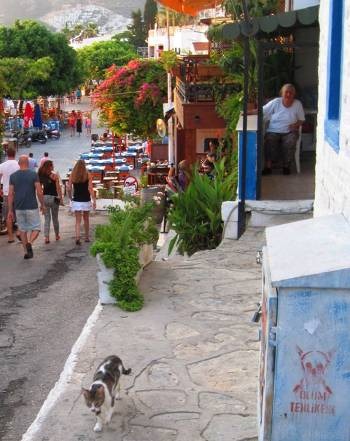
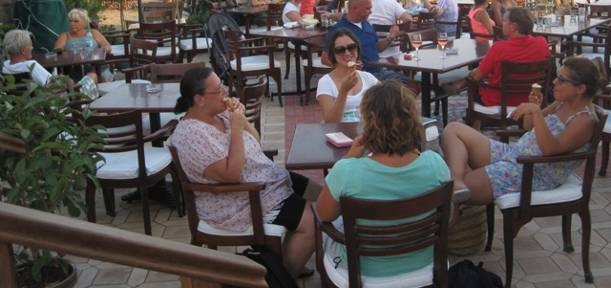
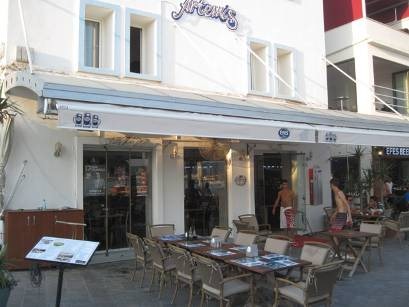
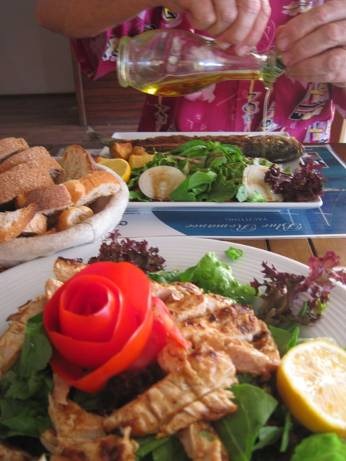
An “American” Story

Merhaba

     As we travel we’ve been asked about "American Food."  My answer is that the U. S. has food from everywhere because there are people from everywhere and this story from my sister tells that story.  My sister sent me this about her travels just down the road from Roanoke to Hagerstown, Maryland.  She calls it a "Ruthie Story" because what happened is the kind of thing we’ve experienced in our travels.  But it shows that "home" really isn’t always so different from "far away."

Ru

By Harriet – A Ruthie Story

All summer we had been cat-sitting for Andrew’s two cats, Q-tip and Addidas. Andrew was spending eight weeks in Germany and Kathryn was traveling and working and studying, so the cats came to stay with us.  (Andrew is my nephew and Kathryn is his best friend.)

Last week Andrew got back to Philadelphia and now Q & A needed to go home… Rather than us drive all the way to Philly, or Andrew and Kathryn drive to Salem, we decided to meet in Hagerstown, MD. That is sort-of half-way for both of us. I Bing-ed “Restaurants in Hagerstown” and decided on Laila’s Kitchen. They had a very interesting menu with both meat and veggie options that worked for all of us. To see all the menu choices check their web site: www.lailaskitchen.com

Anyway, for some reason, on Saturday I decided to call and make sure the restaurant was still where the web information said it was… you just never know… When I looked for their phone number I found that they were closed on Sunday… not good… I decided to call and ask the folks there if they knew of another restaurant near their location that was open on Sunday.

After speaking with the owner, he told me that there were no places to eat anywhere close, but since we were coming from a long distance, and he lived only three miles away, he and his wife would come and open the restaurant for us and asked what items we would like to try. I said everything they had sounded wonderful and we would especially like the veggies. He said he would prepare several items but apologized that he could not promise any of the lamb dishes. I tried to talk him out of doing all this, but he insisted and said he had done it occasionally for other people. So I said thank-you  and agreed to be there at noon.

Finding Laila’s Kitchen from the exit off I-81 was easy. Because it was Sunday there was plenty of space for Andrew, Kathryn and us to park right in front of the restaurant.

 clip_image001

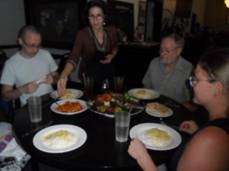
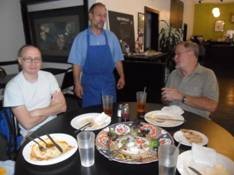
It felt a bit strange to be the only customers

clip_image002

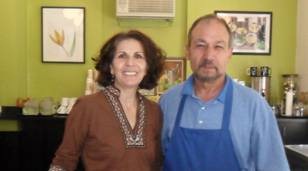
but Sharif and Laila Basharyar made us feel right at home. 

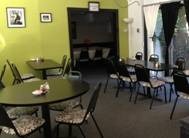
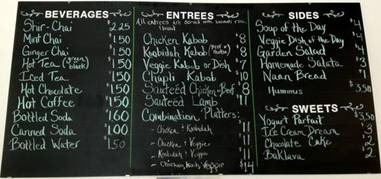
Although the menu had many choices

 clip_image003

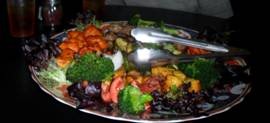
we were served “family style” starting with a wonderful salad that included peaches (I never think to put fruit in a salad, but it was very good.) The dressing was a little tangy and very tasty.

Next was mixed white and yellow basmati rice, pita bread and a platter of chicken, beef and veggies (tomatoes, onions, broccoli and zucchini.) Also there was cauliflower with a spicy sauce.

 clip_image004

Andrew Laila, Har’s husband Jim, and Kathryn

clip_image005

The menu items reflect their Afghanistan culture and it was all wonderful.

We ate everything; there was not a drop left!

clip_image006

(Check the web site for more information and a much better description of the items than what I wrote here.)

I really hope we will be able to go back and have another lunch at Laila’s kitchen – but we will plan that for one of their regular working days.

 clip_image007

Laila and Sharif

Bodrum finale: I love my Kindle and the quiet of the Turkish hills.

Merhaba,

   We are now back from Bodrum after a long, full, 24 hour passage.  We were put back in the water at 11 am Monday morning.  But had we started out then for Marmaris we would have arrived about 11pm, too late to do anything but anchor out and wait until morning to enter the marina.  Instead we dropped anchor in Bodrum and waited around.  But that was just too hot and boring so we pulled up anchor and hoped for slow speeds that would get us to Marmaris about 8 am.  No such luck.  Even with the throttle cut back we zoomed along at over 7 knots.  By 8 pm we knew our plan wasn’t working so well so we found a bay that looked somewhat sheltered from the 24 knot winds and we went in and dropped anchor.  We would wait there and rest for 4 hours, pull up anchor at 1 am and head for Marmaris planning to be there about 8 am when the marina staff would help us into a berth and before the wind would pick up.  We’d had our anchor drag back in Bodrum and then again the first try in this bay.  So though we really were good and stuck the second attempt, we took turn standing watch to make sure we didn’t drift back into the island behind us.  Randal took the first watch from 9 until 11 and then I watched until 1 am when we pulled up anchor and were on our way.  The thing about standing watch at anchor is that I could read so it wasn’t so boring.  When we’re moving there is too much movement to read and too much to watch so reading isn’t such a good idea.  I know people who listen to audio books or can read, but we haven’t had smooth enough crossings of late to make reading possible.  I do read during the day unless we’re really rolling and then even I get queasy looking at print.  As it happened, beware of what you wish for…those earlier wishes for slower speed caught up with us when we didn’t want them, the wind increased and we bounced our way towards Marmaris averaging less than 5 knots for too many hours.  There was a full moon so that was nice and by sunrise, my watch was from 4 am to 7 am, I was wide awake enough to let Randal sleep until 9 am.  We finally arrived in Marmaris Bay and though it was still windy, the bay helped as did the marina walls so we got into our berth without incident with the help of the marinaros.  Marinaros are the men in the small, powerful dinghies who lead you to a berth, push the bow and stern around with their dinghy, hold you in place and then handle your lines on shore and hook you up to the bow line.  Good guys. 

Ru

     Randal, from a habit developed during his Roanoke Wreck Repair days, always gets to work before the “workers.” Our cruising lifestyle hasn’t changed that. So every morning we left our pension room by 7:30, an hour before the traditional Turkish breakfast was served. When we got to the boat yard I made our traditional breakfast. Randal eats Raisin Bran with skim milk and sliced banana and I have oatmeal with yogurt; just as we do where ever we are. Randal turns on his computer first thing. After I get our breakfast, I check email and baseball scores. Not a good year to be checking baseball scores if you are a Red Sox fan. After that I would go for a walk in the hills behind the boat yard. I could have taken a dolmus into town, or even walked for that matter as it was just a little over 2 miles. The point of being in Bodrum is to be in town seeing the sites or shopping, laying out at the beach or buying a ticket for one of the charter boats that cruise around the bays. At least that’s the point if you’re in Bodrum on “vacation.” And though Randal and I are on one long permanent vacation, we had work to do. Randal “supervised” and at times lent a hand to DoraMac’s bottom job and I had a load of hand wash to do every day along with the few dishes we would use. Cleaning the inside of the boat was pointless as particles from the sanding process and just general dust was inescapable as all of the portholes, hatches and doors had to remain open or the temperature in the boat would have been well over 100. Yat Lift had great wifi! I was able to research my blog mails and also download a bunch of books to my Kindle. My sister forwarded me Amazon deals and other suggestions. Lots of choices for less than $4.00 per title and most are actually free which makes you wonder about who makes money from books these days. I can also borrow books for free from my library at home and have done so in the past. Unfortunately my taste in books doesn’t seem to match what’s available to libraries electronically as some publishers won’t allow libraries the use of electronic titles. Too bad; hopefully that will change. But from a reluctant Kindle user, I am now quite the fan or the media and am almost as happy reading from my Kindle as from a paper book. My Kindle is the middle model so does pictures, but not really well which is too bad but okay for now. I still am looking forward to our time at home when I can borrow tons of books from the Roanoke Valley Libraries. Nothing electronic will ever replace libraries and librarians. And you can take that comment to the bank. As for the Red Sox….one can only hope.

This email is some last photos of our visit to Bodrum……..

clip_image001

Laundry facilities….

I am spoiled by having a washing machine on DoraMac. For most of our cruising friends, hand washing and local laundry facilities, are part of their cruising life. The problem isn’t even washing. Rinsing takes tons of water and then wringing is about impossible. I remember watching the women in Cochin, India slap their laundry on a huge wood stump. Probably works as well as a washing machine. And maybe gets some of the water out too, but nothing beats the spin cycle on our tiny washing machine. It may not clean so great, but it does spin really well. As it was truly hot, and the sun beat down all day, even Randal’s cut off jeans shorts, hung up dripping wet mid-morning were dry by late afternoon.

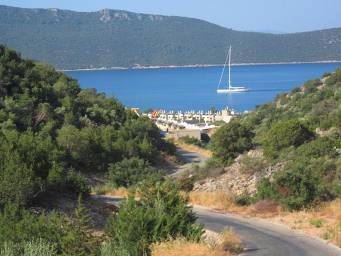
My daily walk

clip_image002

Funny what perspective will do.

The sailboat looks 10 time larger than the resort buildings and it looks as if the sea is higher than the roof tops.

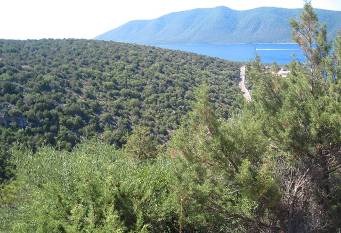
One day I hiked to the end of that road off in the distance.

clip_image003

Not so far as it looks; but all up and down hill.

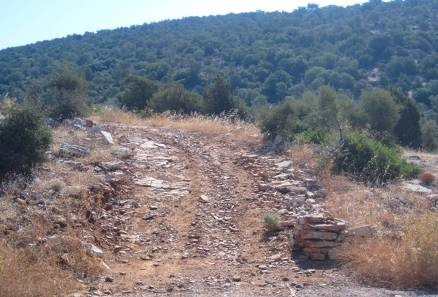
clip_image004

My sitting place on the rocks at the foot of this hillside driveway.

It would take me about 30 minutes to walk here but then I would continue past and down the next hill until time or tiredness made me return back here to “my spot.” It was quiet enough to hear the breezes. There were crickets, distant bells, and only the noise that comes when industry is far away. Up the driveway were two domestic buildings, one a home. Often there was a car, but I never saw any people. One day I saw a horse. I could have sat there for hours, but there was work to be done on the boat. And though I could sit and stare into space for hours in elementary school, now I don’t have the patience. Or the imagination perhaps.

clip_image005

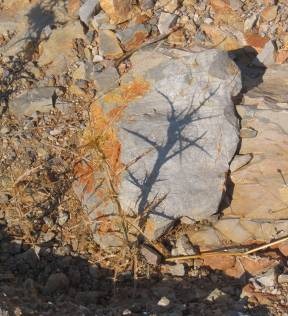
Even this shadow could prick your finger.

In town……

clip_image006

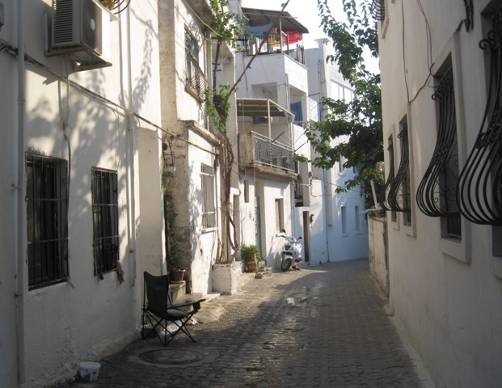
I also loved the evening quiet on our street.

clip_image007 clip_image008

If life always looked like this it would be okay with me.

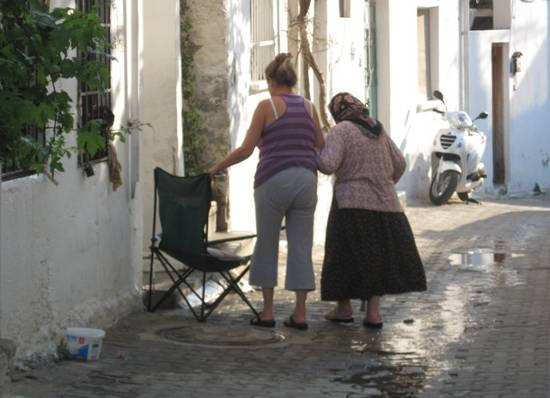
Ladies of Akasya Sokak, Kumbaçhe Mah (Our street in Bodrum.)

clip_image009

Babies to the “ancient” lived together in the neighborhood.

clip_image010

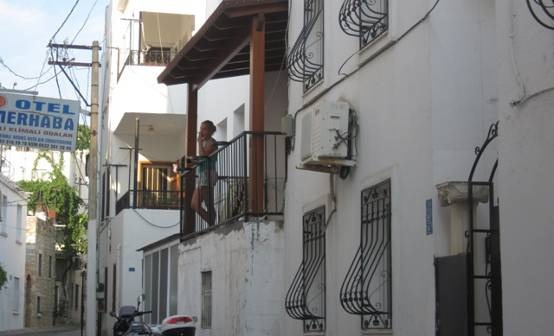
A “smoke” out on the balcony.

And on Restaurant Row…..

clip_image011

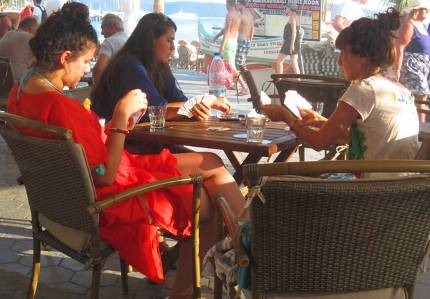
Spying on the tourists.. . Ladies who eat ice cream, smile. Ladies who play cards and smoke cigarettes, are very serious.

We ate dinner at the same window table in the same restaurant every night (except for one time, because we’d had a huge late lunch at the yard, we had PB and J in our room.) Randal ordered the grilled sea bass every night. People staying in the hotel would sit in the tables outside oblivious to our people watching them. I started to recognize some of them as each night we saw them come from the beach to retrieve their room keys.

clip_image012 clip_image013

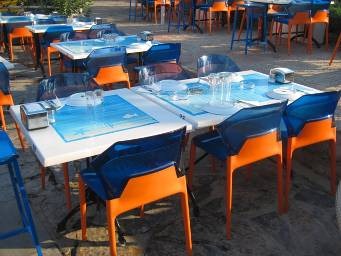
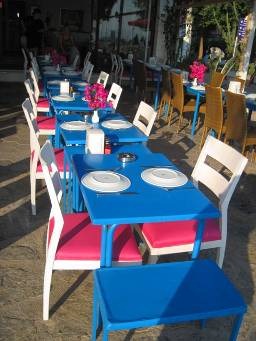
Who would have thought orange plastic could look so good…and pink and blue.

clip_image014

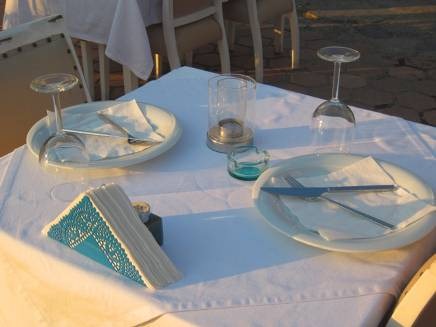
Perfect seaside dining.

(Our dinners were eaten indoors with AC and paper place mats advertising something I should remember, but don’t.)

clip_image015

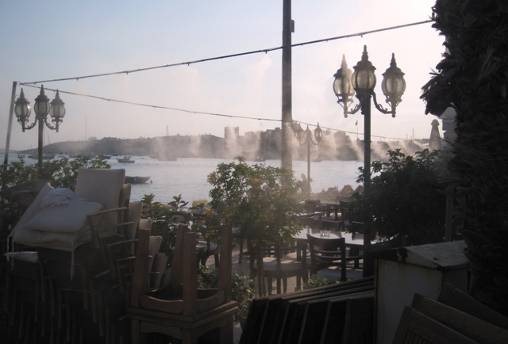
This cooling mist looks like fog. The Bodrum Castle is ghostlike in the distance.

clip_image016

Reading

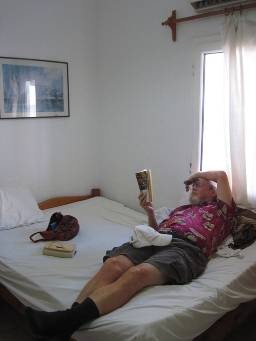
Most afternoons we’d head back to our pension room about 5 pm. We’d relax and read for about an hour or so. Then we would shower and go have dinner, walk a bit, return to our room and read. Happiness is having a good book to read…and a best friend to read next to you. Of course we did fight over the pillows. 

clip_image017

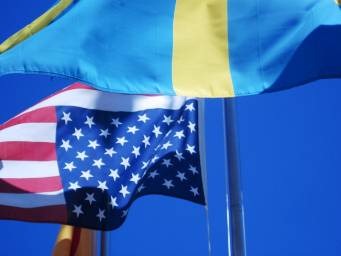
This photo is right side up: it was our flag that was upside down.

     Amazingly this was the “first upside down flag” we saw Sunday morning. Randal and I took Sunday to do some touring. We went off on our motorbike in search of the covered market. We passed a fairly large hotel and I noticed the flag was upside down so we U-turned and I went inside to tell them. While they were apologizing and explaining that a “technician” had been called to fix it, Randal was outside in the parking lot actually fixing the flag. Once a Marine, always a Marine. Later, in town, we passed a restaurant displaying small flags of several countries. Ours again was upside down! So Randal fixed that one too.

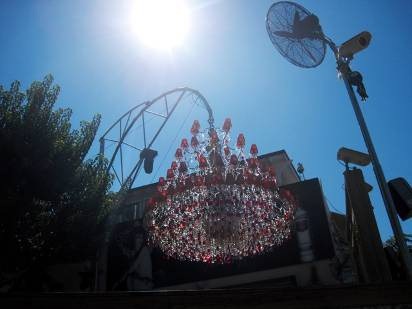
clip_image018

The giant chandelier that amazed me last year still amazes me.

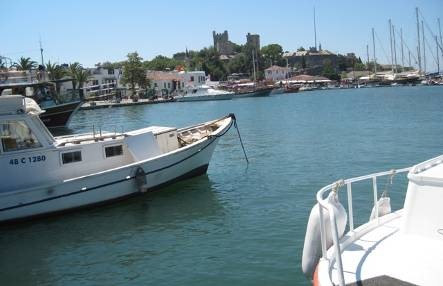
clip_image019

Bodrum Harbor with the Castle in the distance.

We tried to visit the Castle which houses a museum of underwater archaeology, but we got there at noon as it was closing for the lunch hour. It was just too hot to wait around so we put it on our “to do” list for the next time we visit Bodrum. We will be here for a year so there still might be a chance.

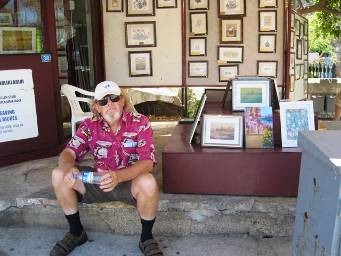
clip_image020

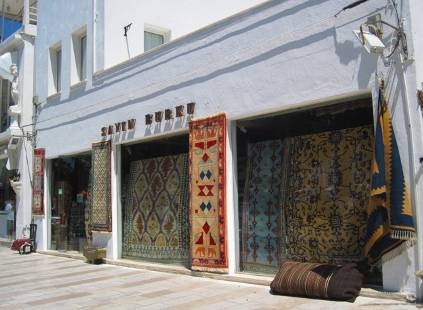
I couldn’t resist one of the tiny watercolors from this shop.

clip_image021

http://sayinburku.com/

Randal is still searching for that perfect (and perfectly priced) Turkish carpet.

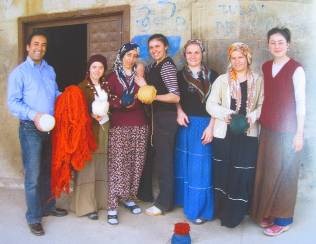
If you are interested in Turkish carpets, visit the website from this shop. Last time we visited we learned quite a bit and this time too as the owner Sayin Burku really tried to teach us about carpets. According to his website Bette Midler is one of his clients. So are several people with Sheik before their name.

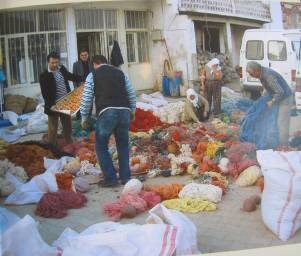
clip_image022 clip_image023

These photos of Sayin Burku and his weavers are from the booklet he gave us. Lots more photos are on his website.

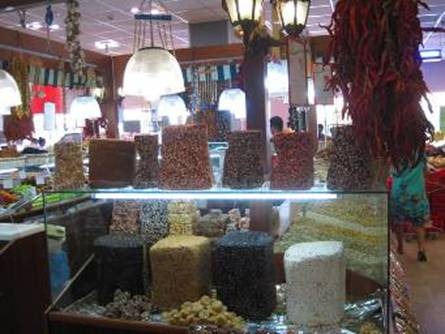
clip_image024

A scene from a Carfour Express in Bodrum where we stopped for less exotic staples such as cucumber and tomatoes for our passage back to Marmaris.

clip_image025

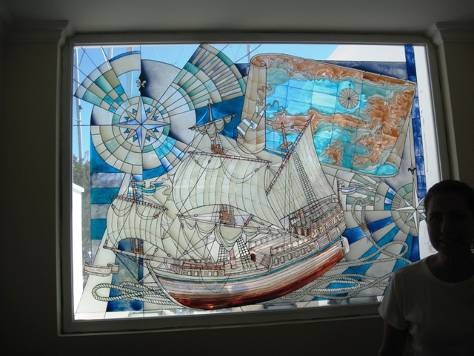
The beautiful painted window in the Yat Lift office and in shadow, Nurten.

Nurten worked in the office. She spoke English to us, French to the French cruisers, Turkish to the local workers and who knows what other languages. Very impressive, woman and window.

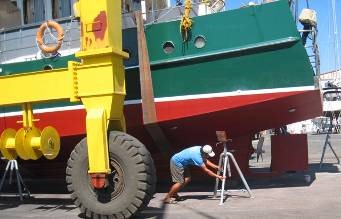
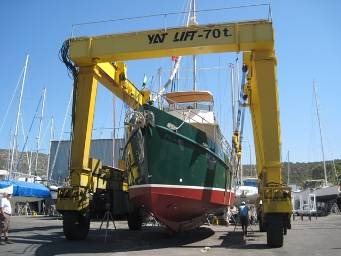
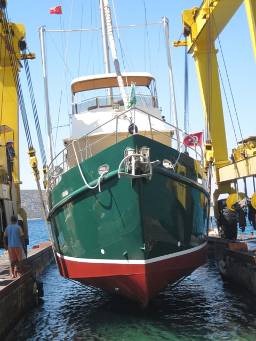
Photos of us going back into the water. It would be easy to confuse the coming out with the going in except for the beautiful bottom paint you can now see where before it was pretty grungy.

clip_image026

Once the lift straps were in place, removing the tiny stands that look too impossibly small to hold up a 34 ton boat. But those straps look pretty puny too, except in real live they are rather larger looking. The stands look as puny in real life as they do in the photo.

clip_image027 clip_image028

Rolling back to the travel lift slip and being lowered back into the water. Randal then had to reattach our front sail. When that was finished, the men threw us our lines and off we went…to drop our anchor and wait. We’d asked to be put into the water later, but 11 am was the only time their schedule would allow for it. So that was that.

The End.

Four Synagogues in the Jewish Quarter of the Old City of Jerusalem

Merhaba/Shalom,

   I thought I’d never get this email finished.  I certainly wish I had a library handy to make research easier.  This email goes on forever, and it’s about one small part of the Old City of Jerusalem.  But I found it fascinating.  It was quiet and away from all the hustle and bustle.  I wish I’d had more time.  Wish I’d taken the time to pay more attention to the handout while I was there so I would have better photos for you to match what you read.  Oh well, to quote my pal Joesephine, "done is better than good." 

Ru

I don’t know why I decided to visit the Four Synagogues. I almost didn’t because the door looked closed. And since I’m really non-observant, I almost feel as if I’m intruding. But the kind man working at the desk that day, covering for his friend who regularly sits there, made me feel welcomed. When I was confused about which synagogue was which, he walked with me matching the information from the hand-out to where I was actually standing. I don’t have his photo as he didn’t want to pose. He was, after all just covering for his friend. Of course what made sense while he was showing me made no sense when I started writing this email. I hope I have them correct.

“According to the Talmud, as Rabbi Yochanan ben Zakkai was coming out of Jerusalem after the destruction of the Temple, he stated, "…be not grieved, for we have another means of atonement which is as effective, and that is the practice of loving-kindness, as it is said, For I desire goodness, not sacrifice (Hos. 6:6)".The basic philosophy of Judaism in all of its forms today can be traced back to this one great Rabbi.” http://www.jpost.com/Travel/AroundIsrael/Article.aspx?id=252353

Here is a map of the 4 Synagogues that I stoel from the website you see near it…in case it disappears when I send the email.

clip_image001 http://www.jewish-quarter.org.il/atar-bksf.asp

This website has lots of good info about the Jewish Quarter of Jerusalem.

I went to the pink one first (Yokhanan ben Zakai); the orange one second (Emtza’I Middle Synagogue); the darker blue third (Istambuli); and then the greenish one last (Eliahu Hanavi .) It wasn’t the order of the hand-out so I got a bit mixed up and looking at Wikipedia just made it worse. But I think I have it right now. One of the things my “tour guide” told me was that one of the synagogues was actually originally an Ashkenazi Synagogue. But I can’t prove that to myself, so I don’t know.

This is the handout I was given….and didn’t take the time to read thoroughly as it was long and I was tired and it was getting late. I have repeated the parts about each synagogue with the photos of that synagogue so you don’t have to scroll back and forth.

FOUR ANCIENT SYNAGOGUES – THE BEATING HEART OF THE SEPHARDI COMMUNITY IN JERUSALEM

It was in 1267 that Rabbi Moshe Ben-Nakhman (known as Nachmanides or by his initial, as the RaMBaN) arrived in Jerusalem from Gerona in Catalonia, Spain, to bring new life and organization to the city’s Jews. He quickly set up a synagogue in a “half-ruined house with marble pillars and a fine dome” (as he wrote to his son, Nakhman)and for centuries after it continued to serve all the city’s Jews, whatever community they owed allegiances to. Until that is, in 1586 the Turkish city governor (known as Abu Seifin) ordered it closed, on the pretext that a hundred years before the building had been sanctified as a mosque. Jerusalem’s Jews had no choice but to manage again as separate communities. The Sephardim built their new center to the south of the RaMBaN synagogue, at a spot where tradition say, in the time of the Second Temple, had stood the study house of no less then Rabban Yokhanan be-Zakai himself, the renowned tanna (scholar-judge) who took over leadership of the people after the Temple’s destruction and the uprooting of the Sanhedrin from Jerusalem to Yavneh.

The need to build new synagogues coincided with a marked growth in the numbers of Jews in the city, for the rulers of the Ottoman empire allowed Jews who had settled in their territory after the expulsion from Spain (1492) to move freely within the empire and when the Ottomans captured Jerusalem in December, 1516, a steady influx of their Jews into the city had begun. However, under the prohibitions decreed by Islam, no “infidel” prayer house could stand higher than a neighboring Muslim holy place. Jews got round the difficulty by starting their synagogues’ ground floors 3 meters below street level, adorning the necessity by quoting Psalm 130, “Out of the depths, O Lord, I call you.”

By the beginning of the 19th Century the four synagogues were derelict and tottering, with the rain dripping through holes and cracks. At last, in 1835, the Sephardi community’s notables succeeded in obtaining from the Governor of the Holy Land, Ibrahim Pasha (son of Muhammad Ali, the famous governor of Egypt who had conquered the land in 1831) a permit for the synagogues’ renovation and repair. The lay-out of the areas containing the four synagogues was at the same time reshaped to make it a single compound, which now encompassed- because of the different periods of synagogue construction – a uniquely rich variety of architectural styles and features.

This period of physical reconstruction also marked a turning point in the status of the Jewish community in Palestine-Eretz Yisrael. In 1840 the Ottoman authorities restored their direct rule over the land. In consequence of this and of other changes that had taken place (for instance, the great European powers had began asserting their interests by opening foreign consulates in Jerusalem), Istanbul made Jerusalem an independent Sanjaq (district), answering directly to Istanbul and not, as before, to the governor of Damascus, and as a result, the standing of the community and its notables underwent a very positive change. Jerusalem’s Chief Rabbi, a Sephardi, who had hitherto borne the traditional Jewish title of “First in Zion” (Rishon LeTzion) was now officially designated Hakham Bashi, that is, head of the Jerusalem Jewish community and all its rabbis, and as such enjoyed official status under the Ottoman system of government.

The four, now structurally linked, synagogues, together with their study houses and charitable institutions (Bet HaRashal, the Sephardi Talmud Torah (study house), the Tifferet Yerushalayim yeshiva, the widows’ alms-house) now made up the center of the Jerusalem Sephardi community’s spiritual and cultural life, a community which until the 1870s was by far the largest Jewish community in the city and the only one to enjoy official recognition by the authorities and the non-Jewish population throughout the whole period of Ottoman rule.

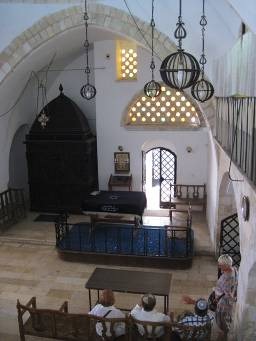
The Qahal Qadosh Gadol (Great Congregation) Rabban Yokhanan ben Zakai

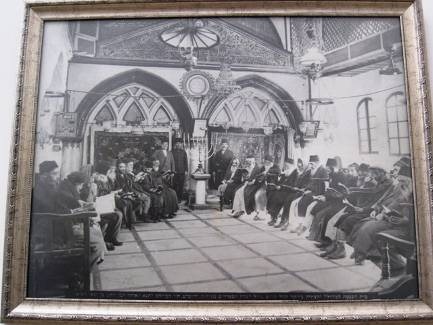
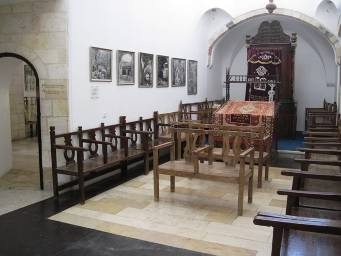
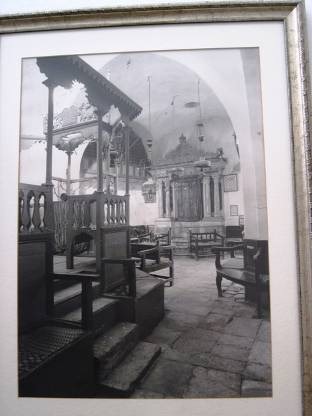
This synagogue, built in the late 16th – early 17th Centuries, held pride of place among the four synagogue, to the extent that the whole compound was sometimes called the Rabban Yokhanan ben Zakai compound. The synagogue, oriented west-east, had an elongated interior leading up to not one but two Holy Arks, both with Gothic-style fronts and symmetrically placed against the eastern wall. The high stone-built prayer dais (bima) in the center was also elongated, with a decorative wrought-iron railing on all four sides. It was in this synagogue that, from 1893 on, the Rishon LeTzion and Kakham Bashi, was ceremonially “enthroned” and where public meetings and assemblies were held and where important communal events such as the official ceremony in 1870 to welcome Emperor Franz Joseph of Austria-Hungary, took place.

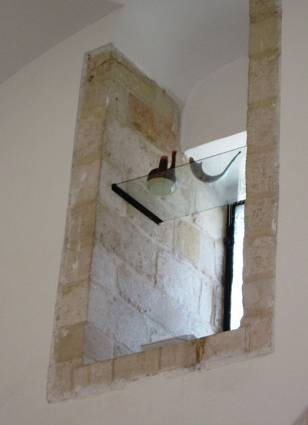
Until the destruction of 1948, the congregation cherished an old shofar (ram’s horn trumpet) and oil jug in a niche in one of the synagogue walls. Tradition whispered from generation to generation that with this very shofar the prophet Elijah would announce the coming of the Messiah and with oil poured from this ancient juglet the Messiah would be anointed.

The Eliahu HaNavi Talmud Torah Congregation

Expert opinion is that this synagogue (it also served as a study house) was the first of the four built. The ceiling of the main prayer hall was domed in the Turkish style and its large stone prayer dais was railed and furnished in wood. In the north-west corner is a large alcove, from which steps lead down to “Elijah’s Cave”. There people came to place lighted oil lamps , each flame imploring the Prophet to make a special wish come true.

How did the synagogue come to be named after the great Elijah? Well, the time-honored story goes that the community of Jews in the city was once so small they could not even make up a minyan (the 10 men required for holding public prayer). This was very distressing to the 9 available men, and even more so when the holiest day of the year, the Day of Atonement, arrived. There they were and the time had come to say the Kol Nidrei prayer that opens the Day, when an old man joined them and, wonderfully, made himself one of them. Then, with the day’s closing prayer, he vanished. Only then did the 9 realize that the Prophet Elijah, himself no less, had made himself one of them. To commemorate the miracle they added the name of the Prophet to the name of the synagogue.

The Istanbuli Synagogue

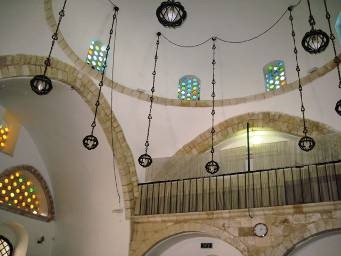
This synagogue is both the largest and last to be built, having been constructed in the 1760s by immigrants from Istanbul; hence its name. Its windows are very distinctive, being large and deeply recessed in the thick walls, each one made up of three long vertical panes surmounted by a single, wide horizontal one. Flanking the Holy Ark stood two Corinthian columns carved around with arabesques. Like the other four synagogues, it had a high prayer dais. The Istanbuli also had a geniza, a space or chamber where books of scripture, too worn or damaged for use but too holy to be thrown out or destroyed, were stored. Every so often the geniza was emptied and the old books and scrolls carried in public procession to be reverently buried in a cave in the ancient Sambuski Sephardi cemetery at the foot of Mount Zion.

The Emtza’I (Middle) Synagogue Zion Congregation

This is the smallest of the four synagogues called the “middle” one for the simple reason that it was built on a plot of land between the other three, a plot which apparently had, till then, been an outside courtyard of the Rabban Yokhanan ben Zakai Synagogue, accommodating its women’s enclosure. The origin of the synagogue’s official name, Zion Congregation, goes back to a tradition that an underground passage once connected the synagogue to the grave-site of the kings of the House of David. Like the Rabban Yokhanan ben Zakai synagogue, it has an elongated interior and a groin-vaulted ceiling.

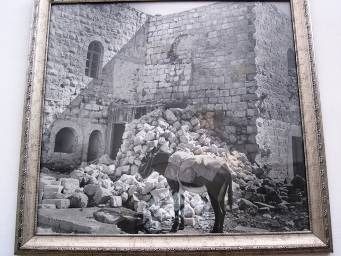
During Israel’s War of Independence (1947-48), all four synagogues provided shelter to the inhabitants of the Old City’s Jewish Quarter, and with the fall of the Old City, it was from them that the Quarter’s defenders filed out to captivity in Jordan. All four were then devastated: they were plundered, burnt and the skeletal remains used as stalls for horses, goats and sheep.

On the liberation of the Old City in 1967 Six Day War, the four synagogues were found in the ruinous state described earlier, and piled high with rubble and manure. But to our great fortune at least the outer walls stood intact. The Council of Sephardi Communities and the Jerusalem Fund, with assistance from the Israeli government, the Yad Avei HaYishuv organization and donations from other funds and individuals in Israel and around the world, took on the task of restoration. It was not until the hundreds of tons of accumulated refuse had been removed and the basic structure of walls and roof repaired and rebuilt, that it was possible to restore the structures to their former, beauty and glory.

The National Parks Authority had charge of the work, with practical direction in the hands of the architect, Dan Tannai, whose first concern at all times was to restore the original lay-out and reconstruct each synagogue’s outstanding former characteristics and features. Before the destruction, the splendor of the buildings had been their interior furnishings, especially the prayer dais and Holy Arks. Antique dais, arks and lamps were now brought from Spain and Italy and their dimensions precisely altered to fit the new settings. Item by item, the atmosphere and appearance of the synagogues of that past age was recreated.

Finally, in the intermediate days of Succot, 1972, all four synagogues were re-inaugurated and rededicated in a solemn and moving ceremony, attended by the State’s leaders and high officials.

Text by Dania Haim

http://tourguides0607.blogspot.com/2011_09_01_archive.html

clip_image002 clip_image003

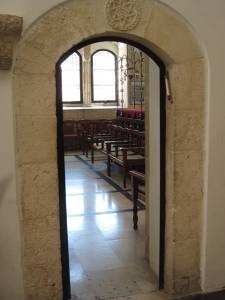
Walking down the steps below street level to enter the Four Synagogues

clip_image004 clip_image005

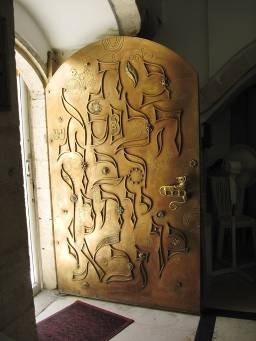
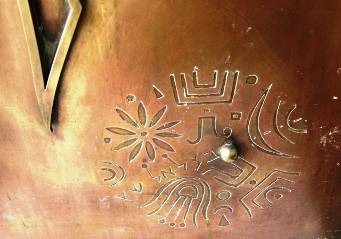
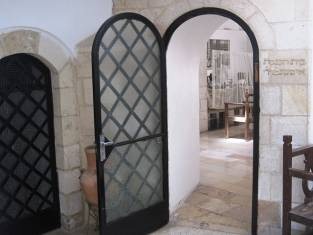
The beautiful door and the artist’s signature in the lower right corner.

Qahal Qadosh Gadol (Great Congregation) Rabban Yokhanan ben Zakai

clip_image006

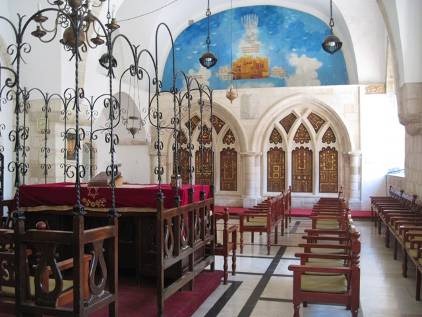
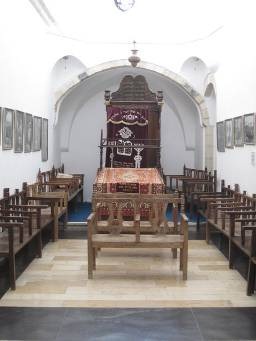
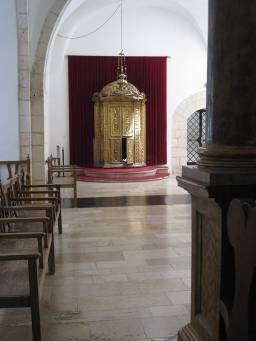
Two Holy Arks, an unusual feature in synagogues.

http://webcache.googleusercontent.com

clip_image007

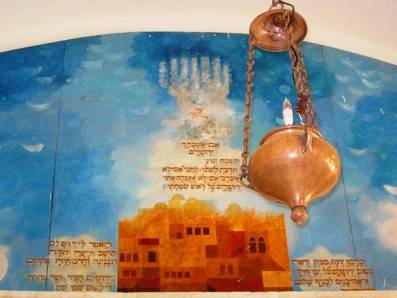
“Have a seat between the bemah (stage) and the arks at the fore of the synagogue. Notice that the bemah is in the center as is the tradition of the Spanish Jews. They believe that when the Torah is read the people of Israel should surround it and it should be held above us, in the midst of the nation. Notice the heavenly painting above the arks. The Sephardic community that returned to the Land of Israel after the Inquisition were Kabbalistic scholars and the art here represents the idea that the universe is made up of spheres, and the gap between the spheres hovered over Jerusalem. Look at the window on the south above you. There is a glass shelf with a shofar (ram’s horn) and a jug of olive oil. The tradition holds that when the Messiah comes he will be announced by the Prophet Elijah from this synagogue and this shofar and anointed king using this olive oil. It was said before 1948 that these vessels were holy and only a righteous person who had immersed himself in a mikveh (Jewish ritual bath) could touch these vessels. About fifteen years ago the synagogue’s caretaker told me that as a soldier during the Six Day War, when he entered this synagogue, which he had remembered visiting as a child, he stumbled upon a young Arab shepherd eating humus, sitting on the floor. He asked him where the jug of olive oil was and the shepherd replied that he had used it all up in his hummus! To this day I couldn’t tell if the caretaker was messing with me or not. These vessels are replicas of the originals.

clip_image008

The painting over the Ark.

clip_image009

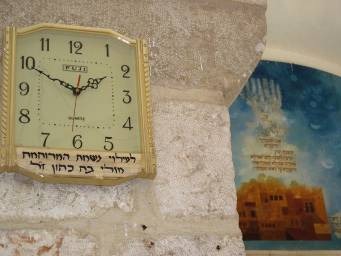
What time I visited the Four Synagogues

clip_image010

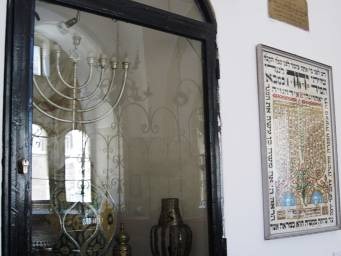
Judaicia showcased in the Synagogue

clip_image011 clip_image012

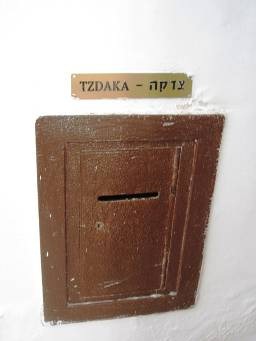
Shofar and Oil Jug On one wall Tzdaka, Donations for the Poor

“Perhaps Yohannan ben Zakkai’s greatest contribution to the Jewish people lies in the Talmudic story of the destruction of the Temple. The Jewish War was raging in the year 69 C.E. and the Jewish rebels had holed themselves up on the Temple Mount. The Romans were ravaging their way through the Land of Israel, and Jerusalem was all but lost. Vespasian and his Tenth Legion would surely breakthrough to the Temple courts at any day. Yohanan ben Zakkai did what no other rabbi dared to do. In defiance of the rebels orders he knew that he must get off the Temple Mount with his disciples in order to continue the study of Torah. He played dead and his students wrapped him in a burial shroud and smuggled him out of the Temple complex, through a cemetery and straight to the camp of the Roman general Vespasian. Ben Zakkai was known to Vespasian as a man of great influence who had tried to discourage the war to no avail. He addressed Vespasian as "king" twice. As Nero was king, Vespasian believed the rabbi was just trying to butter him up, and he had Ben Zakkai locked up in the darkest of solitary confinement awaiting a death sentence. Three days later the news arrived that Nero was dead and Vespasian had indeed become king. Vespasian as a reward for his prophecy would grant the rabbi any wish. His wish was to allow the other great rabbis on the Temple Mount to join him and his disciples in Yavne, and to set up a yeshiva to keep the flame of Torah study alive, and with that he changed Judaism forever.”

Joe Yudin became a licensed tour guide in 1999. He completed his Master’s degree at the University of Haifa in the Land of Israel Studies and is currently studying toward a PhD. Joe Yudin owns Touring Israel, a company that specializes in “Lifestyle” tours of Israel.

http://www.jpost.com/Travel/AroundIsrael/Article.aspx?id=252353

clip_image013

Doorway to “the Middle Synagogue”

clip_image014

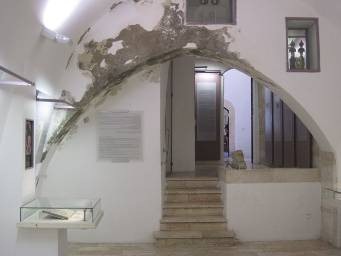
The Ruins of the Four Synagogues

clip_image015 clip_image016

Middle Synagogue

The Emtza’I (Middle) Synagogue Zion Congregation

This is the smallest of the four synagogues called the “middle” one for the simple reason that it was built on a plot of land between the other three, a plot which apparently had, till then, been an outside courtyard of the Rabban Yokhanan ben Zakai Synagogue, accommodating its women’s enclosure. The origin of the synagogue’s official name, Zion Congregation, goes back to a tradition that an underground passage once connected the synagogue to the grave-site of the kings of the House of David. Like the Rabban Yokhanan ben Zakai synagogue, it has an elongated interior and a groin-vaulted ceiling.

clip_image017 clip_image018

clip_image019

Istambuli Synagogue

The Istanbuli Synagogue

This synagogue is both the largest and last to be built, having been constructed in the 1760s by immigrants from Istanbul; hence its name. Its windows are very distinctive, being large and deeply recessed in the thick walls, each one made up of three long vertical panes surmounted by a single, wide horizontal one. Flanking the Holy Ark stood two Corinthian columns carved around with arabesques. Like the other four synagogues, it had a high prayer dais. The Istanbuli also had a geniza, a space or chamber where books of scripture, too worn or damaged for use but too holy to be thrown out or destroyed, were stored. Every so often the geniza was emptied and the old books and scrolls carried in public procession to be reverently buried in a cave in the ancient Sambuski Sephardi cemetery at the foot of Mount Zion.

clip_image020 clip_image021

About two hundred years after the first two synagogues in the

complex were built, Jews from Istanbul arrived in Jerusalem. This wealthy community

built a synagogue for itself, the lstambuli, alongside the two older synagogues.

When the Jewish Quarter fell in the 1948 War of Independence, all the synagogues

were vandalized. ‘With the reunification of the city in 1967, they were renovated as

part of the restoration of the Jewish Quarter. In the case of the lstambuli, the Holy

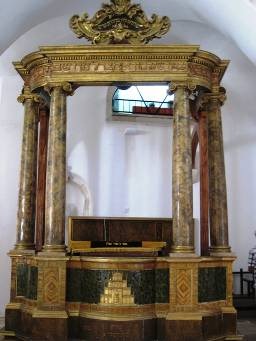
Ark you see was brought from a synagogue in Ancona, and the large “bima" or

podium from Pesaro, both in Italy.

http://webcache.googleusercontent.com

clip_image022

clip_image023

I think this is the geniza of the Istambuli Synagogue which now houses old Torahs and other documents and Judaica.

clip_image024

clip_image025

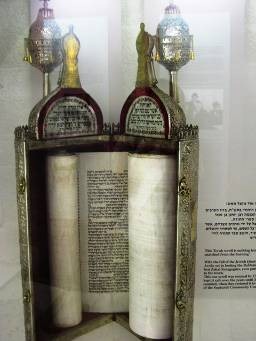
Sephardic Torah

“The Sephardim usually store Torah scrolls in a wooden box. The Torah scrolls in an Ashkenazi synagogue, in contrast, are typically covered by a mantle through the top of which protrude two staves known as atzei hayyim or "trees of life." Two finials or "rimmonim" are typically placed on top of these staves. Usually, a crown is incorporated into the design of the finials.”

http://www.collectionscanada.gc.ca/eppp-archive/100/200/301/ic/can_digital_collections/art_context/torah.htm Canada National Archives

clip_image026 clip_image027

The Eliahu HaNavi Talmud Torah Congregation

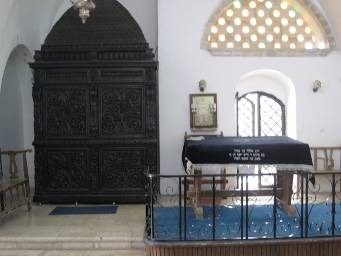
Expert opinion is that this synagogue (it also served as a study house) was the first of the four built. The ceiling of the main prayer hall was domed in the Turkish style and its large stone prayer dais was railed and furnished in wood. In the north-west corner is a large alcove, from which steps lead down to “Elijah’s Cave”. There people came to place lighted oil lamps , each flame imploring the Prophet to make a special wish come true.

How did the synagogue come to be named after the great Elijah? Well, the time-honored story goes that the community of Jews in the city was once so small they could not even make up a minyan (the 10 men required for holding public prayer). This was very distressing to the 9 available men, and even more so when the holiest day of the year, the Day of Atonement, arrived. There they were and the time had come to say the Kol Nidrei prayer that opens the Day, when an old man joined them and, wonderfully, made himself one of them. Then, with the day’s closing prayer, he vanished. Only then did the 9 realize that the Prophet Elijah, himself no less, had made himself one of them. To commemorate the miracle they added the name of the Prophet to the name of the synagogue.

clip_image028

Note the magnificent, carved-wood holy ark, brought from a synagogue in Padua, Italy, after the Second World War. http://webcache.googleusercontent.com

Just some photos of Bodrum

Merhaba,

  So here are just some photos; no research needed so it was quick and painless.

Ru

More Bodrum Photos

clip_image001

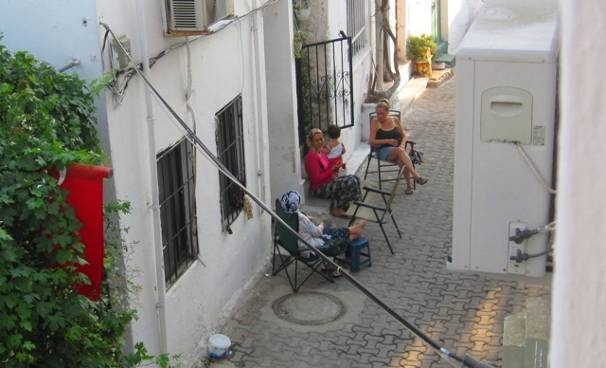
From our room window: Women sitting, tatting, knitting and talking….enjoying the evening .

clip_image002

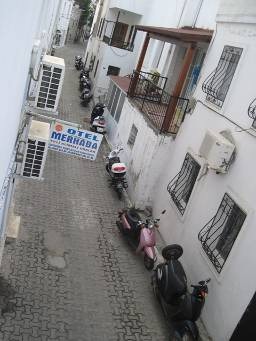
A cock-eyed photo from our window this morning….all of the motorbikes.

clip_image003

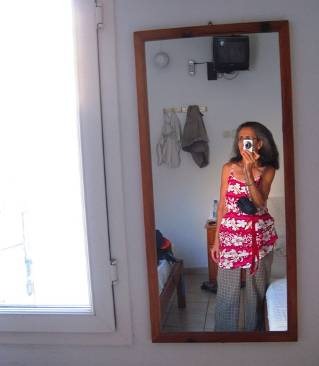
Self-portrait with camera.

I am wearing a dress/nightgown and flannel pants. I need the flannel for my sciatic leg and it really makes a difference as the AC really chills the room. You can see just how basic the room is with lots of hooks on the wall rather than closets or drawer space. But it’s just fine for our needs: a place to sleep that’s cool.

clip_image004

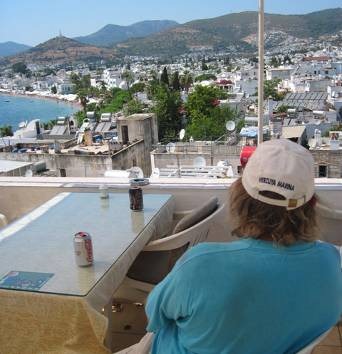
Roof top dining area with the wonderful view, but it’s really too hot to enjoy even by 4pm and we leave before they serve breakfast which starts at 8:30 am until 10:30 am. Most vacationers stay up late and get up late. We’re the odd ducks that get up early and go to sleep early.

Our routine is to get up and be on our way by 7 or 7:30 am so we can use the morning’s less hot temperatures for walking and working. Lunch is usually at the small restaurant at the yard. The food is very tasty and filling with huge portions for only 8TL. But I find it too heavy at lunch time so skipped it today and ate cucumber, tomato and cheese on the boat. Randal ate at the restaurant as he likes to get away from “work” for lunch. We usually leave the yard about 4ish. When we get to the Otel we dump our panniers and helmets and go up to get a cold drink. Then we rest in our air conditioned room until it’s time for dinner. We eat at a most uncivilized early time: usually before 7pm. Most people don’t eat until much later so they can eat on the beach after the sun has gone down. We eat inside with the air conditioning. They turn it on for us, now that we are regular customers. We’ve eaten in the same place twice and the same thing twice. Randal gets the grilled sea bass and I have a “big salad” with grilled chicken. The staff go out to the fish market and get the fish. We could get the fish ourselves and bring it to a restaurant, but we haven’t tried that yet. We’re usually back at the Otel by 8:15 and read for a while before going to sleep just as everyone is going out for dinner and the bars. Late at night, or maybe it’s very early morning I can hear the thrumming of drums from the bars, but it’s just background noise and not head-splitting noise.

clip_image005

Walking down to the beach from our Otel.

clip_image006

Ice cream time….these ladies are obviously enjoying their cones while the folks not eating ice cream seem decidedly less happy.

clip_image007

The restaurant where we eat, which is also a hotel.

While we eat they change their patio seating to beach seating for later in the evening.

clip_image008

My grilled chicken salad and Randal’s grilled fish: too many bones for me to want to mess with and I just really want the “big salad.” Quite tasty.

clip_image009

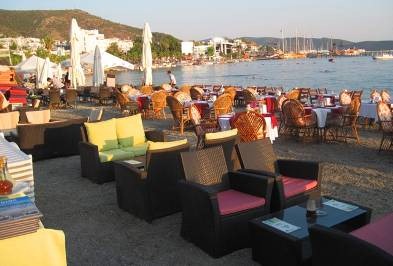
Lots of colorful seating along the beach: hopefully it fills up at night.

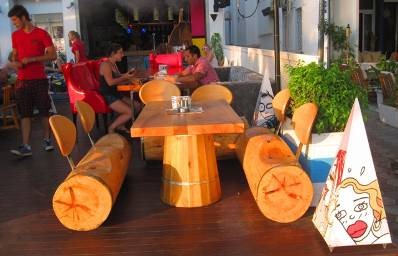
clip_image010

This was the most creative.

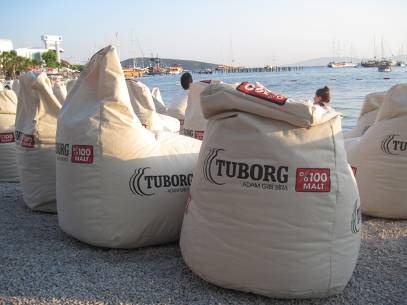
clip_image011

But these made me smile.

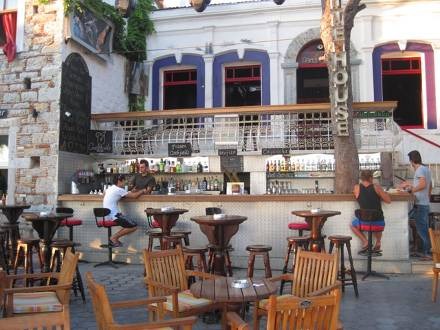
clip_image012

Bars are also a fixture along the beach.

clip_image013

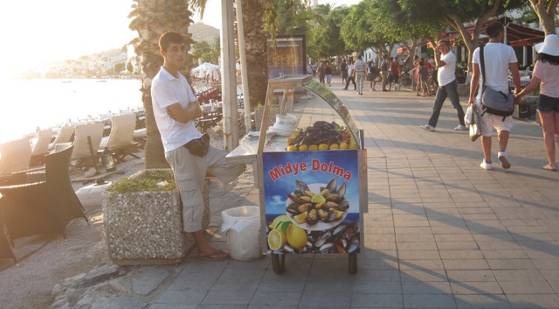
I wish I had the courage to buy some of these muscles, but one bad piece of shell fish and your doomed to hours in the loo.

clip_image014

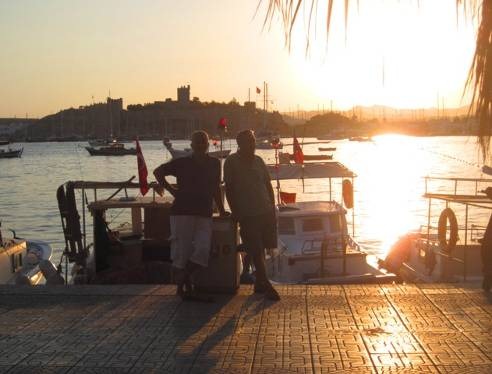
The sun blotted out all of the color but shows the shape of the Bodrum Castle which is now a museum and which we still have yet to visit.

clip_image015


clip_image016

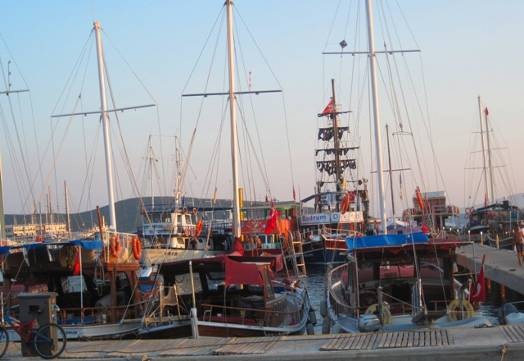
Docks chock a-block with boats waiting for passengers.

clip_image017

I couldn’t resist this photo…..we miss our bikes but the motorbike is so much more useful, especially in the heat.

clip_image018

The road where I take my morning walk.

This is the top of the hill; then the road goes down to the coast and another boat yard. Maybe I’ll go further on day. If Sharman were here were here we’d walk for hours in the hills as there are paths. But the road does for me by myself.

Jerusalem Stories

Merhaba,

   Randal and I were up and out of our pension room by 7:30 am.  We left our key with one of the managers as they want to move us to a smaller room.  That’s fine, we don’t need 4 beds.  We motorbiked the picturesque road along the coast back to the yard where Randal and I both have projects to do.  We ate our usual breakfast, as we do have power and water on the boat.  Then I was off for my morning walk up the hill behind the boat yard.  It really is quite lovely, to me.  Others might just think it barren and dull.  It was really quite hot so at the top I sat for a bit in the breeze, drank some water and then headed back down.  On my way down the hills, a man jogging with no hat, sun glasses or water passed me going up.  Crazy person. 

     My next "event" was laundry which involves working the upperbody, back and arm muscles as well as hands with all that wringing.  After that, because the yard wifi is so good, I searched Amazon for cheap books to download to my Kindle which also picked up the wifi.  At Netsel Marina the wifi is quite slow or non-existent so we use a 3G dongle.  But there is a fee to download books with 3G so I’m loading up here with the wifi…if that makes sense.  There is a library at Netsel and I did find a few books there, but most are thrillers that I really don’t read. 

   I really am enjoying working with the photos from Israel as I’m learning lots that I never knew.  I really can’t wait to sit with our friend Gabriel Szego and ask about a zillion questions.  It was Gabriel’s cousin Nilly and her husband Eitan who took us on our Golan Heights tour day.  Anyway, I do go off on tangents, but then finally have to just stop because if not, I’d never get an email sent. 

Ru

Tifereth Israel Synagogue, Alone on the Walls, and The Cardo

clip_image001 clip_image002

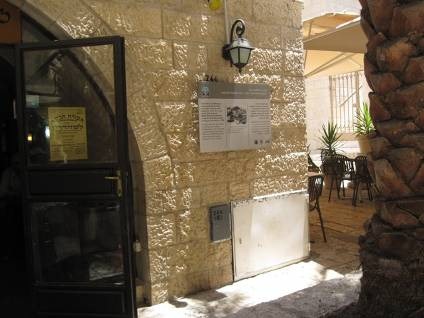
Reminders that people actually really live in Old Jerusalem: it’s not just a giant open air museum.

Growing up in New Bedford we belonged to the Tifereth Israel Synagogue. It was small and is still my idea of what a synagogue should look like: dark and not the least bit modern. I can’t remember if we were the last class confirmed in the old Synagogue or the first in the new one, just a few blocks from our home and across from Buttonwood Park. All I remember is Marsha Cohen’s slip starting to hang below her dress. I don’t remember learning anything particularly spiritual either preparing for my Bas Mitzvah or later Confirmation. Not much to show for years of Hebrew and Sunday School. “Education is wasted on the young,” they say. And whoever “they” are they’re right. At least in my case. Latin, Maths, geology, chemistry, so much just in one ear, on a test paper, and then gone. Thankfully I always loved to read, grew up, became a librarian and learned how to find answers to my questions. It’s the lost chance to know languages that I’m sorry about. …. The point being….I found a Tifereth Israel Synagogue ruin in Jerusalem I had to take photos and learn about it. Of course that’s just raising more questions about the different sects in Judaism. I grew up Conservative. There was an Orthodox Synagogue, Ahavath Achim whose Rabbi Weinberg started a day camp my sister and I went to and worked at for several summers. I think that’s the only place I really felt religion when the Rabbi would tell a different story Friday afternoons. We sang prayers before and after lunch. We sang the American National Anthem and then Hatikvah, Israel’s Anthem. Not sure if Camp Tikvah still exists. Ahavath Achim Synagogue closed in 2010. There is no reform synagogue. As for the different sects, I really know nothing about them.

clip_image003

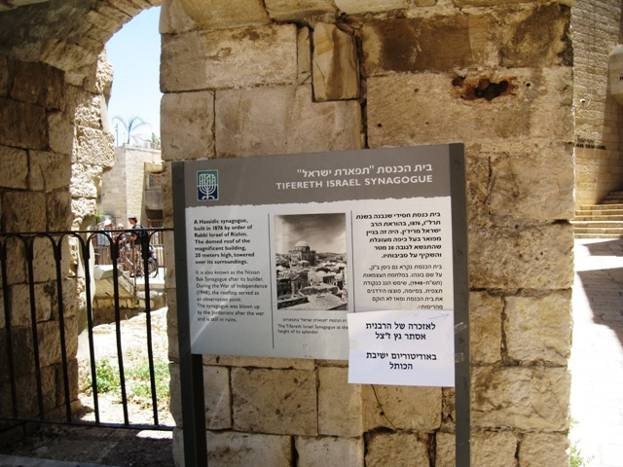
The Tifereth Yisrael synagogue is also known as the Nissan Beck synagogue, after its founder. It was called "Nishes Shul” by the Hassidim, which in Yiddish means Nissan’s synagogue. The name Tifereth Yisrael (Splendor of Israel) is in honor of Rabbi Israel Friedman, the Hassidic leader and founder of the Radzine Hassidic dynasty, who initiated the establishment of the synagogue and was the first donor of funds aimed at buying the land upon which it was built.

The first Ashkenazi Hassidim arrived in Israel towards the end of the 18th century, and settled in Tiberias. When the Pharisees returned to Jerusalem, The Hassidim became jealous and moved to Jerusalem as well.

It was Rabbi Friedman’s intention to establish a Hassidic synagogue in Jerusalem, and it was built simultaneously with the Hurva synagogue of the Pharisees. Construction began in 1882, and continued for ten years.

While the construction was ongoing, the Austrian Emperor Franz Josef visited Jerusalem, and asked why the synagogue had no dome. Nissan Beck replied: "The synagogue has taken off its hat to you, your highness." "How much will it cost me to have the synagogue replace its hat?" the emperor asked, and donated a substantial sum for the completion of the dome.

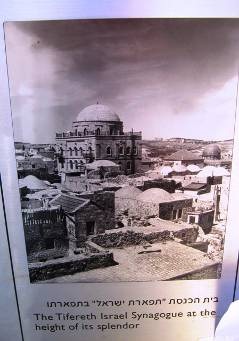
The synagogue was magnificent. It stood at a height of 20 meters, and its domed roof was one of the highest places in the Old City. It served as a community center for many of the Hassidim in the Jewish Quarter, and it had a Mikveh in its basement.

During Israel’s War of Independence, a vital military observation post was established on the synagogue’s roof. For this reason, there was a great deal of hand to hand fighting with the Arab Legion around the synagogue and in the immediate vicinity. Finally, the synagogue was captured and subsequently destroyed by the Arab Legion. The synagogue’s large dome and walls collapsed, covering the synagogue’s foundations.

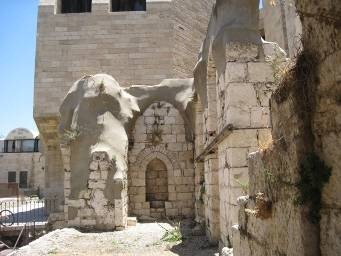
After the reunification of Jerusalem, the rubble and refuse were cleared, and the lower level and the entrance to the prayer hall, built to resemble the facade of a Galilean synagogue, were revealed. Today the site, with its ancient stones restored, serves as a monument to the synagogue’s magnificence.

http://www.jewish-quarter.org.il/atar-tfr.asp

http://www.jewfaq.org/movement.htm give an explanation of the different “sects” in Judaism.

• Movements are sects or denominations of Judaism

• The oldest movements were Pharisees, Sadducees, Essenes and Zealots

• Medieval movements included Karaites and Rabbinical Judaism

• Rabbinical Judaism split into Chasidic, Orthodox, Reform and Conservative in the US today

• Other countries have similar movements differently named

http://www.jewishvirtuallibrary.org offers a different interpretation proving that we see things from our modern perspectives making one “historical truth” pretty impossible.

clip_image004 clip_image005

Tifereth Israel with its dome then….and the ruins it is now.

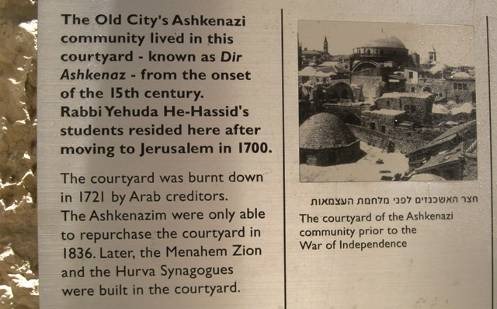
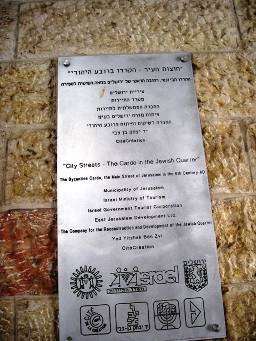
Lunch in an ancient courtyard: the plaque on the outer wall of the restaurant.

clip_image006

The Hurva Synagogue has been restored, but the tour was too late in the day for me.

clip_image007

It was about 1:30 when I ate lunch so was pretty tired and hungry. I ordered a “Tunisian” sandwich which is a tuna sandwich with vegetables and a sliced hard cooked egg. It came with lettuce and tomato and cucumber and it was way too much for me. There was a group of 6 Americans eating there also. One young man hadn’t ordered anything. He said he just ate everyone else’s left overs. I almost offered him mine but he’d already had several pieces of pizza and was claiming to be full. As a whole, they didn’t come across as a very appealing group, so I just left my left overs on my plate…and left.

clip_image008

I took this photo outside as none were allowed inside.

It was a small museum. A short film was shown during which those who had been part of the siege were interviewed. The walls were covered with the photos taken by John Philips.

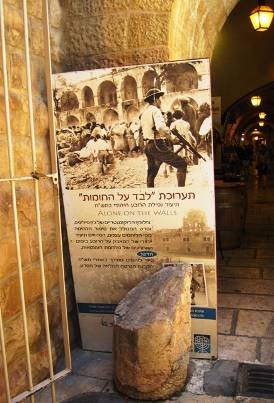
Alone on the Walls (Permanent Exhibit)

The permanent exhibit ‘Alone on the Walls’ was established to perpetuate the memory of the defenders of the Quarter, and of those who lost their lives defending it, during the War of Independence of 1948. Inaugurated in 1990, the exhibition illustrates the siege of Jerusalem and specifically the battles for the Quarter during the last 15 days of warfare. The Quarter was under siege from December 1947 – after the UN resolution for the partition of Palestine, which ended the British Mandate and enabled the creation of the State of Israel – until May 1948. The Jewish Quarter was partially besieged by the Arabs for 150 days, while the British were still in control. During that period many incidents occurred that demanded a heavy price in blood from the Quarter’s residents and defenders alike.

When the British withdrew in 1948, a regiment of the Arab Legion, assisted by a militia of 1500 troops from neighboring Arab countries, attacked the Jewish Quarter. The Quarter at the time was defended by 200 Haganah, Etzel and Lehi soldiers. The defenders fought house to house for 13 consecutive days until their strength, their numbers and their ammunition were depleted. By the 28th of May 1948, the area of the Quarter under their control was reduced to 20 dunams, in which resided 1600 helpless people. The defenders surrendered. 350 residents and defenders were taken into captivity, 1400 were expelled from their homes. 68 residents of the Quarter were killed during the six months of war: 39 defenders and 29 civilians. The exhibit displays a collection of photographs taken by John Philips, a photo-journalist who documented the fall of the Jewish Quarter in 1948. http://www.jewish-quarter.org.il/atar-acharon.asp

About the photo-journalist John Philips.

“John Philips, an American photojournalist, was sent to the Middle East in early 1948 as a correspondent for Life Magazine. On May 19, 1948, Philips joined the Arab Legion in their attack on the Jewish Quarter of the Old City of Jerusalem. Dressed in the Legionnaire’s uniform, he was free to move unhindered throughout the combat zone.

On the 10th day of fighting, Friday, May 28th, Philips’ camera captured the Fall of the Jewish Quarter, hour by hour. .” From the Alone on the Walls brochure

One last stop for this email, The Cardo

clip_image009 clip_image010

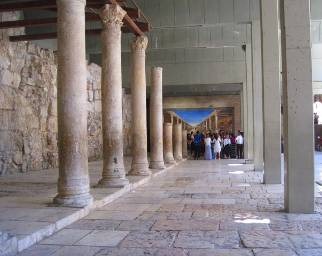
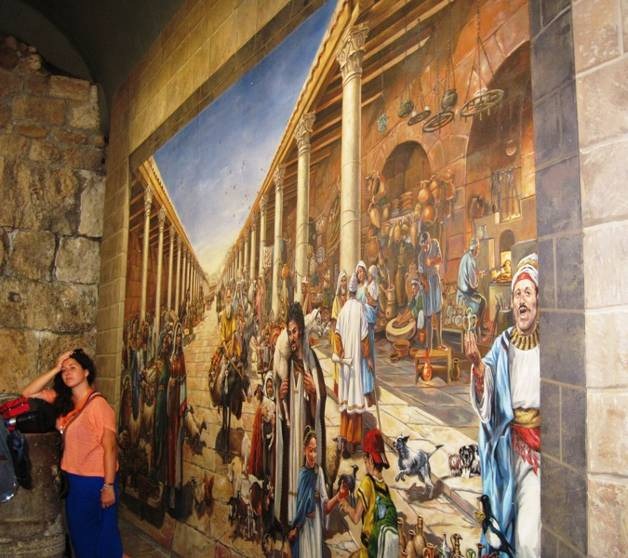
The Cardo was Jerusalem’s main street 1500 years ago. The Cardo was originally paved in the 2nd century when Hadrian rebuilt Jerusalem as a Roman polis called Aelia Capitolina. The Cardo was extended south to the area of today’s Jewish Quarter in the 6th century by the Byzantine Emperor Justinian. In its day, The Cardo was an exceptionally wide colonnaded street running through the heart (or cardo) of the city on a north-south axis, connecting many of Byzantine Jerusalem’s major institutions. Parallel rows of columns supported a red ceramic tile roof and an arcade ran along, at least part of its eastern side. http://www.israelinsideout.com

clip_image011

Can you find the pomegranate? (He has his red ball cap on front to back, and a backpack…or so it looks to me. There was a tour group, of which this tired woman was a member, that was blocking the painting so I didn’t get very close. This is a zoomed photo.)

“A section of Cardo has been reactivated as a shopping street, full of arts and various special goods. In part of the preserved Cardo, the French school of art Creation de la Cite installed a large painting of the Byzantine Cardo – look for the depiction of a Byzantine girl handing a pomegranate to a 21st century boy. “ http://www.israelinsideout.com/Things-to-do-in-Jerusalem/the-cardo-the-ancient-heart-of-jerusalem.html

I was pretty tired at that point too, but stopped off at the Four Synagogues and I’m really glad that I did. That will be next email about Israel.

In Bodrum

11:30 am

Merhaba,

  We’re here safe and sound.  We arrived about 8 M this morning and they were ready for us.  Conditions were blessedly calm when we arrived.  Last Sunday some friends had to wait a day for winds to abate before they could come in!  We had our 20 knots of wind during my second watch from 2am until 5 am with the wind on the nose so a bumpy ride. Our forward speed dropped from 6.9 knots to 3.9 knots, but luckily picked up so we averaged our 6 knots to get here when Randal had anticipated.   Because we were following the cost so had to go around points, each time I had to make a turn in our course there were boats coming the other way.  Crossing the Med from Israel to Turkey was in some ways easier than just going along the coast here.  Plenty more room and just your basic straight line.

   The folks here are professional so the lift out was smooth.  We are on our stands on the hard and Randal is out hosing the salt sea off the boat.  I’m in our shut up hot boat typing this before I pass out.  Or I’ll go stand in front of the frig.  Or try the trick Bill Kimley just emailed; wet a huge towel, lay it over myself, and turn on the fan.  He guarantees I’ll freeze.  I don’t even like fans when I’m dry.  Too noisy. 

  The yard has wifi but mine wouldn’t connect so I’m using our Turkcell dongle.  Hopefully some photos of our lift tomorrow.  The yard also has a small beach so maybe I’ll actually swim in the Med.

Ru

Update

Merhaba,

    Just a quick note to say we are off about 5 pm this evening for a night run to Yat Lift Boat Yard in Bodrum north west of Marmaris. We are going there as it wall cost far less there, than here at Netsel, and the work will be just as good. It will take about 13 hours to get there. We will be pulled from the water about 8:30 am Monday morning. We should be there about a week at the most. In the past we’ve lived “on the hard” while the bottom work was done. Not sure this time as it’s so hot that Randal isn’t sure we’d survive the nights without AC. Our AC circulates sea water through the unit to cool the freon, and on the hard, we have no sea water. There are some budget priced pensions in Bodrum that we might check after the boat is all settled in at the yard. It might not be as terribly hot as we think as Yat Lift is far enough from the city of Bodrum, and of course, right on the water. We rented a car and drove there last Monday with our friends from Blue Cotton, Sharman and Cliff, and it was quite hot, but that was mid-day. Here the nights cool off some. (Sharman and Cliff are in Marmaris for two months doing boat work and then will return to Karpaz Gate for the winter. We’ll miss them a lot!) This week we bought a Turkcell dongle 3G for Internet access at the Yard, so hopefully I’ll catch up on my last few Israel emails and post photos about Bodrum. We need a dongle here also because the wifi at Netsel isn’t very consistent; and often not there at all.

We really can’t wait to be here when the tourists and heat depart. It should be an entirely different story. Not that the tourists are a problem, there seem to be far fewer than last year when we were here. Just about every day a cruise ship pulls up and parks just across the dock from us (our temporary spot until we return from Bodrum.) It’s not noisy or a problem. They hardly generate waves. Even with that, the town seems rather empty. Our temporary berth is at the very far end of the marina which adds about 20 minutes more walking in the heat each time we go to town. It’s about a mile to the center of Marmaris Old Town which is usually our destination. That will be great in the cool, but in the heat, it’s really wilting and even Randal carries a bottle of water. But when we get our permanent spot, we will be nearer the town side of the marina where the liveaboards are. Now we’re on the dock with most of the charter boats or temporary boats.

So anyway: that’s what’s doing. Next time I promise photos.

Ru

Marmaris

Merhaba,

   Here are a few photos of Marmaris I took during a walk a few mornings ago.  We were here a year ago at this time so some photos may look familiar.  We really are looking forward to experiencing the winter here.  We WILL BRING SOME WINTER CLOTHES FROM HOME this visit.  We were told that sweaters would be enough for Cyprus, but we froze with lots of sweaters on.  But it’s so hot now, I’m thinking cold weather will be just fine.  Now I know the real reason Jews wish to be in Jerusalem: it’s cooler!

Ru

ps  I don’t think all of the charms in Turkey and Israel can help my poor TERRIBLE Red Sox.  Yuck!

Marmaris: Morning Walk along the Coast

clip_image001

Our first full day in Marmaris: our first lunch at Aciktim.

It was either Bill and Judy on BeBe or Linda and Michael on B’Sheret who told us about this small tuvuk doner place on the side street where tourists don’t go. That was last year in May during our first Turkey stay. Now, if we’re not eating lunch on the boat; we’re eating it at Aciktim.

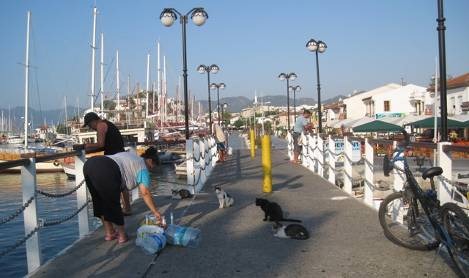
A walk along through the coast from the marina to the beaches and back to the marina.

clip_image002

Where there are fishermen, there are cats! But no crying kittens so we didn’t have to worry.

There are canals that run from Marmaris into the bay so foot bridges cross over to the city center. Not sure the source of the water.

clip_image003

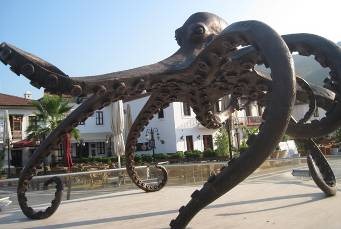
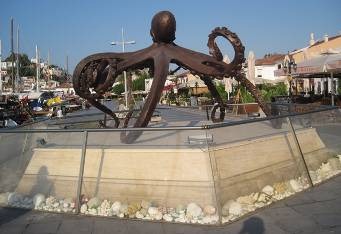
An octopus walking along the promenade?

clip_image004

I rather like this fellow.

clip_image005

I like this fellow too.

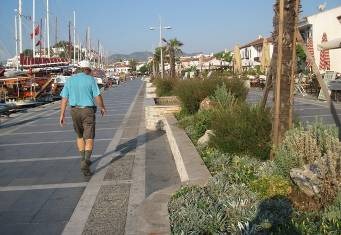
The promenade area is quite nice though with not shade, quite hot!

clip_image006

This fountain with its sculptures of playing children was unfinished our first visit.

clip_image007

The romance of sailing…lovely….until something goes wrong with the boat, weather, or the crew gets seasick. It’s always easy in the harbor.

clip_image008

Ataturk still stands guard at the harbor.

clip_image009

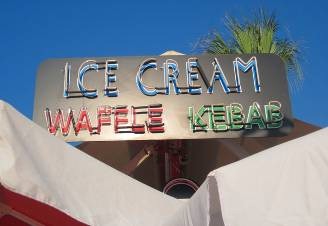
You know you’re not in Kansas when KEBAB is also a choice along with ICE CREAM and WAFFLES.

clip_image010

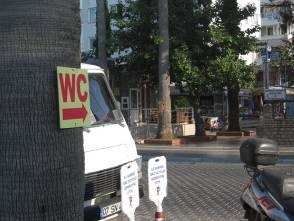
My goal is to know the location of every WC in Marmaris town.

clip_image011

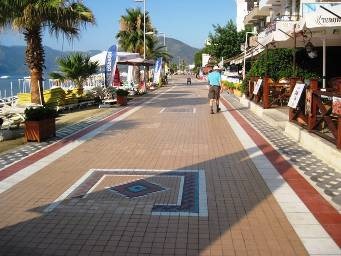
The coast promenade is lined with restaurants and hotels for miles and miles AND MILES; all the way to the next town.

clip_image012

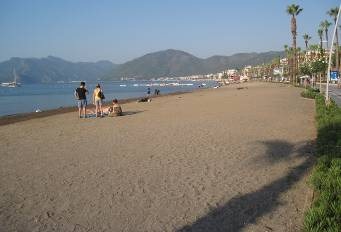
The beach was un-crowded at 8:45 am: (and not very crowded even at mid day a few days later.)

clip_image013

Normally Marmaris beach population jumps from 30,000 to 200,000 during the summer. But things seem much less crowded this year than last year. Not good for the local economy.

clip_image014

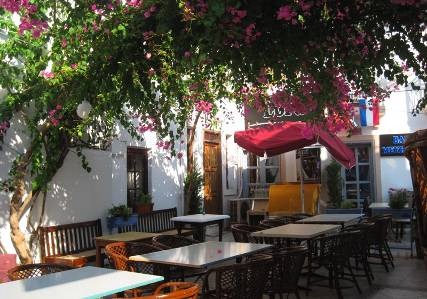
Walking back past the restaurants of old town; lovely, inviting, but empty.

clip_image015

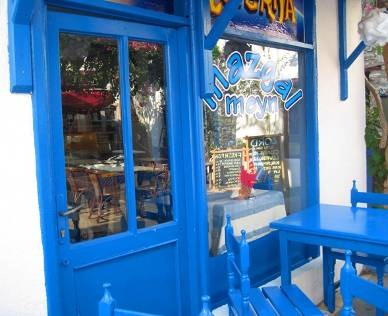
I love the pinks and blues… colors you see on Cape Cod and the New England Coast.

clip_image016

Mountains border Marmaris, hopefully good for hiking in the cool weather.

clip_image017

Small fishing boats line the canal.

clip_image018

Just outside Netsel marina is the Migros grocery store which carries pretty much everything we would need that we don’t get at the Thursday Market. It’s about a 10 minute walk from our boat.

Our friend Avi

Merhaba,

  I am trying to relearn the Turkish Denise tried so hard to teach me.  I’m not having to start from go on the vocabulary, but the grammar….hmm.  I did remember, out of the blue, what to say when someone sneezes.  Our friends, my walking buddy Sharman and her partner Cliff are at Yacht Marine down the road doing two months of boat work.  They will return to Cyprus mid August.  Tomorrow we are all driving to Bodrum in our small rental car to check out the boat yard there.  At some point we need to pull our boat and repaint the bottom so we are checking different yards.  It’s great to get to spend time with them and we’ll be sorry when they return to Cyprus. 

  Randal and I went for an early morning walk along the coast before it got too hot, but then walked back to town to check about phone service rates.  Nothing about anything is seeming as simple as it was our last visit; but that’s a story for a different email.  I still have lots to share about Israel.  I will write a bit about Marmaris next though, just to refresh your memories from our visit here last April-July 2011.

  This email is about our Israeli friend Avi from Aseret.

Ru

Israel: Our day with Avi

While in Israel we had several people come look at DoraMac, oddity that she is in the cruising community. Most cruisers have sailing boats, so the sight of a diesel trawler in a marina is a rarity. One of our visitors in Ashdod was Avi (short for Avraham – Abraham.) Eve was visiting that evening and they established that one of her relatives lived near him..or something along those lines that always seemed to happen in Israel. Avi mentioned a winery that did Friday lunch time tastings and suggested that we try it. However, after our Saturday ride to Tel Aviv, even with the reduced Sabbath traffic, Randal wasn’t keen on motorbiking on the main roads of Israel. So one Friday, not long after his visit, Avi offered to come get us and Eve. Eve was away in Berlin cleaning out her daughter’s apartment, so it was just Randal and me.

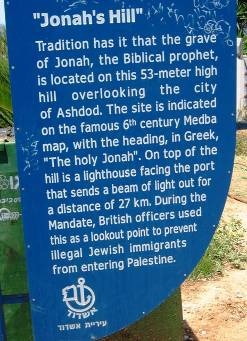
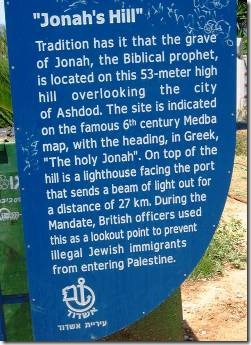
We met Avi about noon in the marina parking lot. As we’d never really taken the time to visit it, our first stop was Jonah’s Hill overlooking Ashdod Port. Avi pointed out the greenway path along the Lachish River and suggested that Randal and I take the motorbike there…which we did a few days later. We also tried out the restaurant up on the hill for lunch one day.
clip_image001

It seems everything in Israel has either a biblical connection or modern military connection.
clip_image002

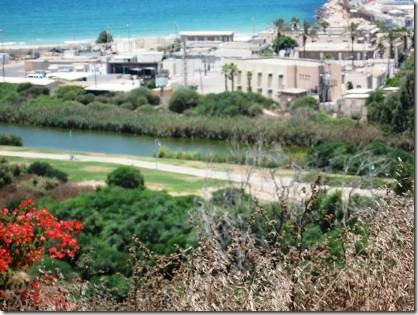
Nachal Lachish Park : The Greenway along the river that runs along the coast near Ashdod Port.

This would be a great place for Charmaine and Linda during bird migration seasons. As it was, the only time Randal and I took the motorbike it was broiling hot, so not so appealing for riding. There were lots of picnickers in the shady spots or fishing along the river. It’s kind of like the Roanoke River Greenway except for the small zoo and the sculptures and monuments. We really didn’t do the park justice, but it was just the wrong time of year when it was just too hot to spend time along the un-shaded path.

Nachal Lachish Park http://littmann613.blogspot.com/2012/04/nachal-lachish-park.html

“The source of the Lachish River is a natural spring in the Chevron Hills. From there, the river stretches 70 kilometers until it circles the city of Ashdod and flows into the Mediterranean Sea. Winding along the side of the south bank of the Lachish River is the large, well-kept Lachish Park.

The pollution from the city’s sewage and industrial waste in the river’s water plagued Ashdod’s residents for years. The mouth of the river was clogged up, and the historic sites nearby were in a state of neglect. As part of an intensive restoration project of the river and its surroundings, initiated in 1991 by several organizations, the discharge of sewage from Ashdod into the river was stopped. (The tall power plant stacks spew steam, not smoke.) The area of and around the stream was cleaned up and underwent renovation and rehabilitation.

Established in 1996, Lachish Park was the culmination of these efforts to salvage the mouth of the Lachish River. A project of riverbank stabilization, using different types of vegetation that are well integrated with the landscape, was successfully implemented.

All this enabled numerous species of wildlife, fish, and birds to return to the site. The calls of numerous water birds that rest here during the migratory period fill the air, as fresh winds from the sea blow into the park. Now, unique fauna, waterfowl, and amphibians can be observed as the stream empties into the Mediterranean Sea.

The park was landscaped and comprises prepared lawns, a 2.5 km promenade, observation points, shady alcoves, playgrounds and picnic sites. A small zoo with antelope, zebra, ostriches, and native Israeli deer lines the back of the park and will delight children. There is even a cage of peacocks.

Many works of art in stone and marble dot the park. One bench has the heads of lions as its armrests. Among the collection is an enormous bitten into apple made of granite, as well as a great, white marble bird.

One can stroll along the riverbed in either direction for about 750 meters, resting under attractive pergolas or walk a bit down to the docks. This part of the park is wheelchair accessible and includes lawns, picnic tables and water for washing. The magnificent riverside walk offers an astounding amount of greenery. The substantial river foliage includes reeds, cattails and tamarisk trees, as well as a huge number of castor-oil plants with large, palm-shaped leaves.

An assortment of fruit trees — including carob and date palms; huge, knotty tamarisks; and small sycamores — were planted on the banks. A slight distance from the edge of the water, fig trees grow naturally. Park Lachish Ashdod is a nature reserve for the prickly white acacia tree, whose name derives from its cream-colored trunk.

A number of modern-day granite obelisks, a reminder of the withdrawal from Sinai after Israel signed a peace treaty with Egypt in 1979, are found at the entrance of the park. The pillars of stone, built especially as monuments, have square bases and sides that taper like a pyramid towards a pointed top.

Directions to Nachal Lachish Park: The park is situated near the Ashdod port. Take Route 41 west, and

make a left onto Bnei Brit Boulevard. At the third traffic light, make a right onto Ben Gurion. After the second traffic light, go around the traffic circle, and the parking lot will be on your right. Leave your vehicle in the lot and walk on the asphalt down to the paved paths.

The Lachish River walk is also accessible by way of Highway 4. Turn toward the sea at the Bnei Darom

Junction and follow Highway 41 into Ashdod and all the way down to the water. Turn left at the port, then follow the signs to the park.”

Our next stop was to be the Kahanov winery. Instead, because it was sort of on the way, we made another detour to an olive oil producing kibbutz.

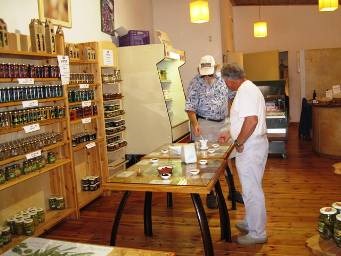
Bnei Darom : Sons of the South for an Olive Oil tasting.

Bnei Darom בְּנֵי דָּרוֹם‎‎ Sons (בְּנֵי Bnei) of the South (דָּרוֹם‎‎ Darom) You read Hebrew from right to left so you see the modifier come before the nouns.

Bnei Darom is one of the more religious kibbutzim, so the fact that we arrived the last hour they were open Friday maybe wasn’t the best time to visit. It was a spur of the moment stop as we were really on our way to the non-religious Kahanov winery for their Friday buffet lunch/wine tasting. We did take the time to taste some olive oil and some vegetable spreads and saw a brief movie about the special process this kibbutz uses to press its olives. Then it was time to go. Other days and times they offer more tours around the kibbutz.
clip_image003

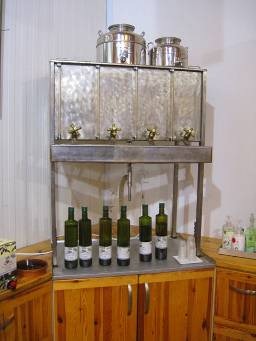
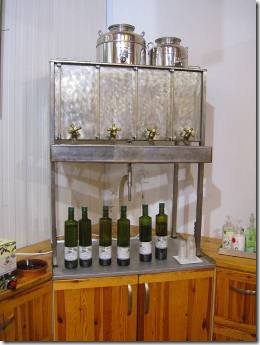
Olive Oil Tasting!

I’ve been to wine tastings, but never olive oil. There really are lots of different flavors. The first one I tasted really surprised me. The aftertaste had a real kick! I would have gotten some, but you had to buy a giant tin of it and I wasn’t sure how well it would do in our closed up boat from mid-September until mid-November. I like the taste of olive oil so I picked one with a rather strong taste. We learned that you should never buy olive oil sold in plastic containers or clear glass. Apparently you should only store olive oil in dark glass or non-reactive metals. I love the giant colorful olive oil tins that folks in the Med use for planters when the oil is all gone.

Keeping Olive Oil Fresh

By Camilla Brown

“Fresh extra virgin olive oil delivers a wonderful flavor and legendary health benefits. To ensure that your olive oil maintains optimum freshness and flavor, there are a few things you can do to store it properly.

Avoid Heat, Light, and Air

When olive oil is exposed to heat, light, and air the valuable nutrients in the oil begin to oxidize and it will begin to lose its fruit flavors. When buying extra virgin olive oil, look for those packaged in opaque or tinted glass. Or, try pouring olive oil into a clean used red wine bottle equipped with a spout. Do not store olive oil in plastic containers, as the oil can leach harmful substances out of the plastic.

Store your olive oil in a kitchen cabinet or another cool, dark location such as a basement or wine cellar. Keep a small container of olive oil within easy reach, and the rest of your supply tucked away to avoid repeated exposure to air. Make sure the lids of your containers fit tightly, and never store olive oil next to the stove, where it will invariably be exposed to heat.

Don’t Store Olive Oil Too Long

Olive oil should be consumed within two years of pressing. Any longer, and the flavors deteriorate and the nutrients degrade. Every month that olive oil ages, the acidity levels increase, a result of oxidization. Extra-virgin olive oils have the potential to last longer than other grades because they have a lower acidity. Buy your olive oil fresh from a supplier, or specialty retailer with high turnover. Pick a bottle from the back of the shelf where it has been shielded from harsh lights. Check the date of pressing if there is one, and abide by expiration dates.

Maybe most importantly, use extra virgin olive oil liberally. You’ll have a healthier diet and your supply will always be fresh.” http://www.oliveoiltimes.com/whats-cooking-with-olive-oil/keeping-olive-oil-fresh/878
clip_image004

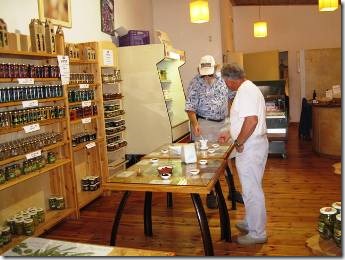
Avi and Randal sample other kibbutz products.
clip_image005

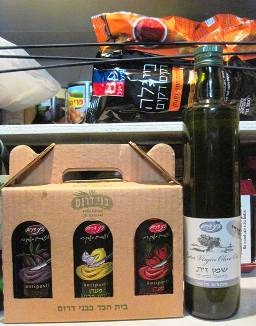
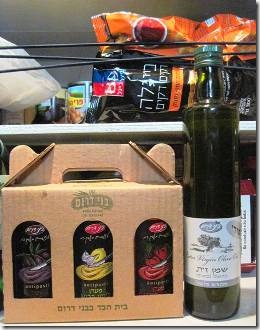
In our pantry on the boat, along with some Israeli pretzel chips: eggplant, lemon with garlic, and tomato spreads and a bottle of olive oil. Can’t wait to break into these, but have to finish off a few open jars in the fridge first.

I was thinking as I took the photo that we have food in the pantry from at least 4 or 5 countries. Of course a couple, like the blueberry pie filling from our first trip to Rebak Marina in Langkawi, Malaysia, expired 18 months ago…perhaps time for it to go. We bought the olive oil because we’d just finished up the last bits of the wonderful stuff our friends Heidi and Kalle gave us in Cyprus.

http://szcnsw.auton.telligence.net.au/blog/?p=166

הבלוג הציוני אוסטרלי Bnei Darom Olives – a good choice

February

“If you try to buy at least one item from Israel each time you are in the supermarket, an excellent purchase is Bnei Darom green or black olives. The olives are exported to Australia and elsewhere by Bnei Darom, a religious moshav not far from the southern port of Ashdod.

Every place in Israel has a history and Bnei Darom is no exception.

History: South of Bnei Darom in what is now Gaza, Kfar Darom was founded in 1930 on 250 dunams of land purchased by Tuvia Miller for a fruit orchard on the site of an ancient Jewish settlement of the same name mentioned in the Talmud. In 1946, Miller sold his land to the JNF (Jewish National Fund) a community was established by Hapoel HaMizrachi’s kibbutz movement as part of the 11 points in the Negev settlement plan.

The next part of this article seems to me to be as much opinion as fact……

In the summer of 1948, Kfar Darom was abandoned following a prolonged siege by the Egyptian army during the 1948 Arab-Israeli War. A book “The 222 Days of Kfar Darom”, which details the heroism of Kfar Darom, was published in 2007 by military historian Aryeh Yitzhaki of Efrat. Originally in Hebrew, it was recently translated into English. For eight and a half months, several dozen young men and women, under almost complete siege and suffering from terrible hunger and thirst, faced the local Arab enemy and the invading Egyptian army. Most of the defenders were religious kibbutzniks, reinforced by Palmah fighters.

Some of those who were forced out of Kibbutz Kfar Darom then established Bnei Darom in its current location near Ashdod. Currently about 400 people live on Bnei Darom and it is thriving.

Meanwhile, following Israel’s victory in the Six-Day War and its subsequent occupation of the Gaza Strip, a Nahal military outpost was established at the original Kfar Darom site in 1970. In 1989, this was converted to a civilian community by the Israeli government. Prior to the withdrawal from Gaza in 2005, there were about 60 families, totaling about 330 people, who earned their living particularly from agriculture, and a central packing center for the world renowned insect-free vegetables produced by the Gaza Jewish communities. Kfar Darom became a symbolic last stand by the Israeli settlers and their supporters in August 2005. Many settlers from Gush Katif, as well as other supporters from the rest of Israel and abroad, mostly religious youth, concentrated themselves in the synagogue. After a bitter struggle, the people were removed by Israeli soldiers. Following the eviction and Israeli withdrawal, Palestinians razed the synagogue. Many of the Kfar Darom people have since struggled to reestablish themselves, with inadequate support.

Location of Bnei Darom:

To get to Bnei Darom: Near Ashdod on Route 41, just east of Route 4. Entrance to Bnei Darom on side of Route 41.

At Moshav Bnei Darom, a communal agricultural settlement of the National Religious Movement, the olive industry is booming. Most of the olives are harvested from trees grown south of the moshav in the desert and irrigated with 10,000 year old underground well-water. The oil, however, is cold pressed at Bnei Darom. Visitors to the olive press learn about the qualities, history and properties of the olive fruit, as well as how to identify real olive oil.

Olive Tour – A Bnei Darom highlight A tour includes the visitors’ center, with a film of how olive oil is produced, and a visit to a modern olive-oil factory. Afterward, people are given an opportunity to produce their own olive oil with a reconstructed ancient press. There are also tractor rides and arts and crafts projects during Chanukah.

Kad Bnei Darom is a family operation on the moshav. It is the only Israeli mill to produce olive oil using the Italian Rappanelli Sinolea olive oil extraction process. In addition to olives, the company makes canned cucumbers, peppers and egg plant.

Uses for olive oil……

*Besides the olive branch being the symbol of peace, olive is one of the seven species of the Land of Israel. Since ancient times, Jews in different cultures have used olive oil for medicinal purposes. Folklore relates that the Rambam drank a glass of olive oil each morning.

* Indian Jews smeared babies with olive oil before bathing the child to strengthen skin and bones.

* Syrian Jews recommended that pregnant women drink olive oil for good luck.

* Tunisian and Algerian Jews used olive oil for massage and prevention of back ache.

* Morrocan Jews recommended olive oil to ease joint pains. Coughing babies were given a mixture of olive oil and honey.

* Iraqi Jews believed that a daily tablespoon of olive oil prevented headaches, loss of appetite, sleeplessness, and digestive ailments.

* Yemenite Jews rubbed olive oil on the head to prevent hair loss and dandruff. A daily spoonful prevented the flu.

* Ashkenazi Jews dripped warmed olive oil into aching ears.

SO next time you are shopping, have a look for Bnei Darom olives!!

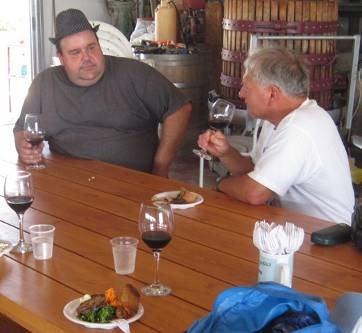
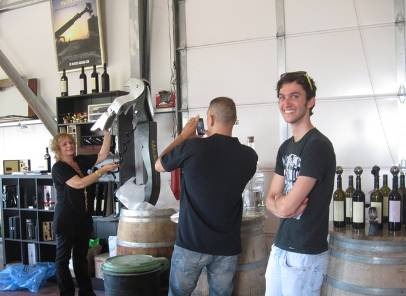
Then it was off to the winery where Randal and I were more interested in tasting the food than the wine. We’d eaten breakfast before 7 am and it was about 1:30 by the time we arrived at the winery.

Kahanov Winery….http://winefromisrael.co.il/wineries/kahanov-vineyards/

“Eliezer Kahanov came from Europe to Gedera as a pioneer in the early twentieth century and planted his first vineyard. Legend has it that at the end of that century while he was kneeling and planting a new vineyard, a man approached him and asked: “You are almost a hundred years old, do you think you will harvest the grapes of this vineyard”.

Eliezer raised his kind eyes and answered: “If I won’t, then my son will.If not my son, my then grandson”.

Indeed, Eliezer did not live to harvest the grapes of this vineyard, but his son and grandson did.

And it is they who follow his legacy of knowledge, experience, tradition and love.

The Kahanov winery is a family winery located in the heart of the family vineyards.The high quality vineyard and the winery providing a picturesque and pastoral atmosphere compatible to the experience of visiting the site. The Winery grapes are only one percent of the family crop, enabling the selection and careful choosing of the grape clusters which make Kahanov’s wine so special and unique.

These wines are produced using traditional methods and state-of-the-art equipment, this production reflecting the winery and its wines – a new world but deeply rooted in a long tradition.

Each bottle receives warm and particular attention from Kahanov family members, who personally produce each one of them.

The family’s deep familiarity with vineyards allows an intimacy with each acre and variety of grape – it is such intimacy and love that have created the miracle of the Kahanov Winery and the Kahanov wines.

Kahanov winery’s flagship wines are noble Cabernet and Merlot varieties. These wines age for a long time in oak barrels in order to maintain and enhance the quality of the wine.

These wonderful wines have won prestigious awards and medals in many competitions and exhibitions worldwide. “

Winery Website: http://www.kahanov.co.il/
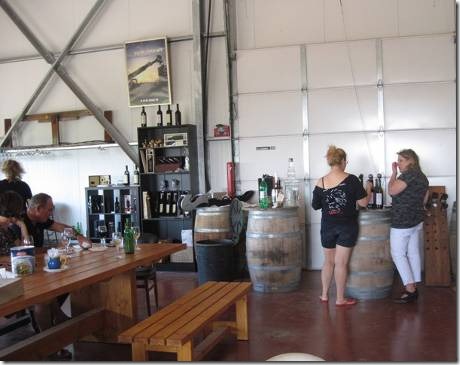
clip_image006

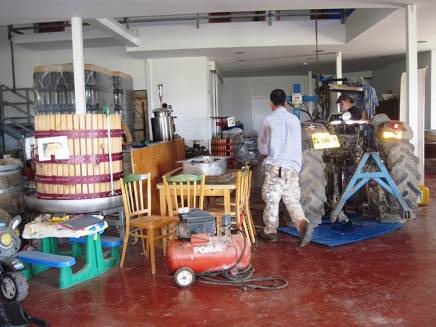
Inside one of the work buildings that was part lunch room/ wine tasting room and garage as you will see.
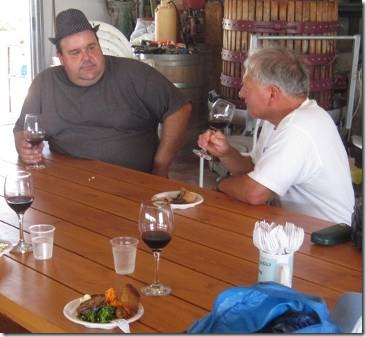
clip_image007

I love the hat! Liked the wine and the different meze and shakshuka that made up lunch.

Avi and I believe one of the grandsons of Eliezer Kahanov who started the winery in the 30s.

Randal needed to buy some chemicals to pickle our water-maker and hadn’t any luck in Ashdod. Wineries use the same chemicals to clean their vats. “Grandson Kahanov” was able to tell Avi where it could be obtained and Avi was kind enough to go get some and bring it to the boat the following Thursday.
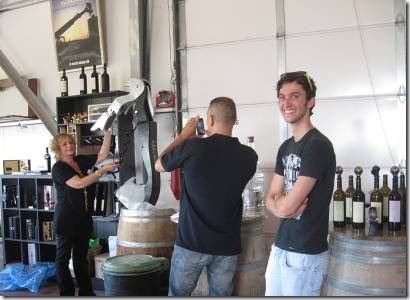
clip_image008

A giant sized corkscrew, can opener used in a winery ad.
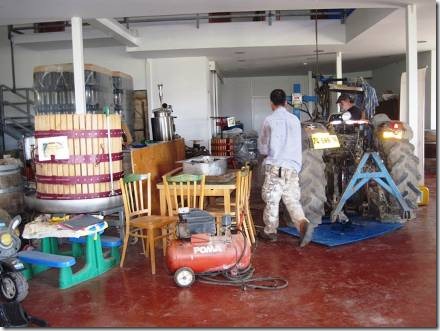
clip_image009

While we were eating, this tractor was being repaired. Everyone cheered when the engine started up.

From the winery we went to visit Avi’s home in Aseret.

Aseret From Wikipedia, the free encyclopedia

Hebrew עֲשֶׂרֶת

Name meaning Ten (after ten members of Bilu)

Founded 1954

Aseret (Hebrew: עֲשֶׂרֶת‎‎) is a communal settlement near Gedera on the coastal plain of south-central Israel. It belongs to the Gederot Regional Council. The word "Aseret" means ten, and the community is named after the ten members of Bilu who founded Gedera.

The community was founded in 1954 as the municipal center of the Gederot Regional Council. It continues to serve this function today. Aseret is the center, both geographically and municipally, of the

other six communities in the council: Meishar, Misgav Dov, Kfar Aviv, Kfar Mordechai, Shdema and Gan HaDarom.

Aseret is built on the ruins of an Arab village Bashshit, which was destroyed in the 1948 Arab-Israeli War. There is an old grave that some people associate with Seth, the son of Adam in the Hebrew Bible.

BILU http://www.jewishvirtuallibrary.org/jsource/Zionism/bilu.html

The year the pogroms began in Russia, 1881, is the year Russian Jews started emigrating in large numbers to the United States. A smaller number of them, however, turned their eyes toward Zion; in 1882, several thousand Russian Jews emigrated to Palestine. Prior to this, most Jews who made aliyah to Israel did so for religious reasons; it was considered meritorious, for example, to die in the Holy Land. Living in Palestine, however, was considerably harder. It was an impoverished land, many — if not most — of whose Jewish inhabitants depended on worldwide Jewish charitable contributions.

In 1882 also, a new Jewish organization was founded that had a very different scenario in mind for Jewish life in Israel. The group was called BILU, an acronym based on a verse from Isaiah (2:5), "Beit Ya’akov Lekhu Ve-nelkha/Let the house of Jacob go!" BILU’s founders believed that the time had come for Jews not only to live in Israel, but to make their living there as well.

The Bilu’im were influenced by Marx as well as the Bible, and hoped to establish farming cooperatives in Palestine. For the fourteen ex-university students who comprised the first group of Bilu’im, farming represented a complete change of lifestyle. (Because Jews had been forbidden to own land in Russia, the country had almost no Jewish farmers.) Arriving in Palestine with enormous "funds" of good will and energy, but with little money and experience, the Bilu’im found life very difficult. Two Palestinian Jews who had already raised money to buy land gave the group a tract to set up a farm in the settlement of Rishon Le-Zion. Within a few months, the Bilu’im faced starvation, and most had to leave.

A few years later, the eight members of the group who had remained in Palestine were offered land in G’dera. Here they struggled against both difficult farming conditions — meals eventually consisted only of radishes and potatoes — and Arab marauders. "They violated our boundaries," one of the Bilu’im recorded in his diaries, "and dispossessed us of whole tracts of our land — and we were helpless." Ironically, the G’dera outpost was eventually saved through the philanthropic efforts of one of the arch-capitalists of the Jewish world, Baron Edmund de Rothschild of France. The dispirited, and by now demoralized, Bilu’im soon left the settlement. Some went to other parts of Palestine, others returned to Europe.

Although the BILU movement, failed completely its vision of Jewish cooperative farms was carried out very successfully a few decades later by the kibbutz and moshav movements. Ever since, the BILU dream of Jews living and supporting themselves in their own homeland has been regarded as one of the important forerunners of the international Zionist movement which Theodor Herzl organized fifteen years later.

SOURCES AND FURTHER READINGS: Howard M. Sachar, A History of Israel, pp. 26-32.

Source: Joseph Telushkin. Jewish Literacy. NY: William Morrow and Co., 1991. Reprinted by permission of the author.
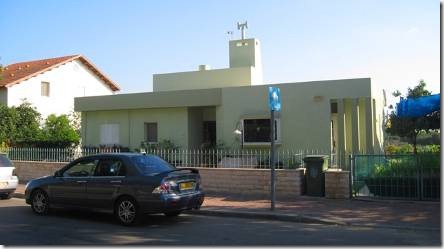
clip_image010

The home of Avi, his wife Rohamah, and their two daughters.
clip_image011

Looks like any place in the USA

clip_image012

I loved the glass wall and the lush foliage.
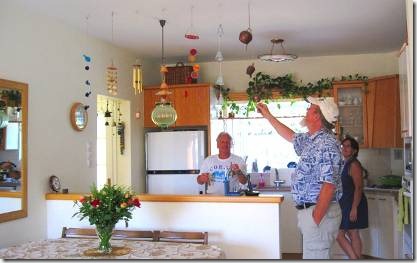
clip_image013

Avi’s collection of wind chimes in the kitchen.

Avi is pretty much retired: Rohamah is the principal of an elementary school.

Both their daughters completed the 2 years of military service.
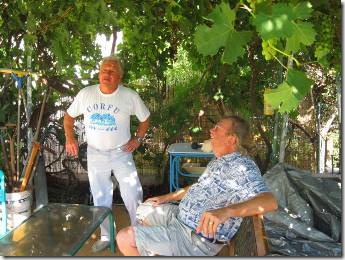
clip_image014

A grape arbor creates a shady patio in the back yard.
clip_image015

 clip_image016

I asked, “ Why spend all that time and effort, in the desert, to make a lawn you then have to mow?”

Avi’s answer was that the kids liked playing on the lawn and he likes maintaining the lawn and plants.
clip_image017

clip_image018

Avi pointing out how the covered ceiling in over the community pool provides for year round swimming.

Aseret has a community center with a gym and pool, schools, a library, a health and dental clinic and a retirement community for the “elderly.” It’s like one of those ideal places to live; except for the need for a safe room with the shrapnel preventing window cover.

Editorial comment.

At dinner the other night with friends we were talking about Israel and I realized that I have less of an open mind about the issues there than before Randal and I visited. I remember “discussing/arguing” with my parents back in the 70s after they’d been to Israel and were so impressed. I kept insisting that there were two sides and Israel hadn’t always treated the Arabs so well and needed to do better. My mother got angry and told me I’d feel differently if I’d go there; that I’d have more respect for what the Israeli people have accomplished. Turns out something else mom was right about. Maybe it will ware off and I’ll regain some perspective. I know I lost my taste for pork in Israel, though I did eat calamari here in Turkey the other night. So anyway, if some of my emails seem one-sided about Israel, I will accept the criticism.

Turkey email # 1

Hi All,

So we’re back in Marmaris at Netsel Marina just a 5 minute walk from “downtown” Marmaris. I’m not sure how that will translate into bar and restaurant noise at night, but it will make for wonderful walks for me and lots of exploring each little street for great scenes to sketch. I am determined this time to do just that.

http://www.netselmarina.com/index_eng.htm Our home for the next 12 months.

We left Israel 10:10 AM July 15th.

clip_image001

Bug hunting on DoraMac in the Ashdod marina.

Hooray for our friend Eve who will now be this little kitten’s friend. We passed along the food and the Frontline (which the Russians had bought along with the fish shaped cat dish) to Eve. The kitten already knows Eve as half the time it slept on her boat deck….tiny paw prints gave it away. Eve loves cats so if this little guy plays his cards right, maybe she’ll keep him forever. He loves to curl up next to you and purr.

clip_image002

Fruitcake in Ashkelon

We left Ashdod at 7 am July 15th. Eve came to throw our lines and to make sure the kitten was on land and not on our boat. We arrived in Ashkelon about 8 am with just time to tie up and have our last freezing blended coffee before we met with the custom officials who checked us out from Israel. A very professional, friendly, and “cute” woman who also wanted to know if we liked Israel and would come back. We said, yes we liked Israel, and one day might come back, but not by boat. There are still places there I’d like to visit, friends we met, and one can never get enough of Jerusalem.
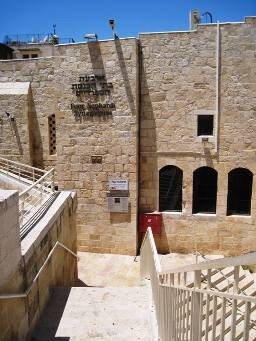
We left Ashkelon Marina heading north-west directly to Marmaris, Turkey. We usually average 6 knots per hour but with a constant head wind and swells and some kind of adverse current we spent most of the first day below 5 knots! At one point our passage calculator predicted we’d reach Marmaris 1 am Thursday morning on the 19th! Not good. Luckily things evened out and we averaged enough speed to arrive early afternoon of the 18th just 4 hours or so later than Randal had projected.
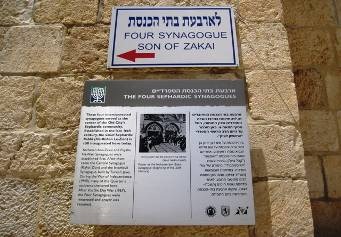
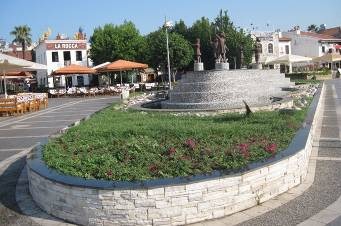
Our first night we had company.

clip_image003

A feathered passenger riding a motorbike riding a boat.

This beautiful bird of prey joined us late afternoon and stayed with us during the night. It was gone when I checked mid-morning. When Randal walked past it to come down from the flybridge the bird just flew up to the helm chair. Then it returned to the motorbike and stayed there all night. (Wish Charmaine and Linda had been here for him: they’d know exactly what kind of bird it was.)

clip_image004 clip_image005

If it had been there in the morning I was going to feed it some raw chicken we have guessing it might not like Randal’s pepper salami.

Our weather was clear but the swells were between 3 and 6 feet or 1 and 2 meters with winds between 6 knots to 18 knots. Nothing like our horrible Indian Ocean crossing (now I can say it’s good to have that horrible experience to look back on.) The swells were front to back so our stabilizing fish wouldn’t help. But I’d packed everything away so there was no crashing of things in cabinets down below. I could read for small amounts of time. Actually the movement and heat were quite tiring so Randal and I took turns watching or sleeping the first two days. Night watches were actually easy as there was very little boat traffic. There was lots of radio chatter to listen to as NATO and the Israel Navy and the Lebanon Navy and Turkish Navy patrol.

NATO was conducting a survey among commercial ships asking if they knew about Operation Active Endeavor. It was nice to hear all of those mostly female NATO voices with accents from lots of countries. My favorites were those from northern North America. (I’ve learned you can tell an American voice from a Canadian voice, but not so easily.) NATO and the Israel Navy were mostly female but only rarely was the voice of a commercial ship female. I did listen in when she was interviewed by NATO early during our passage and that’s when I learned what the survey was and why NATO was conducting it.

http://www.nato.int/cps/en/natolive/topics_7932.htm

No looking over our shoulder as we did from India to the Maldives wondering if some unlit boat was pirates, not with all of these NATO boats patrolling. And the ever present Israel Navy. I’ve said this before: Some people complain about Israel security checks. Any time we had to deal with Israel security they were polite and professional. And you never had to worry about some official wanting a “gift.” Israel officials were only concerned if people meant to do harm to Israel and her citizens or “if we liked Israel.” Israelis are proud of their country which they worked very hard to get and do not yet take it for granted. They also don’t feel as safe as we do in the US, even after 911. At night in Ashdod we could hear Israel’s Iron Dome intercepting incoming rockets from Gaza. We would hear what sounded like an explosion but then guessed what it might be. It’s something they deal with on too regular a basis. We were only there for some of it.

"Two rockets fired from Gaza into Israel; Iron Dome intercepts one

Another missile explodes in open area in Eshkol Regional Council; rocket fire marks first projectiles since early Thursday morning.

By Yanir Yagna and Gili Cohen | Jun.21, 2012 | 11:54 PM

http://www.haaretz.com

But mostly we didn’t think about it. Hopefully, one day, Israel and her neighbors can find a way to make peace and then grow to be friends. I know the parents in all countries, not just Israel, would wish that would happen.

clip_image006

Our Israeli friend Avi showing us the ¾ in steel cover for the window of the “safe room” now mandatory in homes built in Israel. And people own gas masks. (More about Avi when I catch up with the emails about Israel.)

clip_image007

Self portrait…I was bored and tired this passage, which is much better than being Indian Ocean scared.

Or seasick. (Linda, you would not have enjoyed this passage, not even for the bird’s visit…way too much boat movement. More than the passage from Herzliya to Ashdod. )

clip_image008

clip_image009

Diet Nesher Malt Black Beer…Diet, non-alcoholic Israeli version of root beer.  (Some people would call it a "why bother."

but I think this stuff is great!!!! Eve turned me on to it and now I’m hooked but down to my last 1.5 litre bottle. To me it tastes like mild beer, not like American root beer. And I don’t really like beer, but his stuff I do.  It certainly kept me going this passage.

clip_image010

Randal was mildly seasick and tired.

He felt too sick to drink his usual many cups of coffee and so was even more tired. The boat was hot and rolling so we stayed down in the pilot house rather than on the fly bridge which is cooler but exaggerates the motion. Of course, even sea sick Randal can do what needs to be done.

clip_image011

Captain Randal up and at the helm going into Marmaris Bay.

What a difference calm seas make!  At the marina we were directed to a temporary berth and Randal backed in like a pro. I was pretty good with the fenders and stern lines but blew it when the marina guy went to hand me the “mooring line” and I didn’t know what he meant. It’s a line from the dock to the front of the boat when you “Med Moor” which is what we have to do here. In Israel we were lucky enough to tie up alongside. Today we move to our permanent spot. At 11 am our agent Soner, who was our agent last time in Marmaris, will drop off our entry papers and then we’ll go to town to the Thursday market and visit our friends the “cheese guys” and load up with cheese and olives and everything that looks good!

Ru

DoraMac