On the Hard

I don’t know where the expression “On the Hard” comes from but it defines when the boat is out of the water and on firm ground. We were on the hard from November 20 until December 4, 2009. It was the first time since early June, 2007 that the boat had been out of the water. It is customary to pull a cruising boat out about every two years to have the bottom cleaned, sanded, and repainted.

The paint used is called anti-fouling paint. Unknown to me before my cruising life was the fact that marine growth attaches itself to anything and everything under the water. There are barnacles and slime that I see the most, all of which slows the boat’s performance in speed and adds to fuel usage. Under ideal conditions, clean bottom and prop, no wind, and no current, the boat will make 6.5 knots at 1500 RPM while using about 1.6 gallons of fuel per hour. Add a fouled bottom to this equation and the speed slows by one to one and half knots and the fuel usage can easily increase to 2.5 gallons per hour. Apply these figures to a relatively short passage of 600 miles and you can see why it’s important to keep your bottom clean.

Anti-fouling paint does not entirely prevent this but deters it some. Most of this type of paint is described as ablative. Once it is submerged in saltwater it starts to shed off at a predetermined rate. At one time a marine life poison was put in the paint call TBT, Tributyltin. This works great as a biocide but has been outlawed throughout most of the world as a hazard to marine life. My understanding is in the EU; officials can swab your paint and test it instantly seeing if it contains TBT. If it does you can expect heavy fines for bringing it into their waters. This law was put in place primarily because of large cargo and tanker ships because of their large underwater surface. A large oil tanker can have over 200 times the underwater area of a cruising boat but guess who the officials go after and who they ignore?

TBT is easily available here in Asia so while you’re guessing see if you can guess if I added a small amount to my anti-fouling paint. Because of our delay in going across the Indian Ocean until January 2011, our need to have a clean bottom when we do, and the need to have the anti-fouling done now, I chose to use a soft paint that will last about one year. This way we will have the boat pulled again next Nov/Dec, the remaining paint blasted off with a high pressure washer, and new, more expensive longer lasting and TBT free paint put on.

This picture shows the boat just after it came out of the water and before it was pressure washed. Note the barnacles on the propeller. That is Elizabeth from Larbarque looking with me.

In this picture the yard worker is taking a break so I picked up the wand and continued.

In this picture you can see the shine of the bronze prop which I have spent time polishing. I was told it would not do any good but my reply was that the barnacles would see their reflection and turn away. Actually I don’t think barnacles can see.

This crusted item is one of the many hull zincs in place to prevent corrosion to the hull by electrolysis. Most of the material was still there so I cleaned them some and reinstalled them.

These are the old and new zinc for the bow thruster and I did replace those.

In this final picture I am painting on the waterline stripe. The original was a tape but as you can see in one of the photos above, did not survive the pressure washing.


Shopping trip to Kuah Town

Hi Everyone,

  Hanukah has passed and many of you are getting ready for Christmas.  Even here at Rebak Marina that’s true!  Many of the boats have put up lights from mast to bow.   There’s a marina Christmas buffet and the following day a celidh which should be quite entertaining from what we’ve heard coming from some of the boats.  Kuah Town had a few decorations, but not many.  This area seems a bit more traditional Muslim than George Town or Miri, but we’re too far from the mainland to here the prayers during the night and day.  Lots of cruisers come here for Christmas time on their way to Thailand and that’s still our plan for January.  Langkawi is “duty free” so boat parts and things can be shipped here duty free and booze, chocolate and other imports are cheaper.  This is the story of our second shopping trip to Kuah Town.  Our first one was even more whirlwind so there was no time for pictures and when I got back to the boat it was all a blur.  I’m now starting to get it. 

Ru

DoraMac

Kuah Town with Liz and Julia 12-21-2009

This past Monday, Randal and I went on a shopping expedition to Kuah Town with Liz (Blue Tango) and Julia (Papillon.) And it does feel like a major expedition. You have to make advance plans for the transportation. You have to take luggage in the form of carrying bags and coolers. You need money, comfortable clothes, good walking shoes and hats for the sun. Cold drinking water is good too. It’s really good to have a driver and a navigator. And friends: it’s good to go with friends.

Obviously this isn’t your trip to Kroger, Sams Club or COSCO; or even JUSCO for that matter. It’s actually like going on a scavenger hunt. You take your list of needed items and you try to match it up with one of the 96 shops or services listed on the six page handout helpfully compiled by past cruisers. Two of the pages are wonderful hand-drawn maps of both Kuah Town and also Matsirat, the small town not far from the ferry landing on the mainland.

Randal and I met Liz and Julia on our dock at 8:30 am and then ambled over to the ferry dock to board the 8:45 ferry with about 20 other cruisers which filled the ferry to capacity. Everyone is required to wear one of the ferry life preservers and everyone does. The ride is short, fast and free. When you get to the mainland, there are no buses to catch so most cruisers “borrow” (don’t ask) a car from Mr. Din. To “borrow a car,” you pay between 40 and 60 ringgits depending on whether the AC works or the windows roll down. The car will have just enough gas to get you a mile down the road to the Petronas station where most cruisers add about 20 ringgits (11.76 liters) of gas to get through the day and return the car with as little fuel left as possible. Our car cost 60 ringgits but came with a half tank of gas, AC that worked and windows that rolled down and up. The trunk was iffy so we never locked it fearing we’d not be able to unlock it.

clip_image002

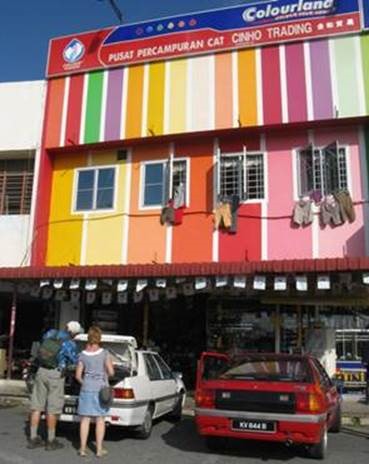
Our first stop Chin Ho Trading.

Everyone says, ‘Look for the multicolored building on the left going into town.” When we came out we discovered the trunk problem which even Randal couldn’t fix. Julia was our willing driver and we all appreciated that she could drive the standard, powerless-steering car on the wrong side of the road and even parallel park. Liz was our navigator since she knows Kuah Town and where to buy what at the better price.

In Kuah Town there is no “one stop shopping;” and, to quote Shakespeare, “there’s the rub;” rub being Shakespearean for difficulty or obstacle. “Twelve stop shopping” was more like it, and that’s because on Monday we needed to take the 2:30 ferry home or it might have become “20 stop shopping. “ Want meat, go here for frozen or there for fresh and depending if you want fish, pork or chicken, somewhere else; fruit and veggies, depends on time; bread here or there, depending if you want baguettes; beverages, a few choices if you want wine or soda; marine hardware more choices. See what I mean. It’s amazing what you can get done if you don’t dawdle, dither, or stay long in the local bargain tents along the sidewalk: just stick to your list! I had no list which is why I could dawdle, dither, and go to the local bargain tents and come home with a giant jar of capers, whole grain mustard, lime pickles, a big, comfy, soft 8 ringgit used man’s shirt like I got in George Town (which I still haven’t shown you yet.) Liz, Julia, and Randal had lists. Along the way I did pick out our 4 bottles and 1 box of wine and one of the scotch drinking glasses, all bought at different stops!

But I’m getting ahead of myself. After Chin Ho Trading we drove into downtown Kuah Town for breakfast.

clip_image004

My back is to the Maybank which was everyone’s next stop.

You can see the “Roanoke like” mountains in the distance where you can take a cable car up to the top and Randal and I are hoping to do that one day.

The main roads are kind of busy and you really don’t see many bicycles here. The marina restricts when you can take a bicycle onto the ferry, but if we stay long enough, who knows though it wouldn’t do for real shopping. The terrain into town is flat enough so my rear wheel , now being brakeless, won’t be a problem. A broken cable is the problem; no way to get it to a bike shop, another problem, if there is even a shop in town. We’ll see about that too, maybe.

clip_image006

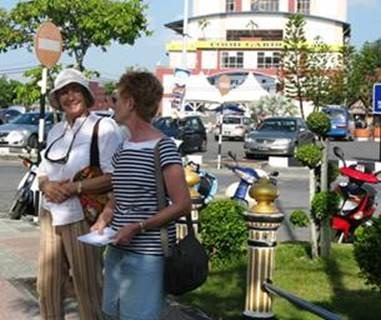
Out of the bank and off to find breakfast! Liz and Julia.

Julia reminds me of the actress Laura Linney. Liz is my newest painting buddy. Julia loves to cook: Liz does lovely watercolor paintings and knows about everyone at the marina and lots of shopkeepers in Kuah Town. Both have done lots of interesting things in their pre-cruising lives. We meet most morning for our walks.

clip_image008

Cleaning the sidewalks for the day.

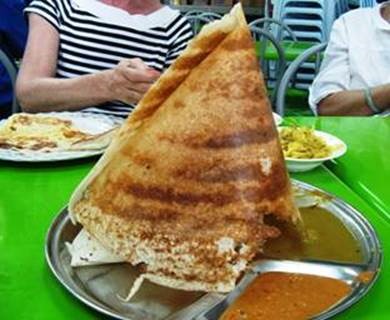
Thosai or Dosa depending on whom you ask….

clip_image010

My Topi Thosai shaped like a tent! Crispy! Light! Totally gone by the end of breakfast.

clip_image012

My topi thosai is trumped by Liz’ “paper thosai” which is supposedly over 2 ft. long. The two types of thosai tasted different, mine was a bit more fried. We had curried cabbage and some spicy chicken. Too early for me to do spicy so I stuck to my plain thosai and skipped the dipping sauce.

clip_image014

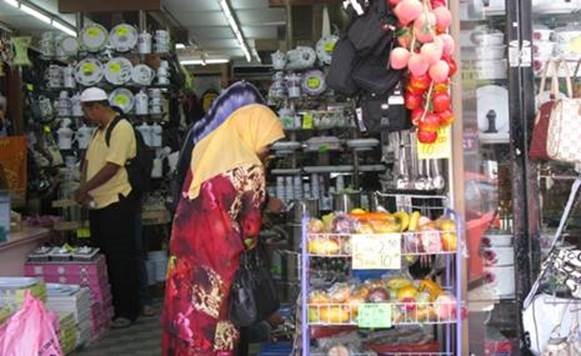
This shop sold all kinds of things for one’s home, but only sets of glasses and I need just one to replace “Randal’s glass that he drinks scotch from.” Since we have more glasses (wrong shape and size for scotch) than we need, I left with only a photo.

clip_image016

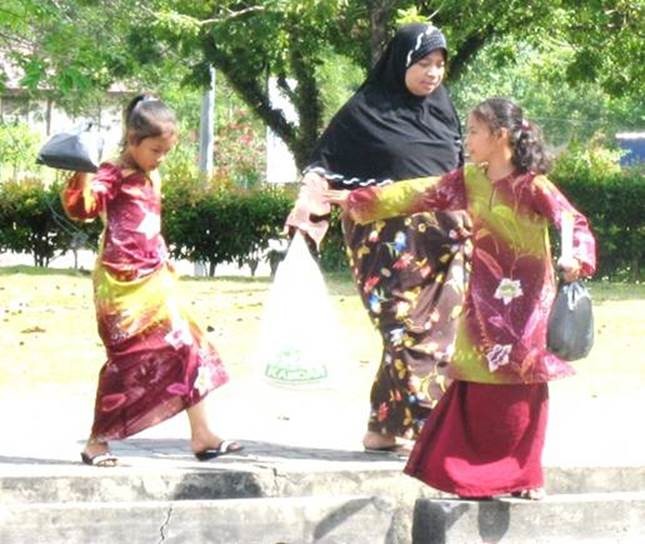
Help from big sister!

Crossing a drainage ditch with short legs, slim skirt, and sandals is hard without help from her big sister.

clip_image018 clip_image020

Pak Brothers meats, cheese, yogurt and other stuff.

We bought two 2¼ lb Australian “beef” roasts. I just asked Randal what cut it was and he said he didn’t know. It looked good. Randal cooked one today and it smelled good. Randal was disappointed; it didn’t taste good. We had paid 20.5 ringgits per kilo which when all the conversion is done came to $2.7 per pound. Hmmm maybe that’s why. It just needed way more garlic. The other one will be cooked into a stew. Always an adventure.

clip_image022

This is only some of our stuff. We entirely filled the trunk of the car.

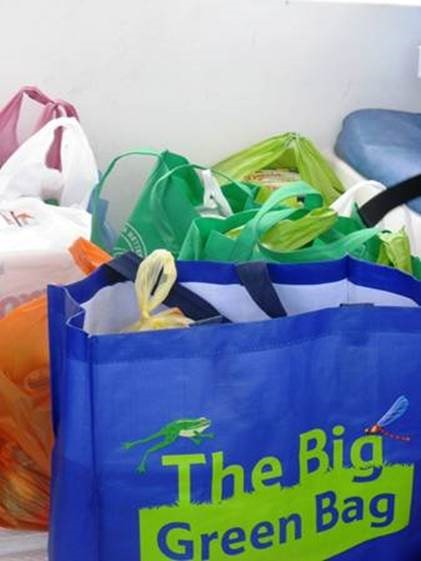
That’s my big George Town JUSCO bag. One day each week JUSCO won’t bag your groceries for free. You have to supply your own bags or pay for your plastic bags. Not a bad idea.

clip_image024

Heading home.

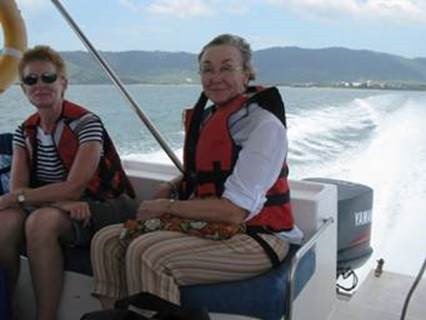
I almost lost my hat! The ferries travel between 25-30 knots (Randal’s guess.) You have to hold on to your hat and not worry about your hair. Liz asked the ferry captain if he would stop at our dock so we could unload and he was kind enough to do it. That made a big difference in getting our trunk-load of provisions back onto the boats.

That was our second visit to Kuah Town and now I look at the map and actually have an idea what it all means. It’s probably a once per week trip we will take and maybe even be brave enough to take a turn driving.

Rebak Marina Christmas Buffet

Rebak Marina Christmas Night Buffet 12-25-2009

clip_image002

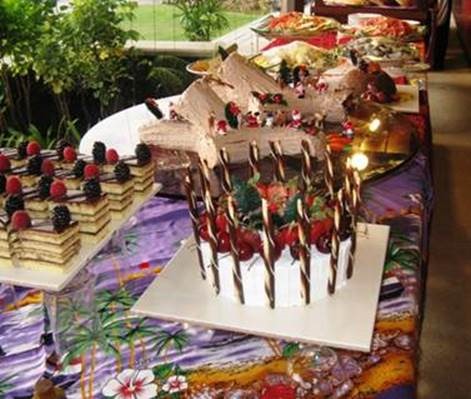
Dessert first…..

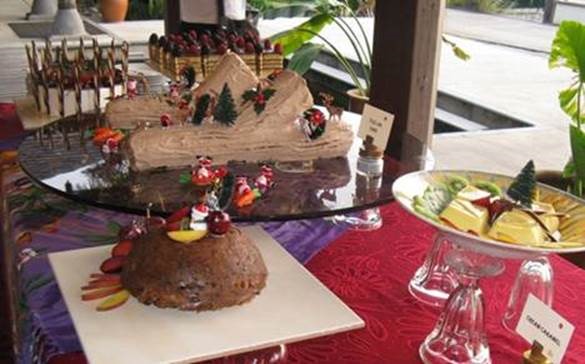
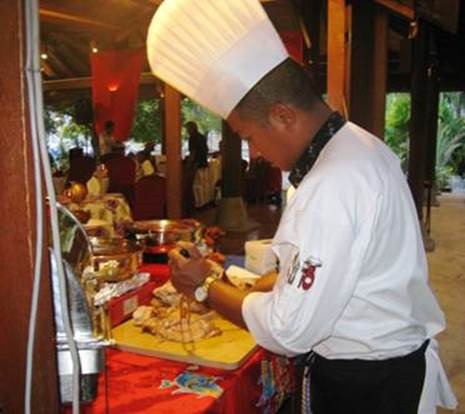
I knew that I needed to take photos right away or there would be nothing left to photograph! Chocolate cake that was moist and chocolaty; Yule logs……..

clip_image004

Chocolate fruit cake with cream sauce and cream caramel! Yummmm

And I ate some of everything! All of the cake was moist and rich in flavor. It all tasted as good as it looked which isn’t always the case with desserts. On Thursday, the marina manager had brought bags of cookies to each boat and those cookies were all just wonderful; baked by a real baker. They’re gone too, though not all in one day, thank goodness.

clip_image006

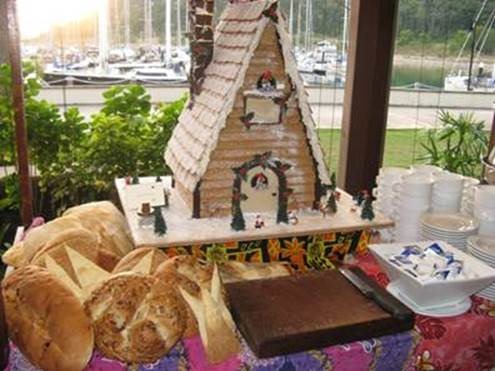
The bread here is wonderful, the best selection we’ve had since we left home, really!

You can see the boats docked in back. Even though we were on the furthest, A Dock, the walk back and forth didn’t begin to work off even one tiny bite of dessert!

clip_image008

Lost in thought!

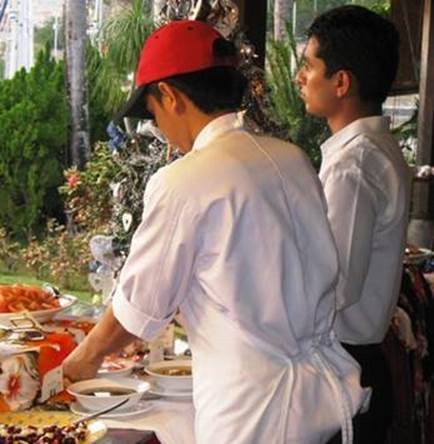
These young men were getting everything ready. The marina employees are all very good at their job no matter what it is.

Turkey!!!!

clip_image010

When they announced that “dinner was served” Randal and I made a bee-line for the turkey.

There were a lots of exotic sounding dishes included as part of the dinner; but we had our priorities straight. Turkey and dessert! While I was waiting in the turkey line, the couple in back of me said they’d never eaten turkey before. They were from Austria and had heard so much about turkey that they couldn’t wait to try it. I immediately became very protective of our other “national bird” and told them that turkey was wonderful but sometimes, just sometimes….the meat could be dry. I felt America’s culinary honor was at stake! Did they like it? They loved it, and so did everyone else. The meat was really moist and tender. Just perfect! Then they quizzed me about the historical accuracy of turkey being eaten at the first Thanksgiving and did it come from the Indians. Uh, hmmm, having visited Plimoth Plantation* in elementary school you’d think I would know. One of their friends said she thought the Pilgrims had eaten chicken. I said, at one point they would have eaten bark since they were pretty starving but we always made turkey cutouts tracing our hand when we were kids so it must have been turkey. I told them I’d look it up and let them know. They also knew that President Obama had pardoned 2 turkeys; did I know that? Sort of, though since it doesn’t relate to the Red Sox off season, I hadn’t really paid attention.

clip_image012

Salad, flat bread, wine and my turkey with ” fruity turkey sauce” hidden by my wine glass.

The sauce was kind of sweet and fruity but wonderful with the turkey. I ate my salad and turkey and then went back for more turkey…got dark meat that time which was also really good. Now if I had just stopped there….

Along with the salads and turkey I could have had roasted tomato soup, chicken piccata, poached mussels with lemon sauce, prawn sambal, lamb stew, baked barracuda with turmeric spice sauce, sweet and sour fish, roasted herb potatoes, Palau rice with green peas and corn kernels, beef with cashew nuts and dry chilies, carrots stewed in yogurt.. and I would love to have tried them all, but I was already full from my turkey and salad. I know turkey isn’t as exotic as many of the other dishes, but I really like turkey. And really, since we left home, pretty much everything I eat is pretty exotic. Which I should have done….

I have no photo of my dessert plate because I ate everything with not one thought of photos in my head. Remember those first photos of the dessert table? I had some of just about everything!

clip_image014

Julia and Jim Parker on the catamaran Papillon, home port Bokeela, Florida.

clip_image016

Happy Holidays from Randal and me!

Hope all of you are staying warm and safe with all of the snow and sleet back home. Wish we could share the sunshine!

Ru

DoraMac

*It really is spelled Plimoth though it is in Plymouth, MA.

Labarque’s photos

Hi all,

Patrick sent these photos along so I could share them with you.  Labarque certainly deserved a better photo than one of her on the hard.  All of the photos are by Patrick and Elizabeth  unless otherwise noted. Thank you to all of the photographers.  We are meeting lots of really nice people as we cruise along and articles like Patrick’s lets you get to meet them also.

Ru

Doramac

clip_image002

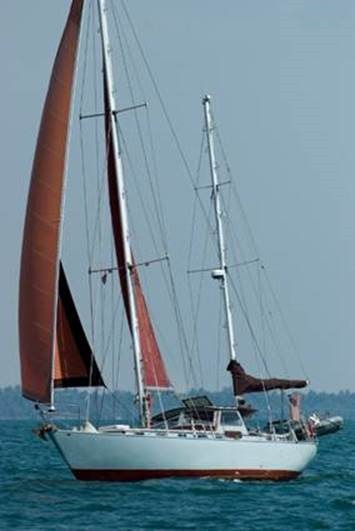
Labarque sailing taken by Yacht Lady Anne

clip_image004

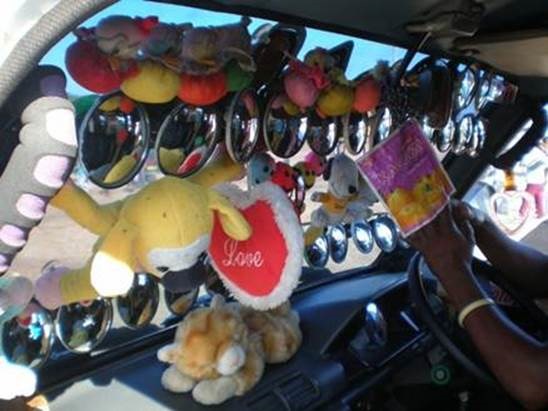
Kupang Bemo West Timor Photo by Yacht Enzo

I think Patrick and Elizabeth must have had great faith to get into this bemo (van.)

How on earth could the driver see.

clip_image006

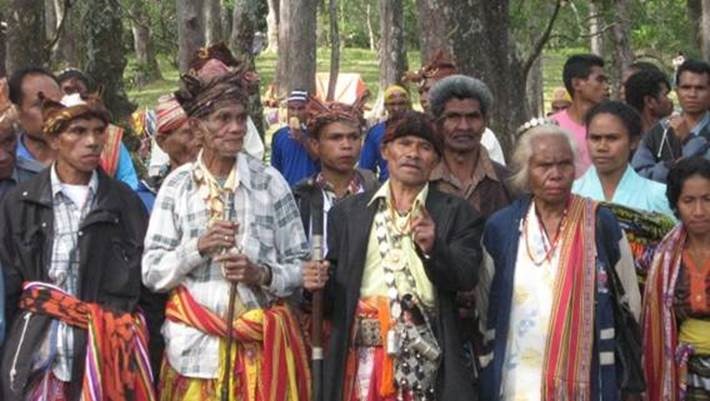
Their welcoming committee on West Timor

Each rally is different and our Indonesia rally didn’t stop there, or perhaps stopped there before we joined on since we started from The Philippines and the rally really starts from Darwin. In any case, Doramac didn’t go to West Timor.

clip_image008

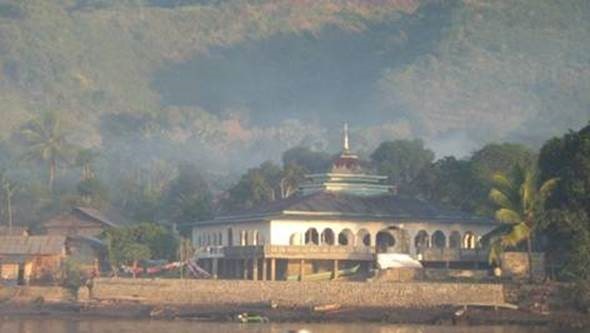
Mosque at first light, Alor (It looks like an oil painting!)

Randal and I didn’t go to Alor either.

clip_image010

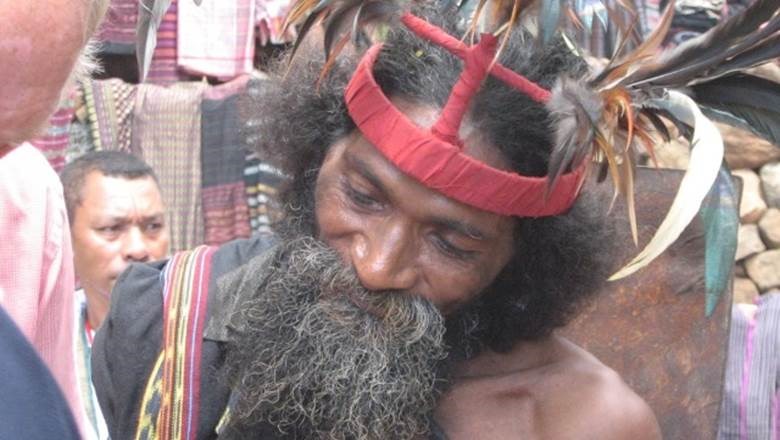
The Chief of Alor.

clip_image012

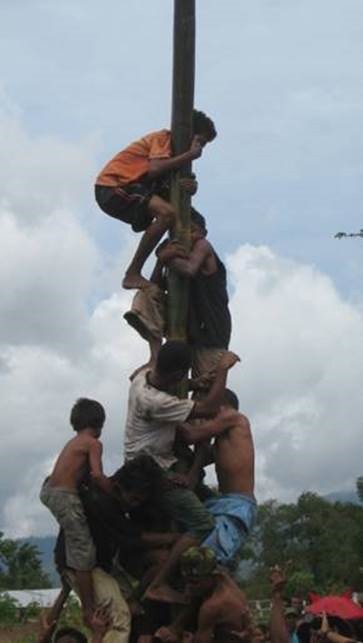
Grease pole climbing on Flores

We did go to Flores and that’s where we began to catch up with our Indonesia Rally but the events had already ended. We had taken our Slovenian hitch hikers Petra and Janez to Flores from Makassar.

clip_image014

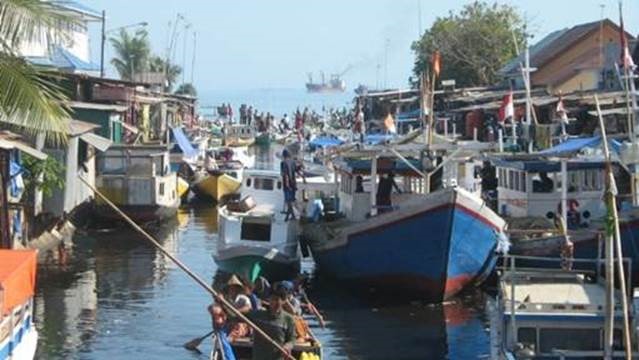
Fishing port, Makassar.

Makassar was Doramac’s first stop in Indonesia. It was from Makassar that we took our land trip to Tana Toraja. We really liked Makassar though it we weren’t there as part of the rally.

clip_image016

Balinese dancers by Yacht Windmiller.

It took me a while to realize these were men. Randal and I were in Bali but didn’t see the dancers. Bali, with its lovely town of Ubud was definitely a favorite or ours.

Rebak Marina

http://www.rebakmarina.com/rim_main.html

According to the marina website the island is 389 acres and about 3 miles from the mainland of Langkawi.

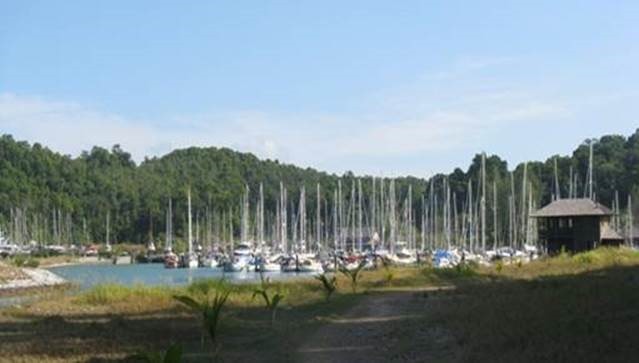
clip_image002

We are in the very first row of boats.

You can see how protected the marina is. It is very quiet with very little boat movement. Even tied to a dock boats can move depending on the design of the marina. There is a very small entryway on the left side of the photo.

clip_image004

This is the very narrow entry.

When we were coming here, I actually couldn’t see the opening in the rocks where we entered the marina.

clip_image006

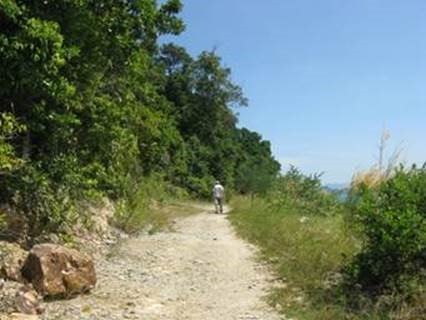
The path that goes part way around the resort.

clip_image008

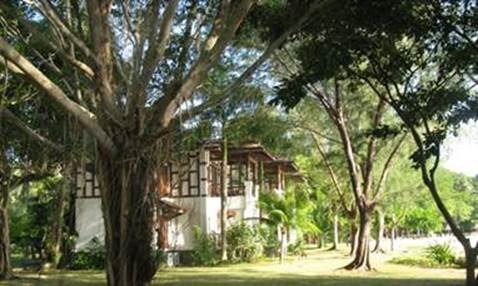
The rooms at the resort.

There is a main building with lounge and restaurant and small reading room where you can borrow books from the paperback collection. There is also a small building that houses a spa.

clip_image010

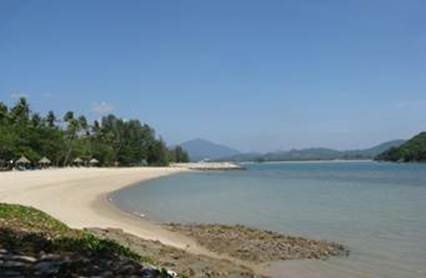
The swimming beach.

I went to go for a swim yesterday but it was low tide and there was no water above my knees in the roped off swimming area. I’ll go sometime at high tide which seems to be early in the morning or very late in the afternoon.

clip_image012

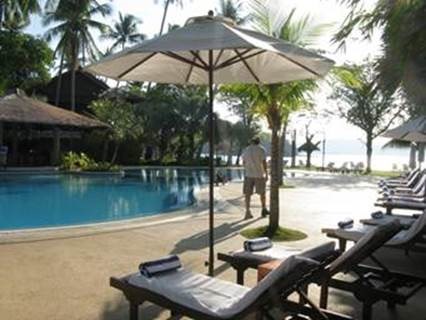
The pool is nice with one of those swim up to bars in the water.

Between 5 and 6 pm is half-price happy hour so many of the cruisers go to the pool about 4:30 or so. Randal and I did once.

clip_image014

The trail goes around the back side of the marina complex.

You can follow the trail to another beach or up into the woods. We walked to the other beach but left the woods for another time.

clip_image016

The second beach.

clip_image018

We walked into the woods for a bit but weren’t sure about spiders or snakes or other biting bugs.

clip_image020

The marina restaurant and office complex where we have eaten a few times.

clip_image022
Near the office is the “freebie” corner. People put books and other things here for other cruisers to take. I’ll make a contribution before we leave.

clip_image024

Recommended Safe Zone

“In the event of fire or natural calamities.” I guess forest fires are possible so they have cleared a space between the trees and the marina.

clip_image026

The ferry dock.

These high speed boats provide free transport to the mainland. They are very fast but comfortable. We have been on them as part of the Sail Malaysia Rally so buses were waiting on the mainland to transport us to town. We’re not so sure how it works otherwise but will find out tomorrow when we go to town with Liz and Wally from the sailboat Blue Tango. The veggie man comes to the ferry terminal every Friday and Randal and I both went this past Friday. He came in a van and there was nothing visible through the van windows so I wondered how there could be enough. The man knows how to pack! He had lots of veggies and fruit as well as cheese, bread, frozen chicken and meat, and smoked salmon. If all you needed from town was food, you’d never have to go. We are his first stop of the morning. I was told that by the time he gets to the second marina, there often isn’t enough left for those cruisers. We’re lucky we are his first stop. When you leave the island you sign out at the small ferry office and sign back in at the small ferry terminal on the mainland.

clip_image028

This lovely building houses the marina shop, small gym, and wonderful relaxing, reading or yoga space. The shop sells staples like bread and eggs and milk, chips, soda and beer. The bread is a wonderful whole wheat that the Roanoke Food Co-op wood be proud to sell. I think it’s the best bread we have bought since we started cruising.

That’s basically the walk around the island that Randal and I have done a few times. There is one spot near an abandoned building near the marina offices where you can see lots of monkeys and hornbills. I had never really seen a hornbill and they make a horrible squawk and move too quickly for me to get a photo. This morning while walking by myself, without my camera, I practically bumped into one sitting in a very small tree along the path. I walked past and realized it was there so stood and watched and it perched and watched and then I walked on. I’m not sure if it’s a Black Hornbill “best identified by a disgusting retching sound” or an Oriental Pied Hornbill, “call a clattering laugh.” Hopefully I’ll find someone who knows. There are also monitor lizards, and Julia from the catamaran Papillion was stopped in her tracks by a really huge one that didn’t seem to want to run back into the water or woods. This morning while she and I were walking, we didn’t see any large lizards, but we saw large lizard tracks.

One additional photo:

clip_image030clip_image032

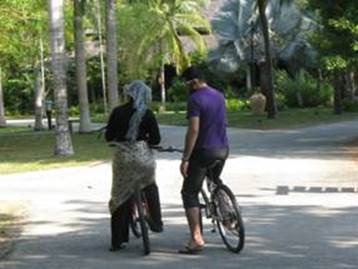
I passed this couple off for a bike ride. They were trying to deal with her lovely wrap so it wouldn’t get tangled in the bike as she rode.

Ru

Doramac

Our friends Elizabeth and Patrick and their Indonesia story

Hi Everyone,

Our friend Patrick was asked to write up an article for the Royal Brunei Yacht Club magazine about his and Elizabeth’s experiences on Sail Indonesia.  (They participated in 2007 and we did it in 2008.)  I enjoyed reading it and Patrick said I could share it with all of you and our web site.  I just wish I had better photos to go with it.  I’ve written about Elizabeth and Patrick many times recently: we like them very much and truly enjoy their company and conversation.
clip_image001

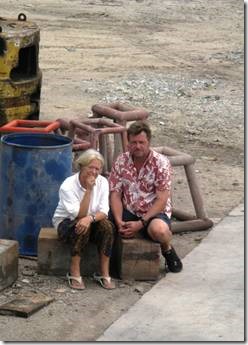
Elizabeth and Patrick

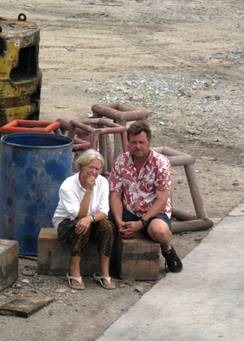
(This is not a great photo, but it’s the only one I have of the two of them together as they watched Doramac entering the Penang boat yard.)
clip_image002

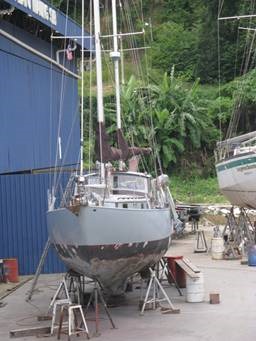
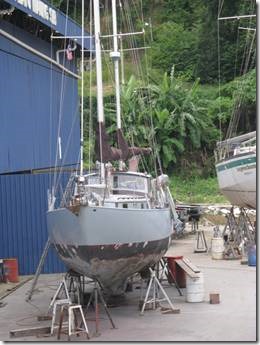
(And I don’t have a better photo of Labarque either)

TWO MONTHS IN INDONESIA

In 1990 we bought Labarque in Turkey. Although she was then 24 years old and had recently suffered a hard life in the charter business, we thought she had potential as an ocean cruising yacht. Of very heavy displacement, with a long-keeled steel hull, big fixed propeller, ketch rig, wheelhouse and teak decks, she’ll never win a race. But she’s proven a safe and comfortable home and we’ve now sailed her just over 100,000 miles.

From Turkey we delivered Labarque to England via the French Canals. Following a daunting refit, we at last set off for Vancouver in 1993. After an extended stay in Canada, we sailed for New Zealand in 1996, returning to Vancouver in 1998. From 1999-2001 we again sailed to New Zealand and back to Vancouver. In 2002-3 we did a one-year excursion to Alaska via Hawaii. We set off yet again for New Zealand in 2004, this time continuing westwards to Australia, Indonesia, Malaysia and Brunei. The following is an account of our adventures as part of the 2007 Sail Indonesia Rally from Darwin to Singapore.

Our four day voyage from Darwin was plagued with calms and very light winds and we had to motor for some 40 hours just to keep up with the tail end of the Rally fleet. In contrast, the final approach to Kupang, West Timor, was enlivened by a strong, contrary sea breeze. The crew of a heavy schooner called for help on the radio because their engine had broken and they could make little progress under sail. We towed them under power for the last few miles into the anchorage. Labarque is certainly not a high-performance sailing machine, but she’s a terrific tugboat. The Rally is not supposed to be a race, but there’s still a competitive element. Many yachts arrived a day or more ahead of us, some crews announcing that they’d sailed all the way. But some of those yachts were subsequently refuelled with suspiciously large volumes of diesel. We smelt a rat, but were perhaps just jealous.

We’d just left Darwin when we heard that Indonesian Customs and Excise had unexpectedly started to demand a (theoretically refundable) cash bond equivalent to 5% of a visiting yacht’s assessed value. We therefore made swift and sudden plans to avoid Indonesia entirely. But then we were assured that Rally yachts were exempted from the new rules. Cash bonds were demanded from other visiting yachts, all of which scattered rather than pay up. The bonds were then scrapped for a fortnight, before being mysteriously re-introduced at a 50% rate. One yacht caught by the new rules cunningly elected to join the Rally (for the standard AUS $450) after which officialdom left them alone. Still later, the regulations changed yet again and we’ve since been told that now a refundable duty is (sometimes) demanded of between a fifth and a half of the yacht’s value (accounts differ). We doubt that there will ever be any takers.

While Customs was doing its utmost to repel foreign yachts, across the corridors of power the Ministry of Tourism was struggling to attract visitors to what it calls “tourism objects”. (We politely objected to the phrase and suggested they substitute “attractions” or “destinations” instead.) The Ministry would obviously like the world to forget about the Indonesian army’s controversial interventions into East Timor. But the Indonesian army is not a shy and retiring organization. The gateposts of a downtown barracks in Kupang are decorated with a pair of enormous concrete grenades, realistically painted and complete with pins. Many governments still recommend that their nationals stay away from Indonesia and West Timor in particular. So how could the region be promoted as a safe and interesting tourism object for foreign visitors?

One conclusion was apparently to pull out all the stops (but fortunately not the pins) for the participants of the Sail Indonesia Rally. We were to be guinea pigs for an embryonic tourist industry and ambassadors to spread the word. As guinea-pig ambassadors, we can report that there are a lot of interesting things to see. The highlights were a Gala Dinner with the Governor, followed by a Cultural Show (including a rather good pop singer from Jakarta, memorable in kinky boots) plus two 15 hour bus trips to the mountains and the last Animist village in West Timor. A Police escort with wailing sirens preceded the convoy of 10 buses; four ambulances followed in case of accident or illness. The main road from Kupang was in good repair, doubtless because it was the supply route for the fighting in East Timor. But the side roads were awful. We gently suggested to our hosts that although their current batch of guinea-pigs were well used to long hours of mild discomfort at little more than walking pace, others might find this sort of endurance sightseeing a bit exhausting. But for us it was a magical experience. The villages through which we passed had clearly seen nothing like it, except perhaps when the buses were full of soldiers. At every stop a little toilet block had been freshly built for our convenience, supplied by a water tanker. And at every stop the honoured guests were individually presented with beautiful hand-woven scarves (ikats).

Kupang is where Captain Bligh first came ashore after being ejected from HMS Bounty in 1787. These days the city is a noisy, dusty, chaotic muddle, but none the worse for that. There are so few tourists that it’s impossible to walk a city street without constant greetings of “Hello Mister! Hello Missus!, Where you from? England? David Beckham, Wayne Rooney, Chelsea, Liverpool, Arsenal, Manchester United!” There was no doubting the enthusiasm. Small motorcycles and bemos (pronounced “bee-moes”) choke the roads. Bemos are small usually Suzuki vans, individually named and elaborately painted. The windscreens of many are decorated with such a profusion of opaque transfers, furry toy animals and convex shaving mirrors that the driver has to peer through a narrow slot. On most bemos the horn has been modified to sound like a machine gun. All bemo drivers sound their horns continuously to advertise their presence to other road users, to drum up custom from pedestrians and to pretend they are shooting down the bemo in front. No road rules are apparent, except for a vague tendency to drive on the left. Fortunately, everything happens so slowly that serious accidents are less common than might be expected. But one Rally participant hired a motorcycle, crashed through the windscreen of a bemo and broke his pelvis. An air ambulance flew him back to Darwin.

Thoroughly Kupanged, we sailed for Kalabahi, the capital of Alor. The island’s bemo drivers had evidently completed bemoantic training in Kupang as the little town rang to the sound of simulated machine-gun fire. The main event was the Alor Expo, an annual festival of music, weaving and traditional dance, combined with serious efforts to promote the island to foreign investors. Tourists seemed rare and the local population genuinely pleased to see us. This was less the case in Lembata, the next scheduled island on our way west. From a scruffy anchorage near Lewoleba it took us three rough and dusty hours by open-sided truck to get to Lamalera on the south coast. Here, brave madmen still kill whales and dolphins with primitive harpoons hurled from canoes. Japanese film crews have descended on the place, presumably to stir up some positive spin on whaling. But the Japanese have worn out their welcome and ours. For us this village was the only unfriendly place in Indonesia. The truck seemed even dustier on the way home.

After sluicing off Lamalera, we sailed away to Maumere on Flores Island. Maumere was almost completely flattened by an earthquake in 1992, but by 2007 the city had been at least partially rebuilt. To mark the 62nd Anniversary of Independence on the 17th August 1945 (when the occupying Japanese threw in the towel, although the Dutch didn’t reluctantly follow suit until 1949) there were formal celebrations to which Rally participants were invited. In the presence of scores of dignitaries, expertly drilled paramilitaries in white uniforms (actually high-school children in disguise) spent 90 (interminable) minutes raising the red and white national flag that had originally been created by ripping off the blue stripe from the flag of the Dutch colonists. Noisy and slightly erratic American-style drum majorettes accompanied the performance. They seemed bizarrely out of place but gorgeous in their day-glo suits, Napoleonic hats, fluffy pom-poms and decidedly kinky boots. Sensing our bewilderment, our guide suggested that we hurriedly move on to his nearby village for an Independence Day party. Here the events included a canoe race, sack races for the young, pea/spoon races for the younger and a tug-of-war (known locally as a ‘string-pull’). With the village string-pull champions decided, the visiting boat-people were challenged. To universal astonishment, we won two string-pulls in a row, helped by arms that had spent the last few weeks working winches. But our Ladies’ team was soundly defeated and so an honourable draw declared. The highlight of the celebrations was a competition to climb three 10 metre vertical poles at the top of which were a selection of prizes. But the poles were heavily greased. The victorious visiting string-pull team was politely offered the chance to try first, but sensibly we declined. In pursuit of the prizes, squads of increasingly filthy young men formed teetering pyramids and slowly inched upwards until invariably a component failed and the team collapsed into a heap. But after about half an hour, enough of the grease on one of the poles was transferred onto the assailants and the heights were triumphantly reached.

Indonesia is the world’s largest Muslim nation, but the island of Flores is four-fifths Catholic. Improvising brilliantly, the local Regent suggested that Rally yachts anchor off the village of Maurole to help celebrate the ordination of five new Catholic priests at the local church. It took some convincing to persuade the Rally organisers that such a tiny village could provide facilities and diversions for up to 124 yachts, but in the event Maurole (and the Regent) succeeded triumphantly. Catholicism in Flores seems much jollier than the Irish version. The new priests were led in by dancing girls and their surplices featured traditional woven designs made by their families. One parishioner explained: “We’re all completely Catholic, of course. But most of us completely believe in the old ways too”. Tours were later laid on to other nearby villages. One is locally famous for making arak (an expertly-distilled palm liquor), another for a sweet brown sugar made from palm sap using “extinct tools” – which we interpreted as meaning traditional methods. On another day, we tried our hand at teaching geography, mathematics and English at two nearby primary schools and then went on to two more villages. At each our welcome was almost overwhelming. We also took a tour to the coloured crater lakes of Kelimutu, passing a magnificent valley of terraced rice paddies on the way. The terraces took centuries to build and must be resilient to have survived the periodic earthquakes that shake Flores.

From Maurole we sailed 260 miles to Makassar, the capital of Sulawesi. The local Bugis people are traditional seafarers (and allegedly recently-retired pirates) whom are apparently thought brash and aggressive by other Indonesians. They are also credited with inventing a hair oil which stained furniture and thus led directly to the development of lace antimacassars. Makassar is now a humming and sophisticated metropolis. Only twelve Rally yachts made the trip, but the city was too busy to notice. The national Jet-Ski championships were (loudly) underway and the last stage of the Indonesian Car Rally was held nearby. Transport was easy, as there were hundreds of bemos (locally called pete-petes) and thousands of pedal-powered tricycle rickshaws (becaks) cluttering the pavements and swerving slowly amongst the traffic. Becak passengers sit up front and act as primitive air-bags in the event of a head-on collision. Undaunted, we took a becak to visit an enormous air-conditioned shopping mall where Manchester United credit cards were heavily promoted. Meanwhile, just a mile away, the fishing harbour was the authentic, teeming, cheerful, reeking shambles we’d been expecting. Few sounds are more evocative than the explosive bark of twin un-silenced diesels in a Bugis fishing boat. With our ears still ringing, we set off south in search of a dragon.

The Komodo dragon is the world’s largest lizard. For us the official tours are prohibitively expensive and so we decided to cheat. We sailed to Komodo first, but saw only a wild pig snuffling in the sand. So we moved on to Rinca Island, close by to the east. And there, parading with dignity along the beach like a digital extra from Lord of the Rings, was an enormous dragon. I must have been at least three metres long from nose to tail. The crew of one yacht on the Rally returned from an official tour on Rinca to find their aluminium dinghy heavily occupied by a dozing dragon. They had to wait politely for a considerable time before it woke up and sleepily moved on. In similar circumstances our inflatable dinghy would have been torn to shreds. Counting ourselves lucky, we ticked the box marked ‘Dragons’ and sailed for Bali.

For the first time the 2007 Rally stopped on the north shore of Bali at Lovina, a long way from the surfing beaches and nightclubs of Kuta in the south. A terrific show of Balinese dancing was presented on the beach, with a backdrop of some 120 anchored yachts. Later we hired a car to explore the local sights, including a rather beautiful Hindu temple near the centre of the island. But our time in Indonesia was fast running out.

At considerable expense we’d purchased Labarque a three month Indonesian Yacht Cruising Permit in Darwin, but we could only stay for two months on ‘social visas’ that cost AUS$60 each. Applicants for a social visa need an approved ‘sponsor’ to vouch for them. The Rally organisers acted as our sponsor and so that particular hurdle was easy. But after eight days in Bali our 60 days were up and rather than pay for two new 60-day social visas (of which we could only use 30 days because Labarque’s non-renewable Cruising Permit would then expire) we decided to move on. At the latest we had to leave on the Monday, so the previous Thursday we’d handed in our passports, expecting them back the next day.

We hate it when officials take away our passports. Of all the 34 countries we’ve visited aboard Labarque, only the Cape Verde Islands (in 1993) and Indonesia have insisted. Friday came and went, and of course little happens at the weekend. Nothing happened on Monday either and it wasn’t until the Wednesday morning that our passports reappeared. By then there had been another development. Friends on another yacht had just suffered a broken gearbox. We suggested that they sail with us so that we could escort (and when necessary tow) them to Singapore for repairs. Then there were yet further complications. The Indonesian Immigration Service pointed out that we’d over-stayed our visas and were therefore liable to fines totalling 800,000 Rupiah (AUS$125). “But hang on” we said. “We couldn’t leave on Monday because you had our passports.” “The reason for the over-stay is irrelevant” they said. Although 800,000 Rupiah is not a huge amount of money, we were determined to make them work for it. By the Wednesday afternoon, “frank, bordering on direct” discussions had been going for six hours when at last they relented (stamping our passports for the previous Sunday) and we were cleared to depart.

Thus it wasn’t until the Thursday that we finally set off in Labarque with our friend’s Invictus IV (swiftly renamed La Barge) in tow. Two months earlier we’d towed one yacht into Indonesia and now we were towing another one out. When the wind blew (albeit feebly) we cast off La Barge to sail in company, although Invictus IV had to be heavily reefed to travel sufficiently slowly. This was further proof (as if proof were needed) that Labarque is a dismal sailing machine, especially in light airs. But after 146 hours of ponderous sailing, 65 hours of towing and a total of 960 miles, we’d together crossed the (shockingly busy) Singapore Straits and arrived at Raffles Marina in Singapore. Invictus IV now has a new engine and is well on her way back home to America.

In 2008 we sailed north to Penang and Langkawi before heading for Sarawak, Sabah, and of course the warm welcome always offered by the Royal Brunei Yacht Club. This year we explored Phuket in Thailand before returning to our favourite destinations in Borneo. We expect to be hovering around these parts for a while yet.

Patrick Southall & Elizabeth Fowler

Yacht Labarque

August 2009.

Last segment of the George Town story…for now

Hi Everyone,

   This is the final installment my George Town day with Elizabeth.  I totally enjoyed my day with Elizabeth, and writing these emails, I’ve learned even more as I try to explain the meaning of each photo.  We certainly will return to George Town and I can act as guide to Randal!  (Though no where near as good as Elizabeth!!)
Armenian Street

I have pulled the bits and pieces from the several pages about Armenian Street that I thought matched the time we spent there and my own bit of knowledge. Khoo Su Nin did a really wonderful job with Streets of George Town Penang. An interesting footnote is that she is a graduate of Duke University in Durham, North Carolina. 

“A map of the early 1800s shows that Armenian Street was once called Malay Lane due to the Malay kampong settlement there. By 1808, the name had been changed to Armenian Lane. The Armenian trading community from India settled here, but instead of remaining in a neighbourhood between the Chulias and the Acehnese, sought social mobility by moving their houses to the suburbs…” “… the Armenian diaspora that settled in Shiraz in Persia, and then in Bombay and Calcutta before coming to Penang.” “….by far the most famous Armenians in the region were the Sarkies brothers who made their mark as hoteliers of the Eastern & Oriental in Penang and of the Raffles in Singapore. By the 1920s most of the Penang Armenians had emigrated largely to Singapore and from there to Hong Kong and Sydney where there are significant Armenian minorities.” “A few houses on Armenian Street may have survived from the time when the Armenians lived here. These houses were probably retrofitted to function like shophouses when the Straits Chinese took over the neighborhood.” Streets 

clip_image002

Armenian Street.

Elizabeth and I visited the Galeri Seni Mutiara on Armenian Street looking for art. But trying to tell that story led me to read about Armenian Street in general. In many ways Armenian Street is the history of the world of southeast Asia including Malays, Armenians, Chinese: the fleeing populations and their success stories. Neighborhoods changed as different groups moved in and out for different reasons, like moving “up to the suburbs” or even to other parts of Asia and the Pacific. The Armenian story and the Jewish story in this area are very similar both coming along the trade route from India. And if you have ever had a Singapore Sling, you have a connection to Raffles Hotel where the drink was invented and now costs more than most cruisers will spend for an entire meal almost anywhere else.

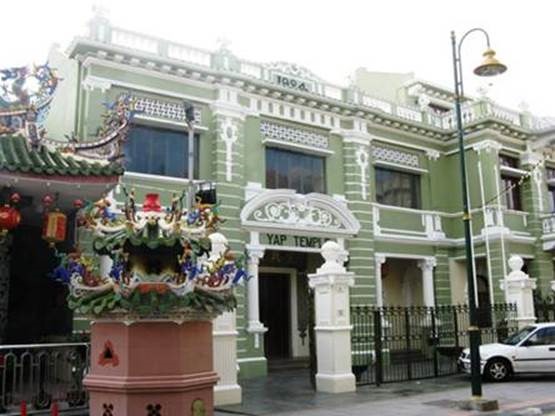
Also on Armenian Street were an Islamic Museum, closed for the holiday;  the lovely green and white Yap Kongsi building and temple; and the shophouse that was Sun Yat Sen’s base in Penang.

clip_image004

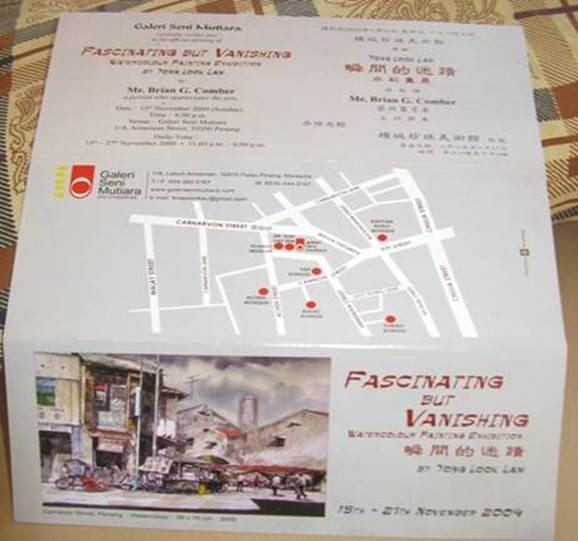
Galeri Seni Mutiara’s exhibit the day we visited.

I don’t know if there was a “no photo” sign or if I just made the assumption that photos weren’t a good idea so I have none. This is a photo of the exhibit brochure. Elizabeth and I went into the gallery housed in a lovely, very large renovated shophouse. We looked at the paintings and were about to leave when Elizabeth went back to ask the owner for a brochure of the exhibit. Until that time he had been talking with a gentleman whom he seemed to know pretty well and I didn’t want to interrupt and really didn’t know what I would say, anyway. Elizabeth’s question and her comment that I was studying watercolor seemed to capture his attention. Mr. Koay Soo Kau provided a brochure and then sat with us for the next 30 minutes chatting about art, George Town, Malaysia, Dickens, Shakespeare and a local artist that Elizabeth had met years ago. He offered us something to drink. He showed us painting from past exhibits and then, a real treat, some of his own paintings. We probably would have been sitting there still but work intervened. It seemed a rather involved transaction concerning the buying and selling of a quite large painting so Elizabeth and I nodded our good-bye and thank-you and went on our way. I had planned to take a photo of Elizabeth with Mr. Koay since they seemed to have so much in common, Elizabeth taught English and Mr. Koay had loved studying it. He made us guess his age and we were flattered that he thought we were younger than he was. He beat us by maybe a year or two but that was it. A very charming man dedicated to art and helping new artists succeed. If you look at the website, under the artist link, select Gallery Artists and you can see My Koay’s work. http://www.galerisenimutiara.com/gallery1.php

Under the Events link you can see the works of Yong Look Law whose works were hanging in the gallery when we visited. http://www.galerisenimutiara.com/events.php

www.galerisenimutiara.com

clip_image006

Yap Temple and the lovely green and white Yap Kongsi at the corner of Armenian and Cannon Streets.

The Yap Kongsi was built in 1924, the temple in 1950 and refurbished in the 1990s. Judging from this photo I was obviously taken much more by the green and white building than by the temple which only gets one small corner of my photo. Now that I have read more about it, I wish I’d taken a better photo. But it was getting to be late afternoon and I was getting tired.

We left the gallery about 4:30 and I was starting to wear down and was definitely getting hungry. It had been a while since our chocolate samples and no matter what time we would leave George Town later in the afternoon, it would be at least an hour on the bus to get back to our boats. And we still needed to visit the Jewish Cemetery. Time for food! We stopped along our way at a small corner restaurant (open on the holiday because it was Chinese) and had small meals that oddly included the best French fries in the world.

clip_image008

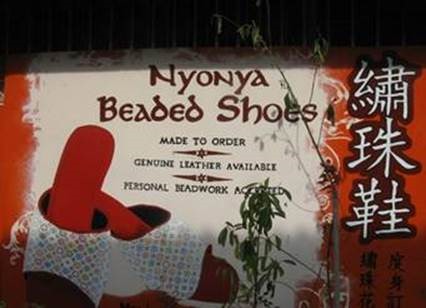
Nyonya is a term for the descendants of late 15th and 16th century Chinese immigrants to other parts of Southeast Asia during the Colonial era.  (I think.)

There is a whole way of dress connected to the Straits Chinese and the Nyonyas. Beaded shoes would have fit perfectly with the long silky/satin skirts and fitted beaded jackets.

clip_image010

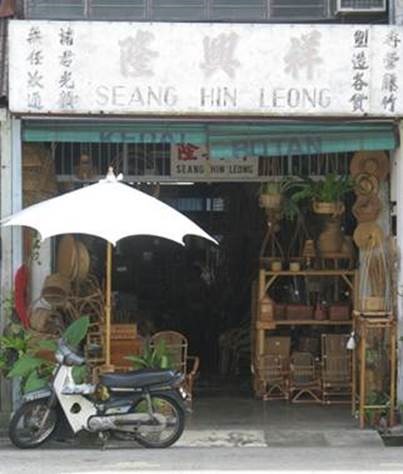
A shop passed along our way.

Our last stop was to the Jewish Cemetery and then we splurged and took a taxi back to Batu Maung because we were both just too tired to wait for the bus and then sit through the 90 minute ride and then walk up the hill to the yard. As it was we didn’t return to the boats until about 6:30 pm. But it had been a wonderful day of unplanned adventures. Oh, and somewhere along the way we stopped at a Heritage Center where the employee had time for us and that’s where I bought my copy of Streets and I’m really glad I did because reading it has taught me a lot about Penang and George Town.  Now when Elizabeth points out places and tells me about Penang, I think I might be a better pupil.

Ru

Doramac

George Town Tour continues

Hi Everyone,

  Randal and I went off to a Rally event yesterday and had our first glimse of mainland Langkawi.  The last event is the final dinner tomorrow evening.  In the morning we’ll take the free Rebak Marina high speed motor ferry to the mainland for the veggie man.  He makes a stop near where we arrive.  He comes once each week on Friday so we’ll load up.

Ru

The Penang Chocolate Mansion

  One last bit of information about the tea shop, its web address: www.e-art2u.com. The web site explains the philosophy of the group of businessmen who bought and renovated the historic building and now want to support and promote local artists of Penang. And I realize now that the young man who served us tea is not the owner, Datuk Seri* Tan Khoon Hai, but does look quite a bit like him so might be related. *an honorary title awarded by the State. The official opening was in November of 2008 so it is an historic building with a new purpose.

We walked to the end of Muntri Street which is the home to many Chinese Associations and Guilds. My favorite bit of information concerns the Chinese amahs. The association of Chan, Seng, Thong, Heong and Wooi surnames represent a joint association formed by a small group of Chinese with these surnames in Penang. A look at the pictures hanging on the wall (in the association building) reveals that the members are predominantly amahs. In the 1930s, these Cantonese women migrated in waves to Malaysia and Singapore to work for wealthy European and Chinese households. The “black-and-white” Cantonese amahs had impeccable reputations as live-in nannies, servants and cooks. Upright and frugal, they wore a uniform of white top and black pants, keeping their own moral cold, foreswearing marriage and family life to join the sisterhood. Careers as overseas amahs were an alternative to the peasant’s life in China and potential oppression by husbands and mothers-in-law. …Streets of George Town Penang The book continues talking about the amahs who have now reached old age and though some have returned to China, many remain in George Town in “shared quarters.” I think it’s really interesting how they chose their lives. Women in the silk industry did the same thing, becoming a sisterhood as well as co-workers. It definitely makes me want to know more about them and I will find out more when we return to Penang.

clip_image002

An example of a Chinese Association building on Muntri Street.

We did get to eat chocolate and I will tell you about it, but before the chocolate tasting came the incense burning. I needed to light more incense for the Red Sox since I had redirected my prior Sox incense wishes toward the solution of our fishing net mishap. Sometimes my priorities are straight. However, when I looked at my photos I couldn’t remember the name of the temple. I could sort of remember things by the order of the photos, but then I mixed up in my head what Elizabeth had told me about the different temples we had seen. So I dashed off a quick, “Help!” email to E and this is her charming reply. ….

I tried to find out about the George Town name at the Penang Heritage Centre

but after waiting for more than ten minutes when the employees didn’t

interrupt their conversations, I left, so I have no official ruling on

the name.

The Temple by the joss stick maker is the Goddess of Mercy Temple. It

has the incense and pigeons. The one where you lit the joss sticks is

the Hainan Temple on Muntri Street. It is also called the Thean Ho

Keong meaning “Temple of the Heavenly Queen”. Apparently it was

founded in 1866 and is dedicated to the goddess Mar Choo, patron saint

of seafarers. It was renovated in 1995. Part of its charm is the

natural lighting and that it is off the main tourist track. (I’ve

taken this from the black Historic George Town Trails booklet which is

the one with the black cover. There should be more information in the

Penang book).

Hope that helps.

Cheers from rust. LBD is now so well fed by the children that our

scraps are refused until she wants a late snack.

You can see why Elizabeth was such a great guide: I just wasn’t a very apt pupil.

clip_image004

The natural lighting.

The Streets book did add that a few more facts, the most interesting being that “Goats are slaughtered in offering to the goddess on her birthday.”

clip_image006

The man from the temple walked around with me since I really didn’t know exactly what to do.

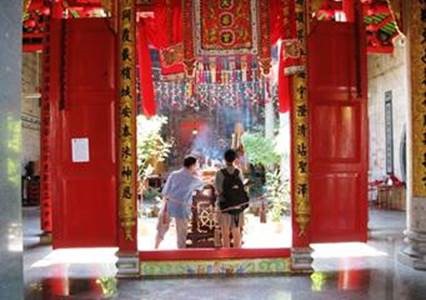
I bought a pack of 15 incense sticks and then proceeded around the temple stopping at different spots to light the incense. It actually isn’t a complicated process once you have done it one or two times; and most temples have a similar procedure. I just do it so infrequently, though my real hesitation comes from feeling that I might be infringing on someone else’s religion for my non-religious reasons. However, one pays for the incense so I guess it goes for the upkeep of the temples and the temple workers are always gracious and helpful.

clip_image008

I think I’m at the third stop now.

clip_image010

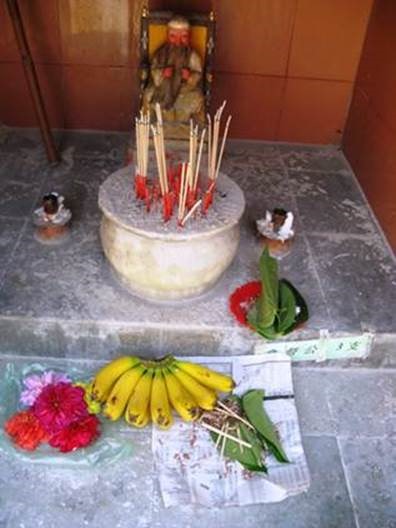
Some of those sticks are mine.

clip_image012

I’m at the last stop to put in my last batch of incense.

I’m parading around in my socks: you always remove your shoes to enter a temple unless told otherwise as well as at many museums and even some shops.

clip_image014

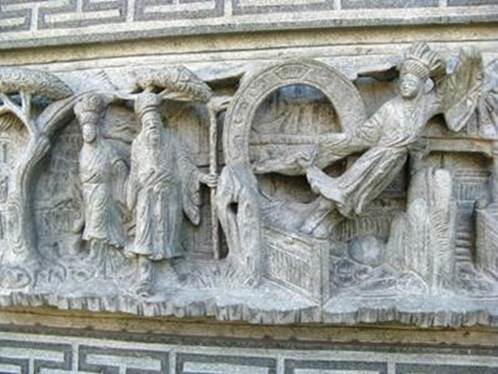
There were stone carved reliefs were on the outside temple walls. We were told that the stone came from China though I’m not sure where the carving was done.

All of the photos of the temple that I’m in were taken by Elizabeth

Then we were off again. I don’t remember if we were aiming for the Chocolate Mansion or the “Blue House,” but the Mansion came first so we forced ourselves to go in.

clip_image016

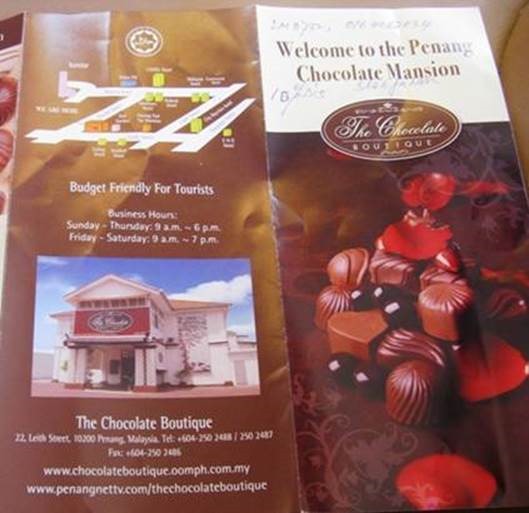
This is the brochure: they were generous with the samples but didn’t allow photos.

We sampled away as our “guide” tempted us with a variety of the locally made chocolate. My favorite, believe it or not, was the chili chocolate. It had such a strong and unique flavor that you wouldn’t need much to be satisfied. Then we went to the coffee tasting room. My favorite was the mixture of tea and coffee. Oddly very good. But the prices weren’t tempting and anything we bought would have been a melted mess by the time we returned to the boats. And after all of the samples I felt pretty chocolated out for a while. Randal is satisfied with a cheapo Snickers bar and I can get by with a teaspoon full of Nutella. We’re such gourmands (if that’s the right word.) Full and no poorer for our treat, we left!

www.chocolateboutique.oomph.com.my and www.penangnettv.com/thechocolateboutique are the two web addresses listed on the back of the brochure.

This bit on the brochure struck me as funny. “Visit Malaysian Collection” “How do you know you’ve been in Malaysia? With those mouth-watering chocolates in the shape of Malaysian symbolic architecture now you can bring “Malaysia” home. “ Somehow that’s just a funny image to me, eating the places that you just visited. (During our visit to Langkawi yesterday, one of the Rally stops was a similar Chocolate shop with the same chocolate and same sample tastings. I still didn’t buy any. Earlier in the day Randal had bought some good ole Hershey Almond Kisses and that was more chocolate than we needed.)

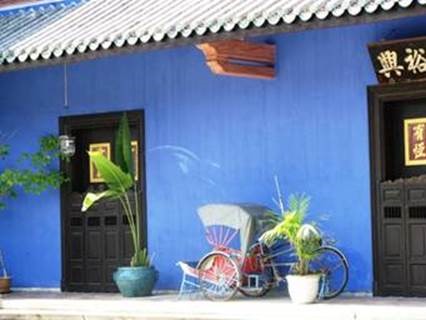
One last stop for this email. Next along Leith St. was the “Blue House.”

clip_image018

Very blue.

The Cheong Fatt Tze Mansion rates two full pages in Streets. Unfortunately, when we got there, we learned that the next tour wouldn’t be for about an hour. Elizabeth had already been and my priority was to see the Jewish cemetery and some art, so I put it off for our next visit to Penang when Randal could see it too.

However, here is an interesting bit about Leith Street:

“At the turn of the century, Leith Street was “Hakka Millionaire’s Row “    Streets

“When the term “Hakka” first appeared in household registries during the Song Dynasty, it was used to indicate “guests” who had left their homelands to settle down in other parts of the country, in contrast to residents originally from the area. The Hakkas took to the road in five separate major migrations. The nickname “Jews of Asia” intimates these mass migrations and their pioneering spirit.” http://edu.ocac.gov.tw/lang/hakka/english/a/a.htm The Overseas Compatriot Affairs Commission of Taiwan provided this info. It’s amazing what I learn trying to explain bits of information to all of you.

I have one last story to tell, and anything else that pops up I forgot for my final (for now) George Town email. I hope to have lots more to share about Penang and George Town when we make return visits, possibly late this year and definitely next year.

Ru

DoraMac

George Town tour continued at the tea house

December 8, 2009 Rebak Marina, Langkawi, Malaysia

Continuing our George Town tour….  (We noticed that the city spells its name George Town and the highway department spells it Georgetown.  We were guessing one is local and one is federal)

clip_image002

Jin Xiu Art Gallery and Tea House 58 Muntri Street, George Town

clip_image004

It was lovely, cool and very relaxing.

clip_image006

Elizabeth going through her mail while we wait to order.

We ordered Puer tea which is a milder tea better to drink on  an “empty” stomach.

Although it was around lunch time, our second breakfast that morning kept us from being hungry for lunch. We were just tired and thirsty and tea was just the thing. The owner recommended puer tea. I remembered Stella (from Seahorse Marine) mentioning it when we were in China and also, the calligraphy teacher of Jingan had served puer tea to Sallie and me.

One of our stops earlier in the day was at the marina in George Town. E and P had stayed there for a bit and were having mail sent to them in care of the marina. That’s how cruisers receive mail and shipments. If you are lucky, mail/shipments will arrive on time; if not there are different options. You can wait for it to arrive. You can leave and hope other cruisers will retrieve it and bring it along to you. It can be sent back to its place of origination. ….. Usually though, if you stay at a marina for a month or so, your mail or package will arrive during that time. Other confusing things can happen when a resort and marina share a complex and the package doesn’t go to the marina office but rather to the resort front desk where often staff won’t sign for it. (No matter that you specifically asked that it be delivered to the MARINA OFFICE.)  We had that happen in KK. 

clip_image008

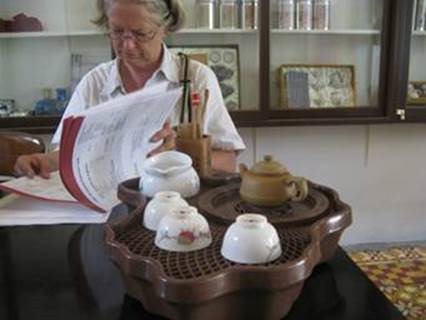
Our tea is being brewed for us.

I asked this young man how he came to be involved in the tea business and he said that serving tea was an art and that’s what attracted him to it.

clip_image010

There is an art to brewing, serving, and drinking tea. The tiny pot is refilled from the never empty glass pot of boiling water which is kept hot over a small candle. Boiling water is poured over the tiny ceramic pot to keep it hot. You drink from tiny cups, but if your tea gets cold you can pour it into the base of the tea tray through the slots and take more tea. And the cup nearest you actually belongs to the person opposite from you. I always mixed that up so we just drank from the cup nearest to us. I had experienced much of this in China acting as tour guide around Jingan for other visitors.  Everyone who visited wanted to buy tea pots and tea so we visited all the shops and drank lots of tea in similar tea “ceremonies”. But it is always a welcomed treat.

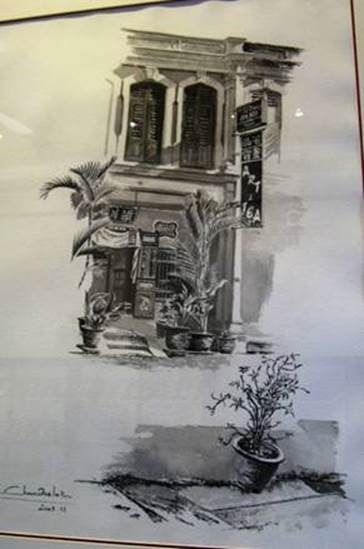
This tea house is also an art gallery. The current exhibit was the works of Charles Chauderlot.

www.charleschauderlot.com is his really fascinating web site

clip_image012

The exhibit was called Memories in Ink (of Penang) done in Chinese ink and brush.

clip_image014

Same temple, different view and nowhere near as interesting. You can see the large pink joss sticks on the right side of the photo since we are on the side street between the temple and the row of shops. At least I think it’s the same temple: I do remember the pigeons.

clip_image016

I’ve obviously cropped this and it’s off kilter, but you can still see how wonderful it is.

Mr. Chauderlot was invited by the Chinese to paint usually restricted parts of the Forbidden City and was later commissioned by the government of Macau to capture the city with his art. Had we been in the tea shop the previous day we would have met him at the opening of the exhibit. RATS!

clip_image018

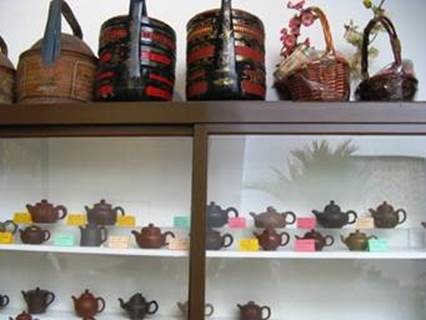
A collection or priceless teapots! Tea pot warmers are on the top shelf.

clip_image020

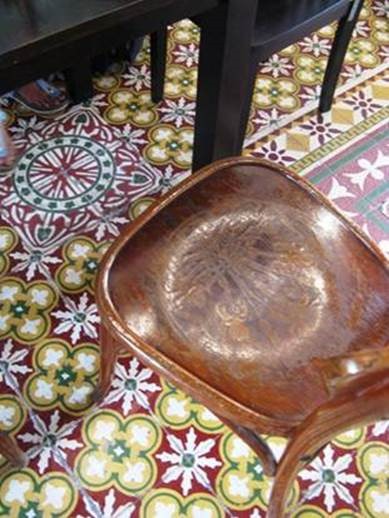
Everything was decorative, even the chair seats if you can see the carving.

clip_image022

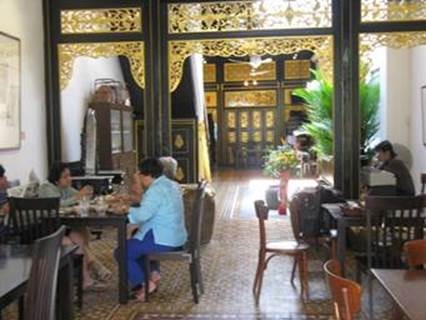
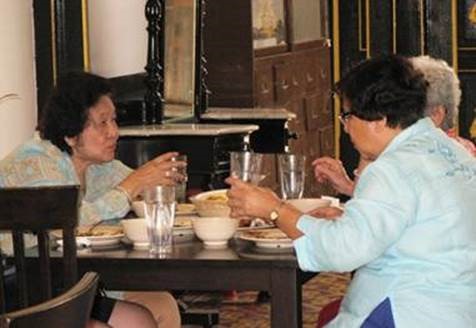
Local ladies having lunch. They gave us smiles as we left.

clip_image024

Looking out to the street.

We had a wonderful time, drank lots of tea, lots and lots of tea…and then refreshed we moved along to see what we would see. And what we would see would involve eating chocolate! And that will have to be left for another email.

Ru

DoraMac

ps: Tomorrow we’re off with a Rally tour of Langkawi for the day.  We take a small marina ferry for the short trip to the mainland and then join the Rally bus for a tour and lunch.  For the past two and a half days Randal and I have done nothing but clean the boat.  Randal works outside and I clean inside.  We’re both looking forward to a day off.  I stil have to clean the forward cabin, aft cabin and the galley. (It took me two days just to clean both “heads” and the entire saloon. To let air circulate many of the cabinet doors and the bottom half of the “head” doors have slats and getting the dust out of those slats takes forever.  I found that if you wet a rag and drape it over a small spatular, you can get that between the slats and rub it back and forth several times.  Takes forever!)   Both of us will clean the pilot house.  Because of the salt, boat yard grit, and just life we have to clean from floor to ceiling and everything in between.  But then I can ignore it for another several months of so, at least this heave duty cleaning.  Is it baseball season yet?

pps: Sorry about the missing photo of Mr. Lee, the joss stick maker.  It was in the email before I sent it.   But it wasn’t mine anyway so I guess the fact that it disappeared is fair.  

George Town part 1

Thanks in large part to Elizabeth being such a wonderful guide I was able to see many interesting bits of George Town in the very short time we were in Penang. ( I should also thank Patrick for parting with Elizabeth’s help for the day and Randal who always encourages me to see the sights while he tends to boat needs.) Please, Elizabeth, correct me where I go wrong or totally make things up!

Elizabeth and Ruth drink tea, eat chocolate and meet an artist.

Our second Friday at the boat yard, Elizabeth was able to take time to guide me around George Town. Randal decided to go along with us, not to sight see, but to get some boat supplies. That Friday, unbeknownst to us, was the first day of Hari Raya Qurban, a Malaysian Islamic national holiday so all museums, some retail shops, and even most Muslim restaurants were closed. That didn’t spoil Elizabeth’s and my day at all but Randal, who had just come for one specific shop went home early and mostly empty handed. For Elizabeth and me, the holiday closings created the opportunity for different adventures.

Our first stop in George Town always being a second breakfast, we headed to our favorite Muslim restaurant only to find it closed for the holiday. As we toured the streets to find another, we ran into our good friend Ian from Reeflections II. We had first met Ian and his wife Robin in Sebana Cove at a dockside happy hour. Robin is the nurse who took care of me when I had my bout of food poisoning. We reconnected with them in Singapore and at that time Ian was the hero for climbing our mast several times to fix our anchor light. They were now in the marina in George Town where Robin was recovering from knee surgery performed at the local hospital. We ate breakfast with Ian and afterwards he and Randal went off for boat stuff and Elizabeth and I went off to see George Town. Had there been no holiday, our favorite green and yellow restaurant would have been open and we might not have met Ian.

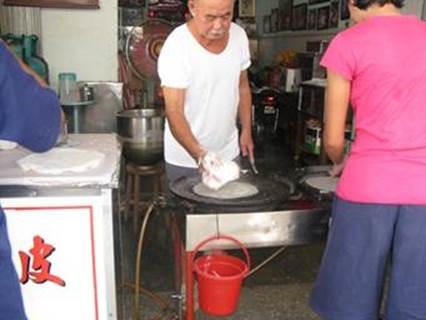
On our way to find breakfast we passed by a man making popiah on Chowrasta Road. He makes them from 8 to 11 on weekdays. Like most shops, this one opens out to the road so you can watch the work being done: an interesting way to advertise.

clip_image002

Step one

clip_image004

Step two

clip_image006

Step three

“Popiah in Hokkien dialect translates to Spring Roll. If you’ve ever wondered how spring roll wrap is made, then this is the place to watch and learn. The owner can make a minimum of 15 pieces of spring roll wrap per minute! For those who aren’t familiar with the history of popiah or spring rolls. This ever popular dish has its origins in Northern China sometime during the Qing Dynasty to celebrate the good harvest. The Chinese believe that the new year’s cycle begins with Spring when everything comes alive after the cold, harsh winter. The original spring roll filling was made mainly out of fresh vegetables collected from the year’s first harvest, sliced, cooked and wrapped in thin dough” http://www.journeymalaysia.com/MI_penang3.htm provided the info: the photos are mine.

    When I had my art classes in Singapore, I had often gone for lunch at the Maxwell Food Court in Chinatown and always ate popiah. The stall didn’t make the wraps, but made the filling and the finished roll as I stood waiting. They were wonderful.

After breakfast Elizabeth took me to see the joss maker.

clip_image008

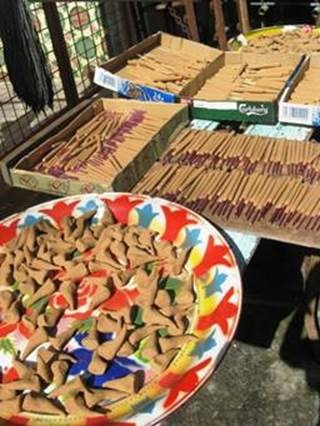
Some samples of joss

clip_image009 This is a photo of Mr. Lee but it’s from the website, he hurried away just as we arrived. We did see a box of joss sticks just like he is making in this photo.

Joss (Incense)

Unfortunately, when we got to his shop he only had time to tell us that he was off to see the doctor. But his story is really interesting.

“Mr. Lee Beng Chuan has been making joss sticks for decades now. This sprightly 60-some year old man and his wife continue to churn out joss sticks for a select group of loyal customers. Mr. Lee started out not as a joss stick maker but he was commissioned to handcraft dragon and phoenix effigies onto large joss sticks that were used for special occasions such as important Chinese festivals and birthdays. As his eyesight began to fail, he decided to switch to a labour intensive but less skilful career and hence making joss sticks instead. Today, Mr. and Mrs. Lee continue to churn out joss sticks for their very niche market. Although, Mr Lee used to produce thin jossticks – those often seen at alters in temples, he can no longer compete in pricing especially those from China and Vietnam. Instead, he makes shorter, fatter jossticks, which he says are more appropriate for his customers who many have moved away from houses and into apartments. In this way, the smaller jossticks would take a shorter time to burn and hence less smoke in the apartment.

Visitors can buy jossticks from Mr. Lee. He sells them in a variety of sizes. He will proudly show anyone interested, the process of making jossticks over and over again without missing a skip. However, Mr. Lee and wife speak only Chinese and a bit of Malay. On rainy days, Mr. Lee does other things apart from making jossticks, as the process requires quite a bit of sun. The final stages before packing is to dry the jossticks under direct sunlight for 2 days. Mr. Lee has lived in this house on this street for over 65years. He sadly reminisces days when the row of houses in which he still lives on were filled with folks working on all sorts of trades. As the younger generation went off to school and universities, they left their homes for luxuries of apartments and bigger cities. Many of the older generations went along and retired from their livelihood. Mr. Lee maintains that he and his wife would prefer to work for as long as they are able to ~ their way of life is what makes them whole.”

No. 1 Lorong Muda. Operations hours: 8.00am – 11.00am (also depending on the rain, weekdays).

http://www.journeymalaysia.com/MI_penang2.htm#5

We walked over near the Esplanade to catch the free bus that takes you around George Town.

clip_image011

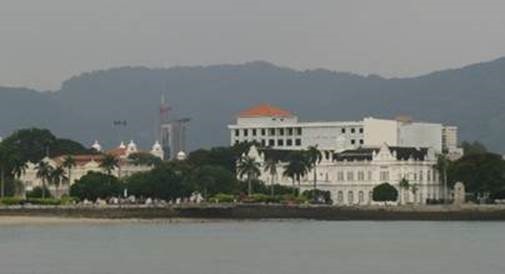
I took this photo from the boat as we passed by on our way to Langkawi. You can see the style of the government buildings along the Esplanade built by the British during the 1800s and early 1900s

clip_image013

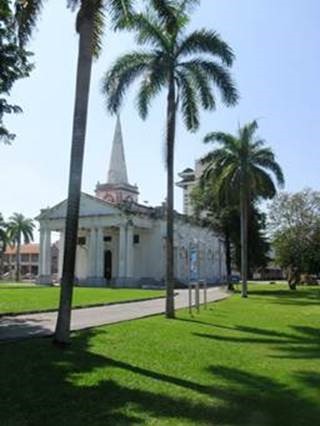
St George’s Church, dates from 1818 and is the oldest Anglican church in Malaysia.

According to http://www.tourismpenang.gov.my/heritage_st_georges_church.html it was built by Indian convicts. I think Elizabeth said it was being renovated. In any event we didn’t go in but waited just in front for the free bus that takes you around George Town.

clip_image015

Elizabeth looks at the map to plan our next stop…to find some art.

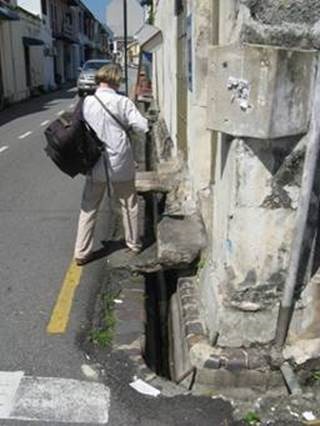
clip_image017 clip_image019

Drainage ditches ran along the sidewalks so you had to plot your way.

clip_image021

Lots of trishaws around but I would guess they are mostly for the tourists.

clip_image023

Not everything was famous but it was all lovely to look at.

clip_image025

Just wandering the small streets gives you lots to see.

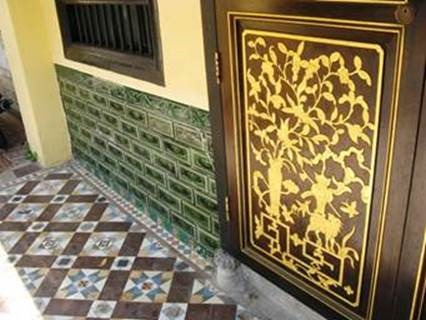
clip_image027

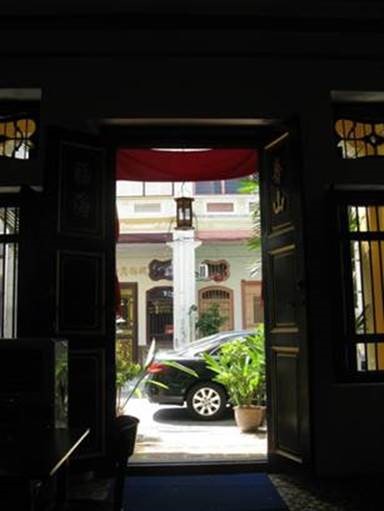
While I was noticing the lovely tile and woodwork in front of this building, Elizabeth had noticed the inside which was a tea shop. We went in for tea and also found art.

I’ll tell you about it next email…..

Ru

DoraMac