Judah Hyam Synagogue in Delhi

Hi All,

  I’ve written about the Taj Mahal and the Ganges, probably the two most recognizable names one associates with India other than Gandhi. Now I’m going to just write about the "not famous stops" of our trip, the visit to the Synagogue in Delhi, the Public Library in Jaipur, and the sugar cane field on the road back to Delhi from Haridwar.  We did see other lovely and famous structures such as the Amber Fort in Jaipur and the Mosque in Fatehpur Sikri.  And I have lots of people pictures and animal photos too.  So these India emails may go on forever…..

Ruth Johnson

DoraMac

Judah Hyam Synagogue and Ezekiel Isaac Malekar

One of my best memories of Delhi will be our visits to the Judah Hyam Synagogue and its congregation. { 2 Humayun road (Opposite the Taj Mahal Hotel: near Christian Cemetery) New Delhi – 11003, India. www.jewishdelhi.org .} I had searched the Internet for synagogues in Delhi and found the address for Judah Hyman. Our first Thursday afternoon in Delhi we asked our driver Sandeep to take us there. Sandeep knows every monument, most restaurants and hotels, and the how to drive to the airport in his sleep. But he doesn’t really know how to find something by its street address. It was also his first contact with the word “synagogue” and we made the mistake of explaining it as similar to a church and that added to the confusion for someone who is a Hindu and had never met anyone Jewish before. Because we wanted to find it and Sandeep wanted to please us, he persisted until we finally did find the synagogue exactly where my information said it would be. However, the synagogue is pretty much hidden behind a fence and only when we called the synagogue and were told to look for a blue gate and police out front did we find it.

We were greeted by Ezekiel Isaac Malekar, Honorary Secretary with warmth and instant friendship and felt truly welcomed to the synagogue. Mr. Malekar is an attorney by profession. But with no Rabbi for the small Jewish community of about 200, it is he who leads the congregation during services. And can he read fast! We were shown around the small, very lovely synagogue and invited back for the Friday night services and to hear the guest speaker. I received the following email from Ezekiel to help with the correct information about him and the speaker at the Friday night service. The talk by Retired Air Chief Marshal Nirmal Suri, a Hindu was very interesting. Before the service I spoke with two priests and later an Imam came. It was quite an amazing gathering and I wish we could have stayed after the service but we had asked Sandeep to collect us at 7:30 and the service ended at 8pm so we rushed away after some quick good-byes. The Jewish couple sitting next to me was from Staten Island and there were other Jewish tourists there also.

clip_image001

Ezekiel at Friday services

Ezekiel was so energetic and charming that you just wanted to be around him and hear what he had to say.

He had the voice of a story teller, like Eli Wiesel. We also celebrated the birthday and engagement of his daughter Shulemit to a young man from Bombay.

Ezekiel’s email….

“ I was very joyous to welcome you all to our synagogue. The name of the speaker is Air Chief Marshal Nirmal Suri, former Chief of the Air Staff who delivered talk on Inter-faith dialogue as well as explained basic universal human values (that is love, truth, peace, non-violence and righteous conduct) in Judaism and other religions. For your information, I am an attorney and voluntarily conducting the services in the synagogue as well as taking care of the synagogue and conducting Hebrew classes and maintaining library. I have also performed inter-faith weddings as well as bar and bat-mitzvah. I have been actively involved in inter-faith work for the last 30 years and representing Judaism at the national and inter-national pray meetings, seminars and conferences, etc. For my work, I am in recipient of many awards such as Ambassador of Peace award, Doctor of Jewish Welfare and Mahavir and Mahatma Award for preserving Jewish culture and identity in India. To know more about me, you may find more details on Google search by inserting my name "Ezekiel. Isaac Malekar". Last year H.H. Dalai Lama also visited the synagogue. My mission is to keep the light of Judaism burning in this part of the world and to achieve this mission, I need your blessings and good wishes.”
clip_image002

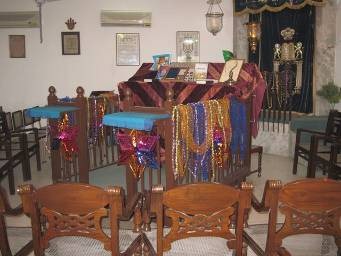
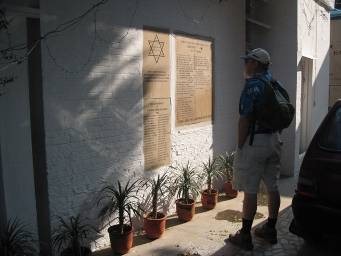
Judah Hyam Synagogue

clip_image003

Quiet on Thursday afternoon but almost full on Friday night.

Ezekiel “invited” Linda and me to sit in the front row as those seats were empty just as the talk was about to begin. It was an “invitation” we felt we couldn’t refuse. I did follow along in the Prayer Book though my Hebrew is horribly rusty and the prayers were sung to different melodies from those I remember from our synagogue in New Bedford.
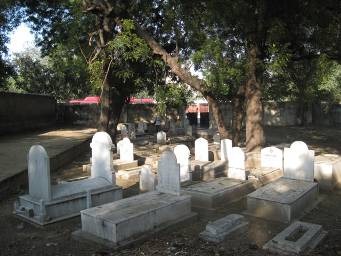
clip_image004

The cemetery next to the synagogue.

An Indian family lives in the cemetery acting as caretakers.  The man I spoke to had taken over the job after his father.  He had a daughter and perhaps she will take on the task next.  We had seen something just like this in the Jewish cemetery in George Town, Penang.  I gave his some money as a donation for the upkeep as I did in George Town.
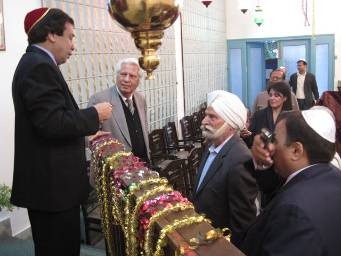
clip_image005

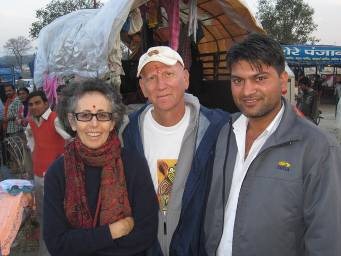
Ezekiel and some of the community who had come to hear the speaker. The man in the white turban is a practicing Jain.
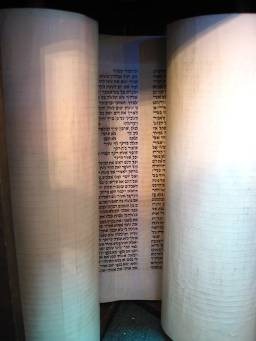
clip_image006

One of the Torahs.

Ezekiel, I hope this is all correct.  If not, please let me know so I can fix it. 
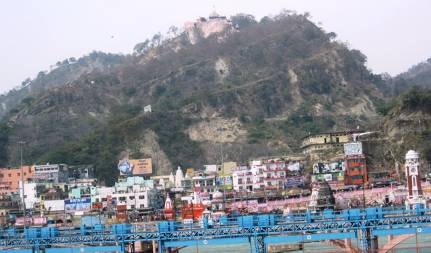
Haridwar Mountain Temple

clip_image001

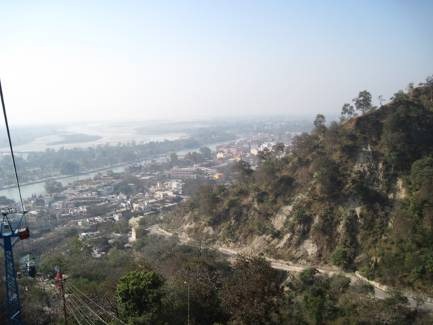
The temple on the top of the mountain over looking Haridwar

clip_image002

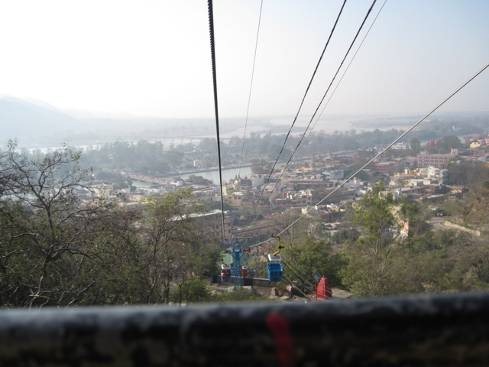
Our view from the cable car.

clip_image003

Another view of the river.

clip_image004

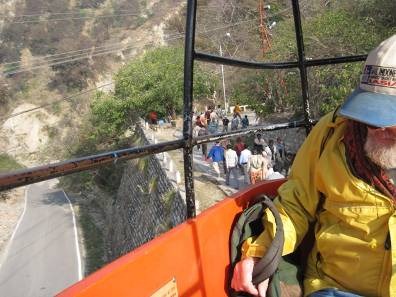
Most people walked but we just didn’t have the time: we had a 6 hour drive back to Delhi.

clip_image005

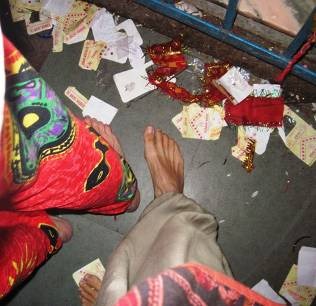
We had to remove our shoes…the floor was kind of yucky.

clip_image006

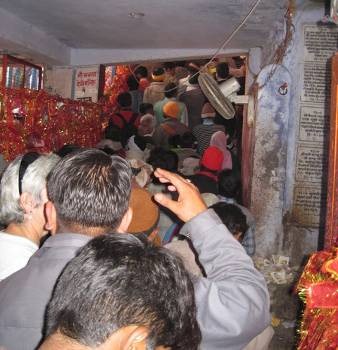
The temple was very crowded.

clip_image007

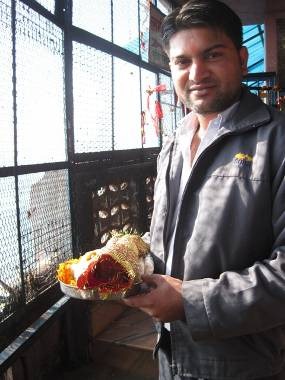
Sandeep had bought these items to have blessed for his family at home.

clip_image008

Orange was the good luck color for Haridwar and for Shiva, I think.

Hari means “god” and dwar means door or gate so Haridwar is the place that is the gateway to god.

clip_image009

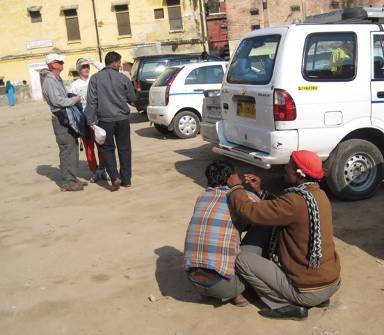
Back at our car I saw this man having his ears cleaned.

Then it was back to Delhi

Ru

DoraMac

Haridwar Festival

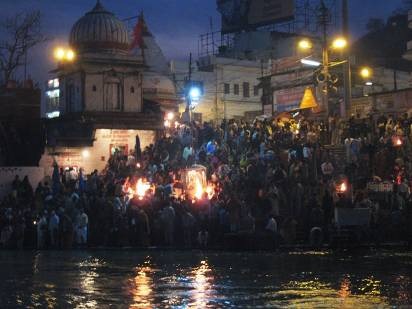
Randal opted out, but Linda, Michael and I went off to watch the nightly ceremony along the Ganges in Haridwar. Sandeep told us that twice each year, villagers come to Haridwar to collect water to “walk” back to their villages. Some of the water is for the local temple and some of it is for the villager’s home and family. Luckily our visit coincided with one of the semi-annual events. It really was quite fun and the locals made us feel welcome, posing for our photos, posing with us for photos, and taking photos of us. Even here in Cochin people ask if I will pose with them for photos!

clip_image001

Ruth, Michael and Sandeep: Linda is taking the photo.

I spent a good deal of time with a red dot on my forehead.

clip_image002

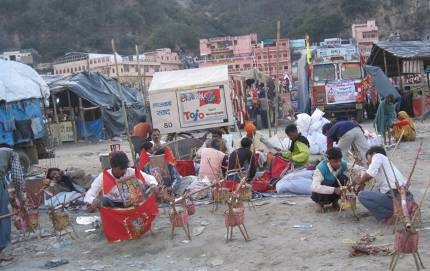
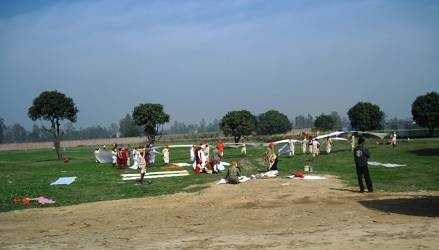
Making the carriers for the holy water.

Many walkers opt to carry the Ganges water on these brightly decorated carriers. Once they are finished and the journey is started, they cannot touch the ground. And no one can walk under them.

clip_image003

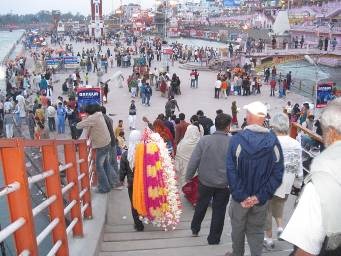
These men were leaving Haridwar carrying the “kawad” of Ganges water.

clip_image004

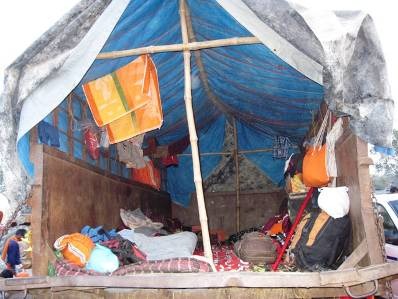
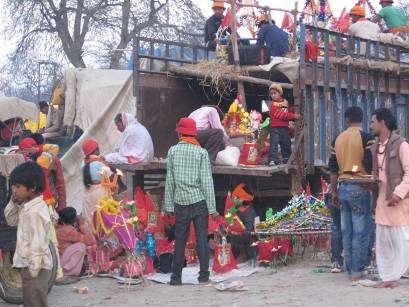
Truck beds become living quarters for those who come to Haridwar either to bathe or to collect the water for their village. The next day when I described it to Randal I used the word sleeping bags and Sandeep emphatically told us that no one had sleeping bags. They just had blankets to wrap up in; sleeping bags would be too costly.

clip_image005

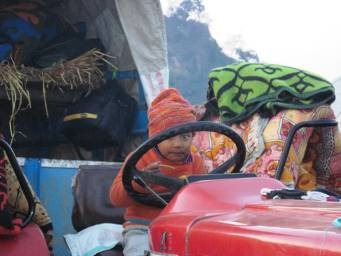
Pulling the wagon with a tractor.

These wagons coming from the villages and are one reason the traffic goes only 30 kilometers per hour.

clip_image006

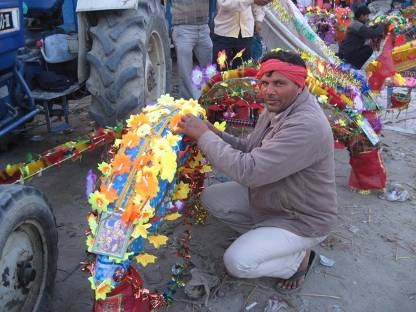
Working on the kawads.

clip_image007

The men not only posed, but asked to have their photo taken. They also wanted us to pose with them for their photos. We were the stars of the show.

clip_image008

It was very much a festival atmosphere for the whole family.

clip_image009

We walked from the camping area to the part of the Ganges where people were bathing and where the evening ceremony took place.

clip_image010

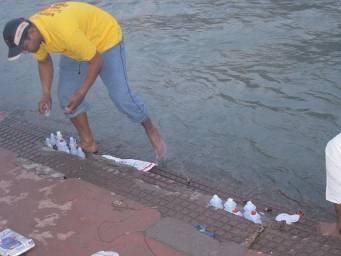
Collecting Ganga water.

clip_image011

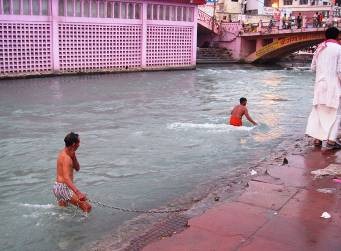
The water moves very swiftly so chains are provided for bathers to hold on to.

clip_image012

These bathers wanted their photo taken too.

No women seemed to be bathing and everywhere were much shyer about having their photos taken.

Then it was time for the evening ceremony…

“During a visit to the holy cities of Varanasi and Rishikesh/Haridwar, make time to partake of the most popular ceremony in Hindusim, Arti. Performed daily, several times throughout, Arti is a greeting ceremony offered to the murti and also gurus, holy people, and other representations of the divine.

Arti is often called “the ceremony of lights” but usually involves offering more than just a lamp.

The priest or worshiper offers various auspicious articles by moving them in clockwise circles before the deity. At the same time he or she rings a small hand bell, while meditating on the forms of the deity.

During the entire ceremony, which normally lasts from five to thirty minutes, the worshipper offers incense, a flower, water, a five-wick lamp, a lamp with camphor and other items. The ceremony is often announced and concluded by the blowing of a conch-shell.

During the ceremony the offered lamp is passed around the congregation; members pass their fingers over the flame and reverently touch them to their foreheads. The offered flowers are also passed around worshippers and the water is sprinkled over their heads.

Arti is usually accompanied by singing (bhajan/kirtan) and out of respect worshippers usually stand for the entire ceremony.

Source – The Heart of Hinduism

Morning Arti begins before sun up, which means you’ll be crawling out of bed in the 5 o’clock hour to reach the temple in time. Tourists aren’t a common sight at this time but of course welcome.

Evening Arti is when you’ll encounter the most tourists. Varanasi has an amazing display right on the Ganges. To enhance your participation and/or observation, find a boat-for-hire down river from Dasaswamedh Ghat. Row into the area of this main ghat where the ceremony takes place. You won’t be alone as many other tourists and some locals will be gliding up to view the Arti. Along the way you’ll be approached by vendors on their own boat selling ghee candles tucked into a small tray-like bowl. The transaction is very quick and simple. Light the wick, make a prayer and set the candle onto the river’s surface. As you reach Dasaswamedh Ghat, you’ll notice a steady stream of candles passing you by.

In Haridwar, the Arti also is performed on the Ganges. And just like Varanasi, ghee candles are lit and sent off into the current. The river runs much stronger in the Arti area, adding to the cornucopia of sights and sounds already on display. The ceremony can be viewed on either side of the river here with massive crowds all vying for the best position.

At Rishikesh, once again the ceremony can be found on the riverbanks of the Ganges. Ghat steps lead into the water allowing followers pristine access to launch their candles. The crowd here is younger and not as subdued as one would wish them to be. Loud dancing and over-the-top chanting comes across in a mocking fashion when played against the spiritual leaders’ rendition of events.” (Rishikesh was really quite “Yuppie/Touristy” so I’m not surprised to read that.)

http://www.fullstopindia.com/2010/01/must-see-arti-ceremony/

clip_image013

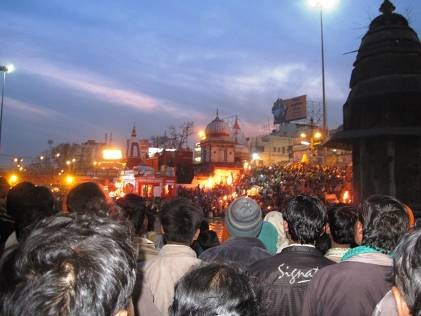
Because we had spent so much time visiting folks and posing for photos at the camping area, we arrived at the ceremony late and were several rows back so could not see very well. There were some prayers and singing which was quite lovely.

clip_image014

When the evening ceremony was over, I could get close enough to the river for a photo.

clip_image015

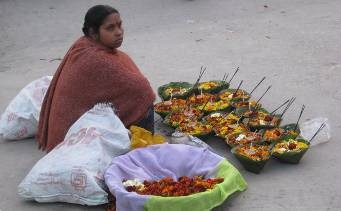
People bought these flower petals in a banana leaf to float along the river.

clip_image016

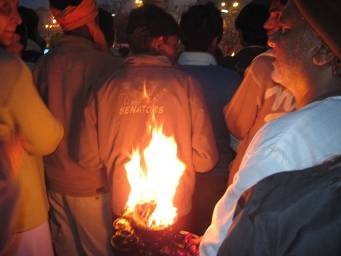
A man walked through the crowd with this fire and people sort of held their hands over it for a few seconds and perhaps lit the candle in the center of their flower petal container.

clip_image017

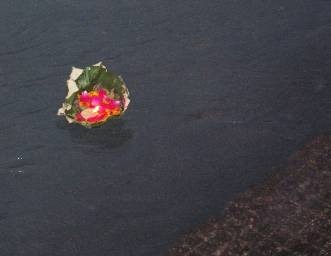
Floating down the Ganga.

clip_image018

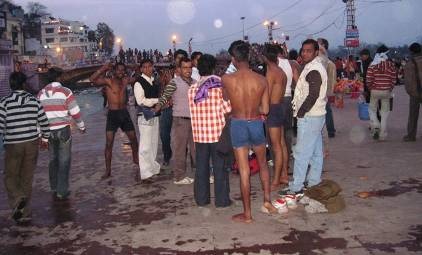
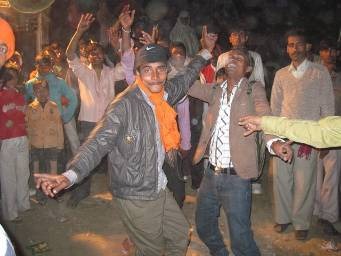
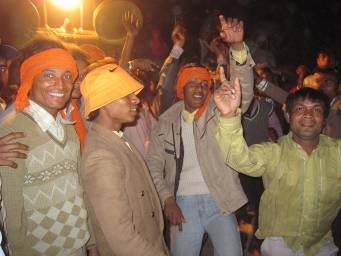
After the ceremony people returned to the camping area where men started dancing.

clip_image019

Take my photo! Take my photo!!

clip_image020

Shiva and the new bridge across the Ganges

clip_image021

Walkers stopping to camp along the way.

Many roadside restaurants feed the walkers for free and give them places to rest. Some walkers rest during the day and walk at night. It would certainly be cooler and there would be less traffic and dust along the road.

clip_image022

Walkers along the side of the road.

Ganges, Rishikesh, and Haridwar

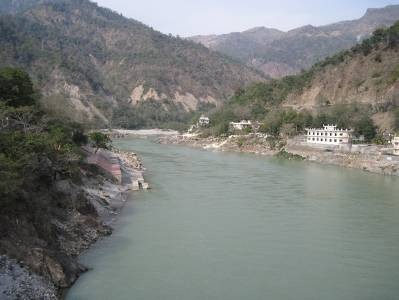
On my list of things to see on our trip up north was the Ganges River. Sandeep always referred to the river as Ganga and it seems odd to me now to call it anything else. We had thought about going to Varanasi, probably the most famous bathing ghat, but that would have taken too much time and planning since it required and overnight train trip. Sandeep suggested we go to Haridwar, closer, cleaner and less crowded. From Delhi, even that was a 5 hour car ride at our average of 30 kilometers per hour. We left Delhi at 6 am to beat the early traffic or it would have taken even longer.

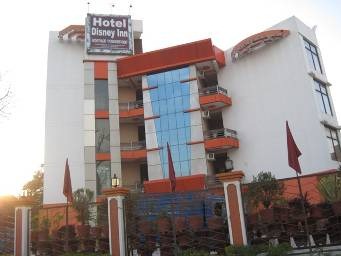
Our first stop was our hotel in Haridwar.

clip_image001

Hotel Disney Inn…well why not?

Because it was cold for us we always asked for space heaters and sometimes extra blankets. This hotel had a space heater that lit up the entire room with the glow. I finally put it into the bathroom and closed the door most way hoping some of the heat would escape the bathroom into the bedroom. Should have just asked for a second blanket. The shower was outside the tub so just wet the whole bathroom floor. Every hotel we stayed in was an experience but all tried very hard to accommodate our various requests, even when we didn’t had out a tip every two seconds. Interestingly, because Haridwar is a “holy city” our hotel restaurant was vegetarian. The restaurant where we had dinner was also vegetarian so I ordered a bowl of fruit and yogurt and it was papaya and banana and wonderful. Randal and I both truly have had our fill of biryani rice and Indian bread. Not that it isn’t good, but it is so darn filling! I truly started craving a big bowl of cabbage/carrot salad and a can of tuna. Randal had peanut butter and honey cravings.

clip_image002

The view from our window of the Jain Temple next door: not old but very lovely as the light changed.

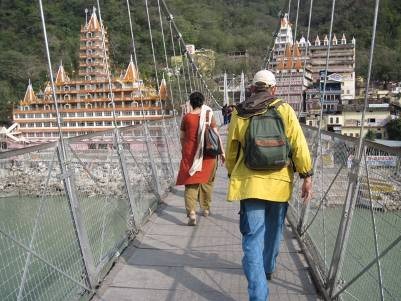
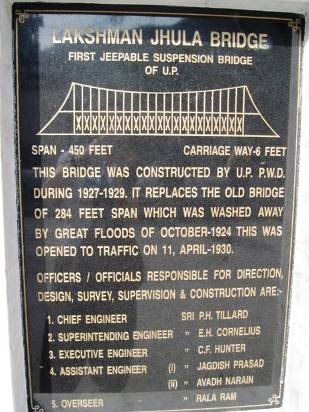
We checked into our rooms, had lunch that would have fed a dozen, and piled back into the car for the short drive to Rishikesh. In February of 1968 the Beatles visited Rishikesh to meet with Maharishi Mahesh Yogi who later ran off to Canada with all the money or something along those lines. We went to see the temple and the old British bridge across the Ganges.

“After flowing 200 kilometres (120 mi) through its narrow Himalayan valley, the Ganges debouches into the Gangetic Plain at the pilgrimage town of Haridwar. There, a dam diverts some of its waters into the Ganges Canal, which irrigates the Doab region of Uttar Pradesh. The Ganges, whose course has been roughly southwestern until this point, now begins to flow southeast through the plains of northern India. http://en.wikipedia.org/wiki/Ganges

clip_image003

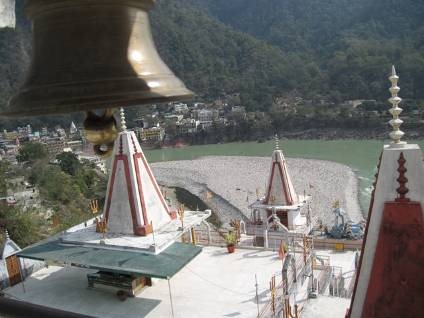
The view from the temple

I went into the temple, walked to the roof, paid my ten rupee donation and got my red forehead dot, a red thread tied around my wrist but took a pass on drinking some of the Ganga holy water. I figured the red thread would be good luck for the Red Sox and so far one of their pitchers was beaned in the head by a ball during batting practice. So much for that.

clip_image004

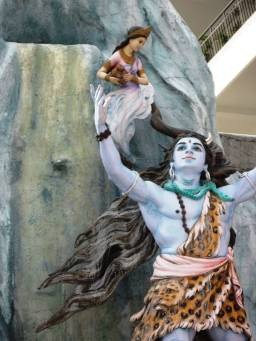
Ganga and Shiva statues at the temple.

“Ganga arrogantly fell on Shiva’s head. But Shiva calmly trapped her in his hair and let her out in small streams. The touch of Shiva further sanctified Ganga. As Ganga travelled to the nether-worlds, she created a different stream to remain on Earth to help purify unfortunate souls there. She is the only river to follow from all the three worlds – Swarga (heaven), Prithvi (earth) and, Patala (neitherworld or hell). Thus is called "Tripathagā" ( one who travels the three worlds) in Sanskrit language.”

Sandeep told us his version of the legend that explains how Ganga came to earth. Like the other versions I have now read, his included the part where Ganga is trapped in Shiva’s hair first before coming to earth. Had the water come directly from Ganga, the force would have flooded everything away so Shiva prevented that by trapping Ganga and slowing her down.

clip_image005

Ganga not so wild but clean and moving fairly fast.

clip_image006

Walking across the Ganga.

clip_image007

No jeeps, but several motorbikes drove across as everyone squished to the sides to let them pass. There was cow poop too, so obviously the cows cross it which seems like quite a brave thing for a cow to do.

clip_image008

But here they were at the other side…or maybe they just live on this side, but the cow poop was fairly recent.

clip_image009

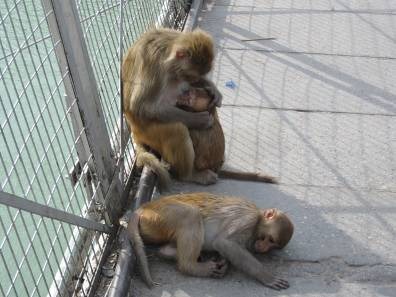
Soon after my photo the near monkey jumped up and started walking towards everyone so we all scattered. I had the impression that it was that monkey’s job to collect the money for the photos which is what you have to do if you take photos of humans like the snake charmer.

clip_image010 clip_image011

Something for everyone.

clip_image012

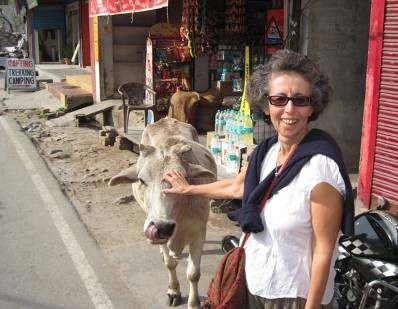
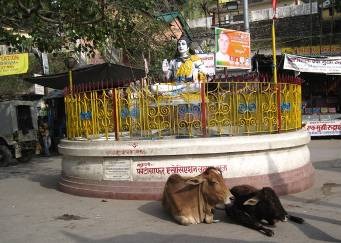
Ruth with red forehead dot and bovine friend.

clip_image013

I gave this fellow a pat on his head too.

Then it was back into the car to drive back to Haridwar to rest for the evening festival.

Marble Crafts Palace

  The Danish sailing vessel, Ing, was taken by pirates February 24th.  There are 4 adults and 3 teens on board.  We had often seen Ing along our way. 

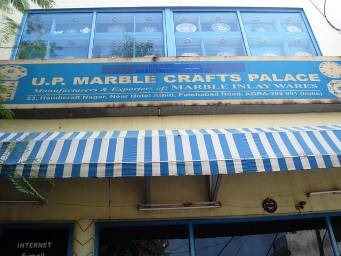
Marble Crafts Palace

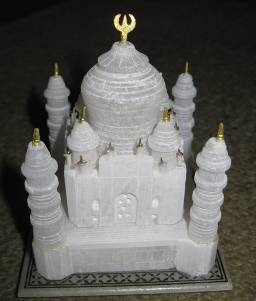
My sister wanted a “mini Taj Mahal” so our next stop was the Marble Crafts Palace. Everything is called a palace in India; or a resort! Sandeep, our combination “driver, guide, friend” told us several times that rich Indians donated money for food for the lucky cows who were living at the various “cow palaces.” We weren’t sure in that particular instance whether Sandeep used the word palace to mean “place” or if he used the word palace to mean a shelter of some sort. We never did see a “cow palace” though we saw lots of cows. Anyway, we did go to the Marble Crafts Palace to see how the decorative marble inlay was done though we knew there would be a sales pitch coming eventually. We were also told that the people working in the marble industry in Agra were descended from the Persian workers brought there to create the Taj Mahal. Skills are still passed from generation to generation in India. At the Kathakali performance in Cochin we had seen the young boy who was becoming a make-up master. During our stop in Fatehpur Sikri I took photos of a ten year old using a straight razor giving shaves at a sidewalk barber shop. Because of the strict caste system there was probably no choice but to do the work your father did.

clip_image001

clip_image002

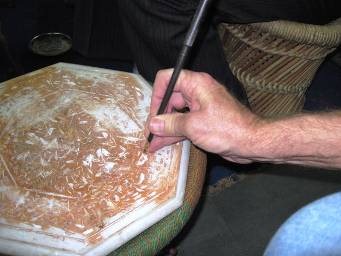
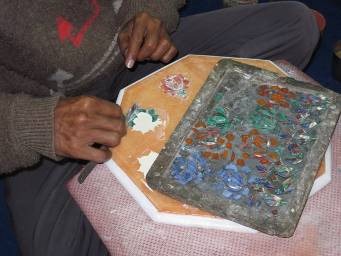
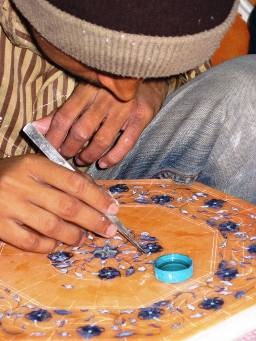
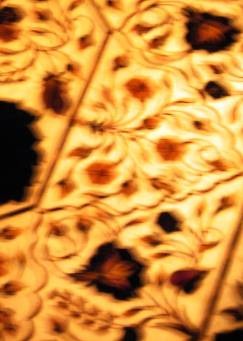
The flower is made up of many pieces of cut and shaped stone. Each piece of cut stone is laid onto the marble which has been coated with ground red sandstone dust. The shape is etched into the marble and the dust leaves a visible pattern. Then the marble is cleaned off and the cut stone is put in place and glued with a mixture that includes sugar cane and honey but is permanent.

clip_image003

Randal trying his hand at carving the marble.

clip_image004

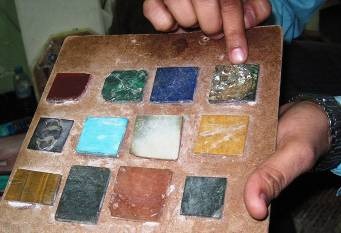
These are the examples of the different stones that are used.

Lapis lazuli, carnelian, coral, turquoise are some of the stones used with the marble. Some are opaque later you’ll see what happens when light is shined through them.

clip_image005

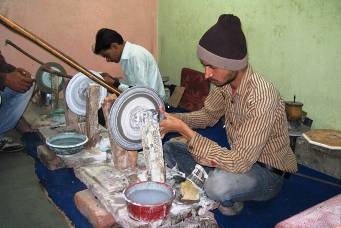
The cutter moves the bow back and forth which moves the wheel used to cut and shape the tiny pieces of stone.

clip_image006

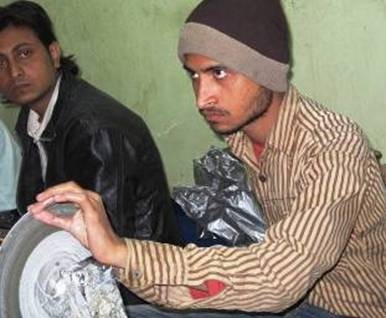
The best workers have slender fingers.

Many of the pieces to be cut are very tiny so fingers also get rubbed against the cutting wheel. With his beard, mustache, hat and concentration, this worker reminded Randal and me of my nephew.

clip_image007clip_image008

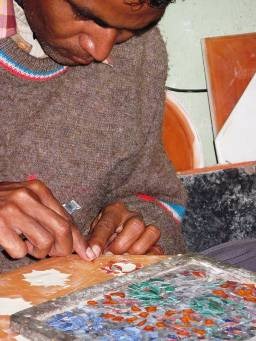
You can see how intricate the work is.

I believe these pieces are being glued onto the marble slab.

clip_image009

clip_image010

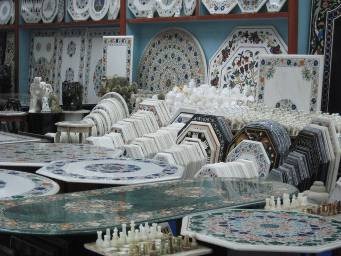
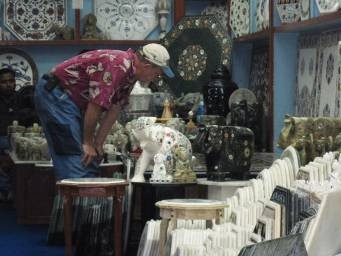
The show room.

clip_image011

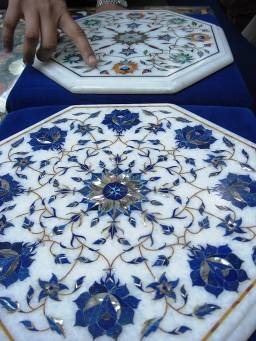
The smaller the pieces of inlaid stone, the more expensive. If you can see the vein in a leaf it’s going to be very expensive.

clip_image012

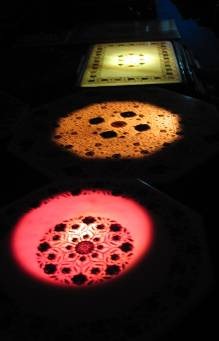
Illuminated marble table tops.

Different colored light bulbs are used showing the colors that the Taj Mahal marble changes to throughout the day as the light changes: morning, noon and evening. The light bulbs are, of course, much more dramatic than the actual sun and moon light on the Taj.

clip_image013

Not a good photo but you can see that the light goes through come of the colored stones as well as the marble. Green and blue are opaque and block the light.

clip_image014

If one lived in a house rather than a boat, one could buy a really lovely table top.

clip_image015

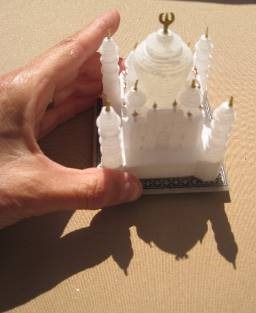
My sister’s mini marble Taj Mahal.

clip_image016

They told us it was real marble…..only time will tell. But definitely not plastic.

Then it was time to get back into the car for the 6 hour drive back to Delhi. Ami on Estrelitta had told us that by car they had averaged about 30 kilometers per hour on a visit they had made to the highlands near Cochin. We found that to be true during our travels too which made it take forever to get anywhere. It would take 5 or 6 hours to go 200 kilometers, about 130 miles.

Taj Mahal # 2

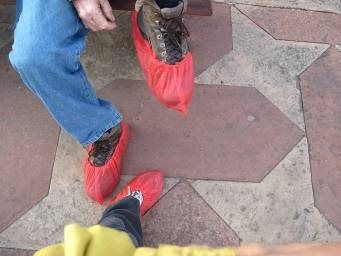
clip_image001

Putting on our shoe coverings to visit the Taj Mahal

This certainly beats taking off and putting back on sneakers and also walking around barefoot on floors that, even if they were clean, were quite cold.

In the very center of the mausoleum are the cenotaphs of Mumtaz Mahal and Shah Jahan but photos weren’t allowed. They are white marble with rows and rows of inlaid flowers. But both are really buried in a dark crypt below.

clip_image002

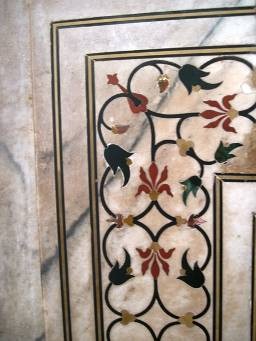
The white marble had colored stones inlaid.

clip_image003

The red and yellow colored stones were translucent and when a flashlight was shone on it, let the light through.

clip_image004

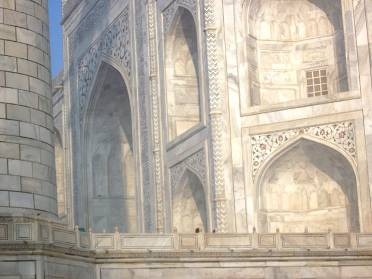
It really is quite immense.

clip_image005

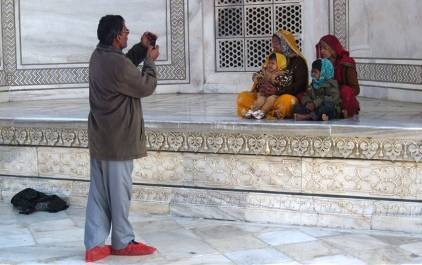
A family outing.

Thankfully locals paid much less for their tickets than foreigners at all of the monuments we visited. One palace in Jaipur charged $55 US per ticket so we took a pass. The ticket charge for the Taj was 750 rupees per ticket for foreigners. That translates to about $16 US per ticket. Everyplace we visited charged and at times, we also had a local guide arranged by our “tour operator.” The local guide did add a great deal but that added “a tip” to the ticket price. We could have chosen not to have a guide but we did learn more though I can’t say that I remember all that much.

clip_image006

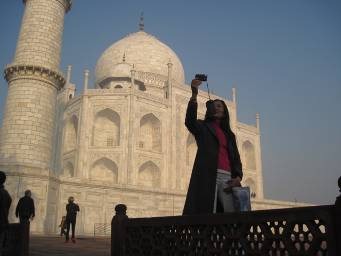
A do it yourself photo.

I offered to take a photo for her but she said that she could do it. My arms aren’t long enough and I always end up with a bad photo of myself. Of course other people don’t always get it right either….
clip_image007

Not sure who took this one but……

clip_image008

I like the two women in their saris.

clip_image009

Looking back at the entrance gate.

clip_image010

Another view showing some of the grounds.

clip_image011

The photo from the other direction must have been an interesting image of the Taj.

clip_image012

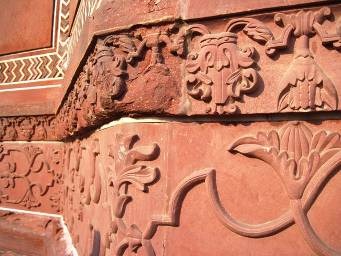
Close up of the red sandstone.

clip_image013

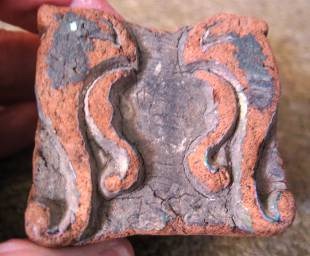
Pattern block for bas relief.

I bought this small block in Jaipur before we visited the Taj. The young shop keeper told me that an artisan would carve this small example to be used as a pattern for workers making columns. I don’t know if that’s true or it was used for block printing but someone had to make patterns that the workers would use and maybe they carved them.

Ru

DoraMac

Taj Mahal # 1

Hi All

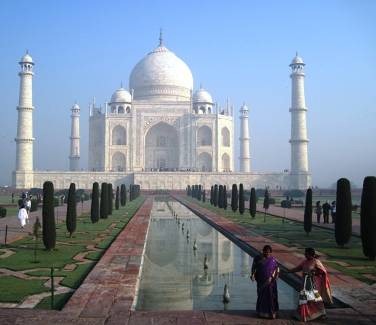
  I’m starting off with the Taj Mahal rather than writing about our trip as things happened.  It really doesn’t matter and I think lots of you are most curious about the Taj.  A "point and shoot" camera just doesn’t do the Taj justice.  Too much light against dark and fog and it’s just so huge!  I did my best.  Here is part 1.

Ru

Taj Mahal

“The Taj Mahal is one of the world’s acknowledged wonders. Its construction began in 1632 and was completed by the middle of the seventeenth century. Though the name of the architect remains a mystery, the inspiration was essentially that of the Mughal emperor Shah Jahan who employed 20,000 men to labor for twenty-two years to fulfill his dream of building for his queen, the finest mausoleum every created by man.

The story behind the Taj Mahal is a poignant one. Mumtaz Mahal, Shah Jahan’s queen and constant companion for nineteen years, even in battle, died giving birth to their fourteenth child in June 1631. It was said that for two years Shah Jahan lived the life of one in mourning. The story is also one of unbelievable opulence. Ancient records refer to the material used, to the white marble from Makrana to the precious and semi-precious stones for the inlay work such as lapis lazuli and sapphires from Lanka, carnelian from Baghdad, turquoise from Tibet, agate from Yemen, coral from Arabia, garnets from Bundelkhand, diamonds from Jaisalmer, onyx and amethysts from Persia and so on. Tragically, most of this wealth was plundered through the years…..Constructed entirely in white marble, the famed mausoleum stands on the gently curving banks of the river Yamuna in Agra.” Rupa Classic India Series 1993

We did learn from our tour that most of the workers were Persian and the descendants of these workers still live in Agra and still work in the marble industry. There is a legend that Shah Jahan wanted no copies of the Taj so had one hand of the 5,500 artisans cut off! We were told a more humane interpretation. Shah Jahan told the workers he would pay them for seven generations of workers who would not work to recreate anything like the Taj. Thus their “hands were cut off from that type of work.”

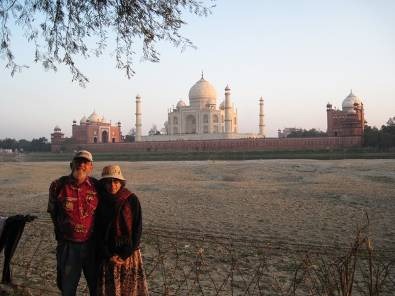
Taj Mahal at sunset from across the Yamuna River: the next morning we would actually go there and go inside.

clip_image001

Ruth and Randal at the Taj Mahal

I’m wearing a wool sweater and wool shawl because it got very cool in the evenings. Though this vantage point isn’t as crowded as the Taj, you had to take turns for your photo op.

The small building on the right is a mosque and the identical building on the left was called a “jawab or answer” and used to house travelers. The red is sandstone and the white is marble. I think the “answer” part comes from the building being a response to the mosque to make everything symmetrical. Because it’s the dry season the river was pretty low and the dust and dirt were not so scenic. The 4 minarets were constructed tilting away from the mausoleum in case of earthquake they would fall way and cause no damage.

clip_image002

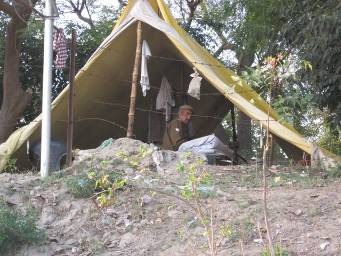
“Housing” for the soldiers who guard the Taj

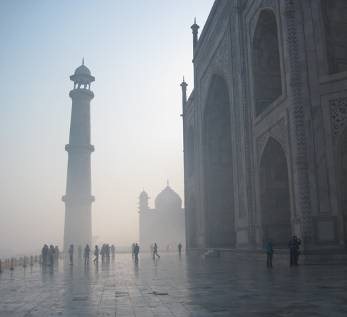
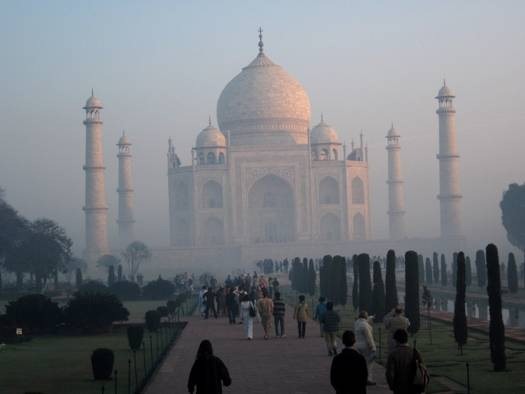
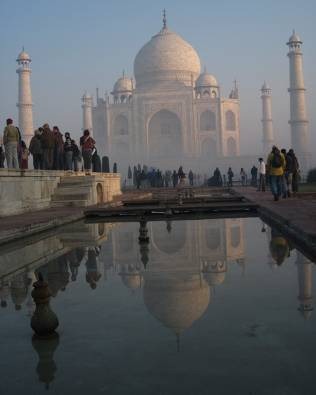
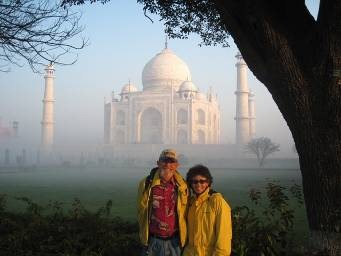
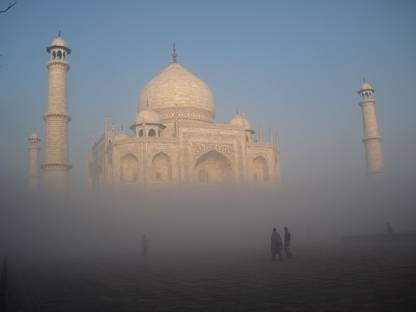
The next morning we met our guide at 6:45 a.m. to see the Taj Mahal at sunrise. At first all of the grounds and the Taj Mahal were coated with fog which made for amazing images that my camera and I just couldn’t capture.

clip_image003

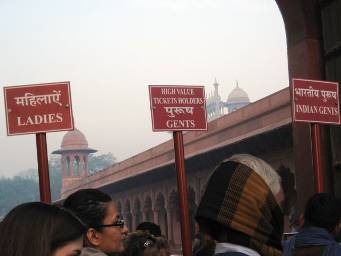
Lines form early and there is a security check.

You can bring in cameras but no food, drink or sketching materials though I don’t know why the sketching materials were banned.

clip_image004

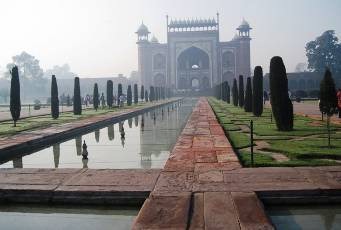
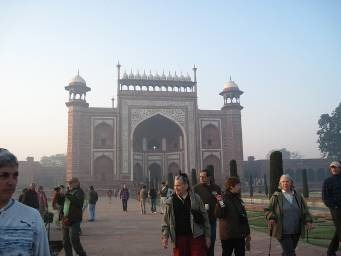
The entrance gate.

You start to walk through and get your first glimpse of the Taj and it is truly impressive.

clip_image005

I just couldn’t capture it: sorry.

clip_image006

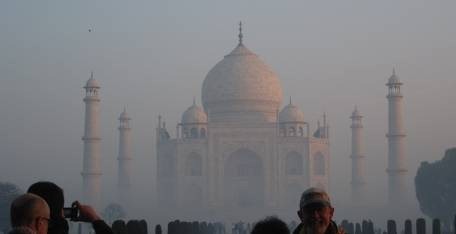
The fog made the Taj look as if it were floating.

clip_image007

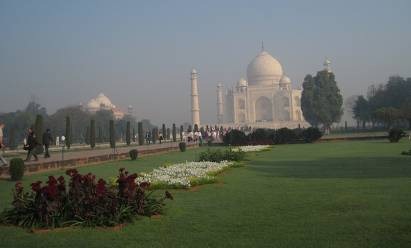
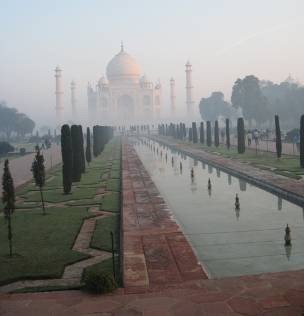
The grounds were lovely too.

clip_image008

Reflection

If I had been back further I could have captured the entire Taj but it was quite tricky to get a shot off without someone walking in front or waiting for you to move so they could take a photo.

clip_image009

Another tourist offered to use my camera to take this photo.

clip_image010

Randal and our guide walking from “the answer” to the Taj.

clip_image011

Taj Mahal shrouded in fog.

clip_image012

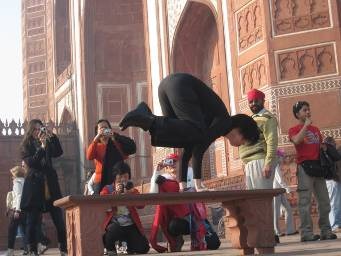
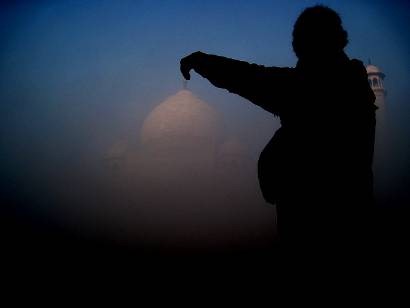
I’m holding up the Taj

As I was walking through “the answer” a 10 year old boy took charge of me. He spoke quite good English at lightning speed while he took me to different spots to take photos and then took this one of me though I’m not so sure what it represents. We were told not to “talk with, listen to, look at” anyone or they would “become our guide” and would expect a tip. I just couldn’t ignore this kid and at the end offered him 40 rupee, about $1. He wanted 100 rupee! He wouldn’t take the 40 so got nothing.

clip_image013

Another image of “the answer.”

Tour of Northern India

Hi All

  After a whirlwind tour of Delhi, Jaipur, Haridwar, etc… we are back on DoraMac.  It was quite the adventure.  We saw the sun rise over the Taj Mahal. We watched as people bathed in the Ganges in Haridwar.  We had a tour of the Jaipur Public Library and we visited a Synagogue in Delhi.  It often took 5 or 6 hours to get from place to place as the roads are crowded with trucks, buses, cars, motorbikes, bicycles, buffalo carts, camel carts, equine carts of all sorts and even Elephant!  And lanes are just suggestions and not something one must stay in.   I took a zillion photos.  I am back using my computer with my Outlook so things should go more smoothly.  If you didn’t receive the one email I sent, it is posted on www.mydoramac.com.  Lots of emails came back to me and that seems to happen when I use the web yahoo.

We will leave Cochin sometime during the first week in March for the Maldives where the list of boats to be shipped is growing as more cruisers reluctantly decide to ship rather than make the passage.  As you can imagine, the Quest and piracy are uppermost on the minds of most cruisers.  But no one is packing up and going home.  We’re all just moving ahead to another part of the world and thankfully there are still parts of the world that welcome everyone. 

  Ru

Taj Mahal

Hi All,

  Saw the Taj Mahal at sunrise today and it was quite an experience.  We actually could stop thinking about the cruising world for a bit of time.  India is, well, "all things are possible in India" is the thought of each day.

  Will send photos as soon as we are back on Doramac in Cochin on Sunday evening.

Ru

India #1

We drove about 8 hours (including a lunch stop) from Delhi to Jaipur through tons of traffic and crazy driving with trucks and cars that say BLOW HORN so the noise is astounding.  But it all works for them and our driver Sandeeb only once came close to giving the finger.  We will spend 3 days in the area and then move on to Agra to see the Taj Mahal.  Then it’s back to Delhi, on to Haridwar with a side trip to Rishikeh and then back to Delhi.  We’ll return to Cochin on the 26th.

   On a very sad note, an American yacht with 4 Americans was taken hostage by the Somalie pirates today. The yacht Quest was tied across from us at the Cochin marina and we waved them off as they started on their passage to the Red Sea.  As much as we chose not to make the passage, it was a horrible shock to learn that a yacht was actually taken.  We hope this is resolved as quickly as possible and our thoughts go to their families and friends.

  Ru


India # 1

Snake charmers, camels, elephants, tombs, forts and a visit to the Delhi synagogue. We like what we have seen so far of northern India. Much of it is reminiscent of industrializing China with smog and congested roads and horrible traffic jams. But, ‘don’t worry, be happy” as our guide Sandeep says. And we are being happy.

clip_image001

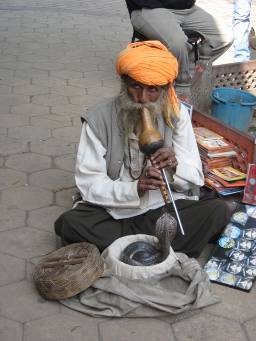
Snake charmer?

He was sitting outside a “tourist restaurant” next to the souvenir sellers. We knew we’d have to pay, but so what so Linda and I took photos and he prodded the snake to face us which I didn’t exactly need. I didn’t have any small bills so Linda told him the 20 rupees was from both of us. The snake barely came out of the basket and I don’t remember any great music coming from the flute; but he quickly let us know that I needed to give him money too. I had a 5 rupee bill so that was it. We told the tour operator who we had started working with that the restaurant was far too full of tourists, the food was bland and twice the price we usually paid for half the food. Next day we ate where the locals ate. The women at the next table were in India because their husbands were there. One woman was from Staten Island, looked like Tracy Ullman and had a nose decoration. Her husband worked for the World Bank and this was a 3 year assignment. The other woman was Indian by birth but hadn’t grown up in India. Her husband had come to work for an Indian company. The restaurant was jam packed, noisy and had good cheap food. Our kind of place. There was a line waiting to get in and we decided it was the equivalent to a New York deli.
clip_image002

Humayun’s Tomb

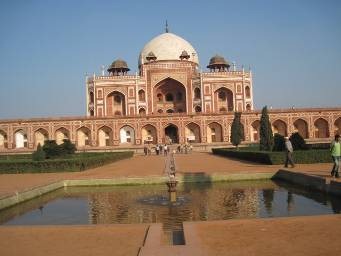
Humayun the Moghul Emperors (Muslim ruler of India) in the year 1555 AD. Six months after retaking Delhi he fell from the stairs of his library and died. His tomb was built by his widow around 1565 AD. “One of the greatest examples of architecture in India, Humayun’s tomb is known for influencing the structure of the Taj Mahal as well.” Delhi, A Travel Guide. It is a UNESCO Heritage Site; it is protected under the rules of the Archaeology Survey of India and is maintained by the Aga Khan Trust.
clip_image003

No more fountains or gardens.
Like the woman in Venice who said it was almost as good as the casino in Las Vegas, my reaction the tomb is that it reminded me of the government building in Johor newly constructed with this architecture with more gardens and actual fountains.

clip_image004

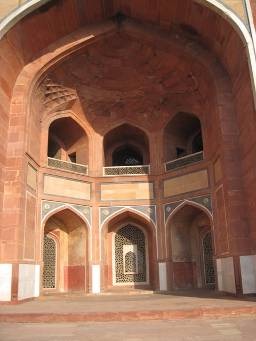
Inside the tomb

clip_image005

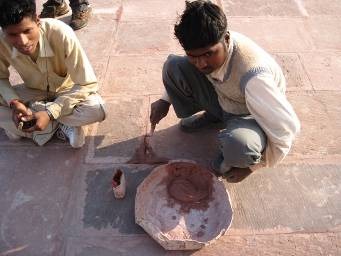
Repair men

clip_image006

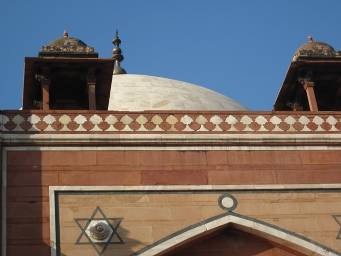
Some of the domes showing how Muslim and Jews share the Star of David.

clip_image007

Other tourists

clip_image008

The Red Fort

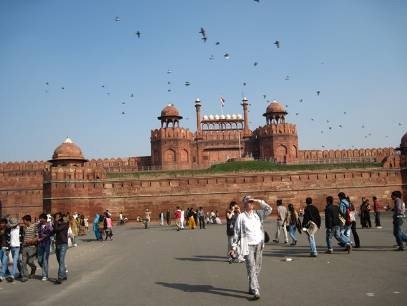
“The Red Fort is to Delhi what the Colosseum is to Rome or the Acropolis is to Athens: it is the single most famous monument in the city. It represents the climax of more than 600 years of experimentation in palace building by Indo-Islamic architects”. City of Djinns William Dalrymple Lonely Planet said it would take at least 2 hours to see the Red Fort. We all managed it in under and hour. Twice men asked if we wanted to hire them as guides and that certainly would have made it more interesting. But though the price was right we have such a hard time with the Indian accent that we took a pass. Also, after the Great Wall we weren’t wowed by the size and scale of the Red Fort after the damage done by the British who drained the moats and fountain and pulled up the flower gardens and planted grass.

clip_image009

A map of the fort area.

clip_image010

Between the outer gate and the inner fort was a tourist bazaar where Dalrymple points out one runs the gauntlet of salesmen and their tourist wares.

clip_image011

Not just a fort, but palaces for the emperor’s family.

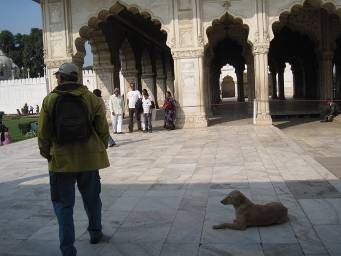
We also kept thinking about the Forbidden City and this paled in comparison. Not sure what that says about the Red Fort or about us. The dog was very sweet. There are dogs all over Delhi and they are all sweet and smile at you if you say hello and give it a pat on the head. Again, Dalrymple has this to say, “Today, the inner enclosure should be the climax of the fort, but the sight of it produces only a sensation of anticlimax.”

clip_image012

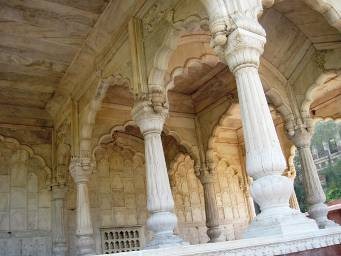
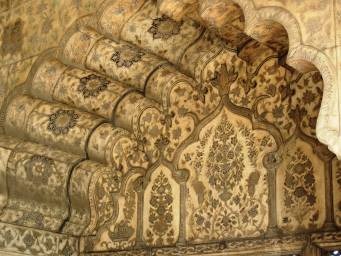
Decorated archways.

clip_image013

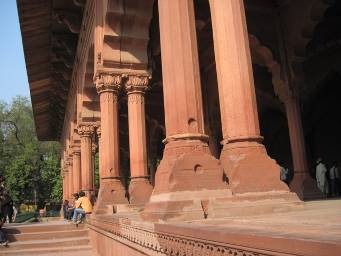
There were several building in the compound for the emperor, his wives, children, etc.

clip_image014

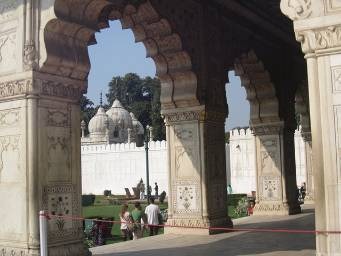
More archways.

clip_image015

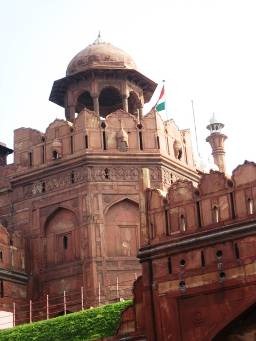
An outer wall.

clip_image016

The very outer walls.

What has impressed us so far other than just the vibrancy of Delhi itself, the Judah Hyam Synagogue and Ezekiel Isaac Malekar its Honorary Secretary, leader of services, warm weclomer of foreign visitors and great ambassador of the Jewish community of Delhi. I had Googled synagogue and Delhi and found information for the synagogue. It was a bit tricky for our guide Sandeep to actually find since he knows monuments etc, but not actual streets per se. Sandeep never gave up; we found the synagogue, met Mr. Malekar and were invited to services and to hear the former head of the Indian Air Force lecture on the commonality of all religions. (Actually I thought Mr. Malekar said he was to lecture on the history of Jews in India.) We had a wonderful time meeting priests, imams, visitors and members of the local Jewish community. That in the next email.