First bit about Marmaris

   Today Linda, Randal and I took the small dolmus (small bus) to town for food shopping at the Tansas Supermarket.  It was hot enough to wear a t-shirt and shorts. Tonight I’m in flannel and a sweatshirt.  When the sun goes down and the breeze comes off the water, it gets really cool; three blanket cool.  We have heat on the boat but really don’t need it with all the blankets and everything closed up.  Here are some photos from Marmaris.  I still have to finish writing about our travels here, but thought I’d mix in some local stuff too.

Ru

Marmaris First Days

Marmaris is a real tourist destination with the waterfront crowded with shops, bars and restaurants. But if you get back off the main road and start to interact with the people who actually live here, Marmaris becomes a neighborhood where you go to the Thursday market for fruit and veggies and flowers for a treat, the computer shop where they tried everything they could think of to test out our Indian dongle before we buy a Turkish sim card for it, and the same chicken wrap shop because they “know us now.” Like Cheers where everyone knows your name. It doesn’t take long to before you’re treated like an old friend. Too good to be true? Maybe, but so far it seems to be so.
clip_image001

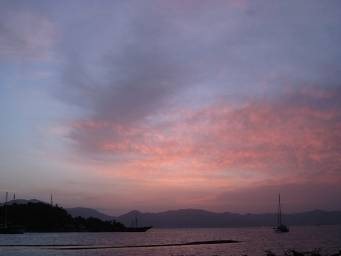
Our starboard view at sundown.

Our port side is an arbor covered walkway and then rows of yachts on the hard where cruisers do boat work most of the day so it gets pretty noisy. It’s sort of like living in a fancy boat yard. We haven’t met any new people yet but that will come. Lots of cruisers speak lots of other languages. Lucky for us many also speak English. Linda and Michael are about a five minute walk from us on one of the more central docks. The marina has a large paperback library so there is no need to buy popular fiction which is good. The books are two deep on the shelf and in no kind of order. The labels on the shelves indicate that once upon a time they were arranged by author but then everyone gave up and now it’s just browse until you find something you want to read. Right now I have books waiting but it’s nice to have the library available. You just take them and return them when you’re done. We have a bag to donate so I’ll walk them over tomorrow.
clip_image002

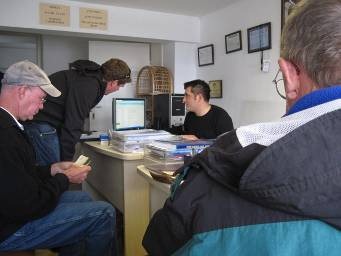
Our agent in Turkey.

Sonar handled the paperwork for all of our boats. Sevenstar suggested an agent who wanted hundreds of Euros so Randal stopped in Soner’s office to speak with him and found the price should be way less. Bill and Chris also had been given Soner’s name but Randal was really the first to approach him and tell him about the 16 of us. Soner was well organized and caring. He made sure things went smoothly. The BBC Everest was docked at the same port that ferry boats use so he made sure we would have access to check on the unloading progress. Early the second day of unloading a cruiser went to the Marmaris Port to get onto his boat on the BBC Everest. The Port Authorities stamped is passport out of Turkey because a ferry boat of people returning to Rhodes (Greece) was going through the security gates at the same time and Turkish Immigration thought the cruiser was with the group and the cruiser thought he was supposed to give them his passport… Could have been a mess but Soner took care of it. We were actually in Soner’s office listening to him on the phone taking care of the problem. We were there as were Bun and Anita from Passage and Soner suggested we wait about 20 minutes for the ferry to leave so we’d have no problem. Soner’s office is on the waterfront and he invited us all to stop in any time for a rest and some tea. And if we have problems while cruising anywhere in Turkey to call him. Soner is young, hip, and very Turkish! Very welcoming.
clip_image003

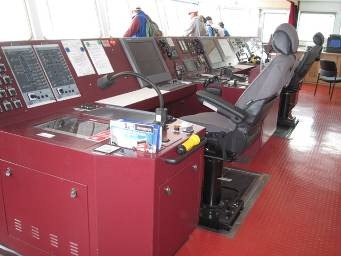
Bridge of the BBC Everest

We spent several hours up there the first day waiting to see what would be. We were all standing around outside and the Captain invited us up, and up and up and up. It was way up. By 4 pm when we still didn’t know when we’d be unloaded but were sure it wasn’t that day, Randal and I went down again and walked back to our Dost Hotel and checked back in.
clip_image004

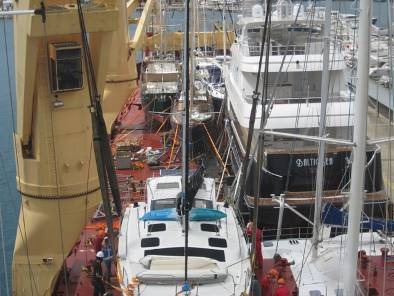
Looking down from the bridge at DoraMac

She is the back one on the left with her green hull and her tan canvas front window cover.

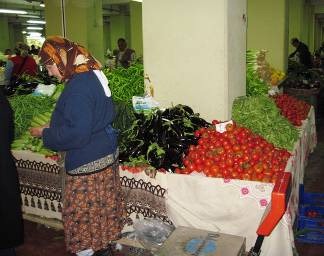
Last Thursday we visited the "Thursday Market" near our hotel just to look. We’ll return there this Thursday to load up on fruit and veggies.
clip_image005

The tomatoes are just wonderful and are served for breakfast with sliced cucumber and olives.

Most Turkish women dress as we do but many also wear more traditional clothing and cover their heads though Ataturk, the founder of modern Turkey banned the Islamic dress code for women.
clip_image006

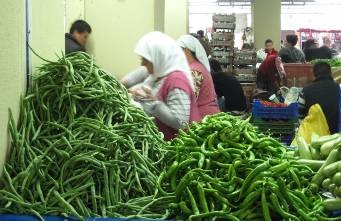
The pink ladies.

clip_image007 clip_image008

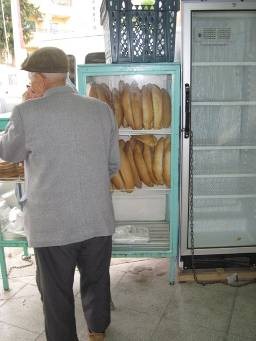
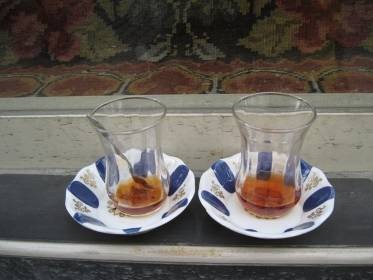
Lots of these bread cabinets everywhere. And tea is also served everywhere in the lovely Turkish tea glasses.
clip_image009 clip_image010

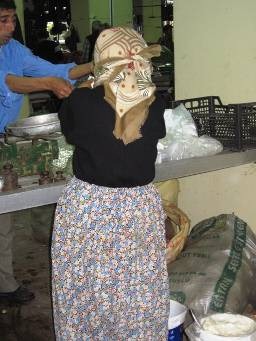
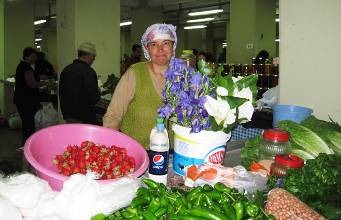
I love their long skirts and scarves. The flowers and strawberry lady!

Back on DoraMac

  The afternoon winds are whistling!  But that’s ok:  it’s howling winds that cause problems.  We’ll definitely have to get used to the Mediterranean weather patterns.  Yesterday about an hour before noon we were lowered off the BBC Everest.  We were the third boat of the day.  It took two days to get the boats off-loaded, but by 8pm Linda and Michael, the last to be unloaded, were tied to a dock here at M Y M.  DoraMac survived the trip just fine and she was no dirtier than when we sent her off.   We had been warned about blowing sand getting everywhere, but most of it must have been washed off in the April showers.  
  M Y M is a giant marina with room for 1,600 boats; 1,000 on the hard and 600 in the water.  Right now it’s quite full though soon many people will leave for the summer cruising season.  We’ve signed up for one month and then we’ll see.  Many of the BBC Everest boats are here but some have already gone off and everyone has quite different plans.  With so many boats there can be little privacy as most are backed into a spot with their sterns tied to the dock and boats on either side.  Coming in we had asked to tie parallel to a dock to off load our motorbike.  We’ll they’ve left us here for our stay.  We’re at the back side of the marina but it’s kind of nice to have just the water on one side and a lovely view of the bay.  And we don’t have to stern tie and walk a narrow plank from the back of the boat to the dock.   (We had to climb up and down ladders and over railings in the unloading process and I have ladder and railing fears so it was a bit of a challenge for me. 

   Just before writing this email I was looking up Turkish food vocabulary for our shopping trip tomorrow.  I did buy a few staples in the small grocery store at the marina but butter, and cheeses, and many other items have no English to help you out.   .  Some things you can just see, but several cruisers have bought something other than  milk because it came in what looked like a milk bottle.   It was either tart yogurt or buttermilk or something they didn’t know at all, but it wasn’t milk. 

  I tried to use the Mango language program on County web site but it won’t seem to work here.  I did look at the Hebrew in Langkawi when we thought we were going there, but here the Internet must just be too slow.  That’s why no photos this time.  We may buy a dongle since the marina wifi is iffy at best and pretty slow.  Of course if it didn’t work I wouldn’t have to wake to the gloomy news of another Sox loss!  May better be better!

  So that’s it.  Hopefully photos next time. 

But one more story.  We checked out of our hotel thinking we’d be off loaded the first day.  When we weren’t we returned to our Dost Hotel and got our old room back.  I felt bad that we had all new sheets and towels because we rarely ask for them.  We were really tired from all of the walking back and forth to the Marmaris Port and then to town for lunch and then back to the port and then back to the hotel.  We wanted some dinner but not much so Randal asked Ibrahim, the hotel owner, where we could get soup.  He paused for a minute and then said, "Here."  We were surprised but he said his Grandma would make it.  I had smelled something good downstairs when I’d gone down to look at the garden as the hotel is above their living area.  Ibrahim asked what time and we said 6 PM.  We went down to the tables where we eat breakfast and waited a bit.  Soon Ibrahim walked past us into the small kitchen carrying a pot of soup.  He brought us out bowls of lentil soup, bread and lemon to squirt in the soup as they do here.  it was wonderful and I ate two bowls, bread and drank half of Randal’s beer.  When we were done Randal asked for the bill.  "No bill, it’s on the house," said Ibrahim.  We were stunned and Randal offered again, but only got a smile from Ibrahim.  If you treat the Turks well, they treat you wonderfully. 

Ru

Mary’s House near Ephesus

It’s 1:30pm and Randal and I are relaxing back in our room, drying out from our morning walk in the rain, I decided to leave my umbrella in the room and Randal doesn’t have one so our rain jackets, pants and backpack got fairly wet.  Now, of course, the sun is shining.

Depending on whom you believe, the BBC Everest will arrive tonight in Marmaris or tomorrow or Saturday.  Our Turkish Marine Agent had told us earlier this morning that the Everest would arrive Friday night or Saturday night so when we returned to our hotel we asked to extend our stay.  In the room Randal read an email from one of the cruisers (who had run into the loadmaster who is here in Marmaris) saying the Everest would be here tonight, Thursday and unloaded tomorrow.  Hopefully we’ll get an official email tonight or early tomorrow morning so we’ll actually know.  The hotel owner has been pretty accommodating about things and is quite nice, reserved but very warm and welcoming.  He provides breakfast from 8 am until 10:00 am and it’s the typical bread, cheese, hard-boiled eggs, cucumber, tomato, jam, tea, coffee.  I’m learning to hold back a bit as one could eat way too much.

Moving back in time, recent and ancient, here is the story of our visit to Mary’s House on the way to Ephesus.

Ru

DoraMac

Ephesus  Mary’s House

clip_image001

The entrance way.

We arrived with the tour buses so you just had to move along too fast.  No photos were allowed and our tour had other stops to make so I didn’t feel as if there was really time to linger.  Not that there was much inside, but it would have been nice just to stand still in one spot and look around.  But it was too crowded.

“The House of the Virgin Mary (Turkish: Meryemana or Meryem Ana Evi, “Mother Mary’s House”) is a Christian and Muslim shrine located on Mt. Koressos (Turkish: Bülbüldağı, “Mount Nightingale”) in the vicinity of Ephesus, in modern-day Selçuk Turkey (7 kilometres (4.3 mi) from Selçuk).

Some believe that Mary, the mother of Jesus, was taken to this stone house by Saint John and lived there until her Assumption (according to Catholic doctrine), or Dormition (according to Orthodox belief).”

http://en.wikipedia.org/wiki/House_of_the_Virgin_Mary

“The modern history of the Virgin Mary’s House is unusual. It was “discovered” in 1812 by a German nun, Sister Anne Catherine Emmerich, who never traveled away from her home.

Sister Emmerich, an invalid confined to bed, awoke in a trance with the stigmata and visions that included the Virgin Mary and Apostle John traveling from Jerusalem to Ephesus. She described Mary’s house in detail, which was recorded at her bedside by a writer named Brentano.

Emmerich described a rectangular stone house, which John had built for Mary. It had a fireplace and an apse and a round back wall. The room next to the apse was Mary’s bedroom, which had a spring running into it.

The German nun went on to say that the Virgin Mary died at the age of 64 and was buried in a cave near her house. When her coffin was opened soon after, however, the coffin and burial shroud were empty. The house was then turned into a chapel.

Years after Emmerich’s visions, a French clergyman named Gouyet read Brentano’s account and traveled to Ephesus to find the House of the Virgin. He found a house matching the nun’s description and sent word to the bishops of Paris and Rome, but didn’t receive much of a response.

On June 27, 1891, two Lazarist priests and two Catholic officials set out to Ephesus to see the house. They found a small chapel in ruins with a damaged statue of the Virgin.

They returned to Izmir with their report, and more priests and specialists were sent out to the site. Since 1892 the House of the Virgin has been a Catholic pilgrimage site. It was restored by 1897 and a shelter for visitors was set up. “  http://www.sacred-destinations.com/turkey/ephesus-house-of-the-virgin

clip_image002

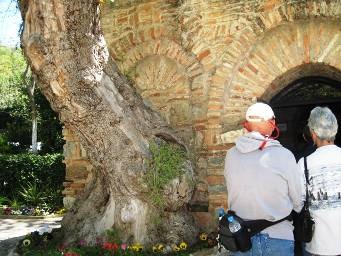
Michael and Linda wait their turn,

The tree is growing next to the house and not through the wall as far as I could see.

clip_image003

The side room of the house.

The pictures on the  sacred destinations website are better than mine because it was allowed to show the inside of the domed area.

clip_image004

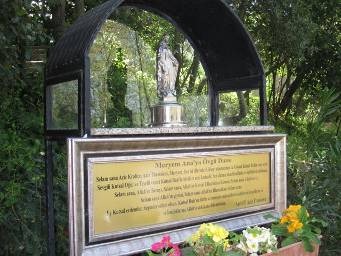
A statue outside the home.

clip_image005

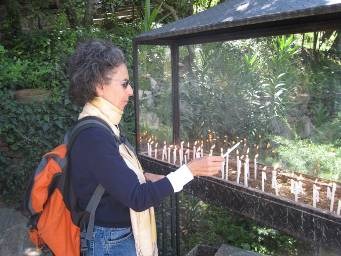
Candles for the Red Sox: in China I lit incense in 2007 and they won the Series.

clip_image006

Healing waters.

I wet my hands: can’t hurt.

clip_image007

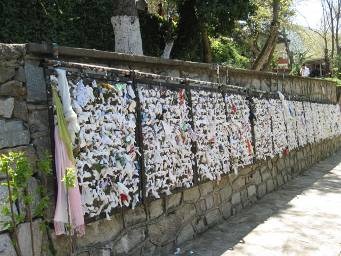
The wishing wall where you tie a piece of something and make a wish.

I pulled a thread from my scarf.  The Sox won five games.  I should have tied the whole scarf because the thread only lasted for 5 games!

clip_image008

There were scarves and handkerchiefs and pieces of paper napkins; whatever one had handy.

clip_image009

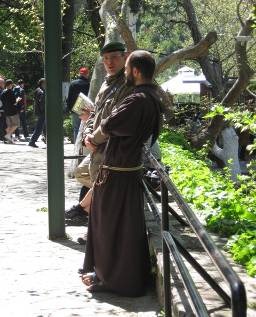
A monk and a Turkish Jandarm together is an interesting comment on the land of the Crusades.

clip_image010

A less “odd couple” give Turkish history.

I have a photo of myself and a Chinese soldier on the Great Wall but, thought he posed, he wasn’t smiling.

clip_image011

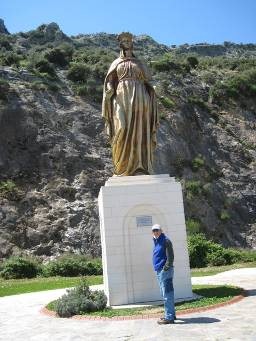
We left Mary’s House on the mountain of many names but stopped for photos of this statue erected by the American Society of Ephesus.  The sign said, ”Erected by the American Society of Ephesus (George B. Quatman Foundation) In Honor of the Blessed Virgin Mary, Mother of Jesus.  Her last years were spent in Ephesus.”  October 13, 1996.   I read that the historic sites of Istanbul are desperate for funding to maintain them, but the House of Mary and the ruins of Ephesus have lots of money for excavation and maintenance because of American funding.

clip_image012 clip_image013

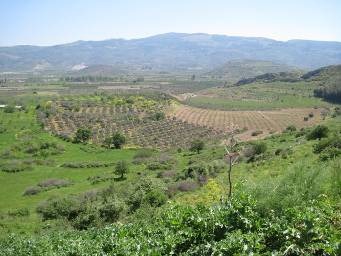
The Statue of Mary.                                    Her view of the valley below: the countryside was just beautiful.

The Blue Mosque

Linda, Michael, Randal and I arrived in Marmaris late this afternoon.  We left Pamukkale at 10:30 am on a local shuttle to Denizli and then caught the 11:30 bus from Denizli to Marmaris.  We arrived in Marmaris almost an hour late because Randal and I got what we had wished for.  In Pamukkale we’d seen posters for a Turkish bike race and wished our timing had been better to see some of it.  About an hour from Marmaris all traffic was stopped to clear the roads for the bicycle racers!  We did get to see them go by but that made us about 40 minutes late.  We encountered 2 other stops on the road probably for the same reason though we didn’t see the racers but only police and more jandarms.  The race finished on the Marmaris waterfront but we were too late to see it.  At first glance Marmaris seems to be a typical seaside resort area.  I’m sure it has its charms but I miss the “oldness” of Istanbul.  Maybe it’s because with Marmaris comes the confusion of dealing with the tons of paperwork to get Doramac into Turkey and then learning the ropes at the new marina.  Randal is looking forward to that part so it’s good that someone is.  I will be happy to get onboard and start cleaning her up after her journey.  And it will be nice to do our own cooking again though we’ll probably keep eating the wonderful local breads and cheeses.

In the meantime our hotel room is “roomy” and the balcony has a clothesline so we can wash some small stuff and not pay small fortunes to the hotel laundry services.  We did some walking this evening but will really start to explore tomorrow.  We’ll probably try to visit the marina before Doramac is off loaded to sort things out and get the lay of the land, so to speak.  All of the yachts should come off much more quickly and easily than they went on.  The BBC Everest is to arrive in Marmaris on April 28th.

To recap, from Istanbul we went to Izmir where we did a day trip to Ephesus.  From Izmir we went to Pamukkale and stayed two nights.  Both Ephesus and Pamukkale which includes ancient Hierapolis, were fascinating.  I’ll tell you about Ephesus next.

Ru

Doramac

The Blue Mosque

Randal and I chose to see the Chora Church and the Dolmabahce Palace (no photos allowed) rather than the Haghia Sophia and the Topkapi Palace.  There just wasn’t enough time to see it all and each charged a hefty entrance fee.  The Blue Mosque, however, was free and just a five minute walk from our hotel, so one morning I went to see it.  Randal chose not to, and instead walked around the small local bazaar and then had coffee at McDonalds.  One day we’ll return to Istanbul because it’s a place that calls you back and then we’ll see more and miss more and then have to go back again.

clip_image001 clip_image002

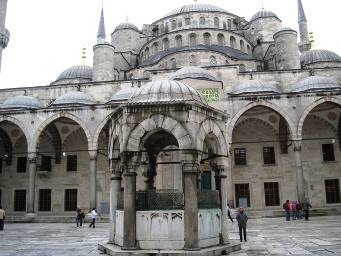
The entry way to the Blue Mosque on a gray rainy day.

“The Blue Mosque was commissioned by Sultan Ahmet I as a rival to Hagia Sophia and designed by architect Mehmet Aga (Aga’s unfortunate predecessor was fired – i.e., executed).

Construction on the mosque began in 1609 and took seven years. Sultan Ahmet died only a year after the completion of his masterpiece, at the age of 27. He is buried just outside the mosque with his wife and three sons.

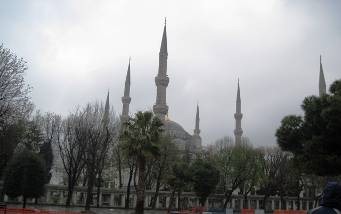
One of the most notable features of the Blue Mosque is visible from far away: its six minarets. This is very unique, as most mosques have four, two or just one minaret. According to one account, the Sultan directed his architect to make gold (altin) minarets, which was misunderstood as six (alti) minarets.”

clip_image003

“Whatever the origins of the unique feature, the six minarets caused quite a scandal, as the mosque in Mecca also had six minarets. The problem was solved by adding a seventh minaret to Mecca’s mosque.”

http://www.usislam.org/mosques/blue_mosque_istanbul_turkey.htm

It was really hard to get a photo of that included all 6 minarets because one would hide the other from most views.  This tilted shot is the best I could do.  As we were walking to the Mosque from our hotel Randal asked me if I knew how to find it and then pulled out his map.  I just looked at him because  the Blue Mosque is the most visible structure in Sultanahmet and you could only miss it if you walked with your eyes closed.

clip_image004

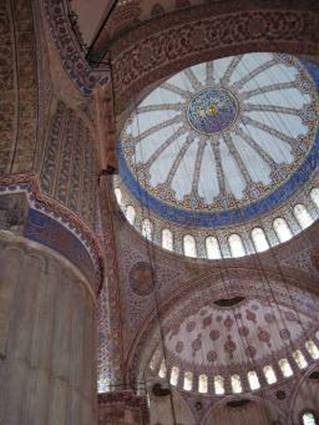
Why it’s called the “Blue Mosque.”

clip_image005 clip_image006

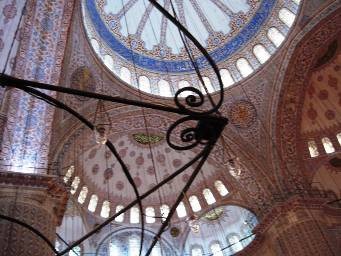
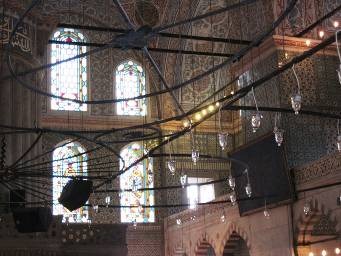
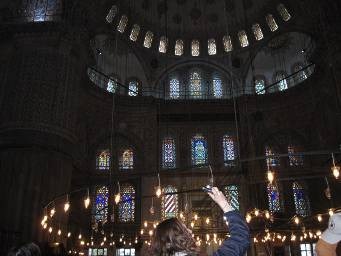
The beautiful blue dome and the hanging glass lights.

clip_image007 clip_image008

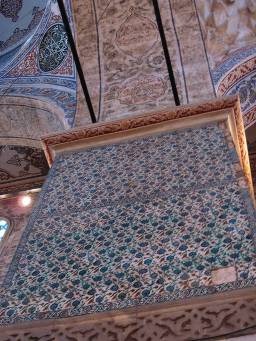
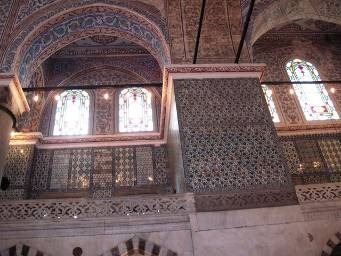
The blue tiles help give the Mosque its name.

clip_image009

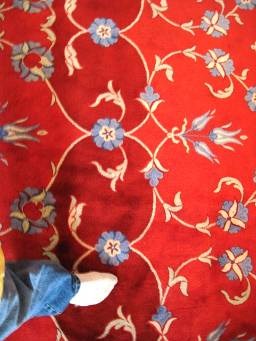
Turkish carpets on the floor and no shoes were allowed.  You were given bags at the entrance to carry them around with you.

clip_image010

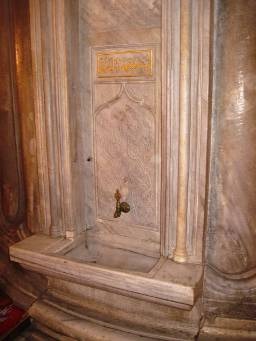
Inside the Mosque were two marble was basins, one for men and one for women.

This one was near the women’s prayer area which was behind a screen, separated from the men and the main beautiful hall.

clip_image011

Stained glass windows would have filled the mosque with colored lights on a sunny day.

I left the Mosque and went to explore the bazaar and the back streets where we hadn’t yet walked.

clip_image012

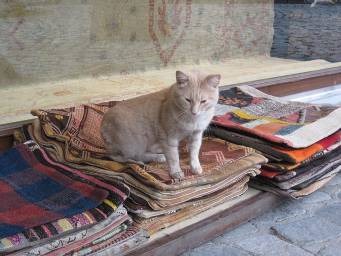
On a street of shops and restaurants this cat had made itself comfortable on a pile of pillow covers.

clip_image013

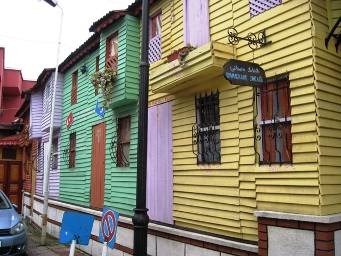
I wandered the back streets past these colorful buildings on my way to join Randal in the center of Sultanahmet.

clip_image014

A display of porcelain in a shop window of one of the hotels in Sultanahmet.

More Istanbul stories..Burak’s Cafe Restaurant

We took the 9 am bus from Izmir to Denizli and then the mini-bus from Denizli to Pamukkale. We arrived about noon.  Turkish buses are a bargain.  Just as on an airplane you can choose to watch a movie, tv, or listen to music on your individual viewing screen with headphones.  Unlike an airplane the only language choice is Turkish.  The bus stewardess bring you drinks and snacks!  An odd thing did happen not far from Denizli.  The bus pulled to the side of the road and stopped where there were several polis and jandarm cars parked. (Police and some other kind of military police.)  The ones sitting in their cars were smiling. The ones standing around had auromatic weapons.  The one who boarded the bus and took our passports as well as the id cards of the Turkish passangers wasn’t smiling and was carrying a pistol; but he wasn’t scary.  After about 5 minutes the bus stewardess came back onto the bus and redistributed our  passports and id cards.  No one seemed to know why it had happened.  Linda and Michael hadn’t experienced it on their trip the day the day before to Pamukkale.  I wondered if things went more smoothly for the Turks because Randal and I were there and no one wanted an international incident.  But that could just be my imagination running wild.

Pamukkale is a cute little resort town and when you finally see the photos you’ll know why.  The food here is really good too.

Ru

DoraMac

Keep Going Sox!

Dinner at Burak’s

clip_image001

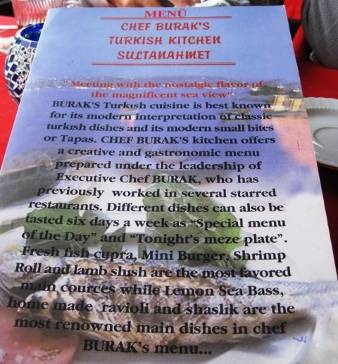
One evening Linda and Michael came to our side of Sultanahmet and we all went to dinner at the cafe next door to our hotel. Earlier in the day I had checked the menu and it seemed pretty reasonable though more expensive than our favorite lunches of cheap, tasty chicken shawarma wraps.

clip_image002

clip_image003

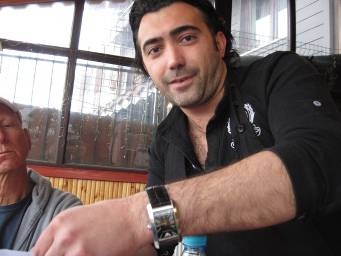
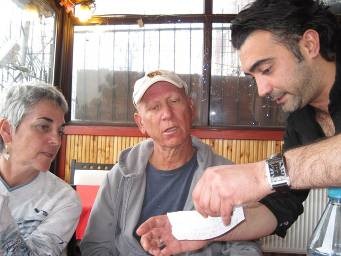
Burak himself!

He told us he was 24.  We’re not sure if something was lost in translation because he had so much restaurant experience it didn’t seem possible.

clip_image004

Our table overlooked the Sea of Marmara.

While we ate our dinners, Burak treated us to a plate of his version of humus, a plate of flavored rice and finally some Turkish Delight for dessert.  He also gave us really nice copies of the April Istanbul travel guide; you can see it on the table.

clip_image005

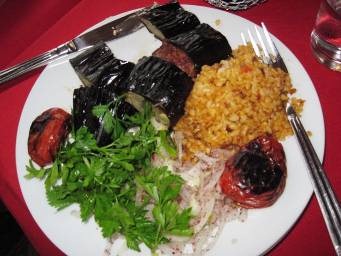
I had grilled eggplant (aubergine here in Turkey) “kebap” with lamb and wonderfully fragrant rice, grilled tomatoes  and greens.  I ate bread and humus and still made room for dessert.

clip_image006

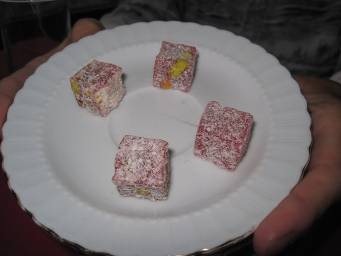
Turkish delight for dessert because Burak wanted us to try them.

They are quite good and not as sweet as you might expect.  It has a gum drop consistency and these had a pistachio nut in them.  Though small, you didn’t eat it in a single bite, but savored the taste.  At the Grand Bazaar we tasted an “all natural” version made with chopped pistachio nuts, cranberry juice and honey and it was wonderful and very expensive.  The Turks love their candies, pastries, puddings and bread!  Turkey has really wonderful food!

clip_image007

Passover food for Linda.

After we had ordered our meals Burak brought us some bread that looked like Challah and told us it was like Jewish bread.  We told him we were Jewish and then things really took off.  Burak’s Jewish grandfather had come from Germany helped by Turkish Muslims because they were in the textile business (I think he said textiles) and were friends.  His Grandfather also lived in Israel for a while but eventually settled in Turkey.  .  His brothers are named Isaac and Jacob.  Linda had mentioned that she wouldn’t be eating bread after our evening meal because Passover was about to start.  Burak raced away to find the phone number for a restaurant that prepared Kosher food and Passover food.  Linda didn’t pursue the option but has resisted all of the wonderful bread for days.  Michael and I aren’t so good.

While we were eating a young couple came in with a small child.  We overheard them speaking and realized it was Hebrew.  They lived near Jerusalem but were on their way to Spain for vacation.  We were focused on our own meal so only spoke with them a bit: they weren’t there very long with a small child.

clip_image008

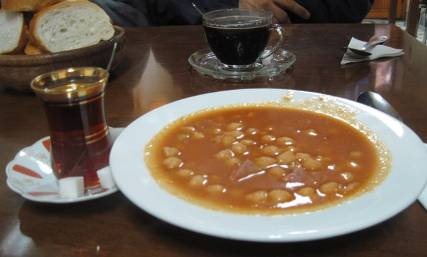
Keeping with a food theme, this was my meal the day we visited the Grand Bazaar.

We were cold and wet and deliberating on the purchase of some bronze dervishes so stopped for tea but then ate soup as well.  Garbanzo soup, bread and tea really warms and fills you.  Linda and Michael did buy the larger dervish and I didn’t buy the small one and now I sort of wish I had…..  Tea is served in lovely “tea glasses.”

clip_image009

A tea seller at the Grand Bazaar

You see tea sellers everywhere and they are usually male. I love the delicate tea glasses and maybe will buy some when we are back on DoraMac.  I tried holding a cube of sugar in my teeth and drinking tea through it as my grandparents might have done but the cube just melted all at once.

clip_image010

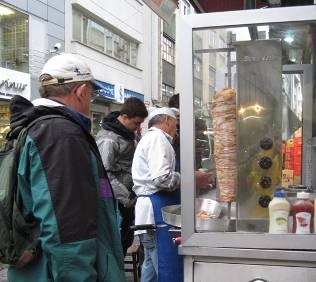
Randal buys a “shawarma” near the Spice Bazaar

Vertical piles of meat, lamb, or chicken are cooked and then sliced to be piled into pita bread or wraps.  We love them.  I think we’ve had one a day since we’ve been in Turkey.

clip_image011

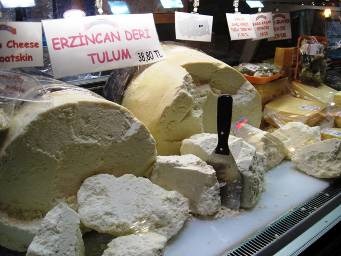
Nuts, fruits, Turkish candies, cheese, salami were sold at the Spice Bazaar.

clip_image012

And cheese!

Every morning I eat bread and this wonderful white cheese.  I haven’t blimped up yet but I don’t know why.  We eat a huge breakfast and a medium lunch and then often skip dinner because we’re just not hungry. However, last night in Izmir we ate dinner and it was truly wonderful.  We ate bright green and red salads, warm crispy bread and for my meal I ate grilled sardines!  I’d read about them in my travel books and they are truly wonderful, a very light white fish.  I washed my meal down with lovely, light white Turkish Agora wine.  I’d ordered a glass but got a half liter bottle so I had more than I normally drink.  (No I didn’t drink it all.)    Randal had beefsteak and beer with his salad and bread.  Then, when we were truly stuffed, the manager brought out a plate of soft white cheese covered with real blueberries that were sweetened mostly from the sun.  Randal and I ate it all!  I was so full and it was so wonderful.  Emniyet 1367 Sakak No. 14 Cankaya Izmir is the address if you ever find yourself in Izmir.  I have no photos because we were only going out for a quick, light meal around the corner from our hotel.

Turkey has bread and cheese and lamb and fish and vegetables and pastries and and and….It is a great country for eating!  And there’s so much to see, Asia and Europe mixed together. You should come here!

More about Istanbul

Randal and I spent the morning wandering around Izmir lost in the confusion of streets around the bazaar.  Everyone tried to help us, and thankfully Randal is good with a map because if not we’d still be wandering around out there.  The bazaar seemed to be surrounded by dozens of other narrow shopping streets filled with everyone in Izmir who wasn’t doing something else.  As it turned out we’d gone the long way around to get there and were, when we finally realized it, “just down the main road from our hotel!”  We’d actually started the morning walking along the waterfront which is a linear park with walking and bike paths.  But we’d headed away from the part of the city with the bazaar.  I stopped a woman walking her dog and she helped us by expaining to a taxi driver where to take us.  He asked for 10 Euros but we said 10 lira and to use his meter.  It came to 10 Turkish Lira.  We got out of the taxi and then got ourselves lost again but it worked out fine and the weather in Izmir is lovely, sunny sweater weather.  Tomorrow we’ll take the bus to visit Pamukkale and stay two nights at the Artemis Yoruk Pension.  Pamukkale has natural formations created by hot springs flowing downhill depositing layers of calcium carbonate.  The ruins of ancient Hierapolis are there too.  But I still have to catch up on Istanbul stories.  This one is about our visit to the Million Stone and the Basilica Cistern.

Ru

DoraMac

Million Stone and The Basilica Cistern

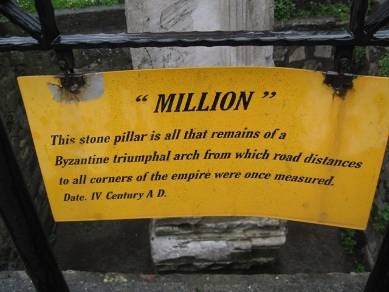
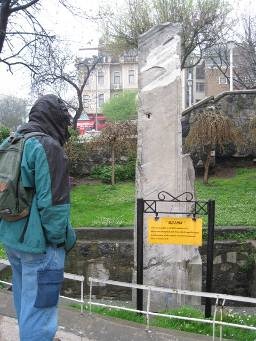
Million Stone

clip_image001

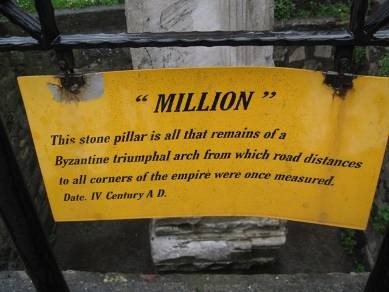
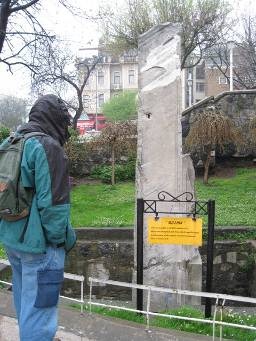
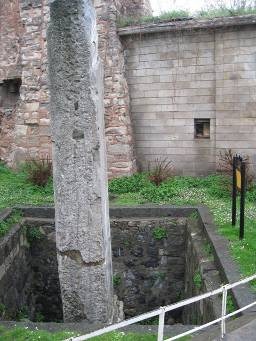
“The Million Stone, marking the beginning of the road to Europe, used to be considered as the center of the world during the Byzantine era.  The city (Constantinople, now Istanbul) was the center of the world and this point was the center of the center.  All geographical distances were calculated in accordance with this point.  Its name, (which can also be milion) comes from the unit of length, the “mile.”   From my Istanbul Guide

clip_image002 clip_image003

And here I thought Fenway Park (home of the Red Sox in Boston, Massachusetts) was the center of the Center of the World.

The Million Stone was just a short walk from our hotel and the Basilica Cistern just a bit further.  It was cold and drizzling so shortly after this I bought my souvenir umbrella to make it stop raining, which it did.

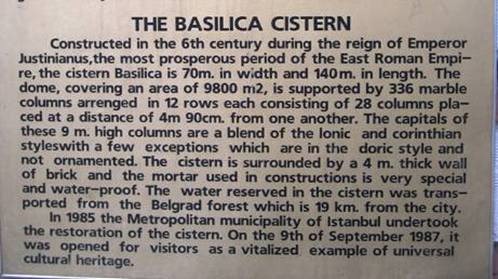
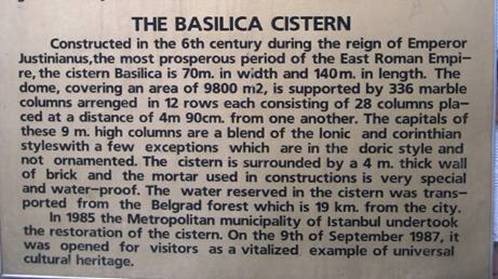
Yerebatan Sarayr or The Sunken Palace or the Basilica Cistern

clip_image004

!

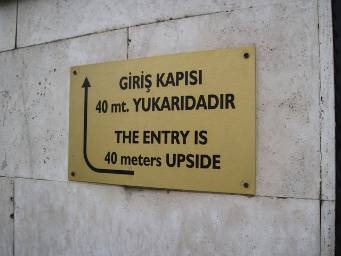
Upside and downside became two of our favorite new words in India.  We heard them used here too.  During our tour of Dolmabahce Palace we were told the throne used by the sultan was on our behind.  (In back of where we were facing.)  I wanted to point out that it had connected with his behind but never ours, but resisted.  Language can be so fun.

clip_image005

clip_image006

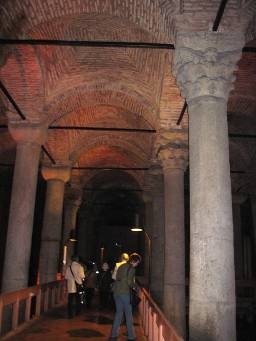
The entrance is street level and then you walk down to the “sunken palace.”

clip_image007

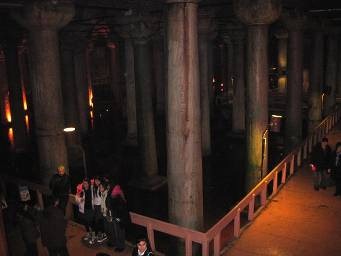
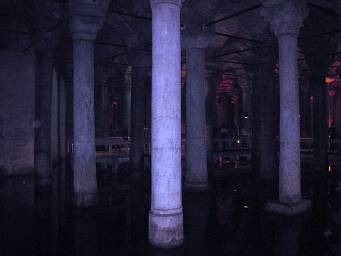
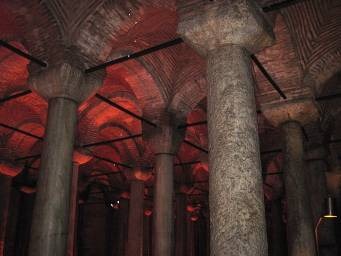
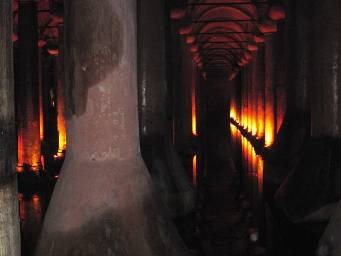
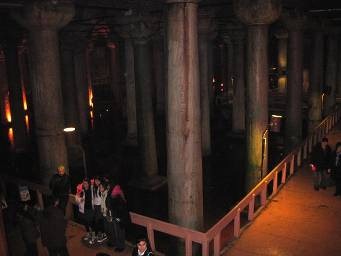
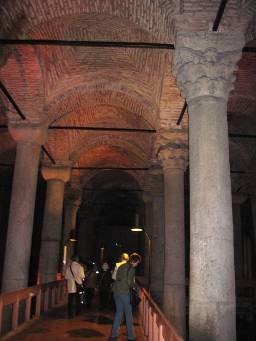
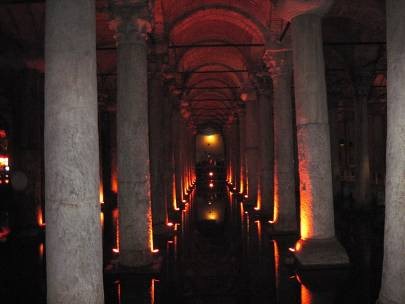
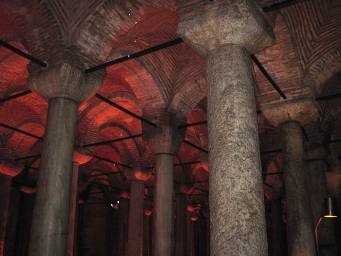
The cisterns were dark with “Halloween” lighting so photos were hard to take.

clip_image008

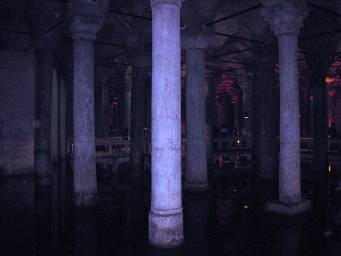
The bases of the columns were in water where carp were swimming.

clip_image009

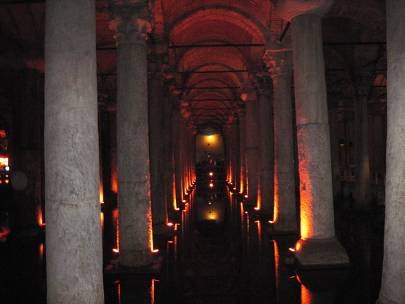
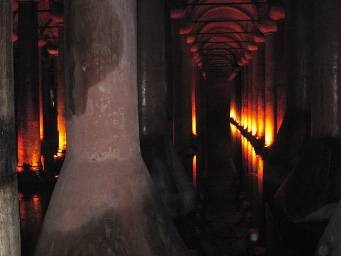
This is what it actually looked like with the ghostly lighting.

An interesting factoid* I found while trying to learn enough to explain it to you……

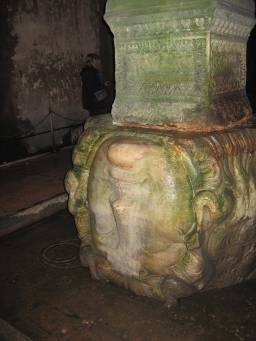
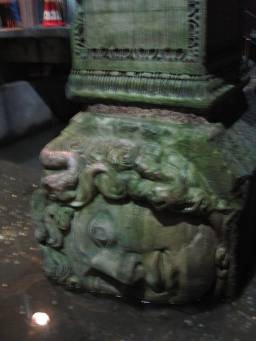
“Remember the scene in the old James Bond movie From Russia With Love when Bond is rowing in a small boat through a forest of marble columns? That scene was filmed in Yerebatan clip_image010 clip_image011

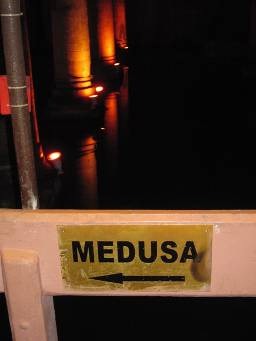
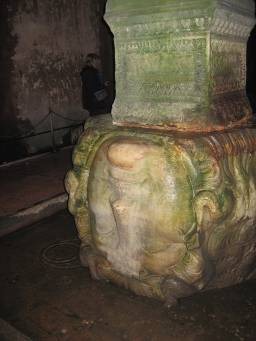
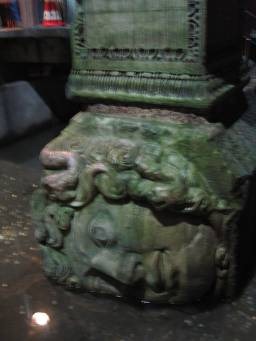
Two sculptured heads of Medusa are used as the base of two columns in the southwestern part of the cistern.

The cistern brochure tells several stories about the Medusa heads. Medusa was one of the three Gorgonas, female monsters of the underground and their powerful images was used to protect important places.  Perseus cut off the head of Medusa which gave him the power to defeat his enemies.  Because looking at Medusa would turn one to stone the head was placed upside down and sideways to somehow preventing that from happening.

clip_image012

clip_image013 clip_image014

The Cisterns were so huge and open that you never felt “underground” or claustrophobic; it was too fascinating. The underground reservoir has the capacity to hold 100,000 tons of water.

clip_image015

The land over the cisterns is apparently sinking and there are plans to perhaps close it off from any construction.

clip_image016

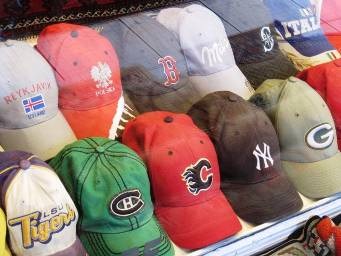
From the Cisterns we walked to the Carpet Museum near the Blue Mosque.  It was closed for renovation so we walked through the small bazaar behind the Mosque.  “And what to my wondering eyes should appear” in the window of a carpet shop but a Boston Red Sox cap just like the one I had lost in India.  “I want to buy that hat,” I said.  “I have to buy that hat!” I said.  But though they happily would have sold me a zillion dollar carpet, it was no dice on the cap.  Apparently tourists had given the shop owner their hats, maybe for a better carpet deal.  The owner wasn’t there and the salesmen wouldn’t sell me the hat.  But the Sox are winning and that’s all that matters.

*Factoid..

“The “-oid” ending in English is normally added to a word to indicate that an item is not the real thing. A humanoid is not quite human. Originally “factoid” was an ironic term indicating that the “fact” being offered was not actually factual. However, CNN and other sources have taken to treating the “-oid” as if it were a mere diminutive, and using the term to mean “trivial but true fact.” As a result, the definition of “factoid” is hopelessly confused and it’s probably better to avoid using the term altogether.”

http://www.wsu.edu/~brians/errors/factoid.html

I don’t know what made me use the word factoid rather than fact, but when I looked it up it seemed appropriate.  Sometimes everything I write here should be assumed to be factoids because I don’t always get it exactly right and it is more “my memories” than real facts.

More about Istanbul

  Randal and I spent the morning wandering around Izmir lost in the confusion of streets around the bazaar.  Everyone tried to help us, and thankfully Randal is good with a map because if not we’d still be wandering around out there.  The bazaar seemed to be surrounded by dozens of other narrow shopping streets filled with everyone in Izmir who wasn’t doing something else.  As it turned out we’d gone the long way around to get there and were, when we finally realized it, "just down the main road from our hotel!"  We’d actually started the morning walking along the waterfront which is a linear park with walking and bike paths.  But we’d headed away from the part of the city with the bazaar.  I stopped a woman walking her dog and she helped us by expaining to a taxi driver where to take us.  He asked for 10 Euros but we said 10 lira and to use his meter.  It came to 10 Turkish Lira.  We got out of the taxi and then got ourselves lost again but it worked out fine and the weather in Izmir is lovely, sunny sweater weather.  Tomorrow we’ll take the bus to visit Pamukkale and stay two nights at the Artemis Yoruk Pension.  Pamukkale has natural formations created by hot springs flowing downhill depositing layers of calcium carbonate.  The ruins of ancient Hierapolis are there too.  But I still have to catch up on Istanbul stories.  This one is about our visit to the Million Stone and the Basilica Cistern.

Ru

DoraMac

Million Stone and The Basilica Cistern

Million Stone

clip_image001

“The Million Stone, marking the beginning of the road to Europe, used to be considered as the center of the world during the Byzantine era.  The city (Constantinople, now Istanbul) was the center of the world and this point was the center of the center.  All geographical distances were calculated in accordance with this point.  Its name, (which can also be milion) comes from the unit of length, the “mile."   From my Istanbul Guide

clip_image002 clip_image003

And here I thought Fenway Park (home of the Red Sox in Boston, Massachusetts) was the center of the Center of the World.

The Million Stone was just a short walk from our hotel and the Basilica Cistern just a bit further.  It was cold and drizzling so shortly after this I bought my souvenir umbrella to make it stop raining, which it did.

Yerebatan Sarayr or The Sunken Palace or the Basilica Cistern

clip_image004          !

Upside and downside became two of our favorite new words in India.  We heard them used here too.  During our tour of Dolmabahce Palace we were told the throne used by the sultan was on our behind.  (In back of where we were facing.)  I wanted to point out that it had connected with his behind but never ours, but resisted.  Language can be so fun. 

clip_image005

clip_image006

The entrance is street level and then you walk down to the “sunken palace.”

clip_image007

The cisterns were dark with “Halloween” lighting so photos were hard to take. 

clip_image008

The bases of the columns were in water where carp were swimming.

clip_image009

This is what it actually looked like with the ghostly lighting.

An interesting factoid* I found while trying to learn enough to explain it to you……

    “Remember the scene in the old James Bond movie From Russia With Love when Bond is rowing in a small boat through a forest of marble columns? That scene was filmed in Yerebatan http://www.turkeytravelplanner.com/go/Istanbul/Sights/Sultanahmet/Yerebatan.html

clip_image010 clip_image011

Two sculptured heads of Medusa are used as the base of two columns in the southwestern part of the cistern.

The cistern brochure tells several stories about the Medusa heads. Medusa was one of the three Gorgonas, female monsters of the underground and their powerful images was used to protect important places.  Perseus cut off the head of Medusa which gave him the power to defeat his enemies.  Because looking at Medusa would turn one to stone the head was placed upside down and sideways to somehow preventing that from happening. 

clip_image012

clip_image013 clip_image014

The Cisterns were so huge and open that you never felt “underground” or claustrophobic; it was too fascinating. The underground reservoir has the capacity to hold 100,000 tons of water.

clip_image015

The land over the cisterns is apparently sinking and there are plans to perhaps close it off from any construction. 

clip_image016

From the Cisterns we walked to the Carpet Museum near the Blue Mosque.  It was closed for renovation so we walked through the small bazaar behind the Mosque.  “And what to my wondering eyes should appear” in the window of a carpet shop but a Boston Red Sox cap just like the one I had lost in India.  “I want to buy that hat,” I said.  “I have to buy that hat!” I said.  But though they happily would have sold me a zillion dollar carpet, it was no dice on the cap.  Apparently tourists had given the shop owner their hats, maybe for a better carpet deal.  The owner wasn’t there and the salesmen wouldn’t sell me the hat.  But the Sox are winning and that’s all that matters.

*Factoid..

“The “-oid” ending in English is normally added to a word to indicate that an item is not the real thing. A humanoid is not quite human. Originally “factoid” was an ironic term indicating that the “fact” being offered was not actually factual. However, CNN and other sources have taken to treating the “-oid” as if it were a mere diminutive, and using the term to mean “trivial but true fact.” As a result, the definition of “factoid” is hopelessly confused and it’s probably better to avoid using the term altogether.”

http://www.wsu.edu/~brians/errors/factoid.html

I don’t know what made me use the word factoid rather than fact, but when I looked it up it seemed appropriate.  Sometimes everything I write here should be assumed to be factoids because I don’t always get it exactly right and it is more “my memories” than real facts.

Chora Church

Today we joined a small tour to Ephesus and it was actually astounding!  Ancient Greek and Roman ruins from like 600 B.C.  You couldn’t help but be amazed.  The perfect weather and blue skies against the ancient stone columns, arches, statues and ruins created great photo opportunities and I took over 300 in the 3 or so hours we were there.  We also visited the house that, according to legend more than history, Jesus’s mother Mary lived in and where she died.  Lunch was a wonderful meal hosted by a Turkish carpet outlet.  We finished the day with a stop at the Ephesus Museum and a leather outlet.  Our guide appologized for making us deal with the sales pitches but he was mandated to do it by his travel agency.  He was a wonderful guide, knowledgeable and he spoke excellent English.  It cost a bunch of money but it was worth it.  Randal and I will stay in Ismir tomorrow and see the city itself.  Then we will move on down the cost making our way to Marmaris.  Doramac will supposedly arrive April 28th rather than the first week in May so we have less time to dawdle than we thought.

But this email takes us back to Istanbul and the Chora Church.

Ru

DoraMac

ps  In Istanbul I threw a coin in the wishing waters of the Basicilica Cistern and the Sox won!  At Mary’s house there was a wishing wall where you tied a cloth to make a wish and I did that too.  I also lit some candles for them.  So I’ve done my part.  Keep going Sox!

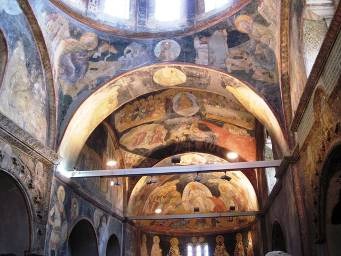
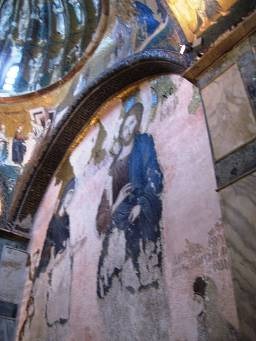
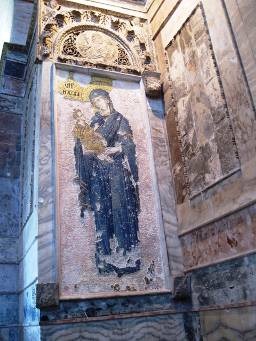
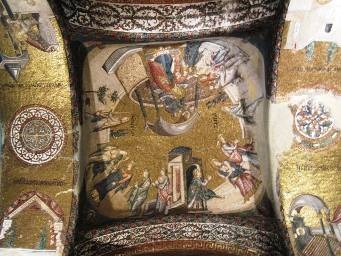
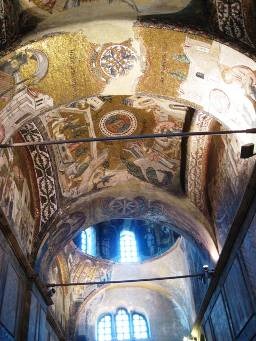
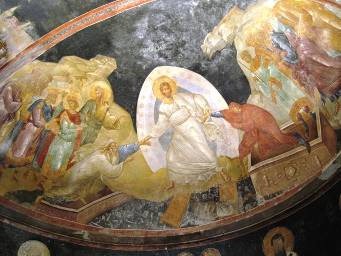
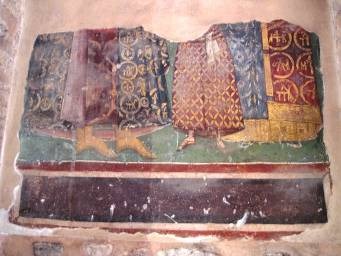
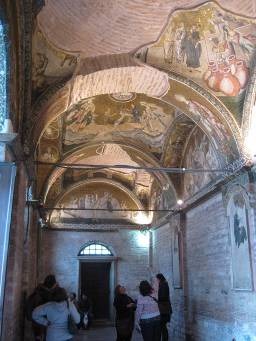
Kariye Camii  (Chora Church)  http://www.choramuseum.com/

clip_image001 clip_image002

clip_image003clip_image004

clip_image005 clip_image006

clip_image007

clip_image008 clip_image009

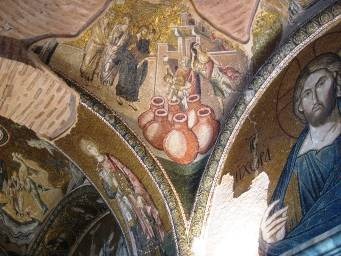
I wanted to see Chora Church tempted by the writers of all of the travel journals I’d read.  Ann Monk Kidd’s Traveling with Pomegranates was the most influential because so far I’ve liked her book the best.  Randal and I took a tram and a bus helped along our way by tram and bus workers who always take the time to help and don’t just point if you truly look confused.  From the bus we followed signs to what is now the Kariye Museum.  The church’s name Kariye Camii means “out in the country” because when the original structure was built (sometime between the 11th and 14th centuries,) it was outside the city walls.  There’s so much to say about this place that I’m not especially since I can’t possibly explain it as well as its own website can.  But my favorite part of the story is this…”The church was rebuilt and decorated in the 14th century under the supervision of  Theodore Metochites, an art lover, statesman and scholar who was a close friend and advisor of Emperor Andronicus II Palaeologus.  Sadly Metochites was reduced to poverty and sent into exile when the emperor was overthrown in 1328.  Metochites was allowed to return to the city in 1330 provided that he remained a monk at Chora, which he did, living out the last years of his life surrounded by the magnificent works he had commissioned.”  The church was converted into a mosque in 1511, but fortunately it was not substantially altered.  The mosaics were covered with wooden screens, some windows were boarded up, and minarets were added.

It would have been lovely to have spent time in this small space looking at each painting, but there were too many people and stopping and standing just put you in everyone’s way.  I think the small “human scale” appeals to me more than the huge mosques or palaces.  Our Tibet tour friends David and Ronnie said the same thing, that visiting smaller countries with small places was a richer experience than huge monuments in large cities.

So enjoy the photos and if you want to know more, explore their website which seems quite good.

clip_image010 clip_image011

clip_image012 clip_image013

clip_image014

Pera Palace Hotel and the Galata Tower

This evening Randal and I picniced in our room on dark crusty bread, goat cheese, green and black olives drenched in lemon juice and it was wonderful.  Then Randal went out and got us a decadent strawberry cream thing to split but we washed it down with diet coke so it’s ok.  One could gain thousands of pounds here and soon they won’t be asking me if I’m French!

Here’s the story of our visit to the Pera Palace Hotel and the Galata Tower.

Pera Palace Hotel and the Galata Tower

clip_image001 clip_image002

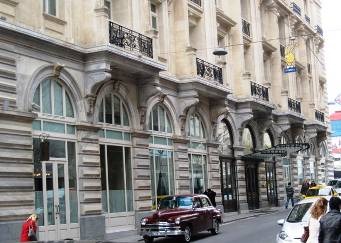
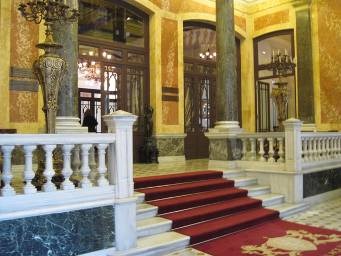
The Pera Palace Hotel was built in 1892 to provide accommodations for passengers on the Orient Express.

clip_image003

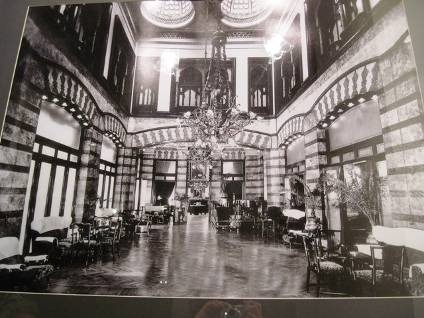
The Pera Palace “back in the day.”

Mustafa Kemel Ataturk, the first President of Turkey had a suite now set aside as a small museum: Room 101. http://www.perapalace.com/en-EN/ataturks-museum-room/66.aspx Agatha Christie stayed in room 441 while writing Murder on the Orient Express. http://www.perapalace.com/en-EN/agatha-christie-room/65.aspx will take you to the Pera Palace Hotel’s website which tells about Christie’s stays at the hotel.  Unfortunately the room was occupied so we couldn’t see it.  But Linda and I did make use of the “ladies.”

clip_image004

Terrycloth towels rather than hot air or paper which is especially impressive after Southeast Asia and India where there is “no nothing” in the “ladies” but 3 walls, a door, and some kind of plumbing.  Definitely a far cry from the AKDENIZ Hotel or the Alican where Linda and Michael have been staying.

clip_image005 clip_image006

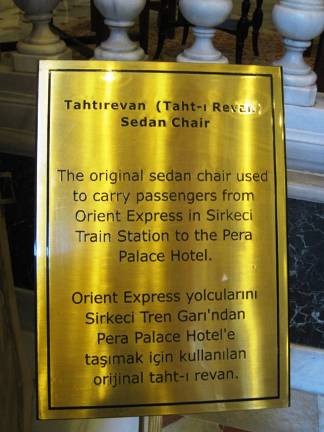
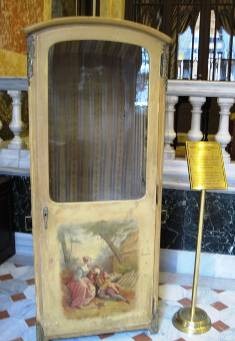
The Sedan chair was displayed in the lobby.

From the Pera Palace we walked to the Galata Tower.

clip_image007 clip_image008

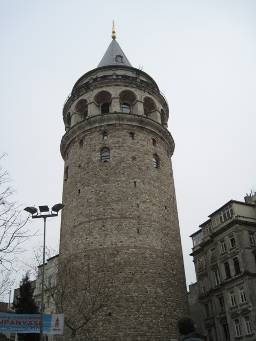
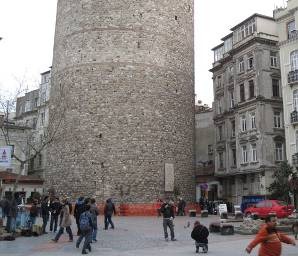
I couldn’t get back far enough to capture the entire tower.

“Although it is not completely certain as to when the Galata Tower was built, it is claimed that the it was built during the reign of the Byzantian Emperor, Iustinianos in 507 CE.  (That tower was built of wood.)

It was called the Christea Turris (Tower of Christ) by the Genoese and the Megalos Pyrgos (The Great Tower) by the Byzantines. It took its present shape during the Genoese period. The Tower was heavily damaged during an earthquake in 1509, and it was renewed by the architect, Hayrettin, who was very famous during that period. During the reign of Süleiman the Magnificent (1520-66), it was used as a jail for prisoners who were sentenced to work at the Kasımpaşa Naval Dockyard. The head astrologer, Takıyeddin Efendi, established an observatory on the top of the tower at the end of the 16th century and functioned as an observatory for a particular period of time. Later, it was closed and again turned into a prison by Sultan Murat III (1546-1595).

In 1638, Hezarfen Ahmet Çelebi flew as an early aviator using artificial wings from this tower across the Bosphorus to the slopes of Üsküdar on the Anatolian side during the reign of Murad V. Towards the 17th century, it was used by the Mehter Band, the janissary band of musicians. After 1717, it was used as a fire-observatory tower, but the tower itself was unfortunately destroyed in a fire in 1794.

After it was repaired, a cumba, a little room made of wood, was added to the tower during the reign of Sultan Selim III (1761-1808). After another fire in 1831, Sultan Mahmut added two more floors to the Tower and covered the top of the tower with a famous cloth in the shape of a conical hat.  An inscription written by Pertev Paşa concerning the tower’s repair works was affixed during that time. After a strong storm in 1875,  the framework of the roof was damaged and was late repaired in 1960. Today, the Galata Tower operates solely as a touristic attraction by a private company. The elevator only goes to the 7th floor, and the last two floors of the tower must be climbed by stairs.

After passing though the restaurant on the top floor, there is a balcony that encircles the tower. The restaurant’s view showcases a scene of Istanbul and the Bosphorus.

Dimensions

The height of the tower is 66.90 meters (62.59 meters non-including the ornament on top), the outer diameter is 16.45 meters, the inner diameter is 8.95 meters, and the thickness of the wall is 3.75 meters. http://www.ibb.gov.tr/sites/ks/en-US/1-Places-To-Go/towers/Pages/galata-tower.aspx

The Galata Tower’s website is   http://www.galatatower.net/english/

Linda and I paid the fee, waited for the elevator that takes you part way and then climbed the stairs to the outside walkway around the top of the tower.  It was cold and crowded but the view of the “Golden Horn” was wonderful.  Randal and Michael sat in the street café next door and had coffee.

clip_image009

Looking down!

clip_image010

The Galata Bridge spans the mouth of the Golden Horn and is said to divide the European side of Istanbul though I’m not absolutely sure what that means.

clip_image011

The Golden Horn.  Buildings are all jam packed together.

clip_image012

Overlooking the Bosphorus

Today was our last day in Istanbul.  It’s a great place to visit and one could spend lots of time here.  But tomorrow we’re off early to catch the ferry and then train south to Izmir.  Linda, Michael, Randal and me.  The ferry leaves at 7 am and takes 2 hours.  Then we’ll board the train and be in Izmir around 3pm.  We are staying at the Alican Hotel.  I still need to write more about Istanbul and maybe will get some written on the train.  I certainly learn more as I write.

Ru

Istanbul Sites

Sultanahmet Square

clip_image001

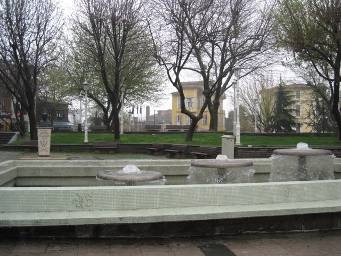
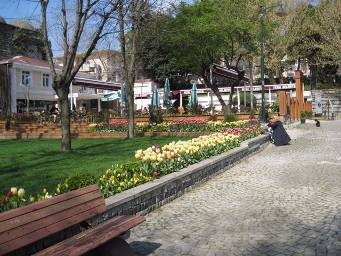
Tulips are blooming in Sultanahmet Square.

I said I wanted cooler weather.  I’m wearing a turtleneck, a wool sweater, my Sox hoodie and my heavy foul weather rain jacket.  But the sun was shining and the cold felt good.  The day it rained I had skipped the hoodie, my Henri Llyod rain jacket soaked up rain and I froze. 

clip_image002clip_image003

“This is one of the oldest pieces of art in Istanbul.  The heads of 3 snakes entwined with each other formed the feet of a cauldron.  The 31 Greek cities that defeated the Persians in the 5th Century B.C. melted the bronze trophies they acquired and constructed this artwork of unique quality.  The Snake Pillar which is 8 meters long was originally erected in the Temple of Apollo in Delphi.  It was brought by Emperor Constantine in 324.  It was erected in the middle of the Hippodrome. (Now Sultanahmet Square) One piece of the snake heads which were lost in the 17th century is exhibited in the Museum of Archaeology in Istanbul.”

clip_image004 clip_image005

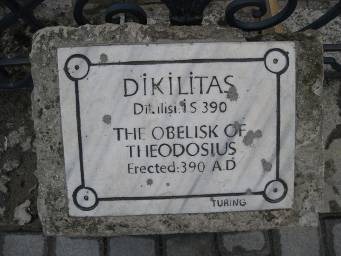
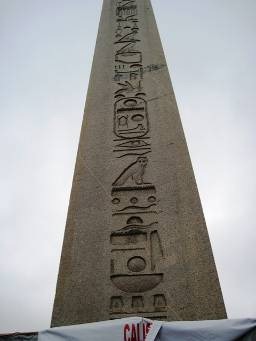
The Theodosius Obelisk

“The two obelisks were erected in front of the Karnak Temple in Luxor by the Pharoh of Egypt, Tutmosis the 3rd in 1490 B.C. for the victories Egypt won in Mesopotamia.  The obelisks were made of pink granite of a rare quality.  A Roman emperor, whose identity is not precisely known, brought an obelisk weighing many tons to Constantinople in the 4th century.  The obelisk, which lay on one side of the Hippodrome for years, was erected with difficulties in 390 by one of the governors of the city, Proclus, during the reign of Theodosius the 1st. The artwork, which has always been considered to be “enchanted,” is the oldest in Istanbul.  The obelisk stands on 4 bronze blocks on a Roman pedestal decorated with embossed figures.”  One of the obelisks is being refurbished and the base of this one is wrapped and not visible.  These two structures are obviously the oldest mad-made works that I’ve ever seen. 

clip_image006clip_image007

Randal was more fascinated with the piles of granite “pavers” used to maintain the roads and center of Sultanahmet Square.

clip_image008

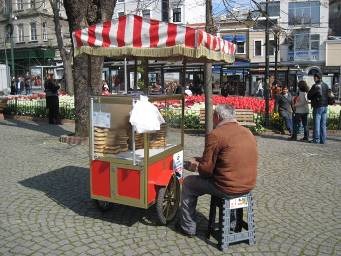
Vendors sell bread, corn on the cob or roasted chestnuts.

clip_image009

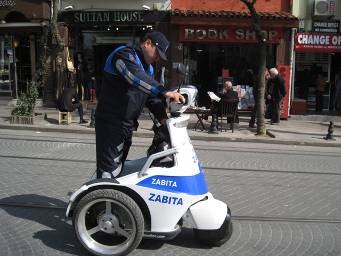
A segue used as a police vehicle shows the modern side by side with the ancient.

clip_image010

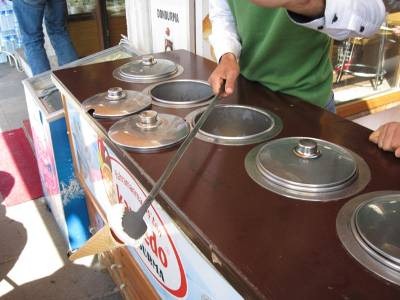
Attack of the ice cream cone.

With a long handled scoop, the vendor would scoop out some ice cream, catch a cone with it, and thrust it at a passerby.  It was too cold so I wasn’t tempted.

clip_image011

Tea glasses left on a window ledge in front of a carpet shop.

Linda and Michael gave us a tip; if you are cold and want hot tea or coffee, walk into a carpet shop and they give you a beverage while they try to see you a carpet.  We haven’t tried that yet but have had hot apple tea from these lovely glasses.  The main character in Bastard of Istanbul would buy a set of tea glasses almost each time she walked through the Grand Bazaar.  There are hundreds to chose from and all lovely and I can see why she had been so tempted. 

clip_image012

AKDENIZ OTEL is just down this alleyway on the left right on the main road and tram route. 

clip_image013

Our favorite bookshop in Turkey on the main street where the tram runs (see its reflection in the window.)

“Our aim is to show Turkey to the world, to act as an international window for Turkey.” “Ali and his staff select their stock by consulting the Bookshop’s “100 advisors”…a group of experts and academics from around the world who alert Bookshop to new publications.”  Amazingly there are two Book Shop locations in Sultanahmet, just about across the street from each other!  The collections are about the same but one the second shop is larger.  We met Ali our first visit and walked out with 3 books, all recommended by Ali or his staff.  Portrait of a Turkish Family by Irfan Orga originally written in 1950;  Turkish Reflections: A Biography of a Place by “Virginian” Mary Lee Settle in 199;, and Belshazzar’s Daughter by Barbara Nadel, a murder mystery series featuring Inspector Suleyman set in the Jewish section of Istanbul.  Ali’s comment about Nadel was that her goal was to kill off all the men in Istanbul.  I may have already mentioned that The Bastard of Istanbul by Elif Shafak was not available.  Ali implied it was because her writing isn’t yet great, but I know there were issues with Turkish censors.  But a bookshop isn’t a library so can choose what it likes and limit what it sells. 

The Blue Mosque is also in Sultanahmet Square but that gets an email of its own.  My favorite places so far are the Chora Church which I’d read about in Sue Monk Kidd’s Traveling with Pomegranates.  Randal’s brother-in-law Ken is a minister and I wanted to see it for him too!  And we went to see the Pera Palace Hotel where Agatha Christie wrote Murder on the Orient Express in room 441.  It was occupied so we couldn’t see it but I told my friend Sarah I’d try because her book club had just read Murder….  And we had a really fun dinner one night because chef Burak of Burak’s Turkish Kitchen became our friend and checked to find where Linda could find food kosher for Passover.  But that’s a story for another email.

Ru

DoraMac

Keep going SOX!!!!!