Mount Etna

Buona note,

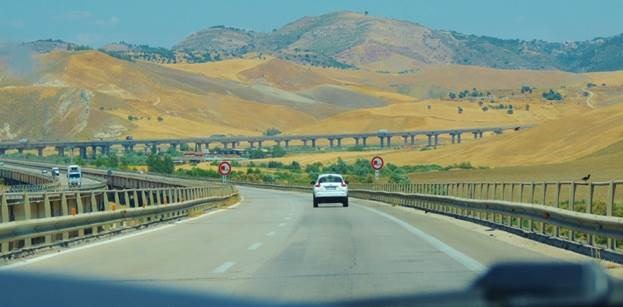
  I’ve written about our road trip, not how it happened, but writing first about my favorites. Enna, then S. Stefano di Camastra, Villa Romana and Piazza Armerina  and finally Mt. Etna.  Of them all my least favorite destination was Mt. Etna.  If you want to see Etna you have to plan at least a full day to do some hiking.  Or better go at night with a guide to see what apparently can be quite a show.  You can also spend a bunch of money for the cable car to avoid half of the hike.   We didn’t really want or have the time to do any of those things.  So we drove to Etna, walked around a bit, collected a rock souvenir, bought a 2 Euro bottle of water ( a small bottle) and drove off.  The drive each way was quite worth it taking us from the south coast, over the mountains, and then down through some valleys on our way to the north coast and S. Stefano di Camastra.  Here are a few photos from that day.

   Our final excursion here on Sicily was to Palermo for 2 nights with newest cruising pals Linda and Frank on SV Interlude.  Much more sensibly we took the public bus.   I hope to write that up before we leave Monday for Tunisia.  At least that’s the plan as of today.  The wind is howling outside this evening, but is supposed to calm down by Monday. 

Ru

“Mount Etna is Europe’s tallest active volcano and is located in Sicily, Italy. Like many other dangerous volcanoes such as Mount St Helens and Mount Vesuvius, Etna is a composite volcano. It has been created by the Earth’s active tectonic plate system – the African plate is moving below the Eurasian plate. As the Eurasian plate moves down into the Earth, it melts. Rising magma erupts at the surface as lava and ash and builds Etna in the process.

    Etna has erupted many times during recorded history and is still very active.

There are towns and villages surrounding the mountain, including Catania. In the past, the Italian authorities have used explosives, concrete dams, and ditches to divert lava flows away from these settlements”.   http://www.bbc.co.uk/science/earth/collections/mount_etna

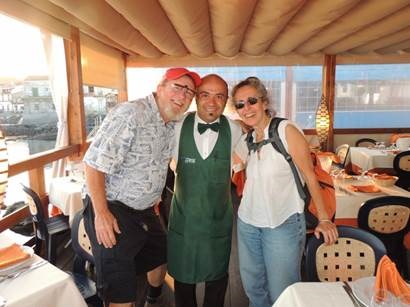
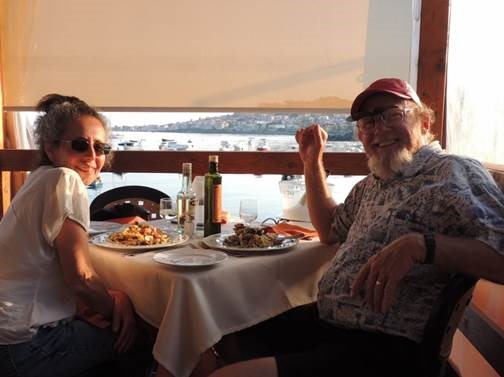
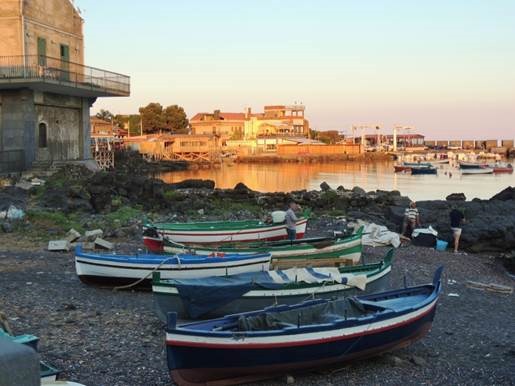
Our first night was spent in Acireale on the south coast rather than in Enna, but you already know that story.   And you saw this photo of us at the lovely waterfront restaurant with “brother John.” 

clip_image001

The dinner brother…John

clip_image002

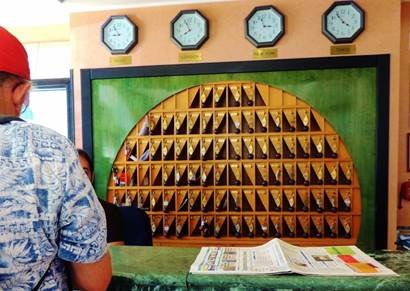
The hotel brother, Giuseppe

We arrived at the Park Square hotel about 6:30 pm the first night of our road trip.  Giuseppe had checked us into the hotel.  The hotel restaurant wouldn’t open until 8 pm and we wanted a walk and an earlier dinner so Giuseppe showed us where to walk out from the pool side of the hotel to get to the waterfront and the many restaurants.  We didn’t ask for nor did he offer a recommendation. It was quite the coincidence that we picked the restaurant of his brother!  Maybe one day they will have a hotel with a wonderful restaurant. 

clip_image003

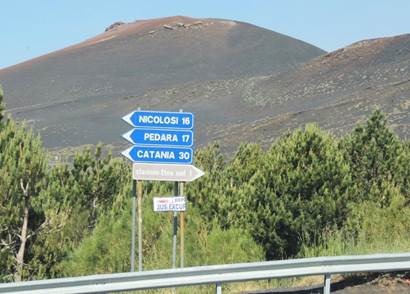
The brown sign points to Etna sud (south rim.)

Leaving Acireale and following the signs through small towns along the way was a challenge, as it was when we were driving away from Etna through small towns with narrow roads and confusing signs.   Finally at one point there is only one road, though a choice either north Etna or south Etna.  We went south.

clip_image004

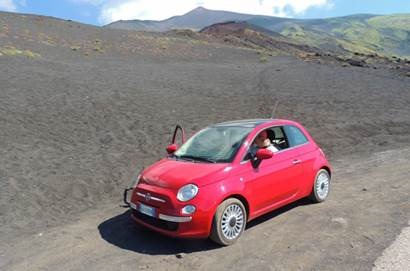
Our little red Fiat with the top of Etna in the distance.

It was a great car; comfortable and roomy for two people with not too much luggage. 

clip_image005

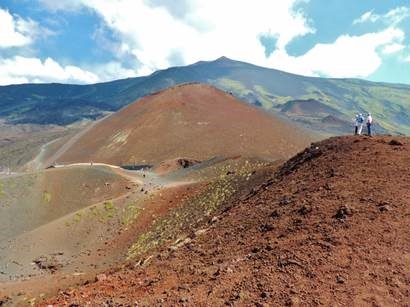
Just a short walk from the parking area near the visitor center

clip_image006

clip_image007

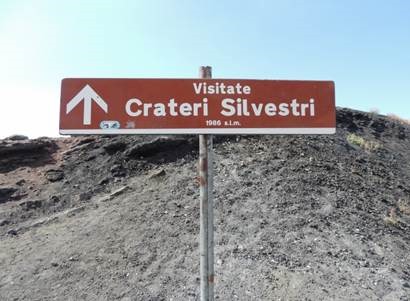
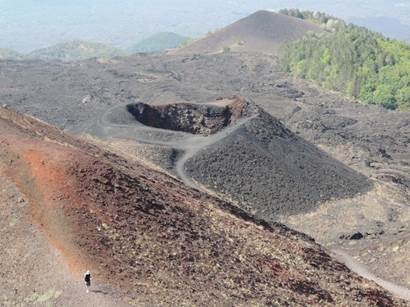
We did walk over to this crater but took a pass on the cable car.  Neither one of us wanted to spend the time it would take to really hike so we just walked around a bit, got back into the car and drove back down to our next destination, S. Stefano di Camastra.

clip_image008

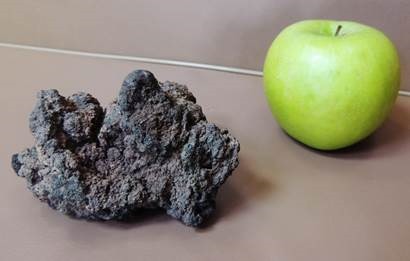
My Mt. Etna rock which smells quite different from all of the other rocks I’ve collected. 

clip_image009

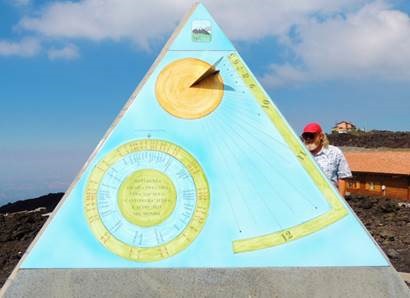
Sundial at the visitor center.

clip_image010

clip_image011

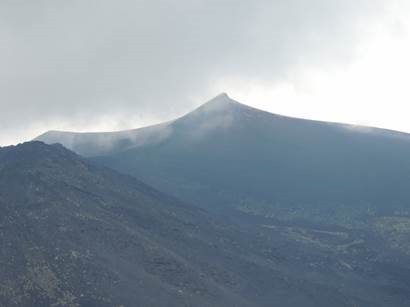
Another view of Etna

clip_image012

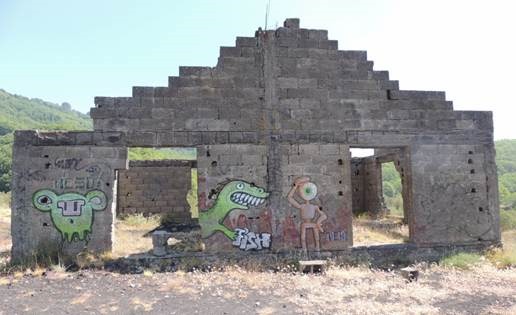
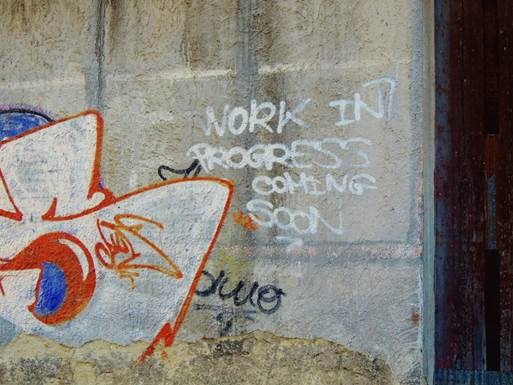
Sicily has lots of graffiti; we passed this example on the Etna road.

clip_image013

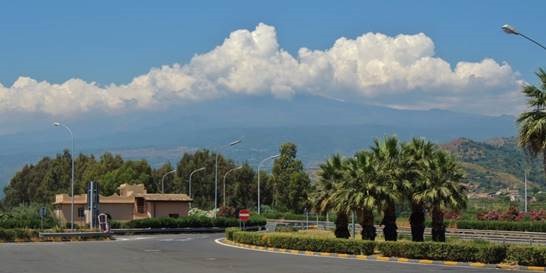
Rest stop on the autostrada looking back at Etna shrouded in clouds.

clip_image014

  There was a town mid way to S.Stafano that Randal chose as the place he’d like to eat.  Only one place on the main street sold any prepared food but it was more pastry like than real food.  I asked a woman passing by for suggestions as she understood a bit of English.  She asked a man in the shop we were near and he gave me a lengthy set of directions in Sicilian.  I guess we must have found the place he meant because we did find a place.  It was cute with not such great food.  Finding lunch in smaller towns can be problematic unless you want gelato and coffee and more pastry.  Apparently the big meal is dinner so folks don’t really pay much attention to lunch.    We were so spoiled in Marmaris with our favorite Aciktim doner place.

clip_image015

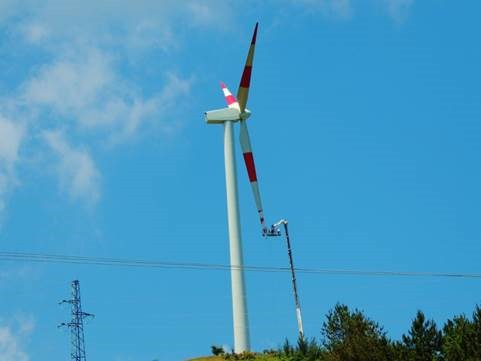
Windmill repair.

There is a very very tiny person in the basket of the crane looking as if to be repairing the tip of the windmill.  Those things are huge.  And the windmills really are everywhere.  As well has fields of solar panels. 

Piazza Armerina and Villa Romana del Casale

Buona sera,

   So, it looks as if we might get a weather break and be heading off for Tunisia on Monday.  We do need to be on our way, but there’s really so much to see here in Sicily that one could spend much more time here.  We spent just returned from several days in Palermo with our friends Linda and Frank and had a great time.  What seems like a confusing mess from the autostrada made much more sense when you take the bus to the central terminal just near the old/central part of Palermo.  Lots of fun; too much food!

   This email returns to our car trip, the first and last mornings actually; Villa Romana del Casale and Piazza Armerina.

Ru

Piazza Armerina & Villa Romana del Casale

  Villa Romana del Casale was the first stop of our Sicily road trip.  The actual town of Piazza Armerina was our final stop the last day.  We found driving to our destinations was fairly easy.  But the closer you got, the more difficult as signs seemed to point in contradictory ways or disappear altogether. (Which reminds me of the joke: the food was terrible and there was so little of it.) Ultimately we found our way and most of the countryside and tiny towns with steep narrow streets were worth the occasional backtracking.  

   Randal has developed a fascination with Roman floor mosaics.  His main reason for seeing Sicily was to visit Villa Romana del Casale famous for its extensive floor mosaics.  We parked in the huge, mostly empty lot, as we’d gotten an early start that morning.  Good thing as the lot was full when we left and the sun quite hot.  We did stop for a snack at one of the stands near the entrance allowing several busloads of folks to arrive turning the place quite crowded.  At the ticket booth are all of the “Do Not” signs including one with a camera indicating “no photos”.  We were both really disappointed until we saw the entire tour group ahead of us clicking away as their guide watched.  So we also ignored the sign but I have to say, none of our photos came out all that well.   And it was hard to take in so much all at one time especially as it got even more crowed and quite hot.  But we did “buy the souvenir book” so now can go back and read in leisure.

“Roman exploitation of the countryside is symbolized by the Villa Romana del Casale (in Sicily), the centre of the large estate upon which the rural economy of the Western Empire was based. The villa is one of the most luxurious of its kind. It is especially noteworthy for the richness and quality of the mosaics which decorate almost every room; they are the finest mosaics in situ anywhere in the Roman world.”  http://whc.unesco.org/en/list/832

This link includes a video explaining the Unesco World Heritage site.

“These extraordinarily vivid mosaics, probably produced by North African artisans, deal with numerous subjects, ranging from Homeric escapades and mythological scenes to portrayals of daily life, including the famous tableau of girls exercising in their “bikinis”.

   The Villa was built in four main sections: the main entrance with its thermal baths, a peristyle with living area and guest rooms, the private rooms of the owner, complete with basilica (public hall) and a triclinium (dining area) and elliptical courtyard.

   Almost completely covered by a landslide in the 12th Century, the Villa was partly rediscovered in the 19th Century. However, not until the 20th Century, with the excavations of Paolo Orsi, Giuseppe Culrera and Gino Vinicio Gentile did the magnitude and magnificence of Villa Romana del Casale come to light. It is now a UNESCO Heritage site.” http://www.thinksicily.com/guide-to-sicily/towns-and-cities-in-sicily/piazza-armerina.aspx

http://sites.davidson.edu/csa/more-than-mosaics-villa-romana-del-casale-a-piazza-armerina-site-report-3/  is a really good description of the Villa Romana from the school’s Classics Abroad program

clip_image001

On the road to Piazza Armerina and the Villa Romana del Casale;  bikers everywhere!

Really serious kind of bikers all over Sicily, but also several bike tourists. 

clip_image002

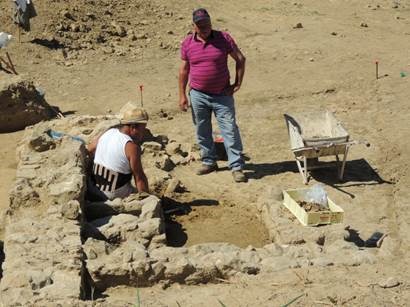
Uncovering  more remains at the Villa Romana del Casale just near the ticket booth and car park.

clip_image003

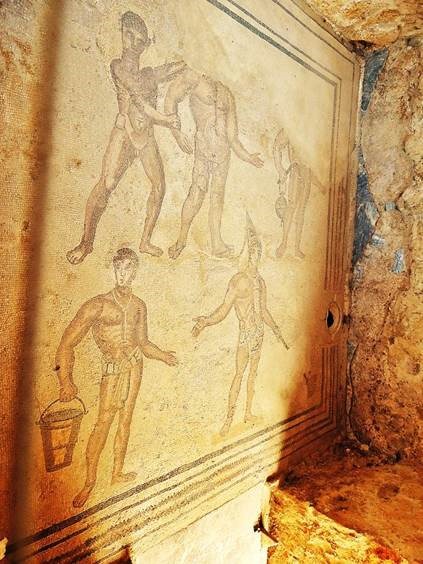
Massage room floor (rotated to see the figures more easily)  depicting a massage scene

“At the center is the naked figure of the owner who has just emerged from the bath, being oiled and massaged.  A slave is holding a strigil in his right hand (the curved instrument used to scrape off grease and sweat) and an ampule containing oil. In the foreground two slaves are wearing loincloths on which are written their names – Tite and Cassi.  One is holding a situla, the other a boom and  he is wearing a cone-shaped headdress used in Syria.  The figures are mutilated due to the digging of a well in the Norman period and the restoration which dates back to VI century AD.  The whole scene is bordered by cordons.” The Ancient Roman Villa of Casale at Piazza Armerina Past and Present

clip_image004

Palaestra ; a room used by Romans for physical exercise.

clip_image005

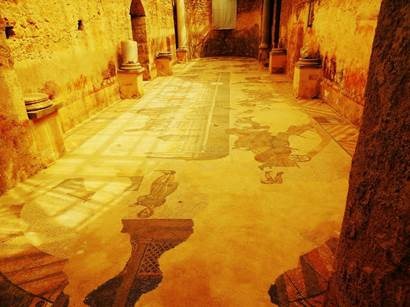
Vestibule, the room where the owner was greeted on his arrival home.

“…at the top of the emblem are three figures, two are holding laurel branches, in the foreground, the other, dressed in a purple-bordered toga….with a beard, and wearing a crown of laurel, is holding a candelabrum with a burning candle with his right hand.”

The Ancient Roman Villa of Casale at Piazza Armerina Past and Present

clip_image006

Bikini Girls: one of the more famous mosaics from the Villa

“This rectangular room with mosaic floor and frescoed walls was used by the servants…. As it was destined for servants’ use, the floor should have had a geometric design.  In the southeast corner it can be seen that below the surface covered with figures, there is another with geometric patterns (the 3rd century original.) At a later date, in the 4th century, the purpose of the room changed  and the new owners had the floor with the 10 girls in bikinis laid on top of the original.”

The Ancient Roman Villa of Casale at Piazza Armerina Past and Present

clip_image007

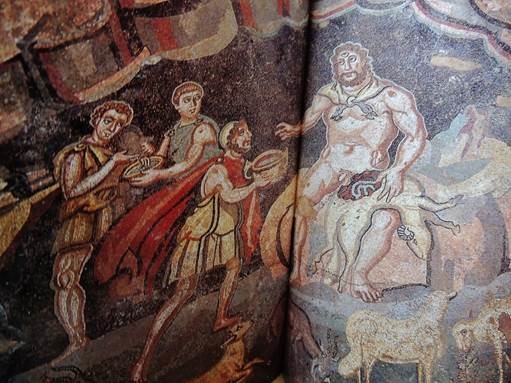
Many of the mosaics illustrated Greek mythology; this one from Homer’s Odyssey illustrated  Ulysses and the Cyclopes.  My photo was terrible so I used the one from the book.

clip_image008

Ulysses offering wine to the Cyclopes mosaic photo from The Ancient Roman Villa of Casale at Piazza Armerina Past and Present

“The Cyclopes were giant beings with a single, round eye in the middle of their foreheads. According to Hesiod, they were strong, stubborn, and "abrupt of emotion." Their every action ebbed with violence and power. There are actually two generations of Cyclopes in Greek myth. The first generation consisted of three brothers, Brontes ("thunderer"), Steropes ("flasher"), and Arges ("brightener"), who came from the union of Gaia (earth) and Uranus (sky). The second generation descended from Poseidon, and the most famous of these was Polyphemus from Homer’s Odyssey.

Brontes, Steropes, and Arges (the three descended from Gaia and Uranus) were the inventive blacksmiths of the Olympian gods. They were skilled metal workers and created Zeus’ thunderbolts, Poseidon’s trident, and Hades’ Helmet of Darkness that was later used by Perseus while on his quest to decapitate Medusa. However, they spent the majority of their early existence imprisoned. Their father Uranus (sky) hated all of his offspring (the Titans, Cyclopes, and Hecatonchires or hundred-handers) and kept them confined deep within Gaia (earth). The defeat of Uranus by his son Cronus (a Titan) freed the Cyclopes for a time, but Cronus was a paranoid ruler. He feared the Cyclopes’ power and cast them into Tartarus (the place of punishment in the underworld) where they remained imprisoned until Zeus (an Olympian and son of Cronus) released them, requiring their aid in the Titanomachy (battle of the Titans). With the assistance of the Cyclopes and their thunderbolts, Zeus overthrew Cronus and the Titans and became ruler of the cosmos. He was grateful for the Cyclopes’ help and allowed them to stay in Olympus as his armorers and helpers to Hephaestus, god of smiths. The Greeks also credited them with building the massive fortifications at Tiryns and Mycenae in the Peloponnese.

Brontes, Steropes, and Arges are mainly mentioned in passing in most of the myths to convey strength in heroes and the fine quality of weapons but are major characters in one other event � their deaths at the hands of Apollo. Zeus struck Asclepius, Apollo’s son, down with a thunderbolt for having risen a person from the dead. Apollo was outraged and killed the Cyclopes who had forged the deadly thunderbolt. It appears that Apollo’s rage was misplaced, yet by killing the Cyclopes, he was indirectly punishing Zeus. The ghosts of Brontes, Steropes, and Arges are said to dwell in Mt. Aetna, an active volcano that smokes as a result of their burning forges.

The second generation of Cyclopes was a band of lawless shepherds living in Sicily who had lost the skill of metallurgy. Polyphemus, son of Poseidon and the sea nymph Thoosa, is the only notable individual of the lot and figures prominently in Homer’s Odyssey. Odysseus and his crew landed on Sicily, realm of the Cyclopes. He and a few of his best men became trapped in Polyphemus’ cave when Polyphemus rolled a large boulder in front of the entrance to corral his sheep while Odysseus was still inside. Polyphemus was fond of human flesh and devoured many of the men for dinner. On the second night, Odysseus told Polyphemus that his name was "Nobody," and tricked him into drinking enough wine to pass out. While he was incapacitated, Odysseus/Nobody blinded him with a red hot poker. Polyphemus shouted in pain to the other Cyclopes on the island that "Nobody" was trying to kill him, so no one came to his rescue. Eventually, he had to roll away the stone to allow his sheep to graze. Odysseus and the remaining crew clung to the bellies of the exiting sheep where Polyphemus could not feel them as they passed him on their way to pasture and escaped. As Odysseus sailed away from the island, he shouted to Polyphemus that it was Odysseus who had blinded him. Enraged, the Cyclops threw huge boulders at the ship and shouted to his father, Poseidon, to avenge him.

Recent scholars have hypothesized about the origin of the Cyclopes’ single eye. One possibility is that in ancient times, smiths could have worn an eye patch over one eye to prevent being blinded in both eyes from flying sparks. Also, smiths sometimes tattooed themselves with concentric circles which could have been in honor of the sun which provided the fire for their furnaces. Concentric rings were also part of the pattern for making bowls, helmets, masks, and other metal objects. Notice that the first generation Cyclopes were associated with metal-working while the second generation was not. Apparently, the lawless band of Cyclopes is a later addition to the myths. The incidence with Polyphemus seems to have had an independent existence from the Odyssey before Homer added it to his epic adventure. It was probably told as a separate myth at certain functions.

It is uncertain why the Cyclopes were demoted from the smiths of the gods to a lawless group of monsters with no reverence for the gods. When the universe came into being, there were many monsters and vague forms that were gradually replaced with beings with more human forms. Order was replacing chaos. The monsters were phased out, and this could have lead to the transformation of the "good" Cyclopes to the "evil" Cyclopes that were destined to be fought and defeated by the divine human form.  http://www.pantheon.org/articles/c/cyclopes.html

The Villa Romana del Casale is located just near Piazza Armerina.  We stopped at the villa our first morning and the town of Piazza Armerina our final morning.

clip_image009

Those lovely narrow streets.

clip_image010

My first thought was that it was a plaza from the 18th century.  But I think it really is a city plaza according to section 18 of some code.  But I liked the scanning code sign too.  It’s also one of the zillion Garibaldi squares in Sicily.

clip_image011

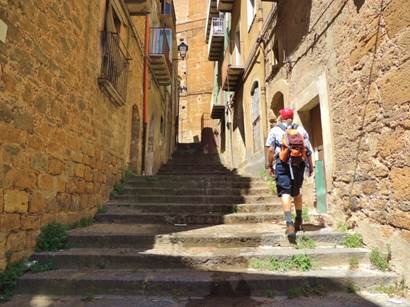
Walking to the Duomo up the old stone steps and narrow streets

clip_image012

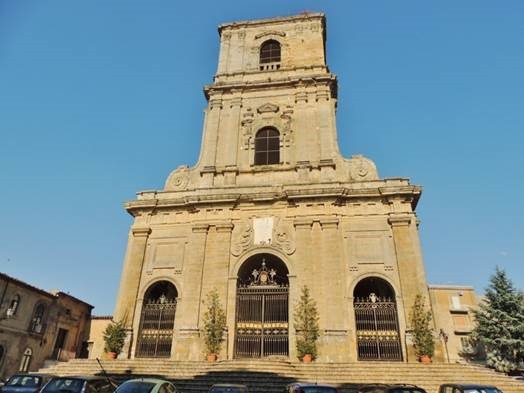
Duomo

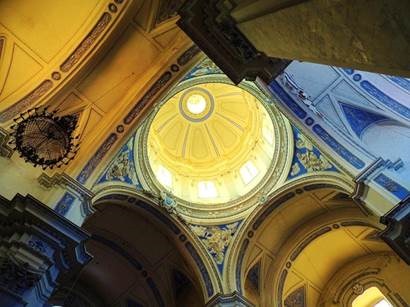
“The massive Baroque style Cathedral, which incorporates both Norman   Gothic and Catalan Gothic features, was built over a long period of time.  The upper part dates from the 16th century, the lower was built during the late 17th and early 18th centuries on the foundations of an existing church.  The dome was completed in 1768”  http://www.visitsitaly.com/sicily/piazza_armerina/

clip_image013

Looking up at the dome

clip_image014

You can get “churched out” in Sicily as you can get “mosqued out” in Turkey.  We haven’t been “synagogued” out yet as we’ve only been to about 4 in all of our travels; one in Rome, one in Tel Aviv, and two in Singapore.

clip_image015

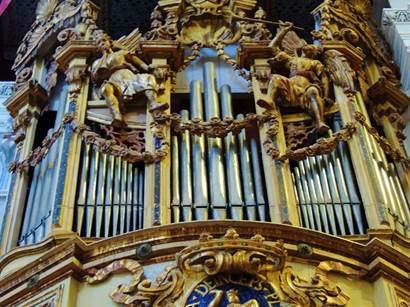
A close up of what looks like organ pipes. My friend Sharon’s son Asher refurbishes organs so this photo is particularly for them.

clip_image016 clip_image017

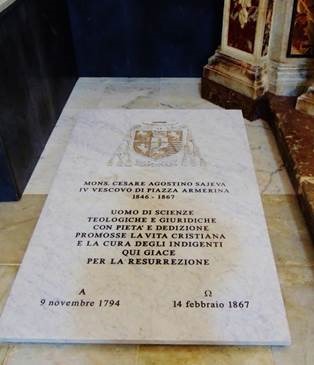
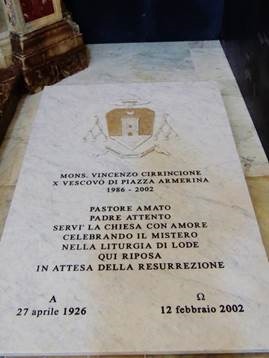
I think these are head stones and these two men are buried here?

clip_image018

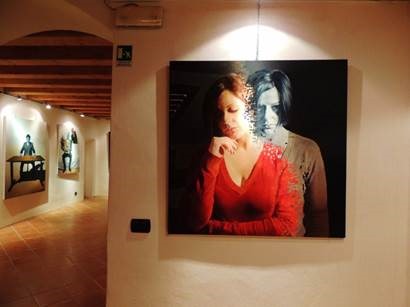
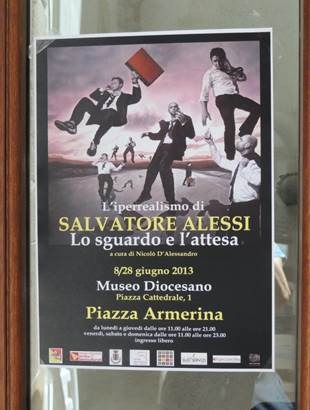
The small café/art gallery/ next door.

There were supposed to be church related items here, but we only found this contemporary art exhibit.

clip_image019

clip_image020

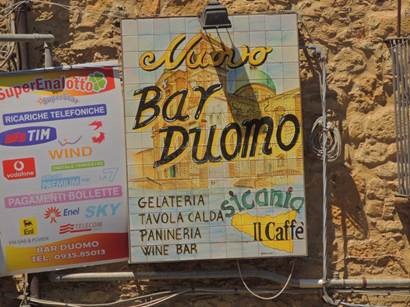
Many Duomo have bars in the vicinity and most are called Bar Duomo or Duomo Bar

clip_image021

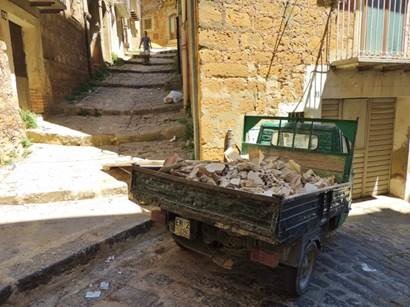
Constant renovation is possible in countries with ancient history, earthquakes, volcanoes and war destruction.

clip_image022

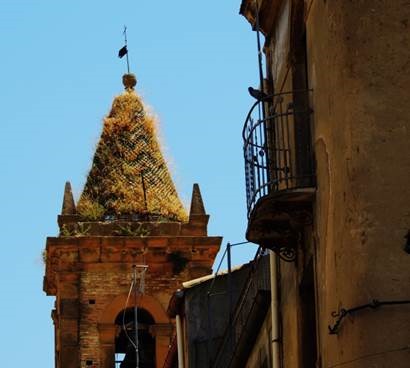
This bell tower was fascinating with grasses growing from it.

clip_image023

The streets are narrow but no one seems to mind when folks in the car in front stop to chat holding up the traffic.

S. Stefano di Camastra part 2

Buona Sera,

  Ru

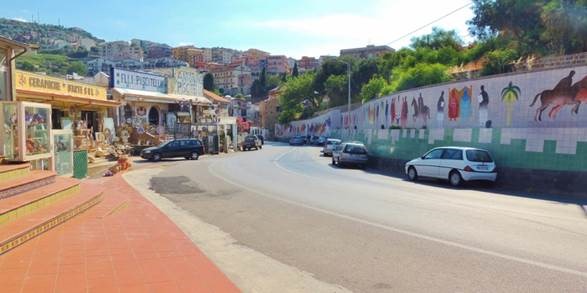
The buildings of Santo Stefano are pleasant but undistinguished. What is remarkable is the flood of bright colors that pours out of store fronts on the Palermo-Messina road. The hills around the town are a source of excellent clay which has made Santo Stefano the ceramics capital of Sicily. The main street is lined with merchants and manufacturers displaying all manner of beautiful and useful objects, from traditional to modern designs, from small plates to giant urns. The prices are some of the best to be found anywhere, clearly lower than those in more touristy destinations like Taormina, and only a fraction of those charged in the ritzy establishments of Florence or Siena. Shopkeepers in Santo Stefano are also glad to negotiate and offer substantial discounts for large purchases. When you barter, you are likely to be talking to the actual artisan who made the pieces. Pride of workmanship is apparent. No particular ceramics shop stands out above the others. There are a few which feature more modern pieces. The traditionalists have lots to choose from. Just remember to enjoy the views as you walk from shop to shop.  http://www.initaly.com/regions/hilltowns/sims.htm

http://sicilia.indettaglio.it/  more info about Sicilian ceramics

http://www.italyworldclub.com/

http://www.thejuicesqueezer.com/

Santo Stefano di Camastra

S. Stefano di Camastraa Ceramic center part 1

Buona Sera,

   The wind is fierce just now and has been all day; here in the marina!  Our schedule has never been so impacted by weather as it has been here in the Mediterranean.  It will be days before we can leave so we’ve signed up for the Linda Szerdahelyi Palermo tour.  Linda is another cruiser we met recently.  She and her husband Frank were planning a 2 day tour to Palermo and we’ve joined with them, sort of.  We’ll meet them 6:30 am tomorrow morning to go catch the 7 am bus to Palermo.  We’ve booked a room at the Moderno Hotel which Linda had found.  They have their vague plans and we our vague but it will be fun traveling together.  Linda and I walked this morning visiting a lovely church, the local fort and the huge cemetery.  Linda’s mother and father are from Sicily so she was actually hunting for possible relatives.  We especially had fun with the castle staff and some of the cemetery workers as Linda chatted with them in Italian about her family.  Much more sensible to visit Palermo by bus than by car.

Ru

S. Stefano Di Camastra

“The buildings of Santo Stefano are pleasant but undistinguished. What is remarkable is the flood of bright colors that pours out of store fronts on the Palermo-Messina road.”

http://www.initaly.com

    At 55 Euro ( $72 U.S.) per day renting a car in Licata isn’t  cheap. (Mr. Din junkers on Langkawi cost 40 ringgit for the basic junker and 50 for the one that had most parts working. $15.61 tops!   In Turkey it was 50 Lira which was about $27 off season and $40 in high season. )  Amazing to us, there’s actually no rental car company in Licata so it has to be brought here and that also adds to the cost.  The price of gasoline is typical for what you find in Turkey, Greece, Europe :  1.79 Euros per litre = $8.50 per gallon back home.   So Randal and I were pretty choosy as to where we would go and how long we’d keep the car.  And we hoped to only be in Sicily for about a week or 10 days tops; we only have so many Schengen days.   We’d both seen enough Greek and Roman ruins in N. Cyprus, Turkey, and Israel so skipped places famous for those sites.  Ours was a very personal tour of Sicily.  Randal wanted to see the mosaics in the Villa Romana del Casale just outside Piazza Armenia and also Mt. Etna.  I wanted to see Enna and also S. Stefano Di Camastra for its ceramics.  Palermo was actually an afterthought so the fact that we didn’t see it; well maybe if we ever come here again.  Palermo has a Jewish past and tours are offered. 

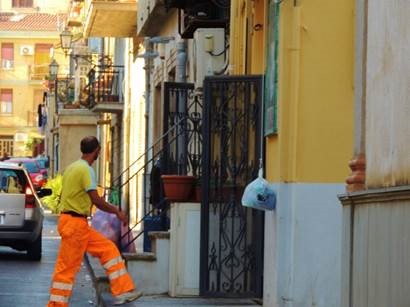
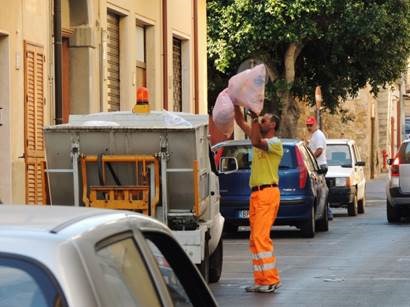
    S. Stafano was full of ceramic shops and I did find my souvenir 3 legged Madusa fairly similar to the one I’d seen in Siracusa, but it took a lot of hunting to find it.  We also became fascinated with the trash collection system they have.  Like I said, it was a personal interest tour of Sicily.

     I’d actually gotten the idea to visit S. Stafano from the Sicily book we’d bought in Siracusa.

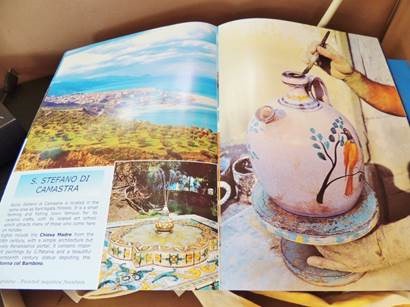
“S. Stefano di Camastra is located in the same area as Sant’Agata Militello.  It is a small farming and fishing town famous for its ceramic crafts, with its related art school which attracts many of those who come here on holiday.  Sights include the Chiesa Moadre from the 18th century with a simple architecture but lovely renaissance portal; it contains important paintings by G. Patania and a beautiful seventeenth century statue depicting the Madonna col Bambino. “

Sicily : Art,History,Culture and Folklore  no copyright date given.

clip_image001


clip_image002

Windmills topped many inland hills

We actually were on our way to S. Stefano instead of staying in Enna the first time.  That got us there about 4 pm which was good as most shops were just reopening from their afternoon siesta.    We always felt that half the day was wasted because of this schedule, especially if you don’t have tons of time.


clip_image003

Main road into town.

We’d already visited two large shops about a mile back from here.  It was in one of these shops that I found my Triskele after hunting through all of them.  Some were too cartoony or the wrong color or terre cotta.  I wanted one like the one in Siracusa.  You’d think they’d be all over the place.  Not a big deal to most tourists I guess.  And I couldn’t find a pomegranate in Enna, so go figure.  Someone is missing a big opportunity.

clip_image004

Siracusa Triskele …… I didn’t buy one here because I hadn’t yet become addicted to them.  But this one must have stuck in my head because the one I bought is similar; though definitely not so lovely.

clip_image005

Triskele made in S. Stefano di Camastra (it says so on the back.)

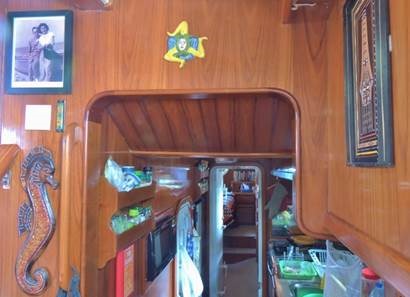
She is mounted over the entrance to our galley.  Mine is not so lovely as the one in Siracusa, but if she falls off the wall during a rough passage and needs to be glued together, my heart won’t be broken.  If I find “the perfect triskele” I’ll get one for our “someday home.

clip_image006

Reminders of other places

The seahorse from Miri, Malaysia; the wood tray from Tana Toraja in Indonesia.  The photo is my mom and dad in Provincetown, MA, 1947 on their honeymoon.  And the mezuzah is from their trip to Israel.


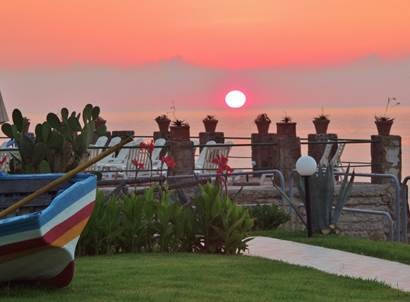
After looking in several shops we got back into the car and went driving around the center town looking for a B & B or hotel.  Good luck there!  We finally found the one B & B that had a sign posted, but it was locked and no one answered the buzzer.  Then we drove around some more and found signs for a hotel down the hillside, behind the railroad tracks, on the waterfront.  As it was the only game in town, we took it.  They had AC and it was clean; and by then we’d  gotten used to paying Sicily hotel prices.  Also the management was actually very accommodating.   And dinner overlooking the Mediterranean sunset was quite lovely. 


clip_image007

Randal’s discarded muscles from his pasta dish and the dregs of my pasta with vegetables.

At this point I prefer pasta just with olive oil and herbs, but the pasta with vegetables comes with a light tomato sauce.  This tasted quite good.


clip_image008

Watching the sunset


clip_image009

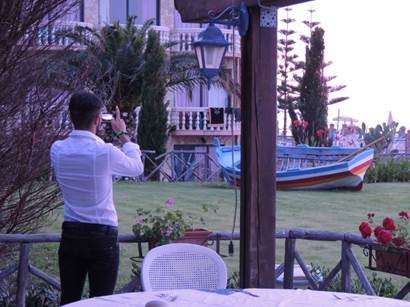
Even the waiter was impressed and took photos.

Our room was the second balcony behind the waiter, behind the trees.


clip_image010

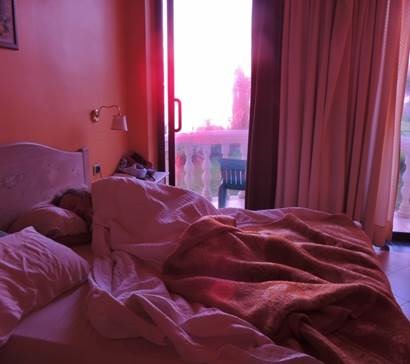
Randal asleep in our pink room.

Sunrise was very early and I got up to take photos.  We were under the impression that breakfast was not included (though we may have been wrong) so we were packed up and ready to leave by 7:30 am.  We wanted more time in S.Stefano and we also still had the plan to drive to Palermo, visit, and then drive to Enna so an early start was important.  No, we were not locked into our hallway, but the office wasn’t open for us to pay our bill.  There was a woman working in the kitchen whom we met the previous evening when we arrived 7:30 pm for dinner.  We’d thought we’d been told that’s when dinner started.  She told us 8 pm.  But she called someone and the next thing we knew there was a man to take our order, bring wine and bread….and then dinner.    We saw her again 7:30 the next morning and she again told us 8 am for the office (or maybe it was breakfast) but she again got on the phone and the next thing we knew there was someone arriving to open the office.  So, though we chose the hotel out of necessity, it was a pretty good place to stay.


clip_image011

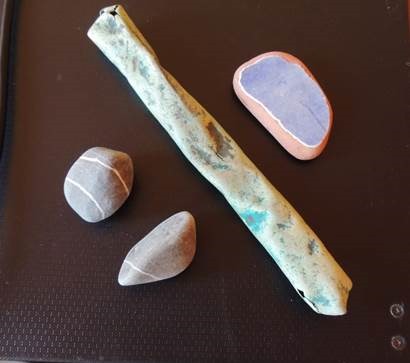
My souvenirs from a walk along the beach:  stones, a weathered piece of copper and a piece of ceramic something.  The stones have complete circles around them some are wishing stones.  The pipe is the first piece of future wind chimes and the ceramic is a canvas begging to have something painted on it.


clip_image012


clip_image013

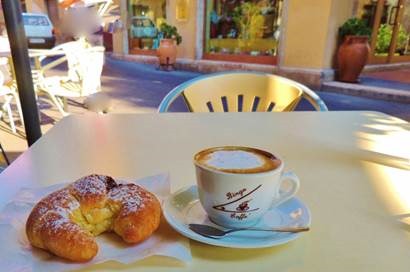
How to gain 4 pounds in 3 days: pastry for breakfast and pasta for dinner.


clip_image014

“Pleasant but undistinguished.”

We felt really at home here walking the narrow friendly streets; very walkable.


clip_image015

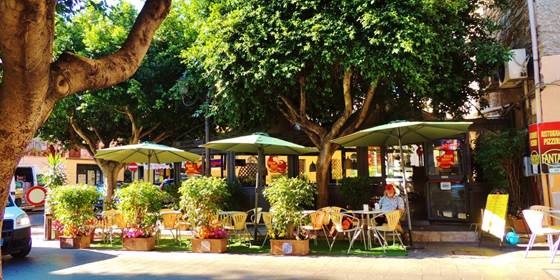
The main street lined with ceramics shops and small cafes. 


clip_image016

Ingenious, simple, sensible trash collection

People from second floors would hang lower their trash down and it would be collected!  No giant trash cans on the street (where there was no room for them or where they fall over and everything blows out.)

clip_image017

The small trash truck could fit into tiny streets and collect the hanging trash.


clip_image018

Water drained down this love culvert into a bulls eye at the foot of the street.


clip_image019

Lots of truck farmers.  We saw one truck full of garlic!


clip_image020

Amazingly these monster trucks could get around too; in streets that seemed just the right size for our tiny Fiat.


Enna Part 3

Buona Sera,

  We visited Enna the first afternoon of our road trip and the last evening and morning or our road trip.  It’s a place I wish I could click my heels and return to for a morning or evening stroll.  A winter visit would be interesting too to see the season so different from the first day of summer. Where according to mythology, the winter months came to be.  To me it seems a very livable city, walkable city.

Ru

Enna Part 3  Narrow Streets

I was trying to explain to myself what it was about Enna that attracted me.  I think it was the same thing that attracted me in Siracusa,  S. Stephano di Camastra and later in Piazza Armerina’s Duomo neighborhoods.  It’s the narrow streets and neighborhoods mixed with small shops and cafes.   Sometime in college I’d read about the development of suburbs, away from commerce with streets wide enough for parked cars on both sides.    The Levittowners: Life and Politics in a New Suburban Community by Herbert Gans  published in 1967 was one of my assigned readings. 

Gans defends Levittown to the critics of suburbia…

     "The critics have argued that long commutation by the father is helping to create a suburban matriarchy with deleterious effects on the children, and that homogeneity, social hyperactivity, and the absence of urban stimuli create depression, boredom, loneliness, and ultimately mental illness. The findings from Levittown suggest just the opposite – that suburban life has produced more family cohesion and a significant boost in morale through the reduction of boredom and loneliness." (220)

And

"They (the critics) also look at suburbia as outsiders, who approach the community with a ‘tourist’ perspective. The tourist wants visual interest, cultural diversity, entertainment, esthetic pleasure, variety (preferably exotic), and emotional stimulation. The resident, on the other hand, wants a comfortable, convenient, and socially satisfying place to live…" (186)  (How can these be mutually exclusive?)

and

"The disappearance of farmland near the big cities is irrelevant now that food is produced on huge industrialized farms, and the destruction of raw land and private upper class golf courses seems a small price to pay for extending the benefits of suburban life to more people." (423) (The countryside around Enna was just beautiful.)

http://geography.about.com/

I find myself definitely agreeing with the critics. 

I also found this information while searching about narrow streets and neighborhoods.

“The things making that corner of the Maeser neighborhood unique are not difficult to understand. The homes are small and well-built; the smaller blocks have alleyways for access, garbage removal etc.; everyone lives close to amenities like parks and grocery stores; there are no big garage doors facing the street.

But I think the best part of all — and perhaps what makes everything else possible — are the smaller streets.

I wrote about this idea back in March while reporting on a post about the difference between the car-centric streets of Atlanta and the narrow lanes of Florence, Italy. And during my recent trip to Europe, I saw plenty of others streets that also emphasized the superiority of smaller lanes:”

http://provocationutah.wordpress.com/

http://www.strongtowns.org  another site devoted to urban planning with narrow streets.

So this email is about Enna streets seen from our room and the room itself; and of course some food photos.

clip_image001

Driving to Enna through the farmlands of Sicily

For miles and miles and miles you see this raised autostrada and tunnels through dozens of hills. 

clip_image002

Our hotel where it helped to have a car the size of a toothpick to fit in the lot. 

clip_image003

This elementary school/JHS shared the hotel’s  plaza/parking lot : that’s our tiny red Fiat

clip_image004

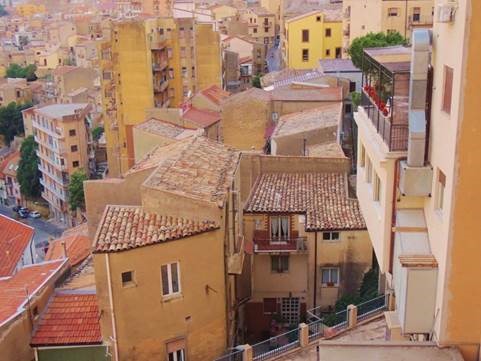
Room with a view

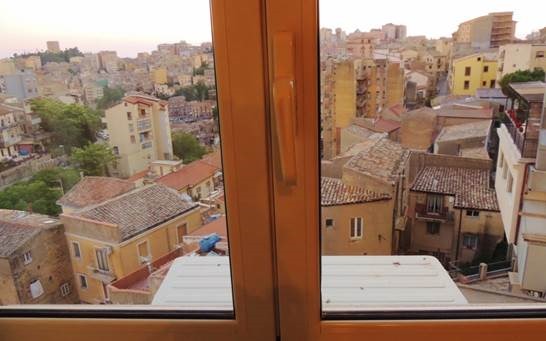
Our floor was Primo Piano, up one floor from the lobby; but high enough on the hill to overlook the city.

clip_image005

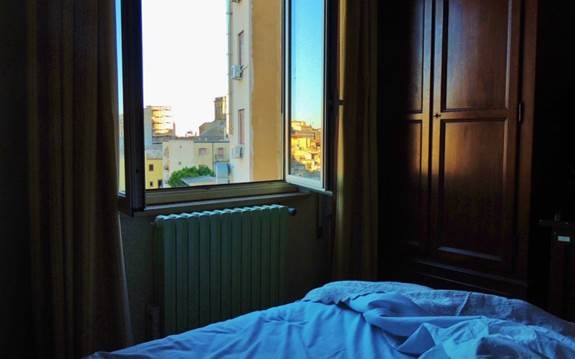
Our room was lovely with lots of soft color, windows that opened to a great cityscape, AC, and the best white cotton sheets!  Botticelli’s Venus on the half shell is over the bed.

clip_image006

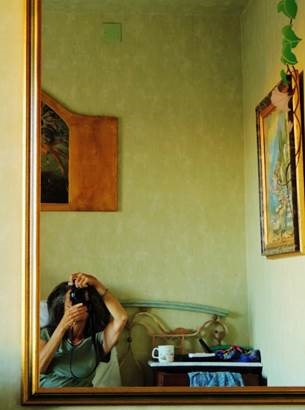
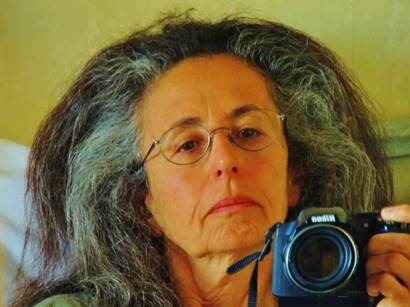
Ru and camera; my mom’s chin and my own gray hair

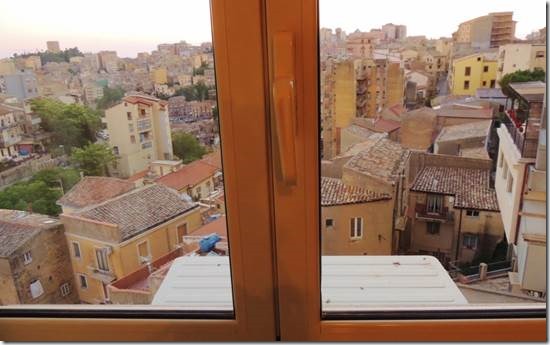
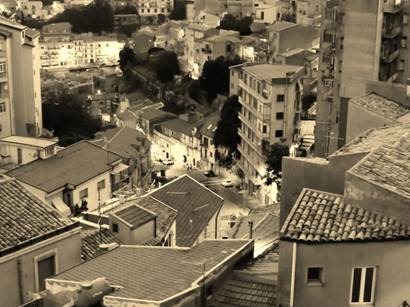
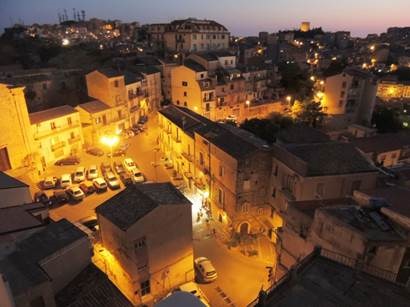
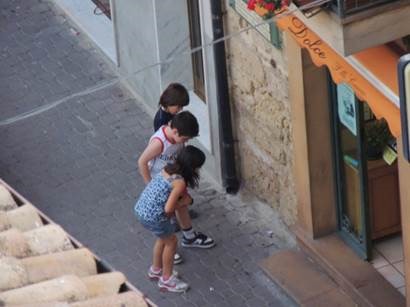
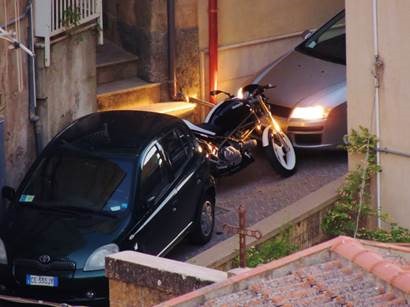
Our view

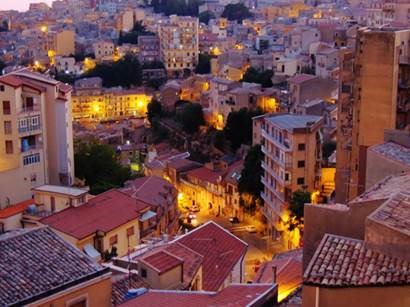
I could have sat for hours just watching the city change colors from dusk to night to dawn.  And with the zoom I could look down at the streets to watch people interacting with each other and the city. 

clip_image007

Dusk

clip_image008

Interesting even in B & W

clip_image009

Night colors

clip_image010

Zooming down at kids out on the streets

clip_image011

And a motorcycle in tight quarters


clip_image012

Sun rise and city shadows


clip_image013

The room with the row of red plants was the porch of the dining room.

clip_image014

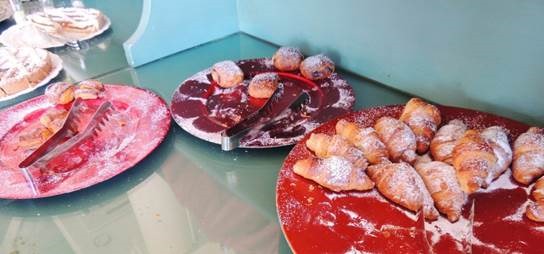
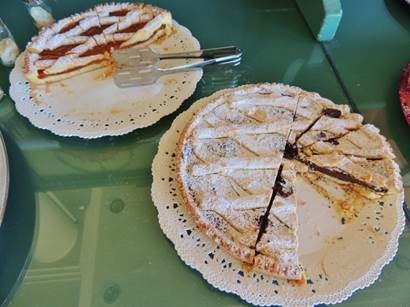
Breakfast

The plates were full when we went for breakfast, but I’d forgotten my camera.  Less than an hour later the plates were mostly empty and there weren’t so many folks staying at the hotel.  I ate two of the lovely pastries in the middle with two cups of cappuccino.  

   When you enter the dining room they ask what you’d like to drink.  I’ve completely forgotten about tea for now and just ask for a cappuccino.  Besides, what else would one eat with an Italian pastry.  It does seem to be what everyone else eats for breakfast.  There was melon and fresh strawberries and eggs, yogurt, ham, cheese, and rolls.  I did take lots of the strawberries, but skipped the rest of the healthy stuff and really enjoyed my pastry and cappuccino; our final breakfast of the road trip.

clip_image015

Even I couldn’t do these; not for breakfast.

clip_image016

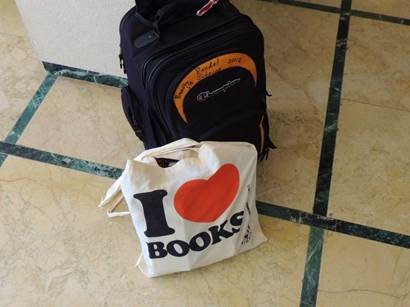
Checking out

Jane from Hydeaway brought this bag for me from England and I used it to carry my books, Kindle, art supplies (which sadly I didn’t use.)

clip_image017

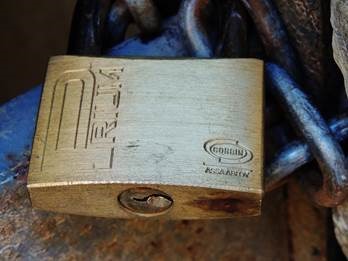
Lock at Lombardi castle.

This photo is for our friends Peter and Jane.

Castle Lombardi and Rock of Ceres : Enna part 2

Buongiorno,

   No castle has caught my imagination like our first visit to Kyrenia Castle in North Cyprus.  Perhaps the motorbike ride up the mountain taking us there added to the drama of the setting.  So Castle Lombardo wasn’t my favorite attraction in Enna but it was on my list and Randal does like castles, so we went.  I saw lots of folks walking there the first evening I visited.  As for the Rock of Ceres, I wanted to see it and we did!  Did I feel the spirit of Demeter?  No, can’t say that I did.  But it was a lovely setting and she was the goddess of nature, so who can say.  You can certainly see what may have inspired the myths, stories once used to explain the world to ourselves before we had science.  Now the myths add to our reasons for travel to see where they were created and the landscape that inspired them.

Ru

Castello di Lombardi

Enna’s main attraction is the Lombard Castle, built by Frederick II in the early part of the 13th century. Many historians, however, agree that the castle was erected upon the ruins of an earlier fortification, possibly Arab or Byzantine.  That older fortress could have been built on the remnants of an even earlier structure dating to the Roman period. http://www.bestofsicily.com/enna.html

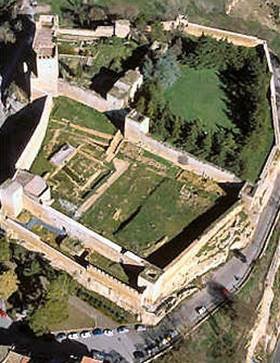
Situated on East most point of Enna, the site has been fortified since earliest times because of its strategic position. Under Norman dominion, the castle was reinforced. It was made habitable by Frederick II Aragon, who added a number of rooms that rendered it suitable. It was here that He was crowned King of Trinacria and in 1324, convocated the Sicilian parliament. The name of the castle dates back to the same period linked to the presence of a garrison of Lombard soldiers posted there to defend it. The ground plan is of pentagonal which follows the lay of the land. Of the 20 towers only 6 remain. The most interesting and complete tower is called La Pisana or Torre delle Aquile (The Pisan Tower or of the Eagles).

Under the Spanish control in the 16th and 17th century, Enna strategic importance was diminished and the castle was used a prison. It fell in a bad state of despair, in the 20th century, archaeologist Paolo Orsi began excavation and restoration work.  

http://www.sicilianexperience.com/history.php?codice=enna

clip_image001

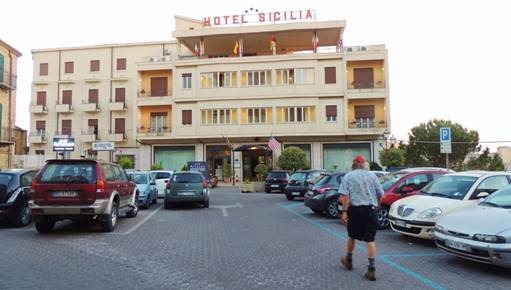
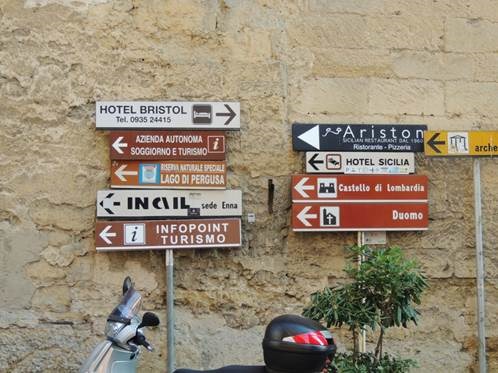
The Hotel Bristol was locked up tight so we stayed in the Hotel Sicilia

clip_image002

Walking up to the Castello di Lombardia

clip_image003

Vicissitudes  : favorable or unfavorable event or situation that occurs by chance http://www.merriam-webster.com/dictionary/vicissitude

My 8th grade English teacher who was also my 9th grade Latin teacher used to say, “Such my friends are the vicissitudes of life which we must all endure.”   Vicissitudes isn’t a word you hear or read everyday so I thought it was a surprise to see it here.

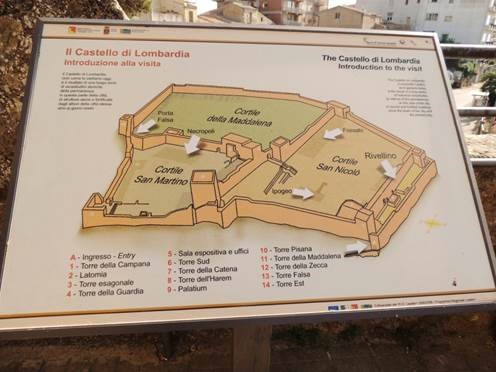
clip_image004

clip_image005

Photo from http://www.sicilyontour.com/  which has additional info and photos

clip_image006

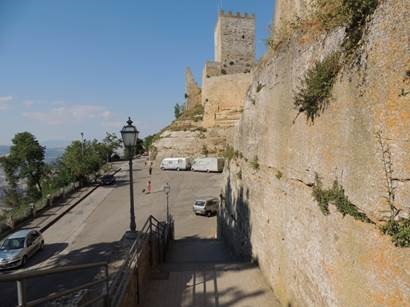
Behind the vans is the statue of Euno and the tall crenellated Torre Pisana

clip_image007

clip_image008

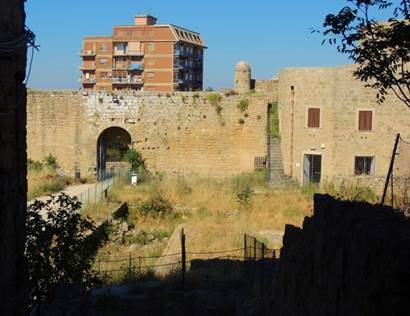
Looking back at the castle from the road to Rocca Di Cerere

clip_image009

Old and new…

clip_image010

Looking back to Enna and the road we drove to get there

clip_image011

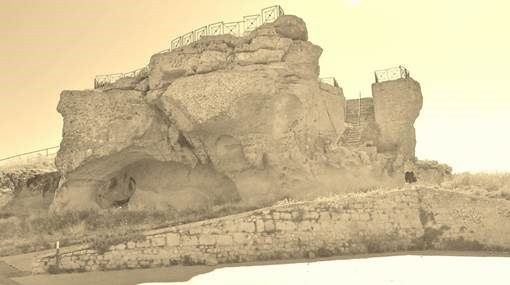
Ceres Rock in Black and White : we walked to the top where the views were stunning.

The Siculians made Enna one of the main sacred centres for the cult of Ceres in honour they built a sacred fence and a sanctuary on the eastern slope of the mount. Traces, mostly imaginable, are in the Ceres Rock, at the foot of the Lombard Castle.  

http://www.welcometoenna.com/

clip_image012

Rock of Ceres

Walking to the very top where you can easily imagine some type of temple stood. You can see the top of the Duomo in the Enna skyline.

“Enna is a very old city, and a temple to Demeter stood on the rocky mount near its Lombard Castle, overlooking the plains and mountains below. In his Hymn to Demeter, Homer recounts the story of Persephone. It is much embellished over time, with local versions featuring details unknown to the ancients.”  http://www.bestofsicily.com/mag/art45.htm   (full article below)

clip_image013

clip_image014

Somewhere out there is Lake Pergusa  (a great place for bird watching  Charmaine and Linda)

The Pergusa Lake, the only natural lake in central Sicily, is located 5 km from Enna, and has originated due to a subsidence of the land. According to the mythological story of the abduction of Proserpina, daughter of Ceres, on the part of Pluto, is believed to be one of the gates of hell, perhaps for the red color that its waters are in some periods of the year. Brackish water coming from rain only because the lake has no tributaries or emissaries. Since 1995, the lake and the environment surrounding Pergusa are a Special Nature Reserve to protect, according to the official justification, of a lake that is home to a rich variety of bird life and is the only wetland of stopping in the heart of Sicily, for migratory birds.

Between April and May and between October and November Pergusa becomes a real crossroads for birds, due to its geographical position and for being an oasis in a wet landscape for many months dominated by the drought. Pergusa represents the ideal habitat for birds that make long hours of uninterrupted flight over the sea to and from Africa. Periodically, the lake, for a synergy between some of the microscopic organisms that live in it, has a unique phenomenon: its waters are tinged with red. Protagonists of this phenomenon is a little "shrimp" that, to defend himself from the rays of summer sun, is tinged with red pigment and is setting up in dense colonies in the aquatic plants. The pigment is then transferred to water and bacteria in it to give up the mirror of the lake a reddish color

http://www.villacasablanca.it/en/to-visit/pergusa-lake.html

clip_image015

Enna’s modern government building.

clip_image016

Oxymoron but clever


     “Today, the typical young Sicilian woman stands about five feet five inches. If not a goddess, she’s shapely but not overweight, perhaps rather stylish, and spends most of July and August at the beach. She finds her first employment of any kind at around twenty-six, following an interrupted year or two of specialized higher education. In a sexist society, she’s slightly left of center politically and opposes the death penalty (which anyway doesn’t exist in Italy). Having studied in Italy’s schools, she believes that an Italian named Meucci invented the telephone. A non-practicing Catholic, she nevertheless marries in a lavish religious ceremony at thirty-two after a lengthy courtship.

      Persephone’s courtship, by comparison, was a last minute affair, though she had little need for religious ceremonies.  In mythology, she was the beautiful daughter of Zeus, king of the gods, and Demeter (Ceres), goddess of agriculture and fertility. While gathering flowers in the Valley of Enna, Persephone, who is also known as Kore (Greek for "maiden") was abducted by Hades and taken to the underworld.  Having lost her daughter to this dark realm, Demeter descended into sorrow, losing interest in the mortals and their agriculture, and Zeus had to intervene to bring an end to the famine that resulted from this abandonment. This he did by ordering Hades to release Kore, but not before the maiden had consumed a pomegranate seed as a sign of fidelity to Hades. That meant that she had to spend at least four months of every year with Hades, by whom she had a son, Plutus.

     Kore became the goddess of grain (wheat), and her annual absence was meant to account for the barren winter fields. Her cult was widespread, particularly at Enna, and Lake Pergusa is sometimes identified as the place where she was abducted or raped by Hades. She appears in several Greek myths and was worshipped at Eleusis in Attica.

     The allegory of Persephone is timeless. Grain sprouts to life from the earth to be harvested by man in the same way that a nubile girl is taken from her parents and her virginity lost to bring forth new life. Persephone’s case may have been rather extreme, but the principle is unchanged. Her story dates at least from 700 BC, when the first Greek colonies were established in Sicily. Enna is a very old city, and a temple to Demeter stood on the rocky mount near its Lombard Castle, overlooking the plains and mountains below. In his Hymn to Demeter, Homer recounts the story of Persephone. It is much embellished over time, with local versions featuring details unknown to the ancients.

     Persephone’s renewal is not unlike nature’s, and through the myth, human life is said to imitate nature itself. The imagery and message are purely Greek, but the earliest legend may have been Sicilian. It has been suggested that Persephassa, an earlier name for Persephone, indicates a pre-Hellenistic origin, and possibly a Sicanian or Sicel one. This may explain the early existence of a cult to this goddess in east-central Sicily coinciding with the Greeks’ first incursions into the region and their gradual amalgamation with the native peoples.

     To the Romans, she was Prosperina, and that is how she is known to Italians. Her Latin name shares the root of the word meaning "to prosper."

About the Author: Palermo native Vincenzo Salerno has written biographies of several famous Sicilians, including Frederick II and Giuseppe di Lampedusa.

http://www.bestofsicily.com/mag/art45.htm

Visit to Enna Part 1 of several

First Day of Summer

Buona Sera

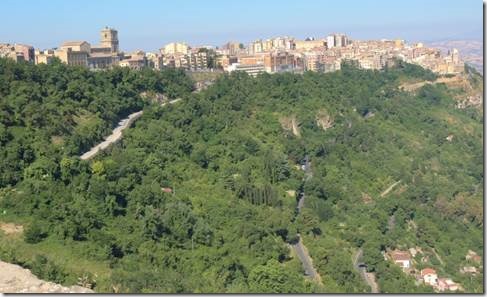
  We returned late yesterday afternoon from our road trip and will be here several more days until the weather forecast for our passage to Tunisia improves.  Hopefully I can catch up with these emils.  I took so many photos of Enna from our hotel room window that I can’t choose which so send so might just send them all.  I could have stood there for hours watching the light change and spying on folks down below with my zoom lens.  I loved Enna so though it wasn’t the first place we visited, I’m writing about it first.  As for the photos, I am trying different settings on the camera and don’t think they did just a great job.  So much bright light here too. 

Ru

     Enna  Listening to Church Bells

We went to Enna twice; the first time not very successfully as we at first couldn’t find any place to stay; and then when we did, they didn’t appeal to Randal. (Long story that no longer matters.)  But as Enna was # 1 on my list, Randal suggested we make a second attempt.   Touring around Turkey with no reservation worked just fine.  Greece, not so fine as we had to break out of our room to actually leave our “hotel.”  But Sicily, wow! Way other story.  Especially in less touristy places like Enna and S.Stephano di Camastra.  We discovered that many B&Bs are locked up tight; you must call on your mobile phone the number posted at the door.  We have no Sicilian phone card, (our stay here will be so short) so calling the number was not an option. You can press a button similar to a doorbell and speak to their mobile phone or house phone, but only if someone actually answers.   The one hotel we finally found that was not locked up, was more than we normally spend when we travel.  I should have put my foot down and said; “too bad I want to stay here.”  But I didn’t which was ironic as we were in the place where Demeter / Ceres  had her temple and we know what a tough lady she was.  We have 6 months of winter thanks to her fury at the abduction of her daughter Persephone by Pluto/Hades, the god of the Underworld.  (While in Hades Persephone ate 6 pomegranate seeds so we have 6 months of winter.)   My reasons for wanting to visit Enna?  In the Netsel Marina library, I’d found the book, Desiring Italy : Women Writers Celebrate the Passions of a Country and Culture.   There was an excerpt from On Persephone’s Island : A Sicilian Journal by Mary Taylor Simeti about Enna with a “literary tour” plan.  Plus I heard whispers of what I thought I remember from Sue Monk Kidd’s Traveling with Pomegranates about Demeter    So I really only had lots of vague reasons for wanting to visit Enna.  The consolation prize after our failed first attempt  was that lovely dinner by the waterfront in Acireale  where we spent the night instead.  When we did actually return to Enna to the “splurge” hotel it was lovely and in the perfect location on via Roma just near the Duomo within walking distance of everything I’d come to see.   Using the Simeti excerpt and the included “Literary Traveler” guide by anthology Editor Susan Cahill, I found my way along Via Roma from our hotel to the Duomo to Lombardi Castle to the Rocca di Ceres (Rock of Ceres.)

clip_image001

Enna on the hill “at almost 1,000 meters,” according to our Sicilian tour book.

We arrived about 3 pm, starving, after a crazy day that involved a 3 hour drive from S. Stephano di Camastra to Palermo and then immediately away from Polermo to Enna.  Driving into Polermo is insane.  Driving into Polermo without a map, dictionary or a clue where you’re going; total madness!!  I honestly thought there’d be a sign for the Capella Palatina or Monreale, but we saw none.  Signage everywhere in Sicily is confusing.  Polermo wasn’t tops on anyone’s list so skipping it was disappointing but not horribly disappointing. In comparison, returning to a doable sized Enna that we knew a bit and having a plan where to stay was a relief.   We were starving because we’d failed on the autostrada to find a town with an open café for lunch so picked pretty much the first place we saw in Enna; a not-great Panini lunch.  We next drove to our hotel, checked in and then went off to visit the Duomo  just almost across the road.  Actually just about everything I wanted to see was on Via Roma which made it easy not to get lost.

clip_image002

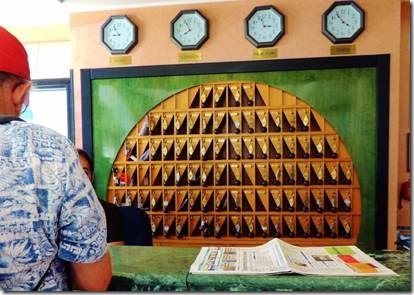
Our key was the old fashion kind, made of heavy metal with a small ball attached.

clip_image003

One of the views from our room.

clip_image004

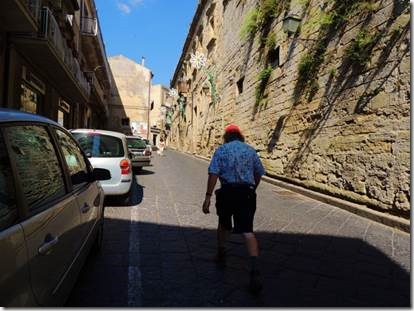
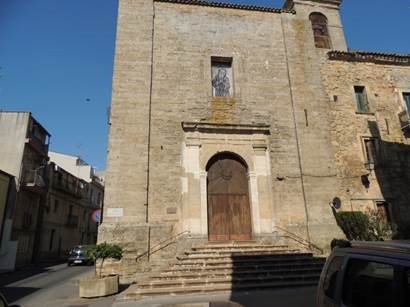
Walking up the narrow street to the Duomo

clip_image005

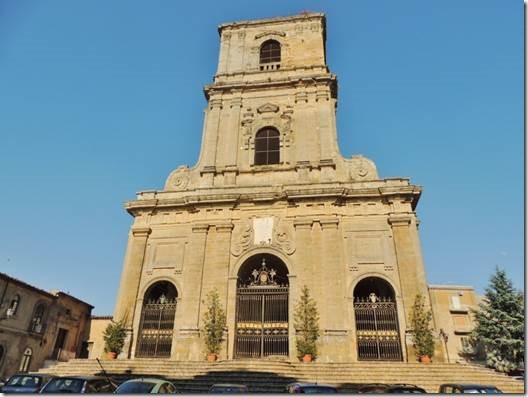
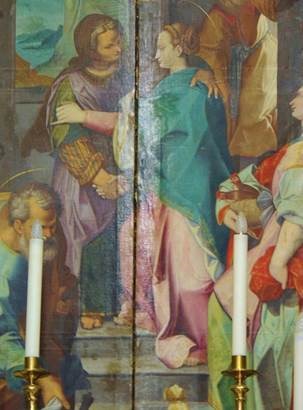
“The Cathedral of Maria SS. is the Mother Church of the Visitation of Enna, 16 May 2008, was declared a UNESCO “Monument of Peace” and is one of the greatest expressions of art in the province of Enna.”

http://www.sicilia360.it/en/provincia/enna-en/ The entire article is below.

clip_image006

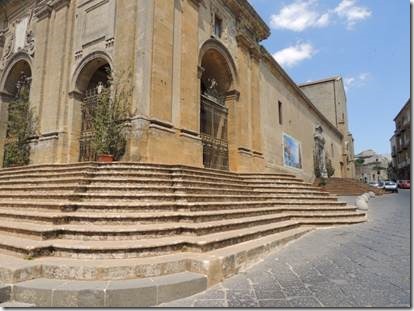
The front door looks pretty permanently shuts so you enter on the side just a bit further than the poster on the wall.

clip_image007

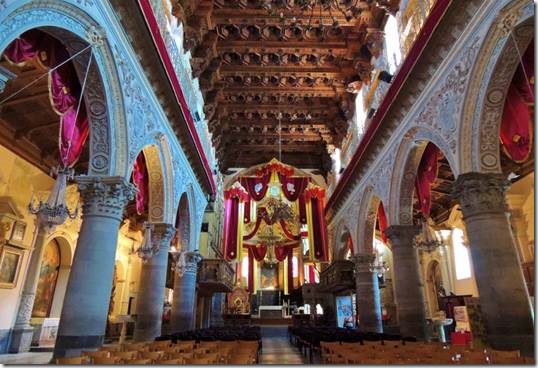
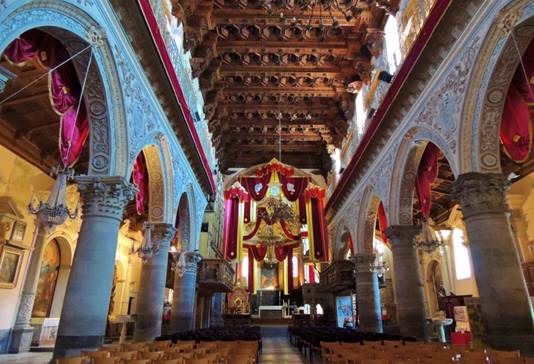
Quite spectacular!

clip_image008

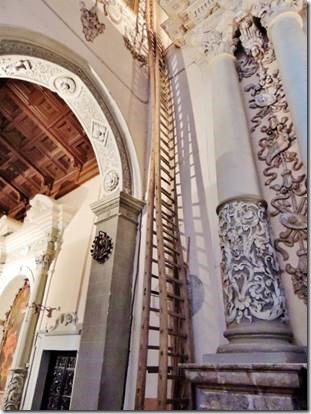
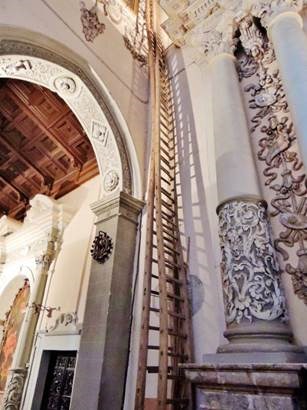
Do you think this ladder is still used today?

clip_image009

clip_image010clip_image011

“The imagery is so different from the usual iconography of a Christian temple that it’s easy to believe the theory that the cathedral sits on the site of the temple of Demeter’s daughter Persephone. Spirals are prehistoric symbols of the mother goddess.”   Susan Cahill’s “Literary Traveler” note.

clip_image012

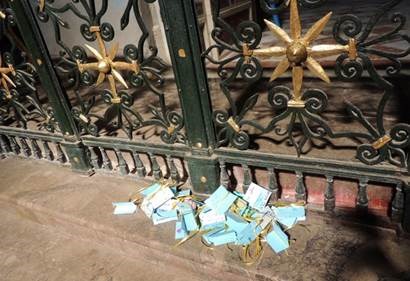
We saw notes in Ephesus asking help from Mary.

After our visit to the Duomo Randal went back to our hotel; he had some computer work to do.  I went on alone because there was no way to get lost;  I only had to walk up the Via Roma and then back down the Via Roma.  We’d eaten lunch at 3 pm so we wouldn’t need dinner until after 7 pm.  That’s sort of late for us though it’s early by European standards.  Hotel restaurants don’t even start serving until 8 pm. 

clip_image013

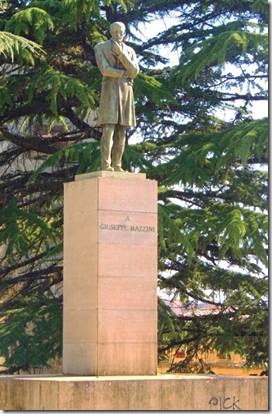
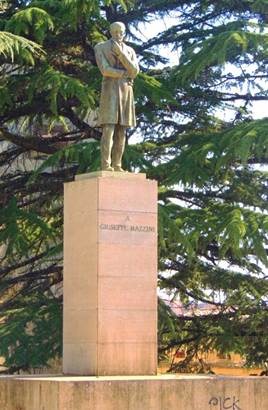
GIUSEPPE MAZZINI, (1805-1872) “The Beating Heart of Italy.” Statue in the plaza across from the Duomo

“Giuseppe Mazzini,  (born June 22, 1805, Genoa [Italy]—died March 10, 1872, Pisa, Italy), Genoese propagandist and revolutionary, founder of the secret revolutionary society Young Italy (1832), and a champion of the movement for Italian unity known as the Risorgimento. An uncompromising republican, he refused to participate in the parliamentary government that was established under the monarchy of the House of Savoy when Italy became unified and independent (1861).” http://www.britannica.com/EBchecked/topic/371294/Giuseppe-Mazzini


clip_image014

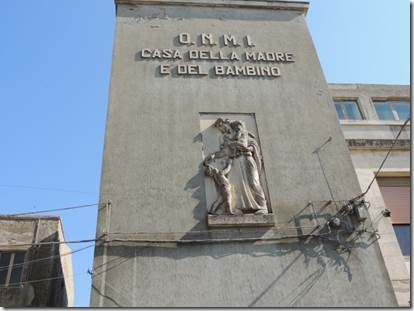
Building of a social service agency

clip_image015

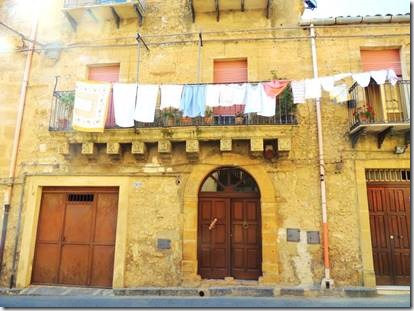
Real Life Enna

clip_image016

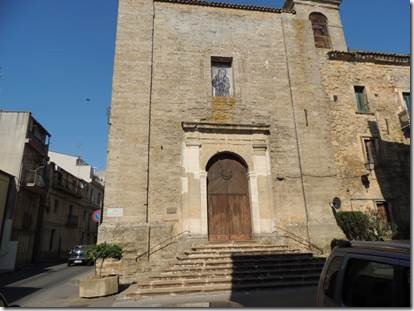
The plague on the wall was dedicated to S. Francesco di Paola

Tomie dePaola was one of my favorite children’s book illustrators especially his character Strega Nona

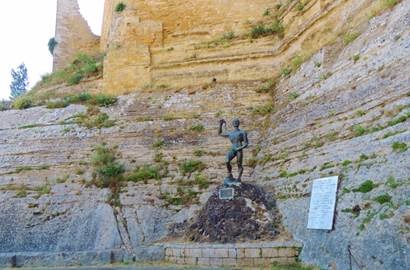
At the top of the hill Via Roma splits and you must go either left or right.  There is a small plaza with two small food stands, tables and chairs.    Just beyond that is Castello Lombardo and the Rocca di Cerere as well as the best views of the valley beyond and hill town Caltanissetta.  Just outside the Castle is this statue of Euno.
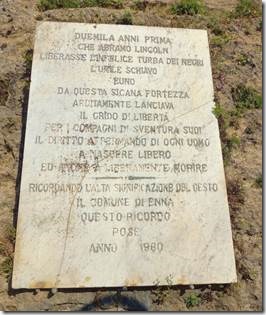
clip_image017clip_image018

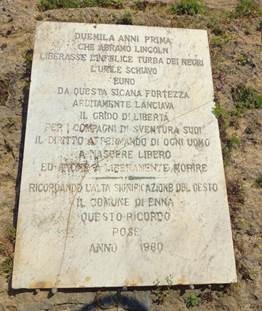
Euno  leader of first revolt against the occupying Roman Empire in 135 BCE

“The huge slave population of Sicily was made up of prisoners of war captured by the Romans in their wars in the east.  Partly because of the impregnability of Enna, the  Roman army did not defeat the slave rebels for two years.  The plaque attached to the Euno memorial quotes Abraham Lincoln, who referring to the history of slavery, invoked the name of heroic Euno.” “Literary Traveler” notes Susan Cahill.

I scouted out Castello Lombardo but decided to wait for Randal and a walk the following morning when we would also climb to the farthest point and visit the Rocca di Cerere .

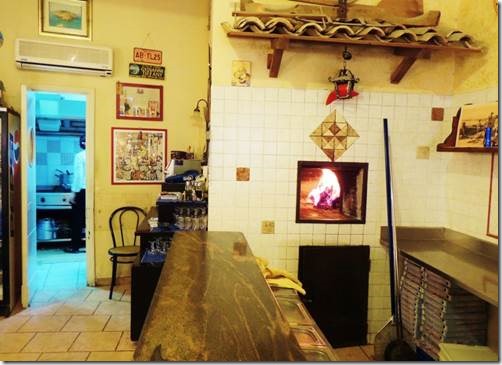
I returned to our hotel hot and tired.  Time for a shower and a rest.  Then it was time to go find dinner.  Literally we had to go find it.  We walked up Via Roma and then took a side path to a parallel road.  There was one restaurant that said it would open at 6pm.  It was 7pm and not open that we could see.  So then we walked around the tiny plaza and back down Via Roma.  The church bells started to ring and it looked like lots of folks headed for the Duomo perhaps for Wednesday evening mass? 

We did find this cute Trattoria/Ristorante and they happily served us though we were the only customers there. Later another couple came in, but they were the only ones. 

clip_image019

clip_image020

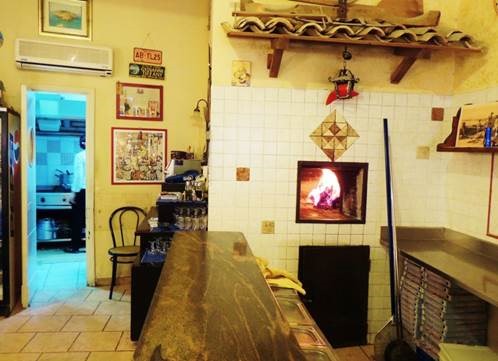
The burning pizza oven and the pizza paddles 
clip_image021

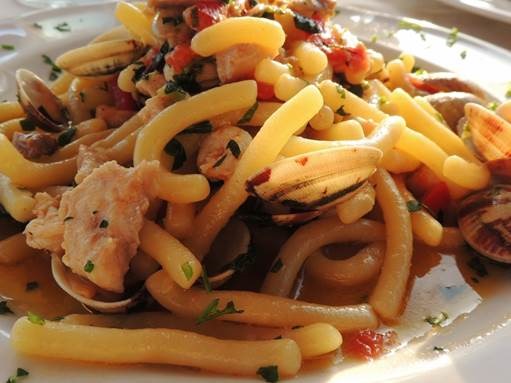
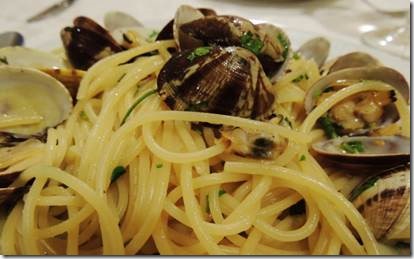
Spaghetti with clams and white wine our new favorite foods.

I do write lots about food because that’s part of the fun of travel until you eat something bad and then it’s no fun at all.  Thankfully Randal and I have only experienced the bad once each.  And who’s not interested in food?  Anyway, I got this hilarious email from a bike pal in Salem, VA.

“OK. Your assignment is to sometime in the future do a posting that has neither pics or text of great food and see if anyone notices.

Wait a minute. That could be the secret code you could use if you are kidnapped but forced to continue acting "normal" while you smuggle narcotics or plutonium or something. You could stop writing about and sending pics of food, we would notice the pattern and call the gendarmes to rescue you because we’d know SOMETHING IS WRONG.” D.H.

I must say food in Turkey was easier and lots cheaper than here in Sicily.  Lots more fresh salad veggies served and fewer surprises when you order.  We used to believe that a Panini was a grilled sandwich.  Here it’s just a sandwich on whatever bread they happen to serve it on.  And there seems to be more bread than filling.  Breakfast seems to be mostly sweet stuff and coffee though the hotel breakfast in Enna had lots more variety. On the streets it’s mostly coffee and some kind of roll.  Now however, I like my flaky croissant filled with Nutella for breakfast!   So to answer my friend Har who asked how I stay thin; this trip I didn’t.  I weigh a few pounds more than when we left.  But the pasta here tastes good!  It’s not just something to hold up tomato sauce.  Often there’s just olive oil and herbs with the pasta.  I think they add some of the clam broth too.  And the pasta noodles are still chewy and taste good.  I bought some today.  There are a zillion kinds with dozens of brands.  I watched what a woman who seemed to know what she was doing bought and I got some of that.  I did the same with the shelves of olive oil to add Italian/Sicilian olive oil to our collection.  I certainly do understand Elizabeth Gilbert and her acceptance of “big girl pants” while in Italy. 

http://www.arcojournal.unipa.it/pdf/mazzara_24_11_03.pdf  talks more in depth about mythology and the myth of Demeter and Persephone.

http://www.timesofsicily.com/ennas-mythical-past/

     On a clear day, the elevated city of Enna is visible from much of central Sicily.  However, winter mists often shroud its ancient secrets.  Described as the island’s navel, Enna lies at its geographical heart and at the core of one of its most enduring myths: the story of Demeter and Persephone. The fabled origins of Sicily’s fruitful abundance is wrapped up in this tale which has inspired poets and writers for centuries, and within the story’s many twists and turns there is a dark metaphor for our modern age.

     Demeter, otherwise known as Ceres, was the sister of Zeus.  She had a daughter, Persephone, or Proserpine to the Romans, who was the maiden of Spring.  The fertility of the primavera siciliana owed its spectacular profusion to their kindly attentions; but an unseen threat lay in wait in the guise of Pluto, god of the underworld.

     Pluto lusted after Persephone, the very embodiment of lightness and floral beauty.  His brooding obsession compelled him to drag her down to the stygian gloom of his realm.  Demeter searched in vain for her lost daughter, eventually abandoning herself to disillusion and pain.  Her reproach to the cruel world was to withhold the bounties of the harvest.   Directed by the Syracusan, Arethusa, from her underground stream, Demeter discovered the whereabouts of her daughter and pleaded with Zeus for her safe return.  Persephone’s release was on the condition that she had refrained from eating.  Sadly, she had already consumed the pulp of a pomegranate seed. (Many versions of this story mention 6 pomegranate seeds.  RJ)  This led to a good old-fashioned compromise: she would spend half the year in the sunlit uplands and half in the kingdom of Hades, during which time the still peeved Demeter would continue to withhold the fruits of the soil.  So runs the legend… but what traces remain in the earth of modern Sicily, and what impact did it have for the art and literature of future generations?

     Today, approaching Enna from the Catania – Palermo autostrada, it’s easy to see how it commands a striking view of the surrounding countryside.  The motorway slip road directs you to a weaving mountainside helter-skelter which ascends the outcrop in short bursts.  Enna’s maze of twisting streets will eventually lead you to the impressive Castello Lombardia at the pinnacle, where the nearby Rocca di Cerere surveys its fertile dominion.  Adherents worshipped Demeter (Ceres) for centuries on this very spot.  Little of the classical architecture is left, but that is perhaps fitting for a goddess of nature: the view to Etna and beyond represents her heritage.  But it is a fragile Eden as the myth itself suggests.

     The light imprint of Persephone’s footsteps can also be found in the neighbouring town of Pergusa.  Lake Pergusa is Sicily’s only remaining natural lake and was the location for her disappearance.   Part of the area is a protected nature reserve and part given over to the more earthly pursuits of motor racing.  The archaeological zone, Cozzo Matrice, has a collection of ruins dating from the period including a temple dedicated to Demeter.  Diodorus Siculus, the classical Greco-Sicilian historian, even mentions it as the site where Pluto’s chariot emerged from the underworld.

     The myth has haunted the imagination of many, Sicilians and foreigners alike.  Italians even drink a Ceres beer!   The story had an inevitable attraction for the Romantic poets of 18th and 19th century England.  The Italianophile, Percy Bysshe Shelley, was drawn to it like a moth to a flame.  His lines ‘Sacred Goddess, Mother Earth / Thou from whose immortal bosom / Gods, and men, and beasts have birth…’ amply reflects its elemental quality.  Coleridge, who spent time in Messina and Syracuse, was more taken with the Arethusan aspect of the legend.  In one of the most famous poems in the English language, seemingly set in far off Cathay, he can’t resist a reference to her underground waters.  ‘In Xanadu did Kubla Khan / A stately pleasure-dome decree / Where Alph, the sacred river, ran / Through caverns measureless to man…’  (This was a favorite poem of my mother’s.  RJ)

      Virgil, Ovid, Thomas Moore, John Milton… the list of devotees is endless.  One of the more interesting modern references was made by the Sicilian-American writer, Gioia Timpanelli.  In her book, Sometimes the Soul, one of her characters, Costanza, conjures up images of Enna’s flower-covered fields.  Artists have been no less reticent in their depictions.  From Bernini to the Anglo-Italian, Dante Gabriel Rossetti, Demeter and her daughter have continued to inspire.

     All over the world, we are so reliant on the good intentions of Demeter, that the potential of her permanent withdrawal still causes us anxiety.  In part, we seem intent on causing this to happen.  Maybe we are the pestilential Pluto, blindly dragging our fragile Persephone to the depths with little thought for the consequences.  Yet we also have the capacity to be Zeus, capricious but capable of arbitration, leaving Demeter to spread the universal joys of the primavera siciliana.

http://www.timesofsicily.com/ennas-mythical-past/

The Cathedral – Enna

The Cathedral of Maria SS. is the Mother Church of the Visitation of Enna, 16 May 2008, was declared a UNESCO “Monument of Peace” and is one of the greatest expressions of art in the province of Enna. The Cathedral is located in the historical centre of the city near the Lombardia Castle and faces Mazzini square, which occupies the entire north side. The cathedral was erected in 1307 on the ruins of the Temple of Proserpine, by order of Eleanor of Anjou, wife of Frederick III of Aragon, for the birth of their son Peter, but in1446 a major fire destroyed all except an apse and part of the right side, and in 1447 Pope Eugene IV proclaimed a Jubilee duration of 7 years to raise the necessary funds for the reconstruction of the important place of worship. Due to a lack of money collected, King Alfonso of Aragon sold various lands and with the proceeds, in the sixteenth century, was able to rebuild the church. At the end of 1574 was completed by the famous builder of the city of Messina, Jacopino Salemi, the elegant portal of St. Martin, enhanced by slender columns culminating in original capitals, which is located in the right side of the church, where at the transept opens the “Holy Door”.  Built on a plateau cut on the rock of tufa yellow,  its bell tower, overlooking the wide valley that divides the nearby Enna from Calascibetta. The building is surrounded by large steps in which there are access doors and porch, which, with its exterior forms the facade. The Cathedral is made up of eight pillars supporting the tower, adjacent to the north wall of the building is a space where once stood a cemetery behind the apse there is a small garden where once there ‘was the old Gothic sacristy of which remain today only a bow and a shelf. The front of the Cathedral Church looks very majestic and impressive, as realized following fees anomalous dimensions in the trends of the time: a long flight of steps to reach a portico with three portals, encircled by six columns, and above the base develop other two levels of the bell tower, with two round-headed windows full of ornaments, decorations, human faces, pilasters and columns in Doric and Corinthian. Remarkable is the Door of the Jubilee, which is reminiscent of the Jubilee proclaimed in 1447 by Pope Eugene IV, and  now walled up, on the right side, which is an excellent example of Sicilian Gothic style, with 6 columns and capitals decorated with a beautiful arch surmounted by the statue of Madonna and Child surrounded by a round arch and friezes zigzag alternating with leaf motifs. On the other side door is the  Sottana Door, dating 1447, bearing two pairs of Corinthian columns surmounted by a pediment crowning and a beautiful marble bas-relief depicting the late Renaissance “Saint Martin and the poor” who divides his cloak with the poor. The interior of the cathedral is a Latin cross, with three naves divided by pointed arches, supported by columns of black basalt, with capitals decorated with leaves, scrolls and reliefs of animals and saints. The wooden ceiling of the nave is a caisson and rosettes of walnut with winged heads grotesque and beautiful decorations, the work of Guido Di Scipio. In the left aisle we see the pulpit of the seventeenth century. a polygonal shape with side ladder, canopy friezes, angels and cherubs, marble white and coloured. Behind the high altar depicting scenes from the Old and New Testament. Very beautiful are the wooden works such as the cabinet where the sacristy are scenes from the life of Jesus Of great value is the chapel with the statue of Our Lady of the Visitation embellished with diamonds and coloured gemstones. Inside, we find of great importance: the font, the rich portal with a bas-relief illustrating San Martino del Gagini, the frontal, numerous paintings by various authors.  http://www.sicilia360.it/en/provincia/enna-en/

Evening of the First Day of our Road Trip in Sciily : It’s all about the food

Buena sera,

  So it’s been a long day and I’m too tired to do any real story telling that involves research and explanations.  This email is just about food!

Ru

    We left Licata about 8 am in our tiny red Fiat hatchback; really cute and has great pickup and turns on  a dime.  We drove directly to Piazza Amerina to see the mosaics of Villa Romana del Casale.  We spent the morning there so Randal could get his fill of mosaics.  Then it was on to Enna, where the story of Persephone and Demeter is most closely associated.  We were mostly lost and everything was closed until 6 pm.  I was sad as it was the stop I’d read about and wanted to visit.  But it was I who suggested going on to Catania which would take us closer to our next stop Mt. Etna.  Cripes what a mistake!  Catania is a giant city with traffic, miniscule streets, no giant billboards telling you where to find a hotel or any Info place being open.  Plus we were winging it with no city map or plan of where to stay.  So we decided to just find our way out and follow the coast and hope we’d stumble across a hotel. 

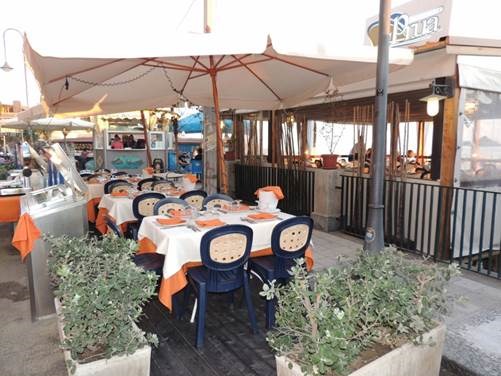
We did find the Park Hotel  which could be anywhere in the world so not so “quaint or cute.”  But it’s clean and quiet and just a short walk from the waterfront where you have a vast choice of restaurants.  Randal picked one and it was a treat.  A great meal in a waterfront setting makes up for a lot.  So here are some photos from the end of our day.  I’ll catch up on our visit to Villa Romana del Casale and Enna another time. 

clip_image001

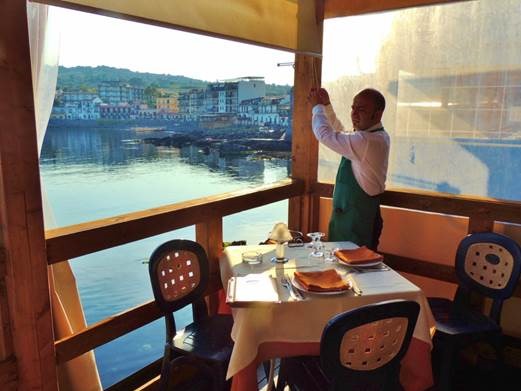
Our waiter at La Prua adjusting the screen to block the setting sun

Our hotel was along that row of buildings further to the left out of sight.

clip_image002

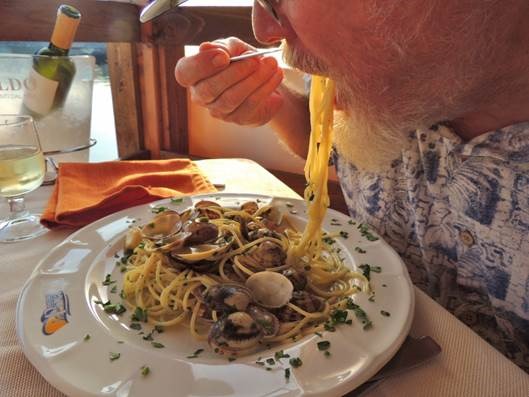
Wine, homemade pasta dripping with olive oil and small pieces of fish, tiny clams, tomato and garlic; YUM!!!  Randal had pasta with clams. 

clip_image003

This was the best stuff: homemade pasta!

clip_image004

Can you taste Randal’s spaghetti with clams?

clip_image005

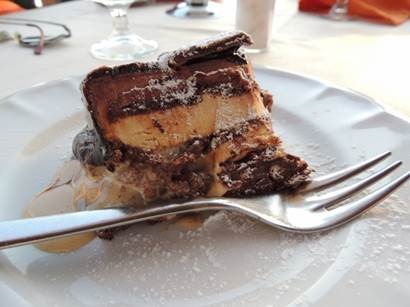
Even better than a chocolate éclair or Boston Cream Pie. 

clip_image006

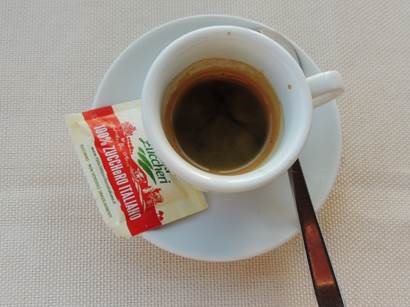
Decaf tiny coffee

clip_image007

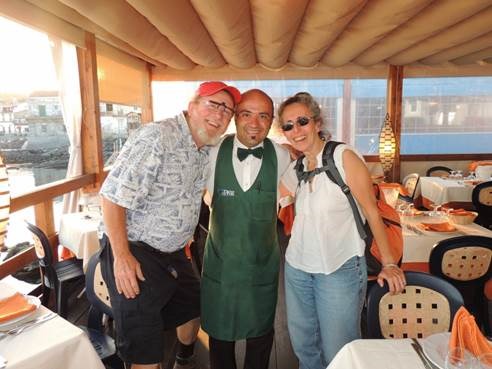
Our great waiter whose brother works reception and checked us into our Park Hotel.

clip_image008

The woman on the left took the photo of us with our waiter.  She was from Austria, I think; and the other ladies were from Iowa!

clip_image009

La Prua which I think was the name of my pasta..very thick and chewy spaghetti noodles. 

clip_image010

Walking back to our hotel along the water front.

clip_image011

clip_image012

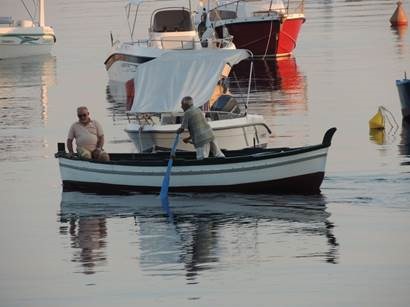
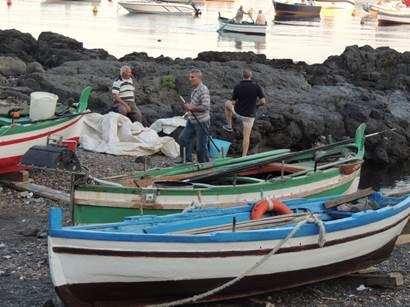
A real fishing village and the food was like being back at Chippy’s in New Bedford!

Sicily:Siracusa check-in and lovely afternoon

4:06 pm or whatever time it is as things keep changing as we journey east.

Buongiorno,

    We are 700 miles from Turkey and 2,300 miles from London.  That’s not how the crow flies, it’s how we planned our stops along the way.  We only have 90 days total in the combined European Union countries and we want to be in London by September 1st.   So along the way we are picking and choosing and seeing some things and missing others.  We spent one lovely afternoon in Siracusa when ssiceveral days wouldn’t have been too many.  We are now anchored in Porto Palo for the afternoon and overnight.  Tomorrow we’ll have a very long 64 mile day to Licatta where we plan to leave DoraMac at the newly opened Marina di Cala del Sole, rent a car and see some of Sicily.  Places on our list are Palermo, S.Stephano di Camastra, Messina, Mt. Etna, and Enna.  Volcanoes, women travel writers, General Patton, Jewish history and Sicilian pottery are some of the reasons for the stops we chose.  I’ll write more about each when we actually visit.

As for Siracusa, or Syracuse as we know it, we spent some lovely hours.  We were anchored out so took our brand new, never been used dinghy to shore for our official check-in to Italy/Sicily, find some lunch with internet access, and hopefully find a shop that sold SIM cards for our computer dongle.  We were successful on all counts, though we had to wait out the 4 hours many “not tourist related” shops are closed in the afternoons before we could purchase our SIM card.  That gave Randal more café-computer time and me exploring time and then both of us time to get lost during a lovely walk.  Thankfully the shop was open when we found our way back to it.  Since the clerk couldn’t promise us our Turkish dongle would work, we now have an Italian dongle to add to our collection.  But after an hour or so for registration to take effect, the dongle works like a charm. 

   Our anchorage was quiet and peaceful and I slept really well until a 5:45 am dream (short version here) where I lost my pocketbook and had to replace driver’s license, credit cards, etc woke me.  I made myself wake up so I wouldn’t have to deal with any of that stuff. 

  Our passage from Siracusa to Porto Palo, other than the rolly first bit, was smooth and comfortable.  We covered the 28 miles easily and were anchored before noon.  It was so calm and quite that I cooked up the bacon we’d bought back in Ios and Randal had a bacon and tomato sandwich.  I nibbled on some bacon along with my daily dosage of cucumber and tomato.  I’d actually done a load of laundry along the way and even washed my hair.  It was that CALM!  When the weather’s good, it’s very very good; but when it’s bad it’s horrid. 

So here are some photos from our afternoon in Siracusa.  I’ve been to Rome and Florence but I’m thinking that Sicily will have its own personality.

clip_image001

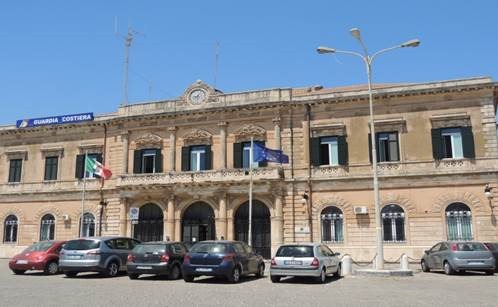
Coast Guard building where we had to go to check into Sicily/Italy

clip_image002

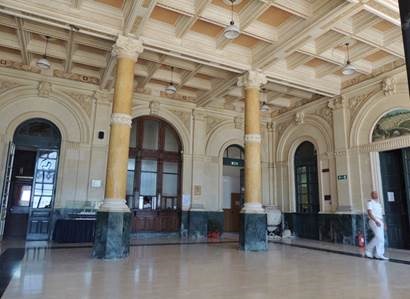
We wondered what it had been once upon a time when it was built.  Randal asked the official checking us in, but his English was limited and he was unable to answer our question.

clip_image003

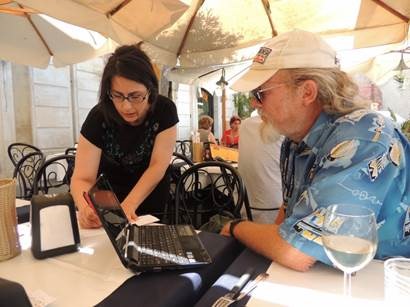
Getting the restaurant wifi code which was more important than the food.

So far Turkey has the best salads and DEKS (N. Cyprus) and our anniversary meal dinner in Herzliya have the best calamari.

clip_image004

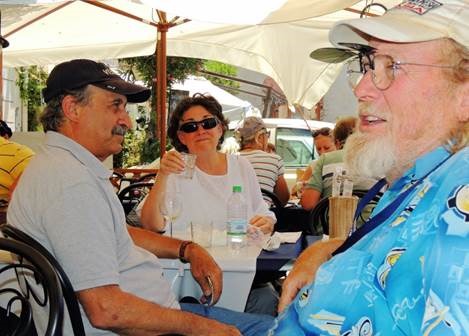
Burlington, Vermonters.

These folks were already having lunch when we arrived but we started to chat.  We didn’t ask names but they have our card and hopefully will keep in touch.  She teaches in the School of Nursing at the University.  It’s a program that takes in multi-disciplined people whose focus is work with the mentally impaired.  I hope that’s a correct description.  He has his own business and rental property.  They were traveling around Italy and Sicily for 3 weeks.

clip_image005

We’d just eaten lunch and had too many hours before we’d return to DoraMac so we weren’t tempted.  But the woman who owned? Managed?  was able to tell us where to buy our SIM card.  It was she who broke the news to us that shops close at 1:30 and reopen at 4 or 4:30 or 5.  We wanted the SIM so decided to wait, hoping the phone card shop would reopen earlier rather than later.

clip_image006

Our next stop was somewhere for a drink and more time to compute.

I asked if they had wifi and one fellow said yes and one no; but the yes guy was correct


clip_image007

I’m not sure how he got it to work; but it did. 

Randal had a beer, I had a cappuccino.  Then I went off in search of a Sicily map and some info.

clip_image008

Great small alleyways with what looked like homes on either side.

clip_image009

I liked the doorway

clip_image010

Randal right here I’d left him.

We still had another hour before shops reopened so walked around the area in an out of the small streets and alleys, many with boutique shops and enticing restaurants.

clip_image011

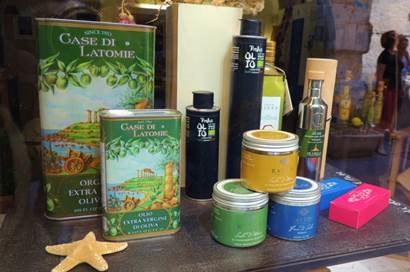
Everything Olive Oil

clip_image012

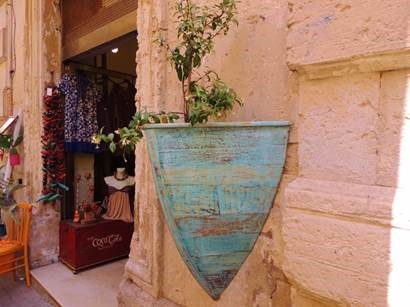
Bow of a small bot used as a planter

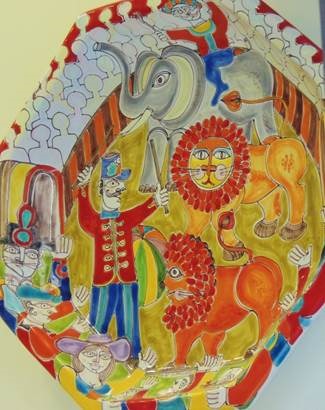
A fantastically painted ceramic plate

clip_image013

clip_image014

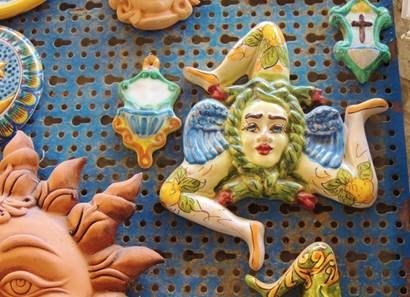
Sicilian Triskelion

I love this 3 legged thing. You see it everywhere and I might have to have one.

“If you venture to Italy’s unique little nugget, Sicily, you will be sure to see a three-legged symbol with a gorgon’s face in the central crotch region staring at you from every manner of tourist trinket. If you want to impress your travel mates, read on to learn the origin on this interesting Sicilian symbol.

The Triskelion (from the Greek for "three-legged") emblem appears on the Sicilian flag and fanciful versions pop up on everything from bottle-openers to lingerie throughout the island. The face of Medusa typically is seen in the center of the graphic, representing the protection of the war goddess Athena, Sicily’s patron. Most of us only know Medusa as the snake-haired demon slain by Perseus, but she originated as an aspect of Athena’s persona. So, never fear, the graphic is not a curse meant to turn tourists to stone!

Also called the Trinacria, the triangular image is said to represent the geographic shape of the island. The image was seen on Sicilian coins at least as early as the 4th century B.C., and it is not likely to fade away any time soon. Now you’re ready to impress your crew on your next Italian adventure!

http://www.examiner.com/
clip_image015

The lady in the straw hat caught my eye

clip_image016

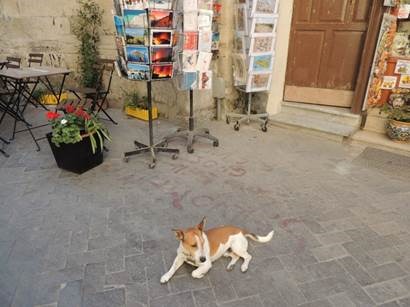
So did this small “Max-like” dog

clip_image017

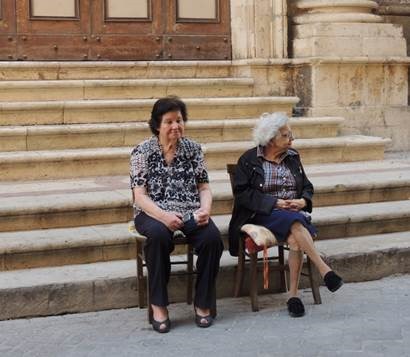
Very pensive.

These ladies, just sitting and being part of everything going by.

clip_image018

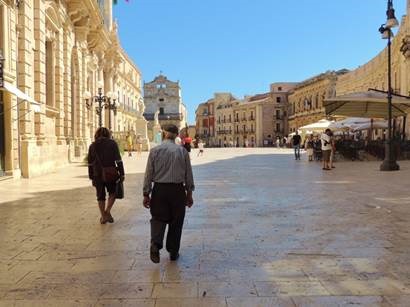
Piazza del Senato home to City Hall on the left.

clip_image019

Piazza Duomo….we just “stumbled” across it in our wanderings.

“The building par excellence which demonstrates Baroque influence in Sicily is the Duomo, built in the 7th century with the transformation of the Tempio di Athena which contains the massive columns that once encircled the cella and today constitute the central nave.  The current Baroque façade of the Duomo is decorated with statues of the Saints and in the centre the statue of the Madonna del Pilar to whom the church is dedicated.  The statues of St. Paul and St. Peter by Marabitti flank the splendid stairway leading to the Duomo.”

Sicily : Art, History, Culture and Folklore

http://www.bestofsicily.com/mag/art423.htm  tells more and shows more.

clip_image020

Noise and food were prohibited but not cameras so I used the “no flash” museum setting

clip_image021

There were many small chapels but where people were praying I didn’t take photos.

clip_image022

An accordion serenade in the piazza just across from the church.

clip_image023

Looking back towards Siracusa from DoraMac

Pilos, last stop in Greece part 1

Buongiorn,

    So far that’s really the only word I know.  As far as understanding any Italian thanks to my half-forgotten French or totally forgotten Latin, no help there at all.  Not so much English understood or spoken in Siracusa that I could tell in half a day. While in Greece  I did manage to learn: please, thank you, you’re welcome (same as please) and hello and good-bye, both yasas though yasas is plural and yaso is singular but most folks said yasas to me except every now and then.  We’re moving on from Siracusa tomorrow stopping to check out the Portapalo marina.  If that doesn’t suit we’ll move on to Licata.  At one of those marinas we’ll leave the boat and rent a car to tour Sicily. 

   Our friends Ed and Sue raved about the market at Siracusa and we did see the remains of it when we walked by in the afternoon.  But we were too tired to think food at that point so provisioning will come later.  We still have tomatoes, cucumber and oranges from Greece.

Below is what I wrote as the original introduction to these Pilos stories.

Ru

   It’s 2:23 pm and I’m actually writing this email while we travel towards Sicily.  The seas are relatively flat which makes travelling by small boat actually quite pleasant.  When there’s 15 to 25 knots of wind and 1 to 2 meter seas, all you can do is take turns sitting watch and sleep when you’re not.    This morning, Monday June 10th we left Pilos about 6 am with the calm seas that were forecasted.  There may be some bumps before we get to Sicily on Wednesday, mid-day,  but for now it’s good.   I wrote that Monday June 10th during our passage from Pilos, Greece to Siracusa, Sicily

THEN EVERYTHING CHANGED AND WE HAD 25 KNOTS OF WIND AND 2 METER (6 FT) SEAS.  RANDAL WAS SICK AND I WAS SCARED SO RHINO RANDAL HAD TO SIT WATCH WITH ME.  IT WAS AWFUL BUT NOT AS BAD AS OUR TRIP FROM LANGKAWI, MALAYSIA TO SRI LANKA; SO THERE’S THAT.   I did see how well DoraMac could do even if her crew was falling to pieces.  Now it’s calm as could be and we’re anchored out in the harbor in Siracusa, Sicily (Italy) after spending most of the day in town.  It was lovely and we met a couple from Vermont!      We didn’t have Sicilian pizza but I will before we leave Sicily.  We’ve planned to spend a week driving around and seeing the island which is the largest in the Mediterranean.

Last stop, Pilos (Pylos or Navarino)

The names I use for ports we visit come from our cruising guides.  In the case of land travel I’ll use what I see in town.  In this case both were Pilos though the 1994 British Which Guide to Greece and the Greek Islands uses Pylos.  (I found the Which guide in a marina library somewhere and hopefully books we left behind are as useful to other cruisers.) 

“With its plant shaded plateria surrounded by whitewashed porticoes, gardens shadowed by palm trees and flopping banana trees, and lovely views across the vast sweep of Navarino Bay, Pylos is a stylish and attractive town, ideal as a base for exploring the southern Peloponnese of just for lazy lingering.”

     After a bumpy day and night passage from Ios, and a two night passage planned next for Sicily, Randal and I opted for the mostly lazy lingering.  We had come to Pilos as our final stop in Greece where we would officially (required) check out from Greece.  But though we’ve checked out from Greece, we’re not checked out from the European Union so our 90 days Schengen clock has started.  Our entry date is the date our passports were stamped in Greece.  We will leave the EU when we visit Tunisia which will stop the clock, but it will begin again when we come back.  We plan to be in England before our 90 days are up so it’s not a problem really.  I stop myself from complaining about the time limit unless speaking with non-EU people as their reply is that America limits visiting time to foreigners.  I think we all need to rethink these visiting policies because travel broadens minds and we could use more broaden minds around the world.

We arrived at Pilos about mid-day and were rafted up to an old fuel barge as that was the only place for us.  Smaller sailboats were rafted up to each other as all of the stern-too spots seemed to be taken by sail boats and many small fishing boats.  Pilos seems more a working harbor than pleasure harbor; no water or power pedestals available.  If you wanted water you had to go over to the water pedestal across the harbor.  We still had half a tank and can make our own, so we didn’t need water.  With most lights, the inverter, and freezer turned off, and the solar panel working, we could stay without a problem.  If we’d needed more power, we would have run our genset to recharge the batteries.

An older man who unofficially works the harbor and two young sailors, Ben and Thomas from Crest Hawk Adventure, caught our lines.  Then the older man took Randal on his motorcycle over to the port authority to check in.  After that it was time for us to get cleaned up, pack the computer and go find food and wifi.  Unlike Ios there was no free wifi access we could pick up on DoraMac though the restaurants don’t charge for theirs and don’t care how long you sit and use it.  Thomas and Ben (

Crest Hawk) even left their computer to recharge at one café while they came back to the boat for a visit with us.

clip_image001

Rhino Randal checking the chart plotter to see if we’re on course to Pilos.

Rhino Randal keeps watch with me during my night watches. 

clip_image002

Small Pilos harbor

clip_image003

The old gas barge with its empty tanks and NO SMOKING signs.  The older man who told us where to tie up and took Randal to check in lit up a cigarette standing in front of one of those signs.  I have to say it scared me to see a match so close to our diesel trawler….though I have lit candles on board when we’re at a dock.  But still. 

clip_image004

To get off you climb over our rails onto the barge’s rail and then jump down several feet.  You walk through the barge and out the opening onto the concrete pier.

clip_image005

Several small fishing boats would come and go in the mornings and evenings.

clip_image006

Cloud covered mountain off in the distance and hills going up the hillside.

clip_image007

Modern windmills

At least some seasons there’s lots of wind so we’ve seen lots of modern windmills.  We saw about a half dozen being built on this mountain.  It’s very appropriate that there are windmills as Cervantes was a prisoner here of the Turks and wrote about his experiences in Don Quixote.

clip_image008

“plant shaded plateria”

clip_image009

“surrounded by whitewashed porticoes”

clip_image010

Sidewalk gas pumps

clip_image011

“You gotta go up.”

“If you want to see it you gotta go up,” was something our friend Linda Levy wrote about hers and Michael’s visit to Greece.  Here in Pilos, if you want to go home, you gotta go up!  Must be very healthy people who live here.  Streets bisect the hillsides but between the streets are only these stairs. 

clip_image012

And down again. 

Each stair is not very high so maybe some kind of truck could get up to deliver furniture or other big items. 

clip_image013

Real life Greece

clip_image014

After getting checked in, showered and collecting trash for the harbor dumpsters, we went off to lunch and to compute.  I had a huge salad with a wonderful olive oil/balsamic vinegar dressing.  Hard passages make me crave junk food so being back on land makes me crave vegetables.

clip_image015

Sad sack!

I tried to cheer him up but no dice.  He just lay there with those sad eyes.  Hopefully he was just pooped out from a long, fun morning walk.

clip_image016

Four Seasons Restaurant: Our lunch/computer place.

Sunday we actually slept late recovering from our night passage.  And truly enjoying the quiet of the harbor that allowed us to keep all of the portholes and hatches open.   We went off to explore the town which was pretty much closed up for Sunday.  Even the small supermarket and fruit shops were closed.  Only restaurants, bakeries, small souvenir shops and museums stay open which was enough for us.  I took bunches of photos at the fortress and that will be the next email and final one from Greec…at least this passage. 

clip_image017

Randal declared that he had everything to make him happy; computer,  Greek salad, white wine, olive oil, bread (not in the photo but always served in Greece) and, of course, me!

clip_image018

Mountain salad made me happy: some type of thin mild spinach-like green cooked in olive oli and served with lemon.  Yummmmm.  That mountain of greens served with bread to soak up the olive oil would have been more than enough.  Bread, olive oil, olives and wine surely must come from the gods.

clip_image019

But I’d also ordered baked feta cheese which came with its own olive oil and grilled tomatoes and green peppers.  Double yummm!

As we had enough food for 3 or maybe even 4 people we went home with a packet for later.

clip_image020

Often something sweet is offered after the meal and these were tiny thumb sized frozen banana flavored ice cream with a thin chocolate cover. 

I left Randal sitting with his wine and computer and I walked around town, up and down and around taking photos.

clip_image021

This grilling meat smelled wonderful, but we were still full from lunch so just took a photo.

clip_image022 clip_image023

The shop where I bought some olive oil.  We have some Turkish olive oil and now Greek.  I’m going to collect different oils along the way and one day we’ll have a tasting….for those of you who come visit us in London!