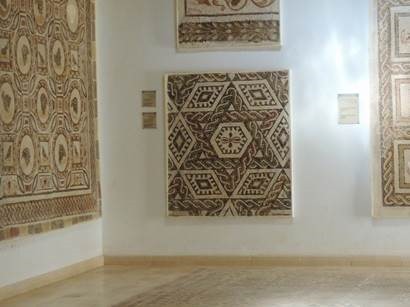
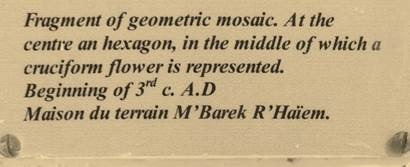
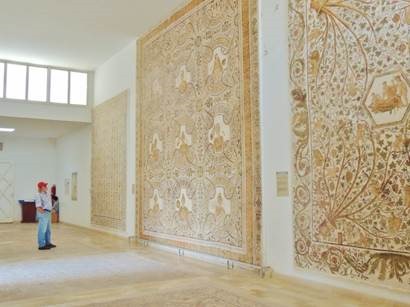
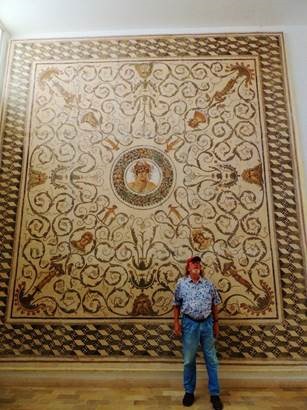
Nabeul, but not Hammamet

Hola

  Our marina wifi stopped working Monday morning.  I’m sending this from the small café here at the marina which has a different wifi source.  I went to the marina office today and the woman behind the desk seemed unaware of the problem but called the technical support for the service and told me to talk to him.  His English was heavily accented and the phone was a strobe phone so I understood about every third syllable.  The bottom line is that he knows there’s a problem but has no clue when it will be fixed.  We’d paid 24 Euro = $34 for a week of internet access.  That’s the most we’ve paid anywhere so far.  Another cruiser in the office told me to go to the next town over and get a Vodafone mifi device which would work in more than one country.  There is a Vodofone office in La Linea but he said they didn’t know much about the device, but that was last year when it was new.  We might try there later this afternoon before we move on to the step of hiring a taxi to try to find the Vodofone shop the next tone over. 

La Linea is really turning into a boat repair stop more than anything else.  But boat needs and weather are two things you have to put tops on the list when you live on a boat.  I really can’t wait to get to London.

Ru

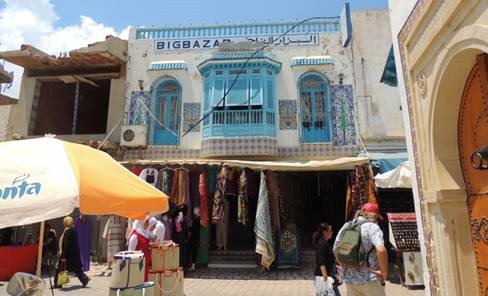
One of the reasons I don’t read Paul Theroux travel books is that he’s so negative about most places he visits.  At least that’s the way it seemed to me the first few I tried years ago.  Actually lots of years ago so maybe he’s mellowed since then.  At this point I prefer women travel writers anyway, and wish that Rosemary Mahoney would hurry up and write something new.  The point of all this is we’re feeling a bit less interested in places the more we’re pushing to get to London.   And it’s getting to be tourist season so there are more crowds.  That said, I’m not sure we gave Tunisia a fair shake while we were there.  Maybe it was too similar to Turkey and Israel so we felt as if we’d been there done that.  Especially the pushy carpet/souvenir tourist hassles.  But Brits Jo and Mick love living in Tunisia and ourAmerican friends who lived there for 2 years loved it too.  I definitely know I would have liked being somewhere other than a resort area which, unfortunately, is where the marina is located.  Because of the crowds we bypassed Sidi bou Said with its hillsides of white homes with blue doors and we also skipped Carthage and the cemetery for the American soldiers.  We just couldn’t make ourselves deal with the heat and crowds.  We did, however, decide to give Nabeul and the Hammamet Medina a whirl the final day of our road trip.  We actually spent several hours in Nabeul.   As for Hammamet, we pretty much drove in, spent 10 minutes in the very hot, empty, souvenir shop filled Medina, had something to drink, and left.  It was in the restaurant in Hammamet that we were told about the impact of “all inclusive” packages were having on the small local hotels and restaurants. 

   Nabeul is famous for its pottery so that’s why I wanted to go and it’s just about an hour or so from Port Yasmine.   We drove there and found a parking space on a side street off the Medina.  We had a small map of Nabeul so I asked a man passing by to show us the street on the map so we could ever find the car again.  He spoke little English but another man coming along jumped in to help.  He then insisted on showing us the way to the Medina…but his real motivation was to lead us to a carpet shop just outside the Medina.  I kept saying we were there to see and not shop, but that made no difference and the head guy of this government run shop made us go through the whole bit, demonstration, mint tea, looking at carpet after carpet.  At this point the last thing we need is another carpet!

clip_image001

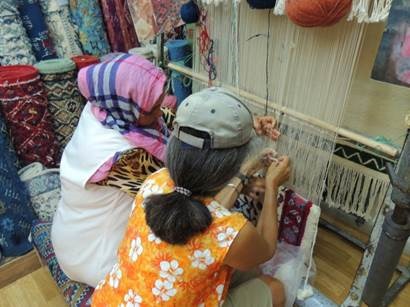
It took me a few tries to get the hang of it; Tunisian carpets are single knotted rather than double knotted like Turkish carpets.  But many are quite lovely. 

clip_image002

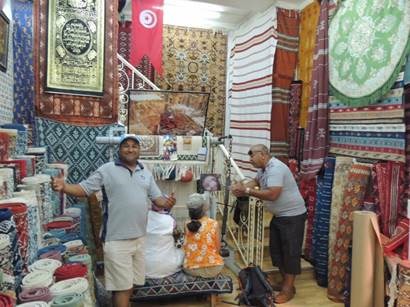
The man on the left was our “guide” and the one on the right seemed to be in charge and the head carpet seller.

clip_image003

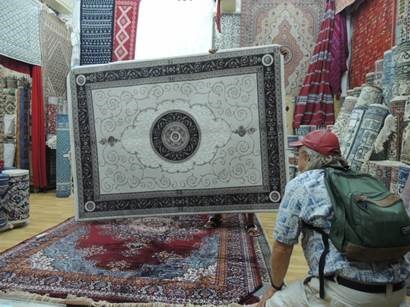
We do have an interest in carpets so we looked.  Most carpet sellers don’t mind if you look, but here it was a mistake as we were then expected to buy something.  There were some lovely woven blankets but I didn’t dare ask about them because that would have led to more unpleasantness if I’d not bought one. 

After the tea, which you really can’t refuse without being rude, we tried to leave.  Head guy just kept going on and on so Randal got up and walked out.  I’d planned to give something to the woman but started out the door after Randal when the head guy told me I should pay for my tea since we didn’t buy anything.  We had never heard that in Turkey or India for that matter, and I was pretty aghast that he would say such a thing.  Then he fumed out of the shop probably to find more unsuspecting tourists.   I walked back in and gave a bunch of coins to the weaver and told her that the coins were only for her and said it twice.  One of the shop staff saw me so I can only hope she actually got to keep all of the money, maybe about 8 or 9 dinar, about $5.  Our initial “guide” started to walk with us and I told him that we really were unhappy and wanted to just walk ourselves.  He took the hint and left us.  So right away we’re not so happy with Nabeul.   But it got better  and walking through the Medina wasn’t so bad.    Later in the day we saw the “carpet seller” again walking through the Medina.  He called out Virginia and came to walk with me.  I told him we were very unhappy with the treatment and his behavior.  I think he looked a tiny bit remorseful, but I might be making that up.  He certainly took the hint and walked away.

clip_image004

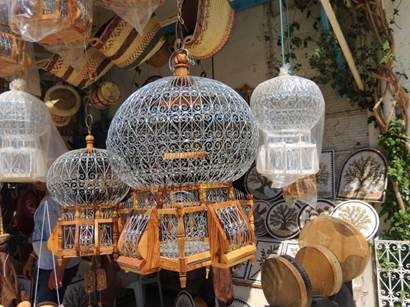
Tunisia is famous for their white bird cages

clip_image005

I would have bought one but Rhino Randal would have been jealous.

clip_image006

Once upon a time these covered balconies were used by the women so they could see out but no one could see them.  

clip_image007

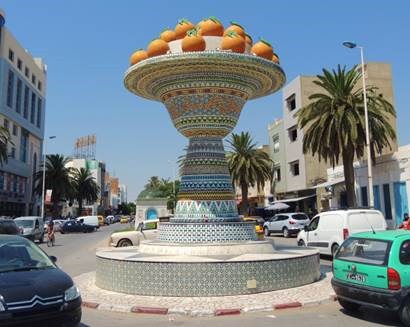
Symbols of Nabeul; pottery and oranges just outside the Medina

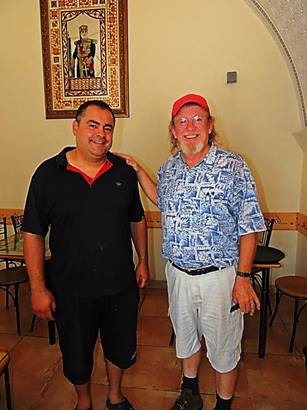
We made one pass through the Medina and then decided it was time for lunch so set off down the main street of Nabeul.   There were several street vendors selling interesting looking food, but we needed a place to sit down that also had a WC.  We picked Sofrat el Bey Restaurant and Pizzeria and it was a good choice as the owner was the total opposite of “horrible carpet man.”

clip_image008

Ben Amor Salim and Randal

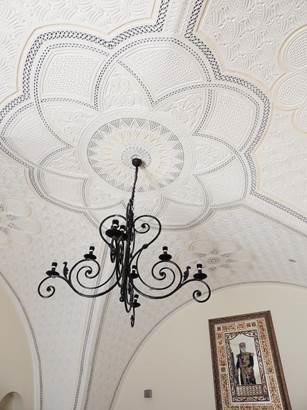
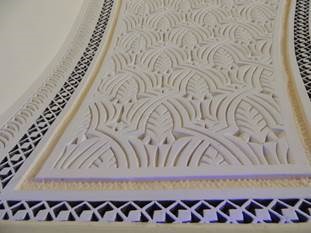
We had a lovely lunch and chat and learned about the architectural details of the restaurant; traditional Tunisian designs.

clip_image009he Medina and then decided it was time for lunch.  There were several street  unhappy and wanted to ju

clip_image010clip_image011

I think we were told it took 4 men three months to create this ceiling from molded plaster from which the design was cut out. 

clip_image012clip_image013

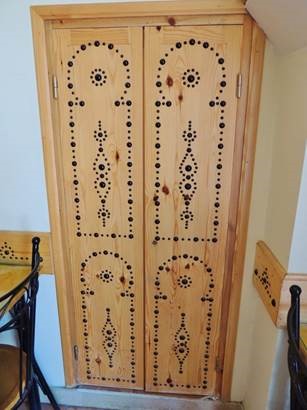
Each glass-topped table had some type of decoration be it carpet or scarf.  Wood door decorated with painted wood studs is traditional Tunisian.

clip_image014

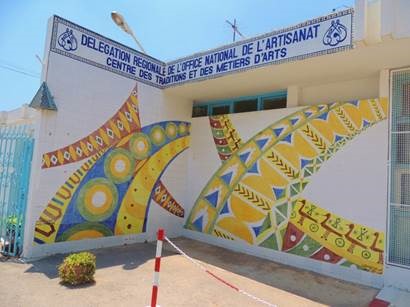
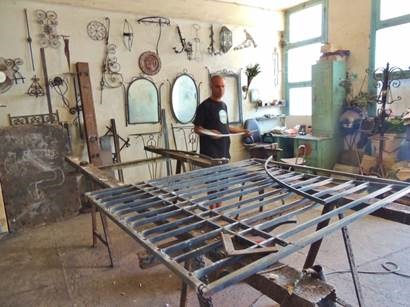
After lunch we went to visit the Center for Tunisian Arts and Crafts

clip_image015

Wrought iron shop; we saw the same overhead light as had been in the restaurant, so perhaps made here.

clip_image016clip_image017

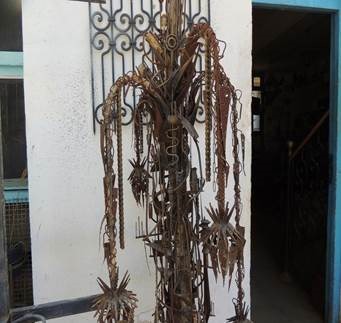
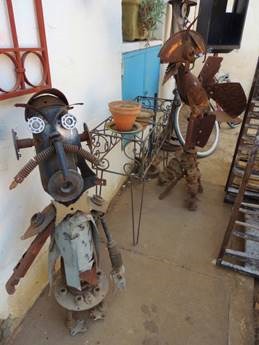
Edward Scissorhands and friends outside this shop selling more decorative than utilitarian work.

clip_image018

clip_image019

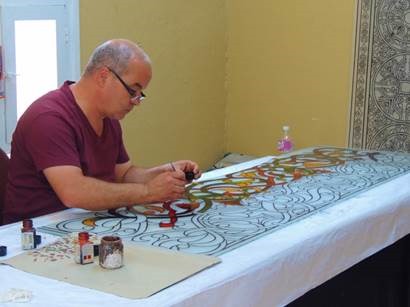
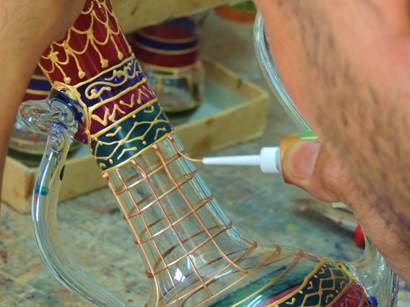
Two different types of painted glass; these bottles were quite lovely but not made for moving boats.

We left the workshops without finding something we just had to have and walked back towards the Medina.  The pottery though hand made looked more mass produced.  We were told by Jo that pottery could be bought in Port Yasmine from the souvenir shops and it would be about the same price and perhaps more choices. 

clip_image020

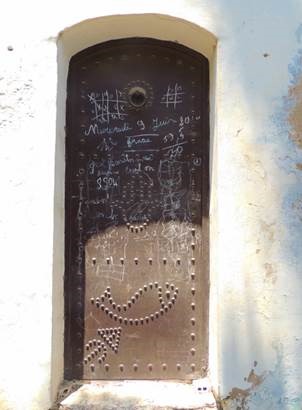
A metal door that worked like a chalkboard

clip_image021

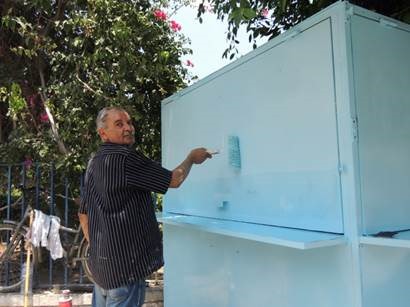
Blue is the predominant color for decoration : Sun sea and Sahara = blue and white

clip_image022

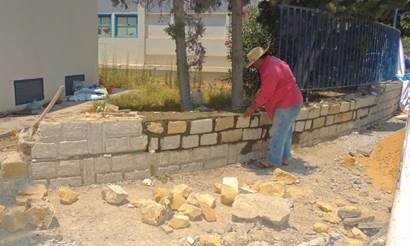
Repairing or maybe creating a wall.

clip_image023

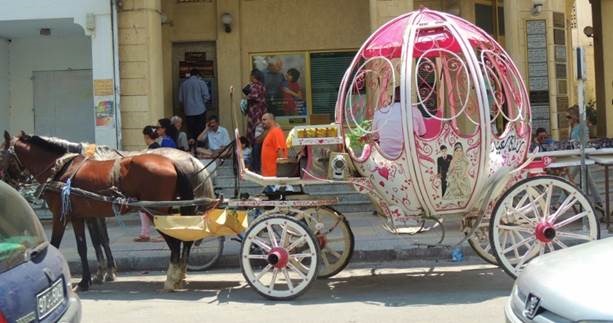
A wedding carriage : Disney/Barby is alive and well in Tunisia

clip_image024

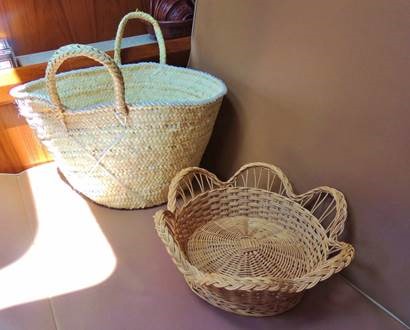
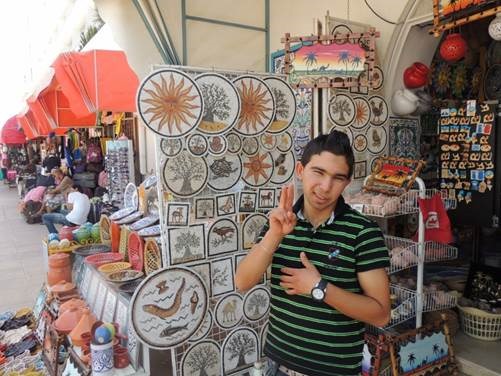
Nabeul souvenirs. 

Our first pass through the Medina I bought the bigger basket and the second time we bought the smaller one.

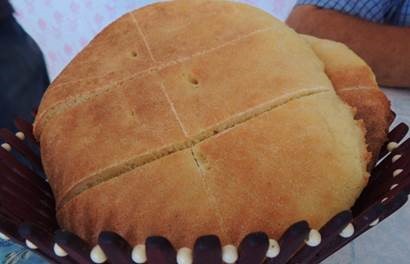
Tunisia is famous for woven baskets.  We’ve used the one with handles for lots of things but most recently to hold all of our chippy snacks during the passage from Tunisia to Spain.  The small one will be a good bread basket

     The info below was written by an xpat Brit a few years ago but it was helpful for our visit to Nabeul.

“Located in the Cap Bon the most fertile and most attractive region in the whole of Tunisia;

surrounded by lush countryside, beautiful gardens and the cool, blue, Mediterranean Sea

lies Nabeul   which for many, including myself, lays claim to being  Tunisia’s "Jewel in the Crown!"

     Becoming an expat can be a challenging, rewarding and exciting experience, but living in a country with a completely different culture and a strange language can be quite nerve wracking at times!  Most new residents find that life in Nabeul, however, is an easy and gentle introduction to Tunisian life!  Everything that a would-be expat is looking for can be found here!  The town is not too small or too traditional which could provide a culture shock for some and certainly not too touristic as to not be able to experience the local way of life!  http://www.nomarmiteintunisia.co.uk/nabeul.htm

https://www.facebook.com/pages/SOFRAT-EL-BEY/327401667274352 is the web address from our restaurant.  Not so much there now, but he was such a nice man.
Tunisia Odds and Ends

Hola

  I can now remember how to spell Alcaidesa without having to look it up each time.  And this is the final email about Tunisia so I’m almost caught up!

The slip next to us  seems to be reserved for boats needing to be here a night or two.  So far we’ve had three neighbors in the short time we’ve been here.  They’ve all been nice.

It really is frustrating not having wifi on the boat.  As soon as Randal is ready we’re heading over to the café to use their Internet.  I’m not at all keen on their food choices but I’ll have to find something as it’s pretty much time for lunch.

Ru

Tunisia Odds and Ends

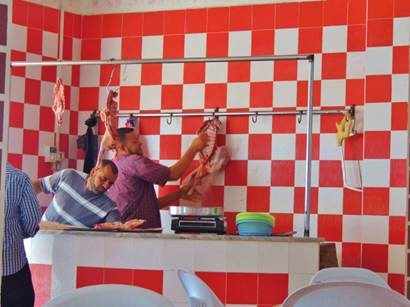
Port Jasmine and the marina seem to have been created simply as a resort with not much thought about those folks like us who actually live on their boat so aren’t tourists looking for tourist kitsch.  We needed things like fruit, vegetables, bread. And don’t even think about diet soda except for Coke.   For serious food shopping (non-prepackaged stuff) you had to go to Barraksal, the next town over.  It really wasn’t walkable, but there was a bus and fairly inexpensive taxis.  The one small grocery store in Port Yasmine  had some fruit and vegetables, but not much and the quality wasn’t great. And it was hit or miss what they had.   Unfortunately the quality of the produce in Barraksal wasn’t so great either, not by Marmaris standards…not even by Licata standards at this point.  Interestingly there were shops to buy red meats, like beef and such and white shops for chicken and eggs and cheese. You knew which was which shop sold beef or lamb by the head hanging outside.  No sugar coating things here with meat parts wrapped in saran at the meat counter.   At a white shop (no chickens hanging outside thank goodness,)  I bought two cooked chickens for our passage and they were quite good as was the cheese from the same shop.

clip_image001

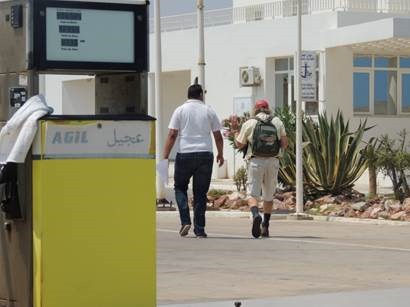
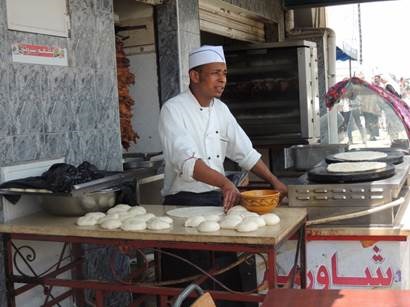
He reminded me of the “roti man” from Sungei Rengit near Sebana Cove Malaysia. 


clip_image002

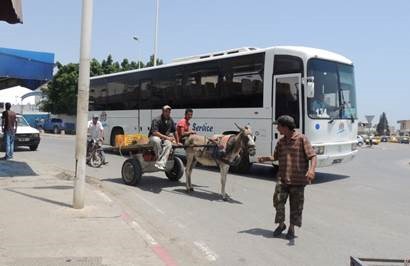
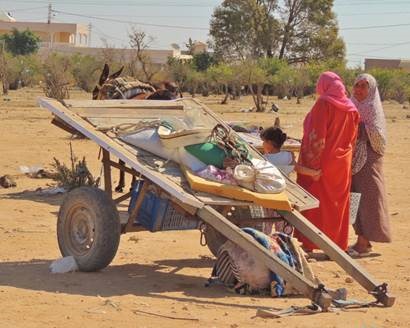
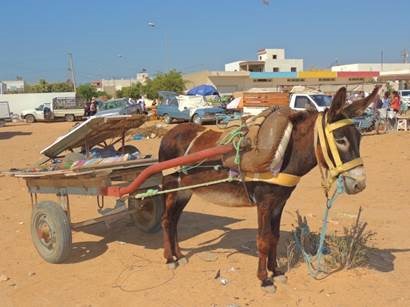
We did see donkeys used for transportation several places. 

clip_image003

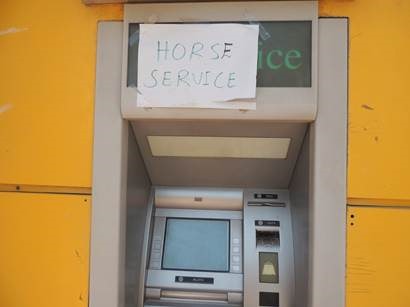
You could think this was folks on horseback, or donkeyback, but it means “out of service.”

clip_image004

One of the souvenir shops that lines the main road in Port Yasmine. 

clip_image005

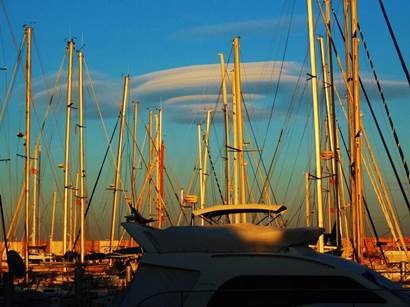
Flying saucer over Port Yasmine Marina.  It was the strangest cloud.

clip_image006

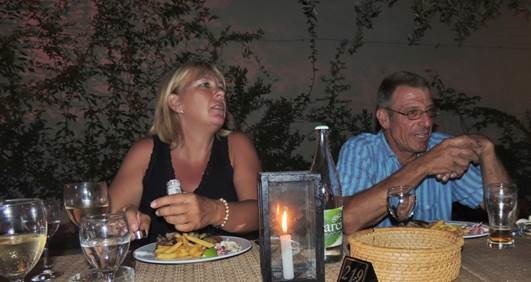
Joe and Mick showed us their favorite restaurant where we took them for all of their kind help before and during our stay in Port Yasmine.

clip_image007

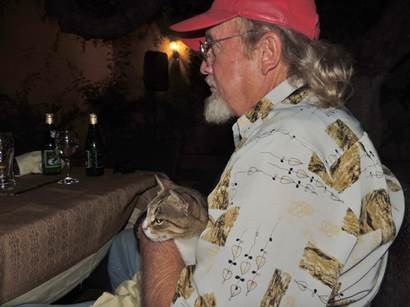
Of course there has to be a cat, but his one lived at the restaurant so we didn’t have to worry.

clip_image008

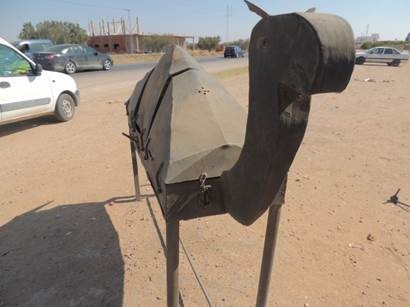
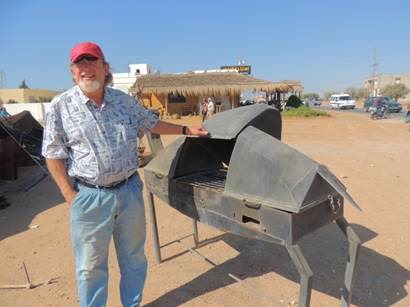
Metal Camel?

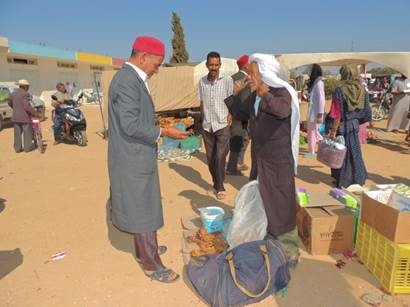
On the road from Sfax to El Jem we came across a small local outdoor market.

clip_image009

A barbeque grill in its hump.

clip_image010

clip_image011

clip_image012

I might like a donkey, they’re actually quite cute.

clip_image013

Old fashioned scales.

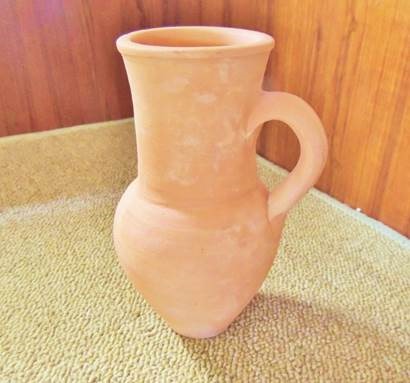
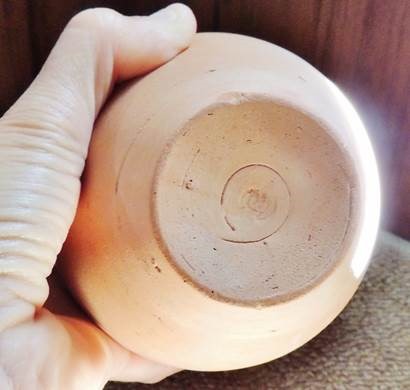
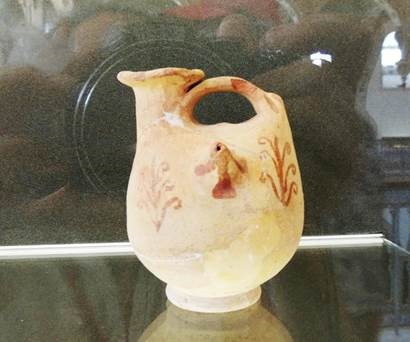
I bought one of his terra cotta pitchers

clip_image014

clip_image015

I paid 2 dinar, about $1.20  but maybe it was made by hand. 


clip_image016

Half day tours went out on these and you heard the theme to Pirates of the Caribbean blasting away while costumed crew entertained.  This one was pulling up to the dock just past where we were tied getting fuel and checking out from Tunisia.  You can see a second one just behind ready to come into the marina area.  But the marina was relatively quiet most of the time so it was fine and folks looked as if they had a good time.

clip_image017 clip_image018

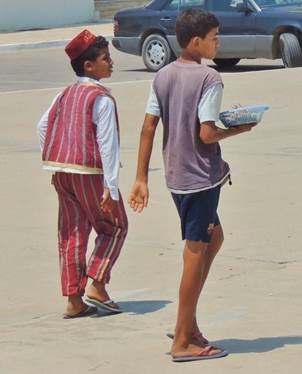
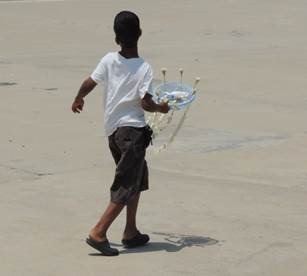
Children selling tiny boquets of jasmine flowers tried to sell them from people disembarking from the “pirate boats.”

When we first pulled up to the fuel dock about 11:15 am the small boy in the red costume was just sitting there with his basket of jasmine boquets. There was no shade.  He had no food or water with him.  He didn’t say a word to us.  He was there from the time we pulled up to the dock until just before we left which was several hours.  Each boquet cost 1 dinar, about 60 cents.  I bought 2.  I gave him a packet of cookies and a can of Diet Coke as we had no small boxes of juice or water.  Then I gave him an apple.  I would have given him all the rest of my dinars but another bigger boy came along, so I had to buy a boquet from him.  He actually asked if I’d buy some jasmine and I said I’d bought some from the other boy.  So he said,”if you can buy one from him, why not from me?’  I had no good answer other than “you’re big and he’s small,” so I bought a boquet from the bigger boy too.  The bigger boy isn’t in my photos, he was even bigger than the 3 boys here.  When the pirate boat pulled in they all ran to try to sell their boquets.  We saw these small kids selling jasmine boquets or roses all of the time by the restaurants that ring the marina.  Even late at night. Joe said the children were safe, that nobody would hurt a child here.  Childhood is so different in different parts of the world.

clip_image019

As Randal walked to the customs office to check us out of Tunisia there was a discussion of “a gift.”  Randal said  no and that was okay.

The Bardo Museum in Tunis and wild tangents……

Hola,

   I’ve made myself a little crazy writing up our visit to The Bardo.  Another one of those wild tangent emails that is interesting to me so hopefully doesn’t bore you to tears.  It really is quite interesting reading about the imagery of mosaics and what they say about the culture that inspired them.  Some art can be ahead of its time, but I’m not sure that could be said about mosaics though it shows the changing beliefs of the cultures that commissioned them.  I also might have found an error in our huge mosaics book.  You’ll read about that below concerning what might or might not be an image of Daniel in the Lions Den.

Ru

The Bardo   http://www.bardomuseum.tn/

http://www.bardomuseum.tn/ link to the 101 Masterpieces in the museum

Randal and I drove off to Tunis to see the Grande Synagogue, the huge Medina Souk, and the Bardo.  By the time we extricated ourselves from the giant weekend before Ramadan  traffic jam surrounding the central  Medina we decided to skip the center and aim for the Bardo.  Miraculously we found it, because though we had a small Tunis map which showed the Bardo, we had no idea where we actually were on the map.  And as we’d been inching our way through the streets near the Medina one young man passing by told us the Bardo was closed on Sundays.  (So much for asking directions.)  Thankfully the museum was open as we’d opted for Sunday with less traffic..ha!

We found the museum, found the parking lot, found the entrance but then found that the cafeteria  wasn’t opened.  We needed some food before we started our Bardo tour so went off to find some.  Between the clerk at the Bardo and a nice man on the street we finally found a restaurant that served more than coffee.  Ever since we left Greece finding lunch has been a bit tricky….unless your idea of lunch is gelato.  (Lunch in Gibraltar is easy)

clip_image001

“brique – crepe filled with tuna, cheese and an egg — eat with your elbows pointing up so the egg yolk doesn’t run down your arms. “  Our friends Eileen and George included this in their Tunisia tips email.

It is more crispy fried than a crepe and our egg was hard cooked so we didn’t have to worry.  Randal and I split one and then each had a Salad Nicoise.  Too much food. 

clip_image002

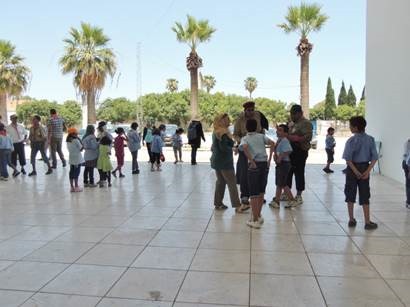
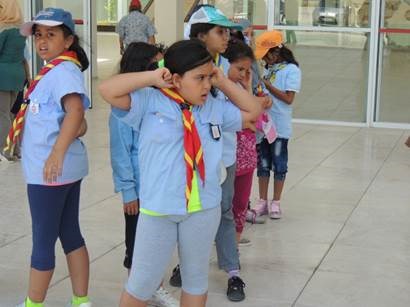
Troops of boys and girls….in seperated groups.

clip_image003

Remember when you were this age and had to go to a “don’t touch anything” musuem.  I have a hard time not touching things in museums now.

The National Bardo Museum

       This is the oldest and the most important of Tunisian museums. Over a century ago, it was established in the premises of a Beylical palace, for the most part built in the mid XIXth century, and which has retained all the features of a princely residence. It underwent several refurbishments to adapt to the expanding collections and to the ever-increasing flows of visitors, but today it is undergoing a huge restructuring plan to improve its visibility and legibility.

Thousands of objects originating from excavations carried out all over the country during the XIXth and XXth centuries are on display. These are divided into departments between fifty or so rooms and galleries, illustrating the various stages of Tunisia’s history, from prehistory to the middle of the last century, which in chronological order are prehistory, the Punic-Libyic period, the Roman and early Christian periods, with the Vandal and Byzantine eras, and finally, the Islamic period running to contemporary times.

Thanks to its collection of mosaics, the Bardo museum has gained an international reputation for the richest, the most varied and the most refined collection. Amongst the finest pieces it holds are the representation of Virgil surrounded by muses, or the pavement of Dionysos giving Ikarios the gift of the vine, or another celebrating the triumph of Neptune, to mention only a few of the key exhibits. But these are not the museum’s only assets.

     Amongst the Bardo’s major exhibits is the “hermaion”, an altar dating to the Mousterian period (-40 000 years ) considered as one of the very earliest forms of human spiritual expression: a conical shaped pile 75cm high and 1.50 m wide , composed of more than 4000 pieces of flint, bones and limestone balls.

From the Punic period there is a superb solid gold armour belonging to a Campanian warrior, jewellery, the stele of a priest carrying a child for sacrifice as well as many refined funerary furnishings originating from various Mediterranean countries belonging to the Museum’s Greek and Egyptian collection.

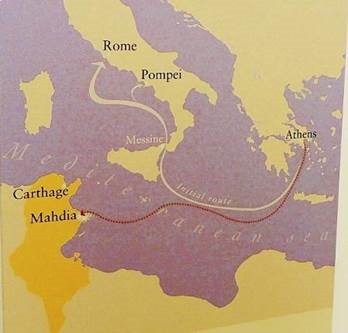
The Greek collection was providentially enriched by underwater excavations carried out during the 40’s off the town of Mahdia, in the wreak of a ship that sank during a storm around the first century and that was carrying furniture and architectural elements for a Hellenistic era patrician dwelling. Amongst the masterpieces retrieved from the seabed is a superb 1,20m high bronze Agon.

The Roman period has provided the Bardo with most of its collections: mosaics, of course, but also statues, pottery, jewellery, coins, religious objects, utilitarian objects etc.

The Islamic department, housed in an Arab-Islamic setting, encloses objects from various periods, manuscripts, jewellery, carved stone and wood, utilitarian objects. Two small rooms, around an elegant patio, enclose objects that once belonged to the reigning family and a third room contains Jewish religious objects. http://www.patrimoinedetunisie.com.tn/eng/musees/bardo.php

We bought our tickets and found that there were “free” tours available.  Each tour would take an hour and point out the various highlights.  We could then tour on our own.  We were joined by two men and a young boy all who spoke fluent English and French.  Our tour was in English.  But to cover everything in an hour our guide had to talk fast and that’s when his accented English became too hard to really understand.  Our tour mates were able to understand him better so “translated” for us.  Also they were extremely knowledgeable in Greek/Roman mythology and history.  It was actually their second visit to the Bardo.  They’d come once before but much had been closed for renovation.

clip_image004

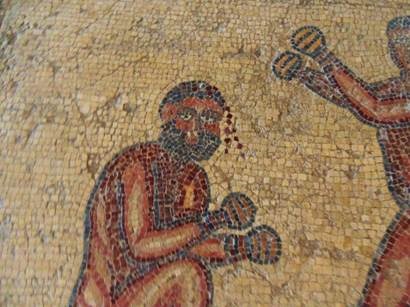
I thought this man had a ribbon tied round his head until one of our tour mates pointed out that it was showing blood pouring from a wound.

     “Central picture of a pavement with a geometrical pattern showing two boxers.  End of the 3rd  Century AD  Thuburbo Majus”   p 296 The Splendors of Tunisian Mosaics by Mohammed Yacoub   from now on referred to as The Splendors as I refer to it a lot.

“The one on the left looks older judging by the features of his bearded face.  Crouching and already defeated, he seems to be only defending himself.  He is bleeding profusely from the wound on his temple.  His friskier adversary closes in, both hands outstretched to deliver the final blow.”

clip_image005

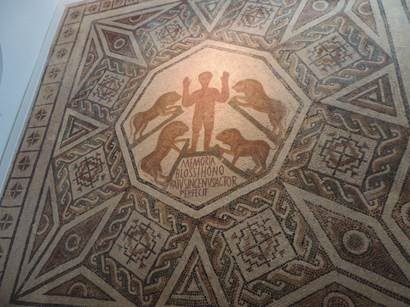
Daniel in the lions den  or is it? 

“Pavement of the funerary chapel of the Blossii, a great senatorial family.  It is decorated with a scene taken from the Ancient Testament showing the prophet Daniel in the Lion’s den.”

“It was only during the course of the 5th century, under the influence of the sepulchral art that was the first to tolerate Christian religious imagery, that we see the appearance of the first figured scenes taken from the Scriptures, although they remain rare.  In fact, we can but mention two mosaics to illustrate the subject, both pavements found at Borj El Youdi.  The first covered the floor of a church and figures Jonas thrown away by the marine monster; the second adorned the mausoleum of a great Roman senatorial family – the Blossi -  portrays Daniel in the lions’ den.  Both scenes, for which the mosaicist had no ancient models available, are treated summarily, with figures simply outlined without shape or life.”  Pages 380-381 The Splendor

However when I was trying to find an explanation for the wood door (below) with symbols from Judaism, Christianity and Islam…I found the following which made me question if the mosaic above is supposed to be Daniel of someone named Blossi as the mosaic was commissioned by the Blossi family

Roman Remains ‘ and Carthage 161

Then our minds went back to Church history,

as we touched the very mosaic which had

covered the remains of the martyr Perpetua,

who was only twenty-two years of age, and

went into the arena at Carthage brave as a

lion, encouraging those with her, and leaving

her father and mother and her baby-in-arms

behind.

She suffered death in a.d. 203, with her

friends Felicitas, Saturninus and Revocatus,

and her brother Saturus, who with her fought

and died among the wild beasts for their faith,

while all Carthage looked on, in the crowded

theatre. There is a full-length mosaic portrait

of her in flowing robes, with doves on either

side of her, and the simple epitaph, " Perpetua

in Pace."

The simplicity of the epitaphs is very touch-

ing ; all have the words " In pace," " Marciana,

in pace dulcis," and many young martyrs’

names are followed by " Innocens in pace."

" Blossi " stands with hands uplifted, two lions

on either side of him. This large mosaic is

full of emblems. ” Primulus " has two doves,

and their outspread tails form a wreath ; in fact

http://www.archive.org/

This early christian mosaic have been discovered in 1898 in the "Furnos Minus" (Messadine, Mannouba near Tunis) archaeological site, it has been since then moved to the Bardo museum where it is still well preserved and displayed (source: bit.ly/SCmunL).

I think that "MEMORIA BLOSSI HONORATUS INGENUS ACTOR PERFECIT" means somehow "a tribute to the honorable memory of the dead (thrown in the lion’s den)"

UPDATE : Thanks to S.Barton who suggested another translation : "Honoratus Ingenus (the name of craftsman) has made possible this work in honor of the dead"

UPDATE 2 : A latin teacher at Jeddah French College, researched and translated "MEMORIA BLOSSI HONORATUS INGENUS ACTOR PERFECIT". As per his translation, the result is less romantic, and it seems that the mosaic has nothing to do with "Daniel in the lion’s den". The artist (craftsman) simply created this scene about a so called BLOSSIUS (probably a gladiator), he’s also glorifying himself through the same writing. The right translation would be : "A HONORABLE (or) RESPECTABLE AND FREE ARTIST REALIZED THE FATES OF BLOSSIUS"  http://www.flickr.com/photos/mahfoudh/8056759568/

MEMORIA

BLOSSIHONO

RATVSINCENVSACTOR

PERFECIT

MEMORY

Blossom honor

APPROVED DINNER PLAYER

Perfect  is a possible Google translation depending on how you interpret what letters are actually meant as in… is it a V or U

clip_image006

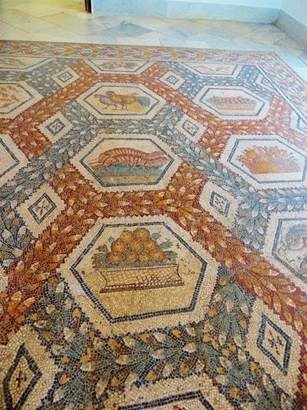
Mosaic Menu on the dining room floor

Our guide said this mosaic had been in a dining room and suggested that it was a menu of the foods that were served there.

clip_image007

Maybe we could have a Mill Mountain Star on our patio…

“The trend to use data from their own observation of reality instead of the decorative elements belonging to the past started to emerge in the figurative repertoire of the African mosaics already in the middle of the 2nd C AD…The taste of the clientele did, of course, play a determining role in these changes….The newly acquired wealth and the taste for ostentatious luxury of this clientele was to a great extent responsible for the long and impressive series of mosaics illustrating events form the economic and social life of Roman Africa.”  P 199 The Splendor

clip_image008

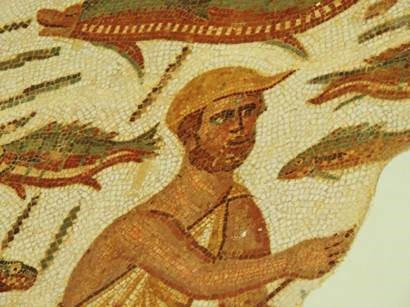
Our guide pointed to this man’s “baseball cap” but had no explanation for its inclusion in this mosaic.

clip_image009

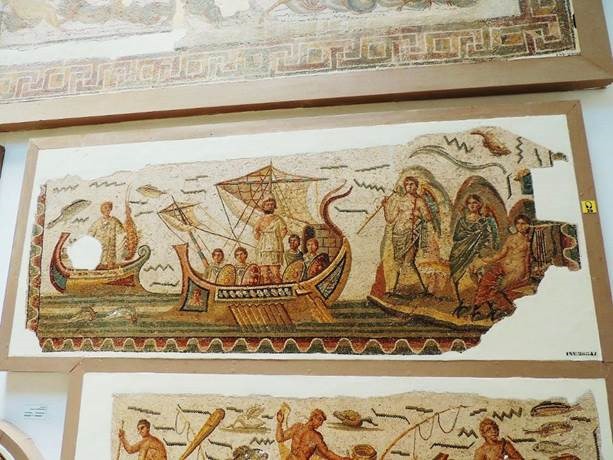
“Ulysses passing in front of the island of the Sirens represented as bird-women towards 260 AD Dougga”

Page 172 The Splendor

Our mosaic artist friend AB had been commissioned to recreate this mosaic and in the small square in the stern, AB had to put in the man’s wife’s face.  I thought I’d heard that the man who had commissioned the original is actually the man in the smaller boat and his face is in the square.  But it really doesn’t look like his face so maybe it’s his wife’s face.  See how stories get started!

clip_image010

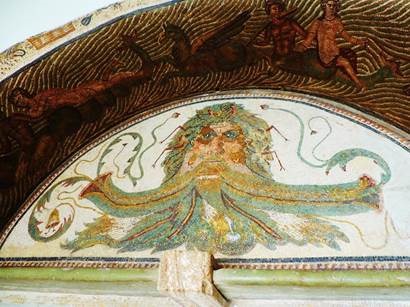
Model for Davy Jones in Pirates of the Caribbean; but really it’s described as Oceanus

“The god Oceanus was just as popular as Neptune.  Oceanus was generally figured as an enormous head, surrounded by fish, various boats and landscape elements…The success in Africa of Oceanus’ head is mainly due to the beneficent value attributed to it.  In a country with scarce rainfall, it probably constituted an appeal to the regenerating and fertilizing water.  Oceanus, furthermore, was not just limited to the marine environment, but was a god whose fecundating waters encircle the earth with a continuous current, penetrating its deep layers and resurging in the form of life-giving springs.”

Page 162 The Splendor.

clip_image011

clip_image012

Clever!

clip_image013

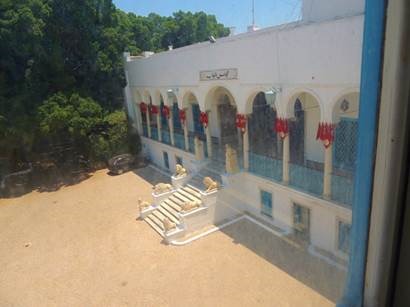
Visible from the museum was the seat of Tunisian government next door. 

clip_image014

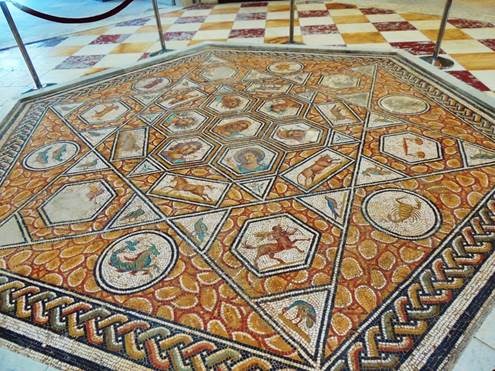
“Mosaic of a cosmological nature figuring the divinities of the seven days of the week and the signs of the zodiac. Early 3rd century AD  Zaghouan area.”  Page 127 The Splendors

clip_image015

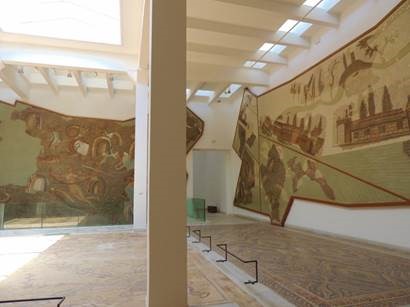
In pieces, our guide said,  this was the largest mosaic found (though I’m not sure the largest one in Tunisia? Africa? The World?)

clip_image016

Routes of ships in the ancient world explaining shipwrecks with ancient artifacts that are found near Tunisia

clip_image017

Artifacts retrieved from shipwrecks

clip_image018

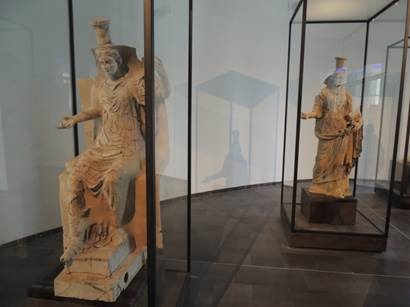
Statues of our old friends Persephone and Demeter


This mosaic shows that they were more than art; they were history and sociology and great clues to the past.

clip_image019

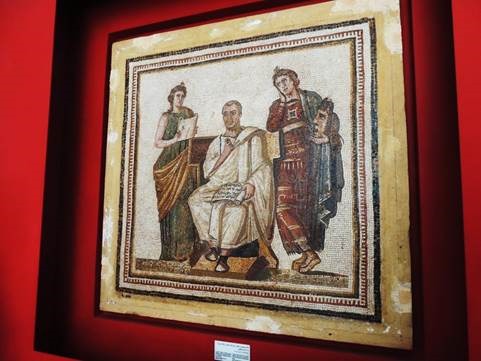
Virgil writing the Aeneid

“But the most remarkable and probably the most faithful portrait of the poet found so far is incontestably that of Virgil shown in a very fine mosaic from a big house in Hadrumentum.  The highly controversial date assigned to this famous work varies from the 1st to the 4th century AD.  But it seems reasonable, on the basis of the clothing details,  to date it to the beginning of the 3rd Century.  The house in which it was found seems to have been abandoned towards the end of the 3rd c. when the whole town quarter in which it was located was destroyed by an undetermined catastrophe and converted into a necropolis.

The two Muses are standing on either side of Virgil. Clio, the Muse of history is probably standing to the left.  The young woman is wearing a long green silk tunic, partially covered by a yellow scarf.  With both hands she is holding a partly unrolled manuscript as an attribute. On the right side is the Muse of Tragedy, Melpomene, a mask in her hand.  She is wearing a long red embroidered robe and a green silk scarf.  The poise of her head, turned to the left, the gesture of her right hand touching her cheek, and the position of her crossed feet  gives her an artificial, almost theatrical pose. “  Pages 143-144 The Splendor

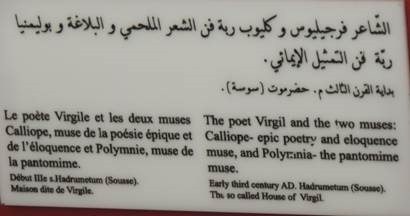
The sign posted by the mosaic in the museum gives a somewhat different interpretation of which Muses are with Virgil.

clip_image020

One interesting note is the gradual changes in the imagery of the mosaics beginning from the 1st to 5th and 6th centuris AD showing the change from “pagan” religious images to Christian images.  “During this period where the new faith had not yet completely superseded the old, the voluntarily ambiguous decorations of masaics often offers no clue as to the relifious convistions of those who owned them and in general they could be interpreteds either as pagan or Christian.” P 360   The Spendor

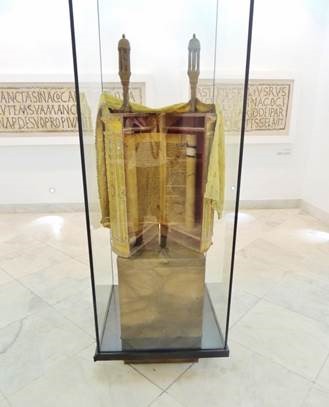
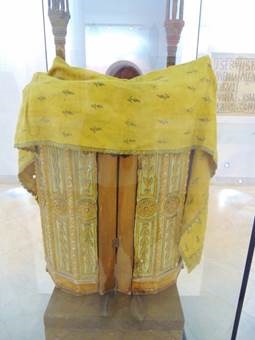
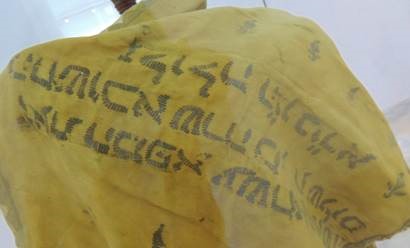
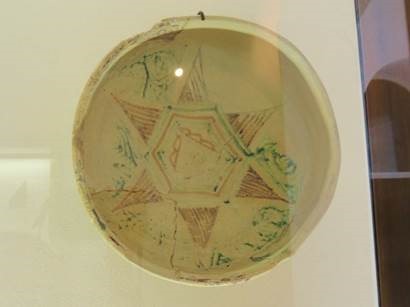
As I was wandering around myself later in the afternoon I walked into the Christian area and found this Torah.  But it seemed to me the shawl wrapped around it was upside down as you had to stand on your head to read the letters.  I did go back to tell our guide and he came with me to see fearing I meant the Torah was upside down.  I told him I wasn’t an expert so to check with someone else.  He then showed me the plates with the Star of David on them and finally took me to the “Wood Door.”  As we walked he told me that Tunisia had always been a place that welcomed Jews and it was sad that a small vocal minority could change that image of Tunisia. 

clip_image021 clip_image022

clip_image023

I think the shawl is upside down

clip_image024

clip_image025

The plates with the Star of David

clip_image026

Our guide said the door had two Stars and a Crescent with a Cross on it and offered to take my photo here.

He hadn’t included the door as part of our tour but I had to wait my turn to have my photo taken as I guess it should be something pointed out if his interpretation is correct.  The recent past of Ottoman Tunisia was inclusive of everyone.  We were given booties to wear over our shoes to protect the floor mosaics that you actually walk on!

Gibraltar 2

Hola,

   Sundays shops are closed here in La Linea so we’re having a quiet day on the boat…catching up with these emails, defrosting the frig, washing the bedding, fixing the running lights, polishing the fuel, repairing the helm chair….quiet.  Maybe later I’ll go for a walk later just to go for a walk…but being on the boat for a day isn’t so bad.  The only catch is that whereas in Tunisia we could both share the Internet password and it didn’t expire after the week as it was supposed to do;  in this marina we have to take turns.  It costs 15 Euros, about $20 for a week so hopefully it will last longer too.  We’ll find out Tuesday morning.

Ru

We spent most of our first visit to Gibraltar in chandleries shopping for boat needs and having lunch at Morrisons.  Our second visit we needed a welder so after meeting up with Sue and Ed at the Queensway Quay Marina we walked to the industrial area a half mile or so further along the road.   During our passage from Tunisia the metal bottom of the seat gave out  on our helm chair so that needed to be welded back together.  The first welder spoke no English so passed Randal on to the other welder who made an effort to understand.  He sort of did and did a “good enough job.”  The language barrier was too great for a detailed explanation of what Randal really wanted so the fellow did what he thought was needed.  When Randal offered him 10 pounds for his work the man shook his head no, that the work was free, but Randal insisted and the welder was quite happy.  We all figured the other welder was quite unhappy that he hadn’t made an effort to work with Randal. 

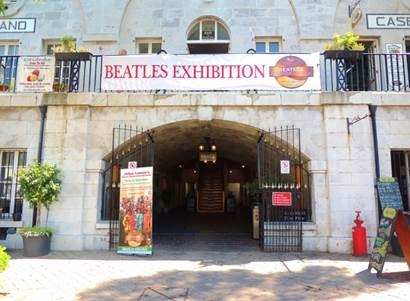
From there we walked over to Main Street with the aim to visit the Glass Museum and maybe the Julian Lennon Beatles Exhibit. 

clip_image001

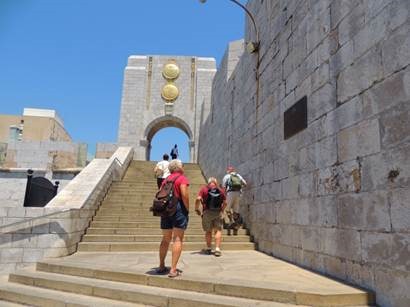
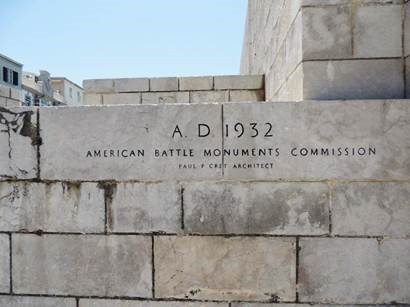
American War Memorial Arch

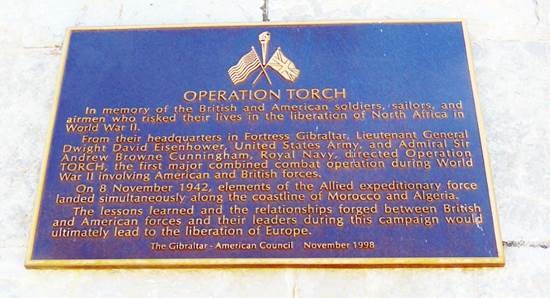
Lots of plaques dedicated to various wars; this plaque was for  WW 2

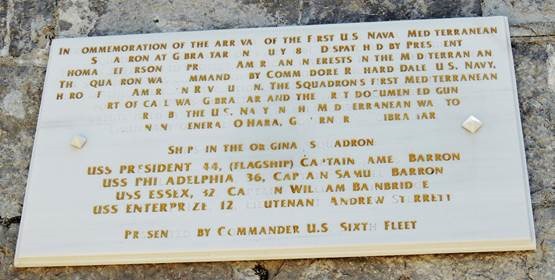
clip_image002

clip_image003

To read this I had to zoom way in and find the missing letters to understand why Thomas Jefferson was mentioned.  Someone on the War Memorials Commission needs to refurbish this plaque.

While researching this memorial I came across the following site and response to his posting…

“June 19, 2013   · by Brit on the Rock       · in Architecture, Gibraltar, Life, Local Information, Photography, Tourism. ·

  Over on Line Wall Road and next to Orange bastion is the American War Memorial. I use these steps almost every single time I go into town, but today I stopped and actually took some pictures for those of you who might well be interested in a closer look.  (He does post some nice photos)

One response on “American War Memorial – Gibraltar”

bluonthemove  June 22, 2013 at 20:09 · · Reply →

“So the USS Enterprise did exist and was based in Gibraltar. Beam me up Scotty.”

http://britontherock.com/2013/06/19/american-war-memorial-gibraltar/

http://www.enterprise.navy.mil/  for the real info about this retired Naval ship

clip_image004

WW I memorial

    “Located near the beginning of Line Wall Road and part of the American steps for pedestrians to connect to the lower Reclamation Road and Queensway, this memorial was designed by Dr. Paul Cret of Philadelphia for the American Battle Monuments Commission.

     This prominent arch was built into the main City Wall in 1932-33 to commemorate the achievements and comradeship of the U.S. and Royal Navies during the World War I (1914-1918).” http://www.gibraltarinformation.com/

clip_image005

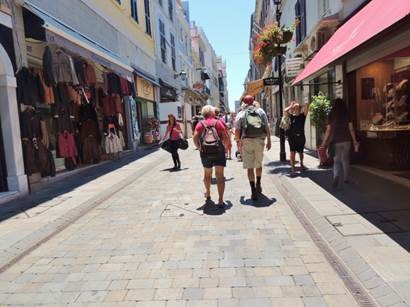
Lots of shops along Main Street including an Marks & Spencer

clip_image006

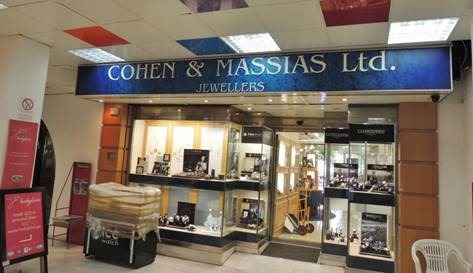
Closed on Saturdays…

Lots of shops with Cohen and Levy to show the presence of Jewish merchants but I read that the Jews here are mostly Orthodox so their shops are closed Saturdays.

Kosher Café

   “ With its chic brown-and-gold suede seating and vibrant orange chairs, Verdi Verdi wouldn’t be out of place on the Upper West Side of Manhattan. On a recent Friday afternoon, an American Jewish woman studying abroad in Spain popped in to grab a soup and was shocked to discover a Jew running a kosher establishment, despite the mezuzah on the door.
   "Kvetching about the price of soup?" Greenberg asked her.

"How do you know that word?" she responded in surprise.

Greenberg says he wants his restaurant to appeal broadly to Gibraltarians, but like Abergel he laments the insularity he associates with the community’s increasing piety. And according to Benady, the isolation is a concern even beyond the confines of the community.

"There is a bit of a concern amongst the non-Jewish population that we are isolating ourselves a little,” Benady said. “But it’s very difficult to decide where to draw the line.”

That sort of closeness yields little room for those Jews who don’t observe in the Orthodox fashion, some say. There are no non-Orthodox synagogues in Gibraltar, and the community observes the religious dicta published by the relatively strict Orthodox religious court in London.
Read more: http://www.jta.org/

clip_image007

A toy shop which obviously sold Legos toys.
clip_image008

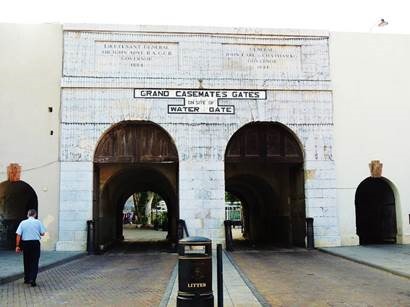
Grand Casement Gates  This one is Water Gate which made me think of “Watergate.”

Casemates Square, positioned at the end of Main Street in the heart of Gibraltar’s shopping district, was once the site of public executions. It is now filled with fashionable outdoor cafes, boutiques, bars, a Tourist Information Centre and the Gibraltar Crystal Factory. Street performers, music and military bands entertain visitors here during the summer months. http://www.gibraltarbreaks.co.uk/entertainment.aspx

  We didn’t see any public executions (though Randal wanted to throttle the woman breatfeeding her baby and smoking…thankfully not at the same time.)

clip_image009

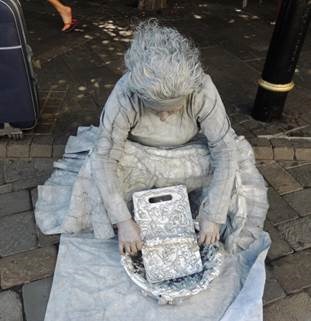
A mime and his dog

I gave him a pound so he shook my hand.  As I walked away from him I looked down at my hand expecting to see that it was now white.  But it wasn’t.

clip_image010 clip_image011

I put a pound in this performer’s cup which caused her to roll the pin up and down on the board.

clip_image012

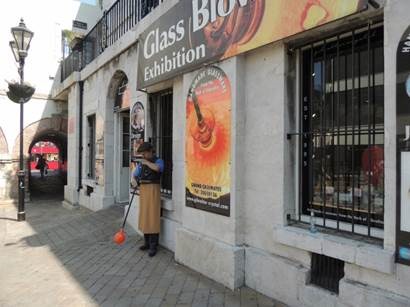
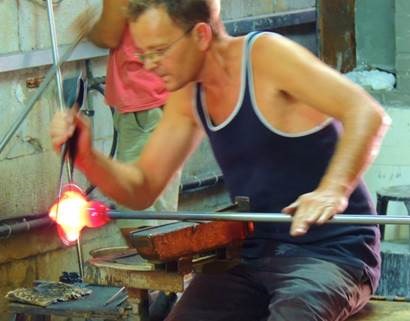
Gibraltar Crystal Factory and it’s glass blowing demonstration/exhibit

  I’ve seen this before where you could get a bit closer and see better so this was a bit disappointing.

The exhibit was free but the glass pieces in the show room….through which you were pointed to exit….were definitely not free. 

clip_image013

It must have started out as a blob of glass but was in the process of being made into a dolphin

clip_image014

clip_image015

Entry fee was 8 pounds = $12 US

None of us thought it worth it.  Sue and Ed were interested and Randal sort of did too.  I didn’t.  Perhaps if it had also been free… 

clip_image016

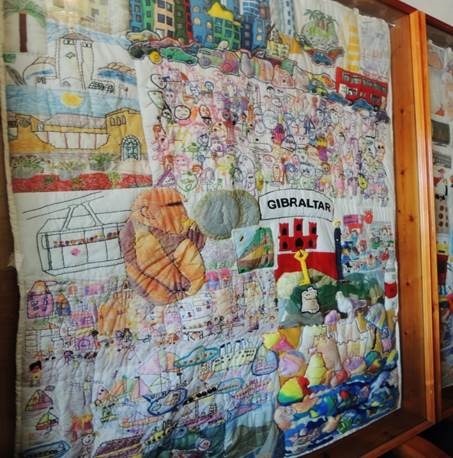
There was a quilt exhibit created using images drawn by school children to illustrate present day Gibraltar.  You can see the cable car to the top of The Rock and the famous Barbary Ape…maybe Scruffy.

clip_image017

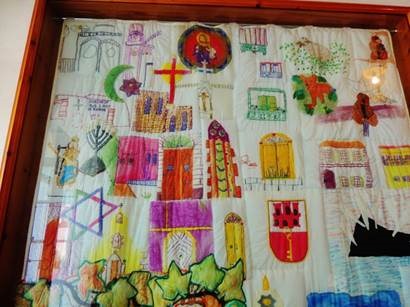
This quilt showed historic Gibraltar.

clip_image018

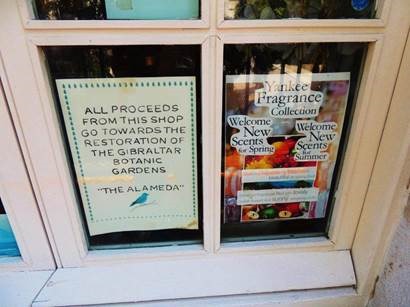
Come all the way to Gibraltar to find Yankee Candle!

clip_image019

I thought this was nice of them

clip_image020

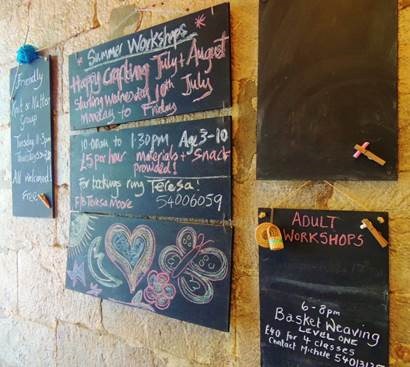
There was a “local crafts” shop that sold products rather than craft materials.  But classes were offered which makes me long to be somewhere finally where I can stay put and take a class.

Gibraltar 1

Hola,

  We left early this morning for a visit with Sue and Ed in Gibraltar.  As a break from Tunisian mosaics I thought I’d write a bit about Gibraltar and then when I’ve more photos I’ll write about La Linea.

And eventually I’ll catch up with Tunisia.

Ru

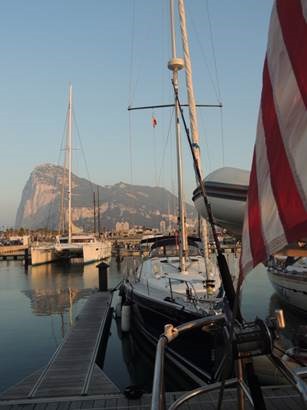
     The Rock of Gibraltar is the last thing we see at night and the first thing we see in the morning.  Sometimes it’s shrouded in fog.  Sometimes, as now at 7 pm it’s lit with bring sunlight.  Late at night, and it has to be really late as sunset is 9:30 pm, the Rock is lit from below so its rock-face shines.  One way or the other I hope we’ll get to the top before we leave.  The views are said to be wonderful. 

clip_image001

9 PM and bright and sunny still.  Screws up my sleeping as it’s hard to go to bed before 11 PM and hard to get up in the dark before 7 AM.  You can see the sunlight still reflecting off The Rock.

We haven’t actually seen much of La Linea or Gibraltar as we’ve been doing lots of boat work (Randal) and boat straightening and cleaning (me.)  And to add insult to injury Randal has a huge toe blister on the foot not afflicted with an awful heel spur.  It’s not feasible to put down our motorbike for our short stay so we might actually be prompted to invest in the purchase of a second bicycle.  We’ll see. 

We have been into Gibraltar twice as our friends Sue and Ed Kelly have their boat berthed in the Queensway Quay Marina.  Here are some photos of those two visits.

clip_image002

Crossing the border from Spain to Gibraltar and the runway that cuts across the road just as you enter Gibraltar. 

clip_image003

I just caught the plane as it was taking off at the far end.

It’s really no problem crossing the border either way.  At least for typical tourists like us.  You just hold up your passport and the kind smiling lady lets you walk through.  That is until today when “the British Grumpy Man” was there.  He asked me to open my passport which I did and then he sarcastically told me to open it to the picture page.  Like I actually look like that photo anymore.  I told him no one had ever asked for the passport never mind the photo page.  He made some comment about being British and having rules.  I should have told him that’s why we revolted; because of their bloody rules.  But I didn’t think of it and I would have lost any argument anyway as he had all the power and I had no phone to call my congressman to get me out of the fix.   

It was the second annoyance of the day.  We’d left our finger pier and walked to the main pedestrian marina gate, swiped our card and found that the gate wouldn’t open.  No way, no how.  Too early apparently though it was 8:20 am.  So we did what other folks had done and pushed the link fence outward around the gate and that was that.  We could have backtracked and walked out the way cars must go, but that was the long way round at that point.  At least we didn’t have to scream and yell and climb over anything.

The first time we went to visit Sue and Ed we walked the whole way which tool about 90 minutes.  This morning we walked to the border and took the red bus from the Gibraltar side to the small bus terminal in the city itself where we would wait for the number 1 blue bus which would take us to Queensway Quay Marina.  Or so we thought…..

clip_image004

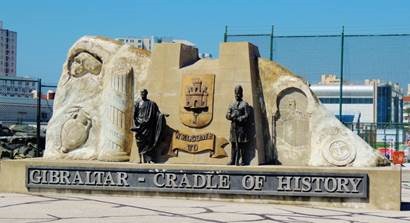
Monument at the entrance to Gibraltar just past the runway area.

clip_image005

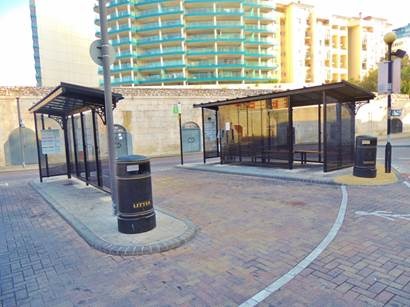
Market Place Bus stop

clip_image006

Senior Hopper fare.  Buy a ticket for 1.20 Pounds and ride all day: hop on and off anywhere. 

   We had just missed the 8:40 bus so had to wait for the 9:20 bus.  It turned out not to be a real bus with Stop buttons at each seat, but more like a large bus/van.  We asked others waiting if it was the bus to Queensway Quay and were told it was.  And that was correct.  According to the bus stop schedule posted, we opted to get off where it said  Queensway Quay thinking that it was to stop near the Queensway Quay Marina.  Wrong…. We went past the marina, down the road, up the hill until finally one of the other two passengers told us to tell the driver we needed to get off.  Luckily he also told us the short cut back down the hill/mountain so that it only took us about 10 minutes before we were at the Queensway Quay Marina.  We should have gotten off at King’s Wharf though that stop was on the opposite side of the road so we thought it only stopped there the other direction.
clip_image007

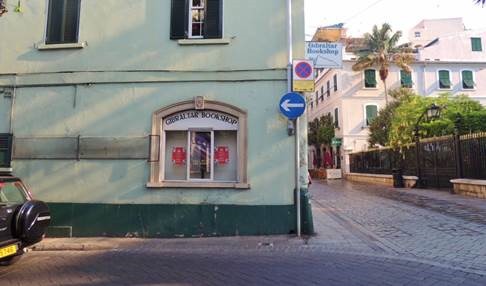
Gibraltar Bookshop

We passed here on our way to the marina but later passed by again with Sue and Ed so stopped in for a small Spanish/English dictionary. 
clip_image008

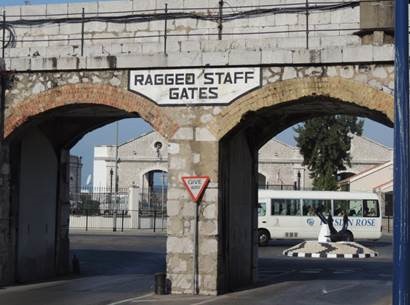
Lots of gates as these walls go on for miles.  I love the name of this one. 

clip_image009

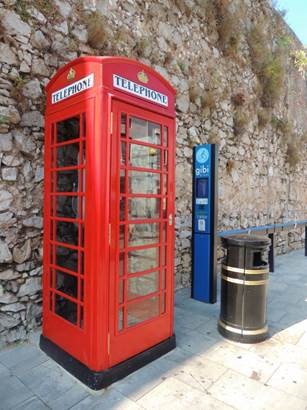
Just like England

clip_image010

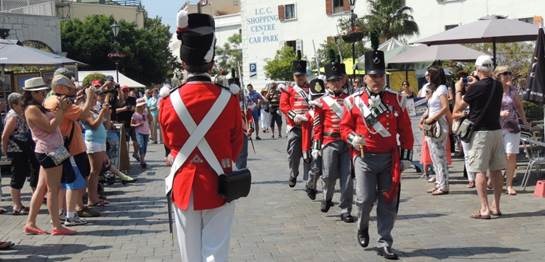
Just like England….

Contrary to page 156 of my book Color:A Natural History of the Palette by Victoria Finlay, the uniforms weren’t died red to hide the blood stains.

History of the British Uniform

     Red was the uniform colour adopted by the first permanent regiment of the British Army, the Yeoman of the Guard, (the Beefeaters), during the reign of Henry VIII.  In 1645, this colour was adopted when the first permanent army was raised.  Red was not used in order to hide blood stains.  Rather, every army adopted certain colours as their national colours.  French soldiers tended to wear blue; Russians wore green; British wore red.

     With the infantry wearing a bright red colour, with white crossbelts and shiny brass, weren’t they easier targets?  However, in the 1860s battle tactics were much different from those applied today.  Before 1866, British longarms were muzzle-loading weapons.  To load these weapons required a soldier to:

1) stand upright to load a gunpowder charge and bullet down into the muzzle.

2) get very close to the enemy in order to hit them, due to the inaccuracy of the musket.

3) stand close together for volley firing.

     It was the quantity of projectiles that mattered, not camouflage.

     By 1867, however, warfare and the times were changing.  With the advent of breech-loading rifles to the British Army in 1866, the

quality of small arms changed considerably.  Faster rates of fire,

from a much more accurate weapon, which could be loaded in the prone position, slowly began to change the tactical doctrine of the Army.  The change in tactics was not as swift as it might have been because during the last half of the 1800s, the British Army did not fight a modern, similarly equipped army.  In essence, the tactics used were ones that made sense with the older style of firearms; the tactics still had to evolve to take advantage of the newer weapons.

     It was surprising that the lessons of the new weapons recently

demonstrated in the American Civil War (1861– 1865) were not absorbed by the British.  Although most European nations had observers on both sides, lessons that should have been learned were dismissed, as it was felt that this war was an isolated case determined by a geography unlike any in Europe.  Further, it was deemed an `unseemly brawl between undisciplined armies.’

     It was not until the late 1800s that a Khaki uniform was issued, the British Army finally realizing that drab coloured uniforms provided better camouflage in response to more accurate, faster firing weapons using smokeless gunpowder.  Once again, tactics continued to lag behind and it took the carnage of the First World War to convince authorities that there was a requirement to seek cover and remain hidden as opposed to standing up in battle formations.  http://www.royalengineers.ca/HistBU.html

clip_image011

Unlike England

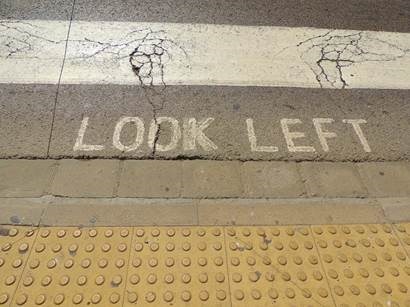
Cars here drive on the right as they do in the US so signs like these are for the unsuspecting Brits rather than for Americans who know which way to look.

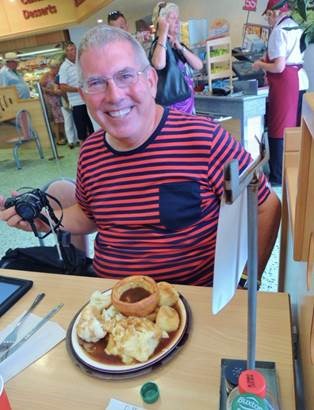
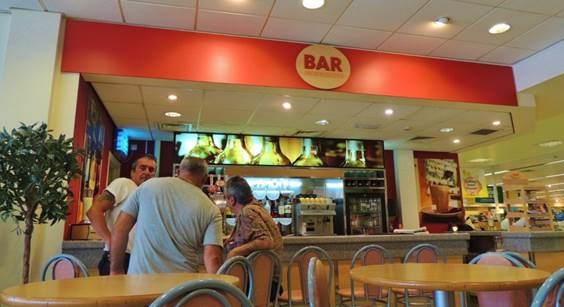
Morrisons is a huge supermarket on the Gibralter side.  (We have a really good one called Mercadona on our side in a really cute shopping/eating area.  More about that in another email.)  Morrisons has a cafeteria and it also has a BAR!  We ate there our first visit to Gibraltar.

clip_image012

Ed with his Yorkshire Pudding and beef and mash…

clip_image013

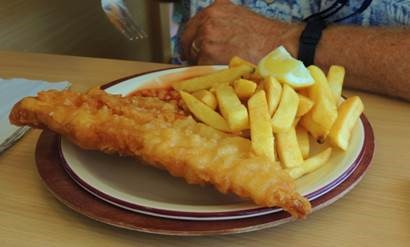
Randal had fish and chips which was good but he’s still partial to the  fish and chips at DEKS!

Funny that we even growing up we always called it fish and chips but every other time called the potatoes fries.  I just realized that.

clip_image014

The BAR at Morrisons with the same characters you’d find at any other bar. 

“On the Rock of Gibraltar, the past is a living reality. Colourful ceremonial events such as the Changing of the Guard and the Ceremony of the Keys are performed exactly as they have been for centuries.  In the Gibraltar Museum – strategically positioned over one of the finest fourteenth century Moorish bathhouses – you can find a series of fascinating exhibits from every period of the Rock’s extraordinary history. It is a story that begins at least as early as the Stone Age, the first Neanderthal skull ever discovered was found here in 1848.

     Since men first braved the sea, the Bay of Gibraltar has sheltered ships and sailors. To the ancient Greeks, Gibraltar marked the limit to the known world. To pass beyond it was to sail to certain destruction over the bottomless waterfall at the edge of the world. Thus the many findings of offerings made to the Gods by these and other civilizations such as the Phoenicians and Carthaginians in the many caves on the shorelines.

     Seven hundred years after the birth of Christ, the Arab leader Tarik-Ibn-Zeyad conquered the Rock and named it Jebel-Tarik (Tarik’s mountain). An important military and naval base, it changed hands many times during the following eight centuries of Arab occupation in Spain. In the early part of the fourteenth century Spanish forces occupied Gibraltar for twenty-four years; but in 1333 it reverted to Moorish control after a bloody eighteen week siege. The Rock did not finally become Spanish until 1462 when the Duke of Medina Sidonia recaptured it. The eighteenth century saw another change of ownership.  In July 1704, as he lay off Tetuan with a large combined fleet of British and Dutch warships, Admiral Sir George Rooke saw an opportunity to capture the Rock. The city fathers initially refused Rooke’s call to surrender but 15,000 rounds of shot and shell and landings by British marines and sailors persuaded them otherwise.

     Since that day, the Rock has played a part in some of the most famous episodes of British history. During the American War of Independence, the combined forces of France and Spain besieged Gibraltar for four and a half years. The body of Nelson, preserved in a barrel of rum*, was brought to Gibraltar after his magnificent victory at Trafalgar and in the Second World War the Rock was a key factor in British victories in the Mediterranean”.   http://www.visitgibraltar.gi/

*Nelson’s Blood

    There are several versions to the origins of another name associated with rum, Nelson’s Blood. Most people believe that after Admiral Horatio Lord Nelson was mortally wounded (see photo below to see the plaque showing where he fell) at the great battle of Trafalgar in 1805 that his body was was preserved in a barrel of rum or brandy for the long journey home to England.

     At the battle of Trafalgar Nelson engaged the combined fleets of France and Spain where he was well outnumbered. His smaller fleet of ships managed to sink or capture 17 of the enemy’s ships without a single loss of his own.

     This victory is considered one of the greatest naval victories of all-time. Unfortunately Nelson never lived to savour the taste of victory, for he was mortally wounded three hours before the end of the battle, but died knowing victory would be his.

     As legend would have us believe Nelson’s body was encased in a large barrel of rum for the long journey home in less than favourable winds. Nelson had requested that when he died he did not want to be buried at sea, which was common tradition, but would prefer to be buried in his birthplace of Burnham Thorpe, England, or if The King wished, in St.Paul’s Cathedral, London.

     During the long voyage home to England it was discovered that the barrel was almost empty of the rum that had been preserving Nelson’s body. It is believed that the sailors on-board the flagship H.M.S. Victory had drilled a small hole in the bottom of the cask and had been drinking the rum for good luck and praying they would inherit some of Nelson’s traits. The barrel was then topped up with French brandy and spirits and bought back to Greenwich where Nelson’s body was transferred to a coffin for the final journey to St.Paul’s Cathedral. This coffin was made from the mainmast of the captured French ship L’ Orient, a trophy from a previous battle. This coffin was then placed in a lead-cased elm coffin for the journey from Chatham to Greenwich, where it was put into a third and final state coffin, that was 6′ 8" long and 26" broad. It was covered in the finest Genoa black velvet, secured with over 10,000 double gilt nails.

     The term, drinking Nelson’s Blood is still used today by many sailors and has been especially adopted by Pusser’s Rum Company amongst others.  http://www.therumelier.com/id70.html

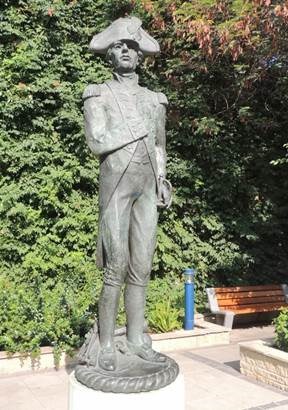
clip_image015

Lord Nelson

http://www.jewishgibraltar.com/synagogues.php is a site concerning the history and current life of Jews in Gibraltar

Scruffy by Paul Gallico  (a book about the Barbary Apes of Gibraltar)

    Paul Gallico writes: “There is one demonstrable fact in this otherwise total work of fiction and that is on the 25th August, 1944, the Prime Minister, Winston Churchill, caused a signal to be sent to Gibraltar expressing anxiety over disquieting rumours concerning the welfare of the Barbary apes established there, and directing that every effort should be made to restore the dwindling number of apes to twenty-four, and that this number should be maintained thereafter. So much for truth. All that follows is nothing but the wildest imagination.”

    From this lurid imagining Paul Gallico has produced Scruffy, the ugliest, nastiest-tempered, roughest old villain of a Barbary ape. The story contains all the fertility of Gallico’s invention, sparked by his love for the British and their odd ways, his understanding of animals, maiden ladies, young lovers, choleric Brigadiers, phychologists doubling as intelligence officers, and prang-prone R.A.F. pilots. It is a unique entertainment written with the inimitable Gallico touch; and renders the unbearable Scruffy the most lovable ape of your acquaintance.  ISBN: 0860090264

Top of Form

Bottom of Form

Rising and setting times for the Sun in Gibraltar

Length of day

Solar noon

Date

Sunrise

Sunset

This day

Difference

Time

Altitude

Distance

(million km)

20 Jul 2013

07:19

21:36

14h 16m 26s

− 1m 19s

14:28

74.4°

151.997

21 Jul 2013

07:20

21:35

14h 15m 05s

− 1m 21s

14:28

74.2°

151.986

22 Jul 2013

07:21

21:35

14h 13m 41s

− 1m 23s

14:28

74.0°

151.973

23 Jul 2013

07:22

21:34

14h 12m 15s

− 1m 25s

14:28

73.8°

151.961

24 Jul 2013

07:22

21:33

14h 10m 47s

− 1m 27s

14:28

73.6°

151.948

25 Jul 2013

07:23

21:32

14h 09m 18s

− 1m 29s

14:28

73.4°

151.934

26 Jul 2013

07:24

21:32

14h 07m 47s

− 1m 31s

14:28

73.2°

151.920

http://www.timeanddate.com/worldclock/astronomy.html?n=89

Tunisia 3 Belgacem Abderrazak Mosaic artist of Eljem

Hola,

   Travelling west as we have been doing you’re never quite sure what time it is.  On our final full day of sailing I looked up to see the sun directly overhead but our clock said 3  PM.  When we arrived in La Linea we had to put the clocks ahead 2 hours…something to do with UTC time and Daylight Savings Time.  It was quite disconcerting but it meant we could go to sleep 2 hours earlier than usual.  We had been standing watches on and off for 6 days and nights so our time clocks were off anyway.  Today we woke up 7:15 am La Linea time to cool dampness.  Lots of fog outside: The Rock of G was totally hidden. Lots of fog inside my head too…I think I’ll be a bit off until my internal time clock is fully reset.   We have boat work to do before we take off for any land travel.  Seville is what we’re thinking but we’ll see. 

  Ru

The American League won the All-Star Game for a change.  Maybe that will benefit the Red Sox come World Series time.  One can only hope!

Belgacem Abderrazak  Mosaic artist of Eljem  referred to as AB

Our friends Eileen and George in the US and Jo and Mick in Port Yasmine all recommended we visit El Jem for the coliseum and the mosaics.  They were certainly correct!  But we also made a friend and spent several interesting hours with him at his shop, atelier ( as they call studio workshops in Tunisia) and his favorite restaurant conveniently located next to his atelier. 

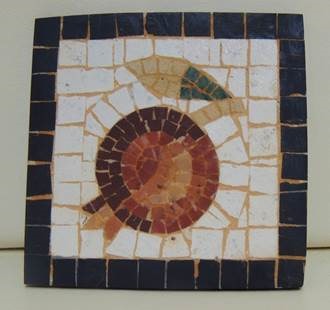
   During our first visit to El Jem we toured the coliseum and the mosaic museum.  But we also visited several mosaic shops and discovered the one of Belgacem Abderrazak.  We spent a good deal of time looking at everything and finally settled on mosaic letters for DORAMAC and a small pomegranate mosaic for me.

clip_image001

My pomegranate mosaic

“Called Granada in Spanish and grenade in French, the pomegranate gives its name to the city of Granada, the drink Grenadine and the grenade because of its shape.”  Info from our friend Roy Moulton

When Randal was selecting the letters he realized the space where the M should be was empty.  But the very helpful shop woman called AB and he came on his motorbike to bring us one.  That’s how we first met

clip_image002

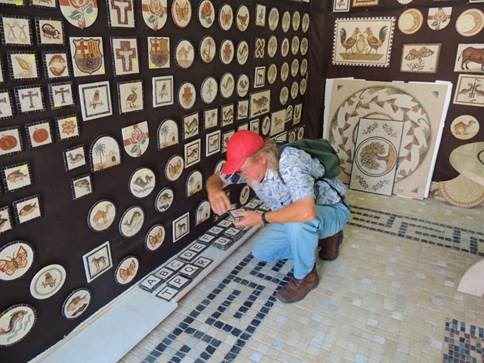
Selecting the letters

clip_image003

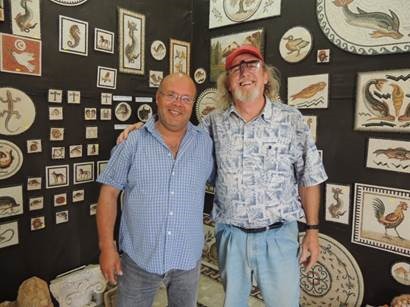
Belgacem Abderrazak   and Randal

clip_image004

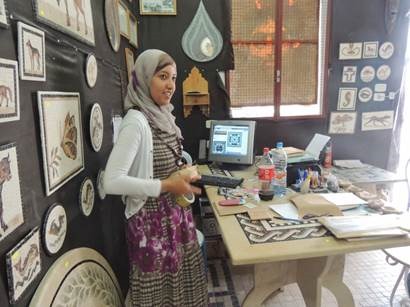
Very helpful woman who runs the shop.

She, thankfully, could understand my bits of French mixed with bits of English

clip_image005

Randal couldn’t resist so we bought this mosaic our second visit.

  It was also during our second visit that we were invited to AB’s atilier just outside of town. 

clip_image006

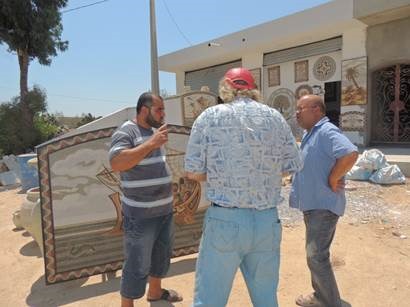
I can’t believe I didn’ take a better photo of the mosaic behind the men as there’s a funny story behind it that you’ll read later during our visit to The Bardo Museum in Tunis.  The man in stripes , his friend from the restaurant next door, speaks English the way I speak French…but between us we could help the conversation somewhat.

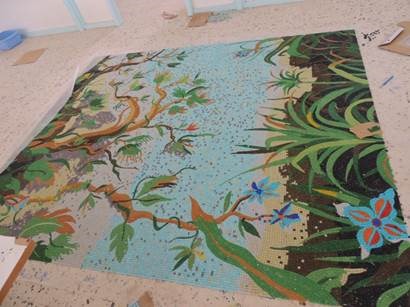
clip_image007clip_image008

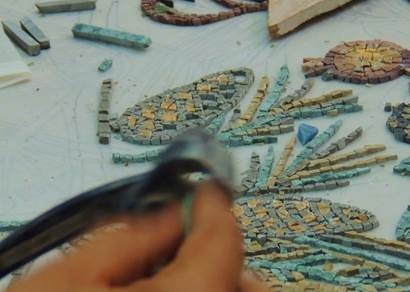
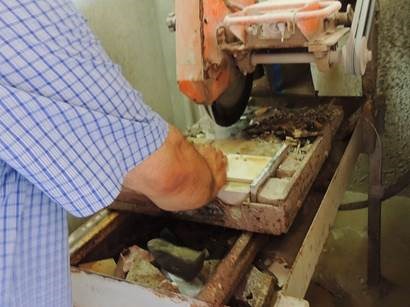
Selecting and cutting pieces to make the correct size and shape; the tool looks almost the same as what blacksmiths use to trip horse hooves.

clip_image009

Laying out the pieces (like puzzle pieces) over the design pattern which will include a pomegranate.

clip_image010

AB was really patient explaining the craft to Randal through their shared language; mosaic.

clip_image011

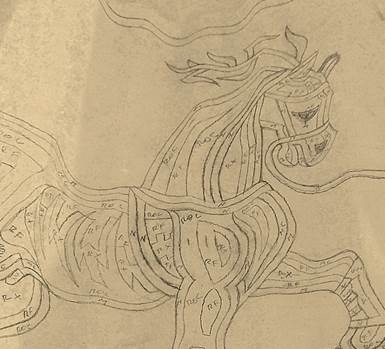
Pattern of a horse for a future mosaic

clip_image012

clip_image013

In ancient times beeswax was used to protect the mosaic; now it’s beeswax and petrol

clip_image014

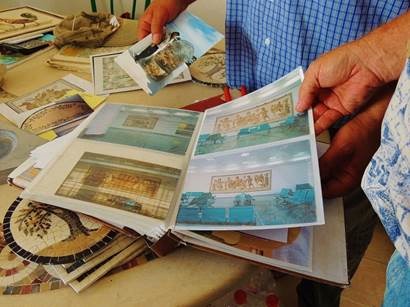
AB’s commissioned mosaics around Tunisia and the world; hotels, embassies….

clip_image015

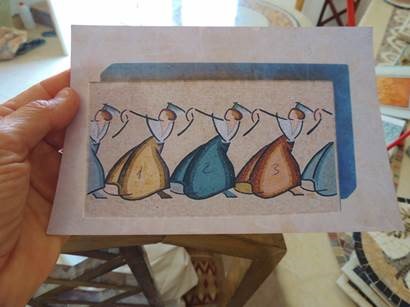
This was part of a mosaic commissioned by a man in France which made me think of the song:  “Sur le pont d’Avignon l’on y danse l’on y danse. Sur le pont d’Avignon l’on y danse tout en rond.”

http://www.mamalisa.com/ tells the story of the bridge.

When I started singing it, AB smiled because, of course, he speaks French and maybe this was commissioned to go with the song.  He also explained to us that when he created a modern mosaic of his own design he signed his full name in Arabic and in English letters.  For mosaics of ancient images he just signed his name in English letters. 

clip_image016

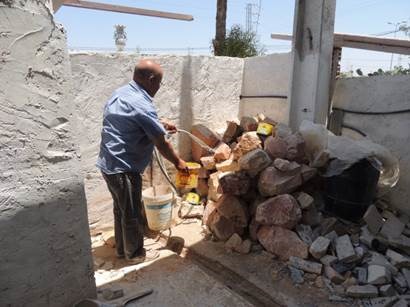
Big pieces of stone that will become tiny mosaic pieces.

AB was washing the dust off to show us the colors

clip_image017

After they were broken up, smaller pieces were piled outside the cutting room.

clip_image018

Scary!!!

Watching AB cut some of the stone with no guards to keep his hands from being chopped off.

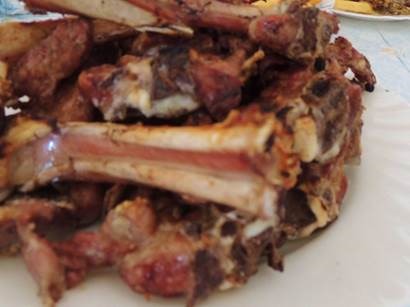
After our tour we drove AB back to his shop in town and his motorbike.  We invited him to come for lunch with us.  He smiled and said he knew a better place with fresher food and not touristy.  So back into the car to the restaurant next to his workshop.  If you’ve ever picked your lobster or even just visited the meat counter at Kroger or Shaws, you shouldn’t shudder at restaurants in Tunisia where you pick your sheep.  Funny how we have a much harder time eating a food that comes from a cute wooly animal than one with pinching claws or no face at ll; like clams or mussels.  We had a foreign business etiquette book in the Reference Dept back at RCPL.  One suggestion was, “Slice thinly, chew slowly, swallow quickly.”   And it’s not as if I’d never eaten ribs before…..

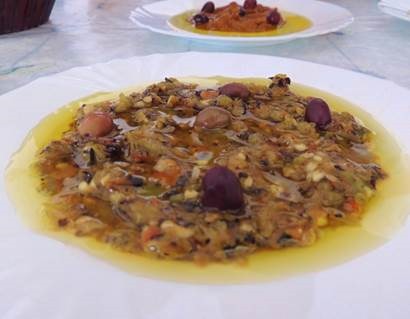
Fresh bread, chopped bell pepper caviar like my mom used to make,  harissa — seasoned chili paste with olive oil (often served with mayo to take up some of the heat!) and barbequed lamb ribs.  You ordered your meat by weight….  Of course barbequed anything tastes good and so did the lamb ribs….

clip_image019

clip_image020

clip_image021

clip_image022

Tunisia 2

Same date, place etc…Ru

Tunisia # 2

clip_image001

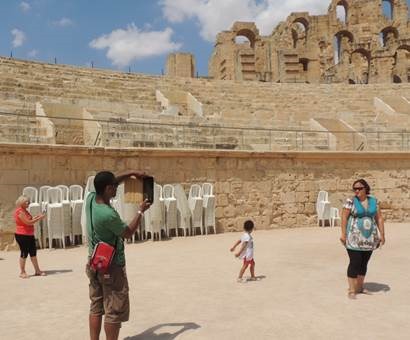
Both the lady in orange and the man in green were taking photos with their tablet.

clip_image002

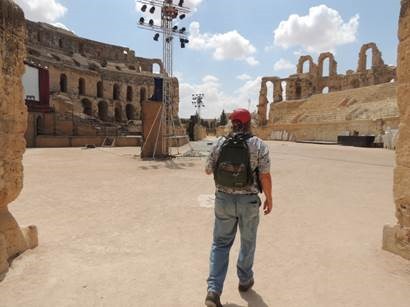
Down one level

clip_image003

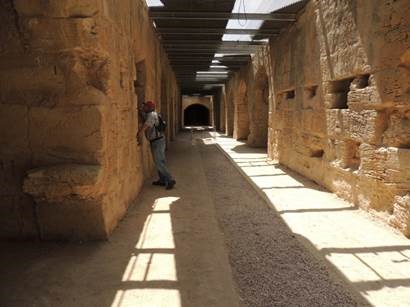
Looking up from below and waiting to get eaten by a lion. 

The Romans may have given us much good, but they also gave us this horror show.

clip_image004

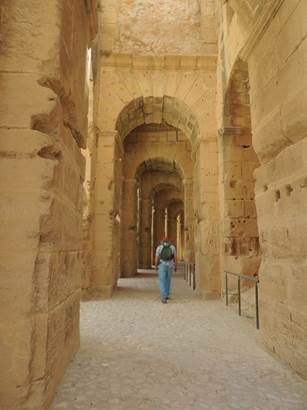
Going up to the bleacher seats.

It really reminded me of walking through Salem Stadium to sit and watch the Salem Red Sox

clip_image005

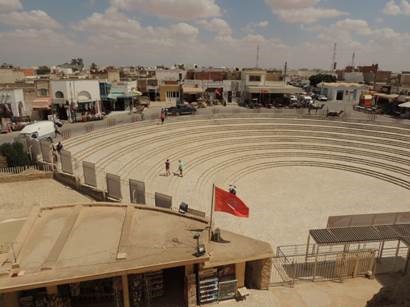
View of the shops surrounding the entrance to the coliseum

clip_image006

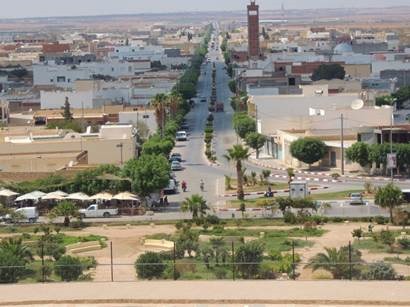
The Roman road leading to the coliseum

clip_image007

We saw this cut in many of the blocks possibly used to lift and move them.  That’s a guess.

clip_image008

Purchasing videos about Tunisia and the Bardo Museum in Tunis

clip_image009

We did some mosaic shopping in el Jem but that’s a whole story in itself so I’m skipping it for now.  From the coliseum we went to the El Jem Museum.  When Randal tried to pay we were asked if we’d visited the Coliseum.  When Randal said yes, the young man told him one ticket was for both so wouldn’t take our money even the 1 dinar charged for taking photos.  The total cost or our visits to both the Coliseum and the El Jem museum was 21 dinar = $14 which was totally worth it. 

clip_image010

El Jem Museum

This is the first room you enter and you’re immediately wowed by the beauty and condition of the mosaics.  Most were once floor mosaics and have been brought to this former home, now museum.  When you look at the patterns you must remember that as with carpets the images are too be looked down on from different parts of the room. 

clip_image011

clip_image012

Our guide in the Bardo museum in Tunis referred to the same image as the Star of David.  The huge entire mosaic book Randal bought ignored it altogether though it did have some pages on Christian themed mosaics.

clip_image013

It was like looking at tapestries, the patterns were so intricate.

You could absolutely imagine these as “carpets” similar to the carpets we saw in India, Turkey, and Tunisia.

clip_image014

Randal, “Spirit of the Year”  and the Four Seasons…

The 4 seasons are the same woman with each image getting progressively older representing Spring, Summer, Fall and Winter.

clip_image015

This one too ould be mistaken for a woven carpet

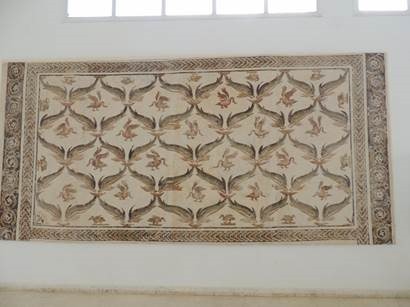
Dolphin and swans; each mosaic had an explanation with it so you could have spent hours looking and reading about all of the imagery.

clip_image016

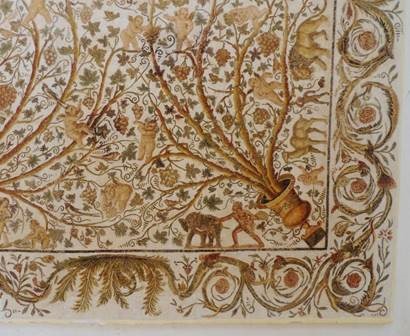
Corner detail shows the details in the designs.

clip_image017

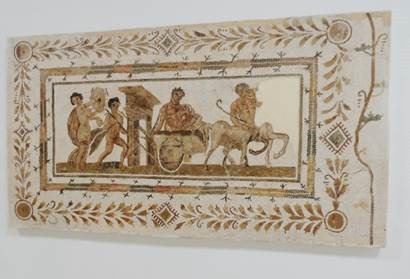
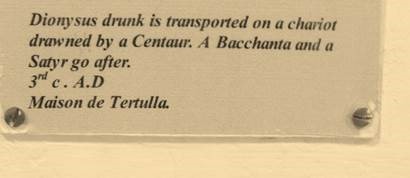
Dionysus/Bacchus features heavily in these mosaics

clip_image018

clip_image019

The original : this image is copied by many of the Tunisian mosaicists

clip_image020

If this were a less grim image it would make me think it came from Where the Wild Things Are by Maurice Sendak.  Wonder if he studied mosaics for some of his images. 

clip_image021

Nice happy bunny mosaic.

You can certainly learn a lot about illustration studying mosaics.

We left El Jem the first time aiming for Sfax as our overnight stop, the plan being to get up early the next day, leave Sfax and drive to Djerba where we would spend the night.  We did finally find a hotel in Sfax.  It was clean enough, more than it was worth, but we had no other option as we’d made no plan ahead of time not knowing actually where we’d spend the night.  We’d hoped to be further along the road to Djerba, but we’d had too good of a time in El Jem so left late in the day.

clip_image022 clip_image023

Hotel Al-Rachid in Sfax with a view of the sun set over concrete

clip_image024

Our less than luxurious room.  But it had wifi, AC, was safe and quiet.  And the shower was hot.  The staff was very nice too.

clip_image025

Finding food.

Hotels don’t start to serve dinner until about 8 pm and we were hungry by 7 pm after an early light lunch in El Jem.  But there was not much around our hotel so we ate in this little local joint down the road a block.  We had Tunisian salad, grilled chicken, fries, bread and some water.  It was fine.  Tunisian salad is like Greek salad without the cheese.  But usually it has tuna with it and this one also had rice.  If you read French or Arabic you could order from the menu.  I know enough French to order a few things combined with the café guy’s bits of English.  Aqua with gas was a stumper.  But they didn’t have any anyway so I had plain bottled water and Randal had regular Coke, no Coke Light, Zero or Diet being available. 

clip_image026

We probably could have taken a taxi to an upscale restaurant and paid more money for grilled chicken but we were too tired and this was just fine.  And kind of fun.

Tunisia part one

Hola ( which I learned from Sue Kelly is pronounced Ola and not Hola which I’d have known if I’d thought about it. 

    Our friends Sue and Ed Kelly and their Iowa friend Norm walked over from their marina in Gibraltar to visit us this afternoon and show us how to cross the border.  No problem there; just walk one way from Spain to Gibraltar and the way back from Gibraltar to Spain.  We’ll go back to visit them tomorrow and see their marina which was booked up so we came to Spain instead.  Sue and Ed are also heading to Saint Cat’s Dock in London.  They were there last year and it was their enthusiasm that convinced us and then our enthusiasm that convinced them to go back.  So we’ll be seeing them on and off on our way to London. 

   This email is the first of several about our trip to Tunisia. 

Ru

clip_image001

Rock of Gibraltar seen from DoraMac  

Remember the TV show Wild Kingdom?  Revered Ken emailed me mentioning Prudential Insurance which had the Rock as a logo but I remembered The Rock of Gibraltar from Wild Kingdom and that was Mutual of Omaha. I needed to check myself and found this confirmation. 

   “ When passing through the Straights of Gibraltar I could hear the radio and early TV voice of zoologist Marlin Perkins (1905–1986). I remember how excited I got as a lad to hear the Mutual of Omaha Insurance Company Rock of Gibraltar ad, which led me to many fascinating animal adventures. After the commercial, Perkins would pause with so pregnant a moment of anticipation that I would catch my breath and wait to be tantalized by the Wild Kingdom drama about to unfold.”

http://www.rrecord.com/-news/2012/2-2-12/church1.asp

Sue, Ed and Norm spent 5 hours hiking up and down.  I’m hoping to talk Randal into going too.  He wants the cable car so we might have to ride one way and walk the other.

Ru

DoraMac

Tunisia

For us Tunisia really was just a fuel stop on our way to other places. Randal wanted to see its famed mosaics and I’d hoped to see the oldest synagogue in Africa.  And I was looking forward to its difference from Greece and Sicily.  So many people we know have really enjoyed their time in Tunisia.  Well we definitely filled up with diesel fuel: over 5000 litres worth.  And we had a wonderful mosaics experience.  We didn’t make it to Djerba Island to see the synagogue as it was too long a drive for the short time we had.  And we missed the Medina and Grande Synagogue in Tunis as well as the American military cemetery in Carthage.  We took a deliberate pass on Sidi bou Said which was like visiting Provincetown, MA in the summer.  Too many people in too small of a space.  I’m sure when artists Paul Klee, Kandinsky,  Matisse, August Macke and Louis Millliet journeyed there in the early 20th century it was a much different Tunisia than we saw.  It was only in the small places like El Jem and a road side village market that we saw an “not tourist” and more interesting (for us) Tunisian way of life.  If it were all changing for the better then that would be a good thing.  But many folks whom we spoke with didn’t see it that way.  The revolution’s promised changes don’t seem to be reaching everyone.  And the tourist boom seems largely to be benefitting huge “all inclusive” hotels so small local restaurants and cafes lose out.  We’d heard complaints about “all inclusive” in North Cyprus and Turkey also.  I have to say that I knew nothing about Tunisia when we arrived there and learned very little from our stay.  I bought 4 Tunisia books through Kindle.  Two were too dumb for words and I’ve no idea yet what they’re about…..some 20 something male finding himself…in Tunisia.  The blurb made it sound more as if Tunisia was the subject of the book and not the author’s ego.  One book was about travels pre WW 2 with all of the stereotypes one found in those years.  But he at least wrote about Tunisia.  One was a not great Tunisia Guide.  The most useful information came from friends who’d been there which was why we visited El Jem.

We did meet individual merchants who were quite wonderful.   And between the mosaics and books/videos about mosaics Randal picked and the small pomegranate mosaic, the village market terracotta pitcher, a woven straw baskets and the El Jem Berber rug I chose, we left a great many dinars behind in Tunisia.  Plus paying for all of that fuel!  So Tunisia did well by us.  

Our complaints were with the really pushy hawkers who make me refuse to stop and look.  And with the customs/police officials who suggested that we might like to give them a gift.  We suggested that we would not like to give them a gift and they did take NO for an answer.  That was not our first experience with “gift seeking” harbor officials.  Hopefully it will be our last.  Tunisia charges no entry fees as other countries do.  If their officials are so poor they must ask for gifts, I wish Tunisia would charge harbor fees and pay the officials more.  Or have the money filter down so small five year old kids didn’t have to go around selling tiny jasmine flowers for hours.  Mostly we encountered totally honest people.  I had no problem holding out a handful of changes and letting the grocery store clerk or the veggies stand man take the amount needed.  I think Tunisia is definitely worth a visit.  Just plan for at least 10 days or 2 weeks to really see something of the country.

clip_image002

A missed road sign can be a good thing!  El Fath Tunisie Marbre

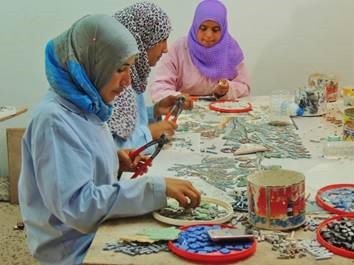
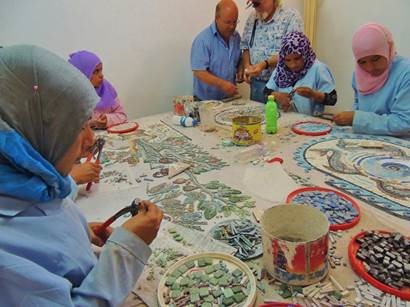
    This is the first mosaic workshop we visited just past the turn off to El Jem which we’d missed.  The staff were kind enough to give us a tour.  It was here we first noticed that most of the mosaics are assembled by women.  Not necessarily designed by women, but they are the ones who put the puzzle together following the pattern created by the artist.  Sometimes the artists use ancient Roman images and sometimes they create new contemporary designs.

clip_image003

El Fath Tunisie Marbre Mosaics display

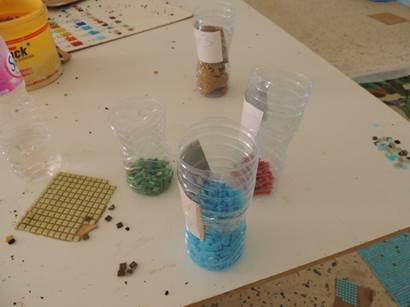
Huge boulders  become smaller rocks which become small oblong stick which get cut into mosaic pieces.

clip_image004

Ladies working on a contemporary mosaic  made from glass pieces

clip_image005

A finished mosaic

clip_image006

Glass pieces for the mosaic in progress

clip_image007

Randal ever the mosaic student

clip_image008

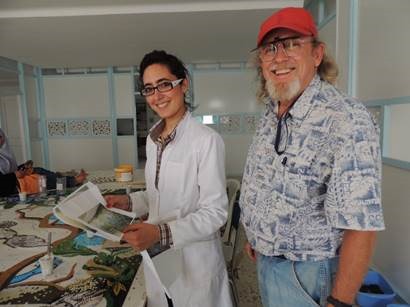
Artist/teacher  and  student : Naceur Bouslah  with Randal

I was especially pleased to see a woman as the artist.

clip_image009

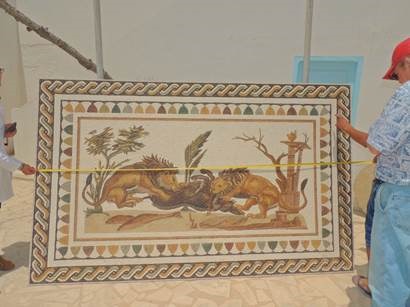
Hungry lions

We saw this image in most mosaic shops but saw the original in the mosaic museum in El Jem

clip_image010

Following the artist’s pattern on this plate

clip_image011

Recycled bits

Left over or broken bits were used to create this contemporary piece which I quite liked.

clip_image012

Lunch with parking…

Just near the coliseum in El Jem hawkers point to parking spaces where you may park if you pay them in dinar one way or the other.  Buy food, souvenirs ….  We opted to park and pay for lunch.  It was actually quite good: omelette, fries, salad with tuna, bread and mint tea for me.  And there was a WC.

clip_image013

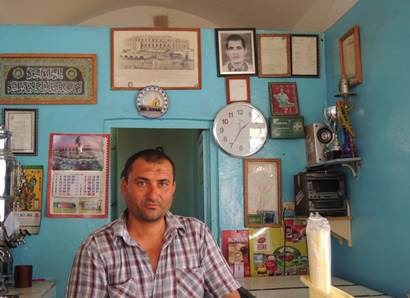
Father and son café: the son.

The black and white photo is his dad.

clip_image014

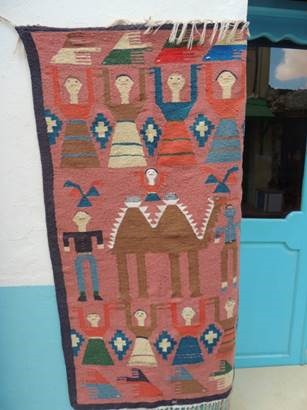
A Berber Kilim hanging outside a shop in El Jem.  Now it’s on DoraMac!

I actually passed it up the first time we were in El Jem as the shop was closed.  But luckily for me, the shop was open our second visit to El Jem, so I bought it.  The shop owner had a “new one” in the with his other carpets but I liked the faces on this one better.  From what I’ve read the colors and patterns are traditional Berber.  The wool seems never to have been carded so it is quite scratchy.  I think it will be a wall hanging somewhere one day. 

     “In contrast, the indigenous rural Berber women have a tradition of weaving short-nap, flat weave rugs or tapestries; their products fall into two categories; mergum or mergoum, which are woven and  embroidered and kilim or klim which are only woven.  The “Mergoum” and “Klim” are characterized by the combination of two simple geometrical patterns, the lozenge (or diamond shape) and the triangle. 

     Berber designs from the south of Tunisia also incorporate animal figures — most often camels. Contemporary urban, mechanized weaving is more the domain of men.

http://www.ibike.org/africaguide/textile/textile2.htm

     “The Kilim has gone through a specific evolution in the area of the city of EL JEM, located at the centre of Tunisia. Originally, it was a plain cloth made of single-tint coloured strips and was used as a ground carpet. By and by, it was enriched with a decoration. It is now commonly made of wide strips, for longitudinal edges, bearing triangular and lozenge motifs; such strips surround a surface ornamented with horizontal strips which would be organized in a symmetrical manner on both sides of a central strip which is a little wider than the others. Set on a red background, motifs and strips are green, orange, black or white; they are obtained thanks to a technique based on a compromise between double-sided weaving and one-side weaving.” http://www.tunisartex.com/eng/produits.asp

clip_image015

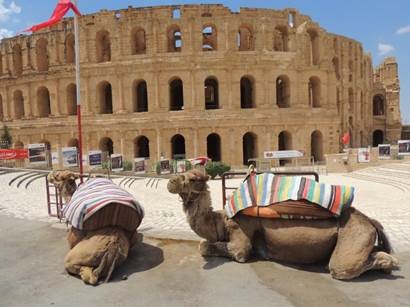
The coliseum in El Jem with the sweetest faced camels I’ve ever seen.  When we walked by they actually looked as if they wanted to speak to us.  I restrained myself from going to pat them as the owner mightn’t have been pleased and perhaps maybe not the camel either.

clip_image016

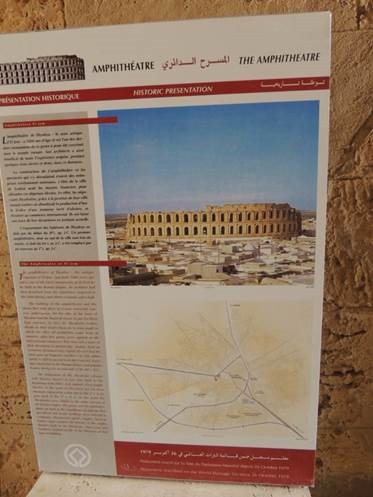
Poster outside the coliseum

     “The Amphitheatre of El Jem bears outstanding witness to Roman architecture, notably monuments built for spectator events, in Africa. Located in a plain in the centre of Tunisia, this amphitheatre is built entirely of stone blocks, with no foundations and free-standing.  In this respect it is modelled on the Coliseum of Rome without being an exact copy of the Flavian construction. Its size (big axis of 148 metres and small axis 122 metres) and its capacity (judged to be 35,000 spectators) make it without a doubt among the largest amphitheatres in the world. Its facade comprises three levels of arcades of Corinthian or composite style. Inside, the monument has conserved most of the supporting infrastructure for the tiered seating. The wall of the podium, the arena and the underground passages are practically intact. This architectural and artistic creation built around 238 AD, constitutes an important milestone in the comprehension of the history of Roman Africa. The Amphitheatre of El Jem also bears witness to the prosperity of the small city of Thysdrus (current El Jem) at the time of the Roman Empire.

     Criterion (iv): The Amphitheatre of El Jem is one of the rare monuments of its kind and unique in Africa, which is not built against a hillside, but on flat ground and supported by a complex system of arches. The monument of El Jem is one of the most accomplished examples of Roman architecture of an amphitheatre, almost equal to that of the Coliseum of Rome.”   http://whc.unesco.org/en/list/38

http://www.africanworldheritagesites.org/

clip_image017

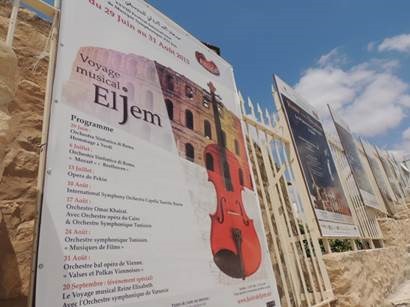
Modern performances in an ancient coliseum  must be spectacular to see (especially as no one is being eaten by a lion.)

clip_image018

clip_image019

In Spain; In Spain

Hola,

  We arrived in Spain early this morning after the fastest, calmest (weather wise) passage we’ve had in ages.  We actually had to slow the boat down so as not to arrive here before daylight.  We’d hoped to have gotten into one of the Gibraltar marinas but they were full up.  We are just across the border at the foot of the ROCK.  I promise photos soon and the stories of Tunisia.

  We must go off and find Customs and Immigration and maybe try to make it to the Queensway Quay Marina in Gibraltar where our friends Sue and Ed Kelly did manage to get a berth.  They were here weeks ahead of us proving the early bird gets the birth.  Or the early Angel Louise. 

  The good thing about this marina is that we are alongside a finger pier so no need for the passerelle.  I have to say when the dock is close and level even that’s not a problem.

  So I’m pooped after our 6 night passage.  I promise more soon.

Ru

Licata Part 2 Sunday morning walk with Linda

Asalama,

  Ramadan began yesterday evening at sundown.  •"Kul ‘am wa enta bi-khair!"  ("May every year find you in good health!")

We are getting everything ship shape and it seems we’ll be aiming for Spain just across from Gibraltar.  We will leave either tomorrow mid-day or Thursday.  It’s a 6 day trip, the longest of our passage to London so far. 

    I am off to Bravo, the small grocery store a few blocks from the marina.  The options are limited but they do have some fruit and eggs.  We can survive on PB and J and tuna so no problem there as long as I have some fruit and veggies.

  One more email about Licata then I’ll begin to write about Tunisia

  Ru

  It was great having Linda and Frank at the marina in Licata.  Not only did we travel together to Palermo, but one morning Linda and I went off to explore Licata.  Wish we’d met earlier in our stay there.  We also traded dinners on each other’s boats.  They were leaving Licata on their way to cross the Atlantic and then go on to the Caribbean.

Our first stop was the Church of Santa Maria Nuova . It’s hard to find in depth information in English about Licata so I can’t verify the story about the “black Jesus” having been blackened by fire.  Some of you out there still working in libraries might see what you can find and let me know.  It does make a good story but I’d prefer a true story. 

“A visit to Licata can start from the Mother Church, completed in the early 16th century in the Renaissance style. The church has three naves with a transept, and was called "Santa Maria La Nuova", to distinguish it from the old Cathedral. The dome was painted by Raffaele Politi (1783-1870).

Among the paintings in the church, many are by Fra’ Felice da Sambuca (1733-1805). The altarpiece depicting the "Nativity of the Virgin and the Saints Peter and Paul and an Angel” is by an anonymous Flemish artist and dates from the first half of the 17th century. In the right chapel is a wooden Crucifix dating to the 15th century, the so-called "Black Crucifix"*.

* The “Black Crucifix” is a 15th century work by artists from Messina. It became black after the Turks sacked the town and burned the church – the crucifix itself was not burned but was blackened by the fire.”

http://www.italythisway.com/places/licata.php

clip_image001

The painted ceiling of the main church

clip_image002

clip_image003

Trompe L’oeil

clip_image004clip_image005

clip_image006

Chapel of the Black Christ

I think the sign says it was made by local artisans between the 17th and 18th  centuries  by local craftsmen but the website says 15th century made by artisans in Messina on the north east coast.

clip_image007

clip_image008

A contemporary artist working from postcards and a magnifying glass

clip_image009

I wish I’d have liked his work well enough to have bought one; but I didn’t.

clip_image010

Walking to the top of the hill to The Church of Maria SS di Pompei and Castel Sant’Angelo

“Castlel Sant’Angelo (the late sixteenth built as a fortification for the sight where you can see much of the coast.”

clip_image011

Almost at the church

clip_image012

clip_image013

The church was closed unfortunately as whomever this is had an appointment in town.   He did tell us the short cut behind the church to the castle.

clip_image014

clip_image015

Info only in Italian.

In July 1553 the city was plundered and destroyed by the pirate Dragut, causing its decision to erect defensive walls and a tower on the Sant’Angelo hills. http://www.initalytoday.com/sicily/licata/

Licata   decayed   under   the Saracens but flourished under the Norman, guarded by the "Limpiados" sea fort, the third one in Sicily. In 1392Licata became a demesnal town and Frederick   II   called   it   "Urbs Dilettissima". In 1542 an earthquake destroyed the town walls. In 1615 the third  castle  was  built  on  Monte Sant’Angelo. In 1943 the Americans landed at Licata, starling the conquest of  Sicily.  On the Sant’Angelo hill in addition to the Castle there is a hypogean  sanctuary and a prehistoric necropolis. http://happening.kalat.org/?q=en/node/187#sthash.WC7pPgxA.dpuf

clip_image016

clip_image017

clip_image018

clip_image019

Linda did her “my momma was born in…and my poppa was born in….so we got a special tour, cold water and hot strong coffee.

clip_image020

Linda swapping stories with the staff of the Fort.

clip_image021

Looking down from the  ramparts.

clip_image022

Views from the fort: the huge Licata cemetery and the old harbor.

clip_image023

Resting before heading down from the fort to the cemetery.

clip_image024

This cemetery worker couldn’t recall seeing the family names Linda asked about.

clip_image025

It was a huge cemetery

clip_image026

Our friend Lee Licata said anyone with the last name Licata probably had family from Licata

clip_image027

Putting up a new head stone.

While hunting around for info about the Church of Maria di Pompei I found this website.  http://www.conigliofamily.com/LaSocieta.htm  shows a picture of America’s immigrant story linking Licata to Buffalo, New York.