Hi All,
I could blame it on bad eyesight but I really have no excuse. Elizabeth was only 9 years older than her husband… at least I think.
Ru

Hi All,
I could blame it on bad eyesight but I really have no excuse. Elizabeth was only 9 years older than her husband… at least I think.
Ru
Cheers,
First I want to thank those of you who have posted in response to my Facebook posting. I normally don’t post on Facebook, but as no good deed goes unpunished…. One of my former co-workers has in the past had technology projects that need participants. When she sent me that Facebook plea, I thought it was part of a project she needed to do. Wrong! I emailed her to ask about it once I started getting email notices about Facebook postings…. This is her response.
That’s too funny about the Facebook request! I only did it because ……had posted it to her wall, and I know she’s kind of new to FB, so I answered it because it sounded so sad ("Nobody ever reads this…"). Then I saw that you’re supposed to re-post on your own wall. I usually ignore these kinds of things! HA!
So that’s what happened. I have no clue how to use Facebook and now it’s especially evident that I should just stick to our website and email and that’s about it. To quote my “not to be named pal, HA !!”
Now for this email about St. Mary at Hill which I’ve been calling St. Mary on Hill. I’ve had a lovely time revisiting the church and learning lots about it. I’d planned to include St Dunstan in the East with this email, but it’s already so long and overloaded that I’ll stop now. I can’t wait to start in on St Dunstan; who knows what I’ll learn about that.
Ru
St Dunstan in the Eanst and St. Mary-At- Hill and Lovat Lane
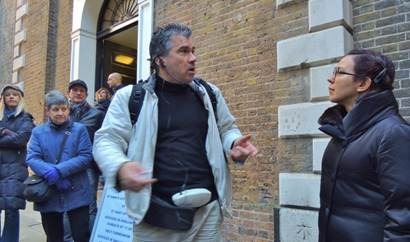
We visited St Mary’s on Hill St. and St. Dunstan in the East during our Square Mile walk with www.walks.com . They were actually the 2nd and 3rd stops on the walk after our visit to The Monument to the Great Fire. Simon, our guide, would talk about the church history; its relation to The Great Fire, rebuilding by Christopher Wren and its survival through or destruction from bombings during WW 2. As usual I half-listened while taking lots of photos. This week I revisited both St. Mary’s on Hill and St Dunstan to “get the rest of the story.”
|
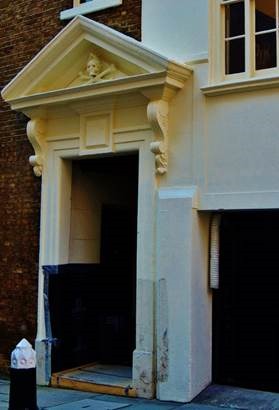
Our stop at St. Mary’s on Hill Our guide Simon was very theatrical in his storytelling. I read that many of the www.walks.com guides are actors in their other lives. The reason for my returning to St. Mary’s on Hill was to learn more about the skull and crossbones over the alley entrance attached to the church. Once St. Mary’s had included a grave yard. (More about that later.) But I thought Simon had said the skull and crossbones represented cemeteries where plague victims had been buried. I still don’t know the whole answer. |
|
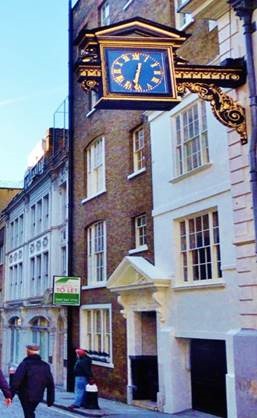
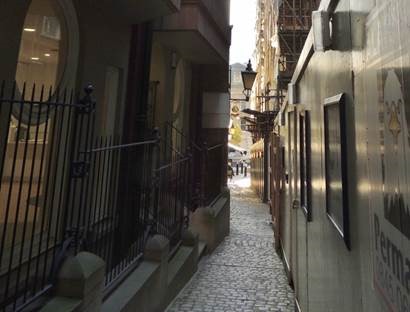
St Mary at Hill on the street of the same name The clock is the church clock and the alley way is closed off and filled with bags of construction materials. “All that we have to remind us of this last of a series of plagues is the old burial grounds, over the entrance to which may be seen the sculptured representation of skull and cross-bones distinguishing the sites of the plague cemeteries . http://www.sacred-texts.com/etc/fcod/fcod13.htm (But this is the only reference I found to plague cemeteries and skull and crossbones.) |
|
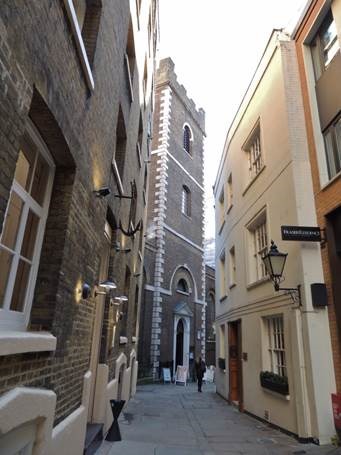
St Mary at Hill tower Lovat Lane London EC3R 8EE |
|
A millennium of ministry St Mary-at-Hill has served in the Parish of Billingsgate for nearly a thousand years. An ‘ancient church’ on this site is mentioned in a legal document dated 1177, so we can conjecture with some certainty that a church dedicated to St Mary the Virgin has stood here since at least the end of the 11th Century. Billingsgate Quay was an important harbour in the 10th and 11th centuries. The route north into the old city would have led past the church. The steep rise of the way up from the river gave it the name of St Mary at or on the Hill. The original church was no doubt smaller than the present building which has been extended, altered and renovated throughout its history. The Churchwardens’ accounts from the C15th inform us that by then it had side chapels dedicated to St Stephen, St Katherine, St Ann and St Christopher. Ancient Graves Burials within the Church and in the Chapels were for the wealthy, as they were charged at 16s 8d, while internment in the Great Churchyard to the North cost just 8d. This is now a pretty courtyard garden. It was closed for burials in May 1846 and all human remains were carefully removed to West Norwood cemetery. The church crypt and vaults were similarly emptied of human remains (some 3,000 in all) between 1892-94. Some slabs and memorials remain, but there are no skeletons below. Museum of London excavations have found traces of much earlier graves on the site, confirming that the area was part of the Roman city as well as the later Anglo-Saxon settlement. 16th & 17th Centuries The Church Bells of the tower and steeple (replaced in 1787-9 by Gwilt’s square brick tower) were rung for the crowning of Henry VIII in 1509. During the later years of Henry’s reign, the English Church renounced the primacy of Rome. The Civil War raged between 1642-51 and six years after the Restoration of the Monarchy, with the City still reeling from losing 1 in 5 of its inhabitants to the Plague, the Great Fire of London (1666) started in Pudding Lane, a stone’s throw away from St Mary-at-Hill. Renovation after the Great Fire The overall plans for restoring the City churches were famously orchestrated by Dr (later Sir) Christopher Wren, but it may have been the somewhat overlooked genius, Robert Hooke, who supervised the rebuilding of St Mary’s while Wren was concentrating on St Paul’s. It is a matter of record that Hooke was responsible for building the internal wall under the tower, at the west end. The Fire had consumed the interior of the church leaving only parts of the walls and the brick work of the tower. Utilizing the previous fabric as far as possible, the original north and south walls were reconstructed, but the building was extended a little to the east. An ornate main frontage of exposed stone was built on St Mary at Hill. There were three windows – mullioned and transomed. (The central window was blocked in 1767). The North and South windows were restored in Gothic style and doors retained in both walls. St Mary-at-Hill was one of the first churches rebuilt after the Fire, and was completed in 1677 at a cost of £3,980. |
|
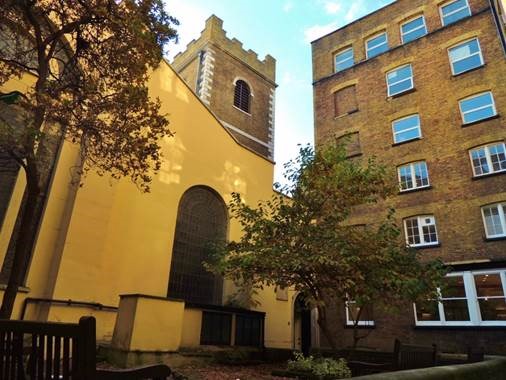
Church entrance and small garden |
|
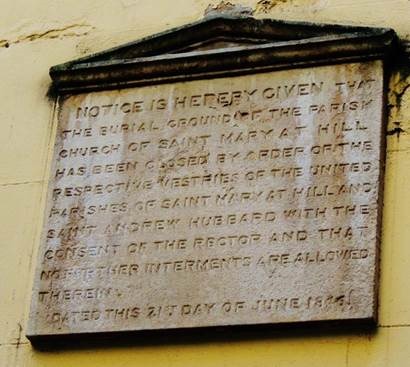
Notice of the closing of the cemetery in 1846. All human remains were removed from the cemetery and the vaults and crypts and were reinterred in the West Norwood Cemetery. |
|
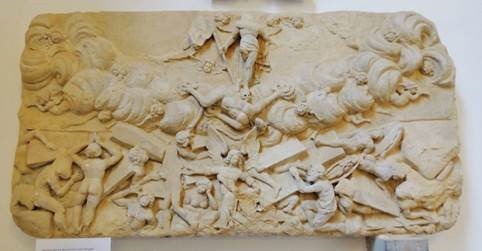
“A carved bas-relief in stone of the Resurrection, formerly over the gateway in Love Lane, is now in the N.W. vestibule.” http://www.british-history.ac.uk/report.aspx?compid=120246 |
|
Fittings—All of late 17th-century date unless otherwise described, but much of the wood-work was altered and added to in 1848–9 by the woodcarver W. Gibbs Rogers, whose work is so like its original as to render the age of many of the fittings, in whole or in part, doubtful. Chairs: two, partly repaired, with carved and pierced backs, enriched arms, carved legs, shaped stretchers, and twisted front posts. Clock-case: projecting from S.E. angle of church, square case with carved spandrels, moulded cornice and pediment, carved supporting beam with carved truss below. Communion Table: with five legs carved and twisted at the top, curved stretchers and moulded and enriched top. Communion Rails: with carved and twisted balusters and flat carved standards, quadrant-shaped angles and carved top rail. Doors: In centre of vestibule under gallery, panelled door to screen. In vestry—two panelled doors. A carved bas-relief in stone of the Resurrection, formerly over the gateway in Love Lane, is now in the N.W. vestibule. Font: octagonal white marble bowl with reeded enrichment, baluster-stem with acanthus-enrichment, black marble base. Carved oak cover with cherub-heads and swags, ogee-shaped upper part with enriched angles and terminal. Gallery: Organgallery at W. end approached by a staircase from the N. vestibule, with turned and twisted balusters. The panels of the front have modern carving. It is brought forward in the centre for organist’s seat. Monuments and Floor-slabs. Monuments: On N. wall, (1) to John Woods, 1658, Anne (Burnet) his first wife, 1645, and John his son, 1670, marble tablet with Corinthian side columns, entablature, broken segmental pediment with cherubs supporting cartouche-of-arms. On S. wall, (2) to John Harvey, 1700, marble cartouche (Plate 26) with drapery, shield-of-arms and cherub head; (3) to Thomas Dovall and Anna (Potts) his wife, 1700, marble wall-monument (Plate 25) with Composite side-pilasters, draped segmental pediment, achievement-of-arms, etc.; (4) to Charles Vickars 1712–3, marble draped cartouche with cherub-heads and shield-of-arms. In N. vestibule —on N. wall, (5) to Isaac Milner, 1713, marble tablet with Composite side-columns, entablature, segmental pediment with urn and achievement-of-arms. In S. vestibule—on S. wall, formerly in St. George Botolph Lane, (6) to Daniel Wigfall, 1698–9, marble cartouche with drapery, cherub-head and shield-of-arms. Floor-slabs: In middle aisle— (1) to John Knapp, 1708, and Mary (Brownrigg) his wife, 1711, with shield-of-arms. In vestibule— (2) to Samuel Leadbeater, 1710. Panelling: panelled wainscot all round church, three panels high, with some modern work. The vestry has panelling two panels high and a moulded architrave and cornice to the fireplace. Plate: includes two cups and cover-patens, one of 1576 and inscribed Thomas Lorimar, the other of 1587, two tankards of 1637, a paten and dish both of 1684, and a sealhead spoon of the same date. Reredos: of three bays, middle bay flanked by Corinthian columns supporting an enriched cornice and round arch and enclosing two enriched round-headed panels, painted cherubs above heads of panels, and below panels a third panel carved with foliage, fruit, flowers and a crown; above arch, a segmental pediment with cherub-heads and a book in the tympanum; side bays each with enriched panels, the lower one carved with swag and crown, frieze carved with swags and wreath. Royal Arms: Stuart (Plate 16), in centre of gallery front, a second of same date at W. end, from St. George Botolph Lane. Screens: Under gallery, in middle of vestibule—with Corinthian pilasters flanking doorway and supporting an enriched entablature with cherub-heads on the frieze; E. side panelled and finished with a coved and enriched cornice. Under gallery, at N. and S. ends—panelled, that on N. with names of churchwardens, Thomas Beckford and Henry Loades and date 1672. Seating: Under gallery—churchwardens’ pews have four posts, with old carving in front, supporting the gallery. |
|
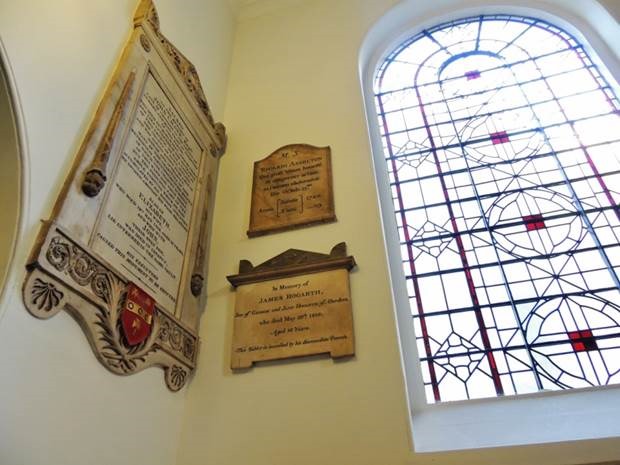
I found this a very interesting corner….. The large plaque to the left….. John Crane died in 1823 at the age of 86. His wife Elizabeth died in 1819 at the age of 91 John was interred in the south aisle of the church. At his death the bulk of his estate went to his poor relations. Elizabeth and their infant son who died in infancy were buried with John. The plaque says that his executors erected this monument. (If I’ve read my photo correctly, John died at 86 and Elizabeth at 91. So why is it we say we’re living longer? It also, if I’ve done my math correctly tells us she was 19 years older than he when they married.) Reference: PROB 11/1668/305 Description: Will of John Crane, Merchant of Croydon , Surrey Date: 04 April 1823 Held by: The National Archives, Kew Legal status: Public Record I might just have to go find this…..
The curved top plaque is in Latin so I give up..
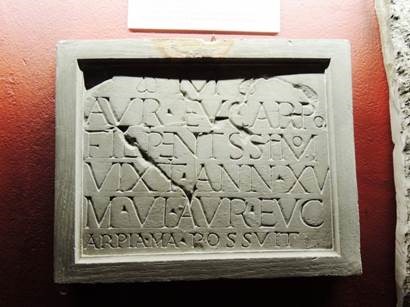
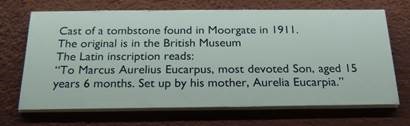
Plaque beneath is in memory of a 16 year old boy In memory of James Hogarth, son of George and Jane Hogarth, Aberdeen who died May 26th, 1816; aged 16 years. This tablet is inscribed by his disconsolate parents. This is sadly very similar to the Roman stone memorial commissioned by the mother at the death of her 15 year old son that is in the All Hallows Undercroft. |
|
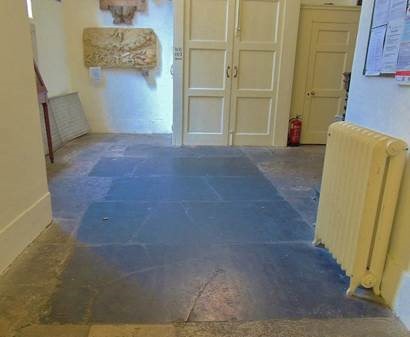
Burial slabs indicating who had once been buried here. |
|
Lunchtime Recitals each week at 1.05pm : The piano is in the left hand corner where those people are seated. But you can’t see the piano behind the pole. There was some type of production about to use the church so the altar was moved and that blue screen set up for filming. November 21 was Masachi Nishiyama at the Piano but I didn’t stay as I’d other places to visit and didn’t want to walk out mid performance. November 28 INVERSION Flute & Organ Duo Ruth Stockdale & Robert Smith “Our lunchtime recitals are informal affairs. It is acceptable to come and go during the playing, and you are welcome to bring your sandwiches into the Church – a precedent set under Prebendary Wilson Carlile, founder of the Church Army* and Rector of St Mary’s at the turn of the 19th-20th century (for working people who had brought food from home to eat and had no place else to go I was told by Kathy, the Church watcher.) Musicians from all over the world perform at St Mary-at-Hill. There is no charge for these events, but we suggest and appreciate a donation of perhaps £5.00 Performances now include Monday and Friday recitals arranged by St Anne’s Lutheran Church and Music Society who brew and serve coffee, to enjoy with the music.“ http://www.stmary-at-hill.org/music.php •Is a part of the ministry of the Anglican Church and is NOT affiliated with the Salvation Army or Jesus Army. http://www.churcharmy.org.uk/pub/aboutus/FactsAndFigures.aspx “An amazing musical event took place at St. Anne and St. Agnes, the Lutheran church in the City of London, on July 28, 2004, the 254th anniversary of the death of Johann Sebastian Bach. “ http://www.nextreads.com/display2.aspx?recid=6943877&FC=1 fascinating reading for Bach lovers. |
|
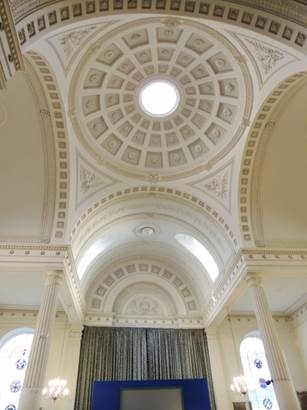
“After a fire in 1848, the ceiling was renewed and the interior remodeled under James Savage, architect. http://www.stmary-at-hill.org/gallery.php gallery shows the church interior as it normally appears. |
|
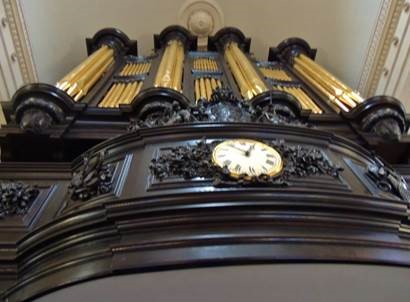
“Saint Mary-at-Hill boasts what has been described as one of the ten most important organs in the history of British organ building.” Church leaflet “On 10 May 1988, a disastrous fire in the church of St Mary at Hill in the City of London destroyed most of the roof of the building as well as much of the interior and parts of the organ. The picture below gives a good impression of the damage to both the building and the organ.” http://www.mander-organs.com/portfolio/st-maryhill.html tells the story the organ and its reconstruction which is really quite interesting. |
|
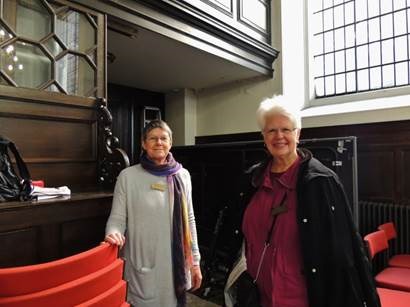
Church watchers Maryanne (L) and Kathy (R) I had a lovely chat with Kathy who told me about the church but discovering we both grew up in New England was the most fun. She was from Connecticut but had gone to college at Tufts in Boston. I was duly impressed that she had graduated from Tufts and she was duly impressed that I lived at St Katharine Docks. |
|
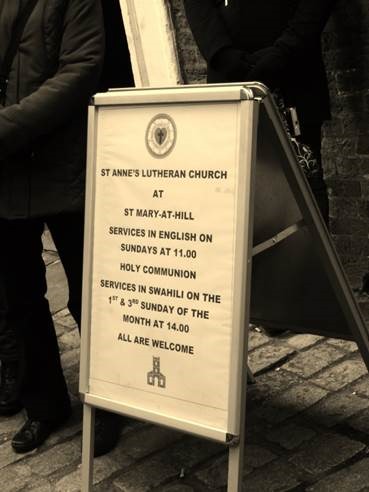
Church sharing : Lutheran services in English and Swahilli St Mary at Hill is and Anglican Church. |
|
Toilet Twinning While reading the St Mary at Hill website I came across this note…………of all places for me to have missed when I usually know everyplace possible to use the loo while out and about. I’ll have to go back, listen to a lunchtime concert and use the loo. Do note the pictures in our toilets which are twinned with loos in the Congo. See website to read about sanitation. If the loos are shut, just ask for them to be opened http://www.stmary-at-hill.org/ http://www.toilettwinning.org/what-is-toilet-twinning/ explains Toilet Twinning which brings sanitation to third world countries. |
|
Lovat Lane “Plague and fire did for medieval London, but the city that rose in its place was built on the old street patterns. The names, even the cobbles, remain – Lovat Lane, for example, where the old surface is barely the width of a plague cart’s wheelbase and the gutter still runs down the middle. “ Lovat Lane, EC3 An endearingly curving and cobbled lane between Monument Street and Great Tower Street, Lovat Lane contains the church of St Mary-At-Hill, known for its ornate gold and blue clock and which was feted by Sir John Betjeman, ‘This is the least spoiled and the most gorgeous interior in the City, all the more exciting by being hidden away among cobbled alleys, paved passages, brick walls, overhung by plane trees.’ Lovat Lane has that slightly Mediterranean feel to it and there are a couple of café restaurants with outside tables to capitalise on this, though we thought we’d wait for slightly more clement weather. Just across the road on the side of the Philpot Lane Café Nero building is the tiny carving of two mice eating a piece of cheese so grab the chance to go and have a look. (My next assignment is to see the twinned loo and find the mice eating cheese now I know where they are.) http://londonist.com/2011/02/top-10-square-mile-alleyways.php “…… Dickens saw the City of London change from being a place where people lived to one where people only worked, as it was gradually taken over by the banks, law firms and financial institutions. The walk began in Billingsgate at the church of St Mary at Hill which is squeezed into a small site surrounded by Victorian office buildings. There is a tiny churchyard with some gravestones – but no dead are buried here. Parliament outlawed new burials in the City of London in Dickens’ day, forcing the closure of its churchyards to new burials. It’s a symbol of the way in which the City was turning into ‘a city of the dead, with the living just coming in to work’. As a child, Dickens experienced the City as a kind of village community; by the time he died, 80% of the population were gone, replaced by office blocks and warehouses. http://gerryco23.wordpress.com/ |
Cheers,
Well maybe cheers isn’t the right way to start on the 50th anniversary of the Kennedy Assassination. I believe history would have been different.
This is email is about All Hallows Undercroft. I should have mentioned in the prior email that the official tours have ceased for the winter. Now there are several school project in progress many days with bits of the church blocked off or clogged with children. Best to go after 3 pm. You learn so much more on a tour if you’re only vaguely interested. The guide points out bits you’d not have noticed making everything more interesting. With only myself and camera visiting places I do it backwards. I go on the tour and then learn about things afterwards so half the time I’m taking the tour with you through my photos.
Ru
All Hallows by the Tower : The Undercroft


|
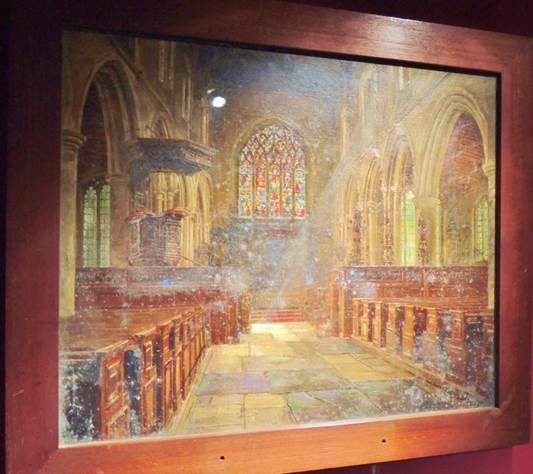
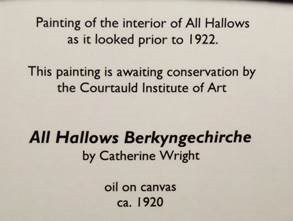
This painting was in the Undercroft but I should have included it in the email about the Main Church. |
|
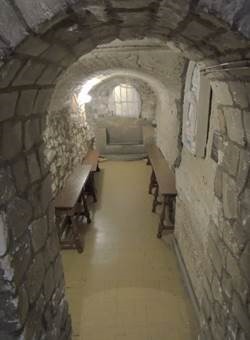
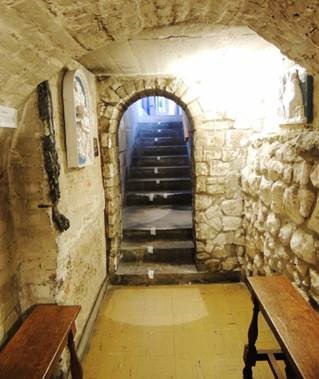
Beneath the present nave is the undercroft of the Saxon church containing three chapels: the Undercroft Chapel, the Chapel of St Francis of Assisi and the Chapel of St Clare. |
|
Chapel of St Clare “Clare of Assisi was born into a wealthy Italian family but soon shunned her luxurious upbringing to embrace the life of piety and poverty. Inspired by the words of Francis of Assisi, Clare fled her home and joined Francis, establishing her own religious order. The group became known for their austere and devout lifestyle and for the power of their prayer, which is credited with saving Assisi from invaders twice. After Francis’ death, Clare continued his work and broadened her own influence. Clare died in 1253 and was canonized two years later by Pope Alexander IV. http://www.biography.com/people/st-clare-of-assisi-9249093 |
|
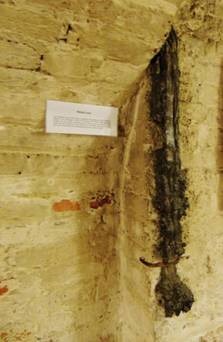
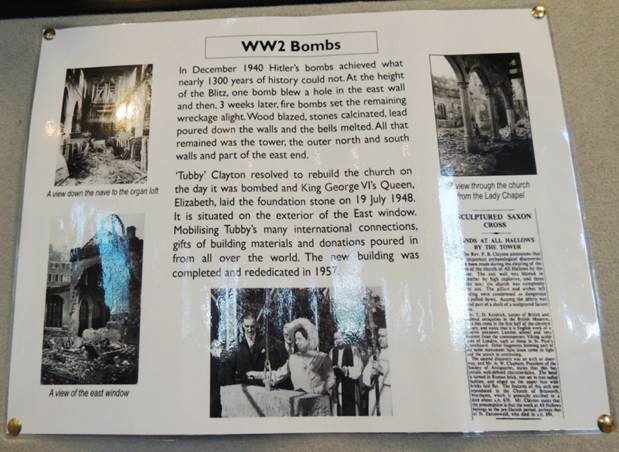
“The misshapen piece of lead is left as a reminder of the destruction that All Hallows suffered in the bombings of WW2. On December 29th 1940 a bomb came right through the east window destroying much of the centre of the church. Three weeks later the ruined church also suffered from fire bombs. The heat from those fires was so intense that the roofing lead melted and ran down the walls. |
|
St Francis Chapel just next to the Chapel of St. Clare ( I have a soft spot in my heart for St. Francis who loved animals.) St Francis organizations now train wonderful services dogs! |
|
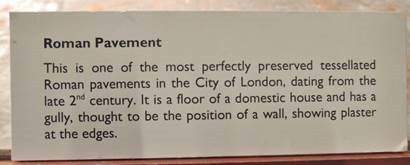
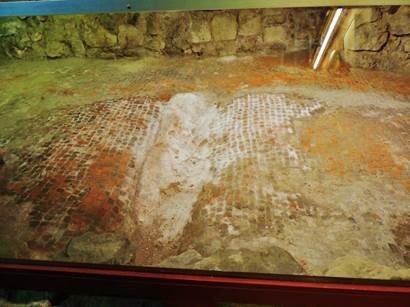
“The Crypt Museum leads you on a fascinating journey through time, beginning with the Roman tesselated floor of a domestic house in the late 2nd Century and charting the history of the church, its people and the City of London. The museum is in part of the original Saxon church and contains a collection of Roman and Saxon artefacts, church plate and ancient registers dating back to the 16th century. Their entries record the baptism of William Penn, the marriage of John Quincy-Adams and the burial of Archbishop William Laud amongst many other historic events on Tower Hill.” http://www.allhallowsbythetower.org.uk/visiting/crypt-museum/ |
|
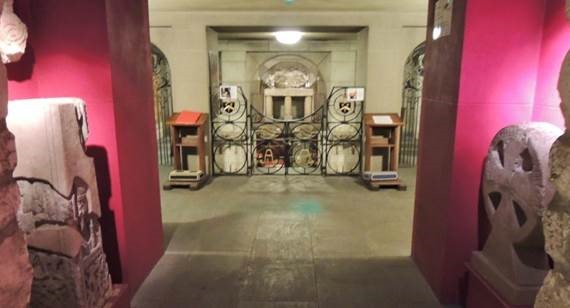
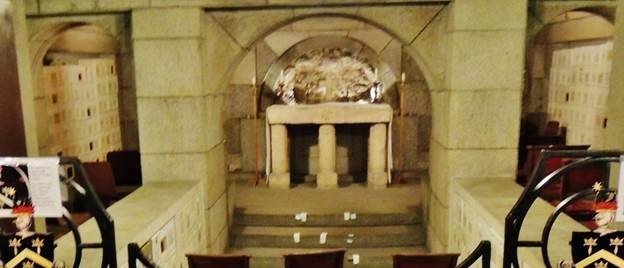
The Undercroft Chapel is constructed out of the former ‘Vicars’ Vault’, and is now a columbarium for the interment of ashes of former parishioners and those closely associated with the church. This site was formerly outside the main building and part of the burial ground adjacent to the apse of the Saxon church. Here lie at least three Saxon coffins, buried in the pre-Norman period. The rough rear wall is part of the 14th century church. Standing below the present High Altar are altar stones brought back to All Hallows from Castle Athlit in present-day Israel. It is thought that the altar comes from the Chapel of Richard Coeur de Lion in the Templar Church of Athlit. This has great significance for All Hallows in view of the connection with the inquisition of Knights Templar in the earlier Chapel of St Mary. It was in a vault in this chapel that Archbishop William Laud lay buried for over twenty years after his beheading on 10th January 1644, and a memorial plaque commemorates this. |
|
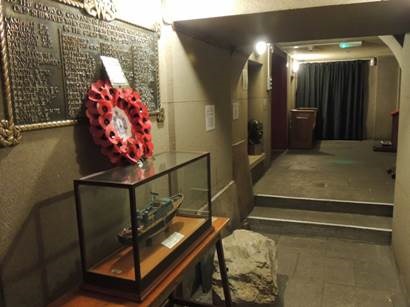
Memorial to those who died for their country |
|
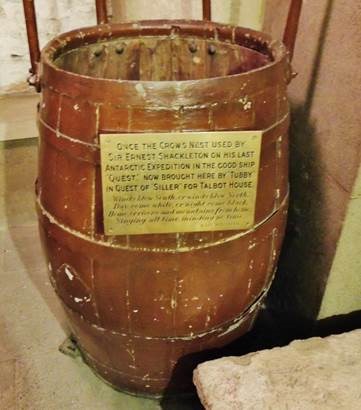
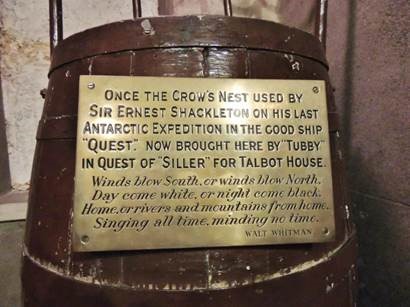
I can’t imagine climbing rope ladders and then crawling into and out of this thing…in the Antarctic! |
|
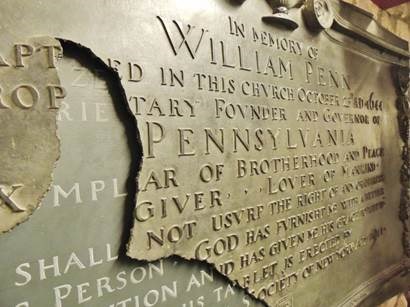
Plaque for William Penn whose father saved All Hallows from the Great Fire |
|
A very human bit of history |
|
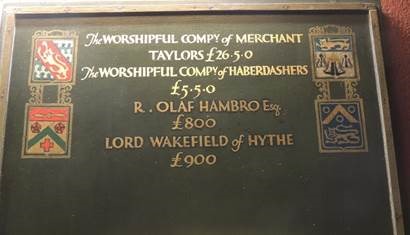
Donations from various guilds and the big donation from Lord Wakefield of Hythe |
|
|
Cheers,
My emails seem to be fewer and further between since we returned to London. Just too much to research about everything we see. During the walking tours we hear lots of stories, but there’s no chance to write them down. I lag behind to take photos and then have to jog along to catch up. Before I send out these emails I have to try to find out what’s so important about all those photos I took during the walk. I don’t mind because I learn lots, but also learn what I missed so have to return to learn more about that church or that lane or whatever. I had to do that to research All Hallows Church.
Today I had to return to Lovat Lane and St Mary’s on Hill because we’d really only passed by those places. Among other things I went looking for the statue of two mice fighting over a piece of cheese. I didn’t find it so I’ll have to return now with a better set of directions. I was also trying to find out more about the skull and crossbones over the alleyway entry to St. Mary’s on Hill. While at St. Mary’s on Hill I had a lovely discussion with a “church watcher.”
http://www.london-city-churches.org.uk/ “The ‘new’ Friends of the City Churches came into being in 1994, bringing together many people who cared for and valued the City’s churches, with the aim of ensuring that the churches would be preserved intact for posterity and, most importantly, be kept open to visitors on a regular basis.” Church watcher Kathy, who introduced me to the doings at the church, is from Connecticut, went to Tufts, and now after working many years in England, lives here. But more about her and Maryanne when I write about St. Mary on Hill.
As for the mice…..“On the Philpot Lane side of 23 Eastcheap is one of London’s smallest statues, of two mice eating or fighting over a piece of cheese. The statue’s exact origin is unclear but it is thought to date from 1862 and was possibly made for the spice merchants Hunt and Crombie by John Young & Son. Another theory surrounding its existence is that it commemorates an incident where an argument broke out between two construction workers when one accused the other of eating some of his lunch, and during the ensuing altercation one of the men fell from the building to his death. It was later found that mice were the culprits.” I am determined to find those mice!

A real tiny mouse!
On my way back to DoraMac just near one of the Tower Hill Exits I saw this adorable fellow. I hated to watch him struggle up the stairs trying to go who knows where. I gave him some of my snack but the tiny mouse wasn’t the least bit interested. A Russian tourist came along and he too took photos wishing good luck to the tiny mouse. This man reminded me of the family next to us in Ashdod, Israel who took turns with us feeding the kitten who lived between our boats.
This email actually concerns the main floor of All Hallows Church by the Tower. All Hallows was one of the stops on our Square Mile tour that started with The Monument. All Hallows wasn’t actually our second stop, St. Mary’s on Hill and St. Dunstan were stops before we arrived at the corner where our guide spoke about All Hallows as well as The Tower. But All Hallows is supposedly the oldest church in London so a Big Deal. This email concerns the street level floor, the main floor of the church as it is used today. The lower floor includes the crypt museum which isn’t as creepy as it sounds. I’ll write about that next.
Ru
All Hallows by the Tower
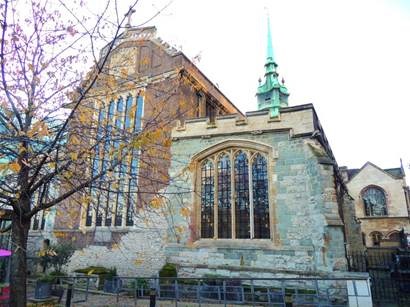
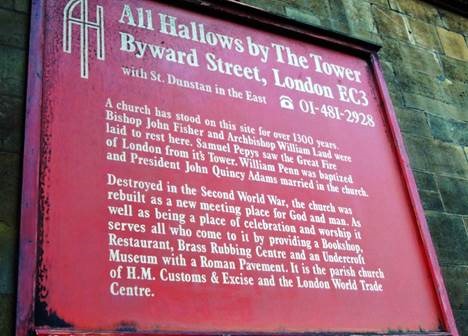
“Shamefully isolated on Tower Hill, between a busy road and an appalling modern shopping precinct, is THE OLDEST CHURCH IN LONDON, All Hallows by the Tower. It was founded in 675, as a chapel of the Great Abbey of Barking, and hence is sometimes known as All Hallows Barking. Inside, a 7th-century Saxon arch containing recycled Roman tiles stands at the south-west corner, THE OLDEST SURVIVING PIECE OF CHURCH FABRIC IN LONDON.
Half-way down the stairs to the medieval Undercroft is a tiny, barrel-vaulted chapel of bare, crumbling stone, dedicated to St Clare. Though only yards away from the uproar of Tower Hill it is one of the most peaceful places in London to sit and think. On entering the Undercroft you can actually walk on a remarkably well-preserved section of tesselated Roman pavement laid down here in the 2nd century. At the east end in the Undercroft Chapel is an altar made of stones from the Templar church of Athlit, in Israel, and brought back from the Crusades. Recesses in the walls hold boxes filled with the ashes of the dead. Charles I’s Archbishop, William Laud, was buried in a vault in this chapel for over 20 years after his beheading in 1645. At the Restoration his body was moved to St John’s College, Oxford.
In 1535 the bodies of St Thomas More and Bishop Fisher were brought into the church after their execution at the Tower for refusing to sign Henry VIII’s Act of Supremacy.
LANCELOT ANDREWES (1555 – 1626), the scholarly Bishop of Winchester, was baptised at All Hallows in 1555. He was the last occupant of Winchester Palace in Southwark and is buried in Southwark Cathedral.
In 1650 some barrels of gunpowder that were being stored in the churchyard exploded, destroying some 50 houses, badly damaging All Hallows and causing many fatalities. In 1658 the church tower was rebuilt, THE ONLY EXAMPLE OF WORK CARRIED OUT ON A CHURCH IN THE CITY DURING THE COMMONWEALTH (1649 – 60).
In 1644 WILLIAM PENN, the founder of Pennsylvania, was baptised at All Hallows. Twenty-two years later in 1666 Penn’s father, Admiral William Penn, saved All Hallows from the Great Fire of London by ordering his men from the nearby naval yards to blow up the surrounding houses as a fire break. Samuel Pepys climbed ‘up to the top of Barking steeple’ to watch the fire and there witnessed ‘the saddest sight of desolation’ before he ‘became afeard to stay there long and down again as fast as I could’.
The following year, 1667, JUDGE JEFFREYS, James II’s notorious ‘hanging judge’, was married at All Hallows. In 1797 JOHN QUINCY ADAMS, later to become 6th President of the United States, married Louisa Catherine Johnson, daughter of the US consul in London, in All Hallows.
From 1922 to 1962 the Vicar of All Hallows was the REVEREND PHILIP ‘TUBBY’ CLAYTON who, as an Army chaplain in 1915, ran a rest-house and sanctuary for soldiers of all ranks at Poperinge in Belgium. It was named Talbot House in memory of Lieutenant Gilbert Talbot, brother of Army chaplain the Revd Neville Talbot who had set up the rest-house. Talbot House became known by its signals code name of TOC H. After the war Clayton fostered the spirit and intent of Talbot House through the Toc H movement and encouraged the setting up of Toc H branches in cities across Britain.
Among the surviving treasures of All Hallows are a wonderful collection of medieval brasses, a rare 15th-century Flemish triptych and what many regard as THE FINEST WOOD CARVING IN LONDON, a font cover carved in lime-wood by Grinling Gibbons in 1682 http://www.nextreads.com/display2.aspx?recid=6943877&FC=1
http://www.allhallowsbythetower.org.uk/history/ official Church site
|
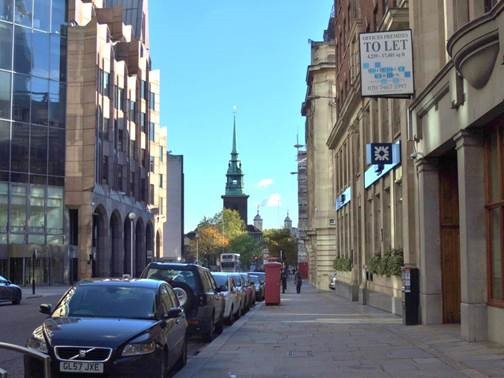
Looking down Tower Street towards All Hallows Church and the original White Tower of The Tower of London. |
|
|
|
|
|
http://www.allhallowsbythetower.org.uk/visiting/virtual-tour/ is a wonderful online tour talking about things I saw but much that I missed. |
|
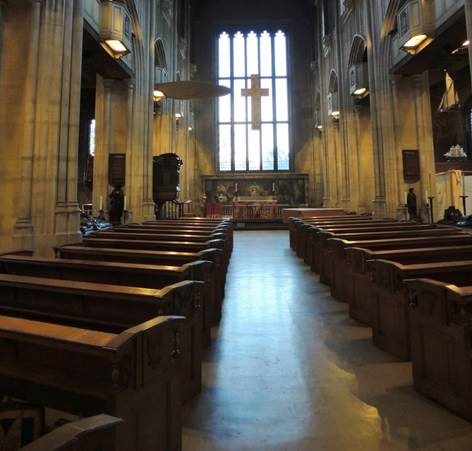
The Nave I think is the correct term? |
|
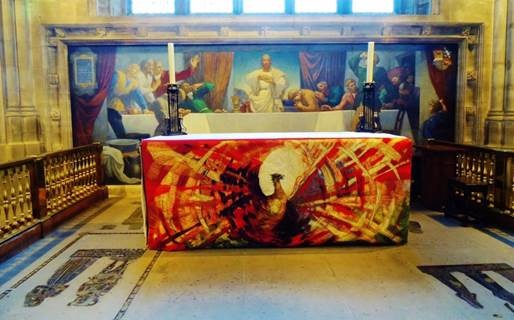
Phoenix Altar Frontal not explained on the All Hallows site but the painting is described in the virtual tour. |
|
|
|
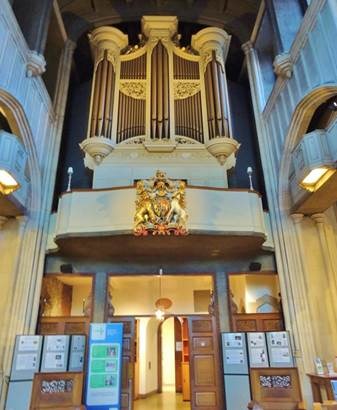
For Sharon and Asher Organ concerts are given in the afternoons and one day I will go listen |
|
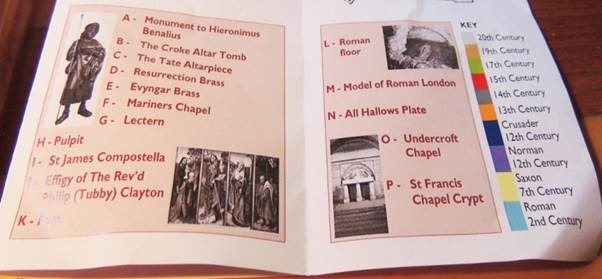
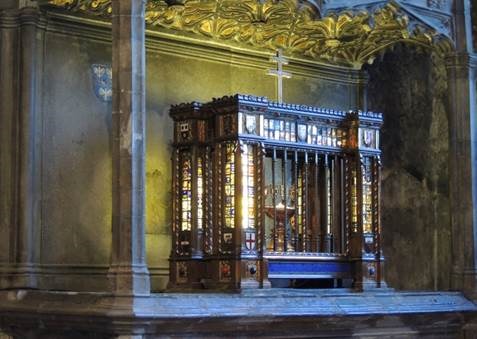
Croke Altar Standing in the Lady Chapel is the altar tomb of Alderman John Croke (1477) which was destroyed by the air-raid of 1940. It has since been completely restored from over 150 fragments. The tomb is made of Purbeck marble, and fine brass memorials at the back of the tomb record the effigies of the Alderman and his eight sons, Margaret his wife and his five daughters. The casket containing the Toc H lamp, given to the movement in 1922 by Edward, Prince of Wales, also contains stained glass shields depicting the arms of places where branches of the Toc H were founded between 1919 and 1929. http://www.allhallowsbythetower.org.uk/visiting/virtual-tour/b–croke-altar/ |
|
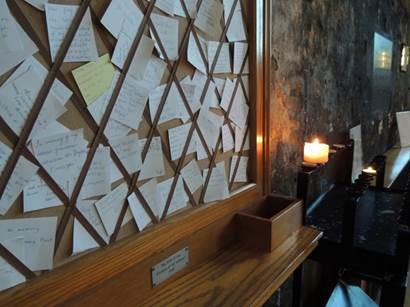
Prayer messages |
|
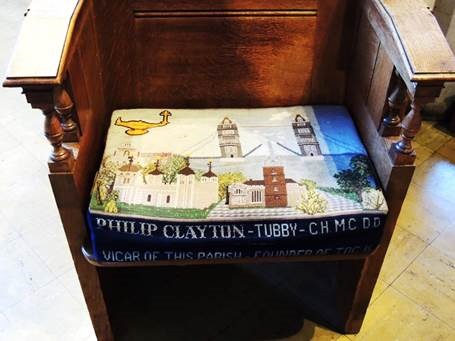
I took the photo because of the images of London, but since then learned a bit about “Tubby” Clayton |
|
The effigy of the Rev’d Philip Thomas Byard Clayton (popularly known as ‘Tubby’) is one of the last works by Cecil Thomas, the ‘soldier sculptor’, who also made the Forster Memorial in the south aisle of the church. Tubby’s dog sits on a tasselled cushion at his feet and the effigy is supported by four lion cubs, one at each corner. Tubby was the founder Padre of Toc H. Assisted by fellow army chaplain Neville Talbot, he established Talbot House (‘Toc H’ in signaller’s jargon), a unique rest house in Poperinge for serving soldiers near the fierce battleground of Ypres in Flanders during the First World War. Tubby became Vicar of All Hallows in 1922 and remained here for forty years, until his retirement in 1962. http://www.allhallowsbythetower.org.uk/ |
|
Destruction during WW 2 |
|
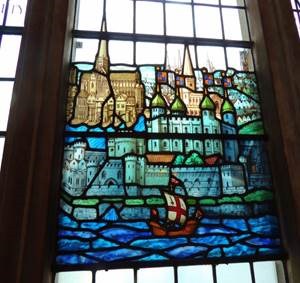
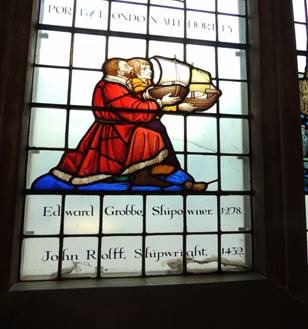
Stained glass windows show London’s connection with the Thames |
Cheers,
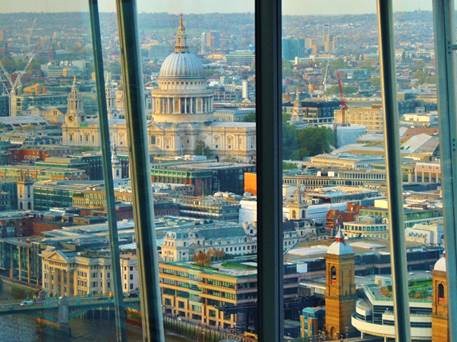
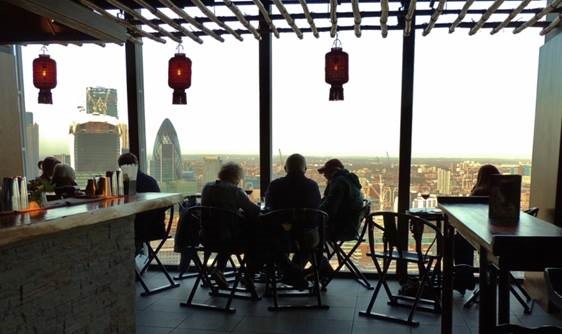
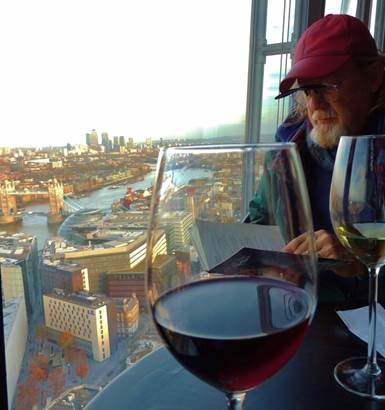
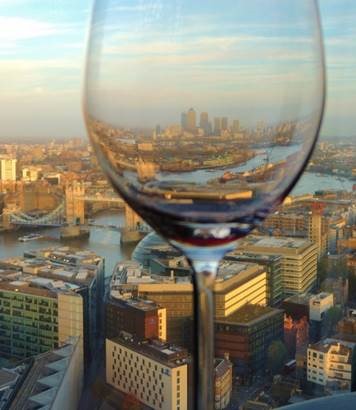
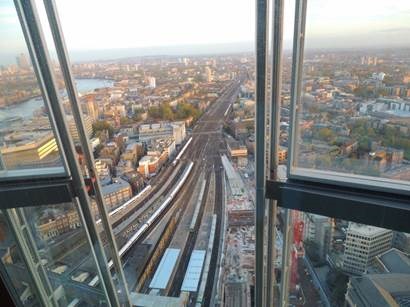
It’s bright and sunny and has been for several days now! What a treat. Yesterday we walked with Sue and Ed to the Angel Pub which is a stroll along the Thames from here. After that, since it was a clear day, we walked over to “The Shard” and took the elevator to the 32nd floor for the view and a glass of house wine.
Today several of us our going to the Idea Store/Library for the writers’ festival.
http://writeideafestival.org/events/
Tickets are free and I chose the following two talks.
Jill Dawson and Louise Doughty http://jilldawson.co.uk/ http://www.louisedoughty.com/
Saturday, November 16 @ 3:30 pm
In an era of e-books, online games and social media, what is the point of the novel? Why do so many still read fiction and wish to write it; what is the role of fiction in contemporary life – is it simply to hold a mirror to the world, or can fiction reach the places that other art forms can’t? Two of Britain’s best novelists, both of whom write and teach fiction, discuss the question: Does Fiction Matter?
The Gentle Author http://spitalfieldslife.com/
Saturday, November 16 @ 5:00 pm
The Gentle Author will talk about his new book ‘The Gentle Author’s London Album’. Between the covers of this magnificent album you will discover more than 600 of the Gentle Author’s favourite pictures of London, setting the wonders of our modern metropolis against the pictorial delights of the ancient city, and celebrating the infinite variety of life in the capital.
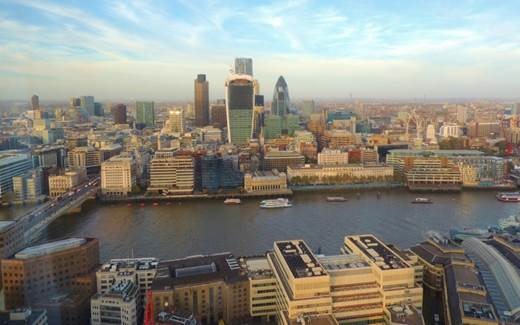
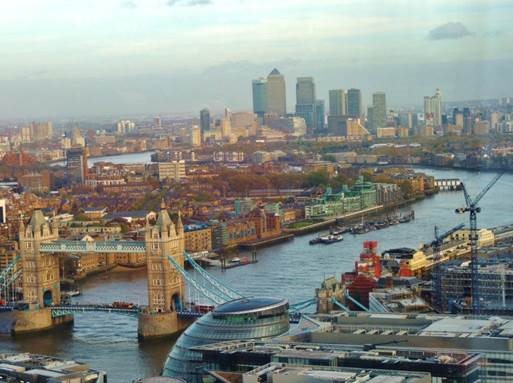
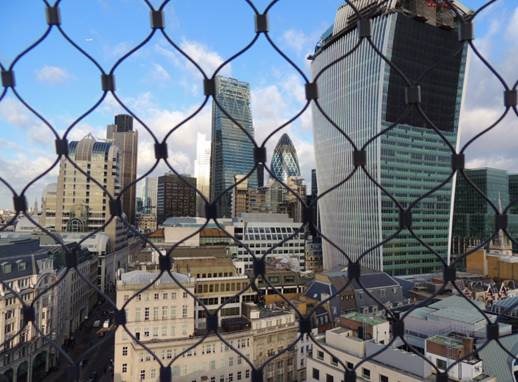
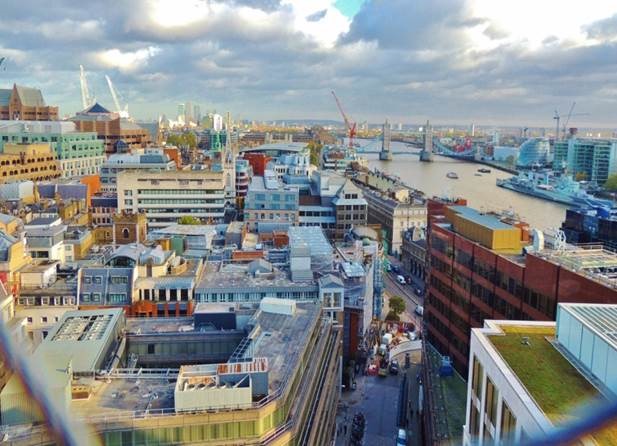
Here are some of the photos from The Shard.
|
London Bridge, the Walkie Talkie and the Gherkin. |
|
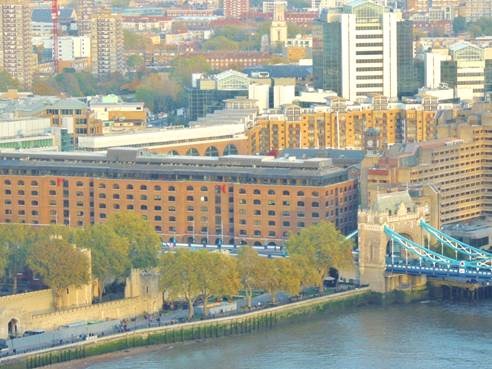
Tower Bridge and the curve of the Thames around the Isle of Dogs with the talk buildings that are Canary Wharf. |
|
St. Paul’s Cathedral |
|
The Tower of London |
|
Looking down on the golden top of The Monument |
|
Sue Ed and Randal with the Gherkin in the distance across the river |
|
Glass half full…..actually totally full if full is defined as what you get for your £4.50. But there was no charge for the great view. |
|
Empty glass still full of Canary Wharf |
|
View from the Ladies’ Loo with its floor to ceiling window. |
|
The west basin of SKD Marina is located in the center of the square of buildings just beyond the Tower Bridge. If you find the clock tower that’s where DoraMac is located. |
Hi All,
Actually maybe more of a correction than addendum. I really glossed over the rebuilding part of the story but our friend Ed Kelly, much more of a history buff than I pointed out the following to me in response to my email. I thought I’d share.
Ru
Thanks. Very nice report.
I think your guide may have missed a bit of the history of rebuilding however. Charles II actually proposed changing city plans, but could not get consensus and city agreement to do so. At the time the City and the King were on opposite sides politically. During the Civil War that had just ended the City had supported the arrest of King Charles I and the King could not actually even enter the city of London. During the fire the city tried to keep the kings troops out of the city, despite an offer to help. They did not trust one another and possibly that is why they were suspicious of the Kings plans to improve much of the city, I am not sure.
But Charles did enlarge the streets and alleys… so they must have really been super narrow before! I think there is an inscription on the river side of the monument attesting to Charles II’s insisting on brick and stone and on his deciding and directing the streets be widened on rebuilding. Although Charles II came back into Power with the 60s, with a promise of no reprisals, the HUNG, DRAWN & QUARTERED Pub just West of the Tower of London presently bears an inscription made by Pepys … which is testament to his revenge … the hangee being a General who had signed the death warrant years earlier for the execution of his father.
SOME INTERESTING NOTES ON THE TIMES:
Encouraged by Charles, radical rebuilding schemes for the gutted City poured in. If it had been rebuilt under some of these plans, London would have rivalled Paris in Baroque magnificence (see Evelyn’s plan on the right). The Crown and the City authorities attempted to establish "to whom all the houses and ground did in truth belong" to negotiate with their owners about compensation for the large-scale remodelling that these plans entailed, but that unrealistic idea had to be abandoned. Exhortations to bring workmen and measure the plots on which the houses had stood were mostly ignored by people worried about day-to-day survival, as well as by those who had left the capital; for one thing, with the shortage of labour following the fire, it was impossible to secure workmen for the purpose. Apart from Wren and Evelyn, it is known that Robert Hooke, Valentine Knight and Richard Newcourtproposed rebuilding plans.
With the complexities of ownership unresolved, none of the grand Baroque schemes for a City of piazzas and avenues could be realised; there was nobody to negotiate with, and no means of calculating how much compensation should be paid. Instead, much of the old street plan was recreated in the new City, with improvements in hygiene and fire safety: wider streets, open and accessible wharves along the length of the Thames, with no houses obstructing access to the river, and, most importantly, buildings constructed of brick and stone, not wood. New public buildings were created on their predecessors’ sites; perhaps the most famous is St. Paul’s Cathedral and its smaller cousins, Christopher Wren’s 50 new churches.
On Charles’ initiative, a Monument to the Great Fire of London, designed by Christopher Wren and Robert Hooke, was erected near Pudding Lane. Standing 61 metres (200 ft) tall and known simply as "The Monument", it is a familiar London landmark which has given its name to a tube station. In 1668 accusations against the Catholics were added to the inscription on the Monument which read, in part:
|
“ |
Here by permission of heaven, hell broke loose upon this Protestant city…..the most dreadful Burning of this City; begun and carried on by the treachery and malice of the Popish faction…Popish frenzy which wrought such horrors, is not yet quenched… |
” |
Aside from the four years of James II‘s rule from 1685 to 1689, the inscription remained in place until 1830 and the passage of the Catholic Emancipation Act.[59]
Another monument, the Golden Boy of Pye Corner in Smithfield, marks the spot where the fire stopped. According to the inscription, the fact that the fire started at Pudding Lane and stopped at Pye Corner was an indication that the Fire was evidence of God’s wrath on the City of London for the sin of gluttony.
Cheers,
Last Sunday Randal and I took part in our second www.walks.com tour. It focused on part of the famous London Square Mile that makes up the old city of London. We began the tour at the monument to the great fire of 1666, a date that once you learn is not hard to remember. The Great Plague was 1665-1666. Not a good time to be in London. Our tour started at the foot of The Monument to the great fire. While we were there, our guide Simon mentioned that the view from the top was worth the 311 steps. We didn’t have time Sunday so today, while Randal and I were out and about, we made The Monument our last stop. Randal waited in a coffee shop down on the street while I walked to the viewing platform. Before I started I’d asked the ticket seller how long it would take. “Five minutes” was her reply and that was just about right. I walked slowly and steadily giving the young man behind me an excuse to go slowly and steadily. I’d invited him to pass me but he said my speed was just fine for him too. So now that’s done, here’s the story of The Monument to the Great Fire. http://www.mydoramac.com/wordpress/?p=19008 has more information and photos from our visit to the Museum of London where there is an exhibit devoted to the Great Fire of 1666.
Ru
The Monument
“The Monument stands at the junction of Monument Street and Fish Street Hill in the City of London. It was built between 1671 and 1677 to commemorate the Great Fire of London and to celebrate the rebuilding of the City.
The fire began in a baker’s house in Pudding Lane on Sunday 2nd September 1666 and finally extinguished on Wednesday 5th September, after destroying the greater part of the City. Although there was little loss of life, the fire brought all activity to a halt, having consumed or severely damaged thousands of houses, hundreds of streets, the City’s gates, public buildings, churches and St. Paul’s Cathedral. The only buildings to survive in part were those built of stone, like St. Paul’s and the Guildhall.
As part of the rebuilding, it was decided to erect a permanent memorial of the Great Fire near the place where it began. Sir Christopher Wren, Surveyor General to King Charles II and the architect of St. Paul’s Cathedral, and his friend and colleague, Dr Robert Hooke, provided a design for a colossal
Doric column in the antique tradition. They drew up plans for a column containing a cantilevered stone staircase of 311 steps leading to a viewing platform. This was surmounted by a drum and a copper urn from which flames emerged, symbolizing the Great Fire. The Monument, as it came to be called, is 61 metres high (202 feet) – the exact distance between it and the site in Pudding Lane where the fire began.
The column was completed in 1677, and in accordance with Wren’s original intention, was at first used as a place for certain experiments of the Royal Society, but vibrations caused by ceaseless traffic proved too great for the success of these experiments and they were discontinued; thereafter the Monument became a place of historic interest, unique of its kind, providing visitors with an opportunity to look across London in all directions from a height of about 160 feet, being the level of the public gallery.
Sir Christopher Wren’s flame-topped Monument to the Great Fire of 1666 is the tallest isolated stone column in the world.
http://www.themonument.info/history/introduction.html
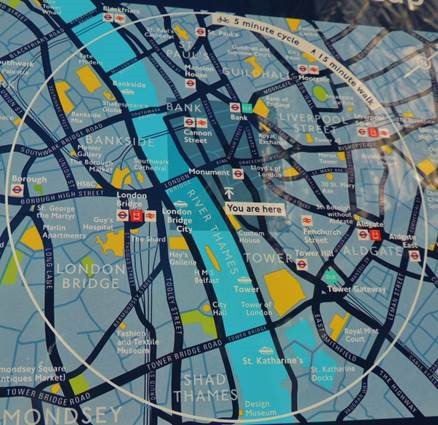
Our guide Simon explained that when rebuilding the King insisted that the City be rebuilt as it had been even recreating the small alleyways and lanes rather than lay the city out as a grid or spoke or something more logical. That’s why London is just as it had been in 1666.
|
Only at a distance could I get a “top to bottom” photo of The Monument |
|
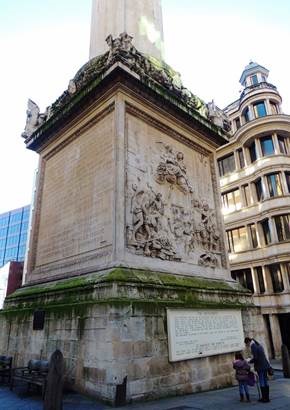
“The column stands on a plinth, three faces of which carry Latin texts with translations. “ North face – Translation of the Latin inscription: In the year of Christ 1666, on the 2nd September, at a distance eastward from this place of 202 feet, which is the height of this column, a fire broke out in the dead of night, which, the wind blowing, devoured even distant buildings, and rushed devastating through every quarter with astonishing swiftness and noise. It consumed 89 churches, gates, the Guildhall, public edifices, hospitals, schools, libraries, a great number of blocks of buildings, 13,200 houses, 400 streets. Of the 26 wards, it utterly destroyed 15, and left 8 mutilated and half-burnt. The ashes of the City, covering as many as 436 acres, extended on one side from the Tower along the bank of the Thames to the church of the Templars, on the other side from the north-east gate along the walls to the head of Fleet-ditch. Merciless to the wealth and estates of the citizens, it was harmless to their lives, so as throughout to remind us of the final destruction of the world by fire. The havoc was swift. A little space of time saw the same city most prosperous and no longer in being. On the third day, when it had now altogether vanquished all human counsel and resource, at the bidding, as we may well believe, of heaven, the fatal fire stayed its course and everywhere died out. *[But Popish frenzy, which wrought such horrors, is not yet quenched.] * These last words were added in 1681 and finally deleted in 1830. http://www.londonremembers.com/memorials/the-monument-west-and-north |
|
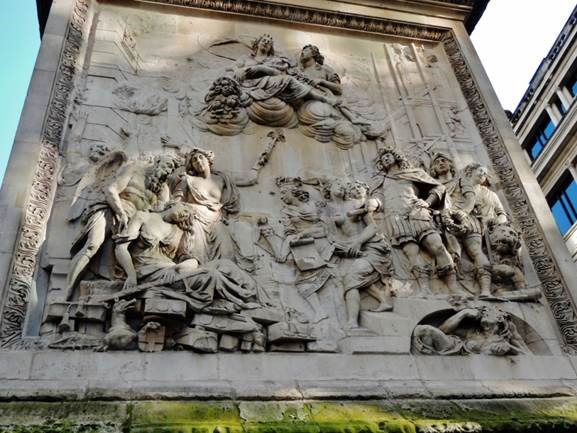
The bas relief on the front of The Monument “The bas relief by Cibber is worthy of close examination. It shows a woman on the left (representing the City) languishing on some ruins. Winged Time supports her and a female figure points with a winged sceptre at the clouds which contain two more bare-breasted lovelies, one with a cornucopia (Plenty) and one with a laurel branch (Praise). Behind the group on the left are some figures waving their hands in distress and behind them, the cause, buildings with smoke and flames pouring forth. To the right of this group can be seen a beehive, symbol of industry. And is that the City dragon/griffon we see at the bottom left creeping out from under the ruins? The main figure in the group to the right is King Charles II standing at the top of some steps. He directs three more scantily-clad women down the steps towards poor City. They represent: Science brandishing a figure of many-breasted Nature and with a very strange headdress; Architecture clutching some plans and a pair of compasses, and Liberty waving her cowboy hat in the air. To the right of the Kings stands his brother, the Duke of York (the future King James II) clutching a garland, presumably destined for the City. Behind James are two more female allegorical figures: to the left Justice wearing a coronet and to the right Fortitude brandishing a sword in one hand while the other controls the leashed lion at her feet. Behind this group the reconstruction of the City progresses, with workmen scrambling over scaffolding. Below the steps on which this group stands, squeezed into an arched cavern is an ugly female figure, Envy eating her own heart.” http://www.londonremembers.com/memorials/the-monument-west-and-north When I enlarge the photo Envy looks like a well-muscled man to me. |
|
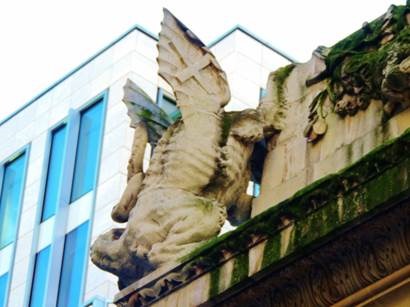
Dragons and crosses are the symbols of Saint George the patron saint of The City of London. http://www.seiryu.org.uk/ppp/city-dragon.html “ Caius Gabriel Cibber executed the sculpture on the west panel, and the four dragons at the base were the work of Edward Pierce, Jnr., a sculptor and architect frequently employed by Wren. “ |
|
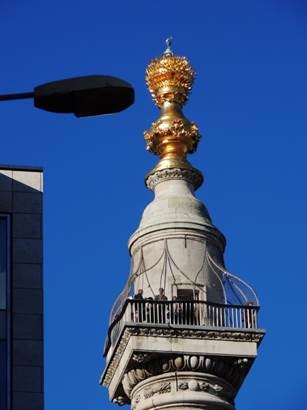
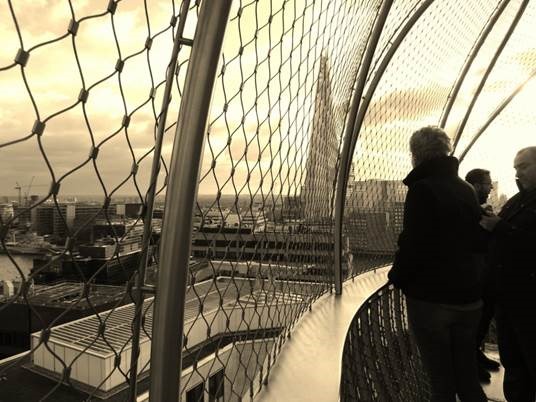
“…on the abacus is a balcony encompassing a moulded cylinder, which supports a flaming urn or vase of gilt bronze, symbolizing the Fire. Defoe quaintly describes the Monument as “built in the form of a candle”. the top making a “handsome gilt flame like that of a candle”. http://www.themonument.info/history/construction.html The wire cage isn’t visible so I wondered if I would have the nerve to actually walk out onto the balcony. |
|
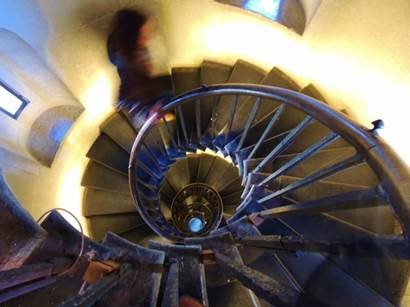
“Within is a spiral staircase with a total of 345 steps; after climbing 311 the staircase opens to a public balcony providing a fine view of the metropolis..” http://www.themonument.info/history/construction.html “Each step is exactly 6 inches high. The very top of the edifice has a hinged lid and the spiral staircase surrounds a void (rather than a solid shaft) so the whole height can be used by a giant pendulum, or as a telescope, or (and who doesn’t want to do this?) for dropping things. “ http://www.londonremembers.com/memorials/the-monument-west-and-north Actually walking up was so bad. Randal and I had been out doing chores so I had already stretched my legs by the time I had to climb the stairs. They are small steps making climbing up less strenuous, but coming down, I really had to watch my step as the rise wasn’t as I’m used to in standard American architecture. |
|
The Shard off in the distance |
|
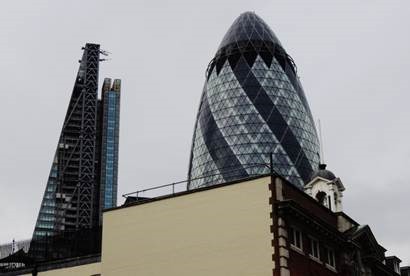
The Gherkin and the “Walkie-Talkie” building whose curved façade, during hot summer days, melted cars on the street below. “A London skyscraper dubbed the Walkie-Talkie has been blamed for reflecting light which melted parts of a car parked on a nearby street. What happened? It’s like starting a fire with a parabolic mirror. "Fundamentally it’s reflection. If a building creates enough of a curve with a series of flat windows, which act like mirrors, the reflections all converge at one point, focusing and concentrating the light," says Chris Shepherd, from the Institute of Physics. The half-finished 37-storey "Walkie Talkie"- nicknamed such because of its tapering rectangular design – is indeed a curvy building. Its design, which has also been compared to a brimming pint glass, has provoked controversy before. It transpires the car, a Jaguar on Eastcheap in the City of London, was parked at just the spot where the focused light landed. http://www.bbc.co.uk/news/magazine-23944679 Our guide said the design was supposed to have been a “money saving design modified from a more expensive plan” but now it’s costing them a fortune to fix the mess They should have followed the old British maxim, Penny wise, pound foolish.” |
|
The Thames and the Tower Bridge |
|
The ticket-taker was chilled but walking up and then down 311 stairs warmed me up. |
|
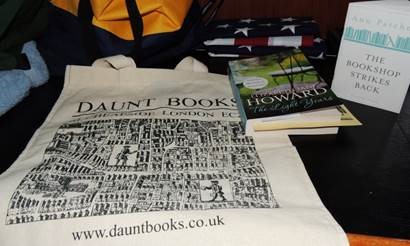
Randal held my new Daunt Book Shop bag while I climbed the Monument. |
|
Here I am back on DoraMac with my “I climbed The Monument” certificate which you receive as you leave. |
|
This is a great book shop! The Sunday Telegraph magazine had run a story about Elizabeth Jane Howard, who at 90, had just written the 5th book in her Cazalet Chronicles. The local libraries didn’t seem to have a copy on the shelves when I checked online so while we were out and about today, I bought Book One: The Light Years. And I also bought Ann Patchett’s small pamphlet The Bookshop Strikes Back about her own bookshop in Nashville and why she started it. My purchases were handed to me in this lovely Daunt Books cloth bag. The shop had a great collection and the guys who worked there were helpful and really well read. Super! |
Cheers.
Today I checked out my first library books at the Artizan Street Library Walking the London Blitz by Clive Harris and Walking London’s Docks, Rivers & Canals by Gilly Cameron Cooper. www.com does a Blitz walk and I do think that would be quite interesting. I love walking along the river and intend to visit the Docklands venue of the Museum of London one of these days.
Saturday Randal and I arrived at the Lord Mayor’s Parade in time to see the tail end go by, we’d overslept… but you can watch the whole thing if you’re so inclined at www.lordmayorsshow.org until November 16th. We did have a lovely visit Saturday afternoon from a N. Cyprus cruising pal who happens to be in England for a bit. Catching up on our lives since then was lots of fun. Sunday we did our second www.com tour of the historic square mile of London. Lots and lots to see and learn.
In this email I attempt to take you along on the www.walks.com Old Jewish Quarter tour. Some of the places are new, others I probably mentioned in the email about Petticoat Lane and Sandy’s Row Synagogue and Toynebee Hall. It’s a bit long, but there are no tests so feel free to read what interests you and skip the rest. That’s what I do.
Tomorrow morning is our first “cruisers coffee.” We already know Sue and Ed and have recently met Helen and Gus. Tomorrow we’ll meet the other folks who will be wintering here at SKD.
So that’s it.
Ru
www.walks.com THE OLD JEWISH QUARTER " a shtetl called Whitechapel “
“This walk traces the history of London’s Jewish community in the East End. It’s a story that embraces the poverty of the pogrom refugees and the glittering success of the Rothschilds; the eloquence of the 19th-century Prime Minister Disraeli and the spiel of the Petticoat Lane stallholder; the poetry of Isaac Rosenberg and the poetry-in-motion of Abe Saperstein’s* Harlem Globetrotters. Set amid the alleys and back streets of colourful Spitalfields and Whitechapel, it’s a tale of synagogues and sweatshops, Sephardim and soup kitchens.”
*Abe Saperstein. “You’re born in England where they hardly play the sport. You’re Jewish. You’re just north of five feet tall. Chances are you’re not going to make it into the basketball Hall of Fame. Yet Abe Saperstein, who was all these things, did just that. Saperstein saw a chance and he took it. In so doing, the unlikely hall of famer changed basketball forever.
Saperstein was born in London in 1902. When Abe was six, his father moved the family to America and opened a tailor shop in a mainly Irish and German neighborhood on Chicago’s North Side. The Sapersteins were the only Jewish family in the area. Young Saperstein threw himself into sports, running track and playing baseball and basketball through high school. By the time he reached college, however, his lack of height caught up with him. He was considered too short to play in basketball at the University of Illinois, and failed to make the team.
Saperstein dropped out of college and started work as a playground supervisor for the Chicago public parks system. He was assigned a job at a small park on the predominantly African-American South Side of Chicago…….you can read the rest of the story here about the London born, short Jewish guy who started the Harlem Glovetrotters. http://www.jspace.com/
Taking a walk through time to the old East End
The Jews may be gone but the memories remain in the streets where they lived.
By Monica Porter, November 11, 2011
The Jewish Chronicle
This is a really good description of the walking tour and I’ll cut and paste parts of it along with the photos I took during our tour.
|
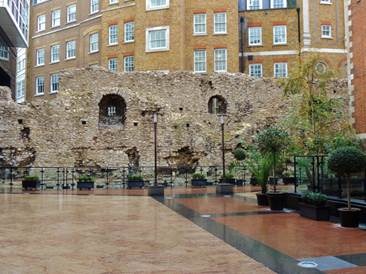
Remains of the Roman wall at Cooper’s Row our first stop of the walk just near our marina. COOPER’S ROW “In 1282 and up to 1750 known as Woodroffe Lane, from the old English word wuderofe = modern woodruff, a woodland flower. It commemorates the family of Woodroffe. David W. was Sheriff in 1554. Present name from owner of property.” http://www.maps.thehunthouse.com/eBooks/City_Street_Names.htm At this stop our guide Judy began to tell the history of Jews in England.
“How did the history of Jews in Britain start? It is a very long history. The first substantial Jewish community arrived in England after the Norman Conquest of 1066, although some historians suggest there was a presence in even earlier times. The Jews who arrived with William the Conqueror were merchants and bankers – they became an integral part of the early Norman period because Christians (much like Muslims today) were forbidden from lending money at interest. According to our guide Judy, interest rates were very high running up to 40% or even 60%. Lending money must have been a risky business but also lucrative as many Jews of these early years were quite wealthy. By the middle of the 13th century, there were substantial Jewish communities in London, Lincoln and York.” http://news.bbc.co.uk/1/hi/5076900.stm |
|
In 1290 Jews were “expelled” from England by King Edward I but were allowed to return in 1856 by Thomas Cromwell. {…the guide mentioned in the article} “launches into the story of the coronation of Richard I in 1189. Richard had issued an edict that there were to be "no women and no Jews" at his coronation, but a number of wealthy Jewish merchants turned up anyway. When they were recognized, they were beaten, many were killed, and this sparked a massacre of Jews in London and elsewhere. "Some Jewish usurers sought refuge in the Tower and the King said: OK, as long as the money keeps rolling in. Like a Mafia boss, he made them pay for protection. A century later, in 1290, King Edward I expelled the Jews from England." …..walking along Jewry Street (named after the Jewish community which settled in this area on their readmission to the country in 1656) and then on to Duke’s Place, where a plaque reminds us that the Great Synagogue once stood there. For centuries, this was the heart of Ashkenazi life in London, until the synagogue’s destruction in the Blitz. http://www.thejc.com/ There were no ruins to photograph and I didn’t even see the plaque. Our guide made the point of saying that the Sephardic synagogue we were to visit just down the street, Bevis Marks, miraculously survived intact! |
|
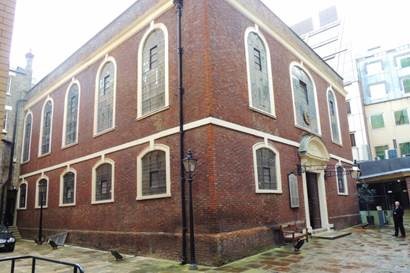
The oldest surviving synagogue in England opened in 1701 http://www.bevismarks.org.uk/ no photos allowed inside but the website is an excellent tour. I believe our guide Judy told us the real name of the synagogue was Gates of Heaven pointing to the Hebrew over the door which was “Saar ha-Samayim “ Bevis Marks is the name of the road where the synagogue is located and is the name everyone uses for the Synagogue. Out on a walk when we first arrived in London I had attempted to find the synagogue but all I could think of was Mavis Beacon, the typing lessons that I’d used during a summer typing course in 1967
|
|
“There is some confusion regarding the origin of the name of Bevis Marks, which dates back at least to 1407 in the form of "Bewes merkes." The name appears to have been derived from the Abbey of Bury St. Edmunds who possessed the property prior to 1156” http://www.cryptojews.com/england_and_bevis_marks_synagogu.htm And merks meant marks as in boundary markings. BEVIS MARKS SYNAGOGUE (known officially as the Synagogue Saar ha-Samayim) The oldest Jewish house of worship in London; established by the Sephardic Jews in 1698, when Rabbi David Nieto took spiritual charge of the congregation. At that time the worshipers met in a small synagogue in Cree Church lane; but the considerable influx of Jews made it necessary to obtain other and commodious quarters. Accordingly a committee was appointed, consisting of Antonio Gomes Serra, Menasseh Mendes, Alfonso Rodrigues, Manuel Nunez Miranda, Andrea Lopez, and Pontaleao Rodriguez. It investigated matters for nearly a year, and on Feb. 12, 1699, signed a contract with Joseph Avis, a Quaker, for the construction of a building to cost £2,750 ($13,335). On June 24 of the same year, the committee leased from Lady Ann Pointz (alias Littleton) and Sir Thomas Pointz (alias Littleton) a tract of land at Plough Yard, in Bevis Marks, for sixty-one years, with the option of renewal for another thirty-eight years, at £120 a year. http://www.jewishencyclopedia.com/articles/3236-bevis-marks-synagogue To avoid drawing attention to itself, the synagogue was designed to be similar architecturally to churches. It is also said to be very similar to the Great Synagogue in Amsterdam which Randal and I visited back in 2000. Maybe I remember. There are seven chandeliers in this synagogue, one for each day or the week and the large one in the center for the Sabbath. The chandeliers are lit with huge candles and on many occasions they are the only lighting which must be beautiful! Growing up in New Bedford with its large Portuguese population, I had many classmates with names like Mendes, Rodriques, Lopez etc but they weren’t the Jewish kids. They were the “Portuguese” kids. It’s what made New Bedford such a great place to grow up. All the variety of people. |
|
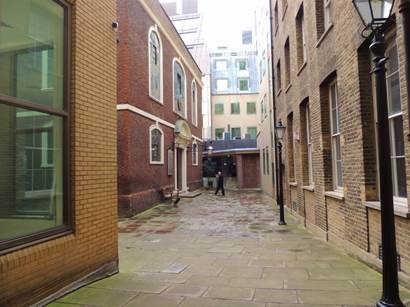
A group of school kids was just finishing a tour as we arrived. Many were Muslim kids and Maurice told us his favorite part of any tour was showing the school kids what all religions had in common. He believed that was one of the most important aspects of offering the synagogue tours. He said the kids had asked great questions and all of us were sorry we hadn’t been there to hear them. You can see the gate leading into the courtyard where the synagogue is located. Jews were forbidden to build synagogues on the street. “Maurice Bitton, the shamash of Bevis Marks, welcomes { us } into the beautiful building, which dates from 1701. Tucked away in a courtyard, because Jews were not allowed to build on public thoroughfares at the time, it is virtually unchanged since it was built. The great brass hanging candelabra, austere dark oak benches, magnificent ark – everything is original. (sorry but you have to go to their website to see as no photos were allowed inside the synagogue.) Bitton recounts with relish the history of the Sephardi synagogue, and regales us with tales of the congregation’s most famous son, the 19th-century philanthropist Sir Moses Montefiore. He shows us the great man’s seat, now roped off. The congregation has shrunk since then, but Bitton says it is starting to grow again, as young Jews move back into the area. (Honored guests such as Prince Charles and Prince Philip are allowed to sit in Sir Moses’ chair. But the current Lord Mayor of London Fiona Woolf, would not be allowed to sit there. Sir Moses’ chair is downstairs in the men’s section of the synagogue. Fiona would have to sit upstairs. It will be interesting to see if this dilemma will ever have to be dealt with, either for Fiona or a future female Lord Mayor. I guess even the Queen would be refused Sir Moses’ seat though I’m sure everyone who deals with the Queen’s schedule would already know of this so the problem would never arise. During the tour women could sit downstairs, but not during a service.) For me, ( me being the author of the Jewish Chronicle article) the visit brings back memories. In the 1970s, long before the City was redeveloped, I worked for a magazine whose creaky Dickensian offices overlooked this synagogue. On dusky winter evenings, I peered down through its windows into the warm, candlelit glow, mesmerized by the sound of chanting. Moses Montefiore was married to Judith Barent-Cohen. Before we could ask, Maurice told us that “Borat” Sasha Baron Cohen was a relative of Judith’s. (I can’t prove that to be true from Internet research, but one would think Maurice would know. Perhaps a more distant relative than I initially thought.) http://www.thefreelibrary.com is a really interesting article about the Baron-Cohen family and life for Jews in England as well as telling about this extraordinary family. No mention was made of Judith Barent-Cohen or Moses Montefiore. |
|
A plaque of Jewish war dead who were members of the congregation, many with Portuguese/Spanish sounding names as this is a Sephardic Synagogue. |
|
Looking back towards the synagogue and kosher Restaurant 1701, the low roofed building next door. Originally there were other building here that supported the Jewish community but those are now gone. http://www.restaurant1701.co.uk/
http://www.independent.co.uk/. The reviewer and his pal each paid £80 for their full meal with wine. It would take a hugely important occasion to get Randal and me there. We’d rather spend it on books, more or www.walks.com . |
|
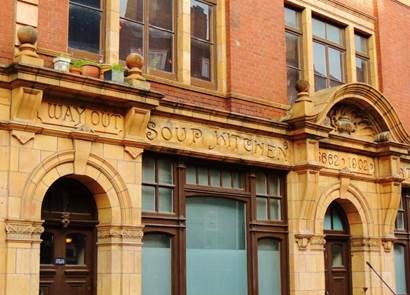
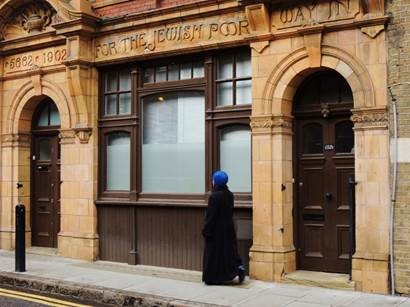
Jewish soup kitchen for the poor; not a 70s psychedelic restaurant. But then that would probably be “far out” rather than “way out.” It just struck me funny: Way Out Soup Kitchen.
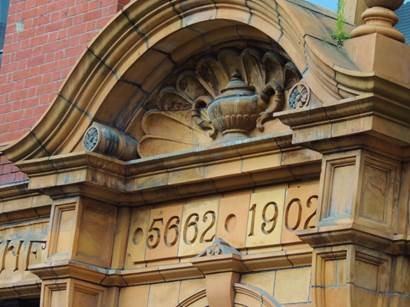
A sign of the changing population ; though Jewish women in 1902 may well have covered their heads as it was an orthodox custom for married women to cover their heads with a shawl or even a wig.
Over the door is the image of a soup pot for people who spoke and read Yiddish but couldn’t read English. The date is written for both the Jewish calendar and the western calendar. |
|
Brune Street @www.ravishlondon.com “Brune Street is a small street in Spitalfields, interesting just because of the way it captures the Jewish past of Spitalfields, with the Bengali present. On one side of the road you’ve got the old Jewish soup kitchen for the poor and then on the right you’ve got the Brune Street Estate, where all the signs are written in English and Bengali……. The building remained empty for years. Now, whilst the sandstone facade remains faithful to its origins, the building itself has been converted into luxury apartments.” To the left of the soup kitchen was the Jewish Free School. http://www.jfsalumni.com/history/?disp_feature=llaOdp tells you all about it and its connection with the Rothschild family. According to my Jewish London book, this school, by the early 1900s, was the largest in Europe with over 4,000 pupils. It still exists today. But, more interesting is one school that I believe was near the Bevis Marks Synagogue run by nuns. There being so many Jewish students, those amazing nuns learned Yiddish so they could teach the children in the only language they knew. |
|
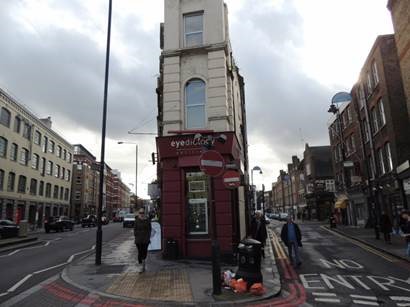
This scene just grabbed my attention. The skinny building looks like it should be in a Harry Potter movie. Sunday, during another walks.com tour we actually did walk through the setting used for the shops where Harry buys his magic wand and other “school supplies.” |
|
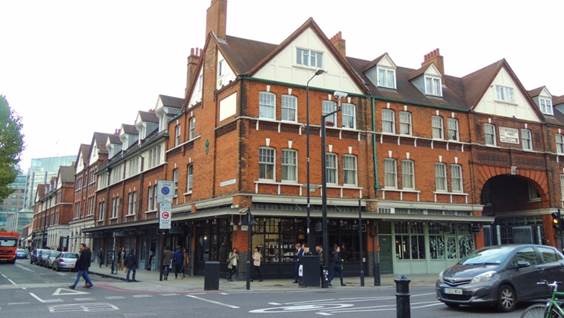
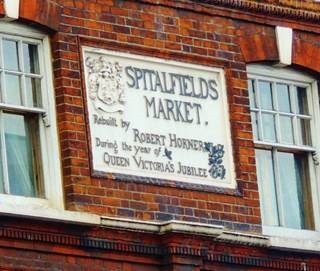
The Victorian Market From its small beginnings in the 17th Century, Spitalfields Market blossomed. Traders working from a collection of sheds and stalls did their best to meet the needs of London’s rapidly growing population and their appetite for fresh fruit and vegetables. Their success made Spitalfields Market a major centre for the sale of fresh produce, trading six days a week. Spitalfields fell into decline after the 1820’s and gained a reputation as cheap area in which to live, proving a magnet to numerous waves of immigrants. By 1876 the market had fallen into decline. Recognizing the need to update the market, a former market porter called Robert Horner bought a short lease on the market and started work on a new market building which was completed in 1893 at a cost of £80,000. In 1920 the City of London acquired direct control of the market, extending the original buildings eight years later. For the next 60 years, Spitalfields’ nationwide reputation grew, as did the traffic congestion in the narrow streets around it. With no room for the expansion it so badly needed, the market was forced to move and in May 1991 it opened its doors at its new location in Leyton, east London. At the end of 2005, after 18 years of sensitive preparation, the Spitalfields regeneration programme was completed. This regeneration has resulted in the creation of two new public spaces, Bishops Square and Crispin Place, a public art programme, an events programme, the restoration of several historic streets in E1 and a selection of carefully selected independent retailers and restaurants. A visitor to the market today will find designers / makers and artists selling fashions, homewares and accessories or a treasure trove of vintage and antique clothing, furniture and other wondrous oddments! Spitalfields is no longer considered just a Sunday destination it has evolved into one of London’s favourite and most vibrant areas. http://www.spitalfields.co.uk/about_history.php#.UoEgi0rFJdg
“Brune Street Estate takes its name from Walter Brune, who in 1197, founded a hospital in the local area on what was then fields, which became to be known as hospital fields and then Spitalfields.” |
|
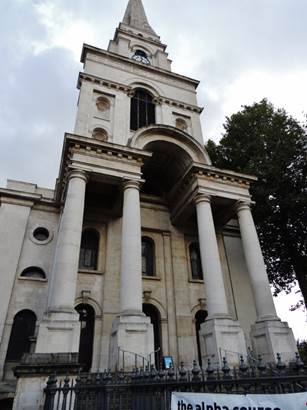
“Christ Church was built between the years 1714 and 1729 as part of the church building programme initiated by the Fifty New Churches act of 1711, backed by Queen Anne, which was implemented by four different Commissions. At the time, there were fears that ‘godless thousands’ outside the City of London had no adequate church provision, and that non-conformists – including large numbers of French Huguenot silk weavers – were moving into Spitalfields and bringing their non-conformist worshipping ways with them. The Commission appointed to build the 50 new churches stipulated that the new buildings should have tall spires so that they would tower above the smaller, non-conformist chapels! The idea was to fund the work through taxes on coal coming into London, although monies ran low in about 1719 and building progressed fitfully. One of the two surveyors employed by the first Commission, at an initial rate of £200 per year, was Nicholas Hawksmoor – a Nottinghamshire-born architect who had worked with Sir Christopher Wren since his late teens. Of the 12 churches completed (out of the projected 50), six were the work of Hawksmoor, and Christ Church was his masterpiece. “ http://ccspitalfields.org/history/
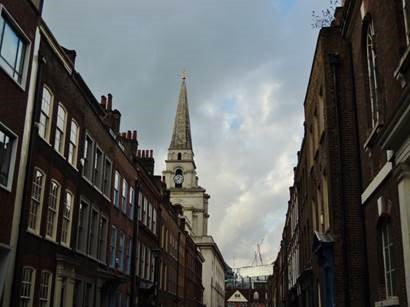
Christ Church towering over the homes of the French Huguenots. |
|
Immigration and Emigration The world in a city http://www.bbc.co.uk/legacies/immig_emig/england/london/article_1.shtml Tells the story of the how these streets changed with each wave of immigration: Hugeunots to Jews to Banladeshis to Somalies |
|
Silk weaving was done in the attic rooms located in the recessed windows topping the buildings. “The wooden spools that you see hanging in the streets of Spitalfields indicate houses where Huguenots once resided. These symbols were put there in 1985, commemorating the tercentenary of the Revocation of the Edict of Nantes which brought the Huguenots to London and introduced the word ‘refugee’ to the English language. “ http://spitalfieldslife.com/2013/04/14/the-huguenots-of-spitalfields/
Wooden spool between two windows |
|
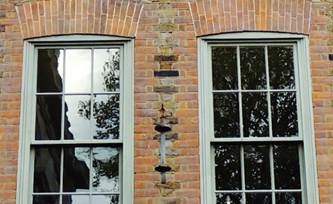
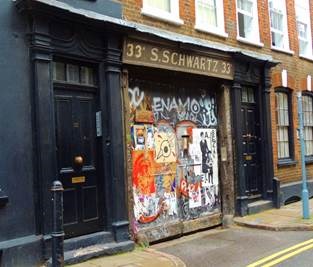
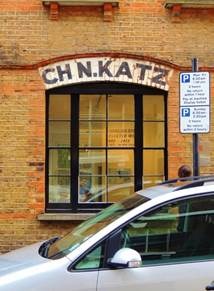
Many buildings now retain the names of the original businesses housed here. At number 92 Brick Lane you can see the CH N. Katz shop that had sold paper bags and string until sometime in the 1990s. Now it’s an art gallery. |
|
|
|
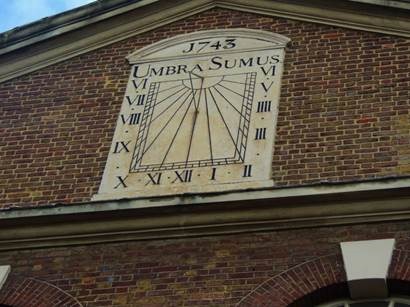
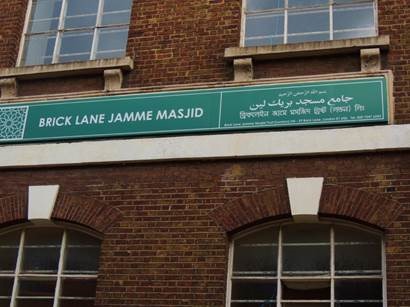
Umbra Sumus We are under the shadows, the sundial dated 1743, place there when the Huguenots erected this building as their church, now the Brick Lane Jamme Masjid (mosque.)
“The Jamme Masjid or Great London Mosque on the corner of Brick Lane and Fournier Street. This building is a perfect illustration of the East End’s role as the point of entry for immigrant groups. It was originally founded as a church for Hugenots – French protestants who fled to London to avoid persecution at home. The chapel was later used by Methodists. In the late 19th century, when Whitechapel became the centre of the Jewish East End, it became the Machzike Adass, also known as the Spitalfields Great Synagogue. With the dispersal of the Jewish community and a new influx of Bengali immigrants, it became the Jamme Masjid or Great London Mosque in 1976. “ Creator: Andrew Holt Credit line: National Maritime Museum “It is often said that Spitalfields, like much of Tower Hamlets, is overcrowded, one of the reasons being the mismatch between the size of Bangladeshi families and the size of family the apartments they live in were designed for. There are a number of mosques in Spitalfields. One of a particular note is the ‘Jamme Masjid’, the history of which mirrors immigration into Spitalfields perfectly, having been previously a synagogue and originally a French Protestant chapel. It is, and could be used for, a metaphor for how religious communities can get on side-by-side in a pragmatic way. The building has been a mosque for the last thirty years. The Brune Street Estate, at least on a Wednesday afternoon in winder, is a sleepy peaceful estate, populated it seems mainly by Bengalis who make up 60% of the Spitalfields suburb. A lot of the signs around the estate are written in English and Bengali. Although the Bengalis arrived in London in the 1970s and 1980s unemployment in their community still runs high, with one source quoting it as high as 30%. For this reason some of the men have quite a lot of time on their hands, and you can see a number at the local mosque located in the community centre on the east side of the Brune Street estate.” |
|
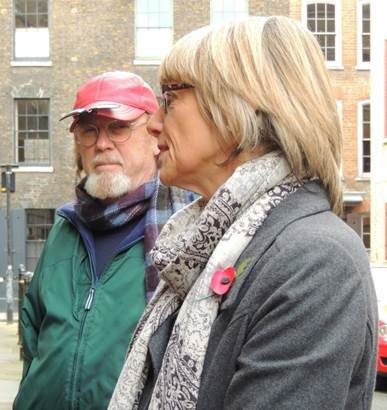
Our guide Judith wearing a poppy to commemorate Remembrance Month “The eleventh hour of the eleventh day of the eleventh month marks the signing of the Armistice, on 11th November 1918, to signal the end of World War One. At 11 am on 11 November 1918 the guns of the Western Front fell silent after more than four years continuous warfare. Remembrance Day is on 11 November. It is a special day set aside to remember all those men and women who were killed during the two World Wars and other conflicts. At one time the day was known as Armistice Day and was renamed Remembrance Day after the Second World War. Remembrance Sunday is held on the second Sunday in November, which is usually the Sunday nearest to 11 November. Special services are held at war memorials and churches all over Britain.” http://resources.woodlands-junior.kent.sch.uk/customs/Remembrance.html#last |
|
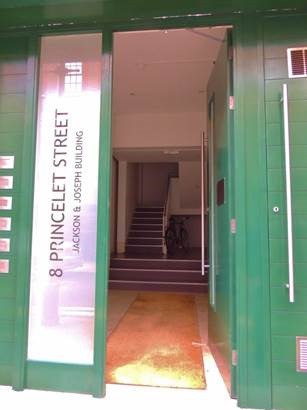
There is no disputing that London’s West End reins supreme in Britain’s theater world. However, there was a time when the East End was renowned for its Yiddish theatrical productions. East London’s first theater group was called the Hebrew Dramatic Club. Located at 6 Princelet Street, this drama club began operating in 1887 under the auspices of David Smith, a kosher butcher. "But in 1888," says Bettington, "17 people died when someone wrongly shouted ‘fire,’ and the audience stampeded for the exit. It closed shortly afterwards." However, if you walk down the street you’ll know you found it when "you see a coal hole cover with a viola on it," http://www.jpost.com/Travel/Around-Israel/Jewish-East-Enders |
|
Our guide connected this address to Norman Adler who helped bring Yiddish Theatre to London. Norman Adler was the father of Stella Adler, acting teacher of such well known actors as Marlon Brando, Robert De Niro, Warren Beatty, and Candice Bergen. |
|
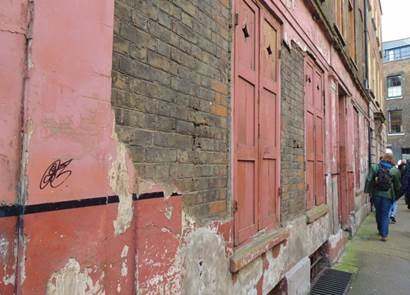
Judith pointed this out as one of her favorite building and one of the few buildings on Princelet Street that hasn’t been refurbished on the exterior though the interior is in excellent enough condition. Because of both exterior and interior it is a favorite location of the film industry. |
|
The Shard and the Gherkin not far from Bevis Marks Synagogue A “Jewish Joke” http://www.thejc.com/ “From here, we head for the highlight of the tour, a visit to the country’s oldest surviving synagogue at Bevis Marks. The vaguely phallic-shaped office block known as the Gherkin, towers above us and Shaughan recalls an elderly Jewish lady on an earlier tour who bemoaned the fact that it was built so near the historic synagogue. "It’s all right, dear," Shaughan told her, "it’s been circumcised." |
“Life in the cool lane” of London’s East End….
“These days, Brick Lane and the surrounding streets are home to writers, artists, stylists and photographers. "I love living here," says Lulu Kennedy, creator of Fashion East, which helps young designers stage shows during Fashion Week. "I can stay in the area for weeks because there’s so much to do." Tracey Emin and Gilbert and George live in the conservation area made up of Fournier Street, Hanbury Street, Wilkes Street and Princelet Street. These are the top-dollar houses everyone lusts after.
"The Georgian houses can fetch anything from £800,000 to £1.2 million," says Simon Stone of Bridge estate agents. "People want to move here because it’s vibey as well as gentrified." And, of course, where you find arty people and nice houses, you find good shopping. Brick Lane isn’t just famous for its curries and bagels any more – it’s also a weekend shopping hot spot.
On Sundays, Brick Lane, Cheshire Street, Sclater Street and Bacon Street are all taken over by the market, which has been going strong since the 18th century and sells bric-a-brac, vintage clothes and furniture.” http://www.standard.co.uk/
Cheers,
Whew it was a quick trip home! Sort of like, “now you see them, now you don’t.” We only saw some of you this trip, but maybe one of these days we’ll be back to stay. Our flight was on time, comfortable and our luggage arrived with us. On the plane with us was a harpist group of school girls from England who had performed for former President Clinton, Barbara Streisand and the British Ambassador. I had a lovely chat with one of the younger members while we waited in line for the “lavatory.” She was sweet, articulate, polite and interested in me as an American. Never mind the VIPs at the concerts, her favorite part was staying with host families. How’s that for getting your priorities straight. Our “tube” trip back to London was crammed full though getting on at an early stop allowed us to have seats. Getting through the crowd with our luggage to get off was a bit tricky. But lots of folks were helpful and no one was rude or unpleasant to us though they weren’t so pleased when their fellow Brits crowded them. One stop early on saw several school boys get on and I had the sensation I was in the first Harry Potter movie. And a formal British accent from the mouth of a 10 year old seems comical to me.
Oh, and by the way, while in Roanoke we signed a contract to purchase 100 acres of land on Little Brushy Mountain in Roanoke County. The i’s should be dotted and the t’s crossed by November 18th. Until that happens we’re not counting our trees or dreaming up house plans. (Well actually Randal is, though we know contracts aren’t valid until every page or every document has been signed.) But if all goes as planned we will begin to look for new owners for Doramac. When we started this adventure we said, 5 to 10 years so 2014 will be about the middle. Until she is sold, we’ll keep cruising along, at least for another year or so. But if the perfect owner comes along November 19th, so be it.
We have joined the Friends of Saint Katherine’s Dock and will also take part in the small, informal cruisers group that began while we were at home. The cruisers meet for coffee Tuesday mornings and the Friends on Wednesday. Also I have discovered www.walks.com and will try to do at least one each week.
So that’s what’s up. Next email will have some photos as we get out and about.
Ru
Cheers,
We’re mostly packed up and ready to go; our flight home tomorrow. We’ll set out tomorrow at noon; our flight is 4ish, the tube trip about an hour. Our pals Sue and Ed scouted out the best route to Tower Hill Tube station with the fewest steps. As we can each bring a 50 lb suitcase, it’s an opportune time to carry home the two wool carpets we bought in Turkey from the carpet ladies. We might actually have more company this winter so we need to clear off the space in the front cabin. Other stuff will go to Oxfam and other charities when we come back.
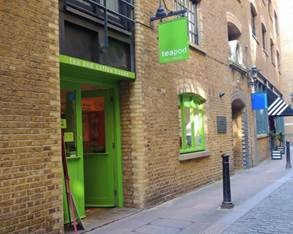
While Singkey was here we decided to visit the Tea Pot for a traditional British tea. (Not only a drink but a small meal.) From the Tea Pot we walked to the Design Museum, also on Shad Thames and then along the river to Rotherhithe where we ate lunch at the Ship Pub. Lots of interesting bits to see along the way; too many for even this second “wharf” email.
This email takes us back to London of Dickens but also to today, the time of designer Terence Conran.
Ru
|
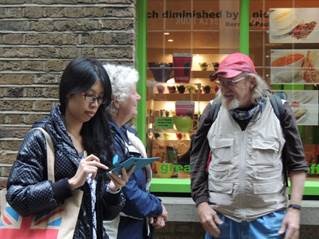
Our first stop, the Tea Pot for scones, clotted cream and tea! Singkey, Sue and Randal, Ed was also taking photos.
Stretched out panorama of the tea shop with the 4 minute green clock. Your tea is brought to the table and you’re told to watch the clock. Only after 4 minutes should you drink it. Does it work? I actually hadn’t heard the waitress so was unsure when my 4 minutes began. But now that I’ve a small tea pot on the boat, I do wait longer before I actually pour the tea. Interestingly, the shop uses tea bags rather than loose tea. |
|
http://designmuseum.org/ founded by among others, Terence Conran We stopped in to look at the Design Museum museum shop. Lots of interesting things. |
|
“Human” book ends but they do take up shelf space |
|
Pop-up books. |
|
On my later wharf walk I came across Conran Designs totally new to me. |
|
Mass production doesn’t have to = ugly. |
|
Not such a new idea really : I ’ll have to look at Penney. Hopefully they’ve changed the stores back to what they once were. The new layout was awful. I once read something that said mass production introduced ugliness because prior to that, each hand-made product met the specific needs of an individual. Mass produced goods met no individual needs; individuals had to adapt to the product, no matter its color, shape or design. Today, because people are encouraged to want lots of stuff, only mass produced products are affordable. And today, most work/life styles don’t match with wardrobes of expensive clothes or handcrafted everyday household items. I’m certainly not careful enough with stuff though I now think “ fewer and better” because “more” takes up too much space. |
|
This is an abstract from : The Atlantic Monthly | August 1927 ……….”Up to the beginning of the great industrial era of machine-made things, mass production, nation-wide distribution and advertising, most of the implements and furniture with which we performed the act of living were made by hand, and things made by hand unconsciously acquire a certain element of beauty. Consider how satisfying are the shapes of some of these old things—a coach, for instance, or a spinet; a sickle or a ladle. The humblest utensils of our grandfathers are preserved in museums to-day, partly, of course, for the historic associations, but mainly because they have a certain charm. And gradually all that charm vanished. The hand worker who controlled every step of the thing he was making was replaced by a machine minder who had nothing to do with the design. The directing minds, absorbed in the new wonder of so many things made so easily, ignored the fact that it was just as easy for a machine to stamp or print a good pattern as a bad one, and by some perversity nearly always chose the bad one, and aggravated that fact by producing the bad design in incredible quantities. The public, tickled to get so many things so cheaply, accepted them without question, and thus, we had a depressing period when, in New York City, brownstone houses were built literally by the mile, and country houses were of two stories, mansard roof, and cupola, with cast-iron dogs and deer on the lawns, and furnished with horsehair sofas, flowered Brussels carpets, gilt-embossed wall paper, and ormolu clocks under glass bells on the mantelpieces above imitation fireplaces. We passed from the hand to the machine, we enjoyed our era of the triumph of the machine, we acquired wealth, and with wealth education, travel, sophistication, a sense of beauty; and then we began to miss something in our cheap but ugly products. Efficiency was not enough. The machine did not satisfy the soul. Man could not live by bread alone. And thus it came about that beauty, or what one conceived as beauty, became a factor in the production and marketing of goods. http://www.theatlantic.com/past/docs/issues/27aug/calkins.htm |
|
A commercial for was being filmed. No issues with fur in this neighborhood, once the poorest of the poor! |
|
The River Neckinger The Neckinger is one of the ‘lost’ rivers of London which now runs entirely underground, probably merging into the present drain or sewer systems. It rises in Southwark and originally entered the Thames at the tidal inlet now called St Saviour’s Dock ("Savory Dock" on older maps). The river is believed to have got its name from the term "Devil’s neckcloth", a hangman’s noose. Until the 18th century, Thames pirates were executed at Neckinger Wharf, near the mouth of the inlet. The corpses were placed on display as a deterrent further downstream on the Thames. St Saviour’s Dock was created in the 13th century by the Cluniac monks of Bermondsey Abbey (founded 1082, ¾ mile to the south-west, Figs 7 and 8) who enlarged and embanked the inlet, naming the dock after the abbey’s patron, and built and ran a windmill on its East bank, The Mill of St Saviour. Around 1536 (after the dissolution of the monasteries) the windmill was converted into a water mill and "water machine" to supply local inhabitants with water. It later became the first gunpowder factory in England to be powered by water, and later still it was rebuilt as a paper mill, becoming one of the first mills in England to make paper from straw. By Dickens’ time, lead mills occupied the site. It was a tidal mill, and the flow of water was two-way. At 12-hourly high tides (the Thames could rise as much as 12′ at this point) water, controlled by slice gates, flowed into the mill pond south of the mill. The sluices were closed and re-opened at low tide to allow the water to flow out again via the mill races and drive the mill wheels. http://www.hsomerville.com/meccano/Articles/JacobsIsland.htm |
|
|
|
Jacob’s Island : "The Venice of Drains", "The Capital of Cholera" and "The Jessore of England". It first came to fame when immortalized as the location of Bill Sikes’ last refuge in "Oliver Twist". Dickens wrote, in 1837: "Near to that part of the Thames on which the church at Rotherhithe abuts, where the buildings on the banks are dirtiest and the vessels on the river blackest with the dust of colliers and the smoke of close-built low-roofed houses, there exists the filthiest, the strangest, the most extraordinary of the many localities that are hidden in London, wholly unknown, even by name, to the great mass of its inhabitants. ‘Beyond Dockhead, in the Borough of Southwark, stands Jacob’s Island, surrounded by a muddy ditch, six or eight feet deep and fifteen or twenty wide when the tide is in, once called Mill Pond, but known in the days of this story as Folly Ditch. It is a creek or inlet from the Thames, and can always be filled at high water by opening the sluices at the Lead Mills from which it took its old name. At such times, a stranger, looking from one of the wooden bridges thrown across it at Mill Lane, will see the inhabitants of the houses on either side lowering from their back doors and windows, buckets, pails, domestic utensils of all kinds, in which to haul the water up; and when his eye is turned from these operations to the houses themselves, his utmost astonishment will be excited by the scene before him. Crazy wooden galleries common to the backs of half a dozen houses, with holes from which to look upon the slime beneath; windows, broken and patched, with poles thrust out, on which to dry the linen that is never there; rooms so small, so filthy, so confined, that the air would seem too tainted even for the dirt and squalor which they shelter; wooden chambers thrusting themselves out above the mud, and threatening to fall into it, as some have done; dirt-besmeared walls and decaying foundations; every repulsive lineament of poverty, every loathsome indication of filth, rot, and garbage; all these ornament the banks of Folly Ditch. ‘In Jacob’s Island, the warehouses are roofless and empty; the walls are crumbling down; the windows are windows no more; the doors are falling into the streets; the chimneys are blackened, but they yield no smoke. Thirty or forty years ago, before losses and chancery suits came upon it, it was a thriving place; but now it is a desolate island indeed. The houses have no owners; they are broken open, and entered upon by those who have the courage; and there they live, and there they die. They must have powerful motives for a secret residence, or be reduced to a destitute condition indeed, who seek a refuge in Jacob’s Island." http://www.hsomerville.com/meccano/Articles/JacobsIsland.htm http://www.archaeology.co.uk/articles/news/digging-jacobs-island.htm a more scholarly article from the UK’s “current archeology” magazine http://www.infed.org/socialaction/charles_booth_jacobs_island.htm |
|
Dickensian The world around us has become more Dickensian lately. At least that’s how it seems by the way the word circulates. Put it into a Google news search, and you’ll see a sampling. Here’s what I got when I did: Dickensian waif Dickensian melodrama Dickensian boarding school Dickensian evening Dickensian Christmases Dickensian schemes Dickensian arm-loss (!) Dickensian nightmare (of American health care) You might even be Dickensian without having realized it. The Oxford English Dictionary tells us the word came into use in the 1880s and defines it as: "of or pertaining to Charles Dickens or his style." Recently it could also have been defined as "of or pertaining to The Wire or Bernie Madoff," both of which were pasted to the word for the last few years. I wonder who uses the word more, Americans or the British. I’d guess Americans. The word may be the equivalent of an English accent, which we Americans tend to think raises IQ points, a tendency that in turn makes the British question our IQs. Surprisingly, it was not an American but a British company that opened an amusement park in 2007 called Dickens World, located in the English county of Kent, complete with an Ebenezer Scrooge Haunted House, a Great Expectations Boat Ride and the as-advertised "costumed Dickensian characters." Seriously. Alongside "Dickensian," the OED lists "Dickensy" as one of the original words used for the same meaning, but now in disuse. That word would probably be less tempting to use so often because it doesn’t make you sound as smart. "Yes, I agree this movie is very Dickensy." When it comes to referring to Dickens’s life, performing plays with your nine children for friends and family during Christmas is Dickensian. Banishing your wife from the family estate while beginning a romance with an eighteen-year-old actress also counts as Dickensian. Considering what a prolific writer Dickens was, the word Dickensian could legitimately cover a vast thematic territory, explaining at least some of the variety of its applications. It’s probably most often used for social issues, as in some of the Googled examples. Yet we don’t tend to read Dickens’s pure social novels that much anymore, such as Hard Times, at least not voluntarily. Dickens’s final book, The Mystery of Edwin Drood, forms the jumping-off point for my new novel, The Last Dickens. This last work by Dickens has very little social commentary, and a pretty tightly efficient storyline and cast of characters. Not necessarily what we think of when we think what characterizes Dickens. He died while the novel was still being serialized and it remains incomplete, so we don’t know how it would have ended. Thousands of articles and hundreds of books have been written speculating on the ending, with different camps heatedly arguing over it. After years of making a study of his final novel, I can state one thing with certainty about how it would have ended: it would have been really really Dickensian. Make a point of using the word Dickensian in a sentence today. See how people respond, and whether they take its meaning for granted. Matthew Pearl. Author of The Dante Club, The Poe Shadow and The Last Dickens. Posted: November 24, 2009 11:32 AM Are You Dickensian? |