Portsmouth continued

Cheers,

   Saturday I joined a walking tour in Bloomsbury based on several “Sketches by Boz” and luckily I’d actually read one of them that morning.  Sunday Sue and Ed Kelly, Sue Ross and I went mudlarking on the Thames looking for treasures.  We had no license so we were only allowed to pick up what was visible and not “dig” for anything.  It was lots of fun and I’ll write about it when I’ve finished with Portsmouth.  That may not be for a bit as a cruising pal is coming to visit for a few days so we’ll be out and about. 

   In the meantime I hope all of you can avoid as much of the bad, cold weather as you can.  Ours has actually been lovely the past several days and hopefully will continue while Valerie is here visiting.

Ru

      During our visit to Portsmouth we visited the HMS Victory, The HMS Warrior and The Mary Rose Museum.  There were also buildings dedicated to the Royal Navy and Lord Nelson.    But my favorite was the  Antiques Storehouse where I bought an old black and white postcard  showing Tower Bridge and the Tower of London taken from The Monument.  I’ll have to compare it to the photos I took from up top or I might have to climb up again to check how different the view is today.  I’m not actually sure of the postcard’s date and will have to see if I can find that out. 

“The largest antiques centre on the South Coast.  Situated in Storehouse 9, you will find 6,000 sq feet of stunning and quirky antiques, art and collectables. We always exhibit:

•400 paintings and etchings from the 17th to 20th Century

• Classic furniture covering early English oak to Victorian

•Ceramics and glassware such as vintage Royal Doulton, Lalique, Beswick, Goss and Staffordshire

•Militaria including antique swords, black powder weapons, cannons, de-activated guns, badges and uniforms

•Maritime items featuring original ship binnacles, telegraphs, wheels, model ships and Titanic artefacts

Plus jewellery, antiquities, early toys, bronzes and so much more!”

http://www.historicdockyard.co.uk/dockyard-shopping.php

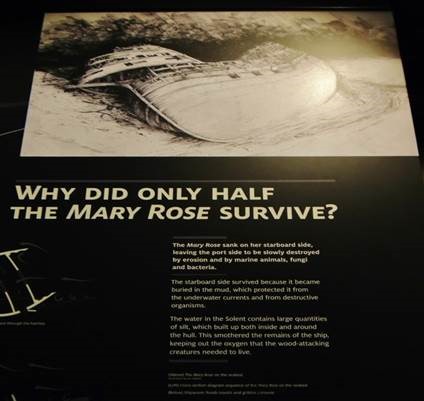
The Mary Rose

      The Mary Rose had a tragic ending but was ultimately half saved by the mud she sank into. 

“The Mary Rose is a Tudor ship, built in 1510.

In service for 34 years.     Sank in 1545.     Discovered in 1971.

Raised in 1982.     Now in the final stages of conservation, she takes her place in a stunning and unique museum”   http://www.maryrose.org/

clip_image001

http://www.maryrose.org/  explains why she sank in the first place:  Human Error, The Winds, The French, or Oveloading are all offered as possible explanations. 

clip_image002

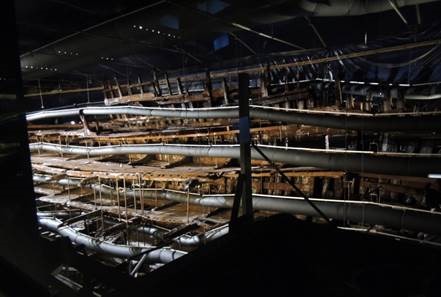
Remains of the Mary Rose

clip_image003clip_image004

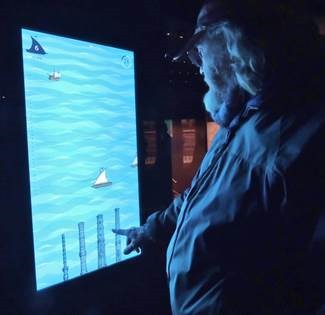
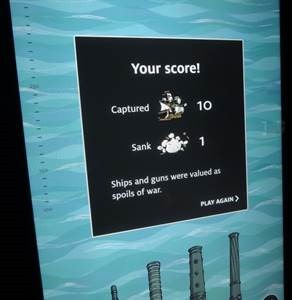
A touch screen test to see how many ships you could capture rather than sink. 

On our first tries Randal and I each sank a bunch but only captured 4 ships.  On his second attempt Randal captured 10!  The point was to capture the ship as a spoil of war.

clip_image005

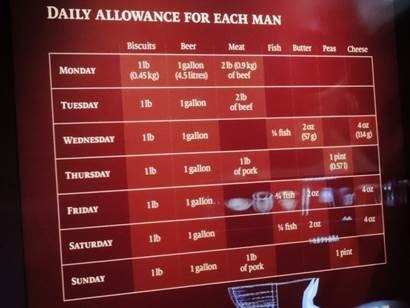
Mary Rose menu

No meat on Friday was interesting to me as England by then was a Protestant country under Henry VIII.

(But that’s a whole other long complicated issue I’m not getting into here.)

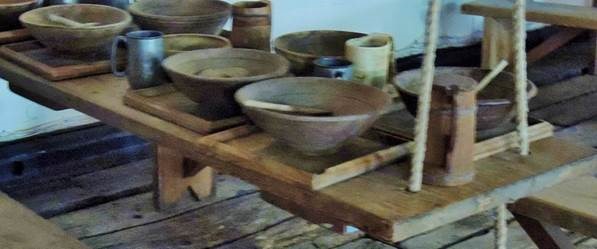
“Fine pewter dishes, plates, tankards and spoons were found on the wreck, which were probably used by the officers. However, the site also contained lots of wooden bowls, dishes, plates and tankards, which are an extremely important find as these kinds of everyday domestic objects were normally just thrown away rather than kept for posterity.

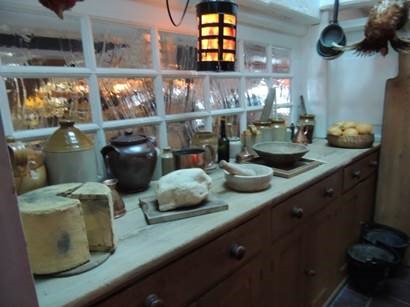
In the galley, down in the hold just in front of the step for the main mast, were two massive brick ovens. The crew’s food was cooked here in two large cauldrons supported on iron bars over a fire box. Smaller bronze, iron and ceramic cooking pots were also found nearby.

The excavation also found casks containing meat bones, both cattle and pig. It looks as if the animals were butchered to meet certain standards – for instance, there were no marrow bones as presumably they would have gone off more quickly than other bones.

The food remains were analysed early on in the excavation and give historians an invaluable insight into how much food was needed to run a ship like the Mary Rose.

The findings have enabled ‘experimental archaeology’, where experts recreate the cooking facilities and the type and variety of meals that might have been on the Mary Rose. “

www.maryrose.org/

clip_image006

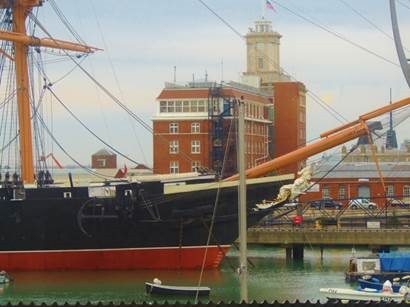
http://www.hmswarrior.org/  seen from the café

clip_image007

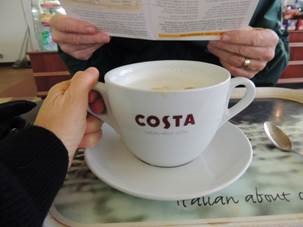
After our very chilly visit on the HMS Warrior we shared this giganto cut of caramel latte.   There was no organized tour so we just wandered around..no so very interesting to me. 

HISTORY

   Warrior was designed and built in response to an aggressive French shipbuilding programme which saw the introduction of the first iron-clad warship La Gloire designed by the brilliant naval architect Stanislas Charles Henri Dupuy de Lome.

     Determined to see off this challenge to the supremacy of the Royal Navy the then First Lord of the Admiralty, Sir John Somerset Pakington, determined to build a ship so superior in terms of quality, speed, size, armament and armour that it would be inconceivable to France that she could take Britain on in a sea battle.

     When commissioned by Captain the Hon. Arthur Auckland Leopold Pedro Cochrane, on August 1st 1861, Warrior was the largest warship in the world, at 9,210 tons displacement she was fully 60% larger than La Gloire.

     The ship underwent minor modifications after a sea trial. In June 1862, she started active service in the Channel Squadron, patrolling coastal waters and sailing to Lisbon and Gibraltar.

     Having introduced a revolution in naval architecture, by 1864 Warrior was superseded by faster designs, with bigger guns and thicker armour. By 1871 she was no longer regarded as the crack ship she had once been, and her roles were downgraded to Coastguard and reserve services. In May of 1883 her fore and main masts were found to be rotten, and not considered worth the cost of repair, Warrior was placed in the reserve, eventually converted to a floating school for the Navy and re-named Vernon III in 1904.

Put up for sale as scrap in 1924, no buyer could be found, and so, in March 1929 she left Portsmouth to be taken to Pembroke Dock and converted into a floating oil pontoon, re-named again as Oil Fuel Hulk C77. By 1978, she was the only surviving example of the ‘Black Battlefleet’ – the 45 iron hulls built for the Royal Navy between 1861 and 1877.

http://www.hmswarrior.org/history

clip_image008

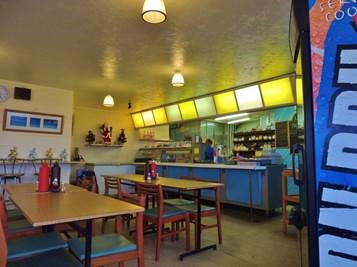
Our view from breakfast at the bus/train station Café! 

They do great eggs, toast and tea  just down the street from the Dockyards.  You can see some of the Warrior and the Dockyard Buildings.  You can also see a flag on the top of the photo.  It’s an American flag which is flown out of courtesy for the American Nuclear Sub, the Missouri which was in port for a visit.    More about that next email with the photos from our short harbor tour. 

clip_image009

By our second day we were regulars and by the third morning…..

clip_image010

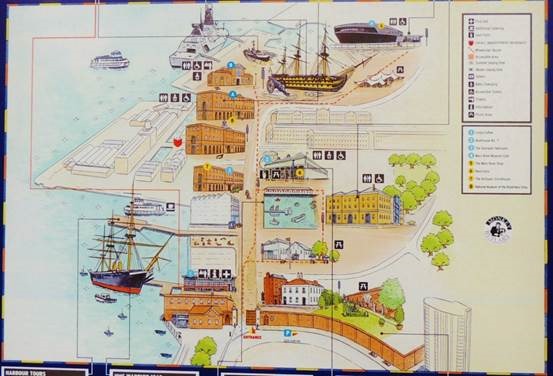
Layout of the Historic Dockyards

The Mary Rose Museum is the dark building up in the right hand corner and the Victory is just near-by.

The Warrior is near the park entrance as is the Porter’s Garden in the lower right.

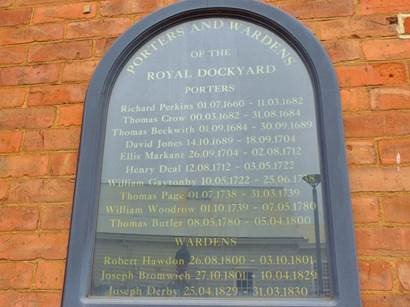
The porters  (very different from what we think of in the US as porters.)

Two porters lived in the Porter’s Lodge from 1739-1800, William Woodrow (1739-1780) and Thomas Butler (1780-1800).

    The porter had three functions. He guarded dockyard boundaries and property and marked working hours by ringing the muster bell and closing the gate against latecomers. To prevent excessive theft of timber, ‘chips’, he allowed ‘no Person to pass out of the Dock Gates with great Coats, large Trousers or any other outer dress that can conceal stores of any kind.’ He also sold beer to the men ‘to enable them the better to carry on their labour and not to distemper them’. The Porter’s life is revealed through his job and outside activities. In 1753, described as a ‘Gentleman’, Woodrow was one of the original pew owners of St George’s Chapel, owning one of the larger pews on the ground floor costing £30. He was the public face of the dockyard, the daily interface between the inside and outside communities.

clip_image011

clip_image012clip_image013

The Porter’s Lodge

The Porter’s Lodge was built in 1708 and is the Dockyard’s oldest surviving building, but an earlier Porter’s watch house stood at the gate in 1698. Other dockyard officers, whose gardens survive, lived in the Commissioner’s house and Long and Short Rows.

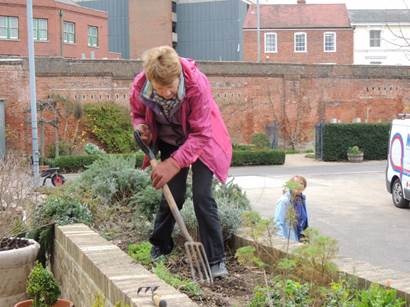
The Friends of the Porter’s Garden

For the millennial ‘Renaissance of Portsmouth Harbour’, in 1998 Portsmouth Naval Base Property Trust commissioned landscape architects Camlin Lonsdale to design a new garden on the site of the former Porter’s garden. During the twentieth century the site had been used for police cells, the Police Superintendent’s Office and an air raid shelter, so it was an architectural confusion. Hampshire Gardens Trust and local residents were consulted. In Spring 2000 a Friends’ committee was set up.

http://www.portersgarden.hampshire.org.uk/#1754

clip_image014 clip_image015

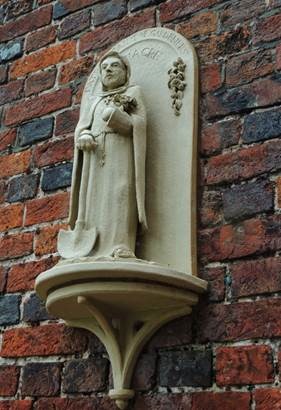
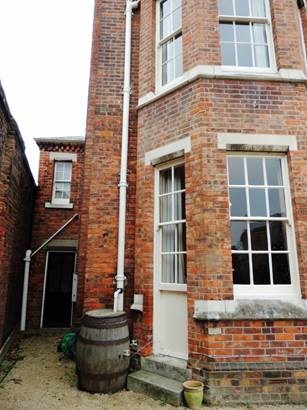
St Fiacre, Patron Saint of Gardeners….catching rain water into a barrel equiped with spiggots. 

clip_image016

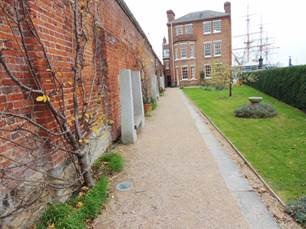
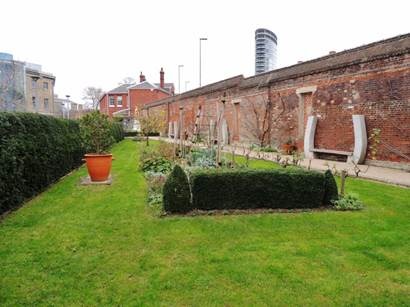
The garden wall with the police cells buiding at the far end.

“The dockyard wall – the garden wall – was built in 1711, so that ‘Ill disposed people inclineing to Purloine, are shut out from doing hurt from the Land’. It also defined the boundary of the Porter’s garden. The gate provided the setting for many embezzlements and a dramatic labour dispute in 1743. It was also used to publish regulations and invite tenders for dockyard contracts and outside projects, such as St George’s Chapel, built in 1753 by dockyard shipwrights and house carpenters.”

http://www.portersgarden.hampshire.org.uk/#1754

clip_image017

Believe it or not…..

clip_image018

clip_image019

clip_image020

Friends of the Porter’s Garden

     “The Friends of the Porter’s Garden were established in 2001 to care for a new garden laid out on the site of the former garden belonging to the Porter’s Lodge (1708), the oldest building in the Dockyard.  Their planting schemes use the kind of plants and flowers which would have been found in an 18th century garden.

     As well as tending the garden all year round, the Friends raise funds by holding a summer garden party, by taking stalls at the annual Dockyard Festival of Christmas and by selling plants along with jams and chutneys made from organic produce grown in their own gardens or in the Porter’s Garden.  Each year they also arrange a series of visits to other historic gardens.

     In 2009 the garden was extended to include the area beside Boathouse 6.  The new Raised Garden is of minimalist style comprising four walnut trees, a raised bed within the retaining wall alongside the slipway, elegant swathes of Bredon gravel and new granite steps.  Designed by the Trust’s architectural Trustee, Sir Colin Stansfield Smith CBE, the Raised Garden was formally opened by Mike Hall, Chairman of Hampshire Gardens Trust.”  http://www.pnbpropertytrust.org/index.asp?upid=23&msid=5

clip_image021

Antarctic Explorer Robert Scott

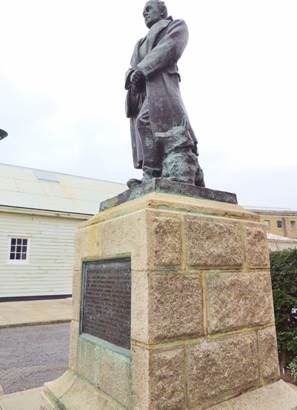
Adjacent to Porter’s Lodge is a statue of Antarctic explorer Robert Scott, commissioned and sculptured by his widow.  The statue was previously in Long Row in the working Naval Base

http://www.historicdockyard.co.uk/

“Edith Agnes) Kathleen Scott (née Bruce,  later Lady Kennet) (1878-1947), Sculptor; former wife of Robert Falcon Scott and wife of  1st Baron Kennet

     Sitter in 15 portraits

     Artist of 3 portraits

Kathleen Scott achieved distinction as a traditional sculptor working in clay from life and during the 1930s her portraits were much in demand.  She studied at the Slade School of Fine Art,  Atelier Colarossi in Paris, and with Rodin.  In 1908 she married the Polar explorer Robert Falcon Scott and was widowed four years later.  By then she had an established career as a sculptor.  Her sitters included Shaw, Lloyd George, Yeats, Galsworthy and Lawrence.

“The "absolute hell" endured a century ago by the youngest member of Scott of the Antarctic’s team on the first British expedition to reach the South Pole has been revealed in 27 letters to his mother that have newly come to light.

The correspondence by Apsley Cherry-Garrard describes his torment both on the expedition and on finding the frozen bodies of his doomed companions, his subsequent physical and mental breakdown, and the team’s acute fear of being perceived as failures back home because their Norwegian rival, Roald Amundsen, had reached the South Pole a month before them.

Led by Captain Robert Falcon Scott, the Terra Nova team and its feats evoke a heroic age of polar exploration. The letters cover the whole span of the expedition, from its departure in June 1910 to the tragic return of the survivors to New Zealand in February 1913.”

http://www.theguardian.com/   The entire article is worth reading.

The Navy wasn’t just about battles; it was also about exploration something I’d not thought about.

clip_image022

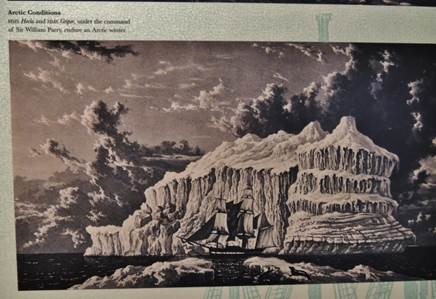
William Edward Parry’s expeditions, 1819–25

Ships Hecla, Griper, Fury

Navigated Lancaster Sound and reached as far as Melville Island – penetrated further west than any previous expedition

Demonstrated that one could effectively winter far north in the Arctic.

http://www.rmg.co.uk/

The race to the South Pole http://www.rmg.co.uk/

This site, part of the Royal Museums of Greenwich (where we intend to visit) tells the story of the British exploration of the Antarctic. 

HMS Victory at Portsmouth Historic Dockyards

Cheers,

   For someone who lives on a boat, I truly have no real interest in them or naval history.  Or military history in general though I am beginning to wonder how we won the Revolutionary War given the great British Navy.  Lots of thanks to the French and Spanish I think.  Sometimes I wonder if the British  lost us or just decided to jettison the whole lot of us pesky Yankee Doodles. 

   This email is about the HMS Victory because she’s the reason Randal wanted to visit Portsmouth….I went along to keep him company.  The more “interesting stuff” will be in the following emails.

Ru

Portsmouth Historic Dockyards 

http://www.historicdockyard.co.uk/

Often when visiting places I take a zillion photos, return home, do tons of research and then send out overly long emails.  Well, I must admit that British Naval History just isn’t one of my interests.  I spent two full days touring  ( more like following along behind Randal) the Portsmouth Historic Dockyards and that’s about enough of that.  The odder quirky things caught my attention, but the real focus, ships and battles didn’t.  Sorry, that’s just the way it is.  There’s lots of good information at your local library for anyone who wants to know more.  Tell them I sent you.

clip_image001

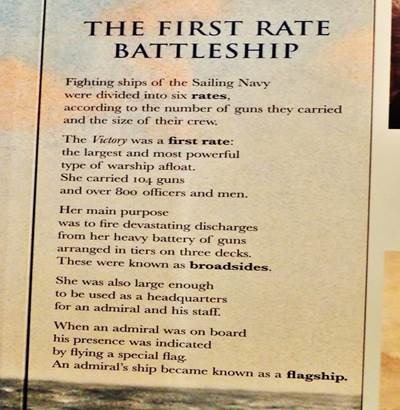
Nautical terms we use in our everyday language, “first rate” and “broadsides.”

What is the difference between a broadsheet, broadside and tabloid?

A broadsheet is a full-size newspaper, sometimes mistakenly called a broadside. A broadside is a a large sheet of paper, generally printed on one side and folded into a smaller size, often used as a direct-mail piece or for door-to-door distribution. A tabloid is a newspaper of less-than-standard size, generally about 1,000 – 2,000 AGATE lines on a page that is 14 inches high and has four or more columns, about 12 inches in width.

//www.newspapersoc.org.uk/frequently-asked-questions

HMS Victory……

“On 7th May 1765 HMS Victory was floated out of the Old Single Dock in Chatham’s Royal Dockyard.  In the years to come, over an unusually long service, she would gain renown leading fleets in the American War of Independence, (against us)   the French Revolutionary War (against the French) and the Napoleonic War.  In 1805 she achieved lasting fame as the flagship of Vice-Admiral Nelson in Britain’s greatest naval victory, the defeat of the French and Spanish at the Battle of Trafalgar.

For Victory, however, active service did not end with the loss of Nelson.  In 1808 she was recommissioned to lead the fleet in the Baltic, but four years later she was no longer needed in this role, and she was relegated to harbour service – serving as  a residence, flagship and tender providing accommodation.

In 1922 she was saved for the nation and placed permanently into dry dock where she remains today, visited by 25 million visitors as a museum of the sailing navy and the oldest commissioned warship in the world.

Over a period of 34 years, between 1778 and 1812, HMS Victory took part in five naval battles. Trafalgar is not only the most famous of these but also the last.  Commissioned for service in the American War of Independence, Victory fought in the First and Second Battles of Ushant and the Battle of Cape Spartel, whilst during the French revolutionary War she was Admiral Jervis’ flagship at the Battle of Cape St Vincent. “  http://www.hms-victory.com/history

clip_image002

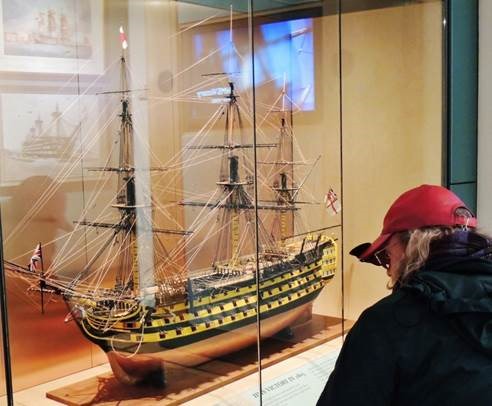
Randal looking at the model od HMS Victory with its full masts.

clip_image003

clip_image004

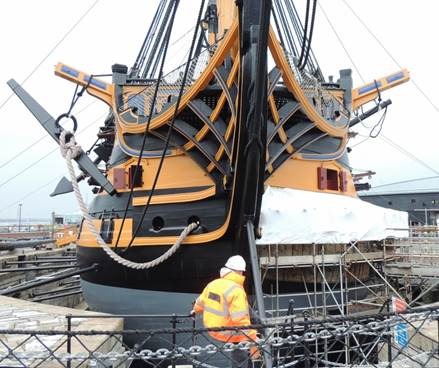
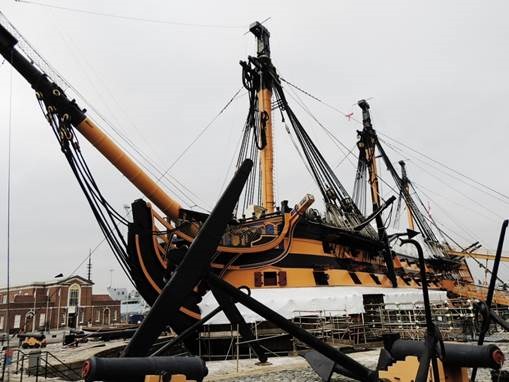
The top half of the masts are being repaired.  (No she’s not leaning to the side, it’s just an odd photo.)

     “The final mast removal on HMS Victory has taken place this morning (0800 Friday 23rd September, 2011) when the mizzen top mast was removed as part of the restoration work taking place on Nelson’s flagship at Portsmouth Historic Dockyard.

     Bell Rigging, sub-contractors for BAE Systems have been overseeing the work as the ship’s three masts, bowsprit and rigging have all been dismantled over the summer. The last time HMS Victory was seen without her top masts was back in 1944, so this really is a once in a life time opportunity to see HMS Victory under-going such extreme maintenance.

     The National Museum of the Royal Navy’s Director General, Professor Dominic Tweddle said: “Watching the team painstakingly disassemble the rigging and masts of HMS Victory has been heart stopping at times! To do this intricate work, while still keeping Victory open to the public, has been a logistical masterpiece.

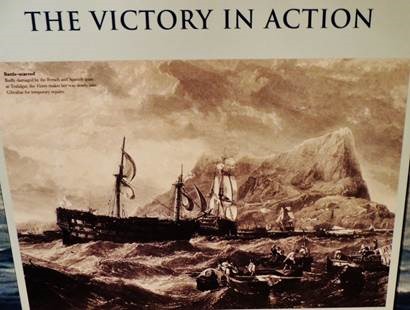
Interestingly, with her topmasts down, Victory will look much as she did after the Battle of Trafalgar when she had to be towed to Gibraltar for repairs.” 

Most of the highly skilled operation has been carried out by master shipwrights and other specialist staff employed by BAE Systems who, while operating on the cutting edge of technology on modern warships, maintain the age-old wooden shipbuilding skills.

     John O Sullivan, BAE Systems Project Manager for HMS Victory, is in charge of the maintenance: “We have removed the upper sections of all three masts and bowsprit, booms, yards and spars, including 26 miles of associated rigging and 768 wooden blocks, some of which are 100 years old. We will then catalogue and document everything for future surveying, design and replacement.

     When the rigging is replaced a decision will be made as to whether the wooden rope blocks can be re-used, recycled or replaced. Our team will carefully manage this major restoration project, keeping disruption to a minimum.”

– See more at: http://www.historicdockyard.co.uk/

clip_image005

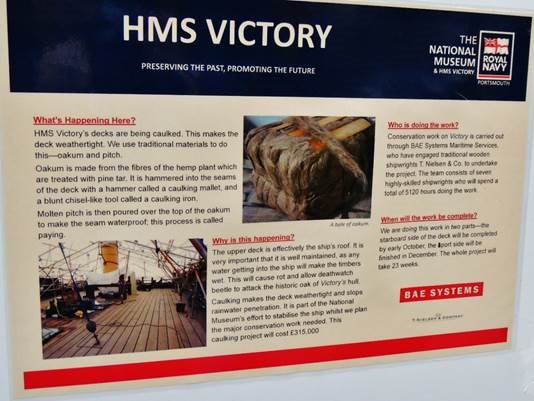
During our tour it was hard to hear over the pounding of the caulking.  Randal did a second tour the following day and the hammers were silent.  And each guide has their own story to tell so he enjoyed both tours.

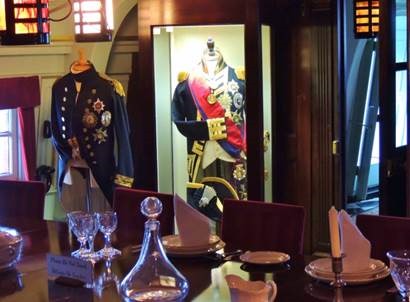
Lord Nelson: the hero of Trafalgar … his dress coats with empty sleeve as he’d lost his right arm in battles.  He really is a huge hero in British Naval History.

clip_image006

clip_image007

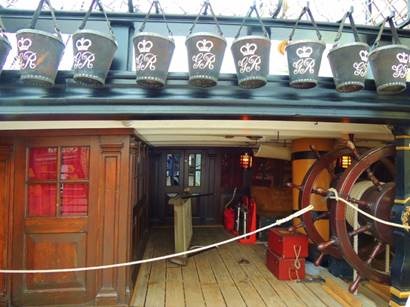
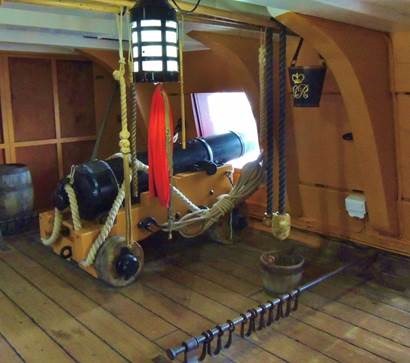
Our guide explained that the G R stood for George Rex….King George the III.  He also pointed out to those Americans on the tour, that George III was our king too, albeit our only king. 

clip_image008

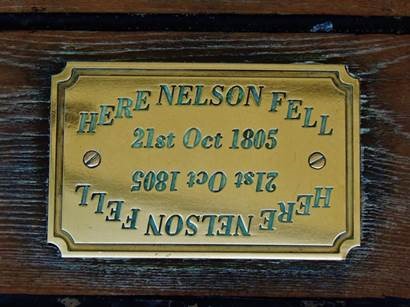
“About fifteen minutes past one o’clock, which was in the heat of the engagement, he was walking the middle of the quarter-deck with Captain Hardy, and in the act of turning near the hatchway with his face towards the stern of the Victory, when the fatal ball was fired from the enemy’s mizzen-top. . .” http://www.eyewitnesstohistory.com/lordnelson.htm

clip_image009

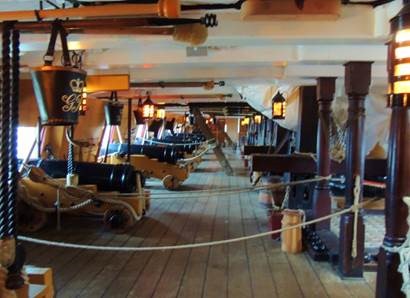
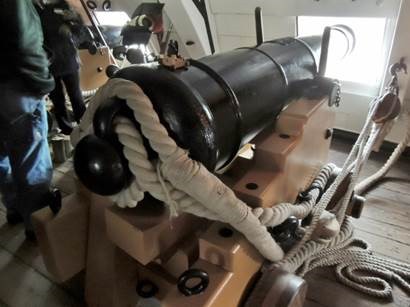
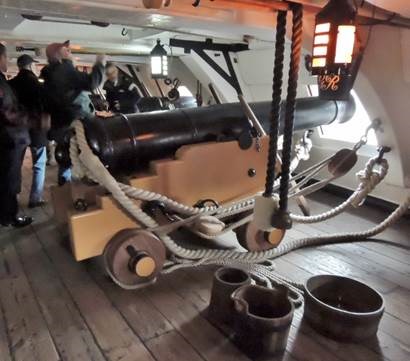
Some of the guns

clip_image010

clip_image011

Today springs are used to check recoil, but in the days of HMS Victory the cannon were on wheeled carriages, with ropes to stop them from recoiling too far when fired. Also, the ship pitched when

sailing, especially in the rough seas, and the term "loose cannon" originally referred to a ship’s cannon loosed from its rope and rolling dangerously on the deck.

http://wiki.answers.com/

http://www.go2gbo.com/  another good explanation

clip_image012

….but we didn’t….Oh well

clip_image013

clip_image014

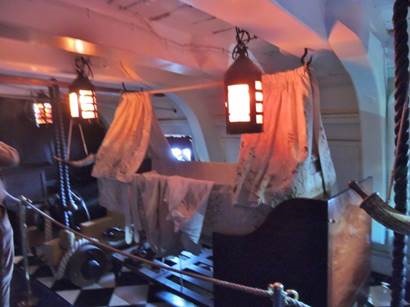
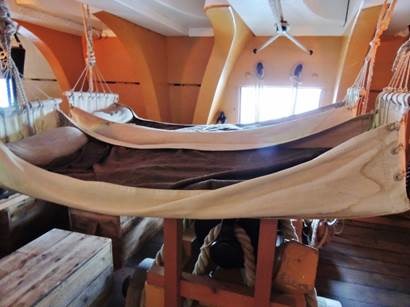
Sleeping quarters…and also you shroud if buried at sea.  They would sew you into the cloth used for your bunk, the final stitch through your nose. 

“Burial at sea, a simple yet most impressive and dignified ceremony, is the most natural means of disposing of a body from a ship at sea. It is still the custom to sew the body into a hammock or other piece of canvass with heavy weights, formerly several cannonballs, at the feet to compensate the tendency of a partly decomposed body (as would be the case in the tropics) to float. To satisfy superstition, or to ensure that the body is actually dead, the last stitch of the sailmaker’s needle is through the nose. Ensigns of ships and establishments in the port area are of course half-masted during a funeral.” http://www.hmsrichmond.org/avast/customs.htm

clip_image015

clip_image016

“HMS Invincible, a 74 gun ship, was wrecked in the Solent in 1758.  In the late 1970’s the ship was excavated by archaeologists.  This collection numbers over six hundred artefacts from the ship providing a unique picture of life onboard an eighteenth-century warship.  This square plate was issued to a sailor for eating his food off.  It is the origin of the expression ‘three square meals a day’.  Ref: 1987.0045.01 INV 175  http://www.thedockyard.co.uk/

clip_image017

Letting the “cat out of the bag>”

   “A second theory ascribes the origin of the saying to the British Royal Navy, asserting the instrument of punishment used upon those errant in their duties or behaviors (a whip called the ‘cat of nine tails’ or ‘cat-o’-nine-tails’) was routinely kept in a red sack, thereby a sailor who brought to light the transgressions of another was "letting the cat out of the bag." However, no evidence documents that such whips were commonly stored in sacks, or that the phrase "let the cat out of the bag" was initially associated with maritime origins or usage. (but it is what our guide told us and you can see the red bag hanging there.)

Read more at http://www.snopes.com/l

LAWS OF THE SEA AND PUNISHMENTS  (not pleasant reading)

   “The punishment listed in the Admiralty Black Book for sleeping on watch, a very serious offence because it endangered the ship, was at first humiliating and for repeated offences brutal. A bucket of sea-water was poured over the head of a first offender. A second time the offender’s hands were tied over his head and a bucket of water was poured down each sleeve. For a third offence the man was tied to the mast with heavy gun chambers secured to his arms, and the captain could order as much additional pain to be inflicted as he wished. The fourth offence was inevitably fatal; the offender was slung in a covered basket hung below the bowsprit. Within this prison he had a loaf of bread, a mug of ale and a sharp knife. An armed sentry ensured that he did not return aboard if he managed to escape from the basket. Two alternatives remained — starve to death or cut himself adrift to drown in the sea.

The Articles of War, a purely naval code of discipline, stem from this source. These were first written in 1661 in the reign of Charles II. The punishments listed were brutal, but the principle has remained to present times: "For the good of all, and to prevent unrest and confusion."

The King’s Rules and Admiralty Instructions (K.R. & A.I.), which made their first appearance in 1731, contain general regulations, including discipline, governing the naval service.

A punishment which was particularly harsh and usually fatal was keel-hauling, awarded for serious offences, and discontinued in the Royal Navy about 1720. It was still practised in the Dutch and French navies until 1750.

Execution by hanging at the yardarm was the normal punishment for mutiny in the fleet. The last execution was carried out in 1860. As a capital punishment it was by no means instantaneous as is said to be with the case with our modern practice. The prisoner’s hands and feet were tied, and with the noose about his neck a dozen or so men, usually boats’ bowmen (the worst scoundrels in the ship) manned the whip and hoisted him to the block of an upper yard, to die there by slow strangulation.

The most common type of punishment, inflicted for almost any crime at the discretion of the captain, was flogging with a cat-o’-nine-tails (1). This was carried out "according to the customs of the service", namely at the gangway. The indicted was given twenty-four hours in which to make his own cat. He was kept in leg-irons on the upper deck while awaiting his punishment. When the cat was made the boatswain cut out all but the best nine tails. If the task was not completed in time the punishment was increased.

With heads uncovered to show respect for the law, the ship’s company heard read the Article of War the offender had contravened. The prisoner was then brought forward, asked if he had anything to say in mitigation of punishment, then removed his shirt and had his hands secured to the rigging or a grating above his head. At the order "Boatswain’s mate, do your duty" a sturdy seaman stepped forward with the cat — a short rope or wooden handle, often red in colour, to which was attached nine waxed cords of equal length, each with a small knot in the end. With this the man was lashed on the bare back with a full sweep of the arm. After each dozen lashes a fresh boatswain’s mate stepped forward to continue the punishment. Each blow of the cat tore back the skin and subsequent cuts bit right into the flesh so that after several dozen lashes had been inflicted the man’s back resembled raw meat. After each stroke the cords were drawn through the boatswain’s mates fingers to remove the clotting blood. Left-handed boatswain’s mates were especially popular with sadistic captains because they would cross the cuts and so mangle the flesh even more.

After the man was cut down he was taken to the sick berth, there to have salt rubbed into his wounds. This was done not so much to increase the pain as for its antiseptic qualities.

From 1750 into the 19th century twelve lashes were the maximum authorised for any one offence.

Until the end of the 18th century the punishment for theft, a hateful crime against one man or many in a ship at sea, was for the thief to run the gauntlet (or gantlope). The offender first received a dozen lashes in the normal manner with a thieves’ cat, with knots throughout the length of the cords, and while still stripped to the waist passed through two lines of all the ship’s company, to be flogged with short lengths of rope. Lest he move too fast to benefit fully from this ordeal the master-at-arms marched backwards a pace ahead of him with the point of his cutlass against the thief’s chest. And to prevent him stopping a ship’s corporal followed him in a similar manner. On completion of the course the thief was given a further dozen lashes.

Another form of punishment was flogging around the fleet. The offender was secured to an upright timber in a ship’s boat, and when it pulled alongside each gangway a boatswain’s mate entered the boat and inflicted a certain number of lashes. For added effect the boat was accompanied on its rounds of the fleet by other boats, each with a drummer in the bows beating a roll on his drum.

Flogging was not abolished in the British forces until 1881 in response to strong public opinion.

Until suppressed in 1811, it was a common practice for boatswains’ mates to carry and use on their men colts or starters, small whips somewhat like knouts or knotted ropes, which they carried concealed in their hats. The boatswain’s mark of authority was the bamboo cane or rattan he always carried, and with which he summarily executed punishment.

A punishment awarded by messdeck court martial for cooks who spoiled a meal was to be cobbed and firked, that is beaten with stockings full of sand or bung staves of a cask. This practice was officially disallowed after 1811.

A form of corporal punishment, i.e. "birching or caning on the bare breach" (K.R. & A.I.) remained until recent years as a punishment for boys. Birching was suspended in the service in 1906, but caning is still administered occasionally as a punishment for boys, cadets and midshipmen. “

http://www.hmsrichmond.org/avast/customs.htm

clip_image018

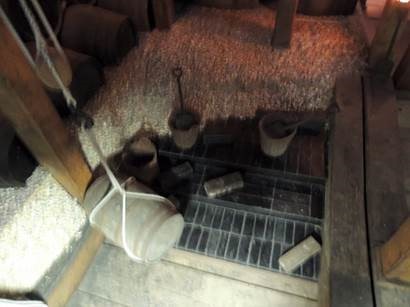
Gravel was used as moveable ballast to adjust the balance of the ship.

clip_image019

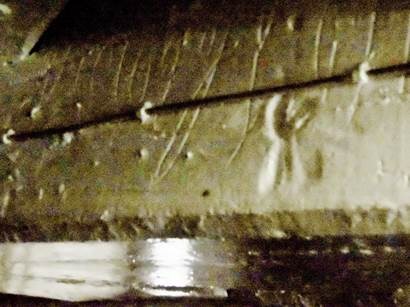
Both Randal and I seem to remember this overhead beam had the name of one of the sailors carved into it.

clip_image020

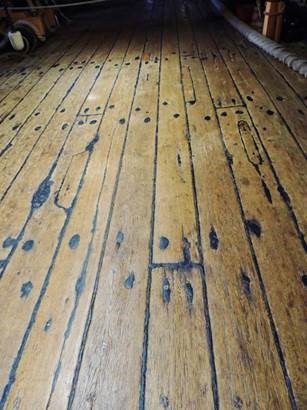
I loved the wood floors.  But unlike the USS Constitution there were no prisms embedded into the deck to let in light below.

clip_image021

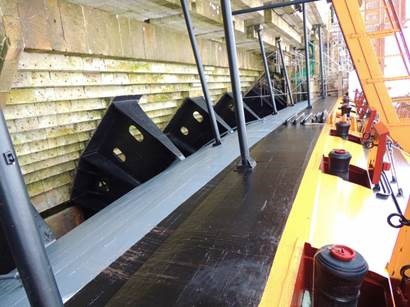
HMS Victory’s hardstand supports.

clip_image022

I certainly recognize “The Rock of Gibraltar” where Victory was towed after the battle of Trafalgar off the coast of Spain.

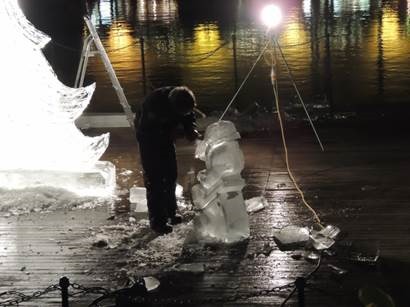
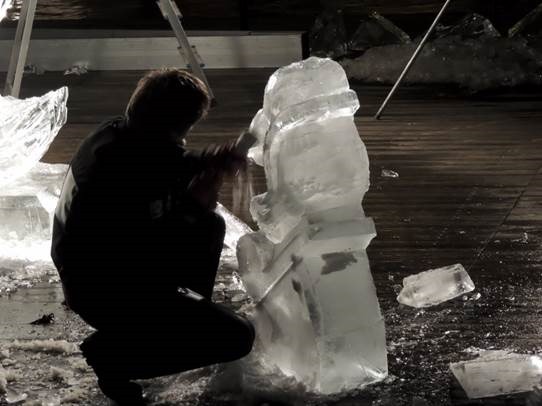
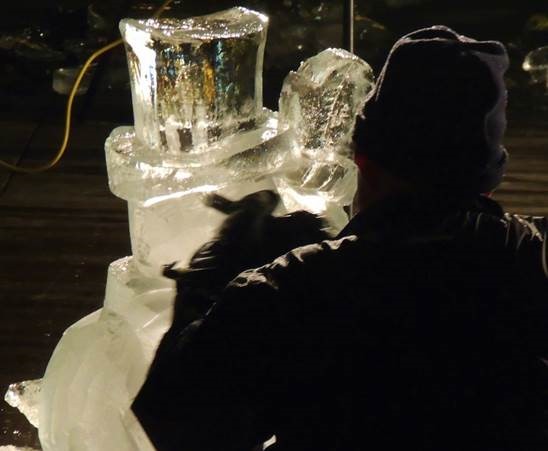
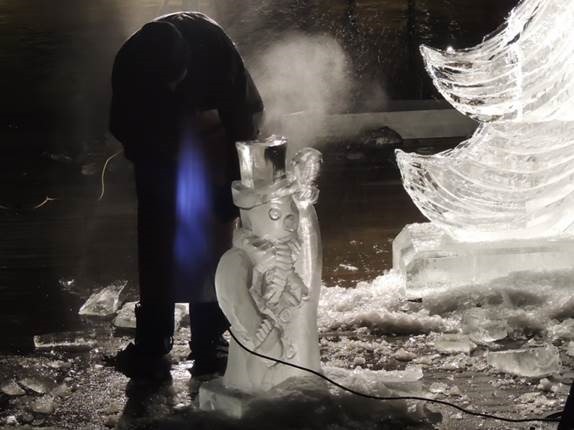
Ice Sculpture at SKD

Cheers,

  With all of the recent horrible weather around Great Britain and Europe, Randal and I have been quite lucky avoiding it.  We spent Tuesday and Wednesday in Portsmouth at the Historic Dockyard and most of Thursday making our way back to London by way of Lymington.  All of our travel was by train and all of our trains were on time, though the weather did affect some train travel from the north.  The only rather silly disappointment was that our train from Victoria to Portsmouth had no food car or tea trolley so I wasn’t able to have any Brit Rail Tea.  Portsmouth was cold and overcast, but most of the time we were indoors at the various museums or aboard the HMS Victory or HMS Warrior.  The weather was even good enough to take the short motorized harbor cruise that came with our entry ticket. 

   It will take me a bit to send photos as I got hung up right away at the mention of the American Revolutionary War.   “Commissioned for service in the American War of Independence, HMS Victory fought in the First and Second Battles of Ushant and the Battle of Cape Spartel.”   Where the hell are Ushant and Spartel?  We have Bunker Hill Day in Massachusetts and Lexington and Concord…so how could I have no clue about the “American Revolutionary War battles of Ushant and Spartel.”   http://www.hms-victory.com/content/history/battles    Anyway, wasn’t Massachusetts the star of the show when it comes to the Revolution?  I certainly do have a skewed sense of history!  Good thing I’m doing this boating thing so I can see there really is more to the world than Eastern Mass and the Red Sox. 

Here’s the quick simple version……  which was discovered by a witty  Frommer’s guide while researching sheep.  Obviously no one takes the direct route to the Battle of Ushant…one must stumble over it looking up something else.

“To my surprise, I learned that this sheep has a tie, albeit a loose one, to the American Revolution. It seems that Ushant, a tiny island off the coast of Brittany on the south end of the English Channel, was the site of a nasty naval battle between the French and the English in 1778.  France, loath to pass up a chance to attack the British, had recently decided to enter the war on the American side.  The British sent out a fleet to keep an eye on French naval activities in Brest, and the French sent out a fleet to see what the British were up to.  They met up somewhere around Ushant, where the weather got so bad that neither side managed to do much damage to the other, nor could either claim a victory.  Each fleet came home to cranky officials and much political squabbling.”   http://useless-paris.blogspot.co.uk/  Margie Rynn author of Frommer’s EasyGuide to Paris 2014.

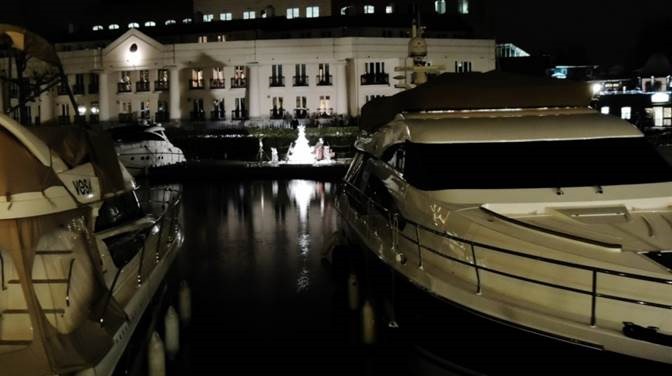
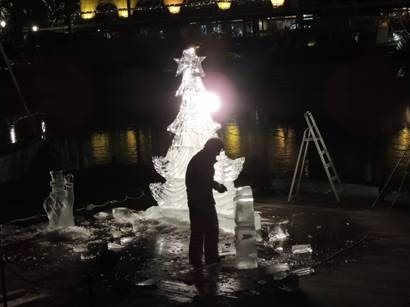
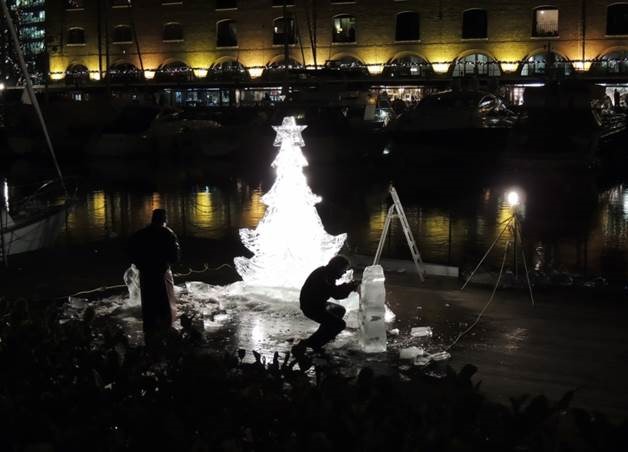
Anyway, this email is about something totally unrelated….   “ 16:30 Friday : Two ice sculptors have been sculpting a Christmas tree this afternoon on the large pontoon in the centre basin.”  This email was from Gus and Helen cruisers here at the marina.  So Randal and I got ourselves together…a long coat will cover flannel stay on the boat pants…and went to take some photos.  The sculpture is in the Central, show off basin where “events” take place.  We’re in the west basin with the construction, but it’s okay.  Each basin has an advantage, ours is closest to the tube, at least it is when the construction isn’t blocking the walkway.  Temperatures will be in the low 50s tomorrow so not sure how long these sculptures will last.

And thank you all for your comments about our approaching lifestyle change.  It will be interesting!

Ru

clip_image001

clip_image002

Close up from across the central basin

clip_image003

clip_image004

clip_image005

clip_image006

clip_image007

clip_image008

clip_image009

clip_image010

clip_image011

clip_image012

clip_image013

Blue Tower Bridge  cables in the background

clip_image014

Walkie Talkie Building at night seen from our marina….

clip_image015

Dora Mac For Sale

Cheers,

    We are now officially the owners of 100 acres of mountain top land in Roanoke County.  One day our home will be up there overlooking the Roanoke Valley.  We will again become land lubbers!

This is the official notice of our decision to put DoraMac on the market.  We hope the next owners, whomever they might be, will feel at home on her as we have.  She has taken good care of us.

Tonight we will join with the Friends of St. Katharine’s Dock for their December get-together festivities.  It’s a very early holiday party.  Tomorrow we’ll get up bright and early (set lots of alarms) take the tube to Victoria Station and then the train to Portsmouth.  (Brit Rail tea for me!)  We’ll spend a few days there seeing what we missed our earlier visit when the museums were engulfed in the venue of a music festival and not open to the public. 

Next Saturday, as the tide will be at a low point, some of us, led by Sue Kelly, will go mudlarking on the Thames to see what we can find.  Maybe some colored sea glass.

Stay warm wherever you are, even our pals in Marmaris (though a recent photo taken by our friend Mary showed everyone in T-shirts or sleeveless!)

Ru

Below is the official word from Randal…..

Subject: Dora Mac For Sale

We are putting Dora Mac on the market for sale. We haven’t turned it over to a broker yet but probably will soon. The boat is currently berthed at St Kathrine’s Dock in London where the slip and electricity is paid for through March.
The boat comes fully equipped and cruise ready. We are ending our cruising life so everything comes with the boat.
I will post pictures and a list of features in a few days. I can be contacted at: randal462@msn.com and our web site with some pictures is: www.mydoramac.com
Sincerely,
Randal Johnson
www.mydoramac.com
"It is not the strongest of species that survives, or the most intelligent,
but the ones most responsive to change" – Charles Darwin

Thanksgiving Day part 2

Cheers,

   Yesterday Randal and I raced over to the British Museum to join up with a www.walks.com tour.  Today I had my third life drawing class.  Time is flying!  

Our cruiser group is passing a set of germs around and several folks have running noses and coughs.  Randal had a dose and shared with me, but mine was much milder…me being a tough New Englander.

This email completes our Thanksgiving Day adventure. 

Ru

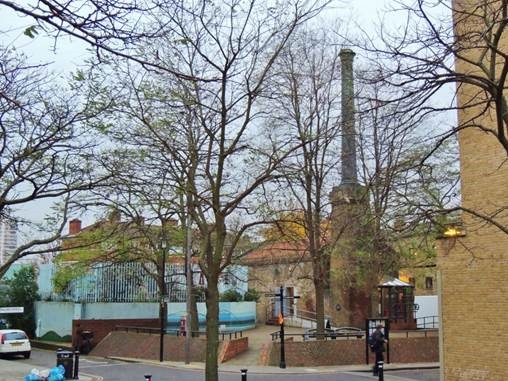
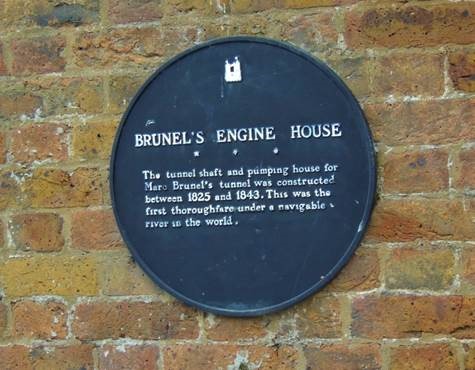
The Brunel Museum and Mayflower Pub Lunch

“The Brunel Museum in historic Rotherhithe is directly above the Thames Tunnel which opened 170 years ago in March this year. This is where Isambard Kingdom Brunel began his extraordinary career, aged nineteen years. Working with his father Sir Marc Brunel, he helped build the first tunnel under a river anywhere in the world.”  http://www.brunel-museum.org.uk/

http://www.dailymail.co.uk/ is a great article with history and loads of then and now photos.

       My favorite part of the visit was chatting with the fellow in charge that day.  He let both of us pay the concessionaires fee (some museums require you be 65,) set up the introductory video, and then interrupted his lunch to make me a cup of “Brit Rail Tea.”   He was a train buff and told me several stories; the most amazing is when he climbed a train water tower to take photos of a train passing by. 

  What is Brit Rail Tea?  I’m not sure what it is, but I know what it’s not.  He offered Earl Grey and Lady Grey and Brit Rail.  When I said “plain old tea” was fine, I got what he called “Brit Rail.”   It was made with a quick soak of a tea bag and then a splash of milk. 

     “The teabags sold in UK supermarkets tend to make stronger tea than their rather frightening American counterparts. If you can get hold of some British teabags, you can make tea the way they do at London train stations. We call this British Rail tea.

     When you order a cup of tea at a London train station they dump milk, sugar, teabag, and boiling water into the cup at the same time and then hand it to you. This makes for a uniquely generic flavor that is just right for an early morning zombie commute. You can achieve similar results on a larger scale by using a full-sized insulated carafe instead of a cup. This should last you all morning, and keep you "going" all afternoon. “  http://ubiqx.org/cifs/Appendix-A.html

clip_image001

Brunel Museum

clip_image002

We couldn’t go into the shaft that day, but on www.walks.com they take you there.

clip_image003

clip_image004


clip_image005

Brunel was also famous for train bridges and train stations as well as the design of several famous ships.

http://www.brunels-old-station.co.uk/section.php/41/1/brunel_s_old_station_history

http://www.bbc.co.uk/history/historic_figures/brunel_kingdom_isambard.shtml

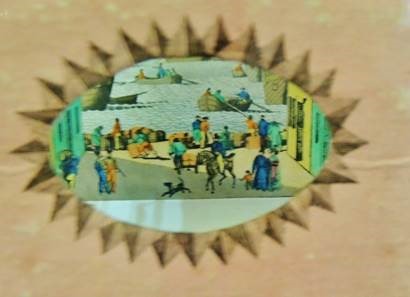
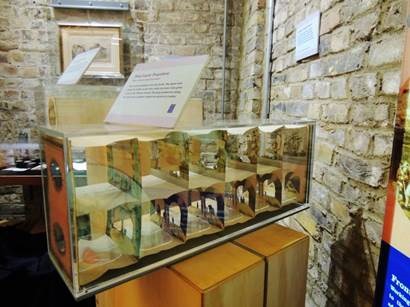
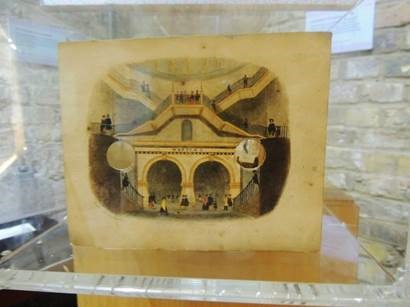
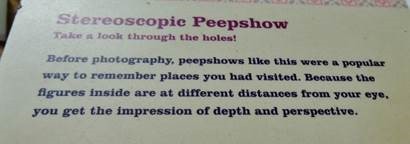
My favorite things were these “peep shows.”   In an episode of Larkrise to Candleford, a great BBC series set at the end of the 19th century, some school children made one of these so to get to see one here was neat!  Theirs was not so elaborate but was constructed on a similar basis. 

clip_image006

You look through this opening……

clip_image007

clip_image008

clip_image009

clip_image010

While in the museum I had a quick chat with an American couple from Ithaca, NY about a www.walks.con tour they’d done related to Brunel and the Thames.  They were also off to have lunch at the Mayflower.  … More about them in a later email.

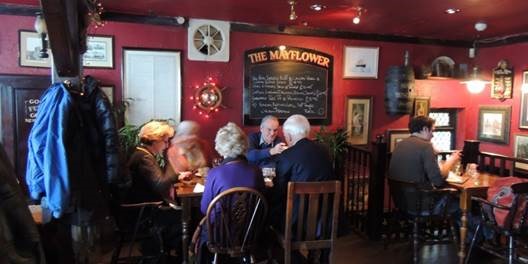
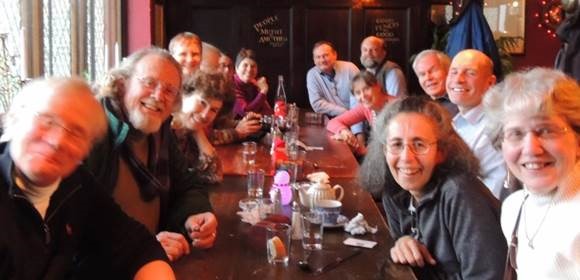
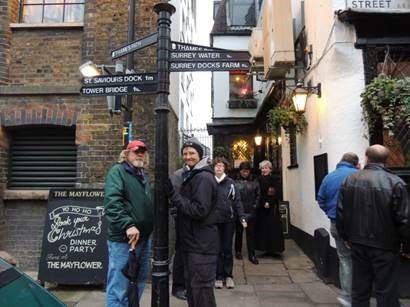
Then it was time to walk the short distance along Rotherhithe Street back to the Mayflower Pub to meet up with our SKD cruiser pals for lunch.  Our reservation was for 1:30 PM.  Randal and I were early but were the last of our group to arrive.  We were all seated in the upstairs room over the bar; the room where Brunel and his friends would come to work on his tunnel project.  The pub was crowded and dark so once we sat down we pretty much stayed put, so I don’t have many photos really.  Service was excellent!  Our food was prompt and we were all served at the same time, amazing as there were 12 of us. 

There’s some info about the Mayflower Pub below  as well as at their website http://themayflowerrotherhithe.com/

clip_image011

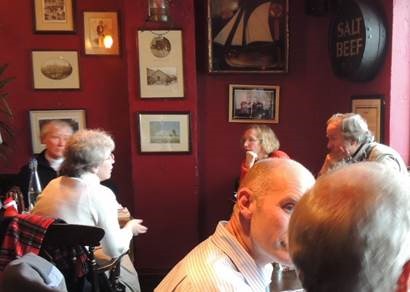
Not our group but you can see what the place looks like

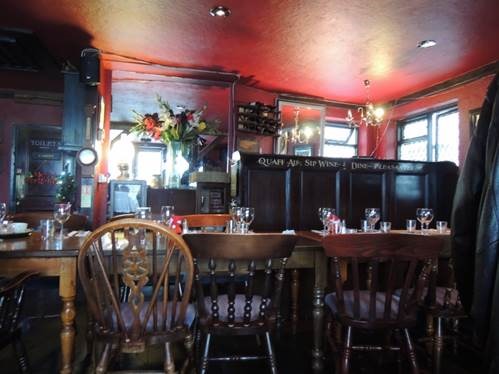
clip_image012

Upstairs bar

clip_image013 clip_image014

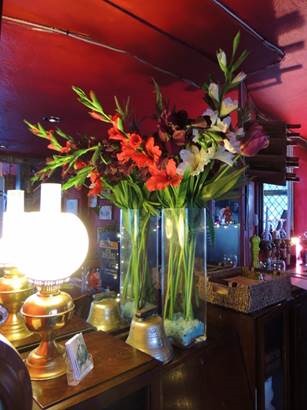
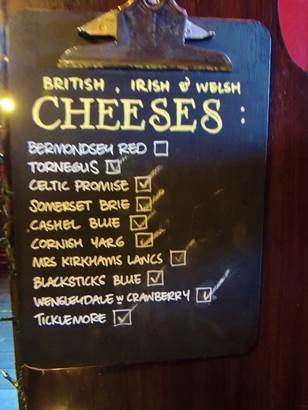
I loved the light and the flowers!   I know the difference between cheddar, mozarella, blue, etc, but the British cheeses, I’ve no clue.

clip_image015

Gerry and Holly, the couple from the Brunel Museum on the left.  Charlotte and Allen  from Portland, ME on the right; all were at the tables just next to Randal and Me.  Our group was at tables set up in front of the window.  I was sitting next to Collin in the stripped button down shirt and Randal was across from me.

We met Gerry and Holloy in the Brunel and Charlotte and Allen in the Pub.  Gerry and Holly came to visit DoraMac Saturday evening, their final night in London before heading to Brighton and then back to Ithaca, NY.  Charlotte and Allen live in London at the Southdock Marina on their boat and will come visit when Charlotte returns from a trip to France.

clip_image016

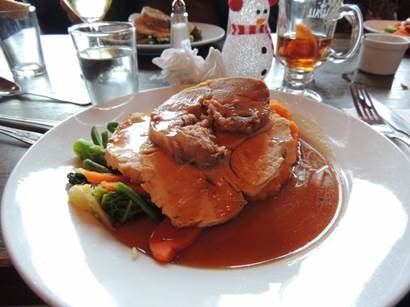
We had what seemed to me traditional Pilgrim fare rather than American Thanksgiving food which now includes everything under the sun and any number of dishes with marshmallows melted on top.  Our meal started with pumpkin soup and “village bread.”  Then this mountain of turkey, roasted veggies and “sweet potato mash.”  It was more than I could do, though I did eat all my veggies which were cooked as vegetables should be.  You can see my mug of mulled apple cider just next to the snowman.  (Of course I do love melted marshmallows on sweet potatoes!) 

clip_image017

I’d intended to bring a plastic container for my dessert but forgot, so I ate it then and there!  I wouldn’t call it pumpkin pie, but it did have pumpkin and crust and a very thick cream on top.  I washed it down with a pot of tea!

clip_image018

Not a great photo, but you get the idea. 

clip_image019 clip_image020

After leaving the pub we revisited the Pilgrim  statue and then walked back as it grew dark at 4 PM.

clip_image021

Rotherhithe

clip_image022

clip_image023

clip_image024

clip_image025

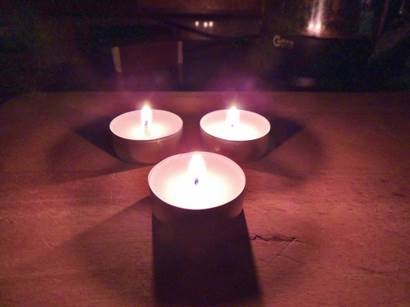
My Hanukkah candles….  Tea candles on a wooden cutting board. 

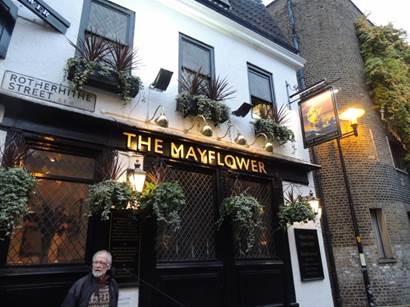
The Mayflower pub stands on the site of The Shippe pub that dates back to around 1550.

It is close to where the Mayflower ship was fitted out for the long transatlantic voyage.

The pub was rebuilt as the Spread Eagle and Crown in 1780 and renamed as The Mayflower in 1957.

It was the nearby landing steps to this pub that the Pilgrim Fathers set sail aboard The Mayflower Ship.

The pilgrims left Rotherhithe and headed for America via Southampton and Plymouth

The location they landed on is now known as Plymouth Rock

· The Mayflower was a 12-year-old, 180-ton vessel, which had previously been used in the wine trade

· The voyage took 66 days

· Former President George Bush, Richard Nixon, Marilyn Monroe and Humphrey Bogart were all descendants of the Pilgrim Fathers

· The Mayflower Pub is the only place licensed to sell American stamps in the UK

· Michael Caine was born in Rotherhithe on 14 March 1933 as Maurice Joseph Micklewhite. He is patron of the Southwark Young Pilgrims

The Mayflower public house was named for the ship that carried the Pilgrim Fathers.  It is not known exactly where the Mayflower was moored, or where she departed from when she left Rotherhithe for her first stop at Southampton, although there is a local convention that it was near the current site of the pub.  The pub’s website claims that it was established in 1621 but although the pub has a satisfyingly ancient appearance it looks a lot older than it actually is. A pub near the site of the Mayflower pub called The Shippe is the oldest one recorded, and is thought to have dated back to around 1550.  A pub called The Spread Eagle was certainly established on this site, but it is not known how old it was when it burned down in the 18th Century.  It was replaced in 1780 with another pub, The Spread Eagle and Crown, but this was also doomed, and its top floor and roof were obliterated in the Second World War.  It was only rebuilt in 1958 when it was renamed The Mayflower.  An attractive building both inside and out, with a large jetty, its architects set out to evoke a vague impression of the past rather than impose a 1950s contemporary design on the area.  In spite of its recent date, its much older look makes it feel authentically connected with Rotherhithe’s early history and that’s rather nice. http://russiadock.blogspot.co.uk/search/label/Public%20art

Our Thanksgiving Day in Rotherhithe

Cheers,

    It was a very overcast day weather-wise, but Randal and I had a lovely Thanksgiving Day here in London, or Rotherhithe to be exact.    I think it’s the first time that I’ve actually thought about Pilgrims rather than food and football, which is slightly embarrassing,  as I grew up in Massachusetts on Plymouth Street.  Our 6th grade school trip was to Plimoth Plantation but who cared then.  Now it’s pretty interesting.  I hope you all enjoyed your day and I do hope if your team was playing, it won. 

     Randal and I did manage to visit all of the places I’d mapped out on our way to Thanksgiving Lunch at the Mayflower Pub:

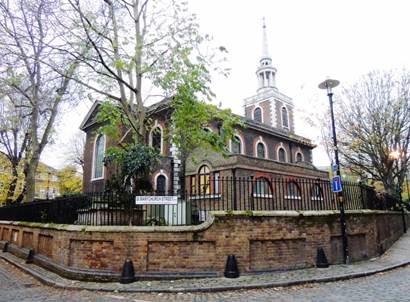
-St. Mary Church-Rotherhithe to see the burial place of Mayflower Captain Christopher Jones.

-The Pilgrim and Lad statue

-The Brunel Museum.

But what we found at those places wasn’t always what we’d expected.  It was better!

BBC Police Drama  “New Tricks” at St Mary’s

“Drama featuring an eccentric group of ex-police officers brought out of retirement to investigate unsolved crime.”  http://www.bbc.co.uk/programmes/b006t0qx   I watched an older episode online and  I  recognized Inspector Dalgliesh from the PD Janes series in a guest role and the  wonderful older solicitor from the Garrow’s Law series as one of the main characters. 

clip_image001

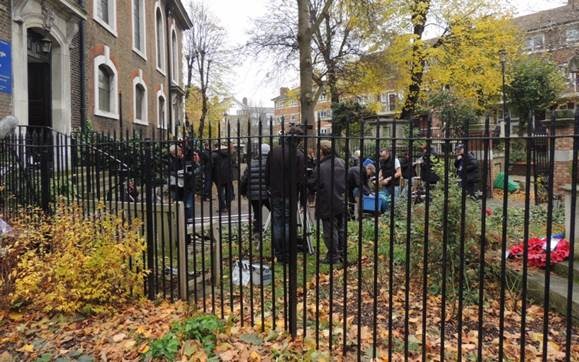
With all the activity at the Church, I thought there was a “yard sale” happening.  But when I got closer I saw there were no tables of “for sale” items.  It was only a bit later that we found out it was the BBC taping a show.

clip_image002

Shooting Take 1,  I think I heard.    It involved a car needing to drive by several times for the scene… or waiting for a car to pass that wasn’t in the scene.  I’m not sure which.  And no one seemed to be wanting to chat it up with me about what was happening.   

clip_image003

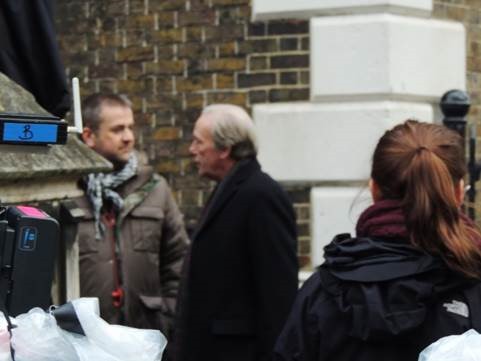
Actor Dennis Waterman  center, one of the show ‘s stars. 

clip_image004

Two  former marines having a chat.

I asked  this gentleman if he knew where Christopher Jones was buried.  But he was part of the BBC crew so couldn’t help with that but did tell us all about the show which was fun.  He and Randal had a lovely chat while I watched some of the filming.  It sort of distracted me from looking inside the church…so that will be another visit.

clip_image005 clip_image006

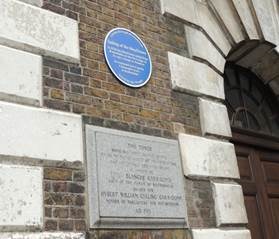
I did find this commemorative plaque but not the one specific to Christopher Jones.

The tablet below was a thank you to the family who rebuilt the crumbling tower.

“Captain Christopher Jones was not a local man, although he was resident in Rotherhithe at the time of Mayflower’s departure for Southampton.  He was born in Harwich at around 1570 and only moved to Rotherhithe in 1611. It was a popular place for sea captains to live in the 17th Century, and it is probable that Jones knew ship owner Edward Maister.   Captain Jones died on the 5th March in 1622, in his early 50s, and was buried in the churchyard of St Mary’s in Rotherhithe.  The church of St Mary’s was rebuilt in 1715, by public subscription, due to damage inflicted by repeated flooding.  Many of the old churchyard monuments and memorials were lost during this process, and the exact location of the burial of Christopher Jones is no longer known.  Apparently there is a stone tablet in memory of him saved from the old church and set into the new tower’s wall. (We only found the plaque.) There is modern monument to him in the churchyard of St Mary’s, depicting St Christopher, the patron saint of travellers, holding a small child.  It was unveiled in 1995, to mark the 375th anniversary of the voyage.  http://russiadock.blogspot.co.uk/search/label/Public%20art This is a great website for Rotherhithe history.

clip_image007

The St. Christopher Statue in honor of Christopher Jones

clip_image008

“Rotherhithe’s most ancient “blue coat school”

    “Rotherhithe has throughout its history been a strongly maritime area, home to docks, ship builders and breakers.   This building (across the lane from St Mary Church) was the home to Rotherhithe’s most ancient school, which was founded in 1613 by Peter Hills and Robert Bell. Peter Hills was an eminent mariner and the school was for "eight sons of mariners from the parish". The school grew, accepting both girls and boys. At one point in the early 18th century it had 65 girls and 77 boys.  In 1836 a girls’ school opened nearby and the school no longer took girls. By the end of the 19th century about 150 boys were educated at the school.

     The original building was on the north side of St Marychurch Street. The school moved to this building in 1795. The school provided an education for Rotherhithe children until 1939.

     The figures are of Portland stone and the children are wearing the traditional blue coats of charity schoolchildren, which gave the name "Bluecoats" to such schools. Beneath the statues is an inscription:

St MARY ROTHERHITHE

Free School founded by Peter Hill and Robert Bell Esqrs 1613

Charity school instituted 1742

Removed here 1797

Supported by voluntary contributions

Sources of Information:

• The Story of Rotherhithe by Stephen Humphrey. London Borough of Southwark. ISBN 0 905849 21 3

• Secret London Bluecoats. Pictures of these and other bluecoats statues in London.

www.stmaryrotherhithe.org St Mary’s Rotherhithe Parish Website. More information on Peter Hills and the school.

http://www.waymarking.com/

clip_image009

St. Mary the Virgin-Rotherhithe 

http://www.stmaryrotherhithe.org/

“……At this time the heart of the village of Rotherhithe was the parish church of St Mary the Virgin. There had possibly been a church on this site since Saxon times; the building standing in 1620 dated from at least the early 12th Century. The list of rectors goes back to 1282. The Church’s position on the river bank, made its tower a welcome landmark to homecoming sailors. The lovely building which stands on the same site today dates mainly from 1714, but a number of memorials preserved from the earlier church provide evidence that this was a parish of seafarers. A finely sculptured stone relief of a ship in full sail, nearly contemporary with the Mayflower, commemorates Captain Anthony Wood who died in 1625. The epitaph of Captain Roger Tweedy who died in 1655, leaving ‘Two Shillings every Lord’s day forever to be distributed among twelve poor seamen or seamen’s widows in bread’, is obviously that of a Rotherhithe Sailor:

‘His soul a ship with graces fully laded

Through surges deep did plough and safely waded.

At Rotherhithe he did at length arrive

And to their poor his tribute fully gives

And in this port he doth at anchor stay,

Hopefully expecting Resurrection’s day’.

Rotherhithe men who were not sailors were shipbuilders and their wooden sailing ships looked a fine sight at anchor in the Thames.  In 1612 Rotherhithe received recognition as an official centre of the shipwright’s craft when a charter was granted to ‘The Master, Wardens and Commonality of the Art or Mystery of Shipwrights of Redrith in the County of Surrey’.  Even in the 17th Century there was a dry dock at Rotherhithe. In 1700, the first of the great wet docks was constructed, known originally as the Howland Great Wet Dock after the Howland family who were the landowners at that time. Its purpose was to provide safe harbourage for ships, which had earlier been forced to anchor in mid river and suffer buffeting by storms. It came to be known by its present name, the Greenland dock, after 1725 when the South Sea Company leased it for the Greenland whaling trade. The other docks, which made up the 365 acres of the Surrey Commercial Docks, were constructed in the 19th Century.

http://www.stmaryrotherhithe.org

We continued down Rotherhithe Street to its intersection with Swan Lane to find  “the most amazing statue of a time travelling pilgrim.”

clip_image010

You can just see the tall pilgrim hat at the end of the path….he looks like the Tin Man from a distance.

http://www.youtube.com/watch?v=ylBltWIX3Vg  is a very “home done” video but fun to watch.

clip_image011

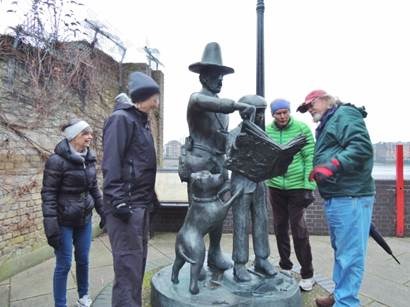
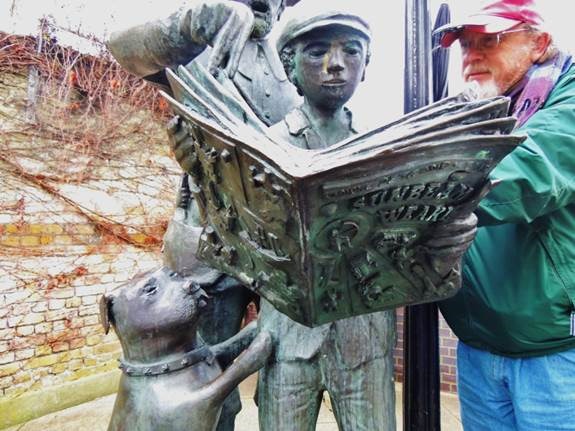
Sunbeam Weakly and the Pilgrim’s Pocket by Peter McLean.

(The sculpture reads "Sunbeam Weakly" but the marker says "Sunshine Weekly." )

Judy, Helen, Warren and Randal

This photo was taken after lunch; some of our friends wanted to see the statue.

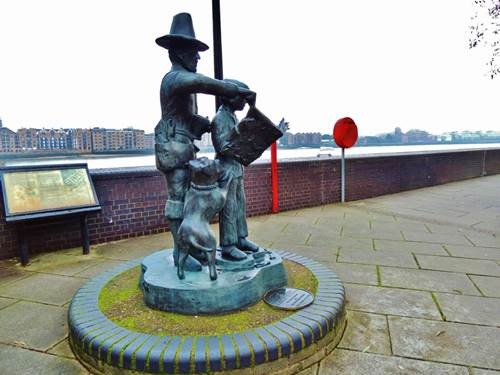
“The statue, “Sunbeam Weekly and the Pilgrim’s Pocket” stands on the walkway at Cumberland Wharf. The work is by Peter McClean, depicting a newsboy in 1930’s attire, reading a copy of the newspaper depicting the story of “The Mayflower” and all that has happened in the USA since those early days. The pilgrim is reading the paper over the boy’s shoulder, looking astonished at how the world has developed since he landed at Plymouth Rock in 1620. The boy’s dog also appears to be trying to read the newspaper, standing on its hind legs.”  http://www.thamespathway.com/chapter13/rotherhithe.aspx

clip_image012

The young boy is reading a graphic novel! Sunbeam Weakly

“Created by local artist Peter McLean it was erected in 1991 and shows the ghost or spirit of a representative Pilgrim Father looking over the shoulder of a small boy in 1930s clothing, who is reading a magazine called the Sunbeam Weekly.  A dog stands on its hind legs, its front paws resting on the boy’s legs, looking as though it wants to be involved. It is a Staffordshire bull terrier which is particularly appropriate for this area, where every other dog seems to be a staffie.  All three stand between a gas lamp.”  http://russiadock.blogspot.co.uk/

clip_image013

Past and future…. The Mayflower on the Left and a good deal of New York City on the Right though maybe Boston would have been a more acurate location to se the future for the Mayflower pilgrims.

clip_image014

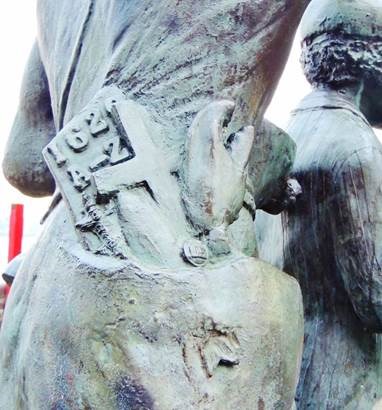
1620 London A to Z atlas, fish, cross, US button, Lobstah claw and under the letter A what might be a daggar?

clip_image015

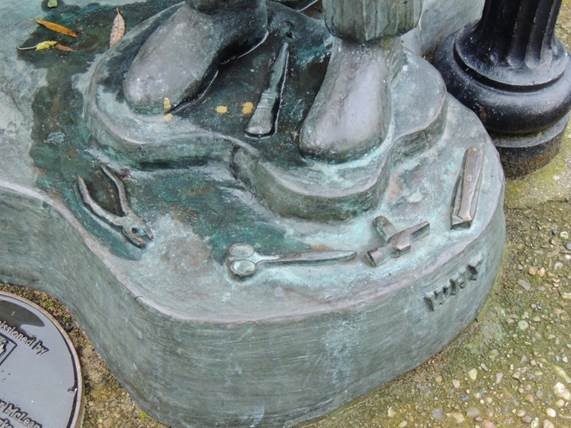
Paintbrush, pliers, scissors, hammer head and knife  and the word WHY.

clip_image016

Converted wharehouse buildings line the Thames on both banks

“The sculpture is accompanied by an explanatory information board which has, understandably, deteriorated since the LDDC put it up some 20 years ago.  It needs replacing, because much of it is illegible, particularly in the section that covers the background details about sculptor Peter McLean.  The bits that can be deciphered are basically a CV of McLean’s college past and the galleries in which he exhibited, and doesn’t say anything about other items he produced.  However it also describes the brief to which McLean worked, which was to create something that reflected local heritage, to be figurative rather than abstract, and to aim for something light-hearted.”

http://russiadock.blogspot.co.uk/2013/08/sunbeam-weekly-and-pilgrims-pocket.html   has more detailed photos than I am showing.

clip_image017

Plaque reads… Sunshine Weekly

Next email will be our visit to the Brunel Museum and Lunch at the Mayflower Pub

Happy Hanukkah too

Somehow I decided Hanukkah and Thanksgiving started on the same day….glad I just noticed this reminder from my sister.

So Happy Hanukkah to those who celebrate!

Ru

Thanksgiving preview

Cheers,

   Well, it’s official!   Randal and I now own 100 acres of land on Little Brushy Mountain in Roanoke County, VA.  Something we can say Thanks for tomorrow.  That and good health and good families and good friends.   Of course, as we’re walking the 1 and ½ miles to and then back from the Mayflower Pub, we’d be thankful for a day of no rain.  The forecast is for clouds.

   This is what our day will be like.  Hope yours will be filled with family, friends and “only a little too much food!” 

Ru

Thanksgiving  in Rotherhithe – preview   (I’ll take photos tomorrow.)

Lunch at the Mayflower Pub and possible side trips to the Brunel Museum, the grave of Captain Christopher Jones and the “not what you expect”  Pilgrim statue. 

The Mayflower and the Pilgrim Fathers

One of Rotherhithe’s better known bits of history is its connection with the Pilgrim Fathers of the early 17th Century.  There are several visible memorials to this achievement:  The Mayflower pub, named after the ship that carried the Pilgrim Fathers to the New World, a blue plaque, an engraved tablet and a modern memorial to Mayflower’s master at St Mary’s Church, and a modern sculpture commemorating the event on the Thames path.

http://www.russiadock.blogspot.co.uk/

Sunbeam Weekly and the Pilgrim’s Pocket

The story of the connection between Rotherhithe and the Pilgrim Fathers was the subject of a post a few days ago.  The bronze statue group commemorating that link, called Sunbeam Weekly and the Pilgrim’s Pocket, sits on Rotherhithe Street at the end of Swan Lane and overlooking the Cumberland Wharf garden.   …….  http://russiadock.blogspot.co.uk/

The Brunel Museum in historic Rotherhithe is directly above the Thames Tunnel which opened 170 years ago in March this year. This is where Isambard Kingdom Brunel began his extraordinary career, aged nineteen years. Working with his father Sir Marc Brunel, he helped build the first tunnel under a river anywhere in the world.

http://www.brunel-museum.org.uk/

Mayflower Pub Thanksgiving Menu  

117 Rotherhithe Street ♦ Rotherhithe ♦ London ♦ SE16 4NF ♦ 0207 237 4088

Starter

Sweet Potato and Corn Chowder

Main Dishes

Roast Turkey Served With Sweet Potato Mash and Seasonal Vegetables. (you had to let them know in advance; we opted for the Turkey.)

OR

Roasted Vegetable Nut Roast Served With Sweet Potato Mash and Seasonal Vegetables V

Dessert

Pumpkin Pie Served With Cream

www.themayflowerrotherhithe.com

Rumour has it, to avoid paying mooring taxes Christopher Jones tied up alongside the Mayflower pub and the passengers boarded the ship, which then sailed to Plymouth to pick up the remaining passengers before their voyage to America. 

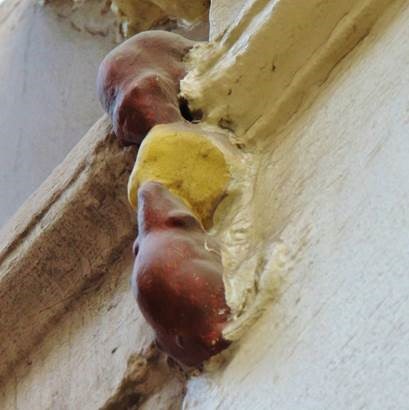
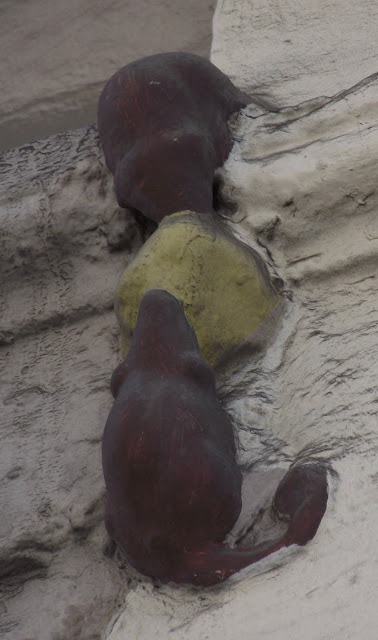
Two Mice and a Piece of Cheese Philpot Lane London

Cheers,

    While reading about The Monument to the Great Fire I’d read about the tiny mice sculpture not far from The Monument.  Monday afternoon I went to find the “insect hotel” at St. Dunstan that I’d missed the first 2 visits and then to look for the two mice.  I finally had the location; Philpot Lane off Cheapside,  just near the Nero coffee shop.  Lucky for me the construction just a bit further along on Philpot Lane was a bit further along Philpot Lane and not obscuring the tiny mice.  However I’d never have found them had not a very kind bright green-jacketed city worker pointed them out to me.  I could tell it was a treat for him to show me exactly where to look; they really are quite small.  Luckily I didn’t say, “Good grief, they’ve made such a stir for being so tiny,” which was what I was thinking.  But when he asked if I knew the story about the mice, I said yes.  Later I could have kicked myself because, though I did know the story, it would have been such fun to hear him tell it.  Fun for both of us.  Next time I’ll pretend I don’t know the story and just enjoy the retelling.  I actually had been in a hurry to get to the 3 Store to buy more internet time for Randal’s dongle, but I really am sorry I rushed off.   After I’d taken my mice photos I went to find my “guide” to take his photo, but he had gone on to other tasks.     So here’s the story of the mice.

Ru

  “Not far from the northern end of London Bridge, in the capital’s historic centre, you’ll find a short street called ‘Philpot Lane.’

     Named after Sir John Philpot (Lord Mayor of London (between 1378-1379), Philpot Lane links Eastcheap and Fenchurch Street.

     It is also home to London’s tiniest public statue; ‘The Two Mice Eating Cheese.’

These two small fellows can be found half-way up a building which sits on the south-eastern corner of Philpot Lane, just by the junction with Eastcheap.

Details of who created these critters, and when they were placed here are pretty much non-existent. However, one thing is certain- these two wee mice are a memorial to two builders who died nearby…

     The builders in question were working on ‘The Monument’; a towering column which stands on the junction of Fish Street Hill and Monument Street, about 400 ft. away from Philpot Lane. (The Great Fire Monument that I climbed.)

     At some point during the Monument’s construction, the two builders mentioned earlier sat down to enjoy their packed-lunch of bread and cheese.

     Clearly having a head for heights, the two men- who were sound friends by all accounts- were content to sit at their workplace; perched on a high scaffold (in those days of course, health and safety was unheard of. Workers on the Monument weren’t even required to wear hard-hats and hi-vis jackets!)

    However, something was amiss… one of the men’s sarnies had been nibbled away to almost nothing!

What’s a Sarnie?

Sorry love, a sarnie is a British term for sandwich! Come on in and try our delicious sandwiches, soups and salads try our chips (crisps) and stay for a cookie (biscuit). http://www.jbsarnieshoppe.com/

For some reason, the victim of this food theft immediately blamed his mate sitting beside him and a fight broke out- not wise when you’re poised so high up.

     Trading punches, the unfortunate pair lost their footing and plunged to the ground, both being killed instantly.

It was only later, after similar disappearances of bread and cheese, that the real culprits were discovered:

    An infestation of tiny mice.

http://blackcablondon.wordpress.com/

clip_image001

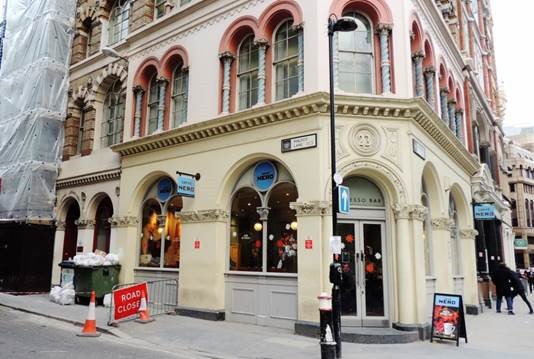
23 Cheapside : Intersection of Philpot Lane (Left) and Cheapside (Right)

“Up to the 12th century, for those living and working in the City of London, Cheapside (‘cheap’ meaning market) was the major of two markets and the names of the streets that lead off it reflect the trades that flourished there – Wood Street, Milk Street, Bread Street, Honey Lane, Poultry and Friday Street (for fish).” http://www.onenewchange.com/

One Poultry Place was part of our walking tour so more about that another time.  It is also where the Boots optemetric shop is located and where I finally got my glasses put back together. 

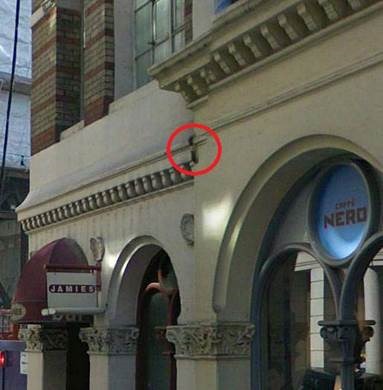
clip_image002

Just past the Nero sign on Philpot Lane

http://blackcablondon.wordpress.com

clip_image003

Very tiny indeed!   And a very terrible recent paint job!

Compare my photo I took today with the one below, you can see the lower mouse’s tail and the upper mouse’s leg and foot have been covered with white paint.  The photo below was from a blog entry in 2011. 

clip_image004

“The mice are still fighting over a piece of cheese on the Philpot Lane side of 23 Eastcheap. They apparently date from 1862 when  the building was constructed for the spice merchants Messrs Hunt & Crombie by John Young & Son.  I can’t think of another piece of Victorian street art in London, so if the Bourchier Street  Pig now claims the crown of smallest sculpture, perhaps the mice can go for the “Oldest Street Art” title instead.”

http://www.peterberthoud.co.uk

http://www.peterberthoud.co.uk/2011/04/pig-on-a-tile-in-bourchier-street-2/   shows the small plastic pink pig that eventually disappeared so I really I don’t think it counts and the mice still win.

And the mouse sculpture I haven’t yet seen……..

Further south, on a quiet stretch of the Thames Path near Rotherhithe, another rodent is easily overlooked. A menagerie of bronze animals ambles towards Surrey Docks Farm: there’s a family of pigs snuffling the ground, a fox prowling behind some waddling geese, and a couple of goats gazing blankly ahead, as goats always do. But, over on the Thames wall, there’s an odd little raised bump. On closer inspection, it becomes apparent that it’s not even big enough for a bump; it’s more of a blip. It’s a perfectly modelled bronze mouse.

http://smokealondonpeculiar.co.uk/

Public Art

   Among the hidden delights of the area along the riverside or by the ponds in the Surrey Docks is a charming series of sculptures by established artists, commissioned by the LDDC and each specifically linked with the history or attractions of the area.   At Cumberland Wharf, near the Mayflower pub, "The Bermondsey Lad and The Sunbeam Weekly", a series of three bronze figures – a Pilgrim Father, a small boy and a bull terrier – by Peter McLean refers to the Pilgrim Fathers who set sail for the New World from here in 1620.  Philip Bews’ Deal Porters at Canada Water recalls the agile men who unloaded deal (timber) from the ships in the local docks while on the top of Stave Hill a Bas Relief by Michael Rizzello depicts the Surrey Commercial Docks as they were in 1896 – after a shower of rain the "docks" fill with water.   At Barnards Wharf a cavalcade of farmyard animals by a variety of artists including pigs, a donkey, goats, geese, an owl and a mouse parades along the riverside towards Surrey Docks Urban Farm.

http://www.lddc-history.org.uk/surrey/index.html

St Dunstan in the East, 3rd stop on The Square Mile Tour

Cheers,

  So, how ‘bout them Pats?   I don’t faithfully follow Patriots football and I’m not a Tom Brady fan, but my friend Bruce has season tickets so I’m very happy for him. 

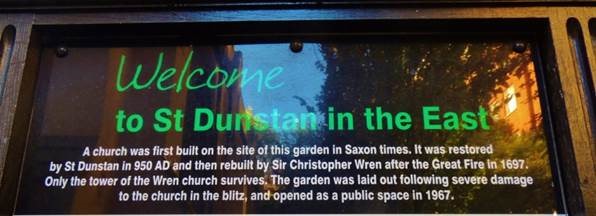
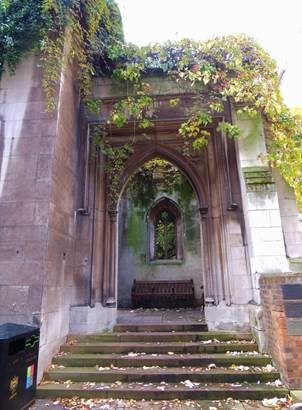
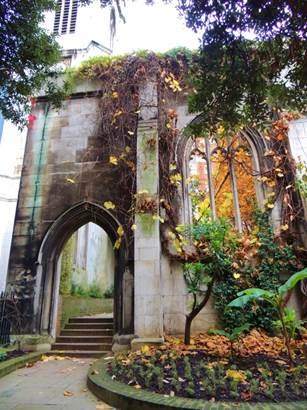
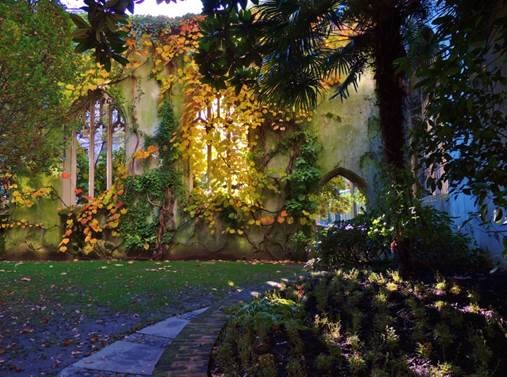
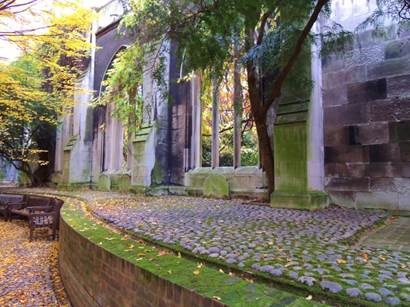
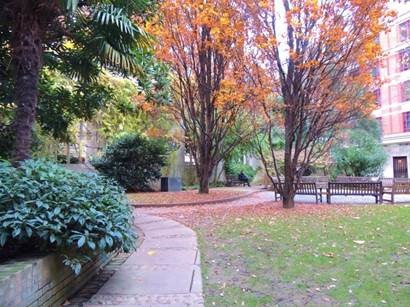
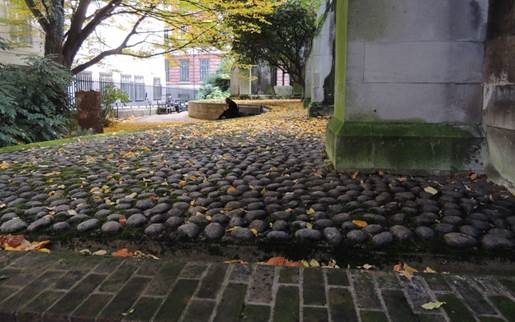
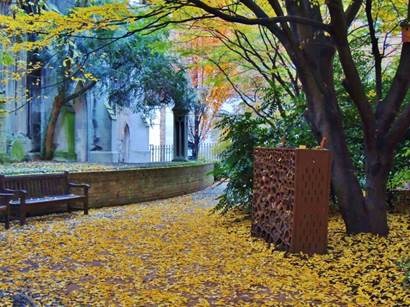
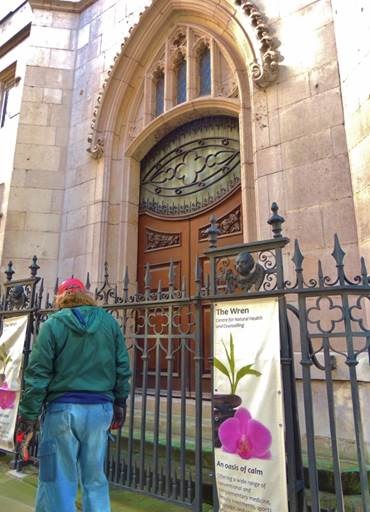
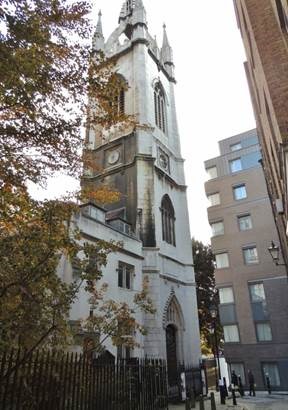
The third stop on our Square Mile tour was St. Dunstan-in-the-East.  Most of the “already ailing” church was damaged so heavily in the blitz that it was not rebuilt.  However, the “Wren” tower still remains and the open space has been designed into a city garden with an “insect hotel.”  The Wren alternative medicines clinic is now located in the small building in the garden just next to the tower.    I’ve put “Wren” in quotes as no one is absolutely sure how much input Christopher Wren had with all of these towers as he was very busy with the rebuilding of St. Paul’s Cathedral.  Kathy, the church watcher I met at St Mary-at-Hill says they now use the phrase “the Christopher Wren influenced church.”  I still have a few unanswered questions about St. Dunstan tower and garden, but for now, I’m done.  It’s not the best time for garden visits, and I’m no flower or tree expert, so I can’t point out the Virginia Creeper or the Drimy Winteri mentioned in the information about the garden.  But it is a lovely space for a quite sit or brown bag lunch.

    While I was reading about St. Dunstan I learned there were  British kings named  Eadred,  and  Eadwig.  Who knew?    And in case you were going to ask, there is a St. Dunstan-in-the-west.  (Like the witches in the Wizard of Oz.)   http://www.stdunstaninthewest.org/  is a place I might have to visit for one of their lunch time recitals.  Many churches offer these lunchtime treats; I attended one at St. Olave just near here.  

Ru

“You really will feel secluded in this gem of a City Garden. Those with green fingers will appreciate the range of plants wending their way around the ruins: the walls and majestic windows have been draped and decorated over time with virginia creeper and ornamental vine, vitis coignetiae, which turns crimson in the autumn. Exotic plants such as the pineapple-scented Moroccan broom, cytisus battandieri, and the new zealand flax, phormium both thrive here in the sheltered conditions.  An unusual plant in the lower garden is winter’s bark, drimy winteri.  Its leaves are high in Vitamin C and were once eaten to prevent scurvy.  Near to the fountain is a japanese snowball, viburnum plicatum, whose blossom in late spring is breath-taking.

     Biodiversity

A beautiful tucked away green space of high ecological value with climbers adorning the historic walls and wildlife including robins and great tits are among the regular visitors to the site. Look out for the winning Insect Hotel built within the garden as part of the 2010 Beyond the Hive competition.​​”

Published:10 May 2012 Last Modified:07 November 2013

www.cityoflondon.gov.uk

clip_image001

Information about St. Dunstan and the church follow the photos.

clip_image002 clip_image003

clip_image004

clip_image005

clip_image006

London Garden Square Competition awards over the years.

clip_image007

clip_image008

Insect hotel

“Two legs good, six legs better!”

clip_image009

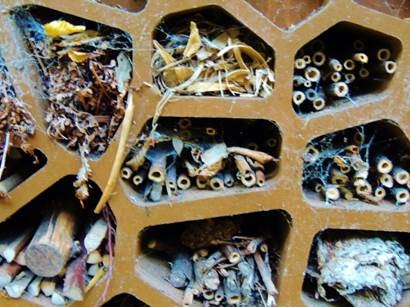
“The Insect Hotel is a classic take on the structure of an urban hotel with multiple levels and a interesting facade based on a Voronoi pattern. The hotel is constructed from 25 layers of birch plywood with voids cut out using CNC, which will be loosely stuffed with recycled waste materials and deadfall for various bugs to make their way into. The sides of the hotel are accessible for butterflies and moths, and the top is suitable for absorbing rain water through planting. The Insect Hotel is found at St. Dunstan’s in the East “ http://www.waymarking.com/

Arup Associates http://www.arupassociates.com/en/projects/insect-hotel/  design for a hotel for insects was the competition winning entry in ‘Beyond the Hive’, Sponsored by British Land and the City of London to celebrate 2010 as the International year of Biodiversity.

     Selected from five shortlisted hotels that were built and placed in parks around London, the jury included Paul Finch; Sarah Henshall; Adrian Penfold, Head of Planning & Environment, British Land; Peter Wynne Rees, the City Planning Officer; and architect Graham Stirk.

     Insects prefer habitats that are essentially neglected. Different varieties of insect require different habitats and environmental conditions to survive, so the challenge of designing an Insect Hotel is to cater for as many of these conditions and contexts as possible. These habitats generally consist of the detritus of the natural and man-made world comprising of organic and inorganic materials most of which can be procured from waste management or garden sources.

     Most simple insect hotels may be constructed in a very straightforward way from an assemblage of materials stacked together aided by an armature structure, that contains the disparate materials. Stacked timber palettes containing a variety of deadfall and inorganic waste is an example of this approach.

    As the objective of the City of London Corporation’s Brief suggests that the hotel is also ‘visually engaging and a well-crafted object’ and ‘enhances its setting and complementing the garden’ as well as having utility and corresponding to a defined volume, a more sophisticated version suitable for the vicissitudes of a London Park and the more critical eye of the human inhabitants.

http://www.waymarking.com

http://inhabitat.com/   for additional information.

clip_image010

clip_image011

The Wren Clinic

clip_image012

The Wren Clinic, EC3

Hello and welcome to the Wren.   Approaching our 21st year, we are one of the longest established complementary health clinics in the City of London. Our practitioners are all highly trained, have generally been qualified and in practice for more than three years, and many of them are involved in coaching and teaching.

Address:   Idol Lane  London, London City of EC3R 5DD

http://www.wrenclinic.co.uk

Therapies:

Acupuncture, Alexander Technique, Allergy Testing/Treatment, Aromatherapy, Beauty Therapy, Bowen Technique, Chinese Herbal Medicine TCM, Chiropody/Podiatry, Counselling, Cranio Sacral, Life Coaching, McTimoney Chiropractic, NLP Therapy, Nutrition, Osteopathy, Pyschotherapy, Reflexology, Reiki, Shiatsu, Sports Massage

clip_image013

The Clinic is located in the building adjacent to the tower. 

  “Tower, 1698, by Wren.  Large, Portland stone structure in gothic style. 3 main stages, Diagonal buttresses rising to octagonal turrets with large finials. Smaller finials between. Stone spire supported on open diagonal arches. Enriched doorways to west and south. North side now obscured by low building. East side rendered where formerly within church. Fine gates and railings to both doorways. Body of church, 1817-18, by David Laing. Destroyed except for walls in World War II. Gothic style with buttresses, traceried windows pinnacles etc. Yellow brick faced externally in Portland stone. North-east vestry. East wall reduced to sill level in centre.

Listing NGR: TQ3314980718

Selected Sources

Legacy Record – This information may be included in the List Entry Details

National Grid Reference: TQ 33149 80718

7 days a week throughout the year 8am – 7pm or dusk – whichever is earlier.”

http://list.english-heritage.org.uk/resultsingle.aspx?uid=1359173

Additional Information about the Church, the affiliated school that once had been here, and  Saint Dunstan.

According to the plaque on the site, a church has been here from ancient times, with a large churchyard by 1193/4. In 1366 the church required rebuilding but the Archbishop had to compel parishioners to contribute to the costs. In 1417 it closed temporarily after a fatal brawl, and in the 1450s a school was set up in the church. The building suffered damage in the Great Fire of 1666, after which the shell of the church was repaired through a private benefactor by Christopher Wren in 1695-1701. Wren re-built the tower and steeple, possibly assisted by Nicholas Hawksmoor. The church was in a bad state by the early C19th and was later rebuilt in 1817-21 by David Laing, but it was destroyed by enemy action in 1941 and little survived although the spire was reconstructed in 1953 and the tower restored in 1970-72 by Seely and Paget Partnership for use as offices.

The Corporation of London had acquired the church ruins in 1967 and these and the former churchyard were incorporated into a well-designed garden on several levels, which includes a circular cobbled area with a central fountain. Unusual trees, shrubs, flowers and climbers grow among the ruined arches and tracery. It was the largest garden to be created by the Corporation of London in the City in the C20th and was opened by the Rt. Hon the Lord Mayor Sir Peter Studd on 21 June 1971. The walls, gates and railings to the churchyard are of the Wren period. The tower and adjoining All Hallows House are now used as a complementary medicine centre and form part of the parish of All Hallows by the Tower (q.v.).

In 2010 the City of London and British Land collaborated in ‘Beyond the Hive’, an architectural competition to celebrate the International Year of Biodiversity. The design brief called for proposals for ‘Insect Hotels’: ecologically sustainable and creative insect habitats, and resulted in five finalists. The winning entries were built during June 2010 in 5 public gardens in the City: Bunhill Fields, Cleary Garden, Postman’s Park, West Smithfield Garden (q.q.v.) and here in St Dunstan-in-the-East.

http://www.londongardensonline.org.uk/gardens-online-record.asp?ID=COL068

The Church

This medieval church was devastated with bombs in World War II, leaving the interior just an empty shell.

But the ruins and the Wren Tower have become dramatic frames for the imaginative planting of wall shrubs and climbers.

This is an extraordinary example of a small space in the City, which makes the maximum use of scarce resources.

The City of London Architects and Parks Departments won a Landscape Heritage Award in 1976 for their imaginative work off Roehampton Lane.

This green oasis is busy on weekday lunchtimes with office workers eating their lunches, but becomes eerily quiet at weekends.  http://www.bbc.co.uk/england/sevenwonders/london/city_gardens/

Related church history from St. Dunstan College

The Foundation has its origins in the parish of St Dunstan-in-the-East, established on St Dunstan’s Hill in the City of London.

     A Christian church has probably stood on this site since the Roman occupation. The oldest remaining written record dates from 1272, the vestry "Grete Book", having been lost in the Fire of London.

     In 1446 a writ of Privy Seal addressed to the Chancellor, stated that the Archbishop of Canterbury and the Bishop of London,

    ‘considering the great abusions that have been of long time within our citee of London that many and diverse person not sufficiently instruct in gramer presumynge to hold comune grammer scholes, in great deceipte as well unto theire scholers as unto the frendes that fynde them to schole’, had ‘of their great wisdome set and ordeigned five scholes of gramer and no moo, one within the church yard of St Pauls, a second at St Martin Le Grande, another at Bow Church in Cheapside, another at St Dunstan-in-the-East and the fifth at the Hospital of St Anthony’.

The Chancellor was ordered to "Command all lige subjects not to trouble or impeche the maisters of the said scols, but rather helpe and assiste inasmoch as in them is."

By 1865 it was agreed to use the majority of the endowments of the parish to provide a new school on parish land elsewhere. "Owing to the enormous prices of London ground suitable and the very signifcant tendancy of large London schools to move out from the centre, the school should be placed at such a convenient distance from London as to be accessible by railway and that it should therefore be built on the Charity Estate at Catford Bridge in the Parish of Lewisham contiguous to a station on the Mid-Kent-Line of the Southeastern Railway Company, whereby proper play grounds would be secured for recreation and the remaining portion of the estate very greatly improved for building purposes…to engage first class talent in Masters and to supply First-Class education to the pupils adapted to the circumstances and the wants of the present day".  http://www.stdunstans.org.uk/history

Saint Dunstan

BY DAVID ROSS, EDITOR

At A Glance

•Bishop of Worcester

•Archbishop of Canterbury

•Patron saint of: Armourers and gunsmiths

•Born 909; Died May 19, 988

•Feast Day: May 19

•Symbol: smith’s tongs, and a dove

Saint Dunstan is fairly unusual among Anglo-Saxon saints in that we know where, if not precisely when, he was born. Dunstan was born in the village of Baltonsborough, Somerset, just a few miles south of Glastonbury, probably about the year 909 or 910. [Note: the Anglo-Saxon Chronicle gives the birth date as 925]. His father Heorstan was a Wessex nobleman of royal blood, and his family connections were to be of great benefit to him in his later career in the church. Glastonbury was at that time a popular place for Christian pilgrimage; folk traditions told that it was the first place of Christian settlement in Britain, and associated it with Joseph of Arimathea and Jesus himself.

Glastonbury Abbey

     The Abbey at Glastonbury was a centre of learning, and housed scholars from as far away as Ireland. The young Dunstan was educated at Glastonbury and then joined his uncle Athelm, Archbishop of Canterbury, at the royal court of King Athelstan.

     Dunstan took to the monastic life much later than most; taking holy orders in 943, when he may already have reached 34 years. Apparently he was at first disinclined to a life in the church, but a skin disease which he feared might be leprosy made him change his mind.

     After taking orders Dunstan returned to Glastonbury and built himself a small cell (i.e. a hut) beside the Abbey church. There he lived a simple life of manual labour and devotion. He soon showed great skill in the arts of metalworking, and he used his skills to craft bells and vessels for the church.

     But his life was not to stay simple for long; Athelstan died, and his successor Edmund called Dunstan to his court to act as a priest. After a short period at court, Edmund named Dunstan Abbot of Glastonbury.

     So once more Dunstan returned to the place of his birth, this time on a mission to reinvigorate the abbey. He instituted the strict Benedictine Rule, rebuilt and enlarged the church buildings, and established Glastonbury as a leading centre of learning and scholasticism. The effect of Dunstan’s reforms, and in particular his efforts to produce a class of educated clerics, did much to encourage the growth of monastic settlements throughout Britain.

     Dunstan acted as a royal advisor and negotiator for Edmund and his successor Eadred, and helped establish a period of peace from Danish attack. Unfortunately in 955 Dunstan’s zeal got him into trouble when he reproved young King Eadwig for moral laxity. Eadwig promptly confiscated Dunstan’s property and exiled the monk.

Dunstan found shelter at the monastery of Ghent, in modern Belgium, but he was quickly called back to Britain by Edgar, king of Northumbria and Mercia.

Edgar shared Dunstan’s monastic zeal, and together they put considerable energy into monastic reform and expansion. Under Edgar’s influence Dunstan became Bishop of Worcester, and when Eadwig considerately died in 960, Dunstan was named Archbishop of Canterbury.

     In this post Dunstan carried on his work of encouraging scholarship and monastic settlements. He also oversaw every detail of Edgar’s coronation as king.

     It is said that he designed the coronation crown himself, and more importantly, that he altered the ceremony to put emphasis on the bond between church and monarch; making the coronation a sacred act, emulating the ceremony of consecration for priests. Dunstan’s coronation ceremony still forms the basis of royal coronations today.

     When Edgar died, Dunstan carried on as advisor to his son Edward, but when Edward was murdered in 978 to make way for his brother Ethelred, Dunstan retired from court life. He lived on at Canterbury, delighting in teaching the young and only rarely troubling to involve himself in the politics of the realm.

     When he died in 988 Dunstan was buried in his cathedral, where his tomb was a popular place of pilgrimage throughout the Middle Ages. Until Thomas a Becket later eclipsed Dunstan’s fame he was the most popular English saint.   http://www.britainexpress.com/History/saxon/dunstan.htm

“Our historic home”  from the Wren Clinic website  with some interesting tidbits about St. Dunstan

By admin, on December 13th, 2012

Is attributed to Sir Christopher Wren, the King’s Architect, but was possibly designed by Robert Hooke, Surveyor to the City of London – the first person to demonstrate an artificial lung, blood transfusion and the modern model of memory.

     St Dunstan’s in the East was built following the Great Fire of London. A church was first built on this site in Saxon times, and was restored by St Dunstan in 950. The mediaeval church was destroyed during the Great Fire of London in 1666, which started only four streets away in Pudding Lane.  St Dunstans was rebuilt between 1697 and 1702. Only the tower remains of the ‘Wren’ church.

    The body of the church was demolished and rebuilt by David Laing in 1817 in the gothic revival style.

St Dunstan’s was badly damaged in 1941 during the Blitz of World War II. The restored tower also retains a consecrated chapel in which services can be held. The walls of the nave were left standing, within which the City Corporation have created a beautiful garden with seating and a fountain for visitors.

    St Dunstan

St Dunstan was born near Glastonbury early in the tenth century and lived during a period of monastic revival after the defeat of the Danes. While a Benedictine monk at Glastonbury, he became skilled in the crafts, particularly metalwork, which may explain why the Goldsmiths’ Company chose him as its patron saint. Besides being an accomplished musician and illuminator, Dunstan was also reputed to have been interested in science, concocting brews liable to explode! This possibly gave rise to the legend of his meeting with the devil, whose nose he is said to have seized with a pair of tongs.

Hence the tongs borne by sculptured angels over the altar of the Chapel of Ease on Idol Lane.

St Dunstan was made Abbot of Glastonbury in 940 and from 960 when he became Archbishop of Canterbury, he exercised great influence over King Edgar and his court. He was canonised shortly after his death in Canterbury in 988. http://www.wrenclinic.co.uk/2012/our-historic-home/

( I didn’t know about the sculptured angels or the Chapel of Ease, so one day I’ll go back and see if I can find them.)

A quirky story about St. Dunstan from a person named Sarah Boulton

On 19th March 2013 I attended an appointment under the name Isabelle Boulton at the Wren Clinic, a health and nutritional centre based in the bell tower of 11th Century church, St Dunstan in the East.

In 1970, the bells were removed from this bell tower. The former bells are said by many to have rung out the most beautiful sound of all the churches in London. After months of attempting to find a ‘live’ partner church – whose bells I might record to make into a sonic gift for St Dunstan – as well as gaining permission to then play this gift inside the bell tower (or at least even just the into the gardens!), i was met with a resounding ‘no’.

Eventually I found a sound recording made in 1970: on the very last day that the bells were installed in their tower. So I set this as my phone’s ringtone, entered into the Wren Clinic with my phone in my coat pocket, climbed to the top of the stairs and hoped that my phone might ring  http://www.sarah-boulton.co.uk/