Geffrye Museum

Cheers,

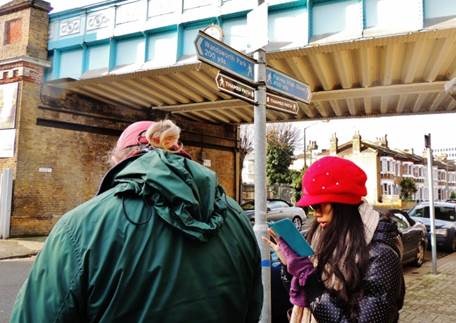
   I took myself to the Geffrye Museum.  It was a total adventure as I had to take a bus for the first time by myself! Cruiser friend Sandi had told me to walk to Gracechurch Street and I could catch the 149 to the Geffrye.  The Geffrey website gave me different directions and the London travel planner site gave me totally complicated directions, so I followed Sandi’s advice.  I wasn’t sure where to get off the bus but by the time we got to the Geffrye stop, the driver and everyone on the bus were all telling me, “here’s your stop.” 

     I really enjoyed my visit, the tour,  and the other people on the tour.  Afterwards I even invited myself to join one of the women who was having a snack in the Geffrye cafe.  She is a “horse person” so we could chat about that and about the tour.  She was a recently retired teacher who, when taking her students places around London always reminded them to “look up.”   That’s good advice in a place like London where there are so many architectural details on the buildings…if you just look up.  Sharing a table isn’t something we do in the US but it really is quite nice. 

     I’d noticed an art supply shop with a half-price sale about a block from the Geffrye where I’d left the bus so, after leaving the Geffrye walked back for a new sketch notebook.  As the day was bright and sunny and I could see the Gherkin off in the distance and knew the route back was pretty uncomplicated, I decided to walk.  Shoreditch is quite an interesting place that might put folks off, but the main street had art shops and restaurants and I felt totally comfortable walking alone.  So many places to explore.

     All in all a really enjoyable day.

Ru

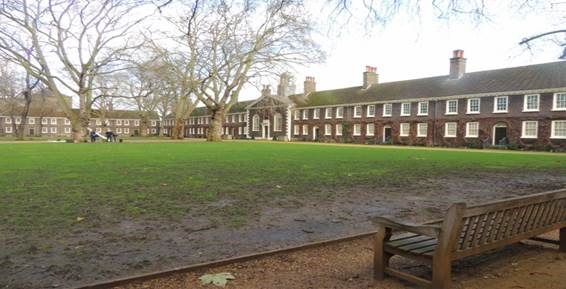
“Visitors to the Geffrye can view our permanent display of eleven period rooms which span approximately 400 years from around 1600 to the present day. There is also a walled herb garden and a series of four period gardens, chronologically arranged to reflect the museum’s period rooms, which can be visited between 1 April and 31 October.  To the front of the museum there is a large garden facing onto Kingsland Road, which has recently been refurbished.  Additionally, there is a restored 18th-century almshouse, open to visitors on selected days, which has been taken back to its original condition and provides a glimpse into the lives of London’s poor and elderly in the 1780s and 1880s.”

http://www.geffrye-museum.org.uk/period-rooms-and-gardens/

clip_image001

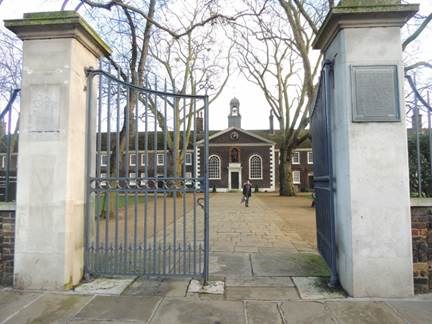
Entrance to the Geffrye : the woman walking in the front was our tour guide.

clip_image002

clip_image003

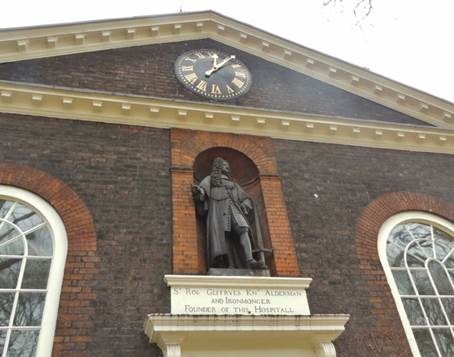
Sir Robert Geffrye left a bequest for the almshouse

“The Geffrye is set in almshouses built in 1714 by the Ironmongers’ Company, with a bequest from Sir Robert Geffrye, twice master of the Company and former Lord Mayor of London.  For almost two hundred years the almshouses provided homes for around fifty poor pensioners. They are now recognised for their historic importance as Grade I listed buildings.

     By the early 20th century Hoxton had become one of the most overcrowded and unsavoury parts of London, and the Ironmongers’ Company decided to sell its Kingsland Road property in order to relocate the almshouses to a healthier area.  The site was bought by London County Council wanting to provide public open space in such a densely populated area.  Leading members of the Arts and Crafts movement petitioned the Council not to demolish the almshouses, and it was agreed to convert the buildings into a museum which opened in 1914. 

(Our tour guide said the London site of the Geffrye suffered no damage during WW2, but the new almshouses, moved a the less crowded area in Mottingham Kent were bombed.

GEFFERY’S ALMSHOUSES, at Kingsland Road, Shoreditch (1712-1910, now the site of the Geffrye Museum), Eltham (1914-1974) and Hook, Hampshire (1974-). 1712-1915 (microfilm only 1911- 15). Ms 17053-  http://www.history.ac.uk/gh/18v.htm

   The Battle of Britain, as it became known, was fought in the skies above Kent’s orchards, fields and villages, and it was here that Hitler’s invasion plans were first stalled, and then put off indefinitely. During the period between 12 August and 15 September 1940, wave after wave of German fighters and bombers attacked targets in Kent, and the countryside became littered with the debris of fighter aircraft from both sides.  http://www.bbc.co.uk/ )

     One of the almshouses, No. 14, has been restored and can now be visited.  It still has most of its internal woodwork intact, including its staircase, upper floors, closets and panelling and is furnished to show the living conditions of poor pensioners in the 18th and 19th centuries.

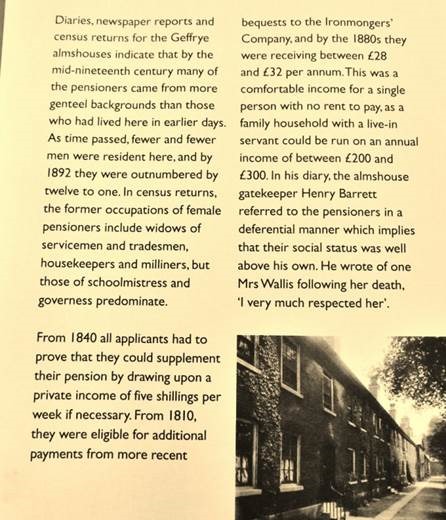
     Visitors are able to compare the sparse furnishings and few personal possessions of the generally poor elderly residents of the 18th century with the rather more comfortable surroundings of the better-off pensioners of the late 19th century, and with those of middle class homes of the time in the museum’s main displays.

     Displays about the history of the Geffrye almshouses, philanthropic and social housing in East London and the kind of people who lived there, can be found in two further rooms and the basement.

A History of the Geffrye Almshouses by Dr Kathy Haslam is available from the museum shop.

http://www.geffrye-museum.org.uk/

clip_image004

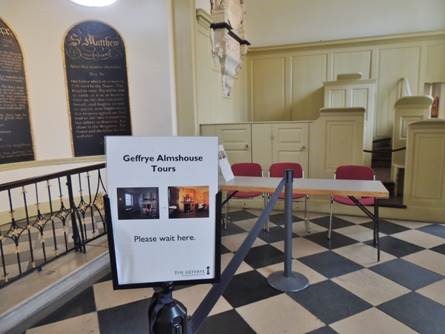
Residents of the Almshouses were required to attend chapel.

Waiting for the 12 noon tour. I was early and first in line;  it was first come first served.  The tours are only offered a few times each month with the size of the group limited to 15 people which is pushing it given the size of the rooms to be visited.  I had arrived just after the 11 am tour had started so spent a bit of time looking at the museum display of furnishing from different periods of history.  But my main aim was to be one of those 15 people for the almshouse tour, so by 11:40 I was waiting in this chapel to sign up and pay my 2£ 50p .  By the time the tour actually started I’m sure there were a few more than 15; but everyone there really wanted to be there so no one was left behind.  I’m finding as I take part in different tours around London that the folks who show up for them are usually quite nice and their questions generate more stories from the guides than one might hear otherwise. 

  Chapel was required of the pensioners housed here.  Our guide said that, especially in the 1790s most people would have been Protestant but no one was prohibited because of their religious beliefs.  She also said that the Jewish community would probably have had its own provisions for the needy and I seem to remember that from our Jewish east end tour. 

clip_image005clip_image006

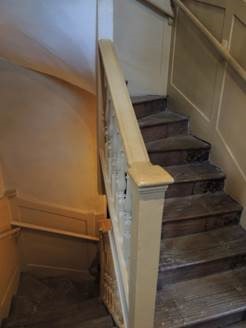
Stairway and introductory almshouse room.

“Stepping in through the double doors from the yard shaded by great trees, you find yourself in a staircase that once led to four residences on two storeys. “

http://spitalfieldslife.com/2011/05/04/at-the-geffrye-almhouses/

clip_image007

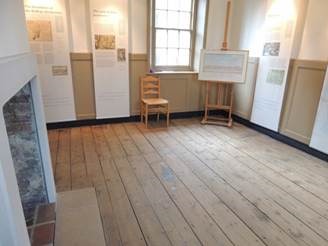
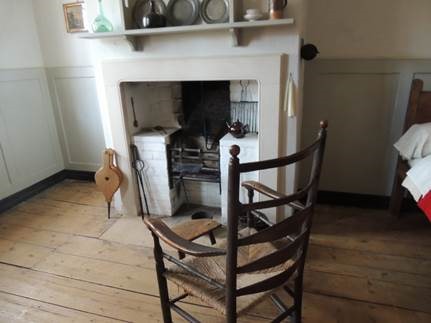
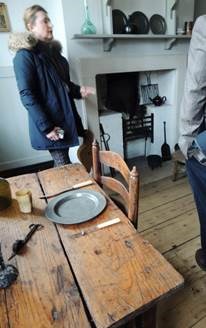
1780 furnishings

    “On the ground floor you enter the austere eighteenth century room, bare boards, lead-grey painted walls, a few unframed prints, a small dining table, a stick-back chair set by the brick range and a stump bed in the corner. Although this single room – with a tiny closet for preparing food – might have been occupied by a couple, it does not seem cramped and is comparable to, or even larger than, rooms I have visited in care homes for old people today.”

http://spitalfieldslife.com/2011/05/04/at-the-geffrye-almhouses/

clip_image008 clip_image009

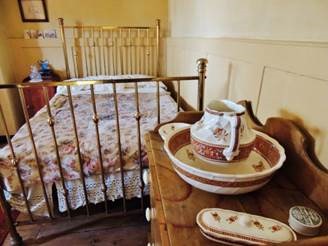
Our guide said that that cloths were hung over the bed to catch bugs dropping on anyone sleeping and that the mattresses were kept off the floor for that reason; avoid crawling bugs.   She also explained that at that time disease wasn’t connected to bacteria and germs or the effect of soap on both so soap was looked at as a luxury and taxed making it unaffordable to most people.   Later when the connection was made, the taxes were eliminated.  But many pensioners lived to very old ages. 

clip_image010

clip_image011

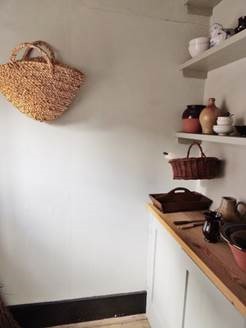
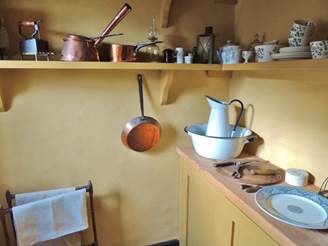
The pantry where household items were kept.

All residents were expected to keep the rooms clean and help with communal cleaning.  In the early years there were outdoor wells and privies that had to be cleaned.  But each room had a fireplace where food could be cooked and for warmth.  I thought the rooms were quite charming actually as did most people on the tour.   We  all  did appreciate the work of living with no indoor plumbing.

clip_image012

clip_image013

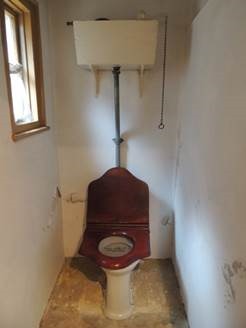
Basement facilities

A communal “washing tub” for clothes from the earliest days.   The later residents shared this one communal toilet for four rooms, but I’m sure it was seen as a vast improvement over the outdoor privies. 

clip_image014

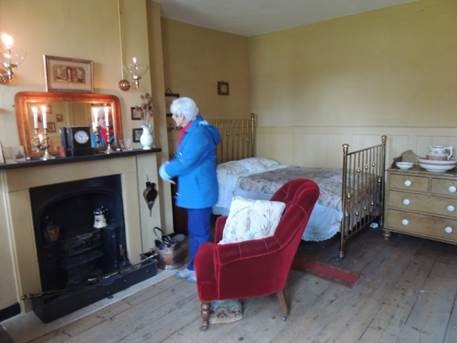
1880 furnishings

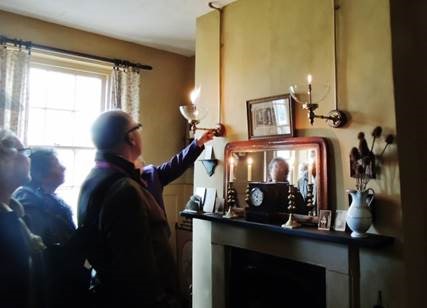
  “One flight of stairs above, you enter a room of the eighteen eighties and the immediate difference is that there are more things, more furniture and more trinkets. The brick range is replaced by a cast iron grate while a brass bedstead gleams in the corner  – and two brackets above the fireplace carry the innovation of gaslight.”

http://spitalfieldslife.com/2011/05/04/at-the-geffrye-almhouses/

clip_image015

Brass bed and pitcher and basin for washing now that soap was a common commodity

     A funny (to me) question was raised by one of the men in the tour.  He wanted to know why, as by the late 1800s most residents were single, genteel women, would anyone need a bed that big.  The rooms weren’t limited to single women, but the residents had to be over the age of 56 when they arrived.  And by the later periods, a small rent was also charged.

clip_image016

A demonstration of the gas lamps

Each room had a large window in the main room and a small window in the pantry which I really liked.

clip_image017

clip_image018

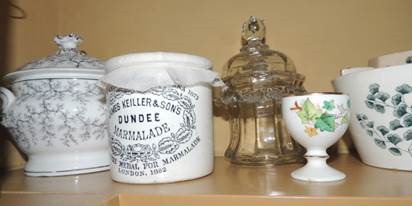
I remember buying Dundee Marmalade as a splurge as it was more expensive than Smuckers , Welches or Kroger brands.   I especially like their grapefruit marmalade as well as the jars!  I really wanted to pick up each item and see where it was made; but that wasn’t allowed which is probably why the stuff is still there in one piece. 

clip_image019

clip_image020

clip_image021

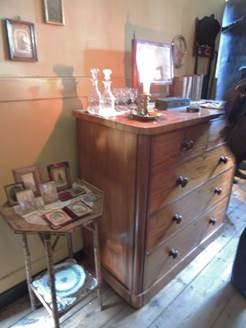
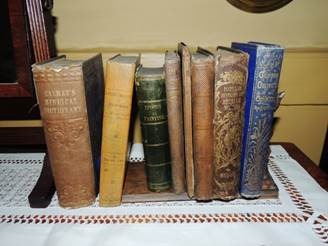
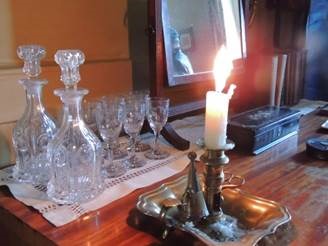
Glass decanters for port or sherry and books to read.  What more could one want?

clip_image022

clip_image023

Signs of the Ironmongers in Shoreditch

1576 THE LONDON GAZETTE, MARCH 20, 1883.

The Bankruptcy Act, 1869.

In the London Bankruptcy Court.

In the Matter of Proceedings for Liquidation by Arrangement

or Composition with Creditors, instituted by

Edward Welle, late of tbe Commercial Iron Work?,

Shorediteb, in the county of Middlesex, of No. 26, Queen

Victoria-street, in (he city of London, now of No. 5,

Dray ton Park, Islington, in tbe county of Middlesex*

Iron Mercban*, James Smith, late of the Commercial

Iron Works, and No. 26, Queen Victoria-street aforesaid,

DOW of No. 12, Chapel-street, Milton-street; in the city

of London, and Allerton Honse, South Hornsey, in tbe

county of Middlesex, Iron Merchant, and Henry James

Fenwick Gale, late of the Commercial Iron Works, and

No. 26, Queen Victoria-street aforesaid, now of No. 12,

Chapel-street aforesaid, and of Lincoln Honse, Ponder’s

End, in the coutty of Middlesex, Iron Merchant, lately

carrying on business in partnership together, undt-r the

firm of Wells-and Company, at the Commercial Iron

^Works, and 26, Queen Victoria-street aforesaid, and as to

the said James Smith and Henry James Fen-wick Gale,

carrying on a separate business as Dealers in Honse

Property, under the firm of Smith and Gale, at No. 12,

Chapel-street aforesaid.   http://www.london-gazette.co.uk/issues/25213/pages/1576/page.pdf

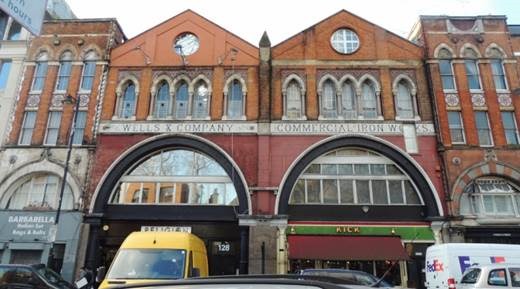
“There are a few interesting Victorian buildings in Shoreditch that managed to survive both Hitler and 60s re-developers like this former ironworks. Shame someone cut a window through that decorative tiling.”

http://shipscooksstuff.wordpress.com/2012/02/01/shoreditch-a-trip-to-londons-victorian-east-end/

“Legend has it that the name is derived from Shore’s Ditch, being the last resting place of Jane Shore the mistress of Edward IV who is supposed to have either died or been buried in a ditch in the area. What’s more likely is that the name comes from Sewer Ditch.”

This blog opened with the paragraph below which I found really interesting as well as reading about his visit to Shoreditch as it was my first visit there.  It’s an interesting area; I walked back from the Geffrye as I knew it was a pretty strait shot back and I could see the Gherkin and the Shard so couldn’t get too lost. 

My friend Brian’s studio is located in a redeveloped Victorian match factory, the Perseverance Works. This was the sort of place where the exposure to white phosphorous in the matchmaking process caused Phossy Jaw, a nasty disease that caused the teeth and jaw to rot away, before causing death from massive organ failure. The phosphorus made the affected jaw bone to glow in the dark, hence the name. The use of white phosphorus over the more expensive, but far less toxic red phosphorus was only banned in the UK in 1910, after a lot of campaigning from the Salvation Army and other philanthropic groups.”   Shipscookstuff again….

While doing my reading about the Geffrye, almshouses in general, and the ironmongers, I came across the following entry from the Spitalfields Life blog.  I’ve quoted it during my write up but posted it intact below as it’s a good read.

“Visiting the Mariners’ almhouses at Trinity Green in Whitechapel last week filled me with curiousity to discover more of the former life of these places, and so I sought out the Geffrye almhouses in Shoreditch which are now the Geffrye Museum, where a couple of dwellings have been restored as they were once inhabited. After three centuries, the bewigged statue of Sir Robert Geffrye – the enterprising Cornishman who came to London at the age of sixteen, enjoyed a prosperous career as an ironmonger and was declared Lord Mayor of London in 1685 – still presides with a satisfied smile upon this fine terrace built in 1714 at his bequest by the Ironmongers’ Company to provide homes for “poor people of good character over the age of fifty-six.”

At that time, much of the land North of Old St was given over to nurseries and market gardens, punctuated by clay pits and kilns for tile making. Quieter and healthier than the City of London, it was the ideal location for almshouses, with the Drapers Company and the Frameknitters company also building to the North and South of the Geffrye site. Built by carpenter Robert Burford, the fourteen Geffrye almhouses were constructed of good quality materials, “of oake or good yellow firr,” and “good plain tyles with heart of oak lathes,” while windows were glazed with “the best Castle (Newcastle) glass,” and each door had “a stoute lock, key and bolt and latch and good hinges.” The buildings were lacking in ostentation, with minimal ornamentation upon the interior where each dwelling consisted of a single unfurnished room of thirteen by fifteen feet.

And for two hundred years, the Geffrye almhouses served their noble purpose until the rowdy city began to impinge upon the delicate sensibility of the elderly residents and, in 1908, the almshouse matron, Annie Young, complained that “All kinds of objectionable rubbish were thrown over the wall…rows between men and women were constantly to be seen…and the children who ran about the yards seemed scarcely to be human.” In 1912, the Ironmongers Company transferred their worthy pensioners to the more isolated and peaceful location of Mottingham in Kent and sold the almshouses to the London County Council who converted them into a museum of furniture, reflecting the location of Shoreditch as the centre of the furniture industry then.

Yet one dwelling remained unaltered with its staircase and internal woodwork intact, in use as the museum warden’s house until 1996, and this has now been restored with one room as it might have been in 1780 and another as it might have been in 1880. Stepping in through the double doors from the yard shaded by great trees, you find yourself in a staircase that once led to four residences on two storeys. On the ground floor you enter the austere eighteenth century room, bare boards, lead-grey painted walls, a few unframed prints, a small dining table, a stick-back chair set by the brick range and a stump bed in the corner. Although this single room – with a tiny closet for preparing food – might have been occupied by a couple, it does not seem cramped and is comparable to, or even larger than, rooms I have visited in care homes for old people today.

A list of residents from the seventeen eighties reveals that most were small tradesmen from London who enjoyed modest success in their working lives, and many were able to continue some form of piecework to supplement their small pensions. They were obligated to keep their rooms clean, to be in before the gates locked at night, to refrain from blasphemy or keeping poultry on the front lawn, and adultery and lewdness were both punishable by expulsion, yet the evidence of the records shows that the apparent strict regulations appear to have been followed leniently. No-one was expelled.

One flight of stairs above, you enter a room of the eighteen eighties and the immediate difference is that there are more things, more furniture and more trinkets. The brick range is replaced by a cast iron grate while a brass bedstead gleams in the corner  – and two brackets above the fireplace carry the innovation of gaslight. In 1898, Henry Barrett the gatekeeper recorded an incident with matron’s new gas oven, “I met with an Axedon today. There Exploded in the matron’s House the Gas. I Filled the Gas oven in the stove & I opened the Door & it exploded in my face, Burned my Face & Hair & Whiskers & Burned off my Eye Lashes. It was God’s Good Providence my Eyes was not Hurt.” Looking from the window out into the tiny courtyard where once fifty people resided in these almshouse, I could only wonder at the drama occasioned by the exploding oven in such an isolated community – where few people left except feet first and some were simply transferred direct to the ironmongers’ cemetery conveniently placed within the grounds at the end of the terrace.

But in spite of the exploding ovens and rowdy neighbours, census records reveal that the Geffrye pensioners lived far beyond average life expectancy at the time – in this shangri la on the Kinsgland Rd – as Henry Barrett recorded in his journal,“Miss Daniel Died after seven years Bedrid, I think near a hundred years old.” Even today, with the steady flow of visitors and school parties to the Geffrye Museum, there is an enduring air of peace in this place that is instantly restored once the crowds have passed through the yard, and inside the almhouses you feel it pervasively, in these quiet rooms where people have sat out time.” http://spitalfieldslife.com/2011/05/04/at-the-geffrye-almhouses/

http://www.almshouses.org/almshouse-vacancies/

The Almshouse Association is a support charity representing 1,700 independent almshouse

charities throughout the United Kingdom providing homes for over 35,000 people

Sir Robert Geffery’s Trust     Reg. Charity No. 219153

     Sir Robert Geffery was twice Master of the Company and was Lord Mayor of London in 1685. Born in the village of Landrake in Cornwall, he died in London in 1704 having made his fortune in overseas trade. He left a substantial endowment for almshouses which were built in Shoreditch, east London. These were sold in 1910 to London County Council and now house the Geffrye Museum. The Company then built new almshouses at Mottingham in Kent, which in turn were sold, in 1972, to the Greater London Council.

     Today the Trust owns two almshouses in Hampshire, one at Hook built in 1976 and enlarged in 1987 and one at Basingstoke which was opened in 1984. These provide sheltered housing for 125 retired people of limited means. There are resident Wardens at both Homes, with the overall management carried out from Ironmongers’ Hall.

Grants are made by the Trust for relief in need, focussing on educational projects for children and young people in disadvantaged areas. A bursary is given to support a student at the City of London School for Girls.  http://www.ironmongers.org/company_sir_robert_gefferys_trust.htm

http://www.ironmongers.org/index.htm

http://www.ironmongers.org/company_livery_companies.htm  explains the history of the various trade guilds and their place in British History.

http://www.ironmongers.org/almshouses_gefferys_fields.htm  describes the modern “almshouse” and the fee to live there.

Little Venice Walk part 2

Cheers,

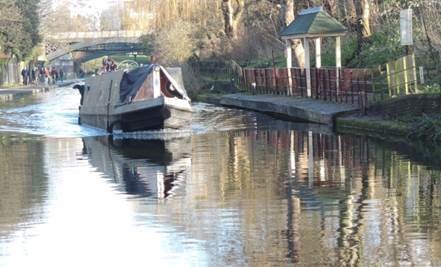
   This email concludes our Little Venice through Camden walk.  According to the Canal Trust website where I found the directions for the walk, completed it was 4.5 miles.   We missed the final few stops but must have walked more than 4 miles just the part we did.  At least it felt that way.  But it was lots of fun and good exercise.  Just wish we’d brought some snacks!

Ru

6. Camden Lock

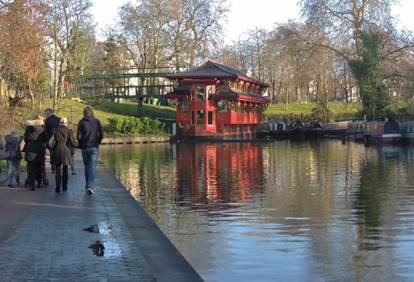
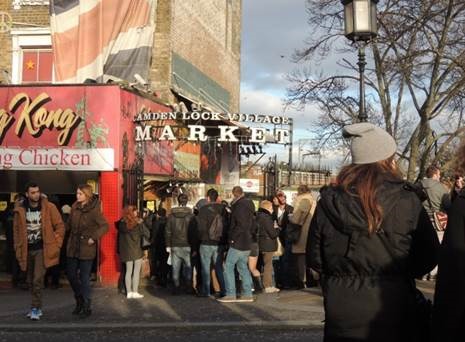
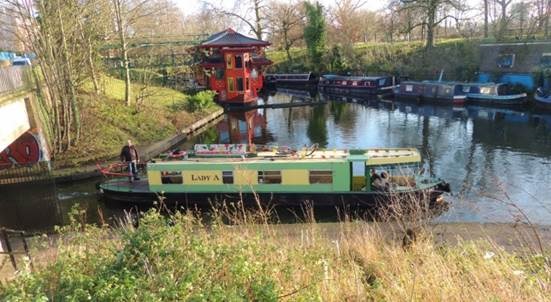
Ahead you will see the Feng Shang Chinese floating restaurant moored in Cumberland Basin. This arm of the canal used to stretch towards Euston station but was largely filled in with bomb rubble after the Second World War. At this point, the canal takes a sharp turn to the left towards Camden. From Cumberland Basin, Camden Lock is approximately five or ten minutes’ walk along the towpath, should you wish to make a detour. Camden is best known for its alternative and vibrant market scene, which centres on a cobbled courtyard just off the canal. Camden Lock Market is particularly lively at weekends and is a great place to break from the walk for shopping and refreshments.

clip_image001

clip_image002

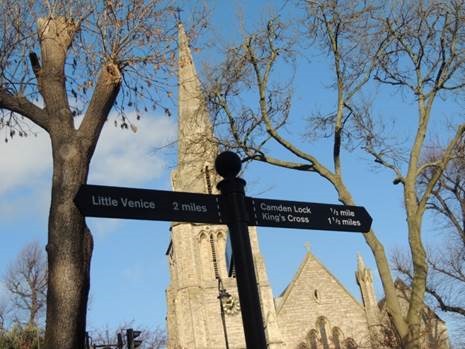
It felt like more than two miles since we’d left Little Venice

clip_image003

Camden Town

clip_image004

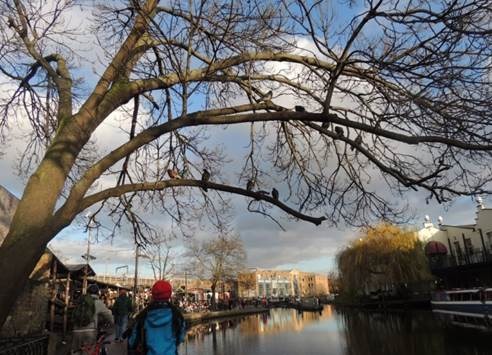
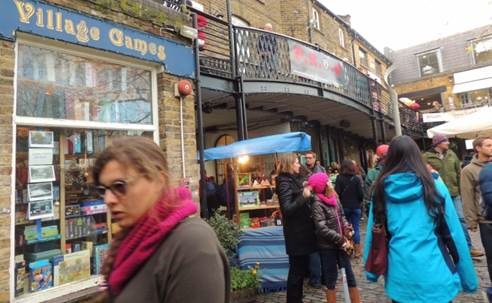
“In recent years, Camden has ditched its grubby image to become one of the capital’s most fashionable addresses. The moment you step outside the tube station, Camden attacks the senses. Bass thumps from the market stalls’ speakers, the scent of street food and incense permeates the air, and goths, punks, pushers and tourists shove past, giving the area an unorthodox charm. Come to Camden for the atmosphere, but stay for the cheap restaurants and awesome live music scene”

http://www.timeout.com/london/things-to-do/camden-area-guide

clip_image005

clip_image006

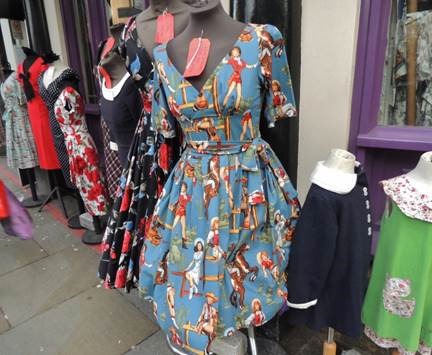
On the right person I think this would look great.

clip_image007

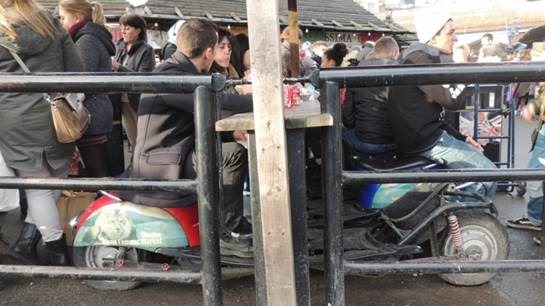
Mini motorbikes as seating for eating the tons of available street food.

Really more crowded than we like so, after lunch at a “sit down place” we continued our journey

clip_image008

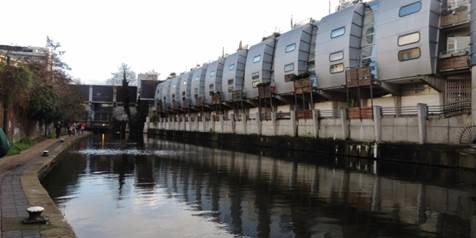
Looks like mobile homes or RVs backed up to the canal, but they’re apartments.  Probably expensive apartments.

We retraced our steps back to the original path to continue on.

When I was 21 I read The Bell Jar by Sylvia Plath and had, during my early library years catalogued  Moon-Whales a book of kid poems by Ted Hughes so we were off to find the locations connected with them on the next part of our walk.

7. Fitzroy Road

For those that don’t want to visit Camden, the circular walk leaves the towpath on the left, immediately after the rail and road bridge. Up the stairs, you will emerge on Gloucester Avenue. For those who detoured to Camden, retrace your footsteps back past the Pirate Castle to the rail and road bridge and take the stairs on the right immediately before the bridge. At the top of the path, continue in the same direction, keeping The Engineer pub on your left. Take the third exit on the left – Fitzroy Road, crossing Chalcot Road, to No 23 Fitzroy Road on the left. Number 23 Fitzroy Road is the former home of the Irish poet William Yeats. The poet and writer Sylvia Plath also lived in the upstairs maisonette of 23 Fitzroy Road until 11 February 1963, when she ended her life.

clip_image009

You had to look up to find these two landmarks…. And we almost missed them.

clip_image010

W.B Yeats and Sylvia Plath

    “By November 1962, she thought she had found the ideal place for herself and her two children: a maisonette at 23 Fitzroy Road in a house once inhabited by WB Yeats, complete with a blue plaque bearing his name. She closed up the house in Devon and in December, back in London, she was declaring herself to be the happiest she had been for months. Each morning she would get up at four o’clock and write in a white heat the Ariel poems that would subsequently make her famous. Although her mother implored her to come back to America, Sylvia maintained that she was exactly where she wanted to be: London. It was, she said, ‘the one city in the world I’d like to live in, with its fine doctors, nice neighbours, parks, theatres and the BBC’.”

Then, on 11 February 1963, during one of the worst winters on record, Plath, in the grip of a deep depression, prepared to end her life. First, she made sure Frieda, almost three, and Nicholas, just one, were safe in their high-sided cots in their bedroom on the top floor. Then she placed two cups of milk and some bread and butter next to them, opened the window and sealed the door frame with tape, pushing tea towels into the gaps. In the kitchen she did the same, put a little folded cloth in the oven and knelt down. She placed her head inside, turned on the gas, lapsed into unconsciousness and died. Poignantly, just a few weeks before, Plath, who was only 30, had written: ‘When I came to my beloved Primrose Hill, with the golden leaves, I was full of such joy.’ ES

http://www.standard.co.uk/

8. Primrose Hill

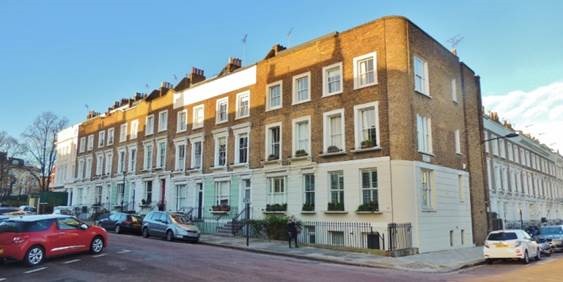
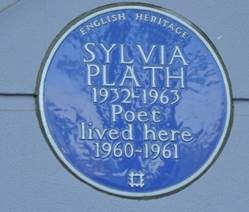
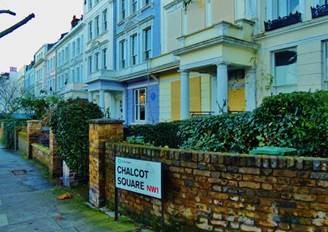
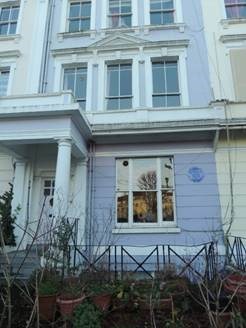
Return to Chalcot Road and turn left. Opposite Chalcot Square is another former residence of Sylvia Plath. Sylvia Plath and Ted Hughes lived at 3 Chalcot Square from February 1960 – August 1961. At the end of Chalcot Road, bear left into Chalcot Crescent with its beautiful Georgian houses. At the end of Chalcot Crescent, turn right into Regent’s Park Road, cross the road and enter Primrose Hill. Following the path through the park to the top of the hill you can admire the panoramic views across the capital. Primrose Hill is popular with kite fliers and frisbee flingers but is also ideal for relaxation or maybe a picnic.

“Sylvia and Ted settled in Primrose Hill, in a small, unfurnished flat at 3 Chalcot Square, which cost six guineas a week,” http://www.standard.co.uk/

6 guineas = 6 L 6 shillings pre 1971  I think

One of the downsides of living in the city, even then, was lack of space. The flat in Chalcot Square — where, in July 2000, English Heritage erected a blue plaque in Plath’s memory — comprised a bedroom, sitting room, kitchen and bathroom. ‘We are dreaming of a house where I can shout out to Ted from one end to the other and he won’t be able to hear me,’ she said. The price of a freehold house on Fitzroy Road, her favourite street in Primrose Hill, was £9,250 and although the area was, she said, ‘quite slummy’, she knew it was on the up.

clip_image011

clip_image012

clip_image013

3 Chalcot Square home of Sylvia Plath and English Poet Ted Hughes

  “Al Alvarez, in his classic study of suicide, “The Savage God,” describes the scene at that Chalcot Square apartment. “It was so small that everything seemed sideways on.” But there was room for the essential: “A typewriter stood on a little table by the window, and they took turns at it, each working shifts while the other minded the baby.”  http://www.nytimes.com/

clip_image014

clip_image015

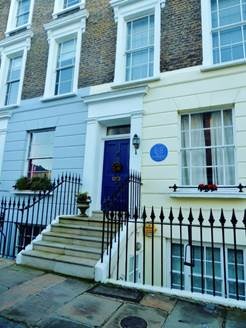
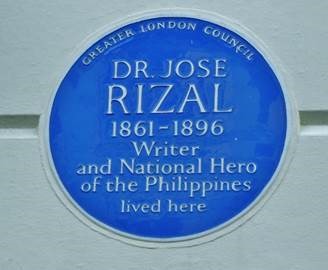
NW1, Chalcot Crescent, 37

    “Dr Rizal lodged here in 1888 with the Beckett family on a weekly rent of £2. On 19 June 2011, to celebrate Rizal’s 150th birth anniversary the London Chapter of the Knights of Rizal and the Philippine Embassy held a heritage walk from an event at the British Museum (where Rizal had been a registered reader in the Reading Room) and laid a floral offering at this plaque.”  http://www.londonremembers.com/memorials/dr-rizal

clip_image016

José Rizal   1861-1896

     José Rizal, son of a Filipino father and a Chinese mother, came from a wealthy family. Despite his family’s wealth, they suffered discrimination because neither parent was born in the peninsula. Rizal studied at the Ateneo, a private high school, and then to the University of St. Thomas in Manila. He did his post graduate work at the University of Madrid in 1882. For the next five years, he wandered through Europe discussing politics wherever he went. In 1886, he studied medicine at the University of Heidelberg and wrote his classic novel Noli me Tangere, which condemned the Catholic Church in the Philippines for its promotion of Spanish colonialism. Immediately upon its publication, he became a target for the police who even shadowed him when he returned to the Philippines in 1887. He left his country shortly thereafter to return to Spain where he wrote a second novel, El Filibusterismo (1891), and many articles in his support of Filipino nationalism and his crusade to include representatives from his homeland in the Spanish Cortes.

     He returned to Manila in 1892 and created the Liga Filipina, a political group that called for peace change for the islands. Nevertheless, Spanish officials were displeased and exiled Rizal to the island of Mindanao. During his four years there, he practiced medicine, taught students, and collected local examples of flora and fauna while recording his discoveries. Even though he lost touched with others who were working for Filipino independence, he quickly denounced the movement when it became violent and revolutionary. After Andrés Bonifacio issued the Grito de Balintawak in 1896, Rizal was arrested, convicted of sedition, and executed by firing squad on December 30, 1896.

Following the revolution, Rizal was made a saint by many religious cults while the United States authorities seized on his non-violent stance and emphasized his views on Filipino nationalism rather than those of the more action-oriented Emilio Aguinaldo and Andrés Bonifacio.

http://www.loc.gov/rr/hispanic/1898/rizal.html

clip_image017

clip_image018

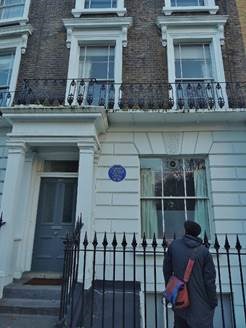
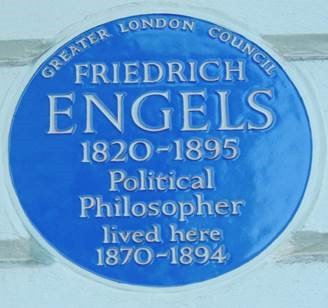
Friedrich Engels

“He moved  to 122 Regent’s Park Road (1) in Primrose Hill, which is where this walk  begins. The door was always open on a  Sunday and all the communists and  socialists of note would come over.  The editors of the Social Democrat  newspaper in Tufnell Park  would come across the railway tracks and there were proper parties, lots of beer and loud debate.”

http://www.timeout.com/media/pdf/hampstead.pdf  Walking with Communists in Hempstead Heath

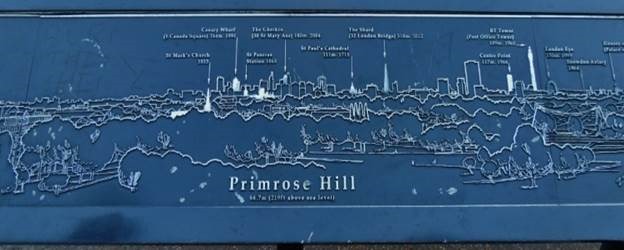
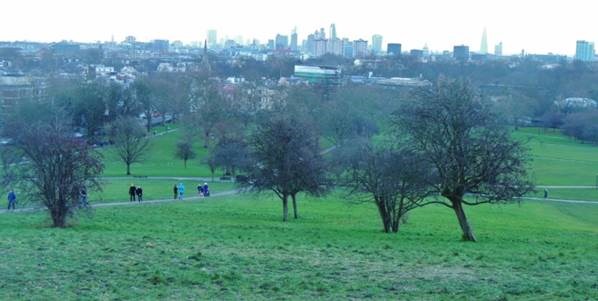
We climbed up to the viewing area on Primrose Hill

clip_image019

clip_image020

clip_image021

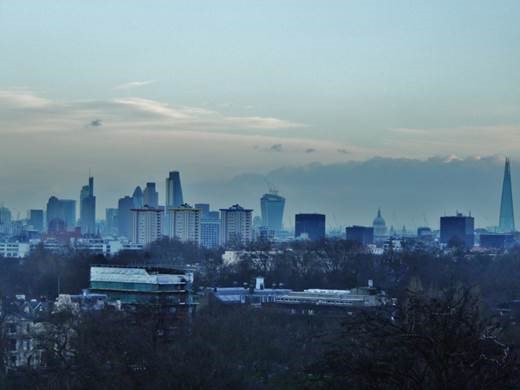
Off in the distance are St Paul’s, the car melting “Walkie Talkie” building and the Shard. 

     We could see lots of familiar places, but getting to them was another story.  By the time we reached this point it was 3 pm.  We needed to be at St Paul’s by 4:30 to get seats for the Evensong concert.  The trick was finding our way out of the park and to a Tube Station. 

     Thankfully a “sort of helpful” fellow driving his dog home from the park gave us directions after first making fun of our American English.  He was an old chap so maybe should have been more polite than to do that.  So we walked and walked and walked and finally found the St Johns Wood Station.  We managed to get to St Paul’s early enough for a “loo stop” but not for coffee.  Unfortunately where we were sitting the acoustics weren’t great so after 15 minutes or so we decided to leave.  It had been a long day which had started out sunny and almost too warm but ended with drizzle and cold. 

There are a few more places of note along the path that maybe we’ll finish one day.  But with so much to do, we may move on to other adventures. 

A future walk…..maybe one day

9. St Johns Wood High Street

Walking over the hill, take the left path and head down the hill the other side. At the T-junction in the path, turn left and exit the park on St Edmunds Terrace. Walk down St Edmunds Terrace and over Avenue Road into Allitsen Road. Continue straight on Allitsen Road, (follow the cycle route rather than the car route) to the end where it meets St John’s Wood High Street. Turn left. On your right you will pass 45a, the former home of composer Benjamin Britten. Britten worked on his first opera, ‘Peter Grimes’ whilst living here and the opera was an immediate success when it was first performed in 1945.

10. Liberal Jewish Synagogue

Turn right off St John’s Wood High Street into Wellington Place. At the end of Wellington Place, cross Wellington Road and turn left towards the roundabout where you will turn right into St John’s Wood Road. Continuing down this road, you will pass, on the right, the world-famous Lords Cricket Ground, home of England’s cricket team since 1813. It is widely rumoured that soil excavated from the Maida Hill tunnel during the creation of the Regent’s Canal was used as top soil for the Lords Cricket Ground. Opposite Lord’s is the Liberal Jewish Synagogue which was built in 1925. Bomb damage during the war forced the synagogue council into a major rebuilding project. It now features works of art, including a Holocaust sculpture by award-winning artist Anish Kapoor.

11. Hamilton Terrace

Continue down St John’s Wood Road. A short detour at this point will take you to the Abbey Road studios made famous by the Beatles but we are carrying on to Hamilton Terrace. At Hamilton Terrace you will find two Blue Plaques. The first, at Number 17, is the former home of Sir Joseph Bazalgette, the great Victorian civil engineer best known for designing and building the hundreds of miles of underground sewers in London. It is claimed that Bazalgette saved more lives than any other single Victorian public official. Number 20, on the opposite side of the road, was home to William Strang, artist and founder member of the Royal Society of Painter-Etchers. Another former resident of number 20 was Sir George Alexander Macfarren, a prolific Victorian composer, who lived and died here in 1887.

12. Warwick Avenue

Return to St John’s Wood road and turn right. At the junction with Maida Vale, cross the road and into Clifton Gardens. Number nine Clifton Gardens was home to Professor Sir John Ambrose Fleming, the electrical engineer, whose invention of the thermionic valve paved the way for modern communications such as radio and telephone. Continue down Clifton Gardens and you will arrive at your starting point of Warwick Avenue tube station.

Distance

4.5 miles / 7.24 Kilometers  felt way longer than that…..

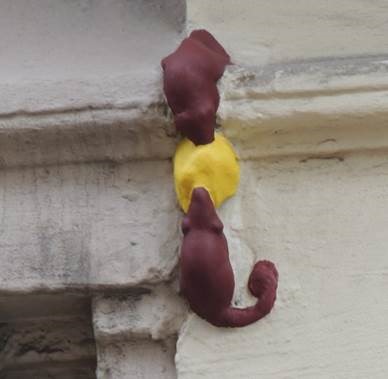
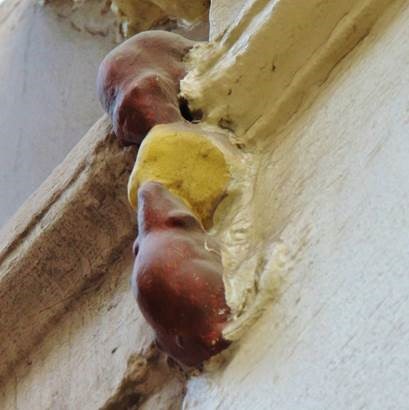
The Philpot Lane mice are repainted!

clip_image001

Repainted mice!!!!!!

Cheers

Hip Hip Hooray is what I should say.  The Philpot Lane Mice are once again recognizable as mice.  Today as I was walking down Cheapside to catch a bus to the Geffrye Museum in Shoreditch, I stopped to check on the mice. Workmen at the site told me the mice had been repainted this past weekend.   I had written to the Canary Wharf Corporation as I’d been told they owned the building where the mice were located.  When I returned home today I found this email in my inbox.

From: Andrew Heath-Richardson
Sent: Wednesday, January 22, 2014 6:39 PM
To: Ruth
Subject: Philpot Lane Mice

Dear Mrs Johnson

Many thanks for your email addressed to Sir George Iacobescu regarding the above.

Please find attached a photograph of the restored mice and cheese, and thank you for bringing this to our attention and we hope your will look out for the mice on your next visit to London.

So I wrote back…..

Dear Mr Heath-Richardson,

   I saw the mice today!   Thank you so much.  Our boat is berthed at Saint Katharine Docks Marina, not so far from the mice so everyone who visits us is taken to see the mice as well as the Monument to the Fire.  Now I have an additional story to tell.

   Thank you again, not only for painting the mice, but for taking the time to read my original email and then writing me telling me the happy ending of the story.

Ruth Johnson

clip_image002

Mice before :  hard to see at a distance without the lower mouse’s tail painted brown.

clip_image003

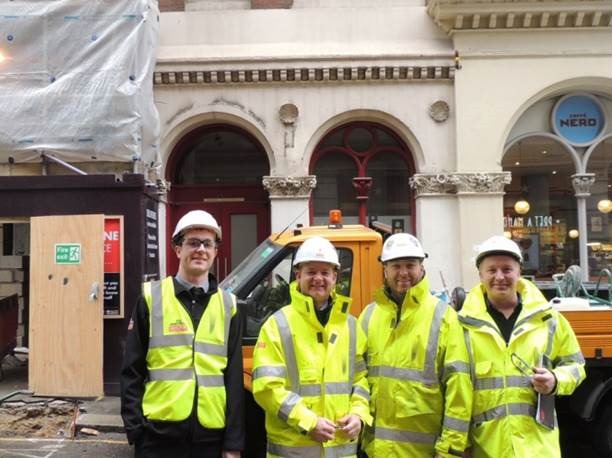
The guys who told me how “I’d gotten the mice repainted.”  You can actually see the mice now.  They are between the two men on the right if you look on the edge of the building.

Little Venice London Canal walk part 1

Cheers,

   I’m trying to catch up on all our past adventures….before I forget most of their best stories.  While Singkey was here I decided we all had to hike the Canal Path….and still make it to Evensong at St Paul’s Cathedral to hear a visiting choir from Canada.  Not the best plan, but it almost worked.  The numbered info comes from the Canal River Trust website. 

Ru

Little Venice Canal Walk : London/Camden

http://www.canalmuseum.org.uk/history/regents.htm tells the history of British and London Canals.

Little Venice to Camden Circular Walk

http://canalrivertrust.org.uk/

This walk starts and finishes at the picturesque Little Venice and takes you through the beautiful green corridor of The Regent’s Canal, Primrose Hill and St John’s Wood. An area rich in history, this corner of London has played a significant part in the capital’s development both economically and culturally. Boasting former residents of writers, artists and inventors this area has always been somewhat avant-garde and is now home to some of London’s most desirable addresses……..

clip_image001

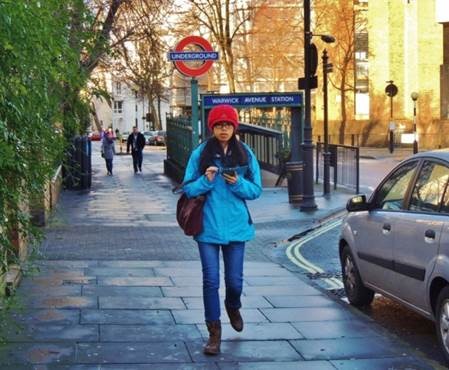
Warwick Avenue Tube station was our starting point.

1. Pool of Little Venice

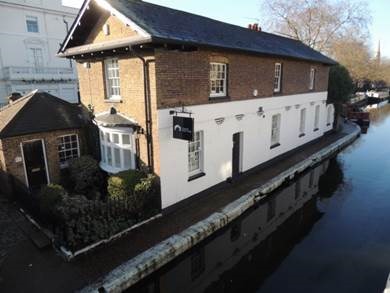
     Take the left exit out of Warwick Avenue tube, walk straight ahead and take the first road on the right, Warwick Place. At the end of the road, turn left and walk over Westbourne Terrace Road Bridge. On the right hand side of the bridge is the Old Toll House which dates from 1812. On the left is the Pool of Little Venice, so named by the poet Robert Browning, who lived overlooking the canal.

clip_image002

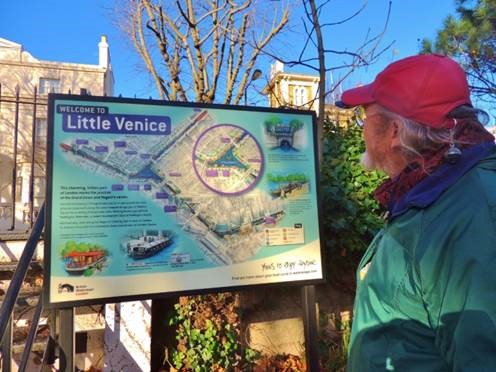
You are here….

clip_image003

Old Toll House?

clip_image004

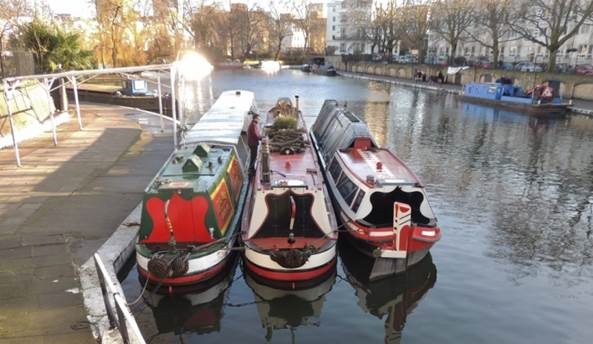
Pool of Little Venice

This area was called “Little Venice” for a reason.  But “Little Amsterdam” might have been just as apporpriate.  Maybe more so for me as I’ve been to Amsterdam but not YET to Venice.

clip_image005

One barge was set up as a puppet theater.

http://www.puppetbarge.com/Temporrarynotice.htm

Wish my pal Martha were here so I might actually go to this puppet show.  But as it’s a schlep from Tower Hill, it’s a long shot that I’ll actually return though their puppets, shown on the website, look pretty remarkable.

clip_image006

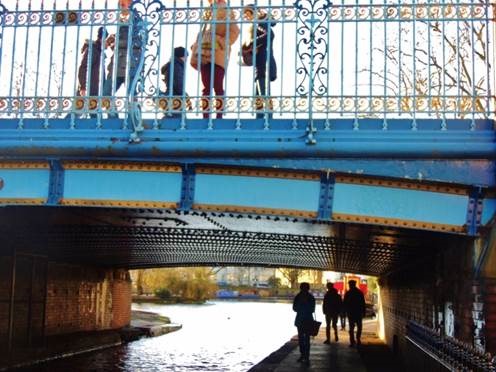
Over/under.  We did both on our walk

clip_image007

2. Edgware Road

On the bridge, turn left towards the slope. Here you will find a footbridge back over the canal. Cross the footbridge onto the towpath opposite the Waterside Café, sign-posted to Camden and Regent’s Park. Following the towpath under Warwick Avenue Bridge, you will reach the pretty residential moorings of Blomfield Road, one of the most prestigious canal mooring sites in London. Turn off the towpath onto Blomfield Road for a hundred metres. At the end of Blomfield Road the canal disappears into the Maida Hill Tunnel. Cross over Edgware Road into Aberdeen Place.

clip_image008

Home of Guy Penrose Gibson  WW 2 RAF hero

     “Gibson flew only the Dambusters raid with 617 Squadron despite them flying more precision bombing missions after. The success of the Dambusters eclipsed Gibson’s previous outstanding record and gave him a place in history. He was awarded the Victoria Cross; the highest and most prestigious award for gallantry in the face of the enemy that can be awarded to British and Commonwealth forces. He was now the most highly decorated pilot in the RAF and a national hero……”

http://www.thedambusters.org.uk/gibson.html

http://www.bbc.co.uk/news/magazine-22510300 tells the story of the Dambusters raid to bomb dams in the German industrial heartland. 

clip_image009

3. Lisson Grove 

Continue until you reach the Crocker’s Folly public house on your left. Once a large hostelry, The Crockers was built in anticipation of a new railway terminal, which was eventually built further South at Marylebone. Continue straight ahead and along the pathway sign-posted Regent’s Canal. Walk down the steep flight of steps and back onto the canal towpath. You have now reached Lisson Grove.

http://www.heritagepubs.org.uk/ shows the pubs interior and tells its history

clip_image010

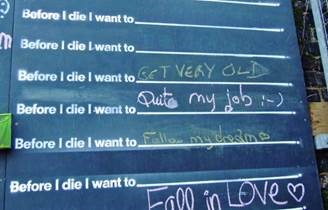
http://beforeidie.cc/site/day-of-walls/   Who knew? 

What is it?

Before I Die is an interactive public art project that invites people to share their personal aspirations in public space. The original wall was created by artist Candy Chang. Read more here. Since then, over 400 Before I Die walls have been created in over 60 countries and over 25 languages.

clip_image011

Wall along the Canal

clip_image012

My response : Get Very Old!

clip_image013

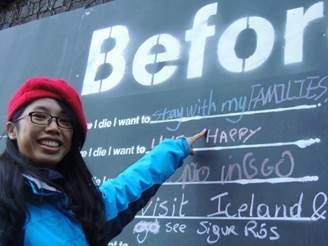
Singkey wants to be with her mom and with Randal and me.

clip_image014

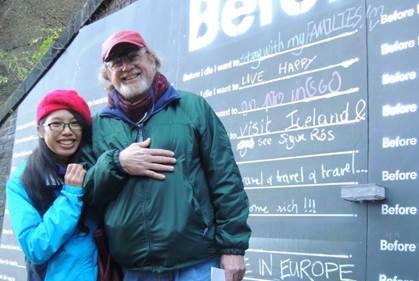
Randal’s goal was to “go home.” 

clip_image015

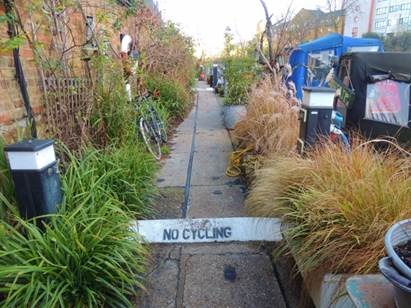
Less “posh” than the Venice Pool address

clip_image016

This reminds me of a seaside cottage patio during the off-season.

clip_image017

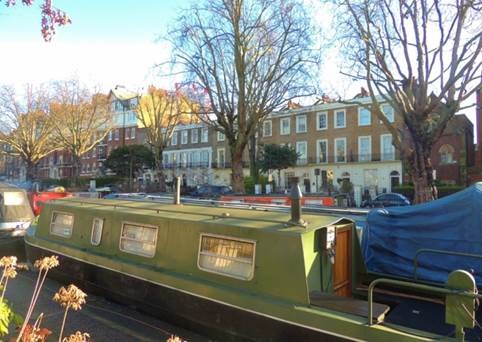
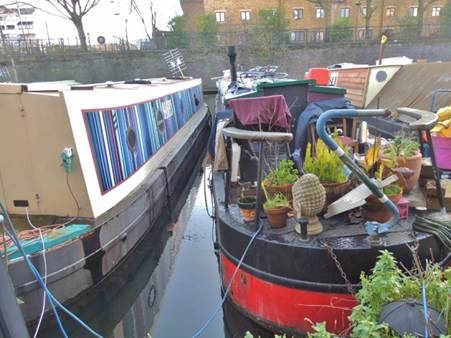
Life on a canal boat…

“Britain boasts thousands of miles of canals, most dug in the late 1700s to serve the factories of the Industrial Revolution, says Oliver Briscoe of Britain’s National Waterways Museum. Trains and trucks have put the canals out of the freight business, but in the last few decades "there has definitely been an upsurge" in people living on canal boats, especially in London, Briscoe says. "It’s a very British thing."

     Boaters pay a license fee that’s the same no matter where they’re moored, allowing them to escape London’s high housing prices. The annual fee depends on the size of the boat, but the typical "narrow boat" used as a canal residence would cost roughly $1,500 a year.

     To fit inside the smallest locks, most of the boats are less than 70 feet long and seven feet wide, hence the name "narrow boats." They usually have several small rooms inside, and possessions — bicycles, flower pots, wooden platforms — are lashed to the roof. Some are painted with the traditional roses that have been an adornment for canal boats for more than a century.

     Many London boaters are "continuous cruisers" who find a new place to drop anchor every few weeks rather than staying in the same place month in and month out.

http://usatoday30.usatoday.com/

clip_image018

Very posh!

4. Regent’s Park  (

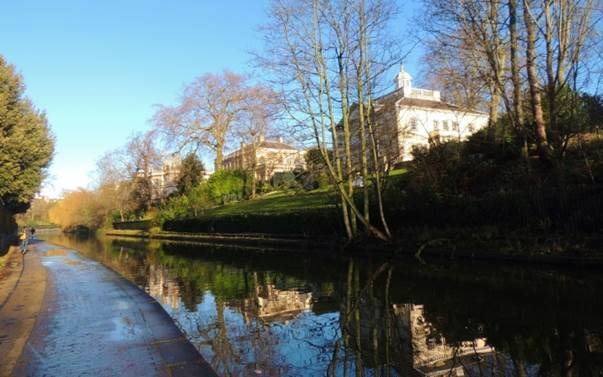
Originally architect John Nash intended to have the Regent’s Canal running through the middle of the park, but he was persuaded that the bad language of the navvies would offend the refined residents of the area so he altered his plans. Nash had plans to build 56 villas in Regent’s Park, however only eight were completed. The beautiful white villas on the right were built to Nash’s original designs during the late 1980s and early 1990s and drew inspiration from the architecture of ancient Greece, Rome and the Renaissance period.

clip_image019

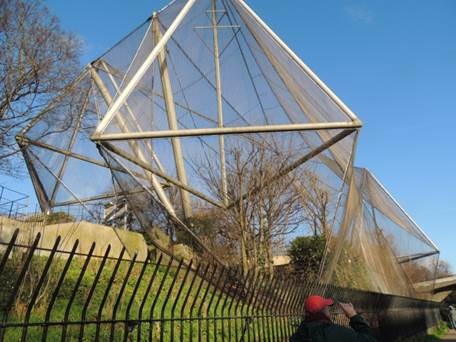
London Zoo Aviary

“The aviary has been a landmark on the London skyline since it was built in 1962.

Designed by and named after Lord Snowdon, it was the first walk-through aviary in existence – pushing the architectural boundaries of it’s time. “  http://m.zsl.org/lz-animals-snowdon-aviary

clip_image020

Canal just near Camden Town

clip_image021

This red floating Chinese Restaurant looked a bit too touristy and the artsyness of Camden Town sounded more appealing.


Greenwich Part 2

Cheers,

   I’m trying very hard not to have a cold. I have an annoying cough and a runny nose.  Yuck.  But  I have plans for tomorrow and Saturday and lots going on and lots I want to do.  So today, I’m having a rest day just doing two loads of laundry and catching up on some email.  And finishing part 2 of our visit to Greenwich.  Makes me want to return to see what we missed or what I missed when it was right in front of me.  Randal is doing some boat cleaning which makes me feel a tad guilty, but I really have too little energy to do much so I’m not.  I’m going to finish this, read, nap, watch an episode or two of New Trick, nap, read…..

Ru

clip_image001

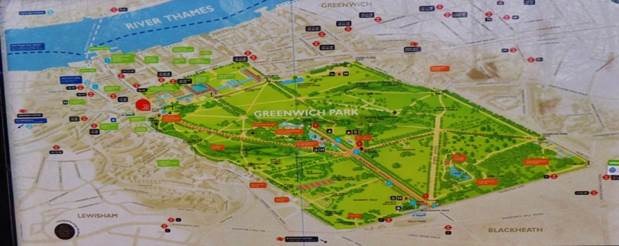
Overall map of Greenwich Park: the Cutty Sark is situated on the Thames

Modern History of the area….

1675 Royal Observatory founded in Greenwich Park

1694 Queen Mary founds the Royal Hospital for Seamen

1705 The first 42 pensioners arrive at the Royal Hospital while building continues

1708 James Thornhill begins to decorate the Painted Hall

1751  Royal Hospital for Seamen buildings completed

1779 Chapel gutted by fire and rebuilt by James ‘Athenian’ Stuart’

1806 Nelson’s body lies in state in the Painted Hall following his death at Trafalgar in 1805

1836 The world’s first suburban railway opens.  It runs from London Bridge to Greenwich

1869 The Royal Hospital closes

1873 Royal Naval College – the Navy’s university – opens

1884 Longitude 0° at Greenwich becomes Prime Meridian

1902 The Greenwich Foot Tunnel is opened

1937 The National Maritime Museum is opened by King George VI

1954 Cutty Sark is moved into a dry dock at Greenwich

1997 Greenwich becomes a World Heritage Site

1998 Royal Naval College closes. Greenwich Foundation founded to look after the Old Royal Naval College (ORNC)

http://www.ornc.org/visit/history/timeline

clip_image002 clip_image003

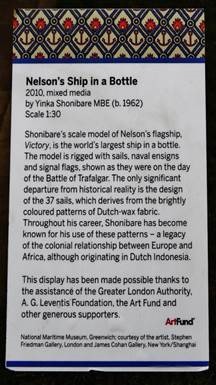
http://www.yinkashonibarembe.com/

clip_image004

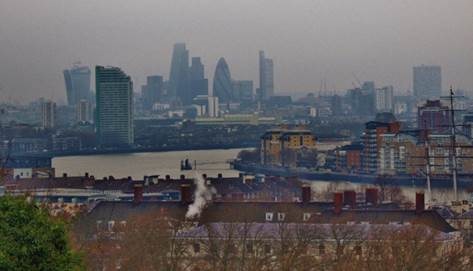
Looking back towards London from the Royal Observatory Hill; not visible here but we could actually make out the dome and spire of St Paul’s Cathedral.   Supposedly Greenwich is only 4 miles from Tower Bridge so we could actually walk one day.

clip_image005

The Greenwich Time Ball   Flamsteed House

The bright red Time Ball on top of Flamsteed House is one of the world’s earliest public time signals, distributing time to ships on the Thames and many Londoners. It was first used in 1833 and still operates today.

What does the Time Ball do?

Each day, at 12.55, the time ball rises half way up its mast. At 12.58 it rises all the way to the top. At 13.00 exactly, the ball falls, and so provides a signal to anyone who happens to be looking. Of course, if you were looking the wrong way, you had to wait until the next day before it happened again.

The Time Ball drops at 13.00 GMT during the winter months and 13.00 BST during the summer. Please note: the time ball will not be run if the weather is too windy.

What did people do before there was a time ball?

Only the richest people could afford to buy clocks and watches of their own. Most people relied on public sundials to tell the time. This led to different local times across the country, with clocks on the eastern side of the country about 30 minutes ahead of those in the west.

The difficulties created by everyone using their own local time eventually led to the creation of Standard Time based on the Prime Meridian at Greenwich.

http://www.rmg.co.uk/explore/astronomy-and-time/time-facts/the-greenwich-time-ball

clip_image006

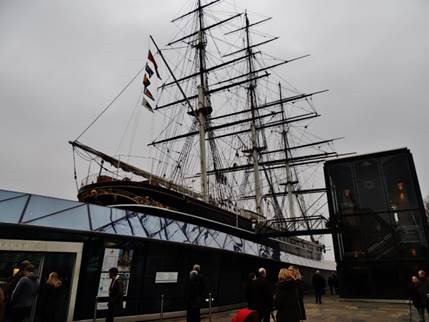
Cutty Sark

The Cutty Sark is the most famous tea clipper built, and is the only one to survive, apart from the City of Adelaide aka RNVR Carrick which is now in Australia and being restored before being opened to the public. She is now in dry dock at Greenwich.

     She was launched at Dumbarton on the River Clyde, Scotland, in 1869. The name comes from Robert Burns’ poem, Tam O’Shanter; Tam meets a group of witches, most of whom are ugly, but for Nannie, who is young and beautiful and is described as wearing only a "cutty sark", i.e., a short chemise or shirt. The ship’s figurehead is a representation of this witch.

The Cutty Sark’s sleek lines and enormous area of sail made her the fastest ship in the race via the Cape of Good Hope for the then particularly money-spinning tea trade with China. Unluckily for her owners, the Suez Canal was opened in the same year as her launch, which is not navigable by sailing ships. Her last cargo of tea was carried in 1877.

     Later, from 1885 to 1895, she was used in the wool trade with Australia, bringing the new season’s clip from Sydney to London, setting new speed records year after year.

     By 1895, she was again losing money for her owner and was sold to the Portuguese as the Ferreira, although interestingly enough her crews called her Pequina Camisola (‘little shirt’).  She was worked by her new owners between Oporto, Rio, and Lisbon for over thirty years until 1920, when she was sold again, this time becoming the Maria do Amparo.  In 1922 she underwent a refit in the Surrey Docks, London, and was driven to shelter from a storm in Falmouth harbour on her way home.  A Captain Wilfred Dowman saw her there, and bought her from the Portuguese owners, returning her to British ownership again.

     On Capt. Dowman’s death in 1938, his widow presented her to the Thames Nautical Training College at Greenhithe on the Thames, where she was used as a training vessel.  After the Second World war she again became surplus and eventually she was towed to Greenwich and placed in a specially constructed dry dock in 1954. After a lot of restoration work she was opened to the public in 1957. Since then more than thirteen million people have visited her.

     The ship was badly damaged by fire that broke out around 4.45 am on 21 May 2007. Thankfully, she was undergoing restoration work at the time of the fire, and about fifty per cent of the ship had been removed, including the iconic figurehead, the masts and rigging, the coach house, and a significant amount of planking, so the damage could have been a lot worse. After nearly five years, on 25 April 2012, Her Majesty The Queen, accompanied by His Royal Highness The Duke of Edinburgh, officially re-opened Cutty Sark.  http://www.greenwich-guide.org.uk/cutty.htm

clip_image007

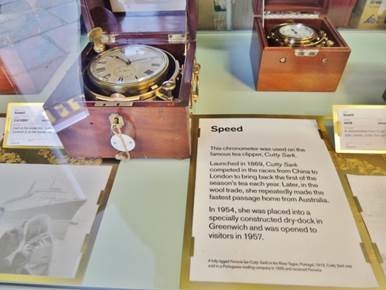
Cutty Sark’s chronometer

clip_image008

Foot Tunnel under the Thames…..something to do one day.

    The Greenwich Foot Tunnel runs under the River Thames between Cutty Sark Gardens and Island Gardens, on the Isle of Dogs. It is 1,217 feet in length and approximately 50 feet deep. Its original purpose was to allow south London residents to work in the docks on the Isle of Dogs. It was designed by Sir Alexander Binnie and was opened on 4 August 1902 at a cost of £127,000. The tunnel is lined with 200,000 glazed white tiles.

The circular entrance buildings are similar both sides of the river and contain a lift and a long spiral flight of stairs. It is open 24 hours a day, although the lifts do not always run the full time.

The Woolwich Foot Tunnel, situated about three miles downstream and opened ten years later, is very similar

http://www.greenwich-guide.org.uk/tunnel.htm

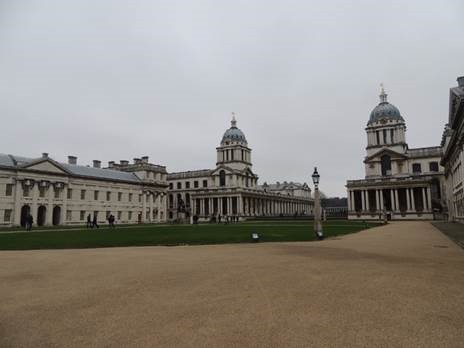
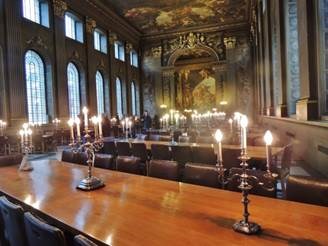
Old Royal Naval College Chapel and Painted Hall

Royal Hospital for Seamen

   Built for charitable public purposes rather than to glorify personal status, the Royal Hospital for Seamen was established by Royal Charter in 1694 for the relief and support of seamen and their dependants.

     Sir Christopher Wren planned the site and the first foundation stone was laid on 30th June 1696. During the first half of the eighteenth century various illustrious architects, such as Hawksmoor, Vanbrugh and James ‘Athenian’ Stuart completed the design.

     In 1706 the first 42 Pensioners arrived. Numbers grew steadily as the buildings became usable, rising to 2,710 in 1814. Although they slept on beds instead of hammocks, their diet (based on bread, beer and boiled meat) would have reminded them of their days at sea. They took meals in the undercrofts below the Painted Hall and Chapel and were allowed to smoke their clay pipes or ‘chalks’ in the Chalk Walk, now the Skittle Alley.

     As the nineteenth century wore on, with peace established, numbers of Pensioners declined and the Hospital finally closed in 1869. http://www.ornc..org/visit/history/royal-hospital

clip_image009

clip_image010clip_image011

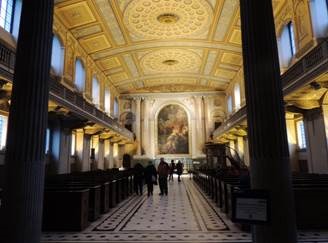
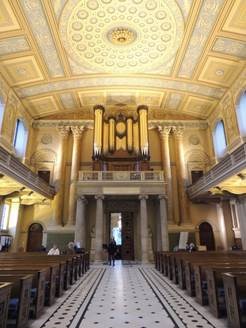
“A glorious neoclassical Chapel”

“The Chapel, constructed by Thomas Ripley to the designs of Sir Christopher Wren, was the last major part of the Royal Hospital for Seamen to be built. Following a disastrous fire in 1779, it was redecorated by James ‘Athenian’ Stuart in the Greek revival style, and today is a wonderful example of a complete neoclassical interior.

     The interior of the original chapel was much plainer than today, with a flat panelled ceiling, an apse (alcove) at the east end, and much smaller galleries.  For many years there were no pews, and the injured sailors had to stand during their daily service.  At 6am on 2 January 1779, a tremendous fire gutted the building, leaving only a shell.

     James Stuart, as Surveyor at the Royal Hospital for Seamen, was appointed to re-design the Chapel in 1781. The Chapel reflects his influences of ancient Greek architecture and design. Stuart left much of the work to his Clerks of Works, Robert Mylne and William Newton who deserve much of the credit for the way the Chapel looks.

Features that merit a special mention include the Samuel Green organ (the only one of its kind to remain in situ).

Key facts

•The Chapel is dedicated to St Peter and St Paul, both of whom have connections with water and the sea.

•The vast altarpiece painting is the only one of Benjamin West’s altarpieces to remain in the same place for which it was commissioned.

•The 1789 Chapel organ is the largest in situ work of Samuel Green, the leading organ builder of his day.

The Chapel today

   Following extensive restoration in the 1950s, the Chapel today looks much as it did in 1798 when it re-opened after the fire. Today it is open to visitors free of charge.

     Join one of our knowledgeable Yeomen guides on a daily tour or download one of our free interpretation guides to learn more about the Chapel. This printed guide is also available in English and other languages from the welcome desk”  http://www.ornc.org/visit/attractions/chapel


clip_image012

clip_image013

clip_image014

clip_image015

clip_image016

clip_image017

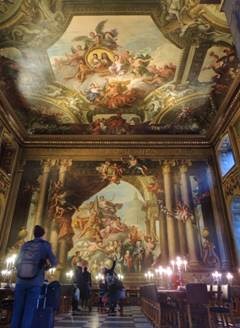
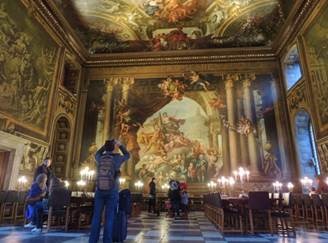
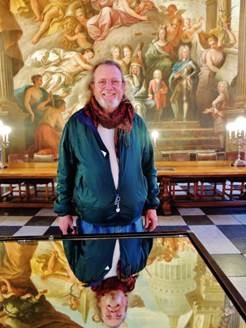
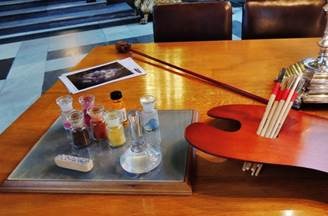
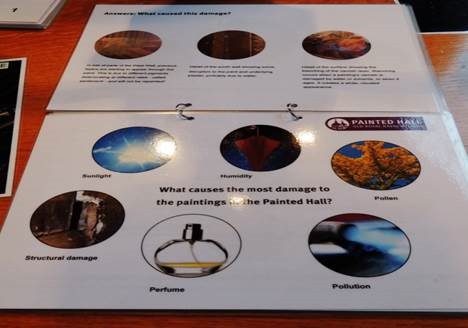
Trolleys with mirrors were available to make viewing the painted ceiling easier.

Though this too reminds me of Harry Potter it wasn’t listed as having been filmed here.  But you’ll recognize lots that were if you click on the link below.

“The Old Royal Naval College (ORNC) has been host to a star-studded cast, which includes amongst others Colin Firth, Helen Mirren, Hugh Grant, Sharon Stone, Keira Knightley, Owen Wilson, Jackie Chan, Nicole Kidman, James McAvoy, Naomi Watts, Jude Law, Rowan Atkinson and Jonny Depp.”

http://www.ornc.org/venuehire/filming/past-features

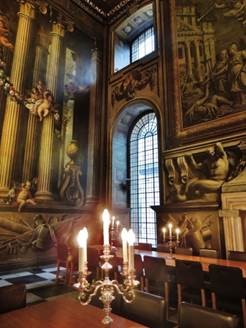
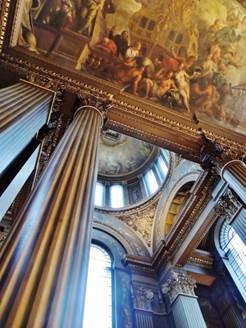
Painted Hall The finest dining hall in Europe

    The Painted Hall is often described as the ‘finest dining hall in Europe’. Designed by Sir Christopher Wren and Nicholas Hawksmoor, it was originally intended as an eating space for the naval veterans who lived here at the Royal Hospital for Seamen. Its exuberant wall and ceiling decorations are by Sir James Thornhill and pay tribute to British maritime power.

     The Painted Hall sits within the King William Court. Wren submitted designs in 1698 and the roof and dome were in place five years later. When in 1708 James Thornhill began decorating the interior, he was instructed to include many references to the importance of the navy in Britain’s fortunes.

     His ‘great and laborious undertaking’ was completed after 19 years, by which time the Painted Hall was felt to be far too grand for its original purpose. Respectable visitors were allowed admittance, after paying a small fee, and the residents of the Royal Hospital – Greenwich Pensioners – acted as tour guides.

     Thornhill was paid only £3 per square yard (about one square metre) for the ceiling, and just £1 per square yard for the walls. However, he did receive a knighthood in 1720 and his legacy is the finest painted architectural interior by an English artist.

Key facts

• In 1806, 3 months after the Battle of Trafalgar the previous October, the body of Horatio Nelson was brought to lie in state in the Painted Hall.

• Between 1824 and 1936, it was known as the National Gallery of Naval Art, with over 300 naval-themed paintings on display.

• In 1939, it was used for dining (including breakfast) by the officers of the Royal Naval College.

The Painted Hall today

Today the Painted Hall is open to visitors free of charge. It is also still used for the purpose for which it was originally built; as a venue for dinners and formal occasions. Visit our events calendar or venue hire pages for more details.

If you would like to learn more about the Painted Hall, join one of our knowledgeable Yeomen guides on a daily tour or download one of our free interpretation guides. This printed guide is also available in English and other languages from the welcome desk in the Painted Hall for 50p purchase.

http://www.ornc.org/visit/attractions/painted-hall

clip_image018clip_image019

clip_image020

The undercroft  “chalk walk” where the men could smoke some of their clay “chalk” pipes.

By the time we got to the Queen’s House we were all pretty pooped.  But “the tulip staircase” in the Queen’s House was on my list so we stopped in to see it. 

     “The Queen’s House, Greenwich, was commissioned by Anne of Denmark, wife of James I (reigned 1603–25). James was often at the Tudor Palace of Greenwich, where the Old Royal Naval College now stands – it was as important a residence of the early Stuart dynasty as it had been for the Tudors. Traditionally he is said to have given the manor of Greenwich to Anne in apology for having sworn at her in public, after she accidentally shot one of his favourite dogs while hunting in 1614.”

http://www.rmg.co.uk/about/history/queens-house

Correction:  In my first Greenwich post I wrote that our White House is based on the Queen’s House per several websites I found.  But I have double checked the White House site and double checked the actual Maritime Museum site and find no absolute link other than the general architectural style of Palladianism.  RJ

The White House:  “The building Hoban designed was modeled on the first and second floors of Leinster House, a ducal palace in Dublin, Ireland, which is now the seat of the Irish Parliament.”

http://www.whitehousemuseum.org/special/renovation-1792.htm

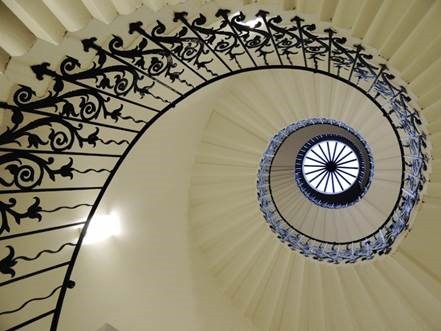
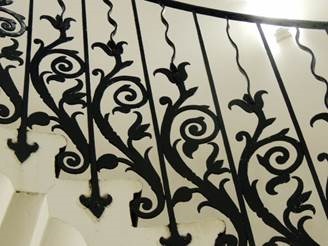
The Tulip Stairs

“The elegant Tulip Stairs in the Queen’s House are the first geometric self-supporting spiral stair in Britain. Although called the ‘tulip’ stairs, it is thought that the stylized flowers in the wrought-iron balustrade are actually fleurs-de-lis, as this was the emblem of the Bourbon family of which Queen Henrietta Maria (wife of Charles I) was a member.

The Queen’s House ghost

     The Tulip Stairs are also the location of the Rev R. W. Hardy’s famous ‘ghost’ photograph taken on 19 June 1966, which when developed revealed what appear to be two or three shrouded figures on the staircase. Find out more about the Queen’s House ghost”

http://www.rmg.co.uk/queens-house/great-hall?show=nav.3536

http://www.rmg.co.uk/about/history/queens-house/the-queen-s-house-ghost?show=conWebDoc.1912#hardy  ghost link

clip_image021

Looking up

clip_image022

clip_image023

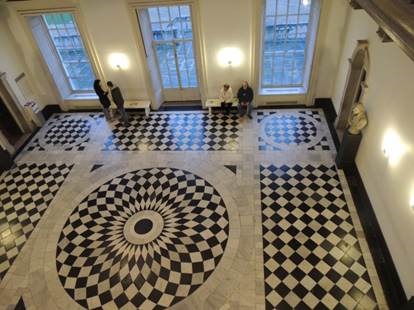
The Great Hall

     “The first room that visitors would have come into was the visually-stunning Great Hall, a huge perfect cube (40 x 40 ft) that rises through the centre of the House’s north side. The design of the whole House and the Great Hall in particular reflects Renaissance ideals of mathematical, classical proportion and harmony. Probably the most striking feature of the Great Hall is the geometrically-patterned black-and-white marble floor, laid in 1635. The wooden balcony running around the Great Hall at first floor level was sometimes used by musicians.” http://www.rmg.co.uk/queens-house/great-hall

clip_image024

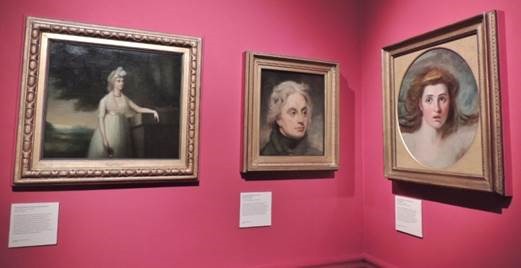
Interesting grouping of portraits:  Mrs Lord Nelson, Lord Nelson, and Mistress Lord Nelson

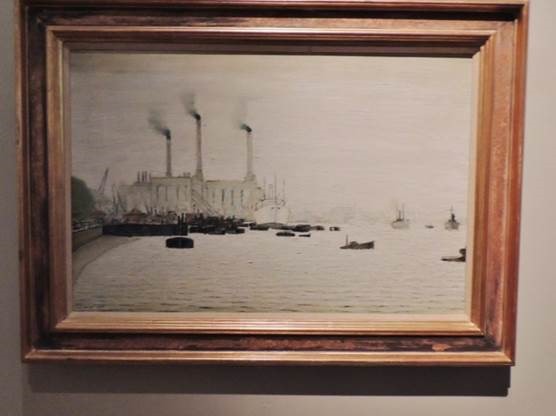
The Queen’s House had a varied collection of art including the portraits of the “Nelson” family but also some more contemporary art.  My favorite is below.

clip_image025

I was fascinated by this power station as we motored past up the Thames on our way to SKD in September. 

The River at Greenwich: Laurence Stephen Lowry, 1877-1976

“This view of the old Deptford Power Station seen beyond Greenwich Pier is one of Lowry’s rare London paintings.  Physically and metaphorically turning his back on the baroque buildinfs of the Royal Naval College, Lowry shows his preference for painting industrial scenes.”  From the caption next to the painting.

http://www.bbc.co.uk/arts/yourpaintings/artists/laurence-stephen-lowry

Greenwich with Valerie and Steve part 1

Cheers,

   Sunday Randal and I met up with friends Valerie and Steve for a day in Greenwich.  Here’s the story.

Ru

     Our  friends Valerie and Steve live in Fleet, not so far from Gosport/Portsmouth; our first port of call in England.  They came to visit us there for an afternoon.  And just a few weeks ago, Valerie came to spend some time with us in London.  At that time Steve was back in Thailand with their sailboat which they are in the process of selling.  Steve returned to England for Christmas but with our plans and theirs we couldn’t work out a trip to Fleet so we decided to meet up for the day at Greenwich.  None of us had ever been before so it seemed a good plan. 

   To fully explore Greenwich, you would need several days.  We only had several hours so tried to see what was high on everyone’s list.  We also limited ourselves to venues that were free since we didn’t have the time to fully make use of a 22 Pound ticket.  ($35 per person.) 

    For anyone really interested in Greenwich and the story of the Prime Meridian I do recommend

Dava Sobel’s book Longitude which is the story of why the Prime Meridian is in Greenwich. 

     “Dava Sobel is a former science writer for the New York Times, as well as contributor to Audubon, Discover, Life, and Omni magazines. The concluding chapter of Longitude is a very touching account of her personal visit to zero longitude in Greenwich (where this writer also straddled that magic line embedded in the pavement).  The Maritime Museum in Greenwich is the actual home of Harrison’s four clocks. Sobel writes, "Coming face to face with these machines at last, after having read countless accounts of their construction and trial, after having seen every detail of their insides and outsides in still and moving pictures, reduced me to tears."  

http://www.thesocialcontract.com/artman2/publish/tsc0902/article_1014.shtml

clip_image001 clip_image002

0 degrees Longitude line free version. 

Valerie and I are in the East and Randal and Steve are in the West.  But that’s okay with me as growing up in New Bedford, MA on the East coast, I always think anything is west of where I am.  Living on the west coast of Turkey was something I really had to get used to.  Good thing here in London we live in the East End. 

Somewhere in the Royal Observatory you can stand over the line, but that involved buying tickets so we opted for this free version.  It was a really chilly day!  While we were inside the Maritime Museum the sun shone, but as soon as we began the outside bits, the sky became gray and cloudy and by the end of the afternoon we had drizzle.                            

Greenwich England is where East meets West at the Greenwich Meridian (0° Longitude); World Time is set Greenwich Mean Time. Remember the new millennium started in 2001.

      There is the famous Cutty Sark to visit and the Royal Naval College.  Just down river is the Thames Barrier   (We saw the Cutty Sark)

     The Royal Observatory at Greenwich is in Greenwich Park along with the National Maritime Museum and the Queens House (on which the White House in Washington DC, USA is based).   (We visited the Queen’s House.)

     The London Marathon starts in Greenwich Park every Spring.

Greenwich has a long heritage; it was the birth place of King Henry VIII and his daughters Queen Mary (Bloody Mary) and Queen Elizabeth I (The Virgin Queen). 

     It has seen many famous visitors from Peter the Great through Charles Dickens to Bob Hope. 

http://wwp.greenwichengland.com/tourism/nmm.htm

     Randal and I took the light rail from Tower Hill Station, changing trains once before arriving at the Cutty Sark stop just outside the historic park area.  We’d planned to meet Valerie and Steve at the Maritime Museum entrance, but upon our arrival, learned there were two entrances.  I called Valerie and Steve who were just arriving at the car park and told them we’d be in the coffee shop.  Then I had to call them and tell them which coffee shop as there were two of those also. 

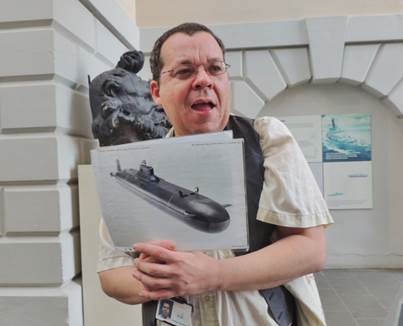
       After our coffee we joined the free introductory tour of the Maritime Museum “highlights”.  It turned into a private tour as there were only the 4 of us led by our guide Stephan, who, during the discussion of nuclear subs and the Cold War told us he had been one of the last members of the East German military. 

clip_image003

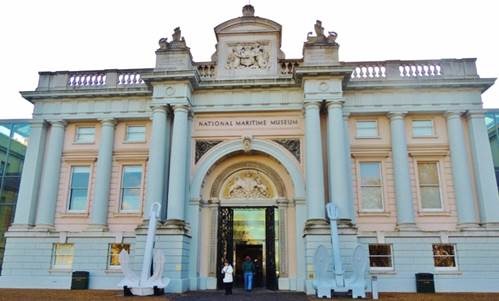
National Maritime Museum back entrance where Randal and I entered.

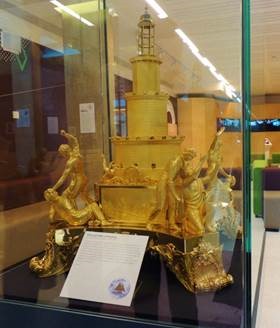
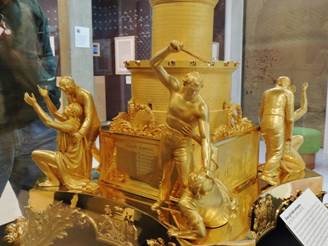
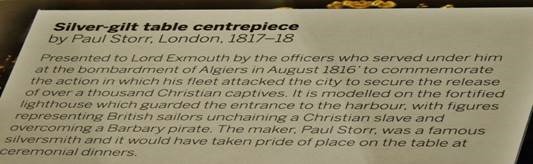
Our tour began with this massive creation….

clip_image004clip_image005

clip_image006


clip_image007

Randal and I passed along the coast of Algeria on our way from Tunisia to Spain but didn’t stop in.

clip_image008

Cold War history come to life…

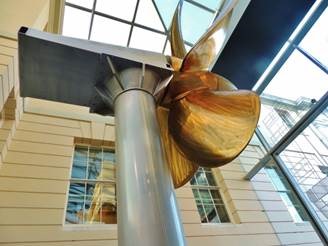
Our guide Stephen explaining to us how nuclear subs and battleships try to avoid generating any sounds that can be picked up by sonar detectors.   That includes very very quiet propellers.

clip_image009

The propeller that failed…though we stood below it we didn’t hear a sound, but it was deemed too noisy for action so was given to the museum.

        “The screw is motorized and rotates slowly.

    Information from sign:

This bronze-alloy propeller was made for a Type-23 frigate, the core warship of the Royal Navy’s surface fleet.  The propeller is specially designed to minimize underwater noise and prevent detection by enemy submarines.  Combined with an innovative propulsion system, two low-speed propellers like this give the Type-23 frigate its reputation as an ultra-quiet anti-submarine ship.

     There are currently thirteen Type-23s in active service in the Royal Navy, making up half of the frigate/destroyer force.  Powerful and versatile, these 133-metre (436 ft) ships are designed to take part in a wide range of tasks including surveillance, anti-piracy operations, disaster relief work.  They are often called ‘Duke-class’ frigates as they are all named after British dukes.  Type-23s were built at the shipyards of Swan Hunter (Tyneside) and Yarrow’s (Glasgow).”

http://www.waymarking.com/

clip_image010clip_image011

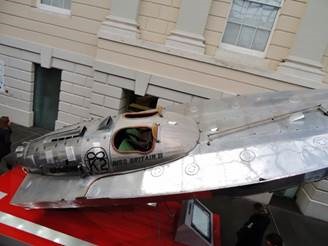
Miss Britain III  looks like something from a James Bond movie

http://www.cogg.co.uk/blog/napier-lion-king-of-engines-part-2.html   tells the real story of the race for the Harmsworth  Trophy in the 1930s.

clip_image012clip_image013

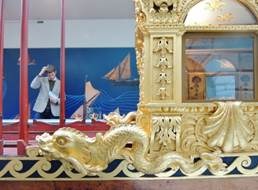
State Barge

“This state barge was built for Frederick, Prince of Wales, eldest son of King George II. At around 19.2 m (63 ft) in length, it is one of the Museum’s largest objects.

      She was designed by the architect, landscape gardener and painter William Kent, and built by John Hall on the south bank of the Thames just opposite Whitehall in 1732. Kent’s drawings for the barge, including a hull plan, have been preserved at the Royal Institute of British Architects………..

     The barge was often used for journeys of pleasure connected with paintings and music. In 1749, for a regatta in Woolwich she was decorated in the newly-Chinese style or chinoiserie, and the 21 oarsmen were dressed in oriental costume.   (Stephen told us everything Chinese was in vogue at that time.)

   After Prince Frederick’s untimely death in 1751, the barge became the principal royal barge used by successive monarchs, together with Queen Mary’s shallop (also on display in the museum). In 1849 she made her last appearance afloat when Prince Albert with two of his children was rowed to the opening of the Coal Exchange. She was then sawn into three sections and stored in the Royal Barge House at Windsor Great Park for over 100 years before being brought to the Museum.”

http://www.rmg.co.uk

clip_image014 clip_image015

clip_image016 clip_image017

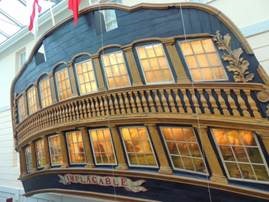
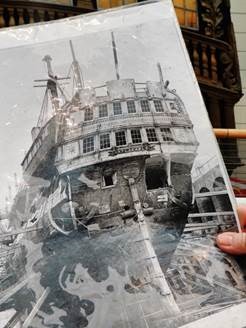
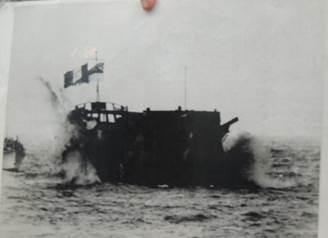
HMS Implacable

   “The Dugay Trouin, 74 guns, was launched at Rochefort in France in 1800. She was involved in the Battle of Trafalgar but managed to evade the victorious British fleet. The Dugay Trouin’s escape was short-lived and on 3 November 1805 a British squadron engaged her in the Bay of Biscay. In the ensuing battle, the captain of the Dugay Trouin was killed, her masts were shot away, and she was eventually captured after a gallant French defence. The ship was taken into the Royal Navy, renamed Implacable, and saw action in the Baltic in 1808-09 and off the Syrian coast in 1840. She became a training vessel for boy seamen at Devonport in 1855 and was finally placed on the navy’s disposal list in 1908. The ship was handed over to Geoffrey Wheatley Cobb for preservation in 1912 and sufficient money was raised to carry out a series of repairs at Plymouth in the 1920s.

     In 1932, HMS Implacable was towed to Portsmouth where she again served as a training establishment.  The Admiralty requisitioned the vessel during the Second World War but it found the cost of her upkeep too great to bear and in 1947 it was decided to dispose of the Implacable. (She had been at the Battle of Trafalgar, albeit as an enemy ship; but Trafalgar is a really big deal here.  RJ)   This move caused a furious public outcry but, despite an appeal to save her, she was scuttled in 1949.

     The figurehead and stern carvings were preserved and presented to the Museum in 1950. The figurehead dates from her refit in Britain in 1805 and is a representation of the gorgon Medusa. Because of their scale, it was found impossible to display the stern carvings (which amount to some 160 objects) at the Museum and they were placed in store. However, with the opening of the redeveloped Neptune Court in 1999, both the stern and the figurehead of HMS Implacable have been brought together and can now be seen for the first time in 50 years. For more on the story of the Implacable and her remarkable career, see Implacable: A Trafalgar ship remembered (1999).

http://www.rmg.co.uk

clip_image018 clip_image019

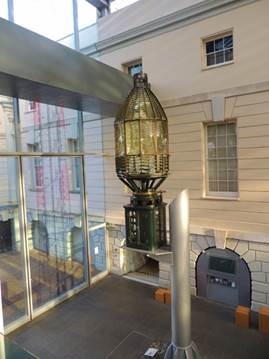
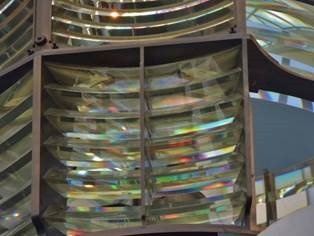
Tarbat Ness Light

   “This light is the one designed by the N.L.B. Chief Engineer D.A. Stevenson in 1891. The glass lenses were made by Barbier & Co Paris, whilst James Dove, Edinburgh produced the mechanism. The loss of sixteen vessels in the Moray Firth storm of November 1826 brought many applications for lights on Tarbat Ness or Covesea Skerries. The former was given priority as it had been named in 1814 and was regarded as important by the Caledonian Canal Commissioners. The Tarbat Ness Lighthouse was engineered by Robert Stevenson and built by James Smith of Inverness. The light was first exhibited on 26 January 1830. The tower (41 m, with 203 steps) is the third tallest in Scotland (after North Ronaldsay and Skerryvore being taller) and bears two distinguishing broad red bands. The total elevation is 53 m and nominal range 24 miles, flashing (4) white every 30 secs. The light was an Argand Paraffin Lamp with 4 burners until 1907 when it was changed to an incandescent pressurised lamp with 55 mm mantles. The optic and lightroom machine now in the Museum were installed in 1892 and remained in use until automation in 1985.”  http://collections.rmg.co.uk/collections/objects/43189.html

The Lighthouse Stevensons

The extraordinary story of the building of the Scottish lighthouses by the ancestors of Robert Louis Stevenson

(HarperCollins, 1999)

Extract from the Introduction

    “Whenever I smell salt water, I know that I am not far from one of the works of my ancestors,” wrote Robert Louis Stevenson in 1880. “The Bell Rock stands monument for my grandfather, the Skerry Vhor for my Uncle Alan; and when the lights come out at sundown along the shores of Scotland, I am proud to think they burn more brightly for the genius of my father.”

Louis was the most famous of the Stevensons, but he was not the most productive. Between 1790 and 1940, eight members of the Stevenson family planned, designed and constructed the 97 manned lighthouses which still speckle the Scottish coast, working in conditions and places which would be daunting even for modern engineers. The same driven energy which Louis put into writing, his ancestors put into lighting the darkness of the seas. The Lighthouse Stevensons, as they became known, were also responsible for a slew of inventions in both construction and optics and for an extraordinary series of developments in architecture, design and mechanics. As well as lighthouses, they built harbours, roads, railways, docks and canals all over Scotland and beyond; they, as much as anyone, are responsible for their country’s appearance today.

But the family who became known as the Lighthouse Stevensons have gone down in history for a very different profession. Robert, the first of the Stevenson dynasty, despised literature; his grandson perpetuated his family’s name with it. The author of Kidnapped, Treasure Island and The Strange Case of Dr Jekyll & Mr Hyde was initially trained as an engineer. To his father’s dismay, Louis escaped aged 21, first into law and then into writing. As he later confessed in The Education of an Engineer, his training had not been used in quite the way his father intended. “What I gleaned, I am sure I do not know; but in deed I had already my own private determination to be an author; I loved the art of words and the appearances of life; and travellers, and headers, and rubble, and polished ashlar, and pierres perdues, and even the thrilling question of the string course, interested me only (if they interested me at all) as properties for some possible romance or as words to add to my vocabulary.”

With age and distance, Louis recovered pride and affection in the Stevenson trade. He wrote with awe of his grandfather’s work on the Bell Rock lighthouse, and of his father’s melancholic genius for design and experimentation. He wrote about almost every aspect of his own brief and unhappy time as an apprentice, in essays, letters, introductions and memoirs. Most of all, Louis alchemised his experiences around the ragged coasts of the North into the gold of his best fiction; Treasure Island and Kidnapped both contain salvaged traces of his early career. The further he grew away from engineering, the more he felt towards it; he was sea-marked, and he knew it. He also recognised, with some discomfiture, that his own fame was swallowing up the recognition which his family deserved. In 1886, far from Edinburgh, he wrote crossly to his American publishers; "My father is not an ‘inspector’ of lighthouses; he, two of my uncles, my grandfather, and my great grandfather in succession, have been engineers to the Scotch Lighthouse service; all the sea lights in Scotland are signed with our name; and my father’s services to lighthouse optics have been distinguished indeed. I might write books till 1900 and not serve humanity so well; and it moves me to a certain impatience, to see the little, frothy bubble that attends the author his son, and compare it with the obscurity in which that better man finds his reward."

Louis was only being a little disingenous; he liked recognition and, to an extent, courted it. But his plaintive belief that his family deserved the same acknowledgement seems far-sighted now. Even at the height of the Victorian engineering boom, great men went unnoticed and exceptional feats unrecognised. Louis did his best to remedy the injustice, but also recognised that the Stevensons hardly helped themselves. Not one member of the family ever took out a patent on any of their inventions in design, optics or architecture. All of them believed that their works were for the benefit of the nation as a whole and therefore unworthy of private gain. They were only engineers, after all; they worked to order or conscience, and were only rarely disposed to flightier moments of reflection. What pride they had in their creations they put down to the advantages of forward planning and the benevolence of the Almighty. And Louis, the tricky, charming black sheep of the family, stole all the fame that posterity had to give.” http://www.bellabathurst.com/writing02.php

St Katharine Docks setting for past season episode of New Tricks

Hi All,

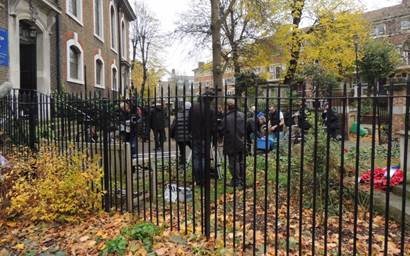
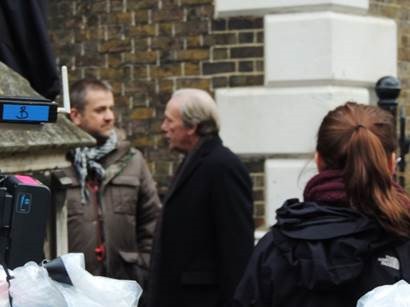
  On our way to the Mayflower Pub on Thanksgiving Randal and I stopped at St Mary’s Rotherhithe to look for the grave/marker for Captain Christopher Jones.    An episode of the cop show New Tricks was being filmed.  I’ve watched some online since then and quite enjoy the characters.  They are now on season 10.  Episode 6 of season 7 was set at SKD much of it in the west basin where we are located.    The link is below.

Ru

clip_image001 clip_image002

Filming New Tricks episode at St Mary’s Rotherhithe on Thanksgiving Day, David Waterman plays Jerry Standing on the show and has since the beginning.

Ru

http://www.youtube.com/watch?v=seLf4jXvpao   Season 6 Episode 7

Singkey’s teacher from China

Cheers,

   I once wrote about our serendipitous meeting on Tower Bridge with Singkey’s Chinese university teacher Jessica.  She and her husband visited DoraMac in September.  A few days after Christmas, Jessica and her husband came again and, along with dinner, we had Christmas crackers!  None of the three Chinese had experience these before so it was fun for us to “show them how it was done.”  Of course Randal and I had just learned ourselves since being here in London. 

   Jessica is here at London University’s School of Education as a visiting scholar.  Her husband visits periodically but lives back in China.  Today Jessica took time from her busy schedule of research to “create” a wonderful Chinese meal for Randal, Singkey and me.  What was quite interesting to me was to here Jessica speak about the “Jews of China” and about Pesach matzos.  While Jessica was doing graduate work in Milwaukee she lived in the home of a Jewish woman who loved everything about the Chinese people.  Jessica learned a great deal about Judaism and would sing along as Sabbath candles were lit.  One of the really nice things about finally settling down in Virginia and building a home will be that people like Jessica and her husband will come visit us. 

   Tomorrow Singkey must return to Birmingham to the University.  But we are making plans for her to perhaps, if there is time, come for a weekend visit in February.  It has been a wonderful visit for us all.

Ru

clip_image001

clip_image002

clip_image003

clip_image004

clip_image005

Introducing Jessica and her husband to the fun of Christmas crackers!

Jessica invited Randal, Singkey and me for a real Chinese lunch at her flat in Putney.

     “Putney is a large district of south-west London that lies on the south bank of the River Thames, to the south-east of Barnes and Mortlake. The name dates from Saxon times and is believed to mean "Putta’s landing-place", but the area has been settled since at least the Iron Age.

For much of its history Putney was a rural area with the main industries being farming and fishing right up until the 19th century. The district has also long been important as a crossing point of the River Thames.

The area began to be developed throughout the 17th and 18th centuries, as Putney became a popular country retreat for wealthy Londoners. But it wasn’t until the 19th century that development of the area changed Putney to the residential suburb that it is today.

Much of the architecture of present day Putney dates from the late 19th century and so the feel of the district is remains that of an elegant Victorian suburb. As a result the district remains a much sought after area, with little of the industrial atmosphere of some parts of south London.

http://www.smoothhound.co.uk/tourism/london/putney.html

clip_image006

Looking down from the bridge that crossed the Thames  Putney Bridge to Putney Green which is another image of London we don’t often see; but looks such a warm, inviting place to live.

clip_image007

The Thames Path follows the river but we were on our way to Putney Bridge Rd to Jessica’s “bed-sit.”

clip_image008

Jessica is in London as a visiting scholar at London University’s school of education.  She is studying the practice and learning theory of vocational education in England as compared to China. 

clip_image009

Jessica is a wonderful cook!

clip_image010

A little vinegar, sugar, salt….perfect!

clip_image011clip_image012

A beautiful and flavorful salad, Chinese cabbage with noodles and scallops  stirfried ribs in a light and fragrant tasty marinade and handmade, from scratch, stuffed dumplings.  Everything was wonderful !!! The dumplings were so light and so flavorful it was hard to stop at just 4 or 5.  We’d started the meal with tofu soup flavored with garlic and cilantro.  Yum!!!!

Very full!

clip_image013

Sprouted garlic!

I am going to try this and use the tops in my cooking.

clip_image014

How many rice cookers…..

Many Chinese graduate students, visiting professors, etc have stayed in this space each bringing his/her own rice cooker!

clip_image015

An absolutely untouched photo.  The light was amazing as we retraced our steps back across the river to the tube station.

clip_image016

Arriving at the underground on the right of the photo; traditional red buses, some double-decker on the left.

clip_image017

Waiting for the tube back to Tower Hill.

Putney is just about the furtheset west we have been in London other than Heathrow.

clip_image018

I will miss the Thames, but I’ll also miss the ease of travel provided by the tube system.

So much to see and do!

Cheers,

CHAPTER I

Down the Rabbit-Hole

Alice was beginning to get very tired of sitting by her sister on the bank, and of having nothing to do: once or twice she had peeped into the book her sister was reading, but it had no pictures or conversations in it, `and what is the use of a book,’ thought Alice `without pictures or conversation?’

So she was considering in her own mind (as well as she could, for the hot day made her feel very sleepy and stupid), whether the pleasure of making a daisy-chain would be worth the trouble of getting up and picking the daisies, when suddenly a White Rabbit with pink eyes ran close by her.

There was nothing so very remarkable in that; nor did Alice think it so very much out of the way to hear the Rabbit say to itself, `Oh dear! Oh dear! I shall be late!’ (when she thought it over afterwards, it occurred to her that she ought to have wondered at this, but at the time it all seemed quite natural); but when the Rabbit actually took a watch out of its waistcoatpocket, and looked at it, and then hurried on, Alice started to her feet, for it flashed across her mind that she had never before seen a rabbit with either a waistcoat-pocket, or a watch to take out of it, and burning with curiosity, she ran across the field after it, and fortunately was just in time to see it pop down a large rabbit-hole under the hedge.

clip_image001White Rabbit checking watch

In another moment down went Alice after it, never once considering how in the world she was to get out again.

The rabbit-hole went straight on like a tunnel for some way, and then dipped suddenly down, so suddenly that Alice had not a moment to think about stopping herself before she found herself falling down a very deep well. http://www.cs.cmu.edu/~rgs/alice-I.html

clip_image002

Among my mess is the beautiful small quilted image of a ship at sea under the stars made for me by longtime, though distant, friend Chimaki Sato. 

clip_image003

clip_image004

clip_image005

So things have gotten a bit out of control! 

I’m just rushing about from one adventure to the next as our time rushes past TOO FAST!!!!!!

Sunday I went to Art Group and Randal and Singkey went to Kensington Palace.  Monday Randal and Singkey rode the London Eye and I went to the Tate Modern with a lovely person name Jane Lane-Roberts.  Jane is an artist, an art teacher, and a member of the Tate so took me as her guest to the Klee exhibit. What a treat!  Tuesday several of us carried our unneeded clothes and things to the Pimlico charity shops and then went to an organ concert at St Mary at Hill.  This morning we started with a Friends of St Katharine Docks coffee.  After that Randal, Singkey and I took the Tower Hill District line tube to Monument where we had to switch to the Circle Line.  It feels as if you’ve walked across London by the time you actually get to the Circle Line platform.  At Holborn we “alighted” from the Tube at which point Randal and Singkey headed over to the British Museum and I headed over to the great Oxfam Used Book shop just near the museum.  It’s a wonderful shop and  I could have stayed hours but had to find something to eat and a loo before joining a walking tour of the St Giles Rookery.  But that will take me ages to write about as I just had to download Dickens Sketches by Boz so I can read  On Duty With Inspector Field which is set in the area of St Giles.  Our Singkey will be returning to University Friday so we’ve been trying to make the most of these last few days with her. 

     Tomorrow we will visit Singkey’s China University teacher, a visiting scholar here in London.  So not much time for writing lately as I’ve also been spending more time reading.  But I will catch up….hopefully.

Try to stay warm all of you!

Ru

Harry Potter and the British Library

Cheers,

  Great day today.  Early morning was our cruiser coffee at the Côte restaurant.  The sky looked gray and the rains continued but thankfully the weather cleared just as new friend Jane Lane-Roberts arrived from Tower Hill Station.  She and I had planned to meet up and walk to the Tate Modern while Randal and Singkey went off to visit Kensington Palace.   I had a lovely day with Jane who is both artist and art teacher.  As she is a member of the Tate, she could bring a guest for the Paul Klee exhibit  and was kind enough to take me.  We visited all 16 rooms dedicated to Klee and then some devoted to others such as Kandinsky and Duchamps.  Hopefully we’ll meet up again for another adventure.  Just before going into the Tate we visited the Bankside Gallery of Watercolour which had a wonderful exhibit that we could have spent hours viewing except our real plan was to see the Tate Modern next door and get some coffee!   www.banksidegallery.com

  Tomorrow Singkey and I will meet up with Sue Kelly and Sandi Shiret for a charity shop run to donate clothes, books, etc that must go from our boats.  Afterwards we will try to make it to the organ concert at St Mary at Hill.  Randal and Ed Kelly will head off to the London Boat Show.

   Yesterday Randal and Singkey rode the London Eye while I went to my Life Drawing Group at Toynbee Hall. 

This email describes our outing Saturday to visit the venues in London associated with Harry Potter.  Also, as we took the wrong tube line and missed the King’s Cross connection, we alighted at St Pancras so passed by the British Library so stopped for a visit.  Photos weren’t allowed in the special exhibits room so you’ll just have to make my word for it that seeing the Magna Carta was awesome. 

http://www.bl.uk/treasures/magnacarta/ is the link to the British Library.

Ru

Ps  Hope all of you are staying warm with the horribly cold weather hitting the North East.

Sunday  was a day of wrong tube trains, Harry Potter and The British Library.

clip_image001

The British Library Plaza

”In the gardens at the front of the British Library a hunched-over statue sculpture by Eduardo Paolozzi can be seen on a plinth, making mathematical examinations.”

http://www.tiredoflondontiredoflife.com/

The maquette of Paolozzi’s  (Institute for Mathematical Sciences) sculpture is based on a sculpture commissioned for the new British Library at St Pancras. Sir Eduardo Paolozzi (1924-2005) gave it to the Institute. The choice of Blake’s engraving of Newton as the model for the sculpture caused some controversy, as Blake was known to be deeply anti-scientific and displayed profound antagonism to Newtonian rationalism. Paolozzi was inspired by the union between two British geniuses, both representing nature, poetry, art, and architecture. Rodin’s famous sculpture also springs to mind. Paolozzi decided that this synthesis of concepts would be ideal for the new British Library.  (Perfect imagery for libraries; a place where all ideas meet.  RJ )

http://www.newton.ac.uk/art/paolozzi.html

http://www.theguardian.com/uk/2005/apr/22/art obit of the sculptor of the Newton statue.

My thought was, with all the knowledge in the library,  they should have been able to design a plaza that wouldn’t be slippery when wet. 

clip_image002

I especially love the blue poster.

clip_image003

Sitting on History in the Library foyer

‘Sitting on History’ was proposed in response to a commission first discussed in 1990 and to Woodrow’s Tate Gallery exhibition in 1996, which gave him the opportunity to realise a sculpture which could function as a seat.

Woodrow had made three maquettes based on a book form: one with coins as the seat backs, another featuring two crows on the spine of the book fighting over a gold coin and this version, entitled ‘Sitting on History’. Woodrow’s idea was to have a sculpture that was only completed conceptually and formally when a person sat on it.

‘Sitting on History,’ with its ball and chain, refers to the book as a receptacle of information. History is filtered through millions of pages of writing, making the book the major vehicle for research and study. Woodrow proposes that although one absorbs knowledge, one appears to have great difficulty in changing one’s behaviour as a result.

The real books from which the original maquettes were made came from a box of books given to Bill Woodrow by a London bookseller, discarded, as they were no longer saleable. To Woodrow’s wry amusement, in this haul were three volumes on the history of the Labour Party, which he chose to use for the maquettes. Woodrow finds books one of the most powerful democratic tools in the world and still the most advanced form of communication.

http://www.sculpture.org.uk/sculpture/352/sitting-on-history

clip_image004

King George III’s library

“At the heart of the British Library in London, a tall glass tower – the King’s Library Tower – houses books collected by King George III (reigned 1760-1820). It is considered one of the most significant collections of the Enlightenment, containing books printed mainly in Britain, Europe and North America from the mid 15th to the early 19th centuries. Consists of 65,000 volumes of printed books, with 19,000 pamphlets “

http://www.bl.uk/

The library café/restaurant where we ate borders the King George Library

clip_image005

Library shop items : the  actual exhibits prohibited photography.  I was hoping for some item or booklet created for the children’s ibook llustrators exhibit; but alas there was none.

     “Discover how illustrators over the years have interpreted – and reinterpreted – our favourite tales in beautiful and imaginative ways. Through original artwork, rare editions and personal correspondence, be reunited with much-loved characters, including Paddington Bear, Peter Pan and Willy Wonka and classic works such as Just So Stories, The Wind in the Willows and The Hobbit.” http://www.bl.uk/whatson/exhibitions/picturethis/index.html

There was a wonderful exhibit of children’s book illustrators with accompanying video interviews available.  I could have stayed for hours listening but only took the time to listen to a bit of one about Sir Quentin Blake.  His first drawing paper was the paper lining the huge tins of cookies sold in the local convenience shop in the village where Blake grew up.

http://www.bbc.co.uk/news/entertainment-arts-20684202  is a video interview of Quentin Blake

clip_image006 clip_image007

Leaning room only in the office of the future

David Smith :  The Observer, Sunday 23 January 2005     

Never stand when you can sit and never sit when you can lie. But why do any of these when you can lean? A new piece of furniture from Sweden is set to change office life for ever and leave that old and tired contraption, the chair, on the 20th century scrapheap.

The Lean Back is a 7ft plank of wood with cushioned upholstery for the back and a base for the feet, all set at a gentle angle to recreate the sense of leaning against a wall. Last week it went on show at a ‘workplace of the future’ trial at the British Library in London, and proved a hit with visitors.

The furniture’s manufacturer in Britain, Kinnarps, claims that when a group of people become engaged in a conversation or impromptu meeting without sitting down, at least one of them will end up leaning against a wall or a door post. The support of the Lean Back, it argues, maintains the benefits of standing up at the same time as giving the user a rest.

Ergonomics experts have noted that sitting all day, which puts weight on the bottom of the spine rather than the legs, can put a long-term strain on the human back. Marc Bird, spokesman for Kinnarps, said: ‘You don’t have to sit down for meetings all the time. It takes time for people to find a chair and sit down, then they get settled and think they’re going to be there for a while, so the meeting takes longer than it needs to. This gives short, sharp interactions, but you’re ergonomically supported instead of just standing.’

Alex Joyce, head of customer services at the British Library, said: ‘We chose it for style and innovation and people are tending to try it. When they realise how comfortable it is they use it more.’

http://www.theguardian.com/uk/2005/jan/23/arts.artsnews

clip_image008 clip_image009

Ball  masques and wigs.  I dared Randal to try it on. 

http://www.bl.uk/whatson/exhibitions/georgiansrevealed/index.html

From wigs to Whigs: uncovering the Georgian era

Who were the Georgians? A new exhibition at the British Library goes beyond Jane Austen and toff rule to redefine the era’s protagonists, from journalists to surgeons to pornographers

http://www.theguardian.com/culture/

clip_image010clip_image011

St. Pancras Hotel

Sir John Betjeman called this Gothic treasure “too beautiful and too romantic to survive” in a world of tower blocks and concrete. Its survival against the odds will cause wonder; the building itself will take your breath away.

“After years of devoted restoration, the St Pancras Renaissance Hotel is being hailed as London’s most romantic building. Its glorious Gothic Revival metalwork, gold leaf ceilings, hand-stencilled wall designs and a jaw-dropping grand staircase are as dazzling as the day Queen Victoria opened the hotel in 1873.”

www.stpancrasrenaissance.co.uk

Nightly rates from           225.00 (GBP)      Jan 10, 2014 – Jan 12, 2014  2-night stay

Check Availability  

Nightly rates from           225.00 (GBP)      Jan 17, 2014 – Jan 19, 2014 2-night stay

http://www.marriott.com/

clip_image012

Guess what’s behind the crowd at King’s Cross just between platforms 9 and 10. 

clip_image013clip_image014

Platform 9 ¾ to Hogworts for all you Harry Potter fans: get in line for your photo.

There was a line about an hour long for photos at the platform below the 9 ¾  sign so we took a pass though it would have been fun to watch Singkey pose with the luggage trolley.

clip_image015 clip_image016

We did walk into and out of the very crowded Harry Potter Shop.

clip_image017 clip_image018

Sweatshirts with 9 ¾ cost about the same amount as my now very ragged Boston Red Sox Sweatshirt. 

clip_image019 clip_image020

Singkey with a real trolley at King’s Cross station  and  later,  Singkey at Leaden Hall Market, where Harry Potter bought his magic wand. 

clip_image021clip_image022

Singkey and sculpture at the Gherkin

“The Chapman dinosaurs, which are up to 13ft (4m) tall, will stand the base of the Gherkin

     Three steel dinosaurs are among works which will be displayed in the City of London this summer as part of an exhibition of sculpture.

Jake and Dinos Chapman’s dinosaurs will be joined by works by Antony Gormley and Robert Indiana in the Sculpture in the City 2013 show.

The 13ft (4m) Chapman dinosaurs, known as The Good, The Bad and The Ugly will stand at the base of the Gherkin.”  http://www.bbc.co.uk/news/uk-england-london-22480024

clip_image023

clip_image024

clip_image025

Glass or acrylic ball in front of the Aviva Tower.

clip_image026

Lots of rain and wind = bad days for umbrellas.