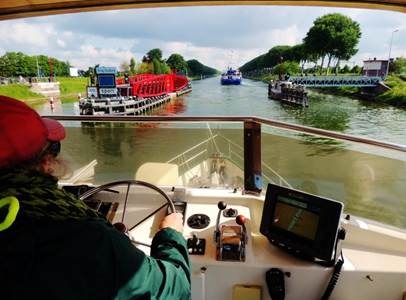
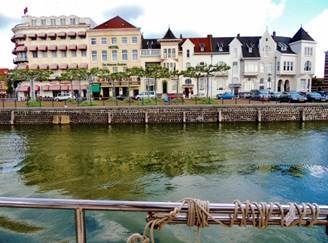
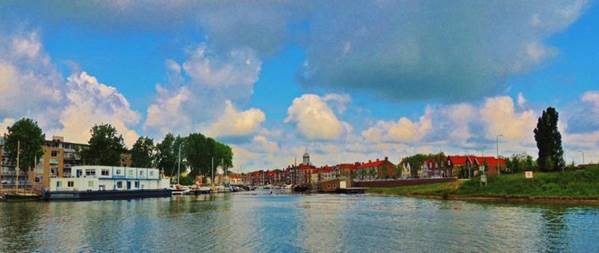
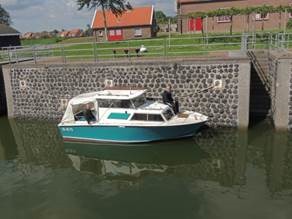
Cologne 1

Guten Morgen,

“Germany is a country for which Jews have a very visceral reaction.”

http://www.obermayer.us/german/german_conscience.htm

During our travels I’ve made attempts in several countries to seek out the “Jewish presence.”   I visited synagogues in Singapore, England  and India and while in New Delhi attended a Friday night service with Jewish cruiser friends Linda and Michael on B’Sheret.  I’ve visited Jewish cemeteries in Malaysia and Ipswich.   I’m neither spiritual nor practicing, though both my sister and I as well as all of our Jewish friends attended Hebrew school and had a Bar or Bas Mitzvah.  I learn for the history and the story.

Seeking out the very long, sad, and complicated Jewish history of Germany is not what our journey along the rivers is all about.  Meeting people as they are today is why most people become cruisers.  Learning the basics of a country’s history and seeing its architecture and natural beauty is part also.  But most important is to keep an open mind about everything.  If not, there’s no point in traveling.  So though I will write about monuments to the Holocaust, that’s just part of what I see.  I feel an obligation to do that but also to talk about the lovely people we meet along the way. 

Unfortunately most all my knowledge of Germany and a good deal of Western Europe comes from TV or movies which is probably worse than having no knowledge at all. But I’ve never been interested in the history of European kings, queens or battles.  The life of everyday people is what I find interesting.   So as we travel along I can tell you what I see, but not much more than that. 

Cologne for a day……

Cologne, German Köln ,  fourth largest city in Germany and largest city of the Land (state) of North Rhine–Westphalia. One of the key inland ports of Europe, it is the historic, cultural, and economic capital of the Rhineland.

Cologne’s commercial importance grew out of its position at the point where the huge traffic artery of the Rhine (German: Rhein) River intersected one of the major land routes for trade between western and eastern Europe. In the Middle Ages it also became an ecclesiastical centre of significance and an important centre of art and learning. This rich and varied heritage is still much in evidence in present-day Cologne, despite the almost complete destruction of the Inner City (Innenstadt) during World War II. Cologne is the seat of a university and the see of a Roman Catholic archbishop. Its cathedral, the largest Gothic church in northern Europe, was designated a UNESCO World Heritage site in 1996; it is the city’s major landmark and unofficial symbol. Area city, 156 square miles (405 square km). Pop. (2006 est.) 989,766.

Cologne is the fourth largest of Germany’s cities (only Berlin, Hamburg, and Munich are larger). Some four-fifths of its population is of German nationality; of the remainder, most are southern European guest workers who have moved to the city since the 1970s, chiefly from Turkey and Italy but also from the Balkan states. The predominant religion of the German community is Roman Catholicism, but there is a large Protestant minority. There is also a sizable Muslim community and a small Jewish one.

http://www.britannica.com

clip_image001 clip_image002

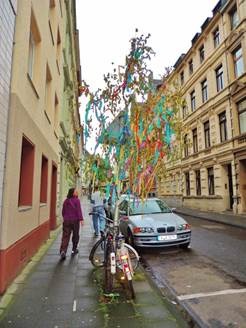
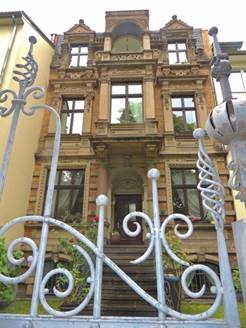
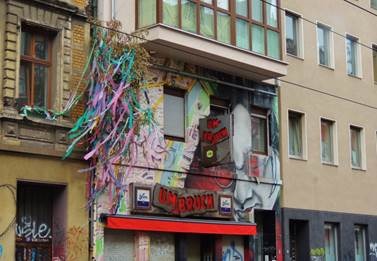
Paper streamers were in evidence but I don’t know why.   Lots of lovely old buildings too

clip_image003

Wake up! 

clip_image004 clip_image005

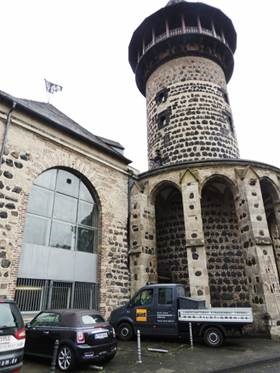
Ulrepforte

The name Ulrepforte is derived from the earlier name for potters, the Euler or Uler, who once had their businesses here.  You can see from the ruins that the Ulrepforte was originally a larger city gate with two towers.  In the 15th century a mill was built here, the tower of which has been preserved.  It belonged to the nearby Carthusian monastery.  At the other side, a small bastion was added on.  In 1881, the city wall was torn down. Only very little of it still remains intact.

      Today the "Kölsche Funke rutwiess", which is the city’s oldest traditional carnival corps, has its headquarters here. This is an historical reference to the city’s former defences: The foundation of the Red Sparks in 1823 was an ironic allusion to the city soldiers of the former Imperial City of Cologne.

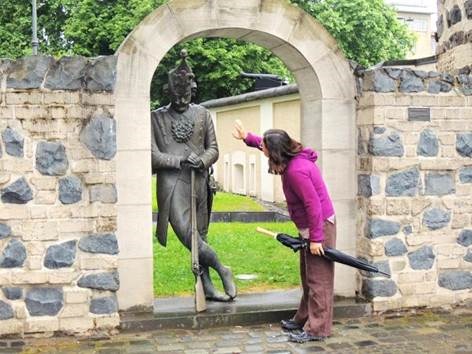
The city soldiers, or sparks, were not particularly respected. They were seen as harmless drinkers with little battle courage. Reference to this is made by the sleeping radio next to the old gate (The word ‘Funke’ can mean both a spark or radio).  Two other traditional carnival societies, the Blue Sparks and the Prince’s Corps, are in residence nearby, on the other side of Ulrichgasse, in the old fortified towers to the right and to the left of the surviving section of city wall.

The two other surviving medieval city gates are Severinstor at Chlodwigplatz and Eigelsteintor in the north of the city.  http://www.shoppingguide.ihk-koeln.de/

clip_image006 clip_image007

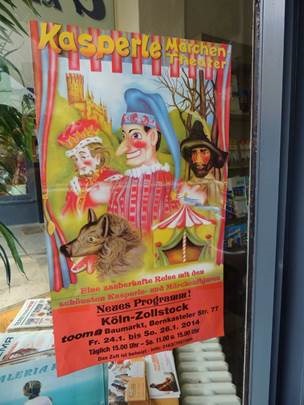
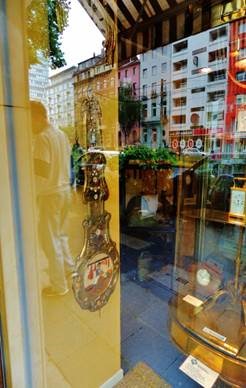
Flyer for a puppet shoe; I’d love to see one and a clock with a second hand that was a butcher’s knife.

clip_image008 clip_image009

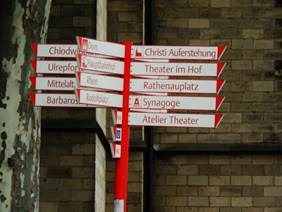
The maps said one way to the Synagogue but the street sign pointed otherwise.  We made the mistake of following the sign rather than listen to Mary.

clip_image010 clip_image011

More streamers and street art.

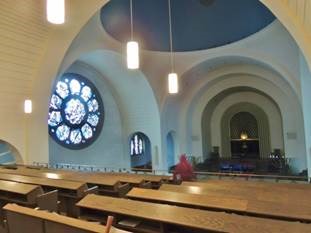
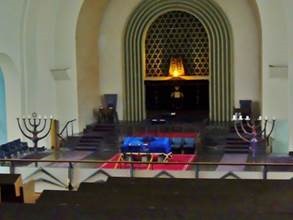
Visiting the Synagogue was an experience.  First of all it was Friday so I wondered if a visit would even be possible.  But we pressed the buzzer and were allowed into the hallway.  There we were asked to show our passports which we didn’t have.  Then they asked if we were Jewish.  I said I was but Mary is Catholic and Rick’s parents were Protestant but he grew up in a Chicago neighborhood with lots of Jewish people.  But did Rick or Mary have any ID?  No as a matter of fact.  But I had my VA driver’s license and as Mary and Rick were my good friends, we were all allowed in.  Unfortunately nothing was in English and there was no one about to speak with.  But we walked around and took photos with their permission.  Later when we visited the tourist office and I asked for information about the synagogue I was handed a “Holy Cologne” brochure with a photo and one paragraph and was told visits were only allowed by booking with the tourist office.  I shouldn’t have told her we’d already visited as that made her smile go away.  Because of security issues visiting synagogues outside the US and Israel is more complicated and I’ll remember that for the future.  As it was the two gentlemen manning the door were very nice.  I left a donation on our way out.

clip_image012 clip_image013

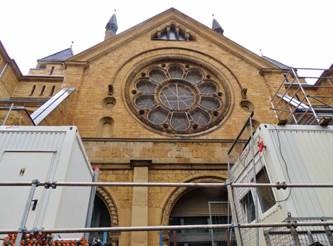
Renovation work hides most of the exterior.

clip_image014

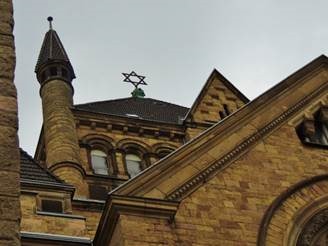
“Since 1899, the neo-Romanesque synagogue on Roonstrasse has been the largest religious and cultural centre for the Jewish communities in Cologne.  After being burned down by the Nazis on 9 November, 1938, the synagogue was rebuilt between 1957 and 1959.  The building’s main front has three arched portals and a large gabled façade with a centrally positioned rose window.  In 2005 Benedict XVI became the first pope to visit a Jewish house of worship in Germany when he went to the Cologne synagogue during the 10th World Youth Day.  Cologne Tourism brochure “Holy Cologne” 2014/2015

The Roonstrasse synagogue was reopened in 1959, having been restored with the financial support of the German government. It contains a memorial hall, with a plaque paying tribute to all the Shoah’s victims, and specifically to the 11,000 Jews deported, most to their deaths, from Cologne.

http://www.germansynagogues.com/

The Jewish community in Cologne is Germany’s oldest, dating from Roman times. The city’s Roonstrasse Synagogue was destroyed in 1938 during the Nazis’ Kristallnacht pogrom and not rebuilt until 1959.

http://www.npr.org/templates/story/story.php?storyId=4807640

http://www.tabletmag.com/ tells about Jewish life in Cologne today.

clip_image015 clip_image016

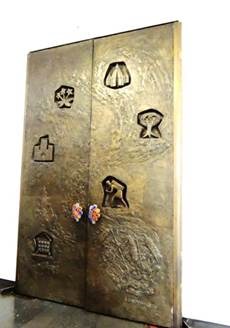
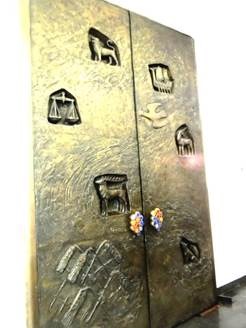
Doors into the main sanctuary : I’m guessing each one of the symbols represents one of the Twelve Tribes of Israel

clip_image017 clip_image018

The main sanctuary

clip_image019 clip_image020

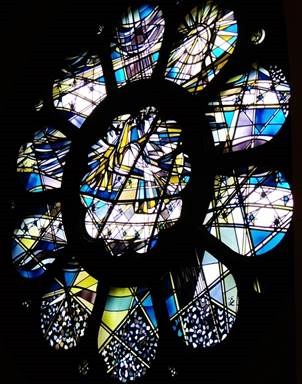
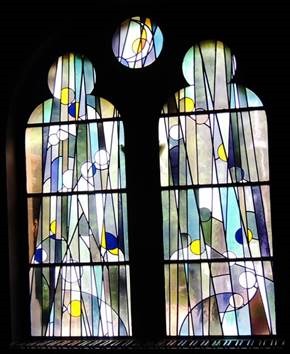
      Lovely stained glass windows       

clip_image021

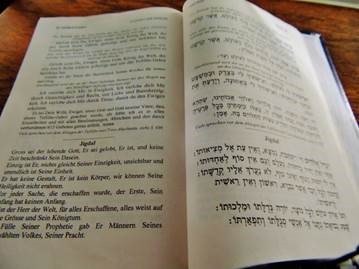
German Hebrew prayer book

clip_image022

clip_image023

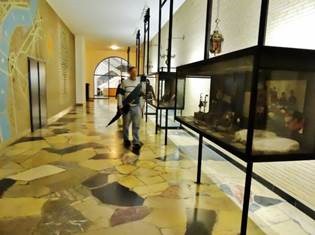
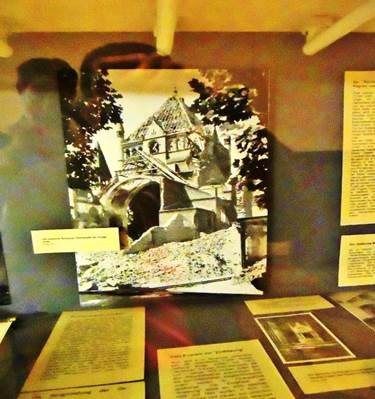
The destroyed synagogue

clip_image024 clip_image025

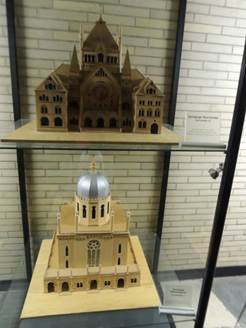
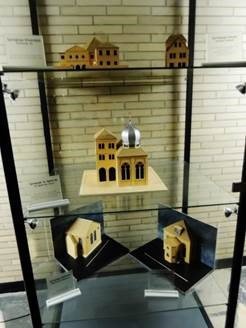
I believe these are models of the 5 synagogues that were pre-WW 2

clip_image026 clip_image027

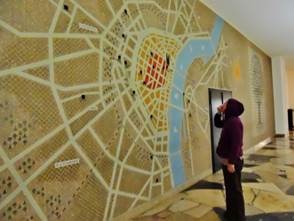
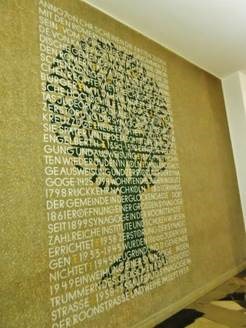
A map showing what was once the locations of Jewish areas in Cologne  and what I think is the memorial plaque referred to above.

clip_image028 clip_image029

clip_image030

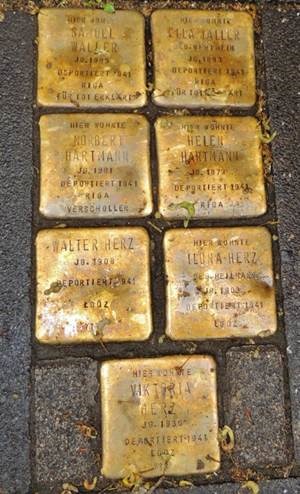
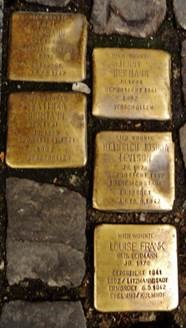
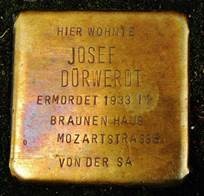
Brass memorial plaques were embedded in the sidewalks

“Those who tread on the brass plaques actually keep the memories alive by inadvertently rubbing the rust off the metal and bringing back the shine. Even if they’re liable to overlook the little inscriptions. So the plaques are intended to be trodden upon. And to spark sidewalk chats among passersby while Demnig is busy hammering in the engraved cobblestones. To read the inscription you’ve got to bend over – which may be interpreted as bowing to the victims in tribute. …..

     The artist hit on the idea of the “stumbling blocks” in 1993 while commemorating the murdered Sinti and Roma gypsies in Cologne.

     By August 2008 Demnig had laid some 15,000 stones in over 345 towns, and there’s still a steady stream of incoming requests.”

http://www.goethe.de/kue/arc/dos/dos/zdk/en78940.htm   brass memorial sidewalk plaques

clip_image031

Rick and Mary trying to turn the sign post to point in the correct directions; but it really wouldn’t budge and we didn’t want to attract too much attention  messing around with a street sign. 

Cologne

http://www.museenkoeln.de  Cologne’s National Socialism Documentation Center

     “The establishment of the NS Documentation Centre of the City of Cologne is itself a typical example of the politics of memory in Germany. It could not have been established without citizen involvement, nor could it continue without this important element today.”

Karl Wozniak

by Jane Ulman

January 3, 2014 | 10:47 pm

   “One dark November evening in 1938, as 14-year-old Karl Wozniak and his younger brother, Max, left their Cologne apartment for a walk, they saw a fire burning in nearby Horst Wessel Park. They headed toward the flames and spied a group of Nazis standing around the fire. They stayed in the shadows, saying little, and soon returned home……”

http://www.jewishjournal.com/survivor/item/survivor_karl_wozniak

Cologne 2

Kilometer post 616 on our way to 591 for the night at Koblenz.  We are now doing 5.7 K

Ru

Cologne 2

clip_image001

The synagogue was quite near the intersections of Mozart and Beethoven Streets

clip_image002

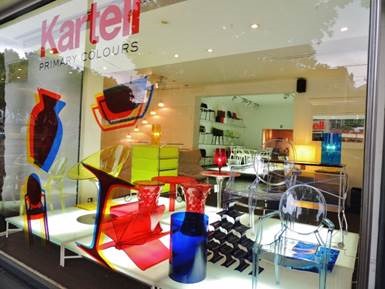
I have to admit I like heavy clear/colored  plastic furniture

clip_image003

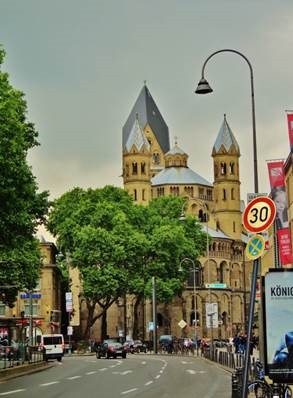
So here we are.  We spent our time in the older areas closer to the river but you can see the ring shope of the city it much bigger.

clip_image004 clip_image005

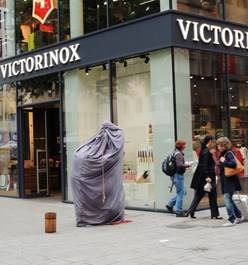
Look one way and you see an ice cream cone sculpture and the other looks like a cake with white icing.

clip_image006

 clip_image007

clip_image008

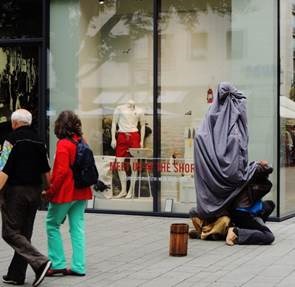
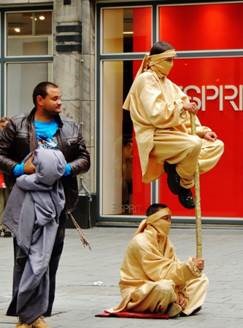
We’d seen similar street performers in London but never how they set up so as not to give away how they balance.  Wonder if the ones in London did the same thing?

clip_image009

 clip_image010

clip_image011

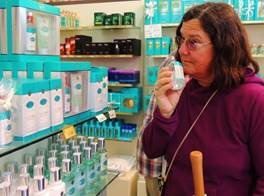
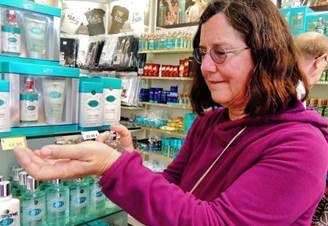
Perfume testing didn’t go so well in Dordrecht but Mary was willing to try it again.  We were in Cologne after all.

Eau de Cologne

The original Eau de Cologne is a spirit-citrus perfume launched in Cologne in 1709 by Giovanni Maria Farina (1685–1766), an Italian perfume maker from Santa Maria Maggiore Valle Vigezzo. In 1708, Farina wrote to his brother Jean Baptiste: "I have found a fragrance that reminds me of an Italian spring morning, of mountain daffodils and orange blossoms after the rain".[1] He named his fragrance Eau de Cologne, in honour of his new hometown.[2]

The most famous Original Eau de Cologne is 4711, named after its location at Glockengasse No. 4711. It was also developed in the 18th century by Wilhelm Mülhens in Cologne and is therefore one of the oldest still produced fragrances in the world. On 12 December 2006, the perfumes and cosmetics company Mäurer & Wirtz has taken over 4711 from Procter & Gamble and have expanded it to a whole brand since then.  http://en.wikipedia.org/wiki/Eau_de_Cologne

clip_image012 clip_image013

http://www.koelner-dom.de/index.php?id=2&L=1  site of the Cologne Cathedral

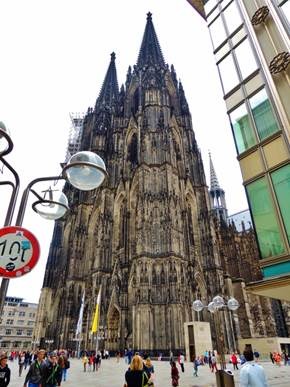
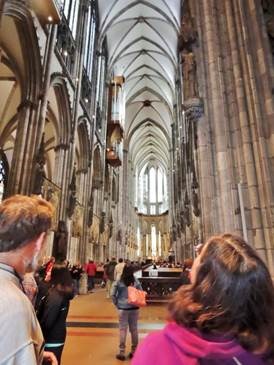
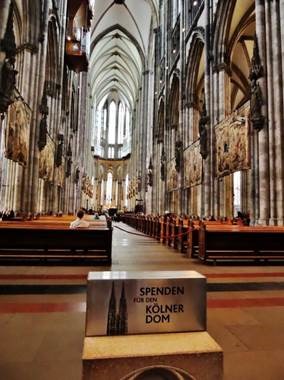
The Dom

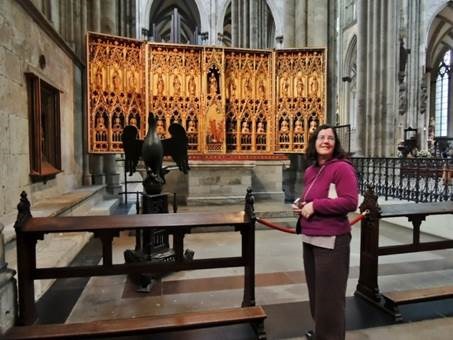
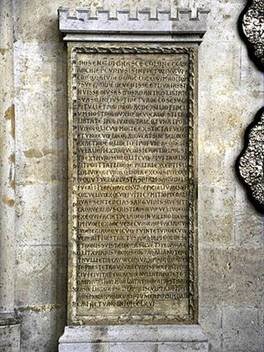
Cologne’s skyline is dominated by the Dom. On the left wall, past the transept, is the original stone-etched letter of protection of Cologne’s Jews issued by Archbishop Engelbert II in 1266. At the rear of the cathedral, the left side of the middle panel of three stained-glass windows depicts Elijah, Abraham and Isaac, Samuel, Salomon and Sheba.

http://www.germany.travel/

clip_image014 clip_image015

The nine pieces of baroque tapestry were designed by Peter Paul Rubens and show the “Triumph of the Eucharist”. They are only displayed for few weeks in about May to June each year.

http://commons.wikimedia.org/

This is the only source I could find about the tapestries.  The Cathedral brochure had no info nor could I find any on the website. 

clip_image016

Mary is a Franciscan so especially wanted to visit the St Clare chapel.

“Altar of the Poor Clares, about 11350/60.  This is the oldest remaining sacrament altar with a permanently fixed tabernacle.  This lavish winged altar can be opened in three different transformations.  It originates from the Franciscan convent of St Clare in Cologne and was brought into the cathedral in 1811.”  DOM brochure

clip_image017

(photo from the Cathedral brochure)

Jewish privilege, 1266

“What makes this privilege so unusual is that it was published ‘in stone’ in the cathedral. Following riots against the city’s Jews in 1266, Archbishop Engelbert of Falkenburg complied with the Jewish community’s request to be granted a privilege. The stone charter outlining the details of the privilege is divided into two stone plaques. The socle and crenellations are not original and were rendered according to a design by Arnold Wolff. The privilege granted the Jews the right to bury their dead without hindrance, exempted them from death duties and arbitrary taxes, and granted them a monopoly in the lucrative money-lending business. The taxes paid by the Jews constituted an important source of income for the Archbishop of Cologne, which explains why he was so keen to protect them. “

http://www.koelner-dom.de/index.php?id=16891&L=1

I only read of this afterwards but could visit on the website.

clip_image018

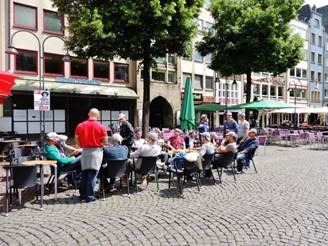
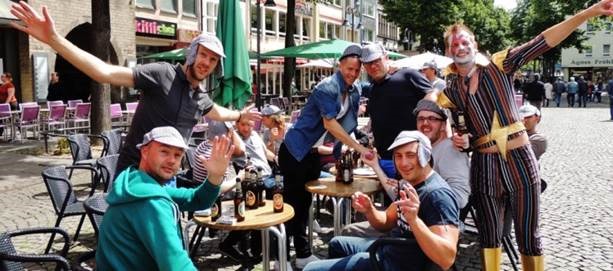
The Sherlock Holmes Club……?

We saw these guys in the Deerstalker hats.  When they saw me taking photos they waved and I asked them if they were all “Sherlock Holmes.”  They all were except for the painted guy who said he was David Bowie.  There were lots of bottles of beer on their table so they were having a good time.

clip_image019

They also enjoyed hamming it up.

clip_image020clip_image021

A festival of Rhine wines.  Mary and Rick each tried one but I took a pass.  However, the next evening in Oberwinter I tried a lovely very dry white Riesling and quite liked it.

clip_image022

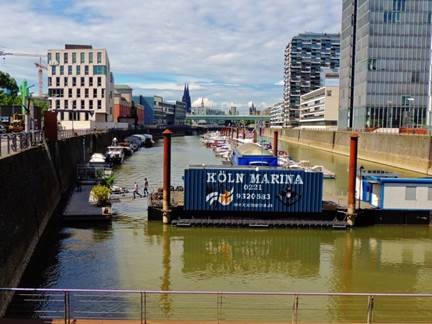
Looking into the Marina from the Harry Blum Platz just near the marina exit.  It was 1100 feet from DoraMac, at the very furthest dock to the harbor master’s office just inside the entrance to the marina.

Randal had to walk back and forth 5 times during the day we went touring and he stayed to do boat work.  There was a gigantic building with Microsoft just next to us.

clip_image023

Looking back in the early morning light at the clock tower in the Harry Blum Platz. 

River Passage from Papendrecht to Germany

Scenes along the river from Dordrecht, Netherlands to Emmerich Germany.

Ru

River Passage from Papendrecht to Germany

clip_image001

clip_image002

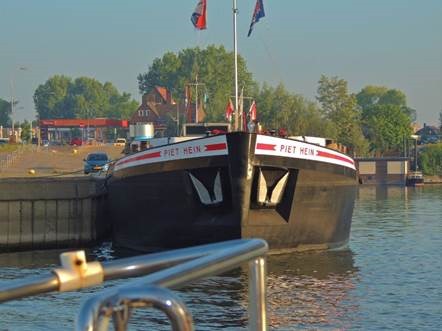
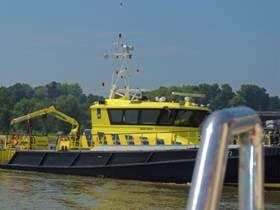
The Piet Hein the ship reminded me of Piet Hein who, among other accomplishment wrote Grooks.  Though that Piet Hein was Danish, not Dutch though I’m not absolutely sure where this ship is from.

Piet Hein (16 December 1905 – 17 April 1996) was a Danish scientist, mathematician, inventor, designer, author, and poet, often writing under the Old Norse pseudonym "Kumbel" meaning "tombstone". His short poems, known as gruks or grooks (Danish: gruk), first started to appear in the daily newspaper "Politiken" shortly after the Nazi occupation in April 1940 under the pseudonym "Kumbel Kumbell".

http://en.wikipedia.org/wiki/Piet_Hein_(scientist)

GROOK ON LONG-WINDED AUTHORS    

Long-winded writers I abhor,

    and glib, prolific chatters;

give me the ones who tear and gnaw

    their hair and pens to tatters:

who find their writing such a chore

    they only write what matters.

WHAT PEOPLE MAY THINK

Some people cower

and wince and shrink,

owing to fear of

what people may think.

There is one answer

to worries like these:

people may think

what the devil they please.

clip_image003

Another interesting name; Sailing Home.  Sometimes these monsters come quite close though their captains seem to be not the least bit worried about us.

clip_image004

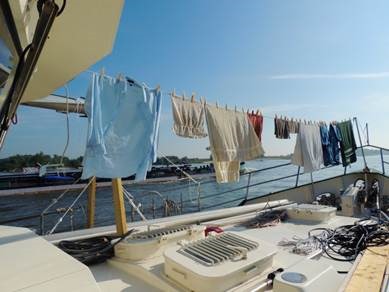
Our very own flag display.. laundry on the bow.

clip_image005

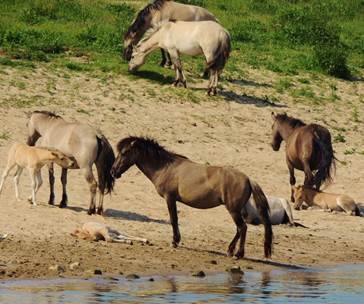
The Netherlands says windmills and bicycles to me, but we certainly saw lots of horses.  Herds of horses, cattle and sheep were all grazing along the river at various places.

clip_image006

Climbing aboard

clip_image007 clip_image008

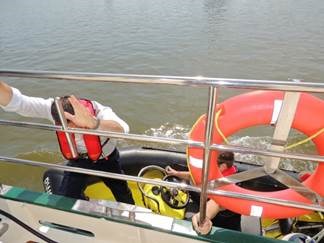
After the customs officials in France, I’ve gotten used to officials in rubber dinghies pulling up to DoraMac and climbing aboard.  This helpful fellow wanted to mark our charts to make sure we followed the channel correctly because there’s so much shipping that everyone has to be exactly where they should be.

clip_image009

clip_image010

clip_image011

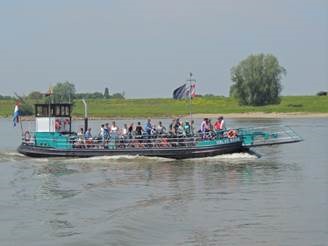
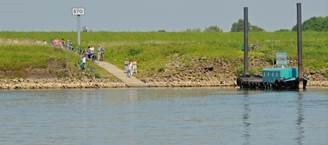
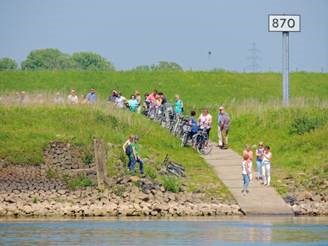
Lots of cycling paths and ferries to transport riders across the river.  The 870 is the kilometer marker just like the mile markers on our highway maps so you know where you are on the charts.

clip_image012

The 8.1 is kilometers per hour so we’re going pretty slowly because of the river current against us. Usually we’re not even going this fast, more like 6 kilometers or less.

clip_image013

Signing in with the harbor master in Emmerich, Germany.

clip_image014

clip_image015

clip_image016

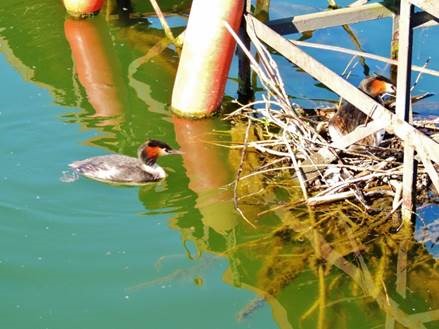
We just used the docks for tying up, but these water fowl used them as a place to build their nests under.

clip_image017

We left Emmerich as early as possible because we had a long way to go and were moving very slowly.

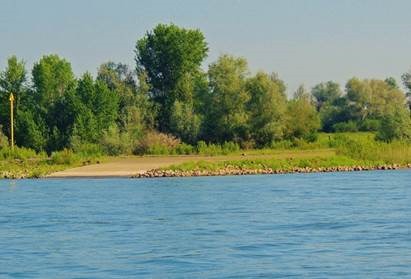
Rick pointed this out as a NATO Cold War boat ramp in case they had to move troops quickly across the river if the Russians invaded.  There was a ramp on the opposite bank.

clip_image018

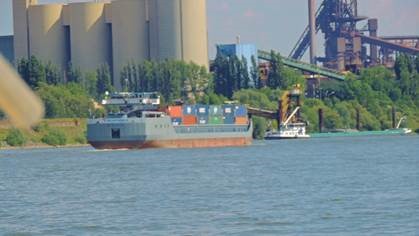
Coal Barges

clip_image019

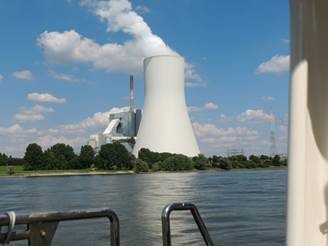
Nuclear Power plants were along the river. 

clip_image020

Lots of industrial scenery replace the lovely horses, sheep and cows of the Netherlands.

Visit to the Great Church

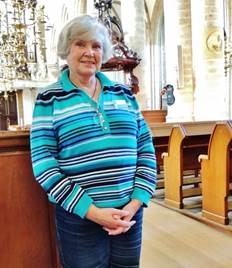
I’m not so much a fan of stained glass windows, but I loved the ones illustrating the Guilds of Dordrecht.  And I’m also developing a fondness for the women who volunteer at the churches who are so interested in visitors to their church and so willing to share their knowledge.  I met several in England and now one in Dordrecht.  She had the most amazing twinkle in her beautiful blue eyes.

Ru

Dordrecht Great Church

clip_image001

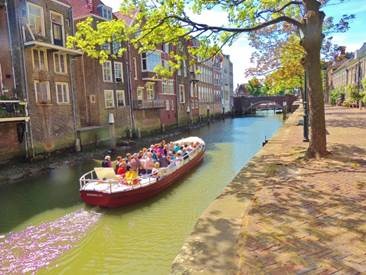
These tourists were seeing Dordrecht by open boat along the waterways through the city.

clip_image002

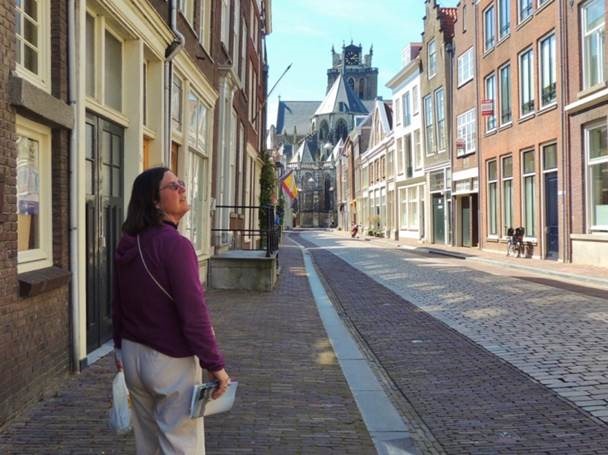
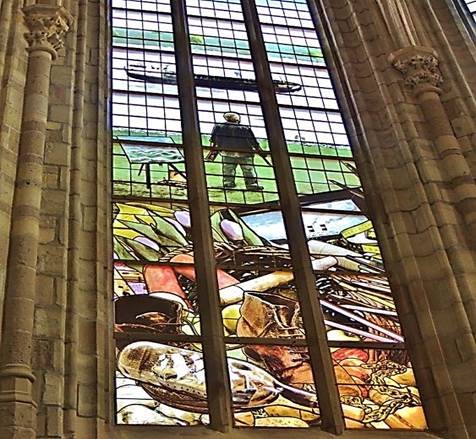
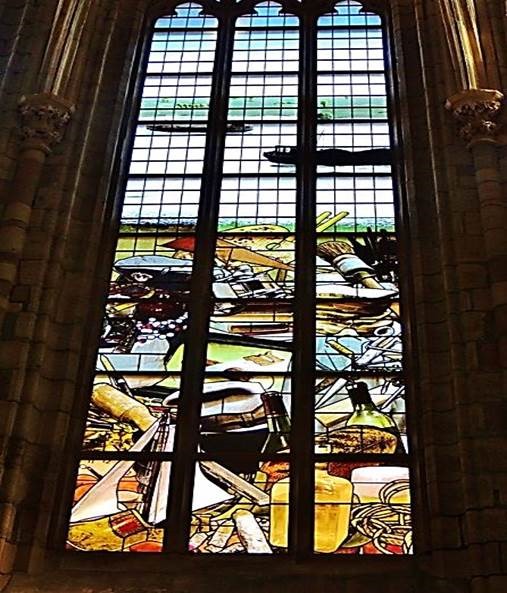
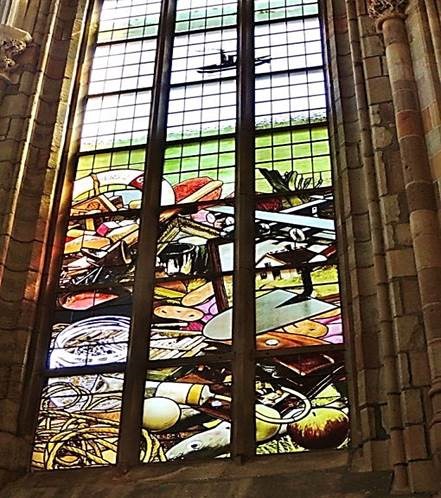
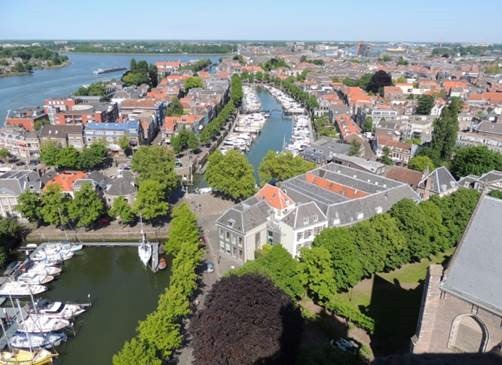
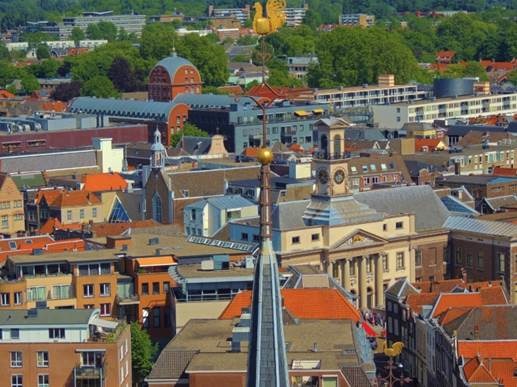
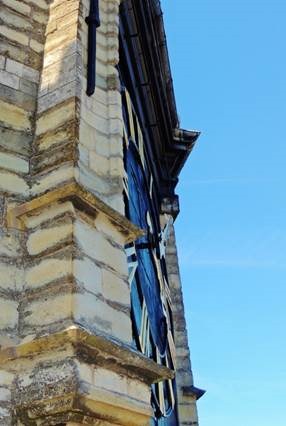
The Grote Kerk  “Great Church” (visible at the end of the road) has a climbable “leaning” tower, so who could resist.  See the clock’s face on the tower?  That’s where we climbed, all 72 meters; 2,376 ft.   I loved the stained glass windows in the church; one set told Dordrecht history, but the other three; my absolute favorites, told the stories of the city Guilds with a few hidden surprises.

“Dordrecht is the oldest city of Holland, as the western part of the Netherlands is called.  The city owes its prosperity to its location in the Rhine and Meuse delta and to the staple right, an old form of levying.  For centuries the tower has been under construction.  Nowadays such a long building period is inconceivable, but 600 years ago it was common practice due to limited resources and techniques.

Construction began in the early 14th century.  Some hundred years later, around 1450, work had proceded as high as the gallery, but then fate struck.  Both church and tower were seriously damaged during an enourmous fire that raged through half the city – a phenomenon that wan not unusual either in those days- in 1457.  Having to rebuild the tower, however, offered an opportunity to change the design.  The tower was to get an octangular stone crowning and to attain a height of no less than 108 meters.  (3.3 times 108 = 3,564 ft.)  But as the tower started to subside, the idea was dropped.  The free standing entrance (locked when we got there) is a reminder of the 16th century plan to tear down the tower in order to enlarge the church building.  But this part of the plan was abandoned as well.  Finally, in 1626 construction came to an end with the installation of four colossal clockfaces that still outline the silhouette of “the Dordtse dom, the city’s cathedral.” 

At present the tower is 2.25 meters (7.4.5 ft) off plumb and braces itself with a twelve million kilo weight against the northwest, symbolizing the city’s relationship with wind and water..

Grote Kerk Tower brochure

clip_image003clip_image004 clip_image005

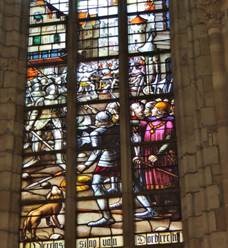
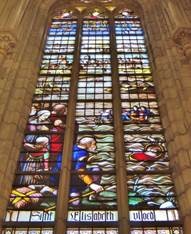
Stained Glass story of Dordrecht history….

-The Hoekse en Kabeljauwse twisten window illustrates the struggle for power between two groups of noblemen and towns in the 14th and 15th centuries

-The Great Flood of 1421 called the St Elizabeth Flood

-Great Fire of 1457 that destroyed large parts of the town of Dordrecht and the church

The Dordrecht Guild Windows installed in 2007

Througout the church the many chapels were owned by different Guilds illustrated with images meaningful to that specific Guild.  The images in these  windows, installed in 2007,  include the tools or products of all of the Guilds. 

clip_image006

The artist who created the windows  Teun Hocks

http://beautifuldecay.com/2012/03/13/teun-hocks/  tells about this fascinating artist.

clip_image007

clip_image008

These wonderful windows represent the guilds

clip_image009

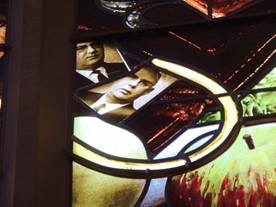
The men who paid for the windows.

clip_image010 clip_image011

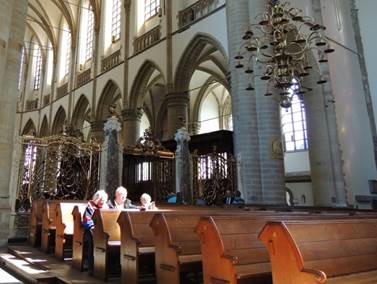
These church visitors were lit by the sun.  The lovely church “guide” was lit from within!  She explained all about the Guild windows to us which was a good thing as the church brochures I bought had no information at all other than when they were installed.  It was Ms. N van Bezooijen who pointed out the window’s artist and the image of the men who had paid for the window.  And the oval shapes with the three triangle cut-out parts that are cookies.

While I was chatting away with Ms van Bezooijen, Mary was sussing out the tower climb.  Turns out that the tower closed at 4:15 and it was then 4 pm.  So it was a race to the top up the 275 steps.  

clip_image012 clip_image013

Tiny people must have built this tower!

clip_image014

clip_image015

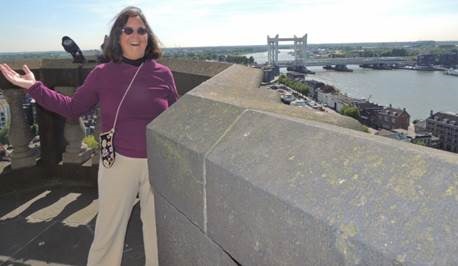
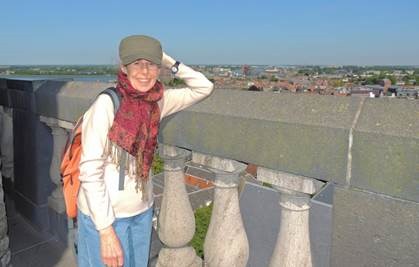
Ta da!  We made it with time to spare!

clip_image016

We left our brochure jammed in the stairwell door just to make sure we could get off the balcony and back into the stairwell neither one of us having a phone.  And doors don’t seem to work exactly as Mary and I expect, so just to be on the safe side….  But when we were just about ready to head back down two other people came onto the balcony so we figured we really weren’t so late after all.

clip_image017

You can see the columns of the Town Hall and beyond that the tower of the Almshouses.  What got me was that we were looking across at the rooster weathervane which meant we were up high.

clip_image018 clip_image019

We were also just about face to face with the clock.  Inside you walked past the clock workings.

     “At the level of the tower’s gallery is the clock that was made in 1624 by Jan Janszoon who lived in Dordrecht.  The clock has two striking mechanisms and a spring mechanism that Simon Douw converted in 1663 – shortly after Christiaan Huygens invented the pendulum clock- equipped with a 6.25 meters long pendulum.  The clock functioned well into the 1930s.  During the restoration works of 1966 it was restored to its natural state, that is to say with a foliot instead of a pendulum.  At the same time big hands were added to the four clockfaces with their  4.25 meters in diameter ring of Roman numerals.  Until then the clocks only had minute hands, indicating only the hour.  At present it is one of the few remaining clocks in the Netherlands that still operates on a foliot.  The {3} weights that keep the spring mechanism going, and those that make the clock strike every half and full hour weigh 160, 220, and 300 kilos respectively.  (1 kilo = 2.2 pounds)  They are suspended from ropes and are wound up electronically.” Grote Tower brochure

clip_image020 clip_image021

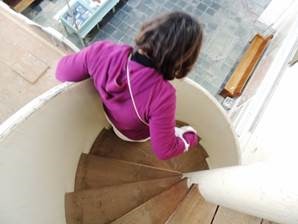
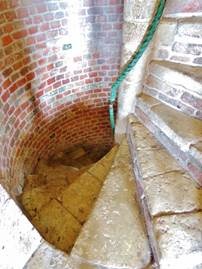
The Tower Hall is where you begin and end your climb.   The actual tower stairwell is circular, stone, narrow, and dark.  I came out fairly dizzy! 

clip_image022clip_image023

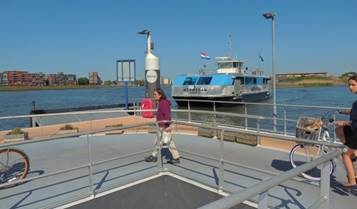
It did finally occur to us we needed to check the ferry schedule back to Papendrecht as they only run every 50 minutes or so.  So then it was a race to the ferry, but we made it with a minute or two to spare.

The bridge across would have been a very long hike so the ferry really was our only option.  And as we were leaving early the following morning we still needed a trip to the grocery store.  Some nights we stop in yacht clubs with full services and shops nearby.  Other nights we just have to tie up where we can find a space so need to be prepared for at least 2 or three days of meals on the boat.

clip_image024

Papendrecht Yacht Club.  Power, water, wifi, a nearby shopping area, ATM and probably most important, a really really helpful harbor master and friendly boaters to lend an extension cord for our power cable.  We now have one of our own but didn’t when we first arrived.  We can last a night without power and could run our generator to recharge batteries if we have to, but it’s nice to just plug in.  You pay for it but that’s just fine.

clip_image025

Apartments surrounded the

Dordrecht part 2

clip_image001

Center City: Once again Mary is figuring out where we are and where we need to go.

clip_image002 clip_image003

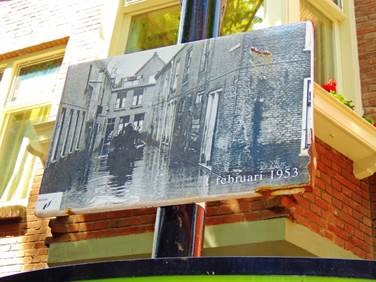
Flood of 1953  Then and now…..

clip_image004 clip_image005

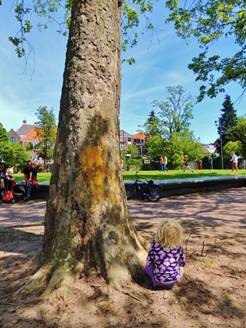
“I think that I shall never see a poem lovely as a tree” “When you start on your journey to Ithaca then pray that the road is long….  A poem for every occasion!

Once the convent’s garden, now a playground.  Mary got bombed with a flying stick that got away from a small boy who just picked it up and walked away without a backward glance.

clip_image006

Restaurant Traiteur Zest on the small busy Nieuwstraat.

clip_image007 clip_image008

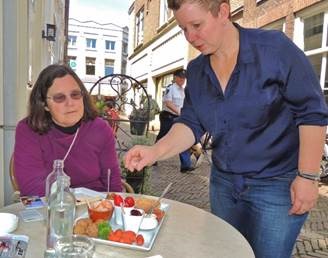
The very helpful  (and very busy!) waitress explained what exactly was on the Tapas plate for two that Mary and I had ordered.  We had just started to eat when I heard Rick’s voice.  I looked back and there were Randal and Rick walking along Nieuwstraat towards us.  But they were supposed to be in Rotterdam getting our VHF radio reprogramed.  The ICom repair man who’d visited DoraMac in Vlissingen couldn’t repair it but thought the Rotterdam shop could.  Papendrecht was a 50 minute water taxi and then an expensive land taxi to the shop in Rotterdam but certainly muchcloser than Vlissingen had been.  Randal had called and emailed ahead of their visit, but to no avail as when they arrived in person the shop didn’t seem to have the correct computer program to fix the problem.  So they returned to Dordrecht to find a hardware shop but instead found us.  It was perfect timing as we had too much food for the two of us.  Though the guys had eaten they had room for a bit more so the plate was licked clean by the time we had finished.  I actually liked the little sausage things and the and the small pimento like peppers stuffed with cream cheese.  Mary and I liked different bits on the plate so it all worked out especially well and the guys ate anything.

clip_image009 clip_image010

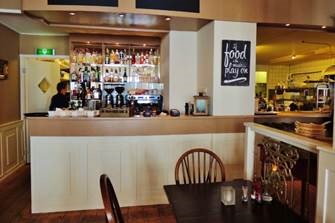
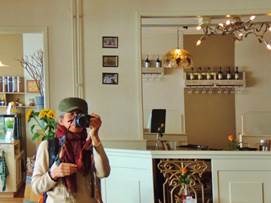
     “If food be like music, play on.”    Traitor Zest                 “Reflections on a selfie.”

“If music be the food of love, play on.”   Twelfth Night

clip_image011clip_image012

Dordrecht Bibliotheek

clip_image013

A very friendly book shop across the street from the library.  We had a lovely chat with the owner who had only recently become a book shop owner.  Of course most books were in Dutch.  We saw 2 Edward Gorey books, one in Dutch and one a picture book.  The book seller told us his daughter always wanted him to make up stories to go with the pictures.

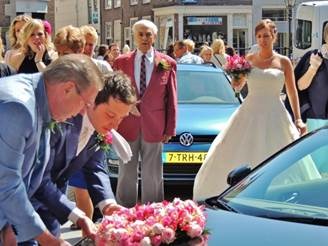
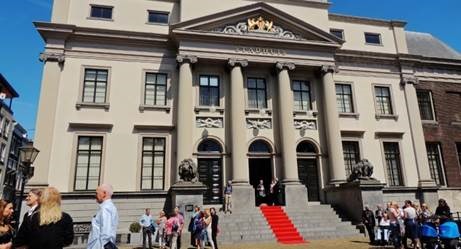
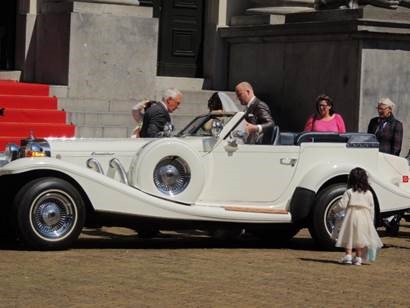
A day of weddings at the City Hall

clip_image014

Concentrating very hard to get the flowers just right on the car but then….

clip_image015

Everyone just went walking down the street.

clip_image016

“The neoclassical façade that the Stadhuis (city hall) received in the 19th century hided the medieval secret behind this building with its cellars with groined vaults and its roof with the original wooden construction, was built in the 14th century as the Flemish commodity exchange.  It became the home of the city council in 1544.  When you visit (which we didn’t have time to do) explore the hunting room, the 18th century prison in the attic and the wedding room with wall paintings by Reinier Kennedy.”

VVV Tourist Guide 2014

clip_image017

Then lots of cheering and commotion just before this car drove up with a bride and groom.  I asked a man next to me who it was?  “The man is nobody famous,” was his reply.  So I don’t know.

clip_image018

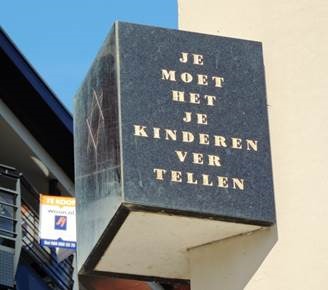
This cube was on the side of the City Hall.

  “The monument "You have to tell your children ‘in Dordrecht consists of two parts.  On the facade of the town hall is a stone cube-shaped plaque attached with a text and a Star of David.  In the hall, the town hall is a white pillar.  Opposite the names of the projected 221 Jewish war victims from Dordrecht.

DORDRECHT LOST HER JEWISH COMMUNITY RESULT OF GENOCIDE BY THE NAZIS in 1945. "

http://translate.google.com/

Dordrecht 1

Guten Tag,

    Today we bought an internet dongle that works in Germany and supposedly all of the other countries in Europe.  We’re amassing quite a collection of these dongles that are billed as working anywhere but then don’t or we’re promised that they won’t work anywhere else, which at least is honest.  Though this marina has wifi, my Outlook email service wasn’t compatible with it so that also was extremely discouraging as I’ve a several emails already written ready to be sent.  So here goes.

Ru

Dordrecht, or as the locals say, Dordt

http://www.vvvdordrecht.nl/en/home

Visited May 16th 2014

“Dordrecht is the oldest city in Holland and has a rich history and culture.

     The name Dordrecht comes from Thuredriht (ca 1120.) The name seems to mean ‘thoroughfare’; a ship-canal or river through which ships were pulled by rope from one river to another, as here from the Dubbel to the Merwede, or vice versa. Earlier etymologists had assumed that the ‘drecht’ suffix came from Latin ‘trajectum’, a ford, but this was rejected in 1996. The Drecht is now supposed to have been derived from ‘draeg’, which means to pull, tow or drag. Inhabitants of Dordrecht are Dordtenaren (singular: Dordtenaar). Dordrecht is informally called Dordt by its inhabitants. In earlier centuries, Dordrecht was a major trade port, well known to British merchants, and was called Dordt in English.”  Wikipedia

clip_image001

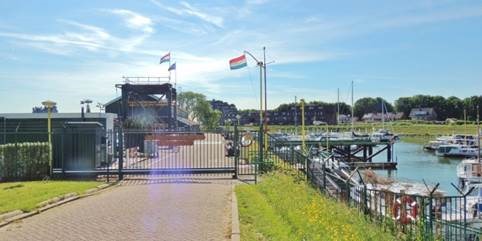
View of Dordrecht from DoraMac as we passed by on our way to Papendrecht across the river for a spot in the yacht club.  To berth in Dordrecht you had to wait for bridges to open and we weren’t sure there was space enough for us.  Mary and Rick had berthed at the Papendrecht Yacht Club and had great memories of the helpful harbour master there.  We found a spot thanks to that same helpful harbour master and just took the waterferry over to Dordrecht. 

clip_image002

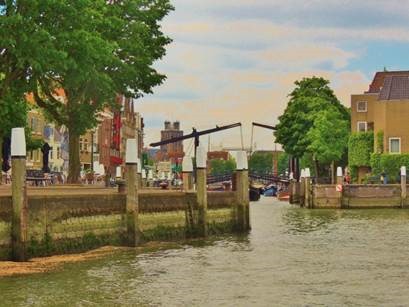
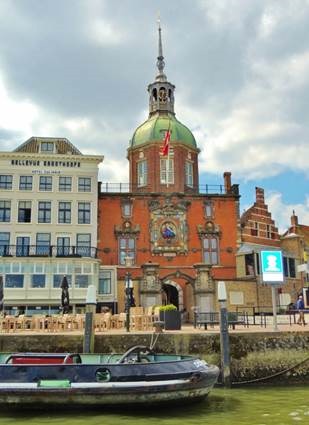
Groothoofdsport Gate

Dordrecht has haven (harbours) but no canals.  The Voorstraatshaven forms the backbone of the old city.  Graceful bridges connect the Voorstraat and the Wijnstraat, streets that lie on either side of the water.  To effectively hadnle trade, the Nieuwe Haven 1410 and the Wolwevershaven 1609 were created, followed by the Maartensgat and the Kalkhaven.  The unchanged attractive harbour quarters with its warehouses, merchants’ mansions, quays and – now-pleasure boats is found between Grote Kerk and Groothoofd. 

clip_image003 clip_image004

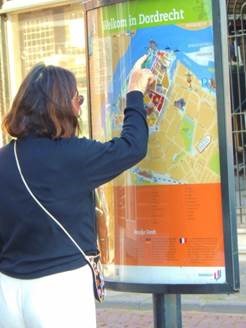
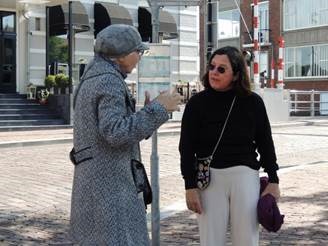
Sometimes the information maps were helpful and sometimes a little more information was needed.

clip_image005

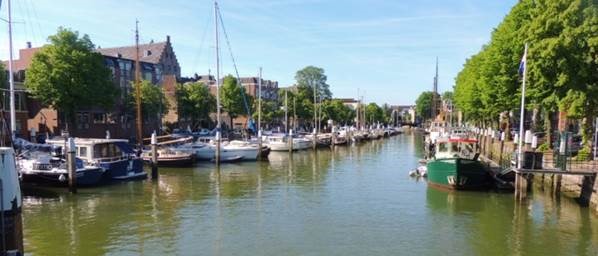
Boats moored along the Wunhaven waterways  on our way to find the tourist office. DoraMac may have been larger than many of the boat we saw but her colors, green and white seemed to be quite popular in the Netherlands.

clip_image006

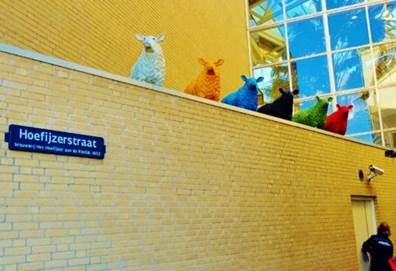
We saw these multicolored sheep but unfortunately not the monument described below.  Wish we had!

     “During Carnaval, Dordrecht is called Ooi- en Ramsgat (Ewe’s and Ram’s hole), and its inhabitants are Schapenkoppen (Sheepheads). This name originates from an old folk story.  Import of meat or cattle was taxed in the 17th century.  To avoid having to pay, two men dressed up a sheep they had bought outside the city walls, attempting to disguise it as a man. The sheep was discovered because it bleated as the three men (two men and one sheep) passed through the city wall gate. There is a special monument of a man and his son trying to hold a sheep disguised as a man between them, that refers to this legend.  The logo of Dordrecht’s professional football club FC Dordrecht includes the head of a ram and its supporters are known to sing Wij zijn de Dordtse schapenkoppen (we are the Dorsts sheep heads) during matches. There is also a cookie called Schapenkop (sheep head) which is a specialty of Dordrecht.” Wikipedia

clip_image007 clip_image008

Tilted building for raising large items to top floors.   ‘No problem, No problem.”  I was taking a photo when a group on bikes cycled past.  “Sorry Sorry” they said; “No problem,” I said so then they all kept saying ‘No Problem” No Problem.”

This building was the home of the Notary Willem Hendrik van Bilderbeek who funded the Dordrecht Museum.  If he charged what our Ipswich notary charged I can see how he could afford to fund a museum.  Sadly there was a special exhibit at the museum (not something of interest to us) that raised the ticket price from 3 Euro to 14 Euro, about $18 US.  We didn’t have enough time to justify the $18 ticket.  However the entire collection catalogue in English is online with photos of the paintings.  Not the same but it will have to do.

clip_image009 clip_image010

clip_image011

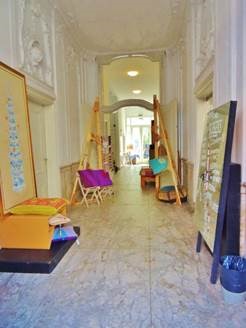
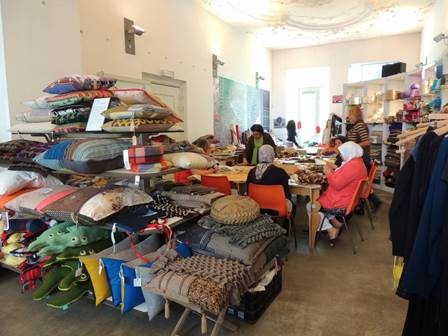
I really wanted the stuffed elephant shaped pillow of the softest boiled wool  and had we been just starting our boating life rather than thinking of how to get stuff off the boat and back to VA, I might have just splurged on it.  This seemed to be a mulit-national women’s cooperative.  I wish I had the nerve to really interview people.  Not sure why I didn’t except they seemed quite busy and we just sort of invaded their working space. 

clip_image012 clip_image013

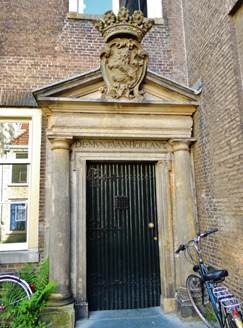
Mary guessed that this was the original Dutch Mint.  Once used as a music school, it’s not studio space for artists until the building owners find more lucrative ways to make money from it we were told by one of the artists just arriving on her bicycle.

“Munt van Hollant : The sandstone gate from 1555 on the Voorstraat gives access to the Muntgebouw [The Mint] where from 1367 up to its closure in 1806 the coins for Holland and Zeeland were minted.  The Holland coat of arms hangs above the entrance of the main building.”  VVV Tourist Guide

clip_image014 clip_image015

The coat of arms and this nearby wall plaque both make their own statement.

clip_image016

Not everything is old….

clip_image017

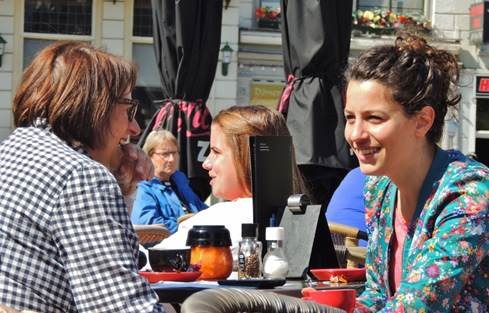
We stopped for about 11 am for coffee along with lots of other folks.  Women having fun.  Mary and I are going to have to learn to do selfies.

clip_image018

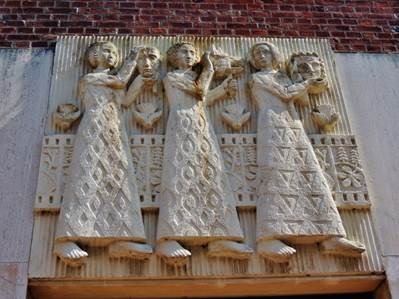
This bas relief was on the front of a modern building, but there was no signage to explain it. 

Now one of my favorite encounters…… 

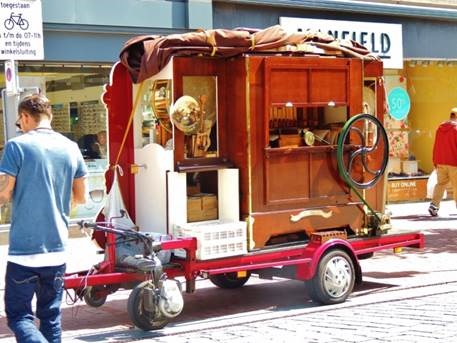
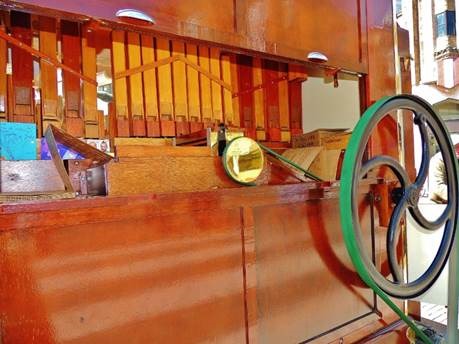
I first saw this contraption from the back on our way to the Tourist Office.   It was playing music and everyone now and then the gold drum would  rat ta tat tat.   

clip_image019

clip_image020

The front looked like a puppet show though they were wood carvings, not puppets.   After leaving the Tourist Office we passed it again so I went closer and looked at the back.  The entire contraption is pulled by a man on a bicycle who travels around the city with this and his tin cup for contributions.  I gave him a Euro when we originally passed by but when I saw what it really was wish I’d given him more. 

I know he pulled it by bicycle because when Mary and I were eating lunch at a lovely café on a small side street, he bicycled past us pulling it along.  Unfortunately my camera was buried in my backpack so I didn’t get any photos of that. 

clip_image021clip_image022

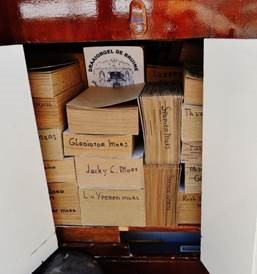
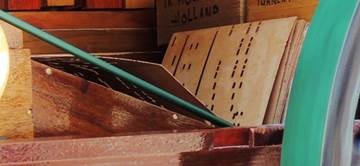
Being a retired reference librarian I first thought these were old phone books used to hold up something but then the machine’s owner came and took one of the books and put it into the machine replacing the one already there.  Not old phone books but old player piano music.  Way cool!

clip_image023

You can see it going in on the left and out on the right moved by the big wheel and cable.   

clip_image024

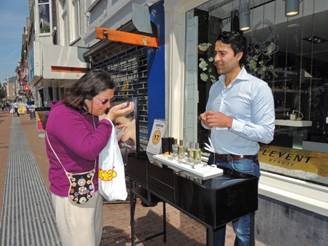
Mary sampling some “way too strong” perfume that we both kept smelling for the rest of the day.  I could at least sort of get away from it, but poor Mary couldn’t. 

clip_image025 clip_image026

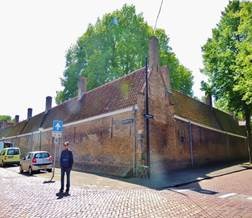
Almshouses

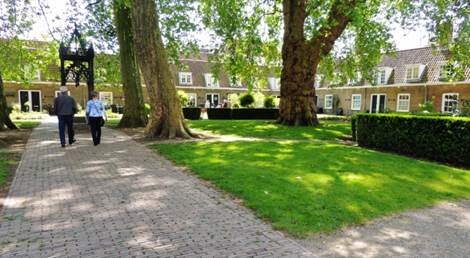
Between Bagijnhof and Vriesestraat are the almshouses of the Regenten- of Lenghenhof.  They are built around several central courtyards.  These almshouses, which date from 1755 and were built for poor women, were governed by trustees.  The oldest are on the side of the Baginjhof.  In 1625, Arend Maartenszoon founded the almshouses for poor women that bear his name in the Museumstraat.  Cottages surround a courtyard with ancient (350 years old) trees and a water well and are now occupied by both men and women.”  VVV Tourist Guide 2014

clip_image027

Courtyard,  water well, and ancient trees

clip_image028

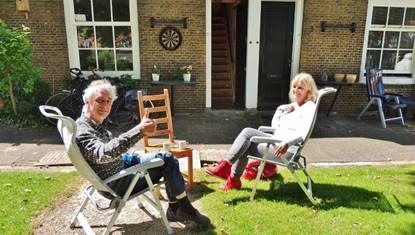
This man is a new resident and feels as if living here, he is on permanent vacation!

clip_image029

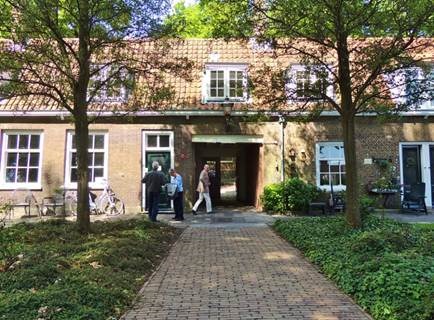
Looking through the entrance back onto the street.

Passage from Vlissingen

Goedenavond,

    Tonight we are 3 stops away from Vlissingen in Tiel at a lovely yacht club for the night.  We traveled 60 kilometers from Papendrecht today with lots of current slowing us to a 4 knot average.  Lots of barge traffic also.  Tomorrow we may reach the Rhine and enter Germany.  Writing these emails has me keeping one foot in our current town and one foot in the town we’ve just left.  I spent most of today’s passage going through the 200 plus photos I took in Dordrecht yesterday.  But it was charming and fun and we managed to get a tourist booklet in English as well as one for the Great Church whose tower I couldn’t resist climbing so Mary and I raced up and down just before closing time. 

    Rick and Mary had cruised some of these miles a few years ago in their sailboat so are doing most of the course plotting.  Good thing as the guides are in Dutch or German.  I’m happy to let someone else plan the route and just enjoy whatever we do see.  I’ve never been in most of the countries we’ll pass through so everything will be new to me.

Ru

Leaving Vlissingen along the Volkerak  River
clip_image001 clip_image002

The bridge at Vlissingen was scheduled to open at 9:25 am so we were ready and waiting to make our way through.  We knew the schedule for all of the bridges between Vlissingen and Middelburg so made our way accordingly so not to be either too early or too late. 

clip_image003

Going through the opened bridge

clip_image004 clip_image005

This big boy had been waiting too and followed us out through the bridge.

clip_image006

We let the big guy pass us and now we’re following him through the second bridge.

clip_image007

clip_image008clip_image009

Passing by Middelburg.  I believe I read that this building was designed to look like a freighter and it certainly does to me.
clip_image010clip_image011

clip_image012clip_image013

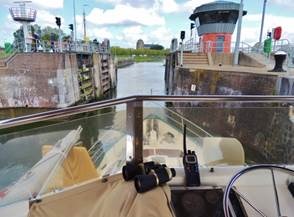
Going through a small lock; we had to tie up but this smaller boat could just hold on t lines made for that.

clip_image014

Sometimes we have to wait for the lock and sometimes pedestrians have to wait for us to cross over the lock.  Given this photo I’m not sure what the blue sign is really saying.

Then we came to this giant lock that took Mary, Rick and me to handle the lines to tie ourselves to the lock walls.  There were two small boats ahead of us.  We were all tied up on the right side of the lock.  Then a giant barge came in just alongside us with not much space to spare.  And, the barge captain who drove so well,…. A woman!!!.   I’ve no photos as we were busy with the lines.  Sometimes the water level changes enough that you have to move where your lines are looped to the bollards on the lock wall.  That happened in this lock, but Mary and Rick took care of all that.  They’ve done this route before so are seasoned hands at going through locks.  But I am learning.  Thanks Sue Kelly for the boat hook trick.  Mary and I two it two handed.  She holds the rope look and I hook it over with the boat hook.  But we might try your tape idea too.

clip_image015

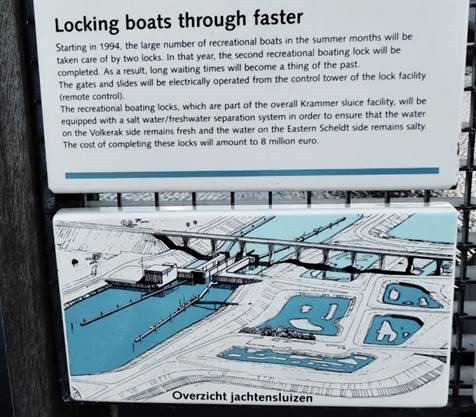
This is the big boat lock, though the barges in with us were huge in my opinion.  We were in what was called the sport lock. 

clip_image016

We’re the red line going through our lock and the line of black triangles are the boats going through the “Overzicht jachtensluizen.”

clip_image017

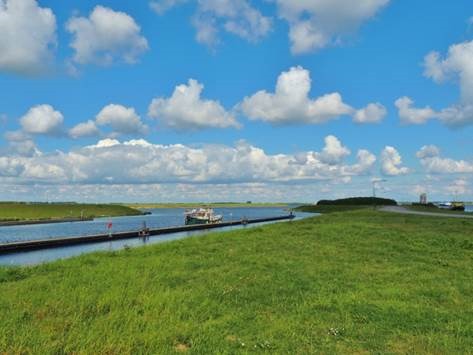
Boats tied up waiting for a chance to go into the lock we’ve just left.

clip_image018

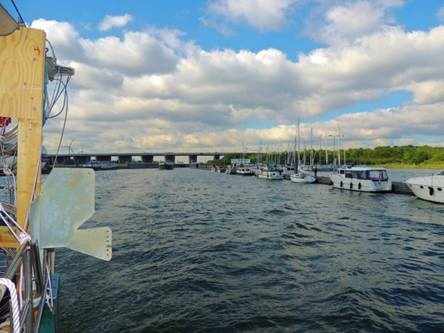
This dock just beyond the lock and bridge were where we spent the night.  It was just lovely.  Lots of water birds shared their space with us.

clip_image019

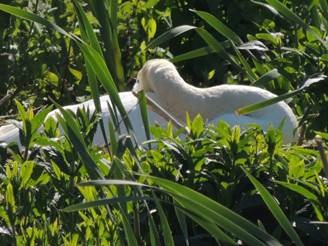
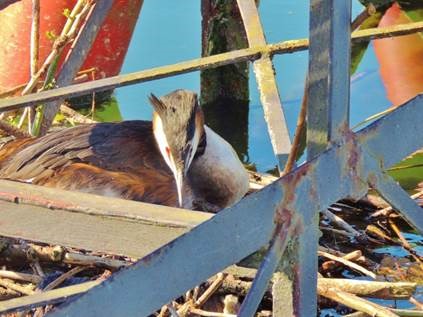
A nesting swan

clip_image020

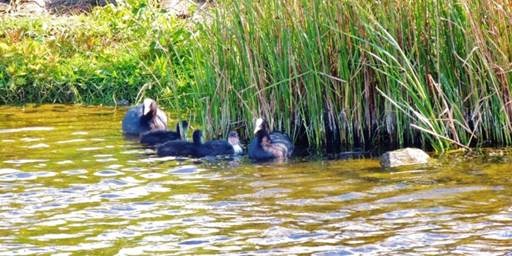
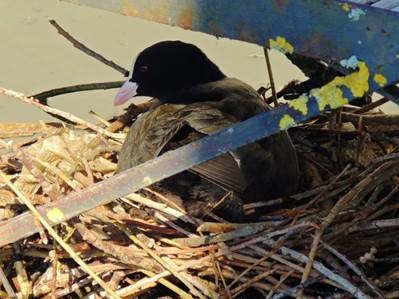
A coot family

clip_image021

clip_image022

clip_image023

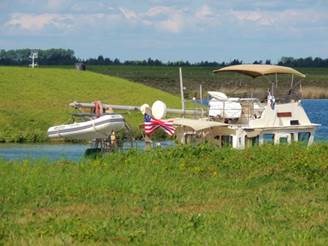
Where’s DoraMac?

clip_image024

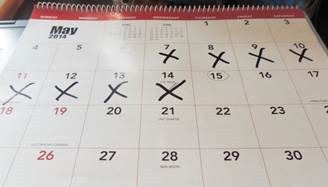
Keeping count of our Schengen days.


Middelburg part 2

Goedenavond,

    It has been a lovely long day.  Randal and Rick went off to Rotterdam on boat chore errands and Mary and I went across the river to visit Dordrecht.  Lots and lots to see!  Someday I’ll catch up with where we are when I’m actually writing an email.  Tomorrow we leave about 9 am continuing on our journey to Germany and the Rhine. 

Ru

Middelburg part 2

clip_image001

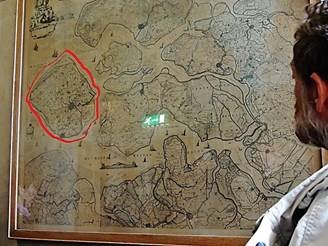
The circled part on the map includes both Middelburg and Vlissingen in what was Zeeland when the area that is now The Netherlands was at a point in history when they were separate islands and provinces. 

clip_image002 clip_image003

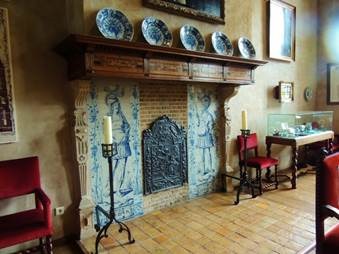
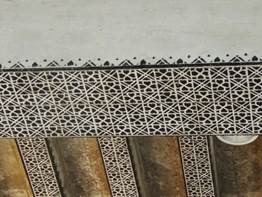
Delft tiles around the fireplace and ceiling decoration is painted concrete made to look like early Dutch tiles around the old wood pieces of the renovated ceiling.  There wasn’t’ enough wood to do the entire ceiling so this ingenious cement-work was used also. 

clip_image004

Gifts from Nagasaki;  the sister city of Middelburg

clip_image005

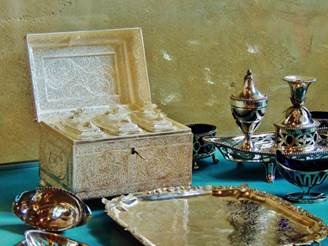
A beautiful locked teabox.  Only the mistress of the home had the key as tea was an expensive luxury at one time.


clip_image006

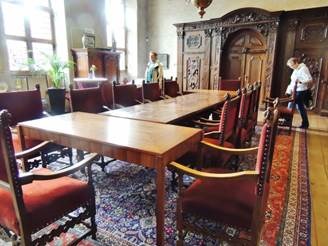
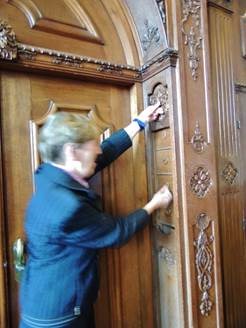
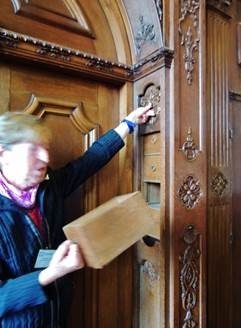
The former town hall meeting room is just through those heavy wood doors.  We can’t remember what this room was specifically used for but we all remember those carved doors.  They were once bed-cabinet doors.  People slept in giant closets to keep the warmth in.  These doors from the sleeping cabinet were those of a very wealthy man.  Our guide showed us the secret money drawers on either side so the sleeper would awaken if anyone was trying to steal his money.

You would lift up the sliding decorative covering and then pull out the drawers. 

clip_image007clip_image008

clip_image009clip_image010

Town Hall Interior  : The former Cloth Hall

     The interior of the Town Hall is open to the public. Above the old Meat Hall (now occupied by an exhibition of modern art) is the imposing Burgerzaal (Burghers’ Hall), originally the town’s first Cloth Hall, which is now used for civic receptions and other great occasions and as a concert hall. Items of particular interest include pictures, Bruges tapestries on mythological themes and a bronze model of Admiral de Ruyter’s flagship.

http://www.planetware.com/tourist-attractions-/middelburg-nl-zld-mid.htm

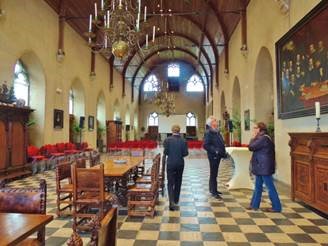
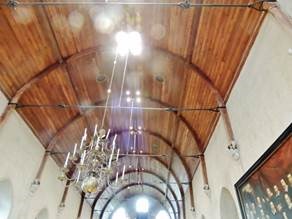
The barrel ceiling, which is called that because it looks like a half barrel, was once over an attic space where hams were hung.  The Cloth Hall was below that and then the Meat Hall below.  The City Fathers liked having both the meat and cloth halls nearby so they could judge the amount of taxes that should be paid from both of those markets.

clip_image011 clip_image012

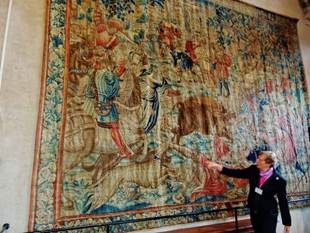
The Bruges Tapestry and a group portrait with one cheapskate who wouldn’t pay the fee for a face portrait so he was painted from the back.  See the red arrow.  This was a shooting club where everyone was sort of related to everyone so they all sort of look alike. 

Our guide explained the discoloring of the Bruges tapestry: the yellow color faded from the green threads leaving blue color where you would expect green.  And she showed us the brown which was the newly discovered madder color gotten from plant roots.

“Materials

     “Wool is the most widely used material for making the warp, or the parallel series of threads that run length-wise in the fabric of the tapestry. The width-running weft, or filling threads, are also most commonly made of wool. The advantages of wool are wide-ranging. It is more available, more workable and more durable than other materials, and in addition can be easily dyed. Wool has often been used in combination with linen, silk or cotton threads for the weft. This mixture of material is ideal for detail weaving and for the creation of delicate effects. Light coloured silks were often employed to create pictorial effects of tonal gradation and spacial recession. The glow of silk thread was often useful for highlights or to create a luminous effect when contrasted to the duller woollen threads. Silk was increasingly used during the 18th century, especially at the Beavais factory in France, in order to achieve subtle tonal effects. The majority of Chinese and Japanese tapestries have both warp and weft threads of silk. Pure silk tapestries were also made during medieval times at Byzantium (Constantinople) and in parts of the Middle East. Pure linen tapestries were woven in ancient Egypt, while Egyptian Christians and Medieval Europeans sometimes used linen for the warp. Both cotton and wool were used in Pre-Columbian art to make Peruvian tapestries as well as some Islamic tapestries during the Middle Ages. Since the 14th century, along with wool and silk, European weavers have also used gold and silver weft threads to produce a sumptuous effect.

     Tapestry Dyes

Dyes commonly used in Europe included: (1) Woad, a plant similar to indigo, which yields a good range of blues. (2) Madder, a root from which reds, oranges and pinks could be obtained. (3) Weld, an English plant whose leaves produce yellow. (4) A mixture of weld (yellow) and indigo (blue) was used to concoct green. “

http://www.visual-arts-cork.com/tapestry-art.htm

clip_image013clip_image014

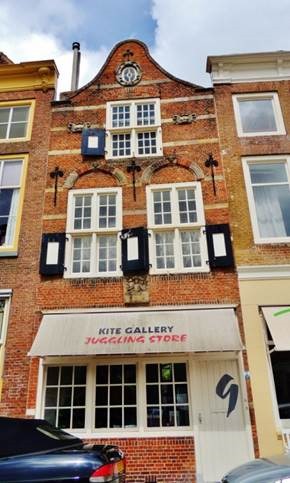
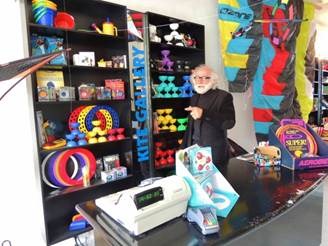
My friend Sharon’s son Warren is a professional juggler/street performer.  So I had to visit this Juggling Store and have a chat with the owner who is more a kite man himself.  I would have loved to explore the building from the 1660s which might have been possible as the door was open and no one was in the ground floor shop.  I called and waited and called and waited and finally the owner came from either up or down.  Many buildings that look old were rebuilt after the war, but some with the dates of the 16 and 17 hundreds I’m assuming are original.

http://www.njf2014.nl/en/index.html  is the site of the 2014 Netherlands Juggling Convention

clip_image015clip_image016

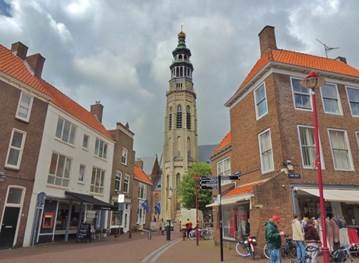
Seems I can’t resist a good climb so we went off the climb the tower of Lange Jan

“The octagonal tower – a rare feature in the Netherlands – popularly known as Lange Jan, originally dating from the 14th century but several times burned down (most recently in 1940), is the great landmark and emblem of Middelburg. A staircase of 207 steps leads up to the top (91m/299ft), which carries a large imperial crown in honor of Count (King) William II. From the top of the tower there are extensive views over the whole of Walcheren and much of the Deltawerken. “

http://www.planetware.com/

clip_image017 clip_image018 clip_image019

clip_image020

The Abbey Complex

Nieuwe Kerk

“In Middelburg, the two-aisled Nieuwe Kerk (16th C.), the parish church, and the aisleless Koorkerk (early 14th C.), the abbey church (beautiful reticulated vaulting), were originally joined. Since the parish church had no choir of its own, the west end of the monks’ church, known as the middle choir, was used as the choir for the lay congregation. Over this is the tower known as Lange Jan ("Long John"). In this church are the double tomb of the brothers Jan and Cornelis Evertsen, two admirals killed in the English war of 1666, and memorial tablets for Count William of Holland (d. 1256), king of Germany, and his brother Floris (d. 1258). The magnificent marble tomb was the last great work of Rombout Verhulst (1680-82). After their restoration both churches were provided with organs by the Rijksmuseum in Amsterdam. The organ in the Koorkerk (built in 1481) came from St Nicolaaskerk in Utrecht, that in the Nieuwe Kerk (1892) from a Protestant church in Amsterdam.”

http://www.planetware.com/

clip_image021

Middelburg

clip_image022clip_image023

Horse statues of all sizes

“The Ring Rider.”

Hooves pound the sand and nostrils flare as the horses run full speed toward the ring – an oh-so-small ring. This is the age old sport of the equestrian ring rider. A traditional sport from long ago still played out today in Middelburg, Zeeland, a province in Holland.

A true test of horsemanship, the rider must be bareback – without the aid of a saddle- and the horse must be colorfully decorated.  The ring rider is also dressed in an official costume of white with an orange sash, symbolizing the connection to the royal house.

A centuries old horseback riding activity dominated by male equestrians, today, women are allowed to join in the festivities on horseback or with carriages where the man directs the coach and the woman stabs the rings that are hung in various places along the course.

http://writinghorseback.com/

Middelburg part 1

Goedenavond,

   We finally left Vlissingen May 13th and made it part way to Papendrecht.  We tied up overnight just along the water way sharing space with lots of water birds which was wonderful.  Today we made into Papendrecht and were helped into the only space possible for us at this small yacht club.  Everyone is super helpful loaning us an extension power cord and a longer hose and just being very welcoming. We walked into the nearby shopping center for lunch and groceries which we seem to demolish in no time so are always needing replacements.  Then Randal and Rick got the boat all hooked up with power, water and wifi and Mary and I went out for a walk that became a longer walk when we decided to make a “loop” rather than just retrace our steps.  But that was fine as we finally got back to the boat.  The weather has been perfectly sunny for two days though driving from our flybridge is still quite chilly or downright cold depending who you ask.

   Tomorrow Randal and Rick will take the water taxi to Rotterdam to get our VHF radio repaired and Mary and I will do some laundry as well as cross the river to Dordrecht and see that very intriguing looking town. 

    Moving every day makes it hard to catch up with stories and to remember them.  Between the 4 of us no one could remember half of what we’d heard during our tour of the Middelburg Town Hall and then we couldn’t always agree on what we remembered.  I will have to start taking notes as finding background info in English is really proving problematic. 

   So that’s it!

Ru

Middelburg….

      “To really be a good town, you need a good market square. It’s best when it is traffic free, lined with cafés, surrounded by interesting buildings, and has — at least once a week — a market happening on it.

     Throw in a tower with a view, some more historical buildings, a waterway and maybe some cozy squares — they don’t have to be as big as the market square — and you have the makings of a good place to while away the time.

     Middelburg, Netherlands, has all this and a bit more.

But first some history. Middelburg is the capital of Holland’s Zeeland province. It is in the center of a piece of land called Walcheren. This was once an island, but, like many places in Holland, due to land reclamation is now part of the mainland. It is a place use to calamities, from attacking armies to the invading sea.

     Middelburg got its name from a castle — “burg” — that was at the center of the island and offered protection from marauding Vikings in the ninth century. It received its town charter in 1217 and throughout the ages became an important commercial center, especially due to its cloth-making trade.

     In 1561 it became the seat of a bishop. Walcheren lies at the mouth of the Schelde estuary, making the island and its capital strategically important, controlling the waterway to the great port of Antwerp.

     In the 17th and 18th centuries, Middelburg experienced a renaissance, being the second-most important home port for the Dutch East India Company after Amsterdam, with its profitable trade with the East and West Indies.

     The city suffered continuously from severe flooding over the years as the North Sea deluged the land.

Middelburg was heavily damaged by the Nazis in World War II, and the Allies, in a move to flush them out, destroyed the dikes in 1944, flooding the island for over a year.

     The great floods of 1953 overwhelmed the city once more, but with the construction of new dikes, the power of the sea has been kept under control.

     The heart of Middelburg is the Markt. Lined on two sides with cafés and restaurants and on a third by the fantastic Stadhuis (town hall), the square has a weekly market on Thursday, a fruit and vegetable market on Saturdays from Easter to October, a book and bric-a-brac market on Mondays, and a flea market on the first Saturday of the month (except January).

     The Stadhuis is a model of ornate Gothic splendor, decorated with statues of the counts and countesses of Zeeland. A graceful clock tower, added in the 17th century, soars into the Dutch sky.

Don’t be fooled by its ancient look. The Stadhuis was nearly destroyed in World War II, and what you see today is a detailed, loving reconstruction of the building.

    The clock tower isn’t the only thing that towers over the city. There is also what the citizens of Middelburg affectionately call “Lange Jan.” Long John is the 280-foot tower of the Nieuwe Kerk (new church), part of the city’s 12th century abbey. The long climb to the top offers a view of the city and on a clear day almost all of Walcheren.  (We did climb the tower, more about that another email….)

     Secularized in 1574, the Abdij is a conglomeration of buildings surrounding a generous courtyard. Three adjacent, internally connected churches — the Nieuwe Kerk, the Wandel Kerk and the Koor Kerk — make up one part of the complex. Within the compound is the Zeeuws Museum, which traces the history of the Zeeland province, and the Roosevelt Study Center, which commemorates the links of Theodore and Franklin Delano Roosevelt, to a Zeeland ancestor, Claes Maertenszoon van Rosevelt who sailed to Nieuw Amsterdam in the New World in the 17th century.”

By Michael Abrams 

Stars and Stripes

Published: March 27, 2003

http://www.hollandhistory.net/

http://www.jhm.nl/culture-and-history/the-netherlands/zeeland/middelburg  if you want to know more/

clip_image001

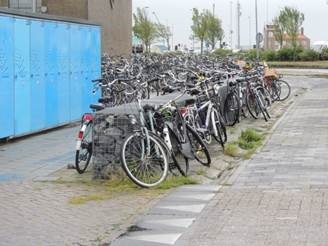
Bicycle parking at the train station in Vlissingen.  This is nothing compared to the train station in Amsterdam when we were there in 2000.

clip_image002 clip_image003

Life on the canal in Middelburg.

clip_image004 clip_image005

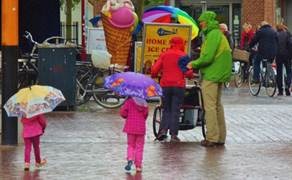
Art and life not imitating each other….. the girls were so cute with umbrellas half their size.

clip_image006

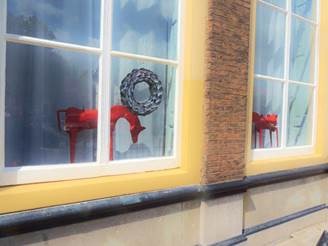
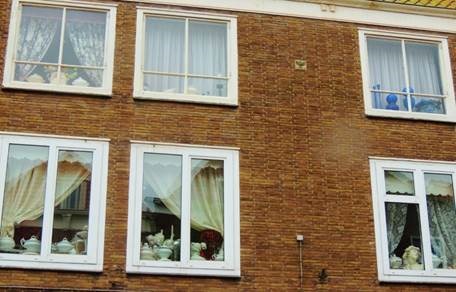
Windows always have something to show off.

clip_image007 clip_image008

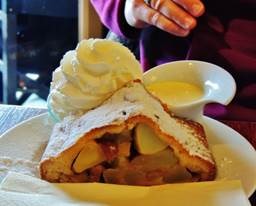
The tourist office didn’t open until 11 am so we HAD to kill some time with coffee.  Mary decided she had to try a local specialty, apple strudel with whipped cream and vanilla cream.  Rick helped her just a bit but Randal and I made do with our cappuccino and a tiny waffle cookie.

Then we returned to the Tourist Office where we were told a tour of the Town Hall would start in 10 minutes so we went back across the square to sign up for it. 

clip_image009

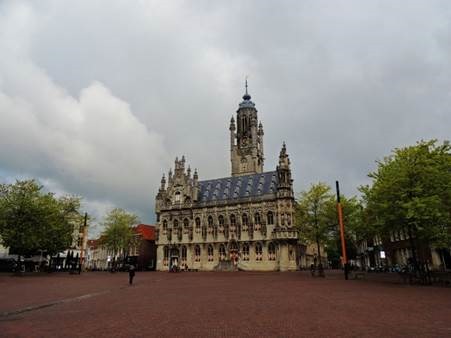
The Gothic Façade of the Middelburg Town Hall in Market Square

The info below is from a site that must have used Google Translate rather than a real human translator, but it matches what our guide told us. 

    “On April 21, 1452 was the first stone of the Town Hall of Middelburg. It would be a combination of a hall, meat market and Cloth Hall. This combination of features was very common in the Middles Ages. The Town Hall contains many Gothic features and belongs to the late Flemish Brabant Gothic. The most striking features are the tower and the beautiful facade with its Gothic windows, red and white shutters and sculptures. …..

     In the 19th century found numerous repair works. In 1884 began the most comprehensive restoration under the direction of the architect Pierre Cuypers. Here the facade overhaul. After the completion of the facade in 1912, the town hall, takes the place for a city museum and the municipal.

clip_image010

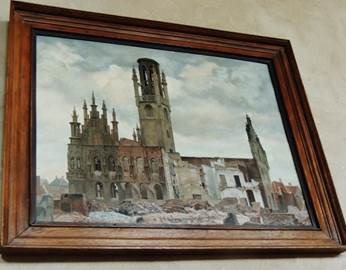
Destruction during WW 2

Then begins a fateful day for the city of Middelburg: May 17, 1940. While the rest of the Netherlands on May 14 after an invasion by the Germans surrendered,  the province of Zeeland was ordered by the government through fighting.  The city is located in the line of fire to lie. Three days after the bombing of Rotterdam, a large part of the historic heart of Middelburg destroyed by shelling and aerial bombardment. This, for many unexpected attack, take the City Hall, there remains only a silhouette on walls blackened. The spire, the roof and the whole interior will be lost.

     Soon the restorations was started. The Gothic facades are restored and a new section added in suitable style. After years of rehabilitation, among others H. Van Heeswijk and A. van der Steur, the Town Hall on August 18, 1950 by Queen Juliana festively reopened. The restoration of the exterior below takes many years to complete.

     During the rebuilding after the bombing, in addition to the outside, were made the inside underway. In the so-called Gothic part of the city hall is the old style interior decorated with antique furniture, tapestries and paintings. This can be seen in the hall, wedding hall, the former chamber of the mayor and aldermen, the council chamber and civic (former Cloth Hall).

Since 2004, the board of the city of Middelburg a new Council office in operation, designed by Thomas Rau (Rau & Partners). The old town hall complex is now used by the Roosevelt Academy. In addition there are regular weddings and place the meat hall used for exhibitions of Visual Arts Foundation Middelburg.

That the Middelburg Town Hall in 2007 on the second place finisher in the election for the most beautiful building in the Netherlands says much about the fame and beauty of this monument.

http://worldalldetails.com/

clip_image011

Our guide told the following story : On the façade is this sculputer created by Pierre Cuypers, one of the Dutch? Queens and her daughter.  Cuypers was Catholic so some interpret this as his attempt at a Madonna and child.  Cuypers’ response was that it showed the queen and her daughter so no one could argue. 

clip_image012 clip_image013

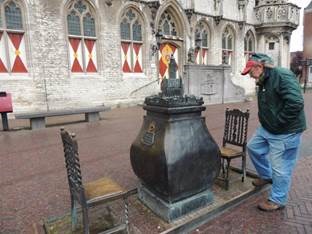
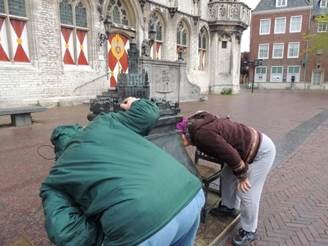
Model of the Town Hall at some point in its history.  More interesting is its base with a peek hole in both sides so if you look through just as someone is looking through you see eyeballs.  The sign said something about a tunnel and the sewage system but the engraving was too faint so I couldn’t  even use  Google translate to translate it.

clip_image014

Randal and Mary eyeballing each other.

clip_image015clip_image016

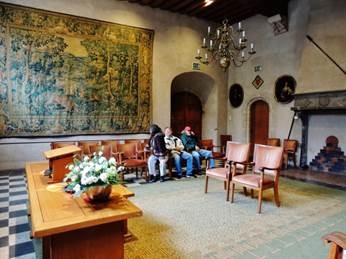
Flemish Tapestries from the 1500 or 1600s, I can’t remember and the wedding ring cushion.

We were welcomed into the main hall and told to wait in the “wedding room.”  I thought our guide had meant waiting room until I saw this small embroidered cushion with the two rings.  It was indeed the wedding room.  Once upon a time it was used as a court for small crimes.  

Our tour continued all through the many rooms in the building. 

clip_image017clip_image018

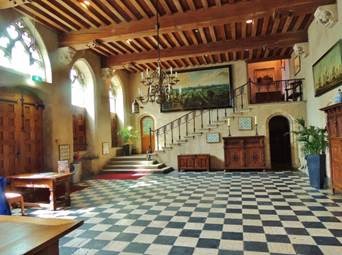
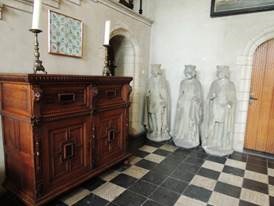
The main entrance hall had been used as a court for major crimes including murder.  Men were hanged and women strangled, our guide guessing that it would be improper to be able to see up the skirts of a woman hanging in the air.  No death penalty now in The Netherlands.  These 3 figures were left overs from the façade, no one knows who they’re supposed to be.  They are called “the spares.”

clip_image019

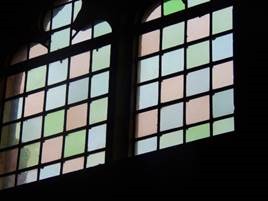
Stained glass or old discolored glass?  I voted for deliberately colored glass but R, R and M said it was just old glass that wasn’t clear.  The small brochure called the windows stained glass, so who knows?

clip_image020

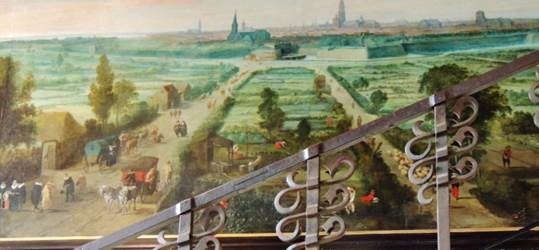
The painting on the stairway was Antwerp not Middelburg

Pre-Napoleonic  Netherlands as evidenced by carts being driven on the left. 

Apparently Napoleon made each country he conquered drive on the right if they weren’t already doing so.  Napoleon didn’t conquer England so the UK drives on the left.